Shhh … it’s time for Secret Voices, the 10th session of TED2013. Get ready to hear stories of the forgotten, marginalized, stigmatized and hidden. Our first speaker while make quite an entrance while the last will give a stirring finish, describing the voices in her head. In between, thoughts on inter-species communication.
In this session:
Beijing-based artist Liu Bolin silently comments on modern sociopolitical conditions by dissolving into his art.
Diana Reiss studies cognition in animals and the evolution of intelligence. She and her colleagues demonstrated that bottlenose dolphins (and Asian elephants) can recognize themselves in the mirror.
Musician Peter Gabriel is the co-founder of WITNESS, which distributes digital cameras to empower people to document human-rights abuses. A founder of the band Genesis, Gabriel is now a solo artist and record mogul, championing world music and innovation.
As Director of MIT’s Center for Bits and Atoms, Neil Gershenfeld explores the boundaries between the digital and physical worlds.
Computer scientist Vint Cerf helped lay the foundations for the internet as we know it.
Shane Koyczan makes spoken-word poetry and music. His poem “To This Day” is a powerful story of bullying and survival, illustrated by animators from around the world.
Lakshmi Pratury is the host of The INK Conference and was the co-host of TEDIndia 2009.
Born in North Korea, Hyeonseo Lee left for China in 1997. Now living in South Korea, she has become an activist for fellow refugees.
Eleanor Longden overcame her misdiagnosis of schizophrenia to earn a master’s in psychology and demonstrate that the voices in her head were “a sane reaction to insane circumstances.”
Anas Aremeyaw Anas can’t show you his face, but his name carries enough weight. Famous in Ghana for his investigative journalism, Anas’ stories like “Enemies of the nation,” about corruption at customs in the Port of Tema, have blown the cover on crime all over Africa.
He started 14 years ago, when he had just come out of college. He received a tip that police were taking bribes from kids in the streets, so he decided to go undercover selling peanuts. Thus began his dedication to exposing corruption through immersive journalism, following 3 basic principles: naming, shaming and jailing.
Anas has gone undercover as a Catholic priest in a Bangkok prison and as a bartender in a Chinese sex mafia ring in Ghana. Thanks to Anas the mafia men in the latter story will be in prison for the next 40 years for the abuse of the sex workers.
Just last month Anas broke a story with the film Spirit Child, about the tragic practice in northern Ghana of killing deformed children believed to carry ill omens. Anas brought a prosthetic baby from London with a fake deformity and caught men in the act of preparing a concoction to have the baby killed. The police were standing by, and court proceedings are happening now. In “Spell of the albino” Anas follows the albino limb trade in Tanzania, where albinos are regularly killed because their body parts are believed to be lucky in witchcraft rituals. He went undercover as a businessman looking to get rich and caught the practice on film for the first time.
And today at TED, Anas breaks his latest story. He’s been undercover for the past six months at Nsawam Prison in southern Ghana, where conditions are inhumane. He shows a shocking video of a room in the prison full of dead bodies piled atop one another. The sanitation conditions in the prison are unspeakably bad, and it’s easier to get heroin, cocaine and cannabis in the prison than out. He will be breaking the story in Ghana in a month.
Not everyone has been a fan of Anas’ work. Some accuse him of a breach in ethics. But as he says, what’s the point of a journalist who doesn’t benefit society? He concludes: “What the evil man has destroyed, the good man has built.” So fight, and build again.
Cybersecurity specialist James Lyne takes the TED2013 stage to show us some of the newest and nastiest creations that cybercriminals have designed to steal data, make off with billions of dollars, watch people through their webcams and target power and utility companies. Every day, he says, about 250,000 new pieces of malware are created and 30,000 websites infected.
“People think that, if you get a computer virus, you’ve been on a porn site,” says Lyne, of the security firm Sophos. “Actually, statistically speaking, if you only visit porn sites you’re safer.” Shockingly, 80% of infecting sites are actually small businesses or other legitimate enterprises that have themselves been infected.
The world of malware is becoming commercialized. Cybercriminals now advertise online, offering their services for $10 to $50 per hour. Lyne shows this video as an example.
There are sites where you can test a virus to make sure it works before unleashing on the world, and sophisticated services for tracking your malware. Some of these services even offer customer support.
So what are some ways to infect a computer with malware? In addition to the old “Hello, I’m a Nigerian banker,” you could, perhaps, walk into a corporate lobby with a copy of your resume soaked in coffee, and make a sad face and ask the receptionist to plug in a USB key and print you a new copy. Or perhaps you can target a website that has an insecure comments section; anyone who visits the page will then be infected. And there’s a new tactic that Lyne has noticed — creating a virus that pops open a fake anti-virus protection software window on a person’s screen. By clicking the button, not only does a person give a hacker access to their computer, but might even pay for the .
So many stories about cybercrime are terrifying. But Lyne has a success story to share — a time he was able to track the group of cybercriminals behind the Koobface malware. This group didn’t protect their malicious code, which was written to send each of them a text message daily to show them how much money they’d accumulated. In other words, Lyne’s team had their phone numbers. From there, he could tell they were located in Russia.
Because many smartphones embed GPS data about where photo is taken, Lyne was able to find the hackers’ exact location through photos they uploaded to Flickr. From there, Lyne’s team generated a 27-page report filled with information about this group — including an ad one of them had posted for the sale of kittens, shots from a fishing trip, a photo of their office on the third floor of a building and images from the office Christmas party. He eventually even found their bank accounts.
Sadly, Lyne reveals that this report wasn’t enough to bring these hackers to justice. Most laws pertaining to cybercrime are national, and because there is no common definition between countries, this group is still at large.
Lyne stresses that, for the time being, the onus is on individuals to protect themselves by creating different passwords for different websites and using basic internet safety protocols. For example, don’t upload smartphone photos to an online dating site – Lyne has found that 60% of photos there contain location data. But vulnerabilites can be even more subtle than that. As you move through the world, using your phone to connect to wireless networks Lyne warns that you are “beaming a list of the wireless networks you’ve previously connected to.”
Lyne collected data on the TED2013 audience by tracing these signals:
23% had been to Starbucks recently
46% could be linked to a specific business
761 could be traced to a specific hotel
And 234 could be traced to coordinates of their homes
“As we play with these shiny new toys, how much are we trading off convenience over privacy and security?” asks Lyne. ”The internet is a fantastic resource for business, art and learning. Help me and the security community make life much more difficult for cybercriminals.”
Microsoft (MSFT) struck a nerve with customers when it revealed that smartphones running Windows Phone 7 could not be updated to Windows Phone 8. This will not be the case for Windows Pone 8 with the company’s rumored Blue update, however. Greg Sullivan, a senior marketing manager at Microsoft, confirmed to PCWorld that the company has “an upgrade path going forward” for Windows Phone 8 devices. The executive added that Microsoft’s current mobile operating system is also powerful enough to adopt to new hardware components, something Windows Phone 7 had trouble with.
“If you’re middle-aged and North American, you probably learned to dance when you were in a gymnasium in junior high.” Allison Hunt didn’t get that training, because her mother was always chaperoning the dances, and worse than that: dancing. What could be more embarrassing to a teenager? She says: “You know the expression, dance like no one is watching? I was at the back of the gym watching like no one was dancing.”
In this short audience talk, Hunt talks about what happened after her recent hip replacement. She was recovering, and saw Brené Brown’s talk on vulnerability. Deciding that she needed to get past the embarrassment of the past, she took private hip-hop lessons. One on one. “I take my vulnerability very seriously.”
The good news: You don’t need to move your feet. It’s all upper-body. As her instructor said, “When you’re in a club on the dance floor, no one can see your feet.”
So she learned, and she shares four rules of hip-hop that helped her relax.
No smiling in hip-hop.
Remember you have hands. If you don’t, you will default into jazz-hands or the dreaded finger guns. Use fists, that’s more badass. That’s more, “I think ‘mother’ is half a word.”
Music is vital. Don’t be caught dancing without it.
Christopher Ryan begins his talk with a strong reminder, “We didn’t descend from apes. We are apes.” A special kind, but we are one. We’re closer to chimps and bonobos than they are to any other primate. But he wants to know, “What kind of ape are we? Particularly in terms of our sexuality.”
That’s a subject he’s been investigating as the co-author, with Cacilda Jethá, of Sex at Dawn. He says that there has been a standard narrative — that men and women are locked in an eternal struggle. That throughout history men have “leased” women’s sexuality in return for security.
This narrative is mistaken. It turns out that in many societies those things were shared in what he calls a “fierce egalitarianism.” Ryan makes it clear that he is not saying they were noble savages. But he notes that that social structure did exist, and is further saying this extends to sexuality. That “human sexuality has essentially evolved, until agriculture, as a way of maintaining and establishing the complex social networks that our ancestors were very good at.” He is also quick to note he is saying ancestors were promiscuous, but is not saying they were having sex with strangers, because, “There were no strangers.”
This is also not to criticize monogamy. “To argue that our ancestors were sexual omnivores,” says Ryan, “is no more a criticism of monogamy than arguing that our ancestors were dietary omnivores is a criticism of vegetarianism.”
Where did our misconceptions about sex come from? Well, Darwin, as it turns out, was a world-class Victorian prude. He was fascinated by the colorful genital swelling in bonobos, but what he didn’t know is that female chimps have sex 1-4 times an hour with up to a dozen partners. Furthermore, Ryan notes that female chimps are sexually available for 40% of their menstrual cycles, but bonobos for 90% — almost as much as humans, who are capable of engaging in sex at any point in their cycle. That is a trait that is vanishingly rare among mammals.
For Ryan, a key question to understanding the origin of human sexuality is, “Are human beings a species that evolved in the context of sperm competition?” Are they competing against each other or with the sperm of other men as well? It doesn’t seem to be the case. For example, the average human has sex about a thousand times per birth. “If that seems high to you,” laughs Ryan, “don’t worry, it seems low to other people in the audience.” A more typical number among apes is to have sex about a dozen times per birth. Additionally, Ryan notes, humans and bonobos are among the only animals that have sex face to face. They also have external testicles. Says Ryan, ”External testicles are like having an extra fridge in the garage for beer. If you’re the kind of guy that has a beer fridge, you expect a party to happen at any moment.”
The evidence that the standard model isn’t correct extends beyond anatomy to anthropology. When one looks, they find all kinds of societies which have sexual practices that should not exist if the standard model is correct. In one culture, they found no shame about sex, and women with many lovers — some with well over 100. Who takes care of the children of those unions? The responsibility falls to the mother, her sisters and brothers. The biological father has no role.
In the Amazon basin, there are a few societies where a child can have many fathers. Those cultures believe that a fetus is made of accumulated semen. A woman who wants a child who is smart, funny and strong will have sex with one man who is smart, one who is funny and one who is strong. When the child is born, each of these men will come forward. Paternity is a team endeavor.
Why is this important? Ryan is worried: “Our evolved nature is in conflict with many aspects of the modern world…. There is a conflict between what we feel and what we’re told we should feel.”
He hopes that thinking about the origin of sex will make us become more tolerant of alternative arrangements than the Victorian models. And most importantly, to “finally put to rest the notion that men have an innate right or instinctive need to control women’s sexual behavior.” He says our real fight is not between the genders, but with “an outdated Victorian notion of morality, that conflates desire with property rights.”
In other words: Forget about “men are from Mars and women are from Venus. Men are from Africa, and women are from Africa.”
Imagine driving through a downpour and coming out with a dry car.
Mark Shaw produces Ultra Ever-Dry, a liquid-repellent coating that may sound mundane but makes for one astonishing demo. The superhydrophobic coating acts as a shield against pretty much any liquids. When the coating is applied to a surface, it coats it with nanoparticles, which are, surprisingly, not super-smooth but rough and craggy. The spaces between the crags grab onto air particles so that a layer of air now covers the entire surface, and whatever hits the surface — dirt, oil, paint — just bounces right off. The applications are endless: anti-wetting, anti-icing, anti-corrosion, anti-bacterial, self-cleaning, the list goes on.
Today we issued a software update for BlackBerry 10 smartphones that’s focused on your feedback. It’s already available from some carriers and we’re working closely with all our carrier partners to get it to you as soon as possible.
It’s almost been a month since we officially unveiled the new BlackBerry 10 smartphones and many of you already have a BlackBerry Z10 in hand. You’ve been using it for weeks, and we’ve been listening to your feedback, and have been working on an update just for you. Here are just a few of the improvements you can expect after updating your software.
3rd Party App Performance
We’ve improved performance for 3rd party applications, so developers can build apps that run fast and smooth for you. With this update, you might want to keep an eye out for some fresh new app launches in March, like WhatsApp.
Among the top improvements and features are fixes for Gmail calendars on BlackBerry 10. You’ll also find improvements in the BlackBerry Hub for logging calls log and how conversations are handled. We’ve also made general improvements to importing contacts from online sources.
Camera
We’ve optimized the camera for better photos in low-light situations. You’ll love the difference this makes for photos where you don’t use a flash – like the Time Shift Camera feature.
Browser and Media
With more and more of you using the gorgeous screen on the BlackBerry Z10 to consume online videos and media, we’ve made a number of improvements to the software in the way the browser handles video playback to provide a fantastic experience.
Battery Life
The software team has included a number of battery life optimizations with over 60 battery saving improvements since launch to keep you moving. These combined improvements are designed so that you see improvements in battery life and heavy users especially should see a longer average usage per charge cycle.
How to update your software on BlackBerry 10
Software is available over the air (OTA). Typically, you’ll get a notification about new updates, but you can manually check to see if it has been made available by your service provider and install it in a few simple steps. Settings> Software Updates> Check for Updates> — then follow the on screen steps to install.
The download is approximately 150MB in size, so I recommend updating when connected to Wi-Fi.
There you have it – the first OTA update to your BlackBerry 10 smartphone. We’ll be rolling out the update with all of our carrier partners around the globe over the coming weeks. Be sure to check it out when it’s available and let us know what you think in the comments below. Your feedback is always welcomed and we will continue to listen as we update and improve BlackBerry 10.
In 1995, the Natural History Museum Rotterdam got a new wing made of glass. It was beautiful for humans — but not so much for birds. Many of them lost their lives flying into the invisible walls.
Photo: James Duncan Davidson
“I developed an ear for identifying birds just by the sound of the bang they made on the glass,” says Kees Moeliker in Session 9 of TED2013. “It was on June 5, 1995, that I heard a loud bang that changed my life and ended that of a duck.”
When Moeliker rounded the building, he saw two male ducks, one living and one dead. He watched confused as the live one mounted the dead one and started to copulate with it. As far as he knew, this was the first observed case of homosexual necrophilia in ducks. But Moeliker, a researcher who didn’t want to kill his career, was worried about sharing this finding. ”It was a nice thing to discuss at birthday parties,” he says, “but not a nice thing to discuss with your peers.”
It took him 6 years to decide to publish, but eventually he submitted the paper. At first, nothing much happened. But then he got a call from a prestigious committee: The Ig Nobel Prize committee. He’d won. Soon, his email was flooded with duck paraphernalia and images of other animals’ strange sexual habits — a moose trying to copulate with a statue, a frog trying to copulate with a goldfish, and necrophiliac pigeons.
“If there’s an animal misbehaving on this planet, I know about it,” says Moeliker. He notes one pattern about these images: ”Missionary position is very uncommon in the animal kingdom.”
Moeliker wonders if we might be somehow to blame for this strange animal behavior. He gives the example of a bird called Mad Max that continually flew into a glass windowpane over and over again, from 2004 to 2008, because it sees its own reflection and tries to fight it. Could it be that our morphing of their environments is changing animal behavior?
Every year on June 5, Moeliker now holds Dead Duck day, a holiday dedicated to finding new ways to keep birds from colliding with windows. He invites us to celebrate with him, and walks offstage.
.@TEDChris on @KeesMoeliker: No one has ever before ended their TED Talk by saying "May I have my dead duck back please?"— TED Live (@TEDLiveHQ) February 28, 2013
A Japanese court on Thursday ruled in Apple’s (AAPL) favor in a recent patent infringement lawsuit filed by Samsung (005930). The company had alleged that Apple infringed Samsung’s 3G wireless patents in various iPhone models, however the Tokyo District Court ruled that Apple did not use Samsung’s data transmission technology, The Times of India reported. Apple and Samsung are currently engaged in a patent infringement dispute across 10 countries on five different continents. A Samsung spokesperson said the company was “disappointed by today’s court decision,” but it will continue to “take the measures necessary to protect our intellectual property rights.”
Salesforce.com, which hasn’t exactly been shy and retiring on the acquisition front over the years, plans to keep right on buying companies and technologies it needs to bolster its marketing and support services push.
“We need to buy more marketing companies. We want to be the company you turn to for sales, service, marketing and the platform,” CEO Marc Benioff told analysts on the company’s fourth quarter earnings call Thursday afternoon. “We want to grow organically and via acquisition.”
For its fourth quarter, the company reported a loss of $20.8 million, compared to a loss of $4.1 million for the same period last year.
Salesforce.com CEO Marc Benioff speaking in New York this week.
Marketing technology has become a hot spot over the past few years. Salesforce.com ponied up $326 million for Radian6 (social media monitoring) in 2011 and then $800 million for Buddy Media (social marketing) to buy both mind share and market share. But rivals have also spent big — Oracle bought Eloqua a few months ago for $871 million. The working theory behind this activity, as Benioff said on the call, is the believe that at some point in the near future chief marketing officers (CMOs) will have more IT buying power than CIOs.
Asked what Salesforce should do to counter Oracle/Eloqua, Benioff returned to the acquisition trail: “I think we’ll buy small and big. We’re going to be aggressive and look at everything.”
Salesforce.com, which started out as a customer relationship management (CRM) or sales-force automation (SFA) company, now also focuses on three other businesses: marketing; help desk type services (desk.com) and “the platform.” The latter is presumably both Force.com, the company’s internal development platform and Heroku, the Platform as a Service it bought three years ago.
But it’s difficult to get any feel for how those newer businesses are faring. Asked about traction for its “non-SFA businesses” CFO Graham Smith didn’t get specific, referring to comments made at the company’s Dreamforce show last fall. “It’s been a pretty gradual shift. I suspect it’s close to what we said then with 55 percent [of business] SFA and 45 percent non-SFA … As our more recently acquired businesses grow at a faster rate than sales cloud we’d expect a shift away from SFA but hopefully not too fast.”
Benioff did say that social advertising — in the marketing group — is probably the company’s fastest growing business. But it would be really nice to hear what sort of new, non SFA accounts are coming buying these new services and how much overlap there is between its CRM customers and consumers of these other services.
Your guess is as good as mine, because Salesforce.com ain’t sharing.
A forthcoming connected device — a onesie shirt that monitors a baby’s position, breathing, temperature and sound — poses the dilemma of how to make one’s little data open to collaboration with other systems developed for the internet of things.
Each washable Peeko Monitor shirt from Rest Devices contains a strip that detects information and then connects to a thumb-sized data logger, which wirelessly sends data to a Wi-Fi Station. From that point, it’s relayed to Amazon Web Services, which normalizes the data and directs it to smartphone apps.
A package of three shirts, the logger, the Wi-Fi station and the smartphone app will be available in stores for $199 following a planned July launch, Rest Co-founder and CEO Carson Darling told me at the Strata conference in Santa Clara, Calif., on Thursday. The company is also testing a shirt for adults that can monitor for sleep apnea.
The Boston-based company, which has taken on around $500,000 in seed funding, has a few interesting question to wrestle with, including:
How can Rest minimize incorrect alerts that unnecessarily wake up parents if a baby’s breathing changes in a normal way while also giving alerts that prove the device is working? The company is already getting feedback from parents using the product in beta tests to improve algorithms.
Should Rest partner with health systems to make sure babies can continue to be monitored even after they leave hospitals? Customers might be able to compare their babies’ live patterns with aggregate normal information or the babies’ individual tendencies, depending on how the product evolves.
Should Rest set off on the journey of getting regulatory approval as a medical device that can help diagnosis and treatment? For now, Rest will release the Peeko Monitor as a non-regulated product such as a camera and microphone for baby-watching. But perhaps the Food and Drug Administration might want to regulate it, as it did for a connected toothbrush.
Perhaps most importantly, how open should the data gathered about babies be? Darling recognized the value of tying such data in with other connected devices, such as a thermostat, which could be automatically lowered should that help parents and their baby get some sleep. And he knows the data could help people learn more about babies’ sleeping patterns, which could be valuable for the medical community. But Darling also said he wants to provide data where it’s useful.
Whether or not the product will be able to push data into a larger system for many connected devices, such as Qualcomm’s AllJoyn peer-to-peer network, appears to be an important issue as more such devices are emerging, and managing all the data could become a hassle. My colleague Stacey Higginbotham has noted that as people adopt more and more connected devices, developers would be wise to think about ways for computers to make decisions on all the incoming data, rather than relying on humans to do it all on their own. And that means it would be best for the data to be open.
Those questions aside, selling the Peeko Monitor to parents who are nervous as it is could be a challenge in itself.
Break Media, through sites like break.com, is building a growing content empire around “bro videos” — short clips that show things like a blacksmith making swords or elephants fighting crocodiles. Some content is crass or sexist (like this clip of a guy playing “butt drums”) but, for better or worse, bro videos are now a permanent fixture of the internet.
While Break is not the only one feeding the demand for bro fare, the L.A. company has done more than most to move these videos into the professional realm. In doing so, Break is also tapping into a deep pool of research to reshape perceptions about how brands should market to men — portraying them as “good guys” rather than doofuses or metrosexuals.
The result, on the surface, is thousands of clips about beer, boobs and bravery. More deeply, the bro video phenomenon is part of an emerging low-cost studio system that is changing men’s entertainment and advertising.
From college capers to consumer content
Break’s office, located in LA’s Miracle Mile, contains a small studio and employs 30 full-time content creators as well as numerous freelancers to feed its video content machine. The place has a few dude touches — a mustache wall and action figures scattered about — but otherwise is a serious business that, according to CEO Keith Richman, brought in $45 million in revenue last year.
The company is also attracting top level talent such as actor Christopher Walken, who recently riffed on trailer park toddler Honey Boo Boo. Last year, Break created a five-part series involving San Francisco Giants pitcher Brian Wilson and a Sasquatch; the show was a content marketing play by Beef Jerky, but the videos went viral all the same.
This star presence on Break is a considerable leap up the value chain for the company that, in its early days, relied almost entirely on homemade videos. ”We started with user-provided, lower quality content. As our audience and sales expanded, we started producing our own,” said Richman.
Now, Break is at the point where it’s producing its own weekly shown like “Man at Arms” in which a blacksmith shows how he makes famous weapons like Jamie Lannister’s sword on Game of Thrones (see video below) or the lethal hat worn by James Bond villain Odd Job.
The shows, which are usually between five and 10 minutes, are cheap to make – Richman says the average price is $700/minute or $3,000-$5,000 per episode – and Break is able to make lots of them because of demands for the company’s male-based ad offerings.
Binders of Men
Marketing to women is a huge and sophisticated industry but, when it comes to men, brands frequently treat them as caricatures – one-dimensional clowns or louts. Break is trying to pitch a more subtle approach based on reams of survey data it collects on the site.
According to its research, men are more receptive to positive messages that show them as good guys, friends and fathers. Break has even published a “definitive guide to men” that cites an evolution from Bruce Willis type “guy’s guys” to self-aware types like Tim Allen to, last decade, metro-sexuals. And now?
“Today’s man is striving to be a “mensch” – a Yiddish word for “good guy,” or someone to admire and emulate,” says the report, which was produced by Break’s SVP Marketing, Andy Tu. He explained that many of the findings come from panels of men that Break consults on a regular basis.
Do all men really want to be mensches? Who knows. But Tu says marketers love using the surveys and data Break provides in designing their campaigns. Sony, FootLocker, Pepsi and Burger King are among their bigger brand partners.
For its campaigns, Break often produces original content for its clients and, on some occasions, as well. It also places display ads alongside videos across its networks (many of the videos are still user-generated or plucked from other sites).
A new studio economy
Research is one explanation for Break Media’s ability to make higher-quality bro videos. Another is the low cost of failure. Compared to traditional TV or movie studios, sunk production costs are tiny for Break and its competitors like College Humor. ”Video is a shots-on-goal business,” says Richman. “If you’re good, you’re going to score. We’re going to have big loser bombs at some point but it won’t kill us.”
In this sense, Break and its bro videos are part of an emerging online ecosystem in which smaller video companies are ramping up their production cycles and, like traditional movies and TV, even adding on-location shoots. The ecosystem is also rapidly expanding as distribution options proliferate (Break shows its videos on its own sites and on YouTube channels) and as consumers become connected to more devices with better broadband.
According to Richman, a tipping point occurred that means brands are now treating online video as a serious alternative to traditional TV. Richman credits the shift with Google’s decision in 2011 to invest $100 million in original YouTube content.
If you want to see an example, here’s the “Man at Arms” piece. But be warned: you first have to watch a manly Khalua (?!) commercial and listen to some power chords before you can see the blacksmith do his thing:
The team behind the $99 Ouya video game console have announced new details regarding the device’s launch date. The Android-powered system is scheduled to begin shipping to customers who preordered the device from Kickstarter on March 28th with a full launch slated to follow sometime this summer. The company also revealed that Kim Swift, a former employee at Value who previously worked on hit games such as Portals and Left 4 Dead, will begin developing an exclusive game for the system along with her team.
While most of the concern over web security has to do with criminal activity such as cyberterrorism, state secrets and hacktivism, there’s a far more annoying threat lurking beneath the surface. It’s a new generation of spam that does away with brute force email barrages in favor of fake online personas so real that people — and, more importantly, email and web-service spam filters — can’t tell they’re fake. Done right, these fake identities could influence everything from app downloads to e-commerce to elections.
It’s called influence manipulation. And, as data scientist Joseph Turian said during a presentation at the O’Reilly Strata conference on Wednesday, “It’s a pretty serious issue and it’s also pretty hard to catch.” (Turian will also be moderating a panel on next-generation databases at our Structure: Data conference in New York next month, but I’m sure he’ll gladly talk black-hat data science if you catch him in the hall.)
Joseph Turian at GigaOM RoadMap 2012 (c) 2012 Pinar Ozger [email protected]
It’s hard to catch because influence manipulation, which Turian also calls black-hat data science, is really just white-hat (or good) data science techniques inversed and pointed toward a nefarious purpose. So, whereas as white-hat data scientists try to uncover unnatural networks of links created to game Google’s PageRank algorithm, Turian explained, black hats will try to build artificial networks so good they look real. If someone wants to send lots and lots of undetectable spam, it’s just a matter of analyzing enough language to create messages that look less like a machine wrote them and more like a stupid human wrote them — because most spam filters try not to penalize users who just don’t write well.
During a one-on-one conversation later in the day, Turian told me he did a lot of work on language modeling as part of his Ph.D. work, and that the same techniques used for language evaluation — something like sentiment analysis, for example — can also be used for language generation. Marketing startups such as DataPop and BloomReach are already using some presumably similar techniques to create personalized online ads and web pages on the fly.
Does evil lurk among our data scientists?
Not evil. Source: hilarymason.com
But are there actually so-called black-hat data scientists among us, using their mastery of statistics to influence our opinions or make us buy Cialis? Turian quoted Bit.ly data scientist Hilary Mason, who he said asks of all her work, “What’s the most evil thing that can be done with this?” We can assume she’s just trying to avoid a mini-Sarah Winchester situation, but others might not be so ethical. (Turian already classifies as “gray hat” certain well-known companies that play fast and loose with user data.)
After all, Turian noted in his presentation, Greylock’s D.J. Patil has called being a data scientist the sexiest job of the 21st century, comparing it with Wall Street quants in the 1980s. And where there’s opportunity, there will always be people trying to cash in on it by any means necessary. Real-life Gordon Gekkos came to make quants almost universally reviled, and a few bad apples could certainly find their way into the data science bunch.
Turian assured me he isn’t one of them. “[I]f I did [this] I’d be riding around in a Rolls Royce,” he joked during our hallway conversation.
Define “good enough”
Maybe, maybe not. If all you’re trying to do is improve search rankings, mediocre bots might work in the same way that “legit” content-generation services like Chirpsy and Servio work, he noted. Marketers don’t necessarily care how good a tweet or article is as long as it’s positive and says their company’s name a lot.
But in order to be successful in the world of online influence manipulation, fake personas and their messages have to be really good. Lutz Finger, co-founder of Fisheye Analytics, laid out some interesting statistics during another conference talk that highlight how difficult it is to really influence someone. According to the studies he cited, 7 percent of people’s twitter followers are actually spambots; 30 percent of social media users are deceived by spambots and chatbots; and 20 percent of social media users accept friend requests from unknown people, 51 percent of which are not human.
Presently, though, the charlatans are not very good. Finger said that when it comes to “astroturfing” — the practice of creating fake grassroots movements to influence opinions — the hit ratio on email spams is about 12.5 million to 1. In order to create an astroturf movement on the scale of the anti-SOPA movement in 2011, every person on earth would have to receive the same spam message 8 times. The number might be even higher on an already-noisy platform like Twitter.
That, he noted, makes spambot @peace_karen25′s (a now defunct spambot) 10,000 pre-election tweets seem pretty inconsequential.
However, he explained, spammers are getting smarter and are working on some of the black-hat data science techniques that Turian warns about. Next-generation bots will be better at gaining trust (attractive females with familiar names are most likely to have their fake friend requests accepted), and they’ll act more real by mixing improved chatbot technologies and analytics to figure out how people speak and what to say in what circumstances. Once they have your trust, these bots can make introductions to more bots and people will be more likely to accept those requests, too.
Even if it’s difficult to change someone’s mind on issues like global warming or politics, Finger said well-timed messages could affect individual decisions. At the time someone is ready to buy something on Amazon.com, for example, he’s open to messages about that product, perhaps in the form of product reviews. Maybe someone waiting in line at the polling place and still sitting on the fence is open to suggestions, too.
And it’s possible the bar to convincing people — especially teens — to act really isn’t that high at all. In his talk, Turian highlighted teenage social media maven Acacia Brinley Clark and her single tweet that led to an app called Pheed becoming one of the most-downloaded apps in Apple’s App Store last week. After reading the rest of her Twitter feed, he said, (only half-jokingly, I think) it took quite a bit of research to convince him she’s a real person.
Her 120,000-plus followers don’t seem to share the skepticism, but they certainly seem willing to follow her lead.
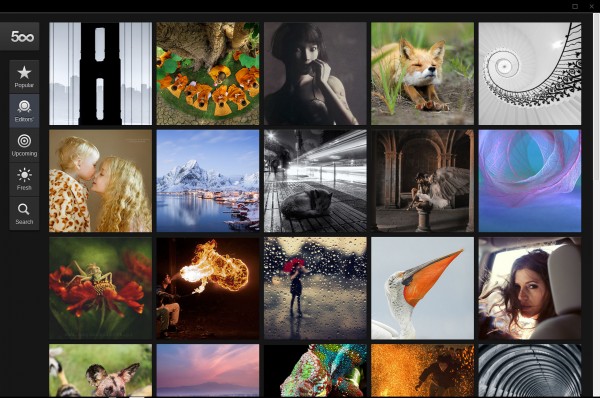
Today, 500px launched a new Chrome web app that, while available for browsers running on OS X or Windows, brings something extra to Chrome OS: Touch natively-supported and optimized for Chromebook Pixel. Take a look, because this little ditty is the computer’s future and hints what Google means by the “For what’s next” marketing tagline.
Chromebook Pixel is Google’s pricey — $1,299 or $1,449 laptop running Chrome OS. Pixel’s naysayers — and, whoa, there are many — gripe about a high-priced browser PC that is useless offline and for which there are no real programs. But that’s not so. Developers can, as Google has done, create “packaged” web apps that can run when disconnected from the Internet. The 500px Chrome app is one of them. Then there is the functionality fine-tuned to Chrome Pixel’s magnificent 2560 x 1700 resolution touchscreen. If you can understand 500px, you might grok Google’s plans for truly making the Chrome OS flagship truly competitive with Mac notebooks.
I’m wrapping up first part of my Chromebook Pixel review, and to get this far something needed to be desperately answered: Who is the laptop for? Is it worth spending as much as 1,500 bucks? I got hung up usage scenarios, which are vastly different from this computer as primary than Mac or Windows portables. I repeatedly came back to question: Why does Chromebook Pixel have a high-resolution touchscreen? Because you really don’t need either the pixel density or touch to view the web or consumer web apps.
The answer, or hint of it, is in Google’s “For what’s next” marketing tagline, which if taken literally means there is more to come. Surely that something is to take advantage of the high-resolution touch screen. Yesterday, François Beaufort, who revealed Chromebook Pixel’s existence before the public announcement, leaked yet something else: Google+ Photo. Google+ already is a popular photographer hangout.
Photos
Today, along comes 500px, which worked closely with Google developing the web app. “Chromebook Pixel is an amazing device, it’s very easy for developers to create an outstanding user experience”, Oleg Gutsol, 500px founder and CEO, says. “Working with Chrome OS and the Google team behind it was a real pleasure and we hope that our users like the end result. 500px for Chrome brings our photographers yet another high quality way to showcase their work”.
Something else to think about, and this points to Chromebok Pixel as a photographer’s tool — the 3:2 aspect ratio. While better for the web than 16:9, there’s more: “Most camera sensors are 3:2 ratio”, Scott Stephens comments to one of my Google+ posts. “When I look at photos from my DSLR on my Pixel, it’s very satisfying to have no cropping whatsoever”.
For those people complaining there’s no Photoshop for Chromebook, well, hell, there might be something as good or better coming from Google or another partner.
“Remember, Google bought Nik Software, who has created wonderful plug-ins for Photoshop and Lightroom”, Kevin Gault comments to the same G+ post. “So the question here could be what does Google have planned using their knowledge of photography for a killer app for the Pixel at I/O. One can wonder and it really makes the Pixel more enticing. Even with that thought in mind and depending on reviews, I could pick up a Pixel with the promise of a brighter future of viable professional quality apps”.
Because Chromebook Pixel is “For what’s next”.
Video
If photography, why not video? Today Vimeo, added 500+ filters for changing how videos look. The enhancement is yet another proof point about how much can be done in the cloud. Google owns YouTube, which already offers some online editing capabilities. By supporting Chromebook Pixel, a video editor could put touch and resolution to work.
Once you cover photos and videos, two of the major reasons many people choose Macs, Pixel starts to look lots more exciting — and primed for the kind of professionals willing to pay $1,299 or $1,449 for a laptop.
Consider something else: Chromebook Pixel comes with 1TB Google Drive storage for 3 years. Critics call the offer nothing more than a Pixel price-justifying maneuver that costs Google nothing. But what if “For what’s next” is all about giving Chromebook Pixel owners storage they will use — for creating digital content, such as photos and videos?
Think about it.
Then there is the name, Chromebook Pixel, which connotations are bigger than the screen. Again think photos and videos. How many of you measure megapixels before buying that shooter?
Circling back, the 500px web app delights the senses — well, touch and sight, anyway — and I can’t help but want to lick the screen.
I like to use my SLR, but there are many times when I leave it behind because I’m not sure whether it’ll be able to handle the conditions I plan to be using it in. LA-based hardware startup Outex is trying to make sure that photographers can use their cameras anywhere, without having to fork over north of $1,000 for environmental protection gear, and it’s taking to Kickstater to fund the latest piece in its product puzzle.
The Outex is a flexible casing for DSLR and other interchangeable lens cameras (it works with mirrorless systems, too) created by founder JR deSouza and his cousin Roberto Miglioli based on their shared love of photography, a hand-me-down from their grandfather, and a lack of good affordable options on the market for protecting cameras during use in harsh conditions. DeSouza told me in an interview that he and his cousin needed something that would work for surfing, kayaking, shooting around the pool, military applications and more, but that didn’t mean sacrificing portability or spending a mint to buy.
In a little over a year, the company has already managed to rack up some impressive customers, including photographers working for Red Bull, National Geographic, Outside Magazine and Vogue. The Outex is being used by a lot of videographers now, too, and the company wanted to build a solution into its product that better serves that market, while also opening up new possibilities for still photography. That’s what this Kickstarter project is about: funding the creation of the “Big O,” an LCD viewfinder window for the Outex.
DeSouza says they came up with the window after first toying with the idea of adding some kind of external LCD monitor to the Outex, and then realizing that the simpler, better and more widely compatible solution would be to simply add a glass window to the case (which itself resembles a kind of camera wetsuit) that would allow the built-in monitors on cameras to be used in any circumstances. Being able to see the viewfinder while the camera was in the Outex was one of the most common customer requests, however, according to deSouza, so coming up with some kind of solution was necessary.
Seeking Kickstarter backing is a first for Outex, and deSouza explained that the reason it went the crowdfunding route this time around was actually the result of a combination of factors.
“I felt that Kickstarter would be a good opportunity to accelerate our development,” deSouza explained. “The key is to be genuine and to do Kickstarter for what it is, and it becomes a great opportunity to get the word out and discover other things[…] I really do think there’s value to the community and the discovery process that also comes along with Kickstarter.”
Outex isn’t meant to be hardcore scuba gear like the Ikelite protectors favored by professional photographers, but where those cost around $1,500, a $375 pledge gets you everything you need to outfit your SLR with protection for up to 10 meters of submersion, as well as a host of other environmental perils. With the cost of high-quality photo gear coming down, it’s only fitting that a hardware startup emerges to so challenge the price tag on some of the more expensive accessories, too.
Japanese electronics company Fujitsu has taken its time pushing beyond its home smartphone market. The company is best known for slick, slender high end smartphones in Japan but earlier this month it announced a European play — eschewing the crowded top tier of devices in favour of a niche in the seniors space, with a custom skinned Android-based smartphone. The Stylistic S-01 is designed to be easier for older people to use. Fujitsu is bringing the device to France in partnership with France Telecom/Orange in June but was showing it off at Mobile World Congress, where we went hands on.
Now Fujitsu is not the first to enter the senior mobile space. Other established players include Emporia, which basically makes simplified feature phones, and Doro, which makes a mix of devices (including dabbling in tablet software). Doro was showing off its own Android-based seniors phone at MWC last year so, again, Fujitsu is a follower here too. But late to the party though it is, it has crafted what feels like a solid and well thought through first offering.
The handset has a rubberised coating to add grip and more curves than the sleek, slick high end smartphones du jour so rests nicely on the palm and feels less inclined to take a tumble than the average slab phone. On the front, there’s a clearly labelled home button below the 4 inch touchscreen. The button is slightly convex making it stand out so it’s easy to press. The buttons on the side of the device — power and volume up & down keys on one side, plus a dedicated camera key on the other — are also labelled (albeit with icons). These keys are raised slightly but don’t feel like they stick out enough to press accidentally.
Fujitsu has made the Stylistic S-01′s capacitive touchscreen deliberately less sensitive to cut back on erroneous key presses for a target group of users which isn’t likely to be as dexterous as the average mobile owner. The screen didn’t feel awkwardly unresponsive during my hands on but on-screen buttons did sometimes need a more deliberate press — which seems like a reassuring feature for the intended user-base.
There are a couple of odd hardware touches. The Micro USB port sits behind a cover which has to be prised off with a fingernail. The cover has likely been included because the phone is dust and waterproof but it does mean that accessing the charging port isn’t as easy as it could be.
The phone is also equipped with an alarm — in case of emergencies. This makes a loud noise to alert people in the vicinity that the owner is in trouble and also dials out pre-chosen contacts. The alarm is located on the back of the device, to the left of the camera lens. The physical switch is rather small and again has to be pushed out with a fingernail or similar. Of course it’s no good having the alarm go off accidentally but in an emergency it could prove a little difficult to activate.
Android but not as you know it
Moving on to the software, this is where the phone really stands out from the Android crowd, thanks to a simplified custom UI that foregrounds key functions, tucks away complexity and does a spot of thoughtful hand-holding — with help buttons and guides and even a phone manual included on the device. The homescreen is divided up into large, clearly labelled icons that decrease in size as you scroll down to reach functions that are likely to be accessed less. The two largest buttons are the call button, and the phonebook (a much more senior-friendly way to describe contacts).
Messages and email also appear on screen at the top of the homescreen, along with three numbered buttons that can be pre-set with specific functions for quick access. Scroll further down and there’s an info widget displaying news updates and weather. Below that, there are a variety of phone functions laid out in a grid of squares — and again clearly labelled. These include Internet, camera, maps, video, gallery, a help forum and a manual. The only button that stands out as slightly obtuse is the one labelled ‘Play Store’ (thanks Google).
Android apps can be downloaded to the phone via the Play Store, or via a ‘download apps’ button. Other preloaded apps are tucked away under ‘More applications’ and ‘Orange services’ — so although the phone has been simplified, the functionality has not been removed entirely. Rather they are cleared out of harm’s way until the user feels confident enough to drill a little deeper.
There are lots of thoughtful little touches in the design, such as the Phonebook app being made to resemble a traditional filofax, and the button called ‘My number’ to help users out who can’t remember their phone number. The gallery also includes a ‘Take a picture’ button, to steer anyone who went into the gallery looking for the camera in the right direction. The back button is also clearly labelled with the word ‘back’ — rather than having a cryptic symbol to confuse people. And the browser has a question mark button at the top which leads to a help page to explain the browsing process for first time mobile web users.
Elsewhere apps are nicely stripped down, simplified and clearly labelled — such as the camera app, which has just a camera button and a flash toggle button, and the dialler app which has two folder-style tabs to show either a dial option, or history (for call log). Time has clearly been well spent by the UI designer figuring out an intelligent way to layer a smartphone for a senior user-base that will probably feel most comfortable taking small steps away from telephones in order to get to know smartphones.
Microsoft (MSFT) on Thursday announced that it will be expanding the availability of its Surface RT tablet to six new markets in the coming weeks. The company’s Windows RT-powered slate will be shipping to Japan, Mexico, New Zealand, Russia, Singapore and Taiwan in late March. Microsoft also promised to bring the Windows 8-powered Surface Pro to Australia, China, France, Germany, Hong Kong, New Zealand and the United Kingdom “in the coming months.”
 Shhh … it’s time for Secret Voices, the 10th session of TED2013. Get ready to hear stories of the forgotten, marginalized, stigmatized and hidden. Our first speaker while make quite an entrance while the last will give a stirring finish, describing the voices in her head. In between, thoughts on inter-species communication.


 And today at TED, Anas breaks his latest story. He’s been undercover for the past six months at Nsawam Prison in southern Ghana, where conditions are inhumane. He shows a shocking video of a room in the prison full of dead bodies piled atop one another. The sanitation conditions in the prison are unspeakably bad, and it’s easier to get heroin, cocaine and cannabis in the prison than out. He will be breaking the story in Ghana in a month.


 Lyne collected data on the TED2013 audience by tracing these signals:


 Brené Brown: The power of vulnerability


 Helen Fisher: Why we love, why we cheat
 Mary Roach: 10 things you didn't know about orgasm
 In the Amazon basin, there are a few societies where a child can have many fathers. Those cultures believe that a fetus is made of accumulated semen. A woman who wants a child who is smart, funny and strong will have sex with one man who is smart, one who is funny and one who is strong. When the child is born, each of these men will come forward. Paternity is a team endeavor.
 Esther Perel: The secret to desire in a long-term relationship