
Blog

  • Live a life to do with beauty: Shane Koyczan at TED2013

    Photo: James Duncan Davidson

    Photo: James Duncan Davidson

    Spoken-word poet and artist Shane Koyczan is onstage at TED, sharing his own experiences and charming us silly. This is an intimate, heartfelt look into a life that has not always been easy. “I’ve been shot down so many times I get altitude sickness just from standing up for myself,” he says.

    Being told to stand up for yourself is a common response to trouble. But “that’s hard to do if you don’t know who you are.” Asked what he wanted to do when he grew up, Koyczan found it a difficult question to answer. “When I was a kid, I wanted to be a man,” he says. “When I was a kid, I wanted to shave. Now, not so much.” (Koyczan, it should be noted, has an impressively full beard.) “When I was 8, I wanted to be a marine biologist. When I was 9, I saw the movie Jaws and said ‘no thank you.’”

    He said he wanted to be a writer. And he was told: “Choose something realistic.” He said he wanted to be a professional wrestler. “They said, don’t be stupid. They asked me what I wanted to be, then told me what not to be. I wondered what made my dreams so easy to dismiss.”

    In Koyczan’s world, even his dreams were called names. But he kept on. I was going to be a wrestler, and my name would be the Garbage Man. “My finishing move was going to be the Trash Compactor.” He turned to poetry, and he concludes this beautiful, lyrical presentation by reading the poem “To This Day,” which he wrote to explore the impact of bullying, and which was animated through an open call for contributions (the film plays in the background). It’s a clarion call for action, and it makes the audience decidedly weepy. A sample:

    so we grew up believing no one
    would ever fall in love with us
    that we’d be lonely forever
    that we’d never meet someone
    to make us feel like the sun
    was something they built for us
    in their tool shed

    It’s a bravura performance, and a tearful Koyczan receives a prolonged standing ovation.


  • Escape from North Korea: Hyeonseo Lee at TED2013

    Photo: James Duncan Davidson

    Photos: James Duncan Davidson

    Hyeonseo Lee saw her first public execution at age 7. A child growing up in North Korea, the moment affected her, but she didn’t have the frame of reference to understand the government repression going on around her.

    “When I was little, I thought my country was the best on the planet,” she says in Session 10 of TED2012. “I was very proud … I often wondered about the outside world, but I thought I would spend my life in North Korea.”

    In the 1990s, a famine struck North Korea, killing an estimated million people. And while Lee’s family was able to eat, in 1995, her mom brought home a girl. With the girl was a letter that read, “When you read this, our family members will not exist in this world because we have not eaten.”

    “I was so shocked,” says Lee. “This was the first time that I heard people in my country were suffering.”

    She began to hear of people surviving by eating grass and tree bark. While she lived only across a river from the Chinese border — close enough to see their lights, and wonder why her side was so dark — the bodies floating in the river of drowned escapees was enough to deter escape.

    Lee can’t share a lot of details of how she left North Korea — she can only say that at some point, she was sent to stay with distant relatives. She thought she’d see her immediate family again soon. That wouldn’t happen for another 14 years.

    Lee lived in China, essentially on her own, posing as if she were Chinese so that she wouldn’t be sent back to North Korea.

    “One day, my worst nightmare came true,” says Lee. She was caught by the Chinese police. Someone had accused her of being North Korean, and she was subjected to brutal tests of her ability to speak Chinese. “I was so scared, I thought my heart would explode.”

    Luckily, she passed the test and felt a surge of relief when the officers said: “She isn’t North Korean.”

    TED2013_0065604_DSC_8972“Every year, countless North Koreans are caught in China, sent back, tortured, imprisoned, publicly executed … It was a miracle,” says Lee. “It’s tragic that North Koreans have to hide their identity just to survive. Even after getting out, their whole world can be turned upside down.”

    Ten years later, Lee started life over again in South Korea, learning a new culture and going to university. But soon, she received another panic in the form of a telephone call. North Korean officials had intercepted money sent to her family. She needed to help them escape, and quick.

    On the stage, Lee narrates the incredible journey to get her family out. When they were caught by Chinese police, Lee managed to convince them that her family was “these deaf and dumb people that I am shepherding.” It worked, and Lee’s family made it through China and into southeast Asia. But then they were arrested for border crossing.

    “This was one of the lowest points in my life,” says Lee. “I did everything to help my family to get to freedom and we came so close. But they were thrown in jail just a short distance from the South Korean embassy.”

    It was the kindess of a stranger that saved them. A random man asked Lee what was wrong. He took her to an ATM and gave her money to pay her family’s way out of jail. When she asked him why, he said: “I’m not helping you, I’m helping North Korean people.”

    Lee’s story is powerful and a good reminder that getting to freedom is only half the battle.

  • Former Apple advertising expert Guy Kawasaki has joined Motorola

    google_motorola

    We’ve seen how big of an impact marketing can make a product, especially from the king of the Android pile, Samsung. And if there’s one thing Motorola and Google could use to sell a few more Moto smartphones, it’s some juiced up marketing. Guy Kawasaki, known for his excellent work done with Apple, has joined up with Motorola to try to steer things in the right direction regarding product design, user interface, marketing, and social media. Priority number 1? Getting a mobile devices Google+ community up and running for smartphone enthusiasts.

    On his Facebook page, he stated one of the reasons he wanted to join the Motorola team was how much it reminded him of Apple back in the era of the G3 computer. He believes Motorola has the potential to release some innovative, great products to give Samsung a run for their money. Between him and Google, I think Motorola’s going to have a successful career in the Android ecosystem.

    source: Facebook

    Come comment on this article: Former Apple advertising expert Guy Kawasaki has joined Motorola

  • The invisible man: Liu Bolin at TED2013

    Photo: James Duncan Davidson

    Photo: James Duncan Davidson

    Can a person disappear in plain sight? That’s the question Liu Bolin‘s remarkable works all seem to ask. The Beijing-based artist is sometimes called “The Invisible Man” because in nearly all his art, Bolin is front and center — and completely unseen. Bolin aims to draw attention to social and political issues by dissolving into the background of his work.

    liu bolin 3

    When Bolin works, he stands as still as he can for as long as he can against the background he plans to disappeared into. He wears a suit, and his assistants paint over the suit and his face. When the camera is placed directly in front of him he appears indistinguishable from the scene behind him. A simple painting takes 3 to 4 hours. Something as complicated as “Supermarket,” below, takes 3 to 4 days. There is no Photoshop involved.

    liu bolin

    Between 1998 and 2000, 21 million people in China were laid off during China’s great economic transition to a market economy. In his piece “Laid Off,” Bolin poses six of those laid-off workers against a green-and-white wall, disappearing them into the factory where they worked for their entire lives. Above them a slogan from the Cultural Revolution reads: “The communist period is the thriving force behind our cause.”

    liu bolin 2

    As he says, “The attitude of the artist is more important than the content of the creation. It’s life’s struggles, not necessarily artistic skills, that touch people. The process of each life struggle is what we call art, regardless of its form.”

  • Remembering Jyoti Singh: Lakshmi Pratury at TED2013

    Photo: James Duncan Davidson

    Photo: James Duncan Davidson

    Lakshmi Pratury on letter-writingLakshmi Pratury on letter-writing

    Lakshmi Pratury joins us for a short talk on a large issue: the gang-rape of Jyoti Singh on a bus in New Delhi, and her eventual death in Singapore. The public was outraged, and it quickly turned into an international online movement to raise awareness for sexual violence. For the first time in India, people were using the Internet to galvanize a political response. Pratury launched a forum called Billionaires of Moments to help Singh’s memory live on, and to keep an archive of similar moments of tragedy that need to be remembered. Her wish is that someday, along with the Fortune 500, there will be a list of 100 Billionaires of moments. Once Pratury was deeply troubled by the public lives of young people on the Internet, but now she has hope — the same kids who post their party pics online are also posting their political outrage.

  • E Ink shows off Android phone that lasts a week per charge

    E Ink Android Phone
    There are obvious drawbacks to a smartphone that utilizes a display based on E Ink technology, but there are also some clear advantages. While the phone’s user interface and video playback both take a hit, the panels in eReaders like the Kindle and Nook are visible in any light and they required just a fraction of the power needed to fuel modern LCD and AMOLED displays. E Ink, the company behind the paper-like display technology, debuted a prototype of an Android-powered smartphone at the Mobile World Congress trade show this week, and Laptop reports that the unit can run for a week on a single charge. Another image of the prototype E Ink phone follows below, and Laptop’s full impressions can be found through the source link.

    Continue reading…

  • The interspecies internet: Diana Reiss, Peter Gabriel, Neil Gershenfeld and Vint Cerf at TED2013

    Photos: James Duncan Davidson

    Photos: James Duncan Davidson

    The internet connects people all over the world. But could the internet also connect us with dolphins, apes, elephants and other highly intelligent species?

    In a bold talk in Session 10 of TED2013, four incredible thinkers come together to launch the idea of the interspecies internet. Each takes four minutes to talk, then passes the metaphorical baton, building the narrative in parts.

    The talk begins with Diana Reiss, a cognitive psychologist who studies intelligence in animals. She shows us a video of an adorable dolphin twirling in the water. But the dolphin isn’t spinning playfully for the camera — the dolphin is watching itself in a two-way mirror.

    “A dolphin has self-awareness,” says Reiss. “We used to think this was a uniquely human quality, but dolphins aren’t the only non-human animals to show self-recognition in a mirror. Great apes, our closest relatives, also show this ability.” Ditto for elephants and even magpies.

    Reiss shares her work with dolphins — she’s been teaching them to communicate through an underwater keyboard of symbols that correspond to whistles and playful activities. Through this keyboard, the dolphins learned to perform activities on demand, and also to express their desire for them. (For more on how a similar dolphin keyboard works, read up on Denise Herzing’s talk from earlier today.)

    TED2013_0065235_D41_2938“You can’t get more alien than the dolphin. We’re separated by 95 million years of divergent evolution. These are true non-terrestrials,” says Reiss. “This self-organized learning, the same thing we heard from TED Prize winner Sugata Mitra. I’m suggesting this is our Hole in the Water.”

    Reiss was conducting this work on her own. And then she got a call from iconic musician Peter Gabriel.

    “I make noises for a living, and on a good day it’s music,” says Gabriel. He has always looked into the eyes of animals and wondered what is going on inside their heads, he says, soe excitedly read about research, like Reiss’, examining communication with animals.

    “What was amazing to me was that [the animals] seemed a lot more adept at getting a handle on our language than we were at getting a handle on theirs,” says Gabriel. “I work with a lot of musicians from around the world. Often we don’t have any common language at all. We sit behind our instruments and it’s a way to connect.”

    TED2013_0064754_DSC_8824So Gabriel started cold-calling scientists to see if he could be a part of this work. His goal: To try writing music with an animal. And he got his chance.

    In a video clip that raises oohs and ahhs from audience, Gabriel shares a video of a bonobo with a keyboard. While bonobos had been introduced to percussion instruments before, and bashed them with their fists, this was the first time this bonobo had ever seen a keyboard. And with accompaniment, she played truly amazing music.

    “She discovers a note she likes. She finds the octave,” says Gabriel, narrating the beautiful melody in the video. “We began to dream … What would happen if we could somehow find new interfaces – visual, audio — to allow us to communicate with the remarkable beings we share the planet with.”

    Gabriel brought the video of this unusual jam session to Neil Gershenfeld, the Director of MIT’s Center for Bits and Atoms.

    TED2013_0064789_DSC_8859“I lost it when I saw that clip,” says Gershenfeld, stepping up to the stage. “I was struck by the history of the internet, because it started as the internet of middle-aged white men … I realized that we humans had missed something — the rest of the planet.”

    At this point, Gershenfeld video-conferenced in animals live — including orangutans in Waco, Texas, dolphins at the National Aquarium in Baltimore, and elephants in Thailand.

    Gershenfeld is known for his work in the internet of things. And he thinks animals can be a part of it, too. ”We’re starting to think about how you integrate the rest of the biomass of the planet into the internet,” he says.

    Which brings us to Vint Cerf, who helped lay the foundations for the internet as we know it and is now vice president and Chief Internet Evangelist for  Google.

    TED2013_0065415_D41_3118“Forty years ago we wrote the script of the internet. Thirty years ago we turned it on,” says Cerf. “We thought we were building a system to connect computers together. But we quickly learned that it’s a system for connecting people.”

    “You know where this is going,” Cerf continues, to a laugh, bringing it back to research in communicating with animals. ”What’s important about what these people are doing: They’re beginning to learn how to communicate with species that are not us, but share a sensory environment. [They’re figuring out] what it means to communicate with something that’s not a person. I can’t wait to see these experiments unfold.”

    So what’s next? The internet of things, yes, and the ability for us to communicate with computers without keyboards and mice. And in addition to the internet of species, he even imagines an interplanetary internet.

    “These interactions with other animals will teach us, ultimately, how we might interact with an alien from another world,” says Cerf. “I can hardly wait.”

  • Samsung to release white and black Galaxy S IV with three different memory options for each

    Samsung_Galaxy_S_IV_Logo_100

    We’re still eagerly awaiting Samsung’s announcement of the Galaxy S IV, but we’re still picking up on a few rumors leading up to March 14th. We’ve already talked about the guts that will possibly power the S IV, but now we’re hearing word that Samsung will launch their new flagship in two colors and three memory options for each color. Instead of the usual white and pebble blue we’ve become so used to, Samsung will launch the device in a simple white and black. Nothing ground breaking there, but if history repeats itself, Samsung will likely release a few other colors a few months after launch, just in case you aren’t a fan of simplistic white and black.

    As far as memory options go, the S IV will come with either 16, 32, or 64 GB versions for both colors, bringing the total up to 6 different variations of the device. Finding the higher memory options for the Galaxy S III could be difficult depending on the region you live in, so it’s good to see Samsung push these options from the get-go.

    So which Galaxy S IV do you guys plan on picking up? Let us know in the comments.

    source: SamMobile

    Come comment on this article: Samsung to release white and black Galaxy S IV with three different memory options for each

  • Is Chromebook Pixel worth spending $1,299? (first-impressions review)

    First in a series. Chromebook Pixel is an enigma. A misfit. Some critics call it a miscalculation — that Google created a pretty kit that offers too little value for the high price. For sure, $1,299, or $1,449 for the model with LTE, is more than most people pay. According to NPD, the average selling price of laptops at US retail was $640 in January.

    But some people do pay more. Apple laptops start at $999 and, according to NPD, the ASP was $1,419 last month. Unquestionably, I see Chromebook Pixel as priced against Macs, and after using Google’s laptop see it targeted at the same professionals who value Apple notebooks. The question any potential buyer should ask: Is Pixel worth spending as much as Google asks? I will answer that question in several parts — this initial review is first.

    Part one focuses on price and basics — what you get for what you pay for and is it a good investment. Part two will address usage scenarios. What is Chromebook Pixel good for and can it really replace a computer running OS X or Windows 8. For the price, Google’s portable had better, right?

    What is Pixel Like

    Chromebook Pixel is the first computer ever designed and sold by Google. Few newcomers get so much right, with respect to the overall package. The Chrome OS laptop is, from a hardware and operating system perspective, finely balanced. Performance is generally smooth and the ergonomics excellent.

    Chromebook Pixel differs from other Chrome OS laptops in a key aspect: It is meant to be used as a primary computer. Design, processor, touchscreen and price say Pixel is the machine used everyday, all day long.

    To that end, Chromebok Pixel must be able to replace something else. As a hardware and OS kit, the laptop is easily agile and competitive. However, apps are more uncertain, such a big topic, and one many people will struggle to understand, that they necessitate the aforementioned second-part review. I may not post for another week. I’ve only had Chromebook Pixel for six days, which isn’t enough time to to adequately address usage scenarios.

    Specs. The configuration is impressive for Chromebooks, although some components comparatively less than some lower-cost laptops: 12.85-inch touchscreen, 2560 x 1700 resolution, 239 pixels per inch; 1.8GHz Core i5 processor; Intel HD graphics 4000; 4GB DDR3 RAM; 32GB or 64GB of storage; HD WebCam; backlit keyboard; dual-band WiFi 802.11 a/b/g/n 2×2; 4G LTE (on one model); Bluetooth 3.0; mini-display port; two USB ports; Chrome OS. Measures: 297.7 x 224.6 x 16.2 mm. Weighs: 1.52 kg (3.35 pounds). Cost: $1,299 (32GB WiFi); $1,449 (64GB WiFi/4G LTE). 1TB Google Drive storage is included free, for three years.

    The key advantages are resolution and touchscreen — and LTE when spending more. No Mac comes with a touchscreen, although some Windows machines do. But no Windows laptop in this size or price class offers nearly as much resolution, which exceeds MacBook Pro 13 inch. The closest competitor for touch and resolution is Microsoft Surface Pro.
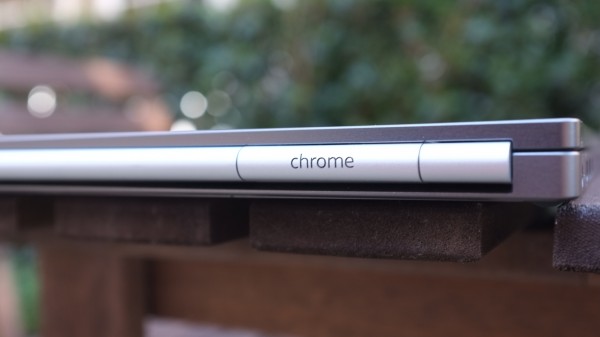
    Design. By overall appearance and features, Chromebook Pixel clearly looks like a MacBook Pro competitor, and everything about the computer is premium. There’s no sense of cheapness or skimping anywhere. The smoky grey anodized aluminum shell is solid, making Pixel feel rugged — tank-like — in the hands.

    The design is a bit industrial for my tastes, and I’ve expressed similar sentiments in the past about other devices Google sells, such as Nexus One and Galaxy Nexus. Chromebook Pixel is beautiful but boxy, an impression the screen dimensions contribute to.

    The screen. The display dominates the device landscape and feels larger than others of similar horizontal measure. That’s because Google chose a 3:2 ratio rather than 16:9. So the screen is higher, rather than wider, which is better for viewing webpages (hey, they do scroll down). Pixel’s display is more squarish than rectangular. I expected to be put off by the 3:2 ratio, but now rather like it.

    Anyone with enough cash to spring for MacBook Pro with Retina Display knows: High resolution matters. Once you go there, you can’t easily go back. Pixel’s 2560 x 1700 is an indescribable delight — a real feast for the eyes. Seeing is the only way to appreciate the screen. My productivity is way up if for no other reason. Reading and writing are a joy now.

    Text is crisp and digital content vibrant, with rich contrast. Viewing angles are superb, and the screen isn’t overly reflective. The display is bright, 400 nit, same as Surface Pro, and makes the $249 Samsung ARM Chromebook’s 200-nit seem like a candle to light bulb.

    Touch. Pixel’s touchscreen sets it apart from other portables in this size, price and screen-resolution class. The screen is more than reasonably responsive to touch, even when tapping smaller objects like browser tabs. But scrolling is nowhere near as smooth as a tablet. There’s some jerkiness, too, in some apps. Google can resolve this problem by way of software updates, as the hardware looks plenty solid to me.

    That said, I am not yet convinced a laptop needs a touchscreen. I experienced small bouts of Gorilla arm using Pixel — and also Surface Pro. Basically the arm aches from reaching up to touch the screen. It’s all about physics and the angles involved.

    The touchscreen’s big value lives up to the laptop name. I find touch most useful when Chromebook Pixel is in my lap. Also, I am less likely to develop Gorilla arm. There’s a big difference reaching down to touch rather than up.

    Overall, the value is hard to argue, say, over MacBook Pro, which costs $200 more without touch. As I’ll explain in part two, touch done right is game-changer. Apple has nothing, while Microsoft is further along with user interface on Surface Pro.

    Keyboard. The chiclet keys are a bit noisy for my tastes, as is the touchpad, but typing is smooth with great tactile response.

    The backlit keyboard is much, much more subdued than MacBook Air or Pro. I find the illumination to be just enough, rather than overly-glaring (granted Apple lets users turn down the intensity).

    Battery life. I have only done one real test, today, and barely got four hours, simply while writing and researching, with about one-dozen tabs open. I expected at least 30 minutes more. I will update this section within a few days, conducting tests again. I also haven’t yet done a good 4G LTE test, so more to come there, too.

    Setup. If you can use Chrome, Chromebook is easy. Connect to the WiFi of your choice and log into your Google Account. That’s it. Everything syncs, including web apps, and you’re ready to go.

    Performance. As expressed above, overall performance is smooth, much more so than either the Samsung Series 3 or Series 5 550 Chromebooks. Pixel feels like a traditional computer in most every way that matters. “Oh, I’m doing everything in the cloud? Who would have guessed?”

    Late last night, I used Peacekeper running in guest mode; the laptop runs Chrome OS 25.0.1364.87 from the stable channel. There are lots of people who value benchmarks. I’m not really among them. But I posted numbers for the Samsung Series 3 and 550 Chromebooks last year, and I know some potential buyers will want the numbers. Chromebook Pixel scored 3847, which compares to 2245 for the Series 5 550 (also run last night).

    Something annoys me and might other people, and it’s about software. To prevent out-of-memory crashes, Chrome OS basically shuts down browser tabs perceived to be idle. This behavior is a real usability problem on the ARM model, which only has 2GB RAM. I didn’t expect this behavior with 4 gigs.

    That said, tab refreshing isn’t as disruptive as on the ARM Chromebook. There, with Google Music set to stream via HTML5 rather than use Flash, song play often just stops because Chrome OS essentially flushes the tab. I have yet to see this happen on Chromebook Pixel, even with lots of other tabs open.

    I find that sites using, or perhaps abusing, Flash affect memory management the most. Just a few of the bad ones open, Chrome OS swaps around tab activity. You will lose work if this happens, as it has for me sometimes writing Google+ posts — once so far on Pixel, which isn’t bad, compared to the problems I had with the $249 model.

    Audio and video. Chromebook Pixel produces great sound, whether from the speakers (which I believe are under the keyboard), or through those externally attached (mine are Bose Companion 5). Even streamed music tickles the eardrums.

    Video playback is excellent and largely freeze-frame-free. But services giving video worthy of the screen are too scarce. Netflix offers no controls for setting or seeing the video quality, but it doesn’t look like 1080p to me, although pretty good. Hulu streams in HD, whatever that means. That’s 480p, right? Amazon makes a HD connection, and the stream looks 1080p enough to me.

    I really had hoped to test video from Google Play, but the service won’t play my purchased content. I instead get preview windows with options to purchase or rent. Frak you, too, Google DRM.

    Measuring Success

    Now comes the harder topic for most people. Price.

    Google’s marketing tagline for Chromebooks is “For everyone“. Pixel is not, for the price. But Ian Betteridge has the right idea, by taking a category perspective: “Up until now, Chromebook wasn’t ‘for everyone’”, he comments to one of my Google+ posts. Betteridge also has Chromebook Pixel. “For people like me, who value high-end, well designed hardware with great screens, there was no Chromebook that fitted the bill. Now there is. ‘Everyone’ doesn’t just mean ‘only people who want cheap plastic machines’”.

    The category is for everyone, when including Pixel. Looked at that way, if only Googlers, developers and a handful of others buy Chromebook Pixel, it can be called a success. Because most people won’t spend that much money anyway. That’s the point I keep coming to in my evaluation. What Google presents is a great computer for people who are willing to spend 1,300 or 1,500 bucks — and who might otherwise choose an Apple or Sony instead. Chromebook as a category is “for everyone”, but Pixel is just for a few. Any evaluation of price and performance should be for them, which might not be you.

    Googlers, many of whom until now carried MacBook Airs or Pros, really have another option — and running an operating system their company develops. Anyone considering a “premium” laptop, or what NPD calls those selling for $1,000 or more, is a potential customer. Then there are coders.

    Developer Calvin Prewitt received his computer yesterday and says that “Chromebook Pixel meets expectations, which were high” He calls it an “incredible device” and say that “Chrome OS will improve in the near term, but easy to love right now. The price is easy to overcome if you will use the 1TB of Google Drive storage. Otherwise, it is logical to have reservations”.

    I’ve thought long and hard about that 1TB of free storage during my evaluation. Critics call the offer nothing more than a Pixel price-justifying maneuver that costs Google nothing. I don’t buy that explanation.

    What if “For what’s next” is all about giving Chromebook Pixel owners storage they will use — for creating digital content, photos and videos? I explain the reasoning and offer proof points in my post earlier today about the release of the 500px Chrome app. Suffice to say, that Google has big plans for high resolution and touch. More on this in the next, unexpectedly-written subhead.

    Seeing Pixel for what it is

    While writing this post, a link to the New York Times review popped up in my Google+ feed. I generally make a point of not reading others’ reviews before writing mine. But being nearly finished anyway, I peaked, expecting to read David Pogue panning the laptop — oh, and he does. Pogue doesn’t get it, like many other people considering Pixel’s merits.

    “The screamingly obvious argument against the Chromebook Pixel boils down to two words: MacBook Air”, he writes. “The Air costs $100 less. It weighs 12 percent less and has four times as much built-in storage, 128 gigabytes vs. the Chromebook’s 32…Above all, the Air, or a similar ultralight Windows laptop, runs real desktop software — Photoshop, Quicken, iTunes, games — that the Chromebook can only dream about”.

    That’s the problem with reviewers who don’t see past features and ignore benefits. I can’t emphasize enough about Chromebook Pixel: The laptop embodies a design philosophy that captures Google’s culture DNA and vision for the digital lifestyle of the contextual cloud computing era.

    True innovation isn’t improving what you have but releasing what you don’t know you need. That’s the vision driving Chromebook Pixel, like iPad, which also received cool, early reception (me among the fools). Comparisons to the existing way are meaningless in this context. People like Pogue have to think differently.

    If you look at Chromebook Pixel from the viewpoint of existing applications like Photoshop you will never buy one. Because the value proposition is different and one that changes — in part because Google’s business is all about continually improving products rather than releasing big platform upgrades every few years. Chrome OS improves with age. It’s a fine wine. For example, the Series 5 550 Peacekeeper benchmark on Chrome OS 21 was 1848 but 2245 on stable channel 25.

    Chromebook Pixel promises to change the computing paradigm — all those cheap Chrome OS models are but Trojan Horses. The primary cost is hardware, up front, that is used for years, while software is minimal investment, or free. That’s reverse the commodity model that exists right now, where, particularly for businesses, PC hardware investment is less (well, except for Macs), and software and cost maintaining it is so much more.

    Anyone considering spending $1,499 or $1,699 on MacBook Pro 13-inch with Retina Display should consider Chromebook Pixel — not for what it does but for what it will do. Google’s laptop isn’t for everyone, not even most anyone, because most people will never spend more than $1,000 on a laptop. But for those who will…

    I’ll make a stronger cause for and against Pixel when writing about usage scenarios.

    Photo Credits: Joe Wilcox

  • OUYA consoles to begin shipping to Kickstarter backers March 28th

    OUYA_controller_dpad_closeup

    The highly anticipated OUYA gaming console will begin shipping out to Kickstarter backers on March 28th, according to a recent blog post by the newly-founded company. The $100 Android-powered gaming console managed to steal the spotlight last year when it surpassed $8.5 million in pledges, making it one of the all-time highest grossing projects on the popular crowdsourcing website. The team behind the console also revealed that a full scale launch would be initiated in June, with consoles inevitably making their way to retail stores.

    The OUYA team provided the following statement:

    “OUYAs will begin shipping to Kickstarter backers on March 28. That’s right. Parts are in the factory and assembly lines are buzzing. We’ll gradually ramp up production as we make sure things are working. (Our full launch is still set for June, which is when OUYA will be available in stores!)

    Meanwhile, tens of thousands of you will receive your OUYA, and you’ll get to start playing right away. You will also get to watch OUYA evolve over the coming weeks and months. We’ll continue to add new features, refine our user experience, and bring on more games. As always, we appreciate your feedback (and apply it), so keep it coming.”

    Source: OUYA

    Come comment on this article: OUYA consoles to begin shipping to Kickstarter backers March 28th

  • First look at HTC Zoe and Zoe Shares

    HTC_One_Press_Shot

    One of the biggest new features on the HTC One was Zoe, which is a new way to take multiple pictures and videos and do some really creative things with them. HTC Zoe will allow you to stitch together your photos and videos into a 30 second film, complete with background music, and will definitely make some splashes on social media. Zoe Share takes those clips and your other pictures, trims them up into and uploads them onto HTC’s servers to be shared with friends and family (and strangers), and we’re finally seeing the servers to that go live, already hosting a few Zoe Shares to give you a feel for what the phone is really capable of doing. In addition to watching the finished clips, you can also view the individual pieces that made up the video. Still need more convincing that it’s a cool feature? Hit the break below to check out some videos that have been uploaded and see if you aren’t impressed.

    https://zoeshare.htc.com/oSZXxATc1
    https://zoeshare.htc.com/Mpr3JtzF1
    https://zoeshare.htc.com/U5Xr1Ybt1
    https://zoeshare.htc.com/k3WrezAr1
    https://zoeshare.htc.com/HyCZaLSi1
    https://zoeshare.htc.com/eGWadNWc1

    I’m sure many of you are already planning your next great masterpiece in your head. Fortunately, we only have to wait a little longer before the HTC One becomes available.

    source: HTC Source

    Come comment on this article: First look at HTC Zoe and Zoe Shares

  • Alien vs. Predator: Evolution arrives for Android, brings plenty of extraterrestrial action

    Alien Vs Predator

    The long awaited follow-up to the hit game Predators has arrived today, bringing with it a multitude of exciting new gameplay features and impressively re-engineered graphics. The all-new title, AVP: Evolutionwas developed by Angry Mob Games–the same team behind other popular titles like Guerilla Bob and Muffin Knight.

    “On a distant planet, the blood feud between Predator clans continues to rage. In a final attempt to eradicate the Jungle Hunter Clan, the Super Predators secure the capabilities of an unlikely and unwilling species, the Aliens. As an Alien, you must ultimately destroy the Super Predators and free your species from enslavement. As a Jungle Hunter Predator, you must eliminate the Alien Queen in order to prevent the Super Predators from annihilating your clan.”

    Interestingly, players can take on enemies from both sides, guaranteeing gameplay as both Alien and Predator. Sure, the $5 price tag may be a bit hefty to swallow, but having played the game for an hour myself, I can vouch for its “fun” value. Jump past the break for the game’s official trailer, photo gallery and Play Store download link.

    Click here to view the embedded video.

    avp 1
    avp 5
    avp2
    avp3
    avp 4

    QRCode

    Play Store Download Link

    Come comment on this article: Alien vs. Predator: Evolution arrives for Android, brings plenty of extraterrestrial action

  • Disney/Pixar’s Toy Story: Smash It! comes to Google Play

    Toy_Story_Smash_Hit_Splash_Banner

    Greetings Mobile Gaming Fans!  A new game has hit the Google Play Store, and it will blow your mind (well, if nothing else your kids will really dig it)!  Disney/Pixar’s new game “Toy Story: Smash It!” will provide hours of fun for any mobile game fan.  Gamers  interact with Buzz, Woody, and other all too familiar “Toy Story” characters on their latest comical adventure through space!  Game play includes:

    • Block-breaking puzzle play – Throw unique bouncing-balls with special power-ups to knock down aliens and break through their defenses!
    • Play as Buzz Lightyear – Team up with Buzz, and work on perfecting the angles and aim needed to beat every level. Encounter your favorite “Toy Story” characters along the way!
    • 4 imaginative episodes – Take a fun-filled journey “To Infinity… and Beyond!” Get ready for an adventure of a lifetime as you stop the evil Zurg, catch alien bandits, and more!
    • 60 challenging levels – Encounter new challenges in every level. Find creative ways to smash through bricks, glass, trains, and more to get the highest score possible!
    • Hours of replay value – Replay each episode to get 3-stars on every level and earn impressive achievements!

    At only .99¢, this game is a steal and will keep you entertained through any board meeting.  View the video and download link for a piece of the action.

    Game on, gamers!

    Toy_Story_Smash_Hit_01
    Toy_Story_Smash_Hit_02
    Toy_Story_Smash_Hit_03
    Toy_Story_Smash_Hit_04
    Toy_Story_Smash_Hit_05

    Click here to view the embedded video.


    QR Code generator

    Play Store Download Link

    Come comment on this article: Disney/Pixar’s Toy Story: Smash It! comes to Google Play

  • HTC confirms some current phones will receive Sense 5 update

    HTC Sense 5 Update

    HTC (2498) announced its new flagship One smartphone at a press conference earlier this month. Along with an impressive list of high-end specs, the device includes the newest version of the company’s Sense user interface. Sense 5 is less intrusive than earlier versions and contains a number of unique features such as Blinkfeed, the company’s Flipboard-style widget for news stories, photos and social updates. The one question on everyone’s mind — at least, everyone who owns an HTC smartphone — was whether or not their device would ever be updated to Sense 5.

    Continue reading…

  • Living with voices in your head: Eleanor Longden at TED2013


    Photo: James Duncan Davidson

    Photo: James Duncan Davidson

    Eleanor Longden did well at school, and gleefully entered student life at university in England. By all appearances, she was a happy, typical student … but it wasn’t true. Underneath it all, Longden was “fundamentally frightened,” and while she did a good job of concealing her fear, she was about to come undone. She started to hear the voice in the second term of that first year, a narrator in her head calmly describing everything she did in the third person. The voice was neutral, impassive, even reassuring, though it would sound frustrated were Longden to hide her anger. “It was clear that it had something to communicate to me about my emotions, particularly emotions that were remote and inaccessible,” she says.

    Longden’s first fatal mistake was to tell a friend about the voice. That didn’t go so well–the implication was that normal people don’t hear voices–and she was persuaded to go to a doctor, her next mistake. ”She is digging her own grave,” the voice said at the appointment. Doctors don’t like voices in heads, and things began to unravel. Hospital admissions followed, then a diagnosis of schizophrenia, and then a “psychic civil war.” The voices increased and grew menacing, and Longden retreated into a nightmarish world. It’s hard to listen. “A vicious cycle of fear, avoidance, mistrust, misunderstanding had been established.”

    Two years later, her deterioration had been dramatic. The voices had turned terrifying, and her mental health status was a catalyst for verbal, even sexual assault. A doctor told her, “Eleanor, you’d be better off with cancer; it’s easier to cure than schizophrenia.” She even attempted to drill a hole in her head to get rid of the voices.

    Yet Longden is a survivor: “Many people have harmed me, and I remember them all, but the memories grow pale in comparison to the people who helped me.” With a group of supporters around her, she began a long journey back to health. She first had to understand that the voices were a reaction to traumatic childhood events. “Each voice was closely related to aspects of myself, sexual trauma, anger, shame, guilt, low self-worth,” she says. Crucially, “the most hostile and aggressive voices represented the parts that had been hurt most profoundly. These had to be shown the most compassion and care.”

    Eventually, she came off medication, and returned to psychiatry … as a professional. To this day, she argues the relevance of a particular approach. The important question in psychiatry isn’t “what’s wrong with you?” but “what happened to you?”

    Now Longden lives with her voices with peace, respect, compassion and acceptance. She is a part of Intervoice, the organizational body for the hearing voices movement. The group has networks in 26 countries on five continents, and it promotes a sense of dignity, solidarity and empowerment for individuals in mental distress. “We don’t have to live our lives forever defined by the damaging things that have happened to us,” she concludes. “My psychiatrist said: ‘Don’t tell me what other people have told you about yourself. Tell me about you.’”

  • HTC Director of User Experience talks about what went into redefining Sense

    HTC_Sense_5

    HTC Director of User Experience, Drew Bamford, posted today about what went into redefining Sense, as in Sense 5. He said that after the introduction of Sense 4, he challenged the team to “take a step back and take a fresh look at the overall customer experience.” After interviewing many users, they found that most people don’t even know the difference between apps and widgets, widgets are rarely used, and most people don’t modify their home screens. Pretty interesting when you think about it, because it’s the ability to modify home screens and the use of widgets that are supposed to make Android attractive. The fact of the matter is that mainstream consumers just don’t get involved all that much.

    This information helped them design Sense 5. The first part was designing something based on how people consume information,  which yielded BlinkFeed. They also found audio clarity to be very important, which led to BoomSound. Finally the camera experience was very crucial, and along with it came the idea of ultrapixels instead of megapixels. They also found that people just don’t have the time to edit their photos and videos, and that’s where Zoe came to be.

    Of all the features of Sense 5, I would say Zoe seems to be the most intriguing. I saw some pretty cool video shorts at the event last week in New York City, and I am excited to try it out for myself and see how it really works in the real world.

    source: HTC Blog


    Come comment on this article: HTC Director of User Experience talks about what went into redefining Sense

  • David Cross: Arrested Development on Netflix is going to redefine what TV can be

    The fourth season of Arrested Development, which is coming exclusively to Netflix in May, won’t disappoint fans, said actor David Cross in an interview with The Hollywood Reporter Thursday. If anything, producing the show for Netflix, which is going to release the entire season at once to facilitate binge viewing, helped show creator Mitch Hurwitz to push the creative envelope, he argued:

    “What Mitch did and how he’s able to tell the story through the Netflix model — I think it’s going to redefine what television can be and stories can be and how they’re presented.”

    Cross added that the result will be “historical,” and that it will be remembered for decades.

    That sentiment was echoed by Hurwitz himself when he talked about working with Netflix at the Dive Into Media conference earlier this month. Being able to ignore ratings and build story lines that strech across a number of episodes will make for more interesting TV, Hurwitz argued: “We are encouraged to make a more interesting show as opposed to flattening it out.”

    Image courtesy of Flickr user mecredis.

    Related research and analysis from GigaOM Pro:
    Subscriber content. Sign up for a free trial.

    • Motorola Products Not ‘Innovative, Transformative’ Says Google CFO

      droid-razr-hd-razr-maxx-razr-m

      Google acquired Motorola Mobility in May of 2012 and has yet to make a big splash under new management. Patrick Pichette, Google’s Chief Financial Officer and Senior Vice President, spoke today at the Morgan Stanley Technology Conference. During Patrick’s session, he talked about Motorola and that its products in the pipeline are “not really to the standards that what Google would say is wow — innovative, transformative.”

      When Google acquired Motorola Mobility, they inherited 18 months of product pipeline. Patrick made it clear that Google is waiting for the pipeline to end “while we’re actually building the next wave of innovation and product lines.” The tech giant has high hopes for Motorola and urgency to do well is at an all time high.

      It was reported that tensions between Samsung and Google have been heating up with Samsung representing around 40% of all Android devices sold. Not only that, Samsung has sold 200 million more Android smartphones than the closest top manufacturer, but Pichette said that any rift between the two giants is overblown

      Google’s CFO didn’t give a time frame on when we’ll start to see more “innovative, transformative” products from Motorola, however, we may see something before the end of this year.

      Source: The Verge

      Come comment on this article: Motorola Products Not ‘Innovative, Transformative’ Says Google CFO

    • Leak reveals HTC’s first new Windows Phone of 2013

      HTC Tiara Release Date Specs
      HTC (2498) confirmed earlier this week that it plans to release new Windows Phone 8 smartphones later this year, and a recent report suggests the vendor’s first new device will feature modest specs. According to Evleaks at Unwired View, the company has cancelled earlier plans to bring a high-end Windows Phone product, originally codenamed Zenith, to market. HTC will instead offer a mid-range handset running Microsoft’s (MSFT) latest mobile operating system in the coming months.

      Continue reading…

    • The Congo is not hopeless: Ben Affleck at TED2013

      Photo: James Duncan Davidson

      Photo: James Duncan Davidson

      On Sunday night, Ben Affleck accepted the Academy Award on behalf of his film, Argo, as it was named the Best Picture of 2012. And today, he appeared on the TED2013 stage kicking off Session 10, “Secret Voices.”

      “This is not a TED Talk. I will not be interesting or funny. This will not be exciting in any way,” he said. “Though I fee a little bit like Al Gore in the TED headset. He’s not here, is he?”

      And then he gets serious. “At the Academy Awards, I mentioned my wife, and I said: The people we love, we have to work on those relationships,” said Affleck. “The other thing that I work on is Eastern Congo.”

      “I felt like I wasn’t doing enough to give back to the world. So I found one of the most damaged, suffering places in the world, where 1 in 5 children die before the age of 5. It’s a place where a million people are displaced, regularly, inside the country. Where there’s the worst gender-based violence in the world … There are a lot of things to lament, particularly in the last 15 years when 5.5 million people died from conflict-related violence.”

      TED2013. Long Beach, CA. February 25 - March 1, 2013. Photo: Ryan Lash

      Photo: Ryan Lash

      As Affleck says, many people object to this number. So he asks us to imagine that the number were 3 million people. Per capita, that would be roughly the equivalent of 12 million people in the United States. “That’s the population of Chicago, Boston and Philadelphia,” he says. ”If they had every single person who lived there die, we would probably take some steps. There would be a reaction.”

      So why haven’t we responded?

      “I think we are a naturally good people. We care about one another. When our neighbor has cancer, we go over with meatloaf and take care of their kid,” says Affleck. “I think what happens [when we think about the Congo] is that we feel it’s too big, it’s too difficult to look at … I can understand my aunt who passed away, but 3 million deaths I can’t understand. I don’t want to understand – it’s just too painful, so I disengage.”

      Too many people say that the situation in the Congo can’t be changed and that corruption runs too deep.

      “I don’t believe that’s true,” says Affleck. “I’ve seen and met people doing incredible things, mending the fabric of their lives – their family’s lives — brick by brick, stitch by stitch. It’s changed my views on what’s possible.”

      Photo: James Duncan Davidson

      Photo: James Duncan Davidson

      Tonight, Affleck is here to show us just a scratch off the surface of the amazing things happening in the Congo. And with that, he introduced the Kinshasa Symphony, from the Congo, playing a composition called “Luba.”

      In crisp suits, the musicians made beautiful music — their strings diving and soaring with beauty. And hope.