Blog

  • Walk Away – Should I Stay or Should I Go?


    clash  << click for youtube video


    great article

    Debtor’s Dilemma: Pay the Mortgage or Walk Away – By JAMES R. HAGERTY and NICK TIMIRAOS – In Down Real-Estate Market, Homeowners Are Deciding to Abandon Their Loan Obligations Even if They Can Afford the Payments  – PHOENIX — Should I stay or should I go? That is the question more Americans are asking as the housing market continues to drag. … – Wall Street Journal

  • Store Review: Spice Station

    From the street, it can be hard to tell just what or even where Spice Station is. Located in Silver Lake’s Sunset Junction, the shop is hidden from the general hustle and bustle, and the curious shopper, perhaps lured by a chalkboard listing “Today’s Spice Prices,” must amble down a walkway, past a fountain, and through a small courtyard. But inside awaits a world of herbs, spices, chiles, salts, and teas…

    Read Full Post


  • Google’s IQ boost is only beginning

    AltaVista was really pretty useful (it’s still around – owned by Yahoo! now), but the first time I used Google, in early 1999, I knew AltaVista was history.
    It’s been almost 11 years since that day, and my brain’s been following the usual middle aged fail. On the other hand, Google keeps getting smarter. So my brain + Google isn’t doing as badly as my brain alone.
    Take yesterday, for example. I asked Google for help with an esoteric Excel problem, and it told me how to use matrix operations to sum a range of inverted numbers. I didn’t even know Excel had matrix operators.
    It took minutes to answer that problem, and to acquire a new set of skills. There’s no way I could have answered the problem 10 years ago.
    Even though Google has its weaknesses (see also), it’s only begun to get smart. Imagine what search will be like in 10 years.
    Vinge’s Rainbow’s End classroom is feeling familiar, even as more of my brain is outsourced to the House of Google.
    See also:


    My Google Reader Shared items (feed)

  • Is a Plant-Based Diet the Best Fit for Fitness?

    Filed under: , ,

    Canadian fitness expert Brendan Brazier, author of Thrive: The Vegan Nutrition Guide to Optimum Performance in Sports and Life, is a big fan of a eating a plant-based diet. Here, he fills us in on some of the benefits of cutting out animal … Read more


    Permalink | Email this | Linking Blogs | Comments

  • Lieberman explained: He’s a lot like Bush

    This explains a lot.
    … my favorite explanation comes from Jonathan Chait of The New Republic, who theorized that Lieberman was able to go from Guy Who Wants to Expand Medicare to Guy Who Would Rather Kill Health Care Than Expand Medicare because he “isn’t actually all that smart.”

    It’s certainly easier to leap from one position to its total opposite if you never understood your original stance in the first place, and I am thinking Chait’s theory could get some traction. “When I sat next to him in the State Senate, he always surprised me by how little he’d learned about the bill at the time of the vote,” said Bill Curry, a former Connecticut comptroller and Democratic gubernatorial nominee.”…

    Lieberman is a dull man who’s not that interested in understanding the world. He’s dull enough to be profoundly corrupted by his insurance company donors, yet still imagine that he’s an honest man.
    A lot like George Bush Jr.
  • Stay Warm This Winter, How Airplanes Can Kill You and More

    Filed under:

    Each morning, we dish out a few links we love. Feeling a bit chilly? Snuggle up to these nine ways to thaw, melt, warm and otherwise heat up the cold, cold months of winter. Sheesh — apparently, new research shows that we spend an average of 56 … Read more


    Permalink | Email this | Linking Blogs | Comments

  • Post-HIV America

    A celebrity is found to have been cheating on his wife. That’s unsurprising.
    He’s believed to have been cheating with a large number of women of professional and easy virtue. That’s minimally interesting.
    Nobody mentions HIV. That’s truly noteworthy. My medical school career began with what we later called HIV, and now it’s all but forgotten.
    We’re in post-HIV America.


    Update 12/19/09: NYT article on remembering a lost era – and lost people. HIV really has been forgotten.

  • Take a Time-Out During the Holiday Season: 3 Quick Exercises

    Filed under: ,

    As the holiday season gets busier and busier we neglect ourselves, skipping after-work workouts for holiday shopping and morning workouts because we were out at a holiday party too late, with one too many cocktails. Sound familiar? Here are three … Read more


    Permalink | Email this | Linking Blogs | Comments

  • Turn Right at the Gas Station: Google Maps Gets More Human

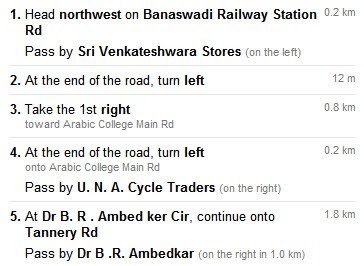
    You’d think it was odd if you called me for directions and I told you to go 0.2 miles southeast and make a slight right onto Old Route 17.

    You’d expect me to say something more like, “Start driving away from the library and take the second right just after the McDonald’s.” Google Maps India has just launched a hybridized version of directions that give geographically accurate distances and directions as well as landmarks most humans would also recognize. We can imagine this coming to the rural U.S. and Google telling us to “follow that-there little jog in the road where the big oak tree used to be before Jimmy Ray hit it with his daddy’s combine, bless his heart, for 2.3 miles.”

    Sponsor

    Although most urban Americans are comfortable navigating by street signs, in other parts of our country and the rest of the world, landmarks are a necessity to successfully reaching one’s destination. Other times, it’s simply reassuring to know that you haven’t actually missed a turn or your destination because you haven’t yet passed a given landmark.

    How many times has someone told you on the phone to “keep going straight until you pass the shopping center” or something of that sort, and it saved you a missed turn as well as a general sense of anxiety? In the words of UX Googler Olga Khroustaleva, “We found that using landmarks in directions helps for two simple reasons: they are easier to see than street signs and they are easier to remember than street names… Sometimes there are simply too many signs to look at, and the street sign drowns in the visual noise. A good landmark always stands out.”

    The point of the whole experiment was to give drivers a sense of confidence when exploring new territory. Ultimately, the Google team found that a combination of street names and distances as well as landmarks gave the best results and best satisfied users.

    Sree Unnikrishnan and Manik Gupta wrote on the Google India blog, “This effort was possible thanks to the large amount of landmark data that users like you contributed through Google Map Maker. Our new algorithm determines from available signals, which of these landmarks are most useful for navigation, based on importance and closeness to the turns that you’re making.”

    Here’s a look at the Google Maps directions design we all know:

    And here’s a version Google Maps India tried that added landmarks to other data to confirm directions:

    Finally, here’s what Indian travellers will see moving forward:

    Looks pretty sweet to us! What do you folks think? Would you like to see more Map Maker landmark data for driving directions all over the world, too? Let us know in the comments.

    Discuss


  • Skip the Asprin, Use Mint For Pain Relief

    Filed under: , ,

    A specific type of mint, Hyptis crenata or Brazilian mint, has been used by indigenous healers in Brazil to treat pain for thousands of years. UK researchers at Newcastle University have presented a new study which has found that this herbal therapy … Read more


    Permalink | Email this | Linking Blogs | Comments

  • Mafia II gets release window

    Details may have been scarce for Take-Two Interactive’s third-person shooter, Mafia 2, but at least we’re now given the opportunity to narrow down the window for its release. It’s not much, but at least we finally heard

  • HTC Imagio by Verizon Wireless Video Review

    Hi, Everyone here is a quick video review of the not so new HTC Imagio. We will have a review of the Omnia2 and comparison a little later, just so you know what to get while your out there shopping this holiday.

    Enjoy:

    Share/Bookmark

  • Video: Dynasty Warriors Strikeforce

    Earlier today, we got new details about Koei’s Dynasty Warriors Strikeforce 2 for the PSP. Now, it’s time to have a little something for the console offering of the franchise, with this new gameplay trailer for Dynasty

  • Confirmed: 2011 Ford Mustang GT to offer 412-horsepower 5.0-liter V8

    Filed under: , ,

    2010 Ford Mustang GT – Click above for high-res image gallery

    Thanks to a loose-lipped Facebookian that couldn’t help sharing insider information and a quick follow-up post from Inside Line, we can now confirm the return of the iconic 5.0-liter Mustang GT for 2011. Even better news is the fact that the Mustang GT’s new mill will crank out an impressive 412 horsepower.

    By way of comparison, the 2010 Chevy Camaro SS has a 6.2-liter V8 with as much as 422 horses when mated to a six-speed manual and the 2010 Dodge Challenger SRT8 has a 6.1-liter Hemi that offers 425 ponies. And remember, both of those rivals are considerably heavier than the Mustang.

    As much as we’d like to unload more goods on the 2011 Mustang, you’ll just have to wait until Ford’s good and ready. Or someone blows another embargo, whichever comes first.

    [Source: Inside Line]

    Confirmed: 2011 Ford Mustang GT to offer 412-horsepower 5.0-liter V8 originally appeared on Autoblog on Thu, 17 Dec 2009 20:59:00 EST. Please see our terms for use of feeds.

    Read | Permalink | Email this | Comments

  • NCAA Tries To Bully Fan Discussion Site Into Handing Over Its Domain Name

    Reader Eileen writes in to alert us that the NCAA — known for its overly restrictive views at times — is trying to bully the owner of the discussion website NCAAbbs.com into handing over its domain names. The NCAA is, not surprisingly, complaining that any domain name that includes NCAA automatically should belong to the NCAA. Of course, it’s not so simple. While the NCAA does have a trademark on its name, that doesn’t mean it gets automatic control over any site that uses NCAA in its domain name. The NCAAbbs site is clearly not associated with the NCAA and is pretty clearly just a fan discussion site. The owner of the site says that he’s planning to fight the demand, and hopefully he can succeed. While the domain dispute process can be a bit arbitrary, the courts have often realized that a trademark holder does not get full control over every domain that mentions them. Hopefully, that will be the case here as well. Of course, the one area where it’s pretty clear that you can keep such a domain name is in cases of “sucks sites.” So perhaps if the NCAA wins this, the owner can simple relocate to NCAAreallysucks.com.

    More to the point, however, you have to wonder what the NCAA thinks it’s doing here. You have a site that has been set up to promote the NCAA and all of the various sports teams within the NCAA. This is an incredibly useful promotional tool that the NCAA should be celebrating and helping rather than attacking. Why do so many organizations think it’s smart to threaten, attack or sue their biggest fans?

    Permalink | Comments | Email This Story


  • Must-see space news on the Web

    ScienceInsider: Obama backs bigger rocket, more $ for NASA
    Planetary Society: Saturn orbiter spots a shining lake on Titan
    Science @ NASA: Colliding auroras spark explosions of light
    Ars Technica: Two events hint at dark matter detection
    Gizmodo: The physics of future space battles …(read more)

  • High Vit. C May Up Cataract Risk in Women

    Moderation is the key in almost anything and with vitamins, it’s no exception. For the most part, people who spend a lot of money on vitamins just end  up with expensive urine, but sometimes too much of a vitamin can cause problems. Researchers in Sweden found such a problem among 25,000 women who took vitamin C.

    The recommended daily allowance of vitamin C is 45 mg per day, according to the World Health Organization (WHO) and 60 mg to 95 mg pepillsr day, according to the United States’ National Academy of Sciences. The researchers, who published their findings in the Journal of Clinical Nutrition, looked at 24,593 women aged 49 to 83 years old, for a little over eight years. The goal was to look at age-related cataracts and the researchers were looking at supplemental vitamin C use, not vitamin C that was taken in through diet.

    Among the almost 25,000 women, there were 2,497 cases of cataracts:

    • 878 cataracts were removed from the 9,973 women who did not take any supplements
    • 252 cataracts were removed from the 2,259 women who took multivitamins only
    • 143 cataracts were removed from the 1,225 women who took vitamin C only

    The researchers also found that women who were older and taking hormone replacement therapy (HRT), as well as taking vitamin C had a higher risk of developing cataracts as well.

    ~~~

    Post from: Blisstree

    High Vit. C May Up Cataract Risk in Women

  • Nihonji Daibutsu: The Great of Buddha of Nihonji

    Japan, Asia | Unusual Monuments

    This giant Buddha is a unique one, being an effigy of Yakushi Nyorai, the Buddha of Healing, known as Bhaisajyaguru in Sanskrit. The immense image of Yakushi was carved out of Mt. Nokogiri, named for the saw-tooth appearance of the mountains in the range of the same name.

    The temple itself dates back to 725 CE, and the Great Buddha and 1500 other statues and carvings were created by the master artisan Jingoro Eirei Ono and his army of twenty five plus apprentices in the 1780s. So large is the Buddha of Nihonji that it appears on Google maps, (the circle in the upper right hand corner) and a comparison with the nearby parking lot gives a good sense of its massive size.

  • Social software is still software

    Quick question. If a conference runs simultaneous tracks on "Enterprise Search," "Document Management," and "Company XYZ’s project to replace the intranet with microwikiblogging," which will have the largest audience?

    I’d venture a guess that most people are drawn to the the experimental and innovative, rather than to the mundane reality of complicated enterprise tools. That’s only natural, certainly at a conference. You go there to be inspired, not to be reminded of that system designed to do essential, but relatively boring stuff; a system which, on top of that, is still exhaustingly difficult to get right. Call it content technology escapism, if you will.

    All that social, collaboration, networking, and community software may appear as green fields where traditional impediments don’t apply, if only because of the perceived limited risk to essential business processes. You wouldn’t use your e-mail server or ERP software for something new without going through a formal testing procedure. But with blogging, wikis, collaboration, you could be more agile, and get around some of those stagnating requirements, right? Well, don’t be so sure.

    About a year ago, I reviewed a community software product for our Enterprise Collaboration & Community Software Report and, within the first day of checking it out, found several technical issues. (I’m not going to name names here, since it seems the vendor has since then worked hard to fix the problems.) It was a SaaS solution, suffering from problematic architecture (things like a shared user directory that meant you had to have a separate email address for each community you wanted to sign up for) and potentially serious security holes (like an API key stored plain text in publicly accessible Javascript). I found it ironic when I saw a presentation by the CTO of one of their customers, lauding the SaaS nature of it, since "It means we didn’t need to have the technical resources in-house." He was obviously blissfully unaware of the risks he was taking.

    And I was reminded of this a couple of weeks ago, when I read a blog post by one of The Next Web’s founders. His personal blog was hacked, and he decided to interview the young Turkish hacker that did it. He also offered the 17-year old some advice. "Sounds like you could learn a lesson in marketing if you ask me. If I would hack 50,000 blogs a week I would make sure to have a multi-language message there, a link to my website and a cool design."  Of course, this was a personal blog.  If you’re running a public corporate blog, you’ll want to make sure to find out how to prevent script kiddies from changing your cool design to a blank page with a Turkish flag. Reading up on vendor patches and updates is as important with blog software as it is with your document management system.

    This is just anecdotal, and I’m not saying it to fault the SaaS vendor and the CTO, or to blame WordPress. But however much you’d like to avoid the mundane, boring, and technically complicated aspects, don’t forget social software is still software. And often, it’s some of the most publicly-exposed software you’ll have around. So take that foundation seriously — or you risk creating Fail 2.0 instead.

  • Covered Bonds Hearing Showed Bipartisan Support

    CBI-logo-clips.jpg MJ-cbi.jpg

    By Mercy Jiménez and Spencer Punnett

    WASHINGTON, D.C.   Although the prime mover in the push for U.S. covered bond legislation is a Republican (Rep. Scott Garrett of New Jersey), substantial support from the other side of the aisle will be essential for any success in the current Democrat-controlled Congress. That political reality gives special significance to positive statements made by Democratic members of the House Committee on Financial Services during the committee’s hearing on covered bonds earlier this week (Dec. 15).

    Here are some examples from members’ opening remarks preceding testimony by expert witnesses on the topic:

    • Rep. Melissa Bean (D-IL): “Establishing a U.S. covered bond market could be very helpful to the residential and commercial real estate markets, but [also to] other asset markets like public-sector loans and other consumer loans as well.”

    • Rep. Bill Foster (D-IL): “We have to look at what provides over time the best stability and the best deal for consumers. And I think both of these lead to the covered bond market as a way forward.”

    • Rep. David Scott (D-GA): “This type of loan [funding] could provide a sense of accountability for both the lender and the borrower … which could potentially decrease risky lending practices.” (Rep. Scott also highlighted the dynamic nature of the cover pools backing covered bonds, which permit problem loans to be “swapped out for better assets.”)

    • Committee Chairman Barney Frank (D-MA): “I am struck by … the unanimity [here] that the European experience [with covered bonds] has been a good one — that it is instructive for us — that it gives us lessons, and that this is the case where acknowledging that something has been done in Europe has some useful lessons for us. We ought to go forward.”

    READ MORE >>

    http://www.coveredbondinvestor.com/news/hcfs-covered-bonds-hearing-showed-bipartisan-support