Blog

  • White Sands National Monument

    Alamogordo, New Mexico | Natural Wonders

    The wind blown sands and rolling dunes of White Sands National Monument blanket an area of 115 square miles in south-central New Mexico. It is the largest pure gypsum dune field in the world. A pure white expanse that has drawn a steady flow of visitors for over 80 years.

    Located at the northern limits of the Chihuahuan Desert and at the edge of a US military base and missile-test facility, this U.S. National Park is as obscure as it is beguiling. Visitors can drive to various undulating dunes, take hikes through a nature reserve and even purchase sleds for cruising down the dunes.

    Year-in and year-out, the most active dune fields can move in a northeasterly direction at a rate of up to 30 feet per year. These abnormal dunes, formed out of pure gypsum (hydrous calcium sulfate), are borne out of “an ephemeral lake or playa with a very high mineral content,” located in the western section of the monument. As the water in the lake evaporates, it leaves behind minerals that form gypsum deposits. These deposits are then transported by wind and form the ever-expanding sea of dunes.

    A reserve can be found at the park as well, where a unique array of specially adapted plants and animals are found. Some of the more distinctive species of animals include the Bleached Earless Lizard, the kit fox as well as the non-native but highly adapted African Oryx. An easily navigable path allows for exploration of this unique landscape.

    The miraculous natural setting is a spectacle to experience and despite the park’s popularity, finding solitude amongst the vast whiteness is remarkably easy.

  • The Very Rev. Michael G. Ryan speaks out against Mass changes

    A St. James Cathedral pastor’s plight

    I’m curious about the resistance to the Very Rev. Michael G. Ryan’s proposal concerning the forthcoming translation of the Roman Missal [“St. James pastor speaks out against changes in Mass,” NWTuesday, Dec. 15].

    Let Catholic bishops of the English-speaking world undertake a yearlong pilot program in selected communities with an educational process, then objectively evaluate the results — hardly a revolutionary proposal, and one sought by more than Ryan.

    To date, more than 4,300 people have signed on to the proposal from all over our country, and from Singapore, Canada, Australia, South Africa, New Zealand, Italy, Austria, the U.K., Scotland, Belgium, Morocco, Nepal, Japan, Guyana, China, Hong Kong and Malaysia.

    Yes, we find the revision process to have violated the spirit of the reforms of Vatican II, but we also wish to pray in an intelligible and, more importantly, beautiful language.

    With others, I find what we presently have not all that bad.

    — Rev. Roger G. O’Brien, Lynnwood

    Unfortunate new translations

    As coordinator for a local group of 140 resigned priests, I would like to commend Rev. Michael Ryan for his courage and integrity as a dedicated pastor in proposing a review of the unfortunate new translations for liturgy recently rubber-stamped by the U.S. bishops.

    Ryan has been highly regarded by his fellow priests for more than 40 years. From his days as chancellor to his brilliant renovation of St. James Cathedral and the expansion of ministries there. He has created a thriving, dynamic parish for more than 2,000 families who flock there for good liturgy from all over the Seattle metro area.

    His forthright article in “America” magazine and related interviews explain that he took action in making this proposal because he felt the new translations themselves would damage our prayer life, and the process that brought them about violated the rights of bishops, priests and laity who would be impacted by them.

    My thanks, and for those local Catholics who share a Vatican II vision, go to Father Ryan for his proposal for evaluation of these new texts before widespread implementation.

    — Patrick Callahan, Seattle

  • The stigma of mental illness

    Big difference between psychopathic and psychotic

    Oftentimes people are too critical of racism, sexism, anti-Semitism and homophobia.

    I am saying this because I have mental-health issues and, contrastingly, citizens are allowed to say whatever stupid thing comes to mind when addressing this issue [“Haq guilty in shooting at Jewish Federation,” NWWednesday, Dec. 16].

    People who make these criticisms do not even acknowledge that people like me read these criticisms. Very little is ever written or said that puts mental-health issues in a positive light. There is no other side to the argument — just stupid chatter.

    When people are actively psychotic, they are much more likely to commit violent crimes; however, they are much more likely to point a weapon at a policeman in order to commit suicide than they are to murder a policeman.

    Murdering policemen is usually psychopathic, not psychotic. There is a very big difference in the motives and perception of reality between the two states.

    I believe Maurice Clemmons was just a psychopath. It is much more difficult to keep psychopaths off the streets because a person cannot be locked up for merely being psychopathic. And besides, psychopaths know how to con.

    I am a caregiver and a student. I have a degree in psychology. I would like to see the complexity of mental illness portrayed in the media. The vulnerability of the mentally ill to crime and to the lack of due process exceeds our propensity to commit violent acts.

    — Dale McCracken, Renton

  • Lawrence Berkeley National Laboratory

    California, US | Inspired Inventions

    The philosophers stone also known as “the great work” was the search not so much for eternal life, or to turn lead into gold, but the search for perfection, for God.

    Turning a human into an immortal represented a step closer to our original pre-fall condition, and turning lead into gold meant transmuting a base metal closer to perfection, gold being seen as the most perfect, the most god-like of all the metals. (Alchemists did in fact accidentally invent gold plating in the process.)

    This search to turn lead into gold has, in modern times, become the symbol of the foolishness of the alchemists and of the middle ages in general… except they were absolutely right, metals can be transmuted and base metals can be turned into gold. Of course to do so, the alchemists would have needed a nuclear reactor.

    The transmutation of metals is not uncommon. It happens in nuclear reactions both natural such as at the center of stars (the idea that lead can be turned to gold in the center of a star would have appealed greatly to the alchemists) and in man-made nuclear reactions such as in particle accelerators like the LHC and in conventional fission power reactors.

    In 1980 at the Lawrence Berkeley Laboratory, Glenn T. Seaborg, a nobel prize winning chemist, achieved for the first confirmed time in history man-made transmutation of a base metal, bismuth, into gold. Granted it was only several thousand atoms, not even enough to see with the naked eye, and cost many many times more to create then it was worth, but nonetheless ‘the great work’ had been achieved. As it turns out, the philosophers stone is a well funded national laboratory.

    (There is a rumor of a Soviet nuclear research facility, sometimes identified as the “Soviet nuclear center of Lake Baikal,” where in 1972, an experimental reactor lead shielding was found to have been transmuted to gold. Unfortunately there is little in the way of documentation to support this story.)

    There is a further irony, this time on the alchemists. It is in fact much easier to turn gold into lead, then the other way around and gold left in a nuclear reactor will eventually turn into lead.

    But then, Alchemists promising to find a way to turn gold into lead just doesn’t have the same ring to it.

  • Health care and lingering questions of church and state

    Why aren’t they listening?

    The Obama administration and socialistic progressive Democrats are trying to force a massive, costly health-care-reform bill upon the American people without the transparency that was promised [“Senate Dems appear ready to drop expanded Medicare,” News, Dec. 15].

    How they plan to make cuts in costs while expanding coverage with an inefficient, money-draining bureaucracy remains to be seen. Why are they pressuring legislators to vote on bills and amendments they haven’t read and to some degree haven’t even seen?

    Why has there been no discussion on portability of health insurance from state to state? What about some degree of tort reform?

    Conservatives and moderates who brought these possibilities for discussion are being shut out. In the latest MSNBC poll, more than 75 percent of the American people are against Obama’s hasty and radical attempt to overhaul health care.

    Why aren’t the progressives in Washington, D.C., listening?

    — Laurie Hatakeda, Redmond

    Kill this bill!

    The current Senate health-care bill has become a travesty [“Cap-cost loophole cut in Senate bill,” News, Dec. 12].

    It has been weakened to the point of becoming a gift to the insurance companies. It mandates that individuals must purchase health insurance from a private insurance company or be fined or jailed. Yet it provides nothing to control escalating insurance premiums — a public option.

    Insurance companies must accept people with pre-existing conditions, but the insurance companies can set exorbitant premiums for these people. Insurance companies will be allowed to charge older people rates that are three times higher than for younger people.

    This is not reform.

    This is a gift on par with the Bush administration’s Medicare Part D gift to the pharmaceutical industry. The Senate bill is a guarantee of additional medical bankruptcies for millions of Americans.

    Better no bill than one that preserves a dysfunctional health-care system and that transfers billions of taxpayer money to the insurance companies for outrageous executive salaries and bonuses, marketing expenses and shareholder dividends.

    I am asking Sen. Patty Murray and Maria Cantwell to kill this bill rather than see a huge taxpayer bailout of the insurance industry.

    — Kenneth J. Jones, Seattle

    Freedom of religion and the Bill of Rights

    The First Amendment and the nine proceeding amendments to the Constitution restrain only the government from impeding certain and specific rights of individuals [“First Amendment rights for all,” Opinion, Northwest Voices, Dec. 15]. The amendments do not necessarily restrain individuals from impeding the rights of other individuals.

    Contained in the nine following amendments is an amendment citing “freedom of religion.” Catholic bishops are making a valiant attempt to circumvent this freedom through imposing their religious and institutional beliefs on the government and other individuals.

    As they cloak their attempts in the garment of humanitarianism, they overstep the same bonds securing the very rights that allow them to exist, as they do, in the U.S.

    If the Catholic bishops think they should have undue influence on government, they should be willing to give up their tax-exempt status, pay taxes on their wealth and register as a political-action group. Until such time as they cede their religious status for political status, they should channel their brand of humanitarianism to influence individuals, not government.

    Again, this writer suggests a reading of the Bill of Rights when assuming their use to support specific actions and causes.

    — Karen Clay, Port Orchard

    An all-too-common misconception of conception

    Pastor Frank Schuster, in his letter regarding the Catholic bishops’ position on abortion and health care [“First Amendment rights for all,” Opinion, Northwest Voices, Dec. 15], makes an all-too-common incorrect assumption that we all agree God places the soul in the child-to-be at the moment of conception —the point where the egg and sperm unite to create that first single-celled fertilized cell called the zygote.

    I don’t agree with this assumption, nor do millions like me.

    Dr. John Opitz, professor of pediatrics, genetics, obstetrics and gynecology, testified before President George W. Bush’s Council on Bioethics that some 40 percent of normal embryos are flushed out unnoticed in a woman’s normal menstrual flow; they are not miscarriages.

    This fact plus several others raise serious questions about the belief that God places souls in eggs as they are being fertilized by sperm — the moment of conception.

    What happens to all those souls up there in heaven who were never born, never had a thought, never had a brain? What about identical twins formed from a single fertilized egg with its one soul? Does each get half a soul?

    My recommendation to all is that we do a little more thinking and a little less believing.

    — Ralph Turman, Seattle

  • The World Reacts to The New Facebook

    It’s been a little over a week since Facebook debuted a massive revamp of its privacy settings. EFF immediately followed that release with a detailed critique, concluding that the changes were “clearly intended to push Facebook users to publicly share even more information than before [and] will actually reduce the amount of control that users have over some of their personal data.”


    Since then, EFF’s criticisms — and those of other vocal privacy advocates like ACLU, CDT, and EPIC — have been echoed throughout the mainstream press and across the web. As a Boston Globe editorial titled “Facebook’s Privacy Downgrade” correctly pointed out, “Most people who join Facebook do so because they want to share photos and messages with friends and family, not to expose their lives to the entire world.”

    Notably, in a testament to the even-handedness of EFF’s critique, The Atlantic cited our blog post both in a story collecting negative reactions and in another story collecting positive reactions to the Facebook privacy revamp.

    Not to be outdone by the media, Facebook users themselves were also immediately up in arms over the new changes. Negative comments flooded the Facebook Blog and the Facebook Site Governance page. Several of those comments were collected by the San Francisco Chronicle in a story titled “Facebook users speak out against new privacy settings”. Meanwhile, unhappy users used Facebook itself to organize opposition to the changes, with new groups being formed to protest the privacy revamp and older groups seeing renewed activity.

    The past week’s privacy backlash culminated today with the filing of a complaint with the Federal Trade Commission by the Electronic Privacy Information Center (EPIC), joined by several other consumer and privacy groups. In the complaint, EPIC alleges that Facebook’s latest privacy changes are deceptive and unfair and asks that the FTC open an investigation and order Facebook to restore to its users the control over their privacy that has been lost in the transition. Considering the many tens of millions of American consumers who use Facebook, we hope and expect that the FTC will seriously consider the important questions raised by today’s complaint.

  • Explaining Deceptive Product Packaging

    Deceptive food packaging is really irksome to a lot of consumers, especially since many people tend to choose products based on packaging size. It’s difficult to know just what 6 ounces of pita chips will look like out of the inflated bag, isn’t it?

    product-packagingConsumer Reports recently asked some companies to explain just what’s going on with that empty space or extra-large packaging. In their January article,”Air to Spare,” Consumer Reports describes their Black Hole Award, given to products with lots of empty air in the packaging. They mention ocean-nasalthat the Fair Packaging and Labeling Act allows “slack fill” if it serves a purpose like keeping a product from breaking or to discourage theft in the retail setting. However, Consumer Reports also adds that the FDA hasn’t charged a slack-fill violation in the last five years.

    In their “Wasted Space article, Consumer Reports explains what a few companies had to say about the empty space in their products. For example, they asked the makers of Ocean saline spray, Fleming Pharmaceuticals, why they have a cardboard partition and empty space in their boxes.

    Fleming explained that they sometimes offer a buy-one-get-one-free promotion and the same box is used whether the extra bottle is included or not. They added that they can’t change box sizes because that would present shelf space issues in stores.

    You can read what the makers of other slack-space products like Uncle Ben’s, Post Shredded Wheat and Bayer One a Day had to say in the January 2010 issue of Consumer Reports.

    Are you offended or confused by extra space in product packaging?

    (Image via stock.xchng; Fleming Pharmaceuticals)

    Post from: Blisstree

    Explaining Deceptive Product Packaging

  • Palm Talks CES, webOS 1.3.5 Details

    webos 1.3.5
    During this evening’s quarterly investor conference call, Palm CEO Jon Rubinstein briefly talked about the next version of webOS and some of Palm’s plans for CES. Mr. Rubinstein stated that Palm Inc. would be showcasing webOS v1.3.5 during the companies upcoming media event at CES. We can gather from the call script that the event will at least include a preview of 1.3.5, a focus on Palm’s developer program efforts as well as some potential new carrier announcements.

    Palm’s CEO also disclosed a few details about what webOS 1.3.5 would encompass. The bullet points he mentioned reveal the new release will include improved battery life, better overall device and wifi performance, a removal of the app download storage limit and a speed boost for Pixi users.


  • Jay Leno to cram SLS AMG’s V8 into 1969 Mercedes 6.3

    Filed under: , , , , ,

    1968 Mercedes-Benz 300SEL 6.3 – Click above for high-res image gallery

    Ask us to pick our favorite Mercedes-Benz products of all time and towards the top of that list sits this: The 1968-1972 300SEL 6.3. Introduced at the 1968 Geneva Motor Show, the original 6.3 was the product of one rogue Mercedes engineer who took the 109-series Type 300 SEL sedan and shoved the Type 600 limo’s 6.3-liter V8 underhood. The heart transplant was good for 250 horsepower, allowed the Teutonic sled to rocket to 60 mph in 7.4 seconds, top out at 136 mph and made it the fastest road-going sedan of the time.

    Not only did the 6.3 out accelerate the Porsche 911 S and Jaguar E-Type 4.2, with it’s pneumatic suspension, anti-dive control and four-wheel disc brakes, it could dance as well as it could surge. And of course, Jay Leno has a 1969 example parked in his So. Cal. stable.

    During a press event earlier this month, Jay and the Mercedes crew held a little soiree at his “shop” and revealed Leno’s plans to swap in the 6.2-liter V8 from the Mercedes-Benz SLS AMG into his 40-year-old sedan. The union of the 300SL and the 563-hp AMG-fettled mill apparently has Mercedes’ blessing, as the automaker’s engineerings are helping Jay with the swap. Naturally, we can’t wait to see and hear the results, and we’d expect a video of the reborn beast to be up in the coming months.

    [Source: USAToday via Save The Enzos]

    Jay Leno to cram SLS AMG’s V8 into 1969 Mercedes 6.3 originally appeared on Autoblog on Thu, 17 Dec 2009 18:28:00 EST. Please see our terms for use of feeds.

    Permalink | Email this | Comments

  • Canadian Record Labels Get Indie Record Store Owner To Plead Guilty… For Getting Rare CDs

    Reader Vincent Clement alerts us to yet another story of a copyright overreach up in Canada, this time involving the owner of a small independent record shop in Ottawa who was charged with copyright infringement and has pleaded guilty, rather than fight it. The details are a bit confusing, but it sounds like the police raided his shop, and took a bunch of CDs, claiming they violated copyright — but reports suggest that these are mostly legal imports that simply haven’t been packaged for sale in Canada. In some cases, the “infringing” CDs were actually CDs of a local band that the store owner himself helped finance. In other words, these are the sorts of CDs you can find in pretty much any independent record store, and are the sorts of things purchased by true fans and collectors who want to own everything they can get. These aren’t the types of products that are “pirated” or bought by people looking to avoid supporting a band. It’s the opposite. But, the Canadian record labels and police have now “cracked down.” Hope this makes the US politicians claiming that Canada is a piracy haven happy.

    Permalink | Comments | Email This Story


  • Decrease Your Carbon Footprint 2600% — With One Click

    Do you like to play with online tools? I do. I like environmental calculators. It’s fun to plug in a bunch of numbers and see what you come up with.

    Take environmental calculators offered by paper companies. Want to know how much you can green your print marketing just by making a simple switch? They’ll tell you. With a few clicks, they’ll tell you how much you can save in water, trees, landfill waste, BTUs of energy, and more simply by switching from virgin to a variety of other stocks with postconsumer waste (PCW) content.

    What’s incredible is how little it takes to make a huge difference. Simply by increasing your PCW content from, say, 10% to 25%, you can actually decrease your carbon footprint by thousands of percent. For example, using the environmental calculator from Wausau Paper (500 sheets of 8.5 x 11″ with 10% PCW content), I could save the following:

    Read more of this story »

  • New insulin regimen

    Hi again!

    Eri is back home. She was discharged today.
    So, they took her off the lantus and now she is just on NPH and humalog. She gets 30u of NPH at breakfast and then another 30u of NPH at dinner. She takes the humalog when she has a bgl over 150.
    We’re a little bit concerned bc they don’t want her to take any for any carbs and they cut her correction scale to 150-200 1u, 201-250 2u, etc…
    She had a really hard time last night … her bgl dropped to 53 and they couldn’t get it corrected w/ even juice, so they had to put her on a dextrose drip.
    Even from the IV in her arm, it took 3 tries to get blood, so that site ran it’s course.
    They are completely against a port(the endos), but the other docs think it is a great idea. We have surgical consult coming up for that for an outpatient procedure.

    Her bgl’s are now in the 200’s, but they aren’t too concerned about that…they want her around 180.

    In other news, her GI doc had an xray done. She MAY need to be flushed out again bc of such slow motility, but we’ll find out more about that next week.

    She’s in a pretty good mood now that she is home, just gets a bit nervous about the lows.

    This is VERY similiar to the regimen she was on when first dx’d, which wasn’t too bad bc her A1c was about 6.1 then.

    I guess looking back at this whole thing, maybe the lantus wasn’t good for her bc she’s been on it since she was 11, and that is when all her DKA’s started. I don’t know, it just makes sense.

    OK, so that’s about it for now.
    Hopefully her body will get used to this and she can have a healthy, DKA-free life from now on.

  • A Day in the Life of NYTimes.com: Visualizing Website Traffic Data

    nytimes_web_log.jpg
    A Day in the Life of NYTimes.com” [bits.blogs.nytimes.com] includes two videos (also shown below) that show the traffic to NYTimes.com on June 25, 2009, the day Michael Jackson died. While on video focuses on US-only traffic, the other has a worldwide view. The animated maps also include a subtle visual hint of night time by revealing the city illumination at night.The 24-hour period of web log data is compressed into a little over a minute and a half.

    The data used to create these maps come from roughly 15 Web servers. Some of the mobile bursts on the maps are a result of compressing the data.

    Thnkx Owen!


  • Should I see a doctor or am I being a Hypochondriac

    Hi everyone,

    Just wondering if I should be concerned about some symptoms I’m having or if I should just chill out. I’m a bit paranoid coz my grandpa and grandma have diabetes and my grandpa lost both his legs and died at only 60 years old coz of diabetes.

    Anyway, I’ve always been scrawny and I’ve never eaten much. I usually snack throughout the day, or just have dinner only, or nothing at all. Recently I suddenly lost too much weight so for the past 2 weeks I’ve put myself on a high carb diet that consists of 4 large meals a day. I’ll admit I love sugar and so it probably contains a lot of sugar too lol.

    Since starting the diet I’ve had heaps more energy which is great but I also feel quite dizzy and sick after meals and I have to have a nap. I’ve also been urinating large volumes and its usually clear. I don’t even have to drink anything at all but sometimes I will go toilet 4 times in half an hour and it’s not just small amounts of pee each time.. It’s big proper amounts. And I dunno if this has anything to do with diabetes but I smell like sugar all the time, even after showers.

    So those are the new things I’m experiencing since eating properly for the first time ever in my life. Could it be diabetes? Or is my body just not used to all this eating? Lol…

    Also, since I was 17 I’ve occasionally fainted but I always thought it was due to not eating. But I’ve fainted twice since I was 21 and I had just eaten before it happened so I dunno why I faint now. I’ve had my blood glucose levels tested once before like a year ago and it was 7 which is normal apparently so yeah.

    Sorry about the long post. If anyone can give me advice it would be much appreciated. 🙂

  • REPORT: Mini CUV could come to WRC

    Filed under: , ,


    Mini Countryman concept – Click above for high-res image gallery

    Mini‘s history doesn’t just include producing attractive, efficient city cars — it’s done some damage in the rally circuit. But while BMW’s 2001 reincarnation of the storied British brand has been a success on the sales front, it hasn’t taken the motorsports world by storm. As previously reported, that could change with Mini’s upcoming five-door people hauler.

    The Countryman will reportedly come in several variants, including a GTI version with similar power to the Cooper S or a BMW-sourced 2.0-liter diesel capable of 200 hp. Word on the street is that Prodrive is working on a WRC concept due to debut at the Geneva Motor Show in March.

    We’re looking forward to seeing the production Countryman in person, but there is some question as to when the micro crossover will finally be on the showroom floor. AutoCar says the Countryman will arrive in September, while Mini-focused site Motoring File says the crossover may be delayed until 2011. If the Rally-ready Countryman does in fact come to fruition, Mini could once again have a mighty mouse ready to take on its larger competition, and that could be fun to watch.

    [Source: AutoCar]

    REPORT: Mini CUV could come to WRC originally appeared on Autoblog on Thu, 17 Dec 2009 17:58:00 EST. Please see our terms for use of feeds.

    Read | Permalink | Email this | Comments

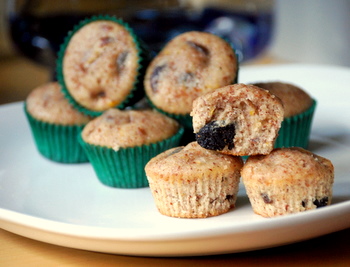
  • Brandied Fruitcake Friands

    Brandied Fruitcake Friands

    Fruitcake isn’t for everyone, even if you like all the individual components that go into a batch of the dense, spicy holiday cake. It’s heavy and filling – something that you don’t want after a big holiday meal. My solution to the problem is a batch of fruitcake friands. These are definitely not your typical fruit cakes. While they do have dried fruit and a bit of brandy in them, they are soft and tender, with a warm nutty flavor to them. They’re also bite-sized, baked in mini muffin tins, so they aren’t heavy and you can simply pop one or two into your mouth to get a taste of something sweet after even the biggest meal.

    Friands are similar to financiers, small cakes made with quite a bit of ground almonds for flavor and texture. Ground almonds, as well as some flour, make up the moist, rich base of these cakes. They usually have some form of fruit in them, and the fruit nut combination makes the ideal starting point for a riff on fruitcake. I left out the spices that you might find in a more traditional fruitcake so that you could easily taste the nuttiness of the almonds in the finished friands. You can also taste the brandied fruits very well this way.

    To infuse brandy into the dried cherries, cranberries and raisins, combine the dried fruits in a microwave-safe bowl with brandy. Microwave on high for about a minute, then let the mixture sit as it comes to room temperature. The dried fruits soak up the brandy and become plump and even more flavorful. Cranberry juice or apple juice could be used as a non-alcoholic substitute. For a traditional touch, splash the cakes with a bit of extra brandy as they come out of the oven to really emphasize the brandy flavor and give them some of that extra moistness (from brandy or other liquor) that is typical of other fruitcakes.

    Who knows – these might just become a new holiday staple in some households. And I mean that they’ll become a staple on the dessert tray, not that they’ll replace a heavy, old fashioned fruitcake as a keepsake (or a doorstop).

    (more…)

  • Nuance Launches Voice-powered Dragon Search App For iPhone

    nuance1

    Hot on the heels of the launch of their Dragon Dictation app (and a short-lived and mostly overblown privacy scandal), Nuance has just launched a second iPhone application: Dragon Search.

    Heralded by Nuance as the “fast, accurate, and smart way to search online content on your iPhone”, Dragon Search allows iPhone users to search across Google, Yahoo!, Bing, iTunes, Twitter, Wiki, or YouTube by speaking their search terms.

    Dragon Search is powered by the Dragon NaturallySpeaking engine, just as with Nuance’s other offering. If you’re having good luck with Dragon Dictation, you should see similar results here.

    The design of the application is rather clever; while you’re only shown one search engine’s results at a time, you can flip between them on a whim via the carousel at the top. You can search for Dr. Dre’s Wikipedia page, then flip over a few boxes on the carousel to check out Dre’s music videos videos on YouTube.

    Like the Dragon Dictation app, Nuance is saying that the app is available for free for “a limited time”. We’re not sure when they’re planning to bump it up to for-pay, nor the price they’ll charge – but in the meanwhile, you can nab it here for the always-welcome price of free: App Store link.

    Crunch Network: TechCrunch obsessively profiling and reviewing new Internet products and companies


  • Windows Mobile trojan becomes more sophisticated

    mobile-virus Kaspersky has uncovered a new Windows Mobile trojan which is a bit more sophisticated than the run of the mill SMS diallers found in the wild.

    The malware, dubbed Trojan-SMS.WinCE.Sejweek.a, which is commonly found associated with pirated software, downloads an XML file from a website which contains the numbers of premium rate SMS numbers and the frequency at which the expensive ($1 per message) SMS messages will be sent. Due to the variety of SMS numbers being sent to it is less easy to block the money making part of the scheme, making the trojan’s utility that much longer lived.

    Read more about the malware at Viruslist.com here, but bear in mind the software is not self-propagating, and requires the installation of untrusted software, which would commonly be found on forums or warez sites.  The solution is therefore simply to support our developers and only install software from trusted sources.

    Thanks Anders for the tip.

    Share/Bookmark

  • Apple iPhone Ad Voice Guy Ruins Christmas in New Commercial

    The guy from Apple’s “There’s an App for That” series of commercials does a fine, upstanding job, don’t get me wrong. He’s a credit to his profession, in fact, and has become iconically associated with one of the most successful products ever released. But he’s seriously ruining Christmas.

    A new Apple ad in the series features an app-centric take on the classic “12 Days of Christmas” holiday carol, as rendered with uncompromising unmusicality by the voice that smugly informs us about everything there’s an app for. The apps don’t correspond to the actual items described in the original tune, but instead highlight various holiday-time activities.

    Here’s how it breaks down (all links direct to iTunes):

    So all told, that’s $22 for a complete holiday. Is it worth it? Probably not. Actually definitely not. Trust someone who has a whole heap of Christmas-themed apps cluttering up his iTunes library from last year, when the novelty of the device was enough to get me to pay good money for a virtual fireplace I could carry around in my pocket. That said, I wouldn’t object to some gifted apps turning up in my virtual stocking Christmas morning.


  • Book Review: Our Time

    The audiobook reviewed is ‘In Our Time’. I’ve classed it here as an audiobook but it is a collection of several episodes of the BBC Radio 4 series ‘In Our Time’ which examine the life and works of Charles Darwin. This audiobook comes at a significant time given that it is the 150th anniversary of the publication of ‘On the Origin of Species’. Melvyn Bragg interviews several prominent figures including Professor Steve Jones and Darwin biographer James Moore. He covers Darwins early life, then discusses the voyage of the Beagle before looking at the publication of ‘On the Origin of Species’ and finishes with a look at some of the events in Darwin’s later life. Such is the breadth of material covered that I found a vast amount of interest. It becomes evident on learning about Darwin’s life that ‘On the Origin of Species’ was not an insightful flash of genius on Darwin’s part but instead represented the cumulative results of a systematic study of different forms of life. Like Newton, who in his study of the diffraction of light made minute observations, so too did Darwin make the most detailed of observations. Testimony to this is his monograph on the Cirripedia (Barnacles) which was completed before ‘On the Origin of Species’ and which represented Darwin’s efforts to develop expertise on a single species before generalising to all species. This work included an analysis of fossil barnacles and an attempt to create a family tree for the barnacles. He had also worked as an entomologist and took a keen interest in geology. What was also conveyed clearly from the interviews in this audiobook was that Darwin created an elaborate network of many types. He was keen to develop relationships with relevant scientists and also had a global network of specimen collectors whom he corresponded with and he arranged for the transport of specimens through this network. This already suggests an immense drive on Darwin’s part for the study of his subject.

    However there are a number of other features that combine favourably with these. In the interviews special significance is given to his grandfather. His grandfather was Erasmus Darwin, a noted natural philosopher, physician and polymath who had written the book Zoonomia which already hints at evolution. I would argue that were Charles Darwin familiarised early in his life with his grandfather’s impressive work, he would have had ample time to both imitate his grandfather’s approach as well as to consider the profound principles that his grandfather had proposed. Here are a few quotes from Zoonomia (freely available here):-

    In the preface Erasmus begins with

    …A theory founded upon nature, that should bind together the scattered facts of medical knowledge, and converge into one point of view the laws of organic life, would thus on many accounts contribute to the interest of society

    Here Erasmus draws a parallel between animal and plant physiology

    ‘This leads us to a curious enquiry, whether vegetables have ideas of external things? As all our ideas are originally received by our senses,the question may be changed to, whether vegetables possess any organs of sense? Certain it is, that they possess a sense of heat and cold, another of moisture and dryness, and another of light and darkness; for they close their petals occasionally from the presence of cold, moisture, or darkness’

    Here Erasmus although disagreeing with it, draws a parallel between an animal and a machine

    ‘But all those actions of men or animals, that are attended with consciousness, and seem neither to have been directed by their appetites, taught by their experience, nor deduced from observation or tradition, have been referred to the power of instinct. And this power has been explained to be a _divine something_, a kind of inspiration; whilst the poor animal, that possesses it, has been thought little better than _a machine’

    Here Erasmus shows evidence of detailed observations of a non-human primate – the Monkey

    The monkey has a hand well enough adapted for the sense of touch, which contributes to his great facility of imitation; but in taking objects with his hands, as a stick or an apple, he puts his thumb on the same side of them with his fingers, instead of counteracting the pressure of his fingers with it

    Here Erasmus shows a profound knowledge of migratory habits of chaffinches across Europe

    ‘Linnaeus has observed, that in Sweden the female chaffinches quit that country in September, migrating into Holland, and leave their mates behind till their return in spring’

    Here Erasmus discusses imitation (or observational learning as it is now known) across animals and humans

    Not only the greatest part of mankind learn all the common arts of life by imitating others, but brute animals seem capable of acquiring knowledge with greater facility by imitating each other, than by any methods by which we can teach them

    Here Erasmus refers to a ’similar living filament’ from which animals are derived. While this is not what he meant, it is interesting to note that animals are derived from filaments – the strands of DNA that code for the instructions on their construction.

    when we revolve in our minds the great similarity of structure, which obtains in all the warm-blooded animals, as well quadrupeds, birds, and amphibious animals, as in mankind; from the mouse and bat to the elephant and whale; one is led to conclude, that they have alike been produced from a similar living filament

    Here Erasmus hints at ‘perpetual transformations’ which could be thought of as analogous to adaptation

    ‘from their first rudiment, or primordium, to the termination of their lives, all animals undergo perpetual transformations’

    Here Erasmus suggests that the filaments are common to animals and plants and that vegetation would have populated the earth before animals did so.

    Shall we then say that the vegetable living filament was originally different from that of each tribe of animals above described? And that the productive living filament of each of those tribes was different originally from the other? Or, as the earth and ocean were probably peopled with vegetable productions long before the existence of animals; and many families of these animals long before other families of them, shall we conjecture that one and the same kind of living filaments is and has been the cause of all organic life? This idea of the gradual formation and improvement of the animal world accords with the observations of some modern philosophers

    Another feature of Darwin’s life that combines favourably with that previously discussed was his place on the Voyage of the Beagle (see review here). This long voyage across the world must have been a very unique trip during that time and Darwin had secured a position on the Beagle. Charles Darwin’s book on the Voyage of the Beagle targetted at a general audience sold immediately on publication while the popularity of ‘On the Origin of Species’ speaks for itself. Thus Darwin by the time of his publication of ‘On the Origin of Species’ had already developed an audience that was interested in his work and this was useful in the dissemination of his theory. In comparison, Freud’s ‘Interpretation of Dreams’ (see review here) sold relatively few copies when it was first published. Darwin was also awarded the gold medal by the Royal Society on his return from the Voyage of the Beagle. From this audiobook, I was also surprised to find that Darwin is credited with the earliest research into hormones – plant hormones known as auxins which preceded the discovery of animal hormones by many decades. For this alone, it was argued that this would be sufficient to guarantee Darwin a place of significance. The series also looks at other aspects of Darwin’s life outside of his work.

    After listening to this audiobook, it was tempting for me to speculate that Darwin’s work ‘On the Origin of Species’ (when he was aged 50) was contingent on the work of Erasmus Darwin culminating in Zoonomia (when he was aged 65) and that their combined age for the publication of both books was 115 years. This suggested to me that in both men there was a long term vision or even a considerable determination to pursue their work. They also exhibited an ability to gather a wide variety of data from across the world and to synthesise this information according to underlying principles.

    In conclusion I found this production of ‘In Our Time’ useful and interesting as it contained a number of interviews with relevant specialists and these interviews conveyed a sense of Darwin’s work, the time in which he lived and the impact that his work has had.

    References

    Melvyn Bragg. In Our Time. Hodder Headline Limited. 2009.

    Twitter

    You can follow ‘The Amazing World of Psychiatry’ Twitter by clicking on this link

    Podcast

    You can listen to this post on Odiogo by clicking on this link (there may be a small delay between publishing of the blog article and the availability of the podcast).

    TAWOP Channel

    You can follow the TAWOP Channel on YouTube by clicking on this link

    Responses

    If you have any comments, you can leave them below or alternatively e-mail [email protected]

    Disclaimer

    The comments made here represent the opinions of the author and do not represent the profession or any body/organisation. The comments made here are not meant as a source of medical advice and those seeking medical advice are advised to consult with their own doctor. The author is not responsible for the contents of any external sites that are linked to in this blog.