Blog

  • Kitum Cave

    Kenya, Africa | Geological Oddities

    When the Kitum cave was first discovered the many marks, scratches and furrows along its walls were assumed to have been the work of picks wielded by ancient Egyptians searching for gold or diamonds. In fact, the excavated sections of the cave are the result of something altogether much stranger.

    The Kitum cave is found on Mount Elgon, an extinct shield volcano and the cave itself developed as the result of cooling volcanic rock. The cave which extends some 600 feet into the mountain has walls covered in salt, and it is here that the mysterious cave diggers reveal themselves.

    Each night for hundreds (possibly thousands) of years animals have traveled into the cave in the dead of night to use it as a giant salt lick. Buffaloes, antelope, leopards, hyenas, and most of all elephants bumble blindly through the cave (the elephants often bump their heads in the process) making their way to the salty walls of the cave. It is the elephants that have done the digging.

    Using their massive tusks they scrape the the salt, the elephants pull off chunks of the walls to crush and lick up the salt. Over the centuries this has resulted in a noticeable increase in the size of the cave and walls covered in tusk marks. The trip to the cave is not without dangers and there is a deep crevasse into which many younger, more inexperienced elephants have fallen leaving behind an elephant graveyard.

    The Kitum cave is more recently famous for a very different sort of lifeform, a deadly virus. In 1980 and again in 1987 visitors to the cave contracted Marburg virus, a deadly virus very similar to Ebola. The cave and Marburg virus rose to notoriety when it was featured in bestseller “The Hot Zone.” It is believed that the bats in the cave may carry the virus and that their powered guano may act as the disease vector.

  • REPORT: Honda finally approves a second act for the Element

    Filed under: ,

    2010 dog-friendly Honda Element – click above for high-res image gallery

    In spite of being functionally outstanding, Honda‘s odd looking Element crossover has never lived up to sales expectations. The funky box never approached the initial sales target of 75,000 units a year, and this year it’s on track for barely more than 15,000 sales. Despite its relative commercial failure, Honda has reportedly given the green light to a second generation model. Despite a couple of modest freshenings, the Element is already seven years into its life cycle – considerably longer than typical for a Japanese branded model.

    Given the slow sales, why would Honda bother with a new iteration? Honda’s executive vice-president, John Mendel, has informed Automotive News that virtually all Element sales are incremental. The Element shares its platform with the much higher volume CR-V, but apparently almost no buyers cross-shop the two vehicles – Element buyers have no interest in the CR-V and vice-versa. If Honda does proceed with a new model, perhaps unique features like the recently introduced dog friendly package will be the key to increased differentiation and success.

    [Source: Automotive News – sub req’d]

    REPORT: Honda finally approves a second act for the Element originally appeared on Autoblog on Mon, 14 Dec 2009 14:01:00 EST. Please see our terms for use of feeds.

    Permalink | Email this | Comments

  • Sony starts talking about PSN fees again

    This isn’t the first time Sony folks have talked about possible PlayStation Network fees. Last time, Kaz Hirai was quick to reassure PS3 owners that current PSN services

  • The Turtle Trader Cashes In On America’s Financial Angst

    tt

    The Turtle Trader Micheal Covel appears to have joined the financial angst gold rush.

    In addition to his blog shown to the right, which always appeared to us like nothing but a giant sales pitch for his Turtle Trader book, he has now also come out with a movie for sale.

    It’s about the crisis, and the trailer doesn’t say much except that we should be confused and outraged.

    We suspect that the secret to turtle trading involves developing additional cash flows around one’s trading activity.

    Join the conversation about this story »

    See Also:

  • C&K Develops Comprehensive Range of Smart Card Connectors

    Compact smart card connectors designed for full size ID1 and SIM/SAM ID000 cards…

    C&K Components has developed a comprehensive range of smart card connectors. Featuring high temperature thermoplastics and compatibility with automatic pick-and-place equipment, the CCM01 and CCM02 Series smart card connectors are designed for full size ID1 cards, while the CCM03 Series connectors are designed for SIM/SAM ID000 cards. The CCM04 Series devices are compatible with both ID1 and SIM/SAM ID000 cards.

    “As a long established supplier of smart card connectors, we have extensive experience matching performance with the need to remain cost sensitive, which is particularly important in consumer electronics applications,” said Jerome Smolinski, senior product manager for C&K Components. “We consider the true cost of the interconnect to be a function not just of price, but also the ease with which the device can be integrated into the customer’s production process and its performance in the field.”

    The smart card connectors are ideal for use in transaction, identification and PoS (point-of-sale) applications, as well as handheld devices and GPS units.

    The CCM01 and CCM02 Series devices feature a sealed, normally open card detection switch and a chamfered opening in the card entry slot to improve the card guidance. Maximum card insertion force is 10N and contact force ranges from 0.25N to 0.5N. Minimum mechanical life for the 8-contact CCM01 Series connector is 100,000 cycles. The 8-contact CCM02 Series connector also features an anti-piracy system and has a minimum mechanical life of 500,000 cycles.

    The compact CCM03 and CCM04 Series smart card connectors are available with 6 or 8 contacts and feature hinged, fixed or auto-locked covers. The CCM03 Series devices exhibit a minimum mechanical life of 10,000 cycles for the hinged cover and 50,000 cycles for the fixed cover. Card insertion force is 1N for the hinged cover and 3N for the fixed cover, while contact force ranges from 0.25N to 0.5N. The CCM04 Series connectors feature a minimum mechanical life of 100,000 cycles. Maximum card insertion force is 10N, and contact force ranges from 0.25N to 0.5N.

  • Food Swapping Article from The Globe and Mail

    Here’s an inspiring article on how people in Vancouver, BC are connecting with others in their community around home-cooked meals. Click here for link to article.

    I made chowder, you made pickles. Let’s trade

    By Wency Leung
    Tuesday, December 8th, 2009

    The concept of preparing large batches of food for exchange is gaining popularity among epicures – and busy parents

    You’ve cooked up a giant pot of Moroccan chickpea and vegetable stew that could feed you for days. It’s healthy, hearty and saves you time and money. The trouble is you’re now stuck eating the whole thing yourself.

    Innovative home cooks have found a solution to that age-old problem of making too much of a good thing: They’re banding together and swapping their creations.

    Food swaps – individuals cooking big batches of certain items and trading portions – have become popular among epicures and busy parents looking for convenience without compromising on nutrition and food quality.

    The concept also encourages participants to try new dishes, challenging their palates and culinary skills, food swappers say.

    Andrea Potter, head chef at Vancouver’s Radha Yoga & Eatery, started food swapping with a friend a couple years ago when she found herself tackling various culinary experiments.

    “I’d be learning how to make bread and sauerkraut and beer and wine and pickles and all of those things,” Ms. Potter said. “It occurred to me, just for practical matters and because I love having homemade food, why don’t I just get really good at making one thing and [my friend] gets really good at making one thing, and we swap?”

    Their idea eventually evolved into monthly gatherings at her friend’s house, where up to 10 people now show up bringing heaps of edibles to exchange.

    Ms. Potter also conducts informal swaps with co-workers and neighbours, trading her sauerkraut and pickles for a weekly supply of homemade granola, bread and fresh juice.

    “I love the fact that instead of going to the store, I get to just go to work or go over to my friend’s house and come back with a loaf of bread,” Ms. Potter said.

    To get around potential discrepancies over the cost of ingredients, Ms. Potter and her fellow food swappers decided each person should trade whatever they felt was the equivalent of a loaf of bread.

    “It’s tricky when you take into account some things take a long time to make, even though they’re inexpensive,” she said.

    Cari Snell, a mother of two in North Vancouver, exchanges entire meals with a friend on a twice-weekly basis.

    “My Monday nights are crazy and her Thursday nights are crazy. So we thought, ‘I’ll double-cook on Thursday night and give it to you and you can double-cook on Monday nights and deliver it to me,’” she said.

    Ms. Snell, who writes food blogs www.CanIGetTheRecipe.com and www.Dinnervibe.com, said she enjoys testing new recipes out on her food swap partner, such as seafood chowder or garlic chicken breasts with grilled asparagus and potatoes.

    And their families are able to save money because the regular swaps force them to plan ahead and buy ingredients in bulk. Cooking a dinner for four adults and four young children can cost as little as $10 in total, she says.

    The concept is gaining popularity among less proficient cooks as well.

    “I actually hate cooking,” said Tracy Schenkers Cross of North Vancouver, who conducts a similar dinner swap with another family. “It’s just nice to have dinner made for you one night a week.”

    She acknowledged there’s been the odd occasion when their concoctions have come out less than perfect. Once, she made an unfortunately mushy Mexican casserole. Another time, her food swap partner called minutes after delivering a meal with an urgent warning not to eat the side of rice.

    “She was like, ‘Don’t give it to the kids. You’ll kill them!’ There was so much sodium in it,” Ms. Schenkers Cross laughs, noting it’s important to swap with like-minded partners who have similar tastes and attitudes toward food. “My friend always says, ‘I don’t care what you put together, as long as I don’t have to do it.’ She doesn’t care that it’s not fine dining or anything.”

    Mass-producing and swapping on a larger scale, adherents of The Big Cook http://www.thebigcook.com, a cookbook written by three mothers in Medicine Hat, often assemble dozens of meals at a time, which they freeze and then trade with each other to be cooked at a later date, co-author Lorelei Thomas said.

    The Big Cook, which provides recipes for preparing and storing meals in mass quantities, has sold more than 33,000 copies across Canada since it was first published in 2006, Ms. Thomas said. She attributed the sales to a renewed interest among families to eat together at home, in spite of their hectic schedules.

    Ms. Thomas’s own freezer contains several months’ worth of nutritious, ready-to-cook meals that have been assembled by friends.

    “A lot of moms are feeling the stress and feeling like, ‘Oh, I’ve got to go through the drive-through again’ or ‘I’ve got to order pizza,’ and they don’t feel good about that,” she said. “The idea of the meal swap is if we can do something better together, do it.”

    Special to The Globe and Mail

  • Desperate White House Tells Harry Reid To Cut Healthcare Deal With Holdout Lieberman

    Joe Lieberman

    Barack Obama is not going to let pesky Joe Lieberman get in the way of its healthcare reforming dreams. In fact, it’s going to acquiesce to him.

    If Joe Lieberman had his own idea for how to fix healthcare, he could probably get it passed, because it sounds like Obama is telling Senator Majority Leader Harry Reid to cut any deal it can with the former Democrat VP candidate.

    POLITICO: The White House is encouraging Senate Majority Leader Harry Reid (D-Nev.) to cut a deal with Sen. Joe Lieberman (I-Conn.) and eliminate the proposed Medicare expansion in the health reform bill, according to an official close to the negotiations.


    But Reid is described as so frustrated with Lieberman that he is not ready to sacrifice a key element of the health care bill, and first wants to see the Congressional Budget Office cost analysis of the Medicare buy-in. The analysis is expected early this week.


    “There is a weariness and a lot of frustration that one person is holding up the will of 59 others,” the official said. “There is still too much anger and confusion at one particular senator’s reversal.”

    Basically, they all have humongous egos, and Barack Obama would like them to try setting them aside.

    Join the conversation about this story »

    See Also:

  • Toyota to Sell Plug-In Hybrid with Lithium-ion battery in 2011 TNR.v, CZX.v, WLC.v, LI.v, RM.v, CLQ.v, SQM, FMC, ROC, AVL.to, RES.v, CCE.v, QUC.v, F

    Now we have Toyota in our Lithium camp and it is very important for our Macro View on Micro Caps:
    It is a very important news for our Lithium Demand model. Plug-In Hybrid above is promised in 2010 with Lithium-ion battery, now Toyota announces that new bigger Prius will be with lithium-ion battery in late 2010. Our discussions at Frankfurt Motor Show 2009 now officially confirmed: that all advanced Hybrids and all BEV are using lithium batteries. Salman Partners have recently put an investment Metals Morning Note where they pronounced “Lithium comeback”

    The New York Times:

    By HIROKO TABUCHI
    Published: December 14, 2009
    Toyota Motor said Monday that it planned a widespread release of its plug-in hybrid car in 2011 as the company scrambled to gain the upper hand in an increasingly crowded battle over next-generation “green” technology.
    Kimimasa Mayama/Bloomberg News
    Takeshi Uchiyamada, vice president of Toyota, demonstrated how to charge the battery of the Prius plug-in hybrid in Tokyo on Monday.

    Toyota, the world’s largest automaker, dominates the current generation of gas-electric hybrid vehicles, but it has refrained from rushing lower-emission cars like the plug-in hybrid to market. Instead, Toyota has focused on plans to introduce regular hybrid technology to all its models by 2020.
    But Toyota’s rivals are surging ahead. General Motors plans to build as many as 60,000 Chevrolet Volt plug-in hybrids a year, starting in late 2010. Other automakers, including Ford and Volkswagen, have announced their own plug-in models, and Nissan plans to mass-produce a fully electric car in 2010.
    Toyota is now increasing its pace. “Several tens of thousands” of the plug-in version of its Prius hybrid will go on sale in 2011, the automaker said Monday. A small number of the plug-in models will be available for lease later this month as planned, but those will be limited to government and corporate clients in the United States, Europe and Japan.
    Takeshi Uchiyamada, Toyota’s executive vice president, said in Tokyo that the company was waiting until 2011 to begin sales so it could hear feedback from users during the leasing period. The plug-ins would carry an “affordable” price tag, he said, without giving an estimate. Prices for a regular Prius hybrid with no plug-in function start at $22,400 in the United States.
    The plug-in Prius would be the first from Toyota to use the powerful lithium-ion battery already used by many of its rivals. The car travels 23.4 kilometers, or 14.5 miles, as an electric vehicle on a single charge before a regular gas-electric hybrid system kicks in. It gets an overall mileage of 57 kilometers a liter, or 134 miles per gallon — exceeding the Prius’s 38 kilometers a liter, according to Toyota.
    The plug-in Prius would charge in about 100 minutes and halve the running cost of traveling 30 kilometers in comparison with a regular Prius if recharged at night, when electricity costs are often lower, Toyota said.
    The automaker says it also plans to sell a pure electric “urban commuter” vehicle in 2012 that would run on lithium-ion batteries.
    But Toyota is not a vocal advocate of cars powered primarily by batteries — partly because it first wants to reap the full benefits of its heavy investment in its hybrid technology. Regular hybrid systems are still the company’s main green technology, Toyota executives stress.
    Executives point to a number of constraints for electric vehicles: short range and feeble horsepower, lack of infrastructure like recharging stations, long charging times and the burden the cars could place on the electric grid. All-electric vehicles, in particular, are suitable only for short city runs, they say.
    “We have been working on developing efficient powertrains to be able to use oil as efficiently as possible,” Mr. Uchiyamada told the Associated Press on Monday. “Many hurdles remain for alternative fuels.”
    Industry experts are split on just how quickly the auto industry will shift to regular hybrids and plug-ins — and ultimately to zero-emissions vehicles like pure electric or even fuel cell-powered cars. Much will depend on the price of oil, as well as emissions standards set by governments, they say.
    The uncertainty over the future mix of technologies is forcing carmakers to hedge their bets with various kinds of technology. That means that, for the time being, manufacturers could “struggle to achieve the required scale economies to cover high up-front investment costs,” Clive Wiggins, an auto analyst for Macquarie Bank based in Tokyo, said in a recent note.
    Heavy development costs could weigh on the bottom line of automakers already dealing with the fallout of the global economic crisis. Toyota predicts a loss of ¥200 billion, or $2.26 billion, for the fiscal year ending in March, following a record ¥437 billion loss last year.
    Mr. Wiggins said he was “cautious on the infrastructure constraints and costs involved” with plug-ins and electric vehicles. Eco-friendly vehicles could log sales of 11.2 million units in 2020, or 12 percent of total auto sales, from 0.8 million in 2009, with the majority of those sales coming from regular hybrids, he predicted.
    Others predict that plug-ins and electric vehicles will be “game-changers” that will allow rivals or even newcomers to leapfrog the industry leaders like Toyota.
    The Nissan chief executives, Carlos Ghosn, has said that pure electric cars will make up at least 10 percent of global demand by 2020, assuming oil costs more than $70 a barrel.
    To address some constraints on its electric vehicle, the company is readying a lithium-ion battery that will power a car for 300 kilometers on a single charge, about twice the distance currently possible, Japan’s largest business daily, The Nikkei, reported last month, without identifying its source.
    With a technological leap of that magnitude, and with rising concerns over global warming, consumers could rapidly shift from gasoline cars and hybrids to zero-emissions technology, said Hiroshi Shimizu, an environmental studies professor at Keio University in Tokyo and an electric car advocate.
    ’“When the market decides on what technology will be dominant,” Mr. Shimizu said, “carmakers better be ready, or ready to fall out of the race.”

  • Frutas Exóticas – Sorvinha

    A Sorvinha é encontrada espontaneamente nas florestas da Amazônia Central, em meio à floresta densa de matas virgens, em terrenos alagados ou de terras firmes. Algumas variedades são espontâneas nos campos ou campinas e em matas secundárias, sendo frequentemente cultivadas nos arredores de Manaus, em sítios e pomares. Sua altura  é variável; em áreas abertas cresce até 12m e na floresta chega a atingir 20m.

    Seus frutos – novembro a fevereiro – são pequenas bagas  que podem ser consumidas ao natural. São colhidos da árvore quando quase maduros, sendo muito comum encontrá-los a venda nas ruas de Manaus e nas margens das estradas ao redor da cidade. Sua polpa mucilaginosa e doce, também pode ser usaada para sorvetes, sucos e cremes.

    Do tronco das sorveiras, especialmente das espécies Couma macrocarga (sorva-grande) e Couma utilis (sorva-pequena), é possível extrair boas quantidades de um látex espesso, branco e viscoso, que é comestível e de paladar adocicado. Esse látex pode ser ingerido puro, porém sempre diluído em água. Dessa forma, é usado como bebida em substituição ao leite de vaca, acrescido de café ou, ainda, como ingrediente no preparo de mingaus2

    Algumas tribos da amazonia utilizam a mistura do látex da sorvinha com banana para combater a diarréia; outros usam o látex com óleo de rícino para combater verminoses. Um outro uso do látex que a planta fornece é para calafetar canoas e embarcações, bem como para caiação das palafitas.

    Fontes de pesquisa: 1– http://www.scielo.br/scielo.php?pid=S0102-33062003000400007&script=sci_arttext; 2 – http://www.seed.pr.gov.br/portals/portal/usp/primeiro_trimestre/imagens/Frutas/sorva.html


  • Climate Bonds Initiative launched: fast-track solution to low-carbon economy (media release)

    Media Release | Climate Bonds Initiative | PASS IT ON!

    CLIMATE BONDS: FAST-TRACK SOLUTION TO LOW-CARBON ECONOMY

    Copenhagen 14 Dec 2009: The global bond market could play a central role in the fight against climate change, according to an international think tank.

    Today the international Network for Sustainable Financial Markets launched the Climate Bonds Initiative, designed to foster the use of long-term debt to finance a rapid, global transition to low-carbon economy. The Climate Bonds Initiative is operating as an autonomous project supported the Carbon Disclosure Project.

    While the talks in Copenhagen have been holding everyone’s attention, the role of private finance in what will be the biggest economic transformation in history — estimated in one recent report to be more than three times the size of the whole industrial revolution — is a side issue.

    According to a number of recent reports a trillion dollars a year of investment has to flow into low-carbon industries if tipping points for runaway climate change are to be averted. The Initiative aims to encourage that investment.

    Climate Bonds Initiative Advisory Panel members include James Cameron, Vice Chair of Climate Change Capital, Nick Robins, HSBC Climate Change Centre of Excellence, and Jeremy Leggett of Solarcentury.

    Mr Robins said: “Putting the emphasis on private financing allows a different perspective. In place of always talking about the ‘costs’ of climate change, we can talk instead about investment opportunities.”

    “Bonds will be an important source of finance for action on climate change. The Climate Bonds Initiative provides a welcome platform to investigate the policy and market framework that will simultaneously raise capital for low carbon solutions and provide attractive risk adjusted returns for investors’.

    Mr Cameron said: “Bonds have allowed us to finance the building of Europe’s sewer systems, the growth of America’s highway system, and the financing of two World Wars. We can now use Climate Bonds to finance the quick, global transition required to head off runaway climate change.”

    He added: “The transition to a low-carbon economy presents capital with what is likely to become the largest commercial opportunity of our time: investing in clean energy and low carbon infrastructure.”

    Climate Bonds Initiative convenor, Sean Kidney, said there were three work streams for the project: “We are developing policy models and advice for governments and corporations, developing agreed definitions and standards for Climate Bonds, and helping countries develop proof-of-concept projects and bond issues.”

    “Globally, there is no shortage of funding; for example, there is some $120 trillion being managed by institutional investors. In the wash-up of the financial crisis, fund managers the world over are re-weighting their portfolios towards fixed interest debt. But most of the bonds on offer lock institutional investors into the carbon-intensive economy.”

    “Discussion with institutional investors such as pension funds has found a large appetite for bond investments related to climate mitigation projects – as long as they first meet accepted risk ratings and rates of return. Many of funds face pressures from their stakeholder groups – governments, public servants, etc – to both deliver solid returns over the long term and to help address climate change with their investments.”

    The past year has seen green bonds from the World Bank and Climate Awareness bonds from the European Investment Bank. If the Climate Bonds Initiative has its way we will see an explosive growth in what are being called “green debt capital markets”.

    See the Climate Bonds backgrounder’:
    http://climatebonds.net/wp-content/uploads/2009/12/climate_bonds_4pager_14Dec09.pdf

    www.climatebonds.net

  • Hussman: Stocks Are “Decidedly” Speculative At These Levels

    Interesting comments from John Hussman, who remains very skeptical of the rally:

    The S&P 500 is currently priced to deliver total returns averaging about 6.1% annually over the coming decade, even assuming that the future trajectory of S&P 500 earnings continues to obey the long-term peak-to-peak growth channel that has characterized earnings for most of the past century. Notably, that 6.1% annual projected return was equaled at the market peaks of the 1960’s, early 1970’s and at the 1987 peak.  Lower prospective 10-year returns were only observed during the late 1990’s, which have been followed, not surprisingly, by 10-year returns lower than 6.1% annually. When stocks are overvalued, one does not get to have his cake and eat it too, without getting indigestion later.

    We generally present valuations from the standpoint of earnings, applying a wide range of historically consistent terminal P/E multiples to mid-channel earnings 10 years hence, projected using the very well behaved historical growth channel for S&P 500 earnings across economic cycles. Of course, we can also analyze valuations from the standpoint of the discounted cash flows that are likely to be delivered to investors over time. These include our variant of the Barsky-DeLong model (presented in Don’t Discount Discounted Dividends, and the realized payout model that I presented in The S&P 500 as a Stream of Payments.  

    The following charts update where valuations stand from a discounted payout perspective.

    The Barsky-DeLong model is the most charitable and optimistic. That approach assumes that stocks have gradually become less risky as the economy has developed, and therefore deserve higher valuations over time. Thus, although stocks were priced to deliver a real, after-inflation return of 7% annually early in the century, the Barsky-DeLong model would currently be happy with long-term real returns of just 4.2% annually. Of course, lower required returns imply higher equilibrium valuations. On the basis of that 4.2% annual real return target, the appropriate index level for the S&P 500 would currently be about 810. Again, this is the most charitable model. The red line below tracks the actual S&P 500 index. The blue line is our version of Barsky-DeLong. Given that current index levels are well above those implied by the model, the conclusion is not that stocks must decline immediately, but rather, that long-term total returns for the S&P 500 are likely to be less than 4.2% after inflation.

    chart

    Read the whole post >>

    Join the conversation about this story »

    See Also:

  • More Charts The Record Labels Don’t Want You To See: Swedish Musicians Making More Money

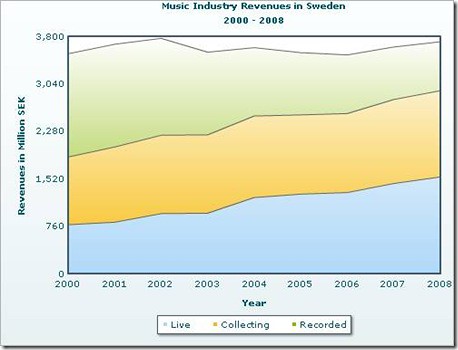
    We’ve already discussed the research on the UK music industry that shows both that live revenue is more than making up the decline in recorded revenue and that musicians themselves are making more revenue than ever before. Some people have suggested that this is a UK-only phenomenon, but a worldwide study found the same thing as well. And, now it looks like the same is being found in Sweden as well — home of The Pirate Bay, which we keep being told is destroying the industry. Swedish indie record label owner Martin sends in the news on data from the Swedish music industry, which looks quite similar to the UK data. First, it shows that while there was a tiny dip in overall revenue, it’s back up to being close to it’s high, mostly because of a big growth in live music:


    Chart by Daniel Johansson


    Basically, recorded revenues dropped. Collections stayed about the same, but live grew. More importantly, though, is the second chart, which shows the revenue for actual musicians. And that’s going in one direction: up.


    Chart by Daniel Johansson


    And yet, The Pirate Bay is destroying the ability to make music, right? Funny that the numbers don’t seem to support that at all. Basically, these charts are showing the same thing that those other studies have shown. More music is being created. There is greater “discovery” of new music. There are greater revenue opportunities for musicians, and the only part of the business that appears to be suffering is the part that involves selling plastic discs. Yes, that sucks if your business was based on selling plastic discs, but for those who can adapt and adjust, there is more money than ever before to be made. That sorta goes against the claims that “piracy” is somehow destroying the industry, doesn’t it?

    Permalink | Comments | Email This Story


  • Happy Hanukkah, Smelly Latke-leh

    Our friends over at Brick Undergound have written a funny piece called Out, damned latke! about the problem potato pancake-makers face this time of year – how to remove the heavy odors left behind as a result of their preparation.

    Read the full post at Apartment Therapy

    Read Full Post


  • The Technological Touch Screen Oven By Barazza

    Touch screens are all the rage right now. It seems that they will be also appearing on appliances.

    This latest oven by Barazza features one as well. Are they worth it?

    Read the full post at Unplggd

    Read Full Post


  • Ask Dr. Richard K. Bernstein Free Live Webcast – Author of Diabetes Solution

    Richard K. Bernstein, MD, Author of the best selling books-Diabetes Solution and Diabetes Diet has monthly free webcasts and teleconference calls every month. You can listen via the web or phone and ask your questions to Dr. Bernstein.
    If you are interested there is a call and live webcast Tuesday December 22nd at 7PM CST.
    Dr. Bernstein’s philosophy is every patient with diabetes is entitled to the same blood sugars as a person without diabetes.
    If you would like to read more about him or register for the free webcast or call, or just ask a question just go to and click on Ask Dr. Bernstein.

    This month he will also be giving out information on Aspirin and Diabetes.

    The calls are very informative with Dr. Bernstein answering 35-45 questions on each webcast. The calls and webcasts are not commericals and Dr. Bernstein does not have anything to sell, except educating people with diabetes on how to normalize their blood sugars and prevent the complications.

  • Seed company marketing and competition scrutiny continues

    AP INVESTIGATION: Monsanto seed biz role revealed
    By CHRISTOPHER LEONARD (AP) – The Olympian
    In this item from ST. LOUIS, competition in the seed maket is put under scrutiny. It says that confidential contracts detailing Monsanto Co.’s business practices reveal how the world’s biggest seed developer is squeezing competitors, controlling smaller seed companies and protecting its dominance over the multibillion-dollar market for genetically altered crops, an Associated Press investigation has found…

    The item reports that Monsanto’s business strategies and licensing agreements are being investigated by the U.S. Department of Justice and at least two state attorneys general, who are trying to determine if the practices violate U.S. antitrust laws. The practices also are at the heart of civil antitrust suits filed against Monsanto by its competitors, including a 2004 suit filed by Syngenta AG that was settled with an agreement and ongoing litigation filed this summer by DuPont in response to a Monsanto lawsuit.

    The suburban St. Louis-based agricultural giant said it’s done nothing wrong.
    “We do not believe there is any merit to allegations about our licensing agreement or the terms within,” said Monsanto spokesman Lee Quarles. He said he couldn’t comment on many specific provisions of the agreements because they are confidential and the subject of ongoing litigation…

    Follow up:

    The Monsanto Company have this response
     

  • COP-15 Day 8: Chaos in Copenhagen

    The Bella Center is hot, crowded and beyond its capacity.  Lines are hours long to even enter the building.  Security is tightening up.  Around the city, Copenhagen is ground zero for climate change this week as there are countless business events, protests, and conferences all day and night.

    Negotiations were suspended as G77 nations, led by African delegates in this instance, walked out.  Their desire is a continuation of the Kyoto Protocol and pushing developed countries for bigger carbon cuts and international climate finance.  Speculation is that this action is about negotiation theatrics to raise the stakes in Week 2 and they will come back to the table soon.  Informal negotiations took place over the weekend in an upscale warehouse district of Copenhagen that were reported to be positive, so the latest G77 action caught some delegates by surprise.


    The Chair’s text was released to set the stage for the final week of negotiations.  This proposed text is supposed to be the basis for negotiations this week. 

    The negotiations appear to be heading towards the following elements:

    1. Political agreement, not a legal agreement.  From a US perspective, this allows President Obama to continue to work for political support domestically, and not get too far out ahead of the Senate. 
       
    2. The new agreement would bring all countries into the fold (unlike Kyoto where several large emitters were left out).  Developed countries will need to set mid-term targets for 2020.  Larger developing countries will need to agree on deviations from business as usual in their own emissions.
       
    3. A fast action fund for 2010 to 2012 in the 10 billion to 12 billion range for mitigation (technology and REDD) and adaptation.  There is some discussion of a fund out to 2030 being agreed upon here but it remains to be seen where the US, EU and other key players are on that issue.  The fund to 2020 or 2030 for $30-$40 billion is being advanced by Mexico and Norway. 
       
    4. A sticking point will be agreement upon a framework ensuring that commitments made by all sides are easily monitored, verified and reported.  Again, in a US context, it will be difficult for the Administration to sell a deal to the Senate if it lacks mechanisms to force transparency on Chinese actions to reduce carbon.

  • 10 Green Gifts for the Cook

    Some kitchen gifts on this list are green because of what they’re made of, others because of their long lifespans. One thing’s for sure: whether you’re shopping for a culinary pro or an amateur home chef, these green gifts will be welcome additions to their kitchens. Here’s a list of kitchen goodies that make the cook’s life easier and greener.

    Read the full post at Re-Nest

    Read Full Post


  • Solar Cell Efficiency Funding Challenge

    Latest round of funding will support basic research that may yield a solar cell efficiency breakthrough. …

    … “Bocian cites lack of funding for basic research as the reason why today’s solar cells have only 6-11 percent energy efficiency. But there is hope in Congress’s recent approval of funding for PARC and 45 similar Energy Frontier Research Centers (EFRCs) through the Department of Energy. ” …

    Via UC Riverside: $1 million to study light-harvesting compounds

    The Dept of Energy support a portfolio of research centers focused on renewable energy. …

    Energy Frontier Research Centers: “he 46 EFRCs, which are to be funded at $2–5 million per year each for a planned initial five-year period, were selected from a pool of some 260 applications received in response to a solicitation issued in 2008 by the U.S. Department of Energy (DOE), Office of Science. ”

  • Twist: Espresso To-Go

    We’re regulars at our local coffee shop and maybe we shouldn’t admit this, but we really can’t live without our espresso. We take it straight up, or as a red eye. Unfortunately, those daily trips to the cafe are taking their toll on our bank account.

    Read the full post at Unplggd

    Read Full Post