Blog

  • Very Berry Holiday Tree

    This season, when creating holiday crafts and centerpieces, make them edible! This Very Berry Holiday Tree was created by cookbook author Tish Boyle. You can make it in under an hour and it’s a fabulous alternative to a floral centerpiece. The tree uses fresh Driscoll strawberries and mint.

    Image: Tish Boyle

    Image: Tish Boyle

    Makes one table centerpiece

    Special equipment:

    • 1 floral foam or green styrofoam cone (measuring 4-5 inches in diameter at the base and 12 inches high)
    • 1 box of toothpicks

    Supplies:

    • 4 one pound containers of fresh Driscoll strawberries
    • 1 bunch fresh mint
    • 1 slice from a carambola fruit (also known as star fruit)*

    *Note: If you can’t find a carambola, you can use a 1-inch star-shaped cookie cutter to cut out a star shape from a mango slice instead.

    Directions:

    1. Wash the strawberries and blot them dry with paper towels. Pull off the green stem from each strawberry. Reserve a perfect strawberry for the top of the ‘tree’.

    2. Push a toothpick halfway into the side of the cone, about 1/2 inch from the bottom edge. Secure a strawberry to the toothpick, piercing it through the stem end. Secure another strawberry right next to the first one. Continue securing strawberries to the cone in circular rows up to its top, covering the cone completely. Secure the reserved strawberry to the top of the tree.

    3. Remove some mint leaves from the bunch of mint and tuck them between the berries, placing them at about 3-inch intervals.

    4. Secure the star-shaped carambola or mango slice to the top of the cone using a toothpick.

    About Tish Boyle
    Tish Boyle is editor in chief of Chocolatier and Pastry Art & Design magazines. A graduate of Smith College and La Varenne Ecole de Cuisine in Paris, she has been a caterer, pastry chef, and food stylist. She is the author of The Good Cookie and Diner Desserts, and coauthor of Simply Sensational Desserts (IACP Award Winner), Chocolate Passion, and the Grand Finales series of books.

    Post from: Blisstree

    Very Berry Holiday Tree

  • Life: Obesity in America, Black Friday, Social Strata in Dubai, John Mauldin is Optimistic

    Bill-Coppedge original content selection by MortgageNewsClips.com


    surlyobesity surly-trader

    Obesity in America – Given that the gluttony of Thanksgiving has just ended, I think it is fitting to address the obesity epidemic in America and its financial impact on our economy. – … Obesity related health conditions will make up 21% of total health care spending in 2018, or $1,425 per person every year.   … – Surly Trader

    ————

    national-retail-federation

    Black Friday Verdict: As Expected, Number Of Shoppers Up, Average Spending Down – press release and survey resultsNational Retail Federation

    ————

    nick-gogerty

    great read – fascinating look at Social Strata in Dubai – Dubai is a lot like the bar in the first star wars film crossed with an American Shopping mall … – Nick Gogerty – Desinging Better Futures

    ————

    johnmauldin09 johnm-frontline

    Why I am an Optimist – John Mauldin’s Weekly E-Letter
    Subprime Dubai
    More Government Data Fun:
    Unemployment Claims Were Not Down
    Why I Am Optimistic About the Future
    The Millennium Wave

  • Lawsuit Demands Answers About Social-Networking Surveillance

    San Francisco – The Electronic Frontier Foundation (EFF), working with the Samuelson Law, Technology, and Public Policy Clinic at the University of California, Berkeley, School of Law (Samuelson Clinic), filed suit today against a half-dozen government agencies for refusing to disclose their policies for using social networking sites for investigations, data-collection, and surveillance.

    Recent news reports have publicized the government’s use of social networking data as evidence in various investigations, and Congress is currently considering several pieces of legislation that may increase protections for consumers who use social-networking websites and other online tools. In response, the Samuelson Clinic made over a dozen Freedom of Information Act (FOIA) requests on behalf of EFF to the Central Intelligence Agency, the Department of Justice, the Department of Homeland Security, and other agencies, asking for information about how the government collects and uses this sensitive information.

    “Millions of people use social networking sites like Facebook every day, disclosing lots of information about their private lives,” said James Tucker, a student working with EFF through the Samuelson Clinic. “As Congress debates new privacy laws covering sites like Facebook, lawmakers and voters alike need to know how the government is already using this data and what is at stake.”

    When several agencies did not respond to the FOIA requests, the Samuelson Clinic filed suit on behalf of EFF. The lawsuit demands immediate processing and release of all records concerning policies for the use of social networking sites in government investigations.

    “Internet users deserve to know what information is collected, under what circumstances, and who has access to it,” said Shane Witnov, a law student also working on the case. “These agencies need to abide by the law and release their records on social networking surveillance.”

    For the full complaint:
    http://www.eff.org/files/filenode/social_network/social_networking_FOIA_…

    Contacts:

    Marcia Hofmann
    Staff Attorney
    Electronic Frontier Foundation
    [email protected]

    Shane Witnov
    Law student
    Samuelson Law, Technology, and Public Policy Clinic
    [email protected]

  • Smuckers PlateScapers Vanilla, reviewed

    Smuckers Plate Decorator

    A few years ago, there was a dessert plate-garnishing craze in restaurants. Whipped cream, chocolate swirls, caramel shards, confectioners sugar and coulis in a dozen different flavors were heaped onto plates to the point where they almost obscured the actual dessert! Fortunately, there has been a big scaling back and now plate garnishes tend to be limited to things that actually complement the flavor of the dessert and its presentation. This is great because it’s fun to garnish a dessert plate as long you don’t need a hundred flavors of coulis to do it. All you really need are a few simple flavors tp fall back on that work well with many desserts.

    I recently tried Smuckers PlateScapers as a way to add a little flair – with very little effort – to dessert. The PlateScapers come in five flavors: Caramel, Chocolate, Raspberry, Vanilla and Chocolate Fudge. They’re described as “dessert toppings” but are packaged in a squeeze bottle that makes it very easy to create swirls, spirals and stripes. I picked up Vanilla because it seemed like the flavor that would be the most difficult to whip up on very short notice. It tastes a lot like vanilla pudding with a hint of cake batter – sweet and with a good vanilla flavor. It’s very easy to use and has a great consistency; it comes out cleanly and has a very minimal amount of spread, so your designs stay put.

    (more…)

  • SquareUp iPhone payment service launched by Twitter co-founder

    SquareUp Receipt

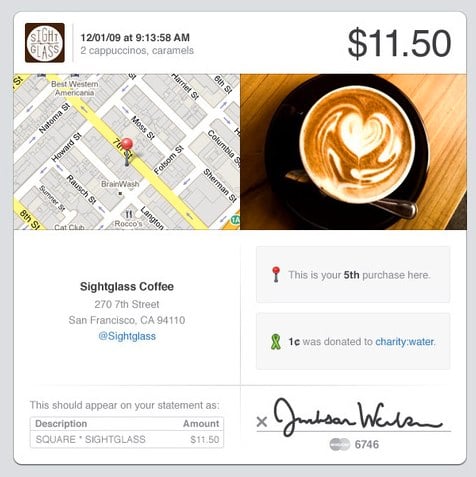
    New iPhone credit card payment service SquareUp has finally been unveiled, and we’ve gotta say, it’s got our attention. The brainchild of Twitter co-founder Jack Dorsey, SquareUp aims to be a simple, sleek, inexpensive, and charitable credit card payment processing service. It works on the and , in conjunction with a credit card reader that plugs in to the audio jack. You get payer verification, receipts that can be sent via email or text message, and receipt signing using your finger. Even cooler, in our opinion, is that Square will donate one penny of every transaction to a charity of the seller’s choice.

    If Square plays their cards right, they will be a force to reckon with in the small business arena. The service is in limited beta right now, but Square says it’ll be fully open in 2010. We’ll see if we can’t get a beta account to give you a better look at how it all works.


    Tags:
    ,
    ,
    ,
    ,
    ,
    ,
    ,
    ,
    ,
    ,
    ,
    ,
    ,
    ,
    ,
    ,

    SquareUp iPhone payment service launched by Twitter co-founder originally appeared on Gear Live on Tue, December 01, 2009 – 1:51:27


  • Councilmember Bruce Harrell on race and inclusion

    Strongest candidates — regardless of race — will win

    Editor, The Times:

    I enjoyed Bruce Harrell’s well-written guest commentary “The value of inclusiveness” [Opinion, Nov. 28], but as a member of the white (privileged) majority, I take issue with a few points.

    Back in the 1990s I voted for Gary Locke, Norm Rice and Ron Sims and other elected officials of color. Could it be that my vote was cast in favor of the best-qualified candidates?

    In 2008 I voted for President Barack Obama because I hoped he would lead us from where we were. I think he was the stronger candidate. In 2009, I followed the same pattern, and voted for the candidates whom I thought were the most qualified.

    In doing so, I helped vote out a member of my group.

    When Bruce Harrell runs again, I plan to use the same criteria and vote for the person who fits my definition as the strongest candidate. I hope it’s Harrell.

    In the meantime, if Harrell speaks for candidates of color I can only provide my formula for bringing back more elected people of color — find and put up the strongest candidates. Good luck in this quest.

    — Larry Granat, Seattle

    Family is the factor in poverty

    Racial inclusion is a laudable goal, but Seattle City Councilmember Bruce Harrell’s approach to the issue troubles me.

    It appears Harrell has bought into the concept of white privilege. This is the idea that white people enjoy unearned social, educational and financial benefits simply by being white, although they may not be individually racist or even be aware of their advantages.

    Some proponents of this theory argue that social justice in America is impossible unless whites acknowledge that they’re part of an oppressive class and that they reject not only racism, but individualism and free enterprise.

    Has racial discrimination disappeared from our society? Unfortunately, no. Are there institutional issues yet to be addressed? Certainly. But I submit that in the 21st century, a far more important factor is the family. There’s a strong association between the percentage of minority kids living in poverty and those living in single-parent households.

    So let’s work to make sure the doors are open equally to everyone. Let’s do what we can to help families become more stable. Let’s emphasize the values of hard work, individual responsibility and education. And let’s reject the silly stuff — like white privilege.

    Trying to lay a guilt trip on any racial group is neither fair nor an effective way to solve our problems.

    — Phillip Johnson, Seattle

  • Marin Headlands Nike Missile Site, Batteries, and Bunkers

    Marin County, California | Subterranean Sites

    You might not expect to find WWII pillboxes, anti-aircraft gun mounts, and missile launch sites among the rolling hills and wetlands of the Marin Headlands, but at one time this was a highly fortified military defensive position.

    The hills overlooking the Golden Gate Bridge are riddled with bunkers, secret tunnels, and batteries designed to protect San Francisco from attack from as early as the Civil War period. On the Marin (North) shore there are three forts and several attack positions.

    Directly overlooking the Golden Gate Bridge, Battery Spencer actually predates the bridge significantly. Started in 1893 and connected to the nearest town by dangerous cliffside roads, the Battery was constructed as part of the overall fortification efforts known as the Endicott Period. President Grover Cleveland with his War Secretary William Endicott set out on a massive building and modernization project at 29 locations around the country, costing some $127 million in construction costs. Battery Spencer was constructed of concrete set into the cliffside and housed three M1888 12″ guns, including one aimed into the harbor mouth, as well as ammunition storage and support buildings. During WWI guns and ammunition were relocated to support the war effort, and in 1943 the remaining guns were scrapped to support that new war effort, effectively ending the life of the battery. Today, the buildings and gun mounts are deserted, but in good repair, painted a drab green, and surrounded by well manicured trails.

    Fort Barry and Bunker Road were also built up during the Endicott Period. There are five seperate batteries that are part of Fort Barry: Battery Mendell, Battery Alexander, Battery Smith-Guthrie, Battery Samuel Rathbone and Battery Patrick O’Rorke. The batteries are well hidden in undergrowth, and features the latest in turn of the century “disappearing carriage” technology, including guns that would raise up to fire, and then lower to a safer reloading position after discharge. These batteries remained active through WWII, upgraded with anti-aircraft weapons.

    Fort Cronkhite and Battery Townsend are more recent additions, built as part of the Harbor Defense initiatives in WWII. Located farther out along the coast, they look out onto the open waters outside the Golden Gate. The fort’s barracks, mass halls and support buildings now house park support staff and other businesses, but are preserved in an original state.

    Up the hill from Fort Cronkhite, Battery Townsend has some of the most impressive buildings. The construction of the batteries was secret, and designed to be hidden from view. Concrete behemoths are dug into the hillside, with only a modest tunnel entrance on one side, but a gaping maw surrounding a gun mount facing the water at the other end. Designed to acommodate two 16-inch caliber guns shooting armor piercing projectiles that reached more than 30 miles out to sea (past the Farallon Islands, visible in the distance), it was the first ever of its kind. Tests of the new guns in 1940 were a success, and plans were made to imitate the design along the coastline.

    The Cold War saw the addition of another super-secret military installation, the Nike Missile Base SF-88. Installed between 1953 and 1979 the anti-aircraft missiles were intended to fend off soviet fighters. It is now the only intact Nike base in the US open to the public.

    All of the forts and batteries can be visited by driving the roads on the Headlands. The paths are maintained and there is good signage, however the weather along the coast can be extremely gusty and/or foggy and the cliffs can be extremely dangerous, so explore with caution.

  • Memorial Stadium at the mercy of Seattle

    School Board lacks integrity

    Integrity. That is what the Seattle School Board lacks if it decides to demolish a memorial — Memorial Stadium — to those who gave their lives in service to our country [“The end for Memorial Stadium?,” page one, Nov. 25]. To replace something built to honor those who gave the last full measure of devotion with parking spaces and grass is dishonorable, reprehensible and wrong.

    May common sense prevail. May the Seattle School Board show some integrity and do the right thing. Show the public that it is better to fix Memorial Stadium, a monument built to honor brave men and women, than it is to demolish it.

    They are not clear where the $206 million to replace it would come from in the midst of a recession, and our soldiers are fighting and dying in two wars. Show us that you care.

    — Mike McHugh, Seattle

    Move the wall of names to some place nicer

    At least one writer seems to feel strongly that a ratty and decaying football field is a glorious memorial to World War II vets [“Do we really need another downtown parking garage?,” Opinion, Northwest Voices, Nov. 29].

    I think it’s kind of an insult.

    The wall with the names could be moved to some place else nice, where some actual respect for these memories obtains. Perhaps Discovery Park? There are many lovely places in Fort Lawton where this would fit in.

    — John Watt, Seattle

    A little history of Memorial Stadium

    As a former Seattleite, I read with interest The Seattle Times story “Seattle Center, schools reach pact to tear down Memorial Stadium” [Seattletimes.com, Local News, Nov. 25].

    The article mentioned former President Harry S. Truman speaking there, and that it is a memorial to the Seattle military lost during World War II.

    Readers might also be interested to know that it was from this stadium that KING-TV broadcast its first live television program of the 1948 Seattle high- school-football championship on Thanksgiving Day.

    It is also interesting to note that most people at that time did not own a TV set, so that aforementioned broadcast was viewed by most people from the windows and display areas of appliance stores.

    — Jim Schiller, Arroyo Grande, Calif.

  • Surveillance Shocker: Sprint Received 8 MILLION Law Enforcement Requests for GPS Location Data in the Past Year

    This October, Chris Soghoian — computer security researcher, oft-times journalist, and current technical consultant for the FTC’s privacy protection office — attended a closed-door conference called “ISS World”. ISS World — the “ISS” is for “Intelligence Support Systems for Lawful Interception, Criminal Investigations and Intelligence Gathering” — is where law enforcement and intelligence agencies consult with telco representatives and surveillance equipment manufacturers about the state of electronic surveillance technology and practice. Armed with a tape recorder, Soghoian went to the conference looking for information about the scope of the government’s surveillance practices in the US. What Soghoian uncovered, as he reported on his blog this morning, is more shocking and frightening than anyone could have ever expected

    At the ISS conference, Soghoian taped astonishing comments by Paul Taylor, Sprint/Nextel’s Manager of Electronic Surveillance. In complaining about the volume of requests that Sprint receives from law enforcement, Taylor noted a shocking number of requests that Sprint had received in the past year for precise GPS (Global Positioning System) location data revealing the location and movements of Sprint’s customers. That number?

    EIGHT MILLION.

    Sprint received over 8 million requests for its customers’ information in the past 13 months. That doesn’t count requests for basic identification and billing information, or wiretapping requests, or requests to monitor who is calling who, or even requests for less-precise location data based on which cell phone towers a cell phone was in contact with. That’s just GPS. And, that’s not including legal requests from civil litigants, or from foreign intelligence investigators. That’s just law enforcement. And, that’s not counting the few other major cell phone carriers like AT&T, Verizon and T-Mobile. That’s just Sprint.

    Here’s what Taylor had to say; the audio clip is here and we are also mirroring a zip file from Soghoian containing other related mp3 recordings and documents.

    [M]y major concern is the volume of requests. We have a lot of things that are automated but that’s just scratching the surface. One of the things, like with our GPS tool. We turned it on the web interface for law enforcement about one year ago last month, and we just passed 8 million requests. So there is no way on earth my team could have handled 8 million requests from law enforcement, just for GPS alone. So the tool has just really caught on fire with law enforcement. They also love that it is extremely inexpensive to operate and easy, so, just the sheer volume of requests they anticipate us automating other features, and I just don’t know how we’ll handle the millions and millions of requests that are going to come in.

    Eight million would have been a shocking number even if it had included every single legal request to every single carrier for every single type of customer information; that Sprint alone received eight million requests just from law enforcement only for GPS data is absolutely mind-boggling. We have long warned that cell phone tracking poses a threat to locational privacy, and EFF has been fighting in the courts for years to ensure that the government only tracks a cell phone’s location when it has a search warrant based on probable case. EFF has also complained before that a dangerous level of secrecy surrounds law enforcement’s communications surveillance practices like a dense fog, and that without stronger laws requiring detailed reporting about how the government is using its surveillance powers, the lack of accountability when it comes to the government’s access to information through third-party phone and Internet service providers will necessarily breed abuse. But we never expected such huge numbers to be lurking in that fog.

    Now that the fact is out that law enforcement is rooting through such vast amounts of location data, it raises profoundly important questions that law enforcement and the telcos must answer:

    • How many innocent Americans have had their cell phone data handed over to law enforcement?
    • How can the government justify obtaining so much information on so many people, and how can the telcos justify handing it over?
    • How did the number get so large? Is the government doing massive dragnet sweeps to identify every single cell phone that was in a particular area at a particular time? Is the government getting location information for entire “communities of interest” by asking not only for their target’s location, but also for the location of every person who talked to the target, and every person who talked to them?
    • Does the number only include requests to track phones in real-time, or does it include requests for historical GPS data, and if so, why did the telcos have that incredibly sensitive data sitting around in the first place? Exactly when and how are they logging their users’ GPS data, and how long are they keeping that data?
    • What legal process was used to obtain this information? Search warrants? Other court orders? Mere subpoenas issued by prosecutors without any court involvement? How many times was this information handed over without any legal process at all, based on government claims of an urgent emergency situation?
    • Looking beyond Sprint and GPS, how many Americans have had their private communications data handed over to law enforcement by their phone and Internet service providers?
    • What exactly has the government done with all of that information? Is it all sitting in an FBI database somewhere?
    • Do you really think that this Orwellian level of surveillance is consistent with a free society and American values? Really?

    These questions urgently need to be asked — by journalists, and civil liberties groups like EFF, and by every cell phone user and citizen concerned about privacy. Most importantly, though, they must be asked by Congress, which has failed in its duty to provide oversight and accountability when it comes to law enforcement surveillance. Congress should hold hearings as soon as possible to demand answers from the government and the telcos under oath, and clear the fog so that the American people will finally have an accurate picture of just how far the government has reached into the private particulars of their digital lives.

    Even without hearings, though, the need for Congress to update the law is clear. At the very least, Congress absolutely must stem the government’s abuse of its power by:

    • Requiring detailed reporting about law enforcement’s access to communications data using the Electronic Communications Privacy Act (ECPA), just as it already requires for law enforcement wiretapping under the Wiretap Act, and make sure that the government actually fulfills its obligations rather than ignore the law for years on end.
    • Requiring that the government “minimize” the communications data it collects under ECPA rather than keep it all forever, just like it is supposed to do with wiretaps.
    • Prohibiting the government from using in a criminal trial any electronic communications content or data that it obtains in violation of ECPA, just as the government is prohibited by the Wiretap Act from using illegally acquired telephone intercepts.
    • Clarifying that ECPA can only be used to get specific data about particular individuals and cannot be used for broad sweeps, whether to identify everyone in a particular geographic area or to identify every person that visits a particular web site.

    It’s time for Congress to pull the curtain back on the vast, shadowy world of law enforcement surveillance and shine a light on these abuses. In the meantime, we give our thanks to those like Chris Soghoian who are doing important work to uncover the truth about government spying in America.

    UPDATE: Sprint has responded to Soghoian’s report:

    The comments made by a Sprint corporate security officer during a recent conference have been taken out of context by this blogger. Specifically, the “8 million” figure, which the blogger highlights in his email and blog post, has been grossly misrepresented. The figure does not represent the number of customers whose location information was provided to law enforcement, as this blogger suggests.

    Instead, the figure represents the number of individual “pings” for specific location information, made to the Sprint network as part of a series of law enforcement investigations and public safety assistance requests during the past year. It’s critical to note that a single case or investigation may generate thousands of individual pings to the network as the law enforcement or public safety agency attempts to track or locate an individual.

    Instances where law enforcement agencies seek customer location information include exigent or emergency circumstances such as Amber Alert events, criminal investigations, or cases where a Sprint customer consents to sharing location information.

    Sprint takes our customers’ privacy extremely seriously and all law enforcement and public safety requests for customer location information are processed in accordance with applicable state and federal laws.

    This response provides some important answers, while raising even more questions. First off, Sprint has confirmed that it received 8 million requests, while denying a charge that no one has made: that 8 million individual customers’ data was handed over. Sprint’s denial also begs the question: how many individual customers have been affected?

    As for Sprint’s claim that in some instances a single case or investigation may generate thousands of location “pings”, that is certainly possible, but that doesn’t make the 8 million number any less of a concern, or moot any of the important questions raised by Soghoian in his report or by EFF in its post regarding the lack of effective oversight and transparency in this area.

    Even assuming that Sprint’s statement about “pings” is true, 8 million — or, in other words, 8,000 thousands — is still an astronomical number and more than enough to raise serious concerns that Congress should investigate and address. Moreover, the statement raises additional questions: exactly what legal process is being used to authorize the multiple-ping surveillance over time that Sprint is cooperating in? Is Sprint demanding search warrants in those cases? How secure is this automated interface that law enforcement is using to “ping” for GPS data? How does Sprint insure that only law enforcement has access to that data, and only when they have appropriate legal process? How many times has Sprint disclosed information in “exigent or emergency circumstances” without any legal process at all? And most worrisome and intriguing: what customers does Sprint think have “consent[ed] to the sharing [of] location data” with the government? Does Sprint think it is free to hand over the information of anyone who has turned on their GPS functionality and shared information with Sprint for location-based services? Or even the data of anyone who has agreed to their terms of service? What exactly are they talking about?

    These questions are only the beginning, and Sprint’s statement doesn’t come close to answering all of them. Of course, we appreciate that Sprint has begun a public dialogue about this issue. But this should be only the beginning of that discussion, not the end. Ultimately, the need for Congress to investigate the true scope of law enforcement’s communications surveillance practices remains. Congress can and should dig deeper to get the hard facts for the American people, rather than forcing us to rely solely on Sprint’s public relations office for information on these critical privacy issues.

  • BREAKING: GM CEO Fritz Henderson steps down

    Filed under: ,

    Well, that was quick. Fritz Henderson, the recently appointed CEO of General Motors, is stepping down. Company chairman of the board Ed Whitacre (remember the “Satisfaction Guaranteed” commercials, that’s the guy) is set to act as the interim CEO until a permanent replacement is found.

    This marks the second CEO that beleaguered automaker General Motors has lost this year, the first being Rick Wagoner, who was asked to resign by the Obama Administration’s Task Force for Autos. Over the last few months, deals that GM had made to offload Opel, Saturn and Saab have all fallen through, and some have reported on clashing styles between Whitacre and Henderson.

    General Motors has just confirmed the news via a press conference being held as we speak. Stay tuned for more as we learn it.

    UPDATE: Official Statement from Ed Whitacre, GM’s new interim CEO, added after the jump.

    [Source: Free Press, GM | Image: Philippe Lopez/Getty]

    Continue reading BREAKING: GM CEO Fritz Henderson steps down

    BREAKING: GM CEO Fritz Henderson steps down originally appeared on Autoblog on Tue, 01 Dec 2009 16:45:00 EST. Please see our terms for use of feeds.

    Read | Permalink | Email this | Comments

  • Pat Robertson is at it again

    I know what the Bible, Quran really teach

    It was nice to read “I missed that verse” by Wendy Fosnight Dymoke [Opinion, Northwest Voices, Nov. 25] who had the courage to speak the truth about Pat Robertson [“In military, Muslims speak out,” News, Nov. 12].

    People like him, who have no knowledge about Islam, get on the TV and spread hatred. Isn’t he the same guy who, a couple of years back, told us let’s kill Venezuela’s Hugo Chávez? Based on the Bible that I have studied, I am sure his advice to kill was against the teaching of Jesus, and now slandering another faith is not advised by the Bible either.

    The violent Muslims, and Robertson promoting violence, are chips off the same block as they have no clue what Islam really is. King Ferdinand and Queen Isabella of Spain, Crusaders and Hitler used the name of Jesus and killed millions of Jews and Muslims. However, the history rightly blames the individuals and no one ever says Christianity is not a faith but a violent political system.

    Robertson is a very confused man and thus ends up misleading innocent people. He should do a favor to himself and his audience; let us meet and let me explain what the Bible and Quran really teach.

    — Yahya Malik, Kent

    Letter missed one important aspect of Islam

    While I quite agree with Wendy Fosnight Dymoke from Bainbridge that Pat Robertson is both a demagogue and a hypocrite, she misses the most important part of understanding Islam.

    It indeed is not just religion, but an all-encompassing set of imperatives that reach into all aspects of life — political, economic and personal.

    The true Muslim believes that Sharia law transcends elected governments and its institutions such as courts and legislatures.

    It is this failure of understanding by most Americans that represents the greatest danger to our institutions and way of life.

    — Howard Phelps, Seattle

  • “Debt Crisis in America” & JCR Advertising are Evil

    I don’t know if you’ve seen the Debt Crisis in America commercials on television or not, but when I saw them, I thought, “This is a whole new level of scummy advertising.” If you haven’t seen them, you can watch two of them here. I can’t decide which one is more scummy. Here are some tactics that I notice right off in these commercials:

    • Imagery of Washington D.C. landmarks including The White House – This gives an aura that this commercial is endorsed by the government when it is not. It’s hard not to see how one could get confused by this.
    • Scrolling News Ticker – This makes it look like a news channel like CNN, CNBC, or Bloomberg. News stations like that are generally considered reputable and typically follow the journalistic principles when reporting information.
    • Special Announcement! – How is that to get your attention?!?! What’s special about this announcement? There is no information in this “announcement” that I don’t see 5 to 10 times a day.
    • Speedy facts and figures – It’s
    • Credit Card and Debt Help Line = 1-800-000-0000 – Ever try dialing that number? Well I’ll get to this later on.
    • Transferring the “News” Coverage to Someone Else – Moving the coverage to another person in the way they do is very much like how the news transfers to a different reporter on the scene.
    • Call to Action – The commercial ends with a strong message that the solution is to call the number below – which seems reputable for all the reasons above.

    You want to know the scummiest part of all this? The actress/fake newsperson asking you to make that call has no connection to the service they are offering. That’s because this commercial isn’t even designed for one specific company. It is made to be re-branded for any and every debt settlement company in the country, whether they are reputable or not. That’s why there is that aforementioned 1-800-000-0000 number. Just check out their sales pitch:

    • Higher percentage of converted calls to Leads
    • Higher percentage of qualified callers
    • Lower cost per in bound unique lead
    • Instant inbound Activity for your sales staff
    • Trackable phone number provided & routed to your location
    • Inbound call analysis completed & e-mailed to you daily
    • Score calls and evaluate sales staff

    It’s pretty clear where their interests lie, isn’t it? If I wanted to buy this commercial and brand it for my company I could. Why should I be worried about these companies just trying to help consumers? Well they aren’t always out to help consumers as you can read on Wikipedia. I don’t really know how to pick a good debt settlement company, but I did find this article which seems like it could have some helpful information. I think the safest way to get out of debt is to go on an extreme savings plan. Cut out or greatly reduce the costs of everything in your life. If you go with that route, I have some tips on how to save money.

    Related posts:

    1. Surprise Honey, I Just Added $60,000 to Our Debt It was really difficult to decide on a title for…
    2. Will Luggage America be Evil? This post is very much a rant. If you don’t…
    3. Finance 101: Good Debt vs. Bad Debt I’m amazed by the number of people who seem to…
    4. Is Now the Time to Take Advantage of the Housing Crisis? The following is a guest post from Rich Credit Debt…
    5. Super Shuttle is Evil! Sometimes customer experience is everything. Actually it almost always is….


  • Sprint Revealed GPS Data To Authorities 8 Million Times In The Last Year [Updated]

    This seems too insane to be true, but the EFF points us to a report, based on a Freedom of Information Act request, that claims Sprint provided law enforcement with GPS location data a staggering 8 million times in the last year. Sprint apparently set up some sort of portal that made such requests easier, and it sounds like law enforcement took advantage of that in a major way. The report also notes that this information should have been disclosed to Congress, under a 1999 law, but the Justice Department has ignored the law for the past five years. The rest of the report also looks at some other concerning factors, such as the fact that the government seems to regularly get all sorts of info from service providers, with little oversight. On top of that, it explains why so many service providers agree to it: they charge the government for such info, and it’s quite lucrative. As such, they actually have the incentive to encourage the government to ask for more information and to deliver it to them as quickly and efficiently as possible. However, you have to wonder how so many requests are being made with such little oversight — and how often this means the process is abused to spy on individuals with no legal basis. Update: Sprint is now trying to explain this by saying that the numbers represent number of “pings” and that can include thousands of pings per a single investigation. In a single investigation, once law enforcement has a court order, it can check someone’s location every 3 minutes for up to 60 days — and that’s what made the number so inflated.

    Permalink | Comments | Email This Story


  • Assassin’s Creed II DLC coming next year

    Ubisoft has announced the release windows for the Assassin’s Creed II DLC that they promised a while back. While details are still scarce, at least fa…

  • “Viridian Joule” picked as winner of Chevy Volt Paint Color Contest

    Filed under: , , , , , ,

    2011 Chevrolet Volt in Viridian Joule – Click above for high-res image gallery

    The votes have been cast, the tallies tallied and the winner determined: Viridian Joule will be the official name of the silvery-green hue as seen on a slew of Chevrolet Volt marketing material for what seems like the last decade or so. So, um, what does Viridian Joule mean? We’ll let the winner himself, 40-year-old David Thomas of Sanford, Florida, explain:

    I looked at the photo of the Volt on the contest web site and thought it looked emerald in color, which led to jewel and then to an alternate yet appropriate play on that word – joule.

    We needed a bit more help, so we looked up the word ‘viridian’. So says Dictionary.com: a long-lasting, bluish-green pigment, consisting of a hydrated oxide of chromium. OK, fine. Joule wasn’t so hard to figure out, but here’s the definition anyway: a unit of electrical energy equal to the work done when a current of one ampere is passed through a resistance of one ohm for one second. So, there you have it.

    Want to know more? Click past the break to read the official press release, and see the image gallery below for more views of a Viridian Joule Chevrolet Volt.

    Gallery: 2011 Chevy Volt

    [Source: Chevrolet]

    Continue reading “Viridian Joule” picked as winner of Chevy Volt Paint Color Contest

    “Viridian Joule” picked as winner of Chevy Volt Paint Color Contest originally appeared on Autoblog on Tue, 01 Dec 2009 16:29:00 EST. Please see our terms for use of feeds.

    Permalink | Email this | Comments

  • RMS Titanic Memorial

    New York, US | Unusual Monuments

    Over fifteen hundred passengers and crew members lost their lives when the “unsinkable” RMS Titanic collided with an iceberg on the evening of April 14, 1912. It wasn’t until seventy-two years later, however, that Joseph Colletti decided to erect his own memorial for the steamship, once considered the largest in the world.

    Colletti, who felt inspired after watching Raise the Titanic, chose the exterior of his townhouse for the site of his shrine. Located near the Pulaski Bridge in Long Island City, New York, the RMS Titanic Memorial has stood as both a monument to the luxury ocean liner, as well as an eccentric local landmark for the Queens neighborhood.

    Since 1984, Colletti has been adding Titanic-related items such as old newspaper clippings and photographs of survivors to his brownstone’s facade. What has perplexed (and charmed) many, however, is the abundance of knickknacks that also adorn the memorial. Plastic frogs, flowers and squirrels; porcelain cupids and ship captains; even a “Photography Permitted” sign are neatly displayed at the site. The landmark has drawn so much attention from the locals that the Village Voice awarded Colletti the title of “Best Public Displayer of an Obsession.”

    Obsessed or not, Colletti’s efforts to memorialize the Titanic have not been in vain. As a member of the Titanic Historical Society, Colletti has spent much of his life collecting memorabilia and corresponding with survivors. Now — nearly a century later — after the last remaining survivor passed in June of 2009, the plaques and letters adorning the walls of Colletti’s home are some of the last relics from one of the 20th century’s greatest tragedies.

    Known by many as “Titanic Joe,” Colletti can be seen outside his home on most days, maintaining the memorial and waving to people on the street. A note to visitors, however: when he’s not outside, Colletti can sometimes be caught indoors, spying on guests from one of his three surveillance cameras. For some lucky visitors, he might even come outside and strike up a conversation.

    Another odd Titanic Memorial can be found at the Addergoole Titanic Monument, a monument erected in Addergoole, Ireland a small Irish village which suffered the greatest proportional loss of life when the Titanic sank, and pieces from the Titanic can be seen at the wonderful and bizarre

  • Autumn Pie Top Cutter Giveaway winner!

    Thanks to everyone who participated in the Pie Top Cutter Giveaway I held before Thanksgiving! It was great to hear everyone’s favorite pie flavors. It put me in the mood to bake some, both traditional and more unusual! I waited with bated breath while a random number generator spit out a winner for the contest: Chelsey, from the food blog CookTeen! Congrats, Chelsey! The cutter (along with a copy of The Baking Bites Cookbook!) is already on it’s way and, since it makes perfect apple-shaped cutouts, I can only imagine that it will be involved in a fresh apple pie project in the future.

  • Final Fantasy XIII boxart released

    Nope, we’ve had our fill of vids and scans, although the last few have been quite good. For today, it’s the official boxart for the Xbox 360 and PS3 …

  • Skarð

    Europe, Globe | Ghost Towns

    “Tis the part of wise man to keep himself today for tomorrow, and not venture all his eggs in one basket” wrote Cervantes, in Don Quixote in 1605. While the sentiment has been challenged (most notably by Mark Twain who wrote “Put all your eggs in the one basket and watch that basket”) in the case of Skarð Village, in the Faroe Islands, the idiom is apt.

    On December 23, 1913 the day before Christmas Eve, all seven able-bodied men of the village climbed into a single fishing boat (quite possibly the only one in the village) and set out onto the North Atlantic Ocean presumably to catch a feast for the coming holiday. The men never returned.

    Without men (able-bodied ones at least, a young boy and an old man remained) the remaining women and children left the town for Haraldssund, and the last inhabitant left only six years after the accident, in 1919. Skarð remains a ghost town to this day, complete with crumbling stone houses. Haraldssund, where the Skarð villagers resettled, isn’t much better off with a current population of only 70.

  • Side A: DJs Win Laptops Back

    Following a hearing in the San Francisco Superior Court today, DJs and party guests Justin Credible and Matthew Higgins had their illegally seized laptops returned to them. This is great news, and a real relief to the pair who have been without their machines for over a month. It started on Halloween, when San Francisco police officers broke up a private party and took the computers — even though neither laptop was being used to play music. The police department attorney conceded at today’s hearing that no charges would ever be filed against Credible or Higgins, which was clear from the very beginning.

    San Francisco law currently requires after-hours parties with live DJs to get a permit, and failure of those throwing the party to do so can be punished as a misdemeanor. But DJing an unpermitted party is not a crime, and certainly not one for which one’s laptop could be forfeited and held. EFF brought witnesses from the Halloween party and other events to testify that what happened to our clients was part of a pattern of illegal police practices, including rifling through purses and backpacks to find and seize laptops by people who were not even DJing. Both the SF Guardian and the SF Weekly have covered the story. The Court said EFF’s offer to prove that the laptop seizures were both illegal and for the improper purpose of punishing after-hours party guests should be heard by another judge at a later time.

    Side A of our efforts: accomplished. Stay tuned for Side B of our effort to protect the privacy of San Franciscans’ laptops.