Blog

  • A Standard for Data Center Containers?

    The interior of a 40-foot container inside the new Microsoft Chicago data center, packed with servers on either side of a center aisle (click to see a larger version of this image).

    The interior of a 40-foot container inside the new Microsoft Chicago data center, packed with servers on either side of a center aisle.

    One of the keys to the success of shipping containers is standardization, as detailed by author Marc Levinson, whose book explains how containers “made the world smaller and the world economy bigger.” Standardizing on a 40-foot size spurred the international growth of intermodal freight transport by either rail, ship or truck.

    Is there a similar boom in store for data center containers? That may depend on whether the industry can agree on a standard for modular designs, including those using containers. Microsoft, for one, is doing its best to nudge the data center industry toward the use of standard Pre-Assembled Components (PACs), which is how the company describes the server-filled containers in its new Chicago data center.

    Some may see Microsoft’s “container farm” as an outlier – an anomaly representing a particular approach unlikely to be replicated in other data centers. Could Microsoft’s effort instead represent a tipping point in a broader movement towards modular data center design? The company’s cloud operation is large enough to focus vendors’ attention on the concept, which could result in an ecosystem that lowers costs for end users.  

    ‘Standard Platform’
    Microsoft aspires to create a container-based “standard platform that our industry can innovate around,” providing common interfaces and an RFP (request for proposal) process that allows many vendors to develop products and compete for business.

    But Microsoft isn’t alone in this effort, and some industry executives warn that Microsoft’s vision of a containerized future may not work for everyone. Two other industry heavyweights, Digital Realty Trust and IBM, are also standardizing their designs around modular systems and repeatable designs that can drive the cost and delays out of data center construction, while leveraging the power of bulk purchasing and RFPs with large numbers attached to them.

    Server-filled containers are just the beginning of Microsoft’s PAC strategy, according to Microsoft’s Daniel Costello, who said the company will also issue RFPs for containerized electrical and mechanical equipment. “For us, it’s about pre-manufactured modularization,” said Costello. “The same thing that’s happened to servers will happen to the back of the house.”

    What happened with servers? When a company buys 2,000 servers at a time, server markers pay attention. And when a company plans to repeat that purchase 100 times, vendors begin jumping through hoops.

    Container Competition Heats Up
    When Microsoft announced its plan for a container data center in Chicago, only Sun Microsystems, Rackable Systems (SGI) and Verari had container products. With Microsoft planning to fill the Chicago site with between 250,000 and 400,000 servers – at a time when enterprise server sales were slowing – the container competition heated up as IBM, HP and Dell soon offered their own “data center in a box” offerings.

    “We’re trying to create an ecosystem,” said Microsoft data center architect Christian Belady. “Think about a world where everyone is doing this. It’s truly about commoditization. We don’t have any problem with (vendors) knocking on our doors. Ultimately, what will drive acceptance is cost.”

    Cost is also the driving factor in Digital Realty Trust’s push toward an “industrialization” of data center design and construction, featuring pre-assembled or modular components that can be quickly brought together at a construction site. Digital Realty has built more than 1 million square feet of Turn-Key Datacenter space and now operates more than 80 mission-critical buildings.

    Who Sets the Standard?
    The industry has a way to go before the vision of “one size fits many” modular data centers can come together, according to Digital Realty’s Michael Manos, who previously worked on the Microsoft team that planned the Chicago facility.

    “There is no set industry standards when it comes to data center containers,” Manos wrote in a recent blog post. “This means that each vendor might have their own approach on what goes in, and what stays out of the container.

    “Some look to the widely publicized Microsoft C-Blox specification as a potential basis for a standard,” Manos adds. “This is their internal container specification that many vendors have configurations for, but you need to keep in mind that’s based on Microsoft’s requirements and might not meet yours. Until the Green Grid, ASHRAE, or other such standards body starts looking to drive standards in this space, its probably something to be concerned about.”

    IBM, meanwhile, is building data centers for clients based on four modular designs – including a container – that Big Blue announced in 2008. A growing number of vendors are offering containerized mechanical and electrical equipment, including the PowerHousefrom Active Power (ACPW) and modular chillers from MultiStack.

    While the cost benefits of modularity and PACs are intriguing, not all the players in the data center business can bring the same bulk-purchasing power to bear as Microsoft or Digital Realty.

    Microsoft is sharing its process because it believes the benefits can drive better efficiencies for the entire data center industry. “Every one of these vendors who sell to use can sell the designs to other customers,” said Costello. “We ‘d be ecstatic if they sold it to someone else.”

  • Entourage announces e-book store for eDGe dualbook

    entourage-duo-blue
    The Entourage eDGe, the world’s first “dualbook” is a dual-screen laptop / e-book reader hybrid thingie. The laptop portion is pretty straightforward, but what about the e-book? In the already crowded e-book space, how can the eDGe compete? Well, today they’ve announced their very own e-book store. That’s right, a device that is not yet in anyone’s hands now has its own bookstore. All sarcasm aside, this is a pretty good move to demonstrate the long-term commitment from Entourage to the eDGe, even if it is yet another e-book store (okay, so maybe it wasn’t all sarcasm aside).

    The good news is that you can purchase and download books and store them on your PC until the eDGe does actually ship.

    The full press release, for your reading pleasure:

    ENTOURAGE SYSTEMS™ LAUNCHES E-BOOK STORE, ENTOURAGE EDGE™ USERS GAIN ACCESS TO MILLIONS OF POPULAR TITLES
    Partners with Google, LibreDigital and Ingram Digital

    McLean, VA – enTourage Systems, Inc.™, creator of the world’s first dualbook™, the enTourage eDGe™, today announced the launch of its e-book store at www.entourageedge.com. The enTourage eDGe is a dual-screen e-reader that is comprised of an e-paper and LCD screen, merging the functionalities of netbooks, notepads and audio / video players and recorders, into one powerful solution.

    To easily download past and present book titles, enTourage eDGe users can take advantage of more than one million free public domain books digitized by Google. enTourage Systems has also inked a deal with Ingram Digital, an Ingram Content Group company, that will provide enTourage eDGe customers access to hundreds of thousands of professional and trade e-book titles. Additionally, enTourage Systems, Inc. has partnered with LibreDigital to provide thousands of books and over 175 popular periodicals, which will allow users to easily carry their favorite magazine or newspaper.

    “We wanted to give our customers the ability to enjoy all of this content at their fingertips, no matter where they are,” said Asghar Mostafa, CEO and president of enTourage Systems, Inc. “These partnerships with Google, Ingram Digital and LibreDigital will ensure our customers always have quality content they can download and take on-the-go.”

    “Today’s digital consumers demand easy access to their favorite content whenever and wherever they decide to read,” said Russell P. Reeder, president and CEO of LibreDigital, Inc. “We work with the world’s largest publishers to ensure that these consumers, including enTourage eDGe users, have even more freedom and fun reading their favorite books, newspapers and magazines than ever before.”

    “We understand the immediacy with which consumers digest content, and are delighted to offer enTourage eDGe users quick and easy access to one of the broadest selections of professional and trade book titles in the industry,” said Andrew Weinstein, vice president and general manager, Ingram Digital. “This device is a further indication of the innovation at work in the marketplace to help propel the consumption of book content on a wider and more diverse selection of electronic devices with varying consumer features.”

    These partnerships are the next step in establishing enTourage Systems’ eco-system – which will give customers a comprehensive environment for all of their digital needs. In the coming weeks, enTourage Systems will announce additional deals that expand the enTourage eDGe user environment further.

    The enTourage eDGe consists of a 9.7” diagonal e-paper screen to read e-books and take notes, and a 10.1” LCD screen to easily surf the Web, watch videos and send emails and instant messages. The product has a built-in camera and microphone to capture audio and video content, such as lectures, and play them back later. The enTourage eDGe runs on the Google Android operating system for access to numerous popular Android apps, and backs up all content on enTourage Systems’ servers. The device folds a full 360 degrees and orients its displays horizontally or vertically, to view as a book, single screen, or prop up laptop style.

    The enTourage eDGe will be on display at 2010 International CES in the e-Book TechZone, Central Hall booth #12140. As a CES Innovations Design and Engineering Award honoree, the product will also be on display at the Innovations Design and Engineering Showcase in the Grand Lobby of the Las Vegas Convention Center and will also be featured at CES Unveiled: The Official Press Event of the International CES on Tuesday, January 5.
    The enTourage eDGe is available for pre-orders now, and will be fully available in February 2010 online at www.entourageedge.com for $490. For more information, please visit this site or the enTourage eDGe Facebook page and @entourageedge Twitter handle.
    About enTourage Systems, Inc.
    enTourage Systems, Inc. is a provider of a new interactive dualbook that improves the way we learn, do business and entertain. The company’s flagship product, the enTourage eDGe, is a comprehensive netbook, notepad, e-reader, video player and audio recorder that allows users to easily manage their digital needs from a central device. enTourage Systems, Inc. is headquartered in McLean, VA. For more information, visit www.entourageedge.com.

    About Ingram
    Ingram Content Group Inc. provides a broad range of physical and digital services to the book industry. Ingram’s operating units are Ingram Book Company, Lightning Source Inc., Ingram Digital, Ingram Periodicals Inc., Ingram International Inc., Ingram Library Services Inc., Spring Arbor Distributors Inc., Ingram Publisher Services Inc., Tennessee Book Company LLC, Coutts Information Services, and Ingram Marketing Group Inc. For more information, visit www.ingramdigital.com or www.ingramcontent.com.

    About LibreDigital
    LibreDigital makes it profitable to manage and market digital content, providing a web-based warehouse and distribution platform for six of the top ten book publishers and over 175 newspapers and periodicals. The LibreDigital solution allows publishers to store and secure digital content in any form, and to deliver content on-demand to any marketplace, consumer, or device. LibreDigital serves the world’s top firms in over 120 countries including HarperCollins Publishers, Hachette Book Group, and Simon & Schuster. Backed by Adams Capital Management, Triangle Peak Partners, Noro-Moseley Partners, the New York Times Company, and HarperCollins Publishers, LibreDigital partners with a number of industry leaders, including Baker & Taylor, to provide a full range of solutions. LibreDigital is based in Austin, Texas, with offices in New York City and the United Kingdom. http://www.libredigital.com Twitter: @LibreDigital.


  • Should Carrie Prejean Run as a Republican for Congress? Sure, Why Not?

    Here's how stars are made in today's Republican Party…

    TMZ spoke with Congressman Jason Chaffetz (R-Utah) who tells us he thinks Prejean could be a serious contender in the political arena:

    "[Carrie] has the ability to draw crowds and if she has a strong message to go with that, who knows what she can do? She has star power which can open doors."

    That's some high regard you hold your job in Rep. Chaffetz.

    In all seriousness, though, could she possibly be any worse than Michele Bachmann?

  • Office Mobile 2010 Beta

    imageFollowing the news that Office Mobile would receive an update for WM6.5, it’s now available for download from the Marketplace for free!

    Get it here, and let us know what you think (I’m having a play right now, will report back shortly).

  • ACLU of Northern California Launches dotRights Privacy Campaign

    We’re excited to share the news that our friends at the ACLU of Northern California have just launched their dotRights privacy campaign, an impressive effort to spread the word about how online services collect and share reams of personal information about internet users. The entertaining and informative dotRights introductory video summarizes the issue, covering how companies can collect data about you and share that information with data brokers and the government, and how the laws meant to protect the privacy of your internet activities are woefully outdated. The dotRights site also has more detailed content on a range of privacy issues related to webmail, search engines, social networks and more, while giving activists a variety of ways to take action on those issues.

    Learn more from the ACLU of Northern California’s blog post about the launch, and visit dotrights.org to check out the campaign!

  • Could Hate Crime Laws Backfire?

    President Obama recently signed the Matthew Shepard and James Byrd, Jr. Hate Crimes Prevention Act into law — expanding existing federal hate crimes laws to protect against assault based on sexual orientation, gender, gender identity, and disability.

    So why would the Sylvia Rivera Law Project, a pioneering group that works on behalf of transgender, transsexual, intersex and other gender non-conforming people, oppose it?

    Sometimes friends and allies disagree. This is as it should be. In progressive circles, we can and should dispute strategy and tactics while still affirming our commitment to the same core set of shared values. Dissent gives our body politic a healthy workout. In that spirit, it seems healthy to consider the SRLP’s opposition to a new law that was generally praised by progressive LGBT voices.

    The group advances two primary arguments as to why the legislation is a “counterproductive response to the violence faced by LGBT people.” First, it sees hate crime laws as expanding the tentacles of the current criminal justice system that already results in “staggering incarceration rates of people of color, poor people, queer people and transgender people.” Second, the SRLP argues that evidence fails to show that hate crimes legislation actually works to deter or prevent violence against oppressed groups. Taken together, the basic proposition is that the new legislation is essentially another version of a “get tough on crime” measure that threatens to increase violence in oppressed communities rather than decrease it.

    (more…)

  • T-Mobile Complete, offers pre-paid BlackBerry to masses

    T-Mo_Complete

    For those of you who were completely underwhelmed by the realities of Project Dark and have a fear of post-paid contract rate plans, T-Mobile has something new for you. Say hello to “T-Mobile Complete.” T-Mobile Complete, and the accompanying “Complete Kits”, will come with the phone of your choice and, uh, well…that’s about it. No contracts, commitments, or legalities involved. Now, we know what you are thinking, why is this news? Well, T-Mobile has stated that the BlackBerry 8520 will be included in these plans as well, and for the first time in the States you can get yourself a BlackBerry device and not be locked into a contract. Sounds good to us. Details are still scarce on the exact pricing of the 8520 and the accompanying pre-paid plan, but we’ve heard that the kits will start at $59 with unlimited talk plans starting around $50/month. What do you guys think? Good idea? No details on the T-Mobile website just yet, but you can hit the jump to read about the release.

    T-Mobile announces the availability of T-Mobile Complete, a pre-packaged no-annual contract solution that offers the value of a monthly plan and the first pay-in-advance BlackBerry smartphone from a national U.S. carrier.  With T-Mobile Complete, customers can choose from four handsets starting at $59.99, which includes first month free. Customers can also choose from a range of unlimited plans starting at $50 per month. T-Mobile Complete is currently available nationwide at Best Buy and at select Walmart locations.

    T-Mobile Complete kits are the easiest way to give phones this holiday season. Just buy the kit, wrap it, give it as a gift, and the recipient can activate service from anywhere, anytime – and they get the first month free! One of the four devices available through T-Mobile Complete is the BlackBerry Curve 8520 smartphone, the first pay-in-advance BlackBerry smartphone available from a national carrier.  Smartphones will be a hot gift option this holiday season – in fact, T-Mobile expects smartphones to account for 40 percent of its sales in the fourth quarter of 2009.

    T-Mobile Complete is just one great holiday gift option from T-Mobile.  With a wide array of devices this holiday season – including the broadest lineup of Android smartphones of any carrier in the U.S. – there’s something for every type of customer.

    Please let me know if you have questions about this new offering from T-Mobile. For more information on holiday giving, we’re happy provide our guide on how to give smartphones as holiday gifts.

  • Battlefield: Bad Company 2 beta launching tomorrow, beta codes up for grabs

    Just because last week saw some big releases doesn’t mean there’s nothing left to look forward to in the near future. Up next on the queue is Battlefi…

  • Don’t forget to upgrade to Firefox 3.6 beta 3 today

    By Tim Conneally, Betanews


    Download Mozilla Firefox 3.6 Beta 3 for Windows from Fileforum now.


    Here’s what happens when our beloved Scott M. Fulton, III is away from his test machine while covering PDC 2009: you get a Firefox beta announcement with none of the scores, charts, or metrics you’re accustomed to getting. Instead you just a plain old “Go download this!” message from yours truly.

    Mozilla pushed out the latest beta last night, just a little over a week after we checked out beta 2. Mozilla says more than 80 changes have taken place since the last version came out, and they include the ability to run scripts asynchronously to speed up page load time, and a feature called “component directory lockdown.”

    Well, it’s not really a feature so much as a loose end that was tied up. Component directory lockdown is an extremely simple concept: third party applications no longer have access to the “components” directory, and can only extend Firefox through traditional add-ons and plug-ins.

    Johnathan Nightingale explained “component” extensions in the Mozilla Developer Blog this week, “There are no special abilities that come from doing things this way, but there are some significant disadvantages. For one thing, components installed in this way aren’t user-visible, meaning that users can’t manage them through the add-ons manager, or disable them if they’re encountering difficulties. What’s worse, components dropped blindly into Firefox in this way don’t carry version information with them, which means that when users upgrade Firefox and these components become incompatible, there’s no way to tell Firefox to disable them. This can lead to all kinds of unfortunate behaviour: lost functionality, performance woes, and outright crashing ??” often immediately on startup.”

    If you are running 3.6 beta 2, you can simply go to Help > Check for Updates… to upgrade to beta 3. It can also be downloaded directly from Mozilla.

    Copyright Betanews, Inc. 2009


    Add to digg
    Add to Google
    Add to Slashdot
    Add to Twitter
    Add to del.icio.us
    Add to Facebook
    Add to Technorati


  • Intel Capital Invests in Mac-focused Active Storage

    Is it possible that the Mac is making inroads with Enterprise IT? Intel Capital announced at CEO Summit that it is leading a Series A investment round in Active Storage of Torrance, CA, which builds high-performance storage solutions for the Mac platform. Other investors in this round include Mission Ventures and Valhalla Partners. Intel Capital invests in companies that drive demand for Intel products, but it also looks to make money and apparently it sees money in enterprise-class solutions for the Mac.

    Active Storage was born out of Apple’s decision to discontinue the Xserve RAID. Alex Grossman, CEO of Active Storage, and the other founders were previously executives in the Servers and Storage products group at Apple, Inc. They left to form their own company that would produce storage solutions of the same quality. While Apple has been pitching the Promise VTrack RAID as a replacement solution, Active Storage has developed its XRAID product line to be a lot more Mac-like with brilliant Mac-native management software. This is high-end gear for serious business — fibre-channel, redundant controllers, redundant power supplies, redundant cooling, etc — with an emphasis on performance. The XRAID comes in two flavors, the original XRAID with 16TB capacity expandable to 32TB and the XRAID ES with 4TB, expandable to 16TB.

    All of this power is wrapped in a sexy package that feels very Apple like. The folks at Active Storage have put a lot of care into building enclosures with no sharp edges, tapered screws that sit flush with the chassis, thick gauge aluminum, and slick handles on the drive sleds that pop out with a light touch. I had a chance to take a look at the XRAID at Macworld Expo in January and the build quality on these units is astounding. Having been in a data center or two in my life, finding a polished product where attention has been given to every detail to make it simple to access from both the front and the back of the rack is a real joy. One of the coolest pieces is an iPhone monitoring app that gives you all the details you could want on how the XRAID is performing even when you are not near the data center. This is definitely a storage solution fit for a Mac.

    The extreme ease of use in a Mac environment has made Active Storage popular in the entertainment crowd. When asked to explain further, Mr. Grossman explained that, “You may not know this because you aren’t in working with these systems every day, but feature-length movie production requires 50 to 100TB of storage. And that need doesn’t go away when the movie is finished either. There is a need for long-term archival storage as well. And it doesn’t always make sense to use tape backup, so disk-to-disk archiving is growing.”

    Final Cut has made the Mac platform a common choice for film editing with some feature films like King Kong being composited and edited entirely on Macs. With the advent of HD, the storage needs for films are growing astronomically. Active Storage appears to be positioned to take advantage of that trend. It makes a great hardware solution in conjunction with Apple products like the Xserve, Final Cut Server, and Xsan 2.

    The company currently has about 25 employees, but about 50 open positions on its web site. It is obviously looking to grow substantially in 2010, especially with this capital available to fund hiring and product development.

    It is great news to see a well-respected investment fund like Intel Capital place bets on the Mac market, especially in a company that is focused on enterprise-class solutions for the Mac.


  • WD TV Live: New 1.01.11 firmware update available, plus our Wi-Fi test results

    WDTVliveupdatebanner

    As the self-proclaimed “biggest fan of the WD TV Live” ’round these parts, I figured I owed it to my fellow enthusiasts to share some good news about this lovely HD media player. Western Digital has released the first new firmware update, 1.01.11, for its WD TV Live box o’ fun.

    Unlike its older sibling, the WD TV, the new, Internet-connected WD TV Live HD media player can download and install firmware updates directly via Wi-Fi / ethernet. If you are not automatically prompted to download the new 1.01.11 update the next time you turn the device on and connect to the Web (as I was) for some reason, follow these simple directions:

    • Turn your WD TV Live on
    • Make sure you are connected to the Net
    • Navigate into “Settings”
    • Select “Upgrade Firmware” (or something along those lines)
    • Sit back, enjoy a nice beverage, and let the Live take care of the rest

    So what all is included in this first firmware update? Quite a lot, actually…at least according to the official release notes (PDF). But let’s just check out the highlights (per WD’s product update page):

    * Added more USB WLAN adapter support. Click here for list of compatible adaptors.
    * Added cover art display function when viewing music files in album view.
    * Added user selectable on/off for fade in and fade out effect while browsing files.
    * Resolved issue of no audio when there is only a single, center channel audio stream in a video.
    * Other bug fixes and product improvements (see release notes).

    Great, so now we’re all on the same page firmware. With that out of the way, I want to share my recent experience using Wi-Fi on the WD TV Live, as I was only able to test a wired ethernet connection back when I did our initial hands-on review.

    For testing purposes, I made sure to use one of the approved Wi-Fi USB adapters per this list. Thus, I used the Belkin F5D8055 N+ Wireless USB Network Adapter (with my wireless G Linksys router).

    Generally speaking, the WD TV Live’s network and Internet capabilities worked as advertised. I was able to stream video (non-HD, full DVD quality rips) over my home network with little to no noticeably latency. Connecting to and streaming videos from YouTube (including HD) worked like a charm, albeit with some (expected) buffering hiccups here and there. Connecting to Pandora and Live365 both worked very well, and streaming audio over my home network was a breeze, complete with album art being displayed.

    Perhaps the most helpful feature (at least for me), is the ability to copy and paste new media files on the attached storage. In other words, I was able to copy a newly ripped movie from my desktop in the office, over the home network, and onto the attached hard drive. While not the quickest of transfers, I experience no problems copying/moving/deleting files over Wi-Fi, and thus have eliminated any need to physically move the hard drive to add new media to in the future. All in all, I give the Live’s Wi-Fi capabilities two thumbs up.


  • Black Friday 2009: Walmart ad leaked: $78 Blu-ray player!

    Walmart Black Friday 2009 ad

    We knew that Walmart would be bringing the heat for , but we didn’t know they’d be going all-out with the goodness. Seriously, if you are looking for the most inexpensive Blu-ray player on Black Friday 2009, it looks like the Magnavox NB500 will be your best bet, because it’ll cost just $78 at Walmart. Oh, and if you need an HDTV to go with that deal, they’ve got you covered there as well. Check out the entire contents of the Walmart Black Friday 2009 sale after the break.


    Continue reading Black Friday 2009: Walmart ad leaked: $78 Blu-ray player!

    Tags:
    ,
    ,
    ,
    ,
    ,
    ,
    ,

    Black Friday 2009: Walmart ad leaked: $78 Blu-ray player! originally appeared on Gear Live on Wed, November 18, 2009 – 11:27:16


  • Nokia to Stake Its Future on Maemo

    Nokia is inching closer to declaring its allegiance to Maemo, according to unidentified (but loose-lipped) executives, and will ditch Symbian in favor of the Linux-based OS on its flagship N-series handsets by 2012. But given the massive head start Apple’s iPhone, RIM’s BlackBerry and the Android OS are enjoying, Nokia will have a lot of catching up to do.

    Members of the Maemo marketing team let the plans slip at a London event last night, forcing Nokia to respond with an official statement that any speculation about its road map for 2012 is “completely premature.” But we’ve heard that kind of talk before from Nokia, and it appears the manufacturer is simply paying lip service to its established OS as it steps up its Maemo agenda.

    Nokia spent $410 million last year to buy out the remaining shares of Symbian, and the company earlier this year took a $630 million loan from the European Investment Bank to help develop the operating system. Also, it clearly must continue to support Symbian given the massive footprint it has built around the world.

    But Nokia continues to lose ground in the U.S. market and is watching its dominance erode in its home market of Western Europe as sexier, more user-friendly phones gain traction. The company has received solid reviews for its N900, a Maemo-based phone that started shipping last week. If the Finnish company is to become a real player in the era of the superphone, it will do it on the back of Maemo.


  • PDC 2009 Post-keynote Day 2: What are we learning today?

    By Scott M. Fulton, III, Betanews

    Banner: Analysis

    The Day 2 keynote is actually still ongoing at the time I’m writing this — it’s run 20 minutes over schedule, and the SharePoint demos are still going on. But here’s an assessment of the information we’ve received thus far today:
    First of all, the first news on Internet Explorer 9. If you weren’t listening closely to Windows Division president Steven Sinofsky, you might have missed this little fact: The team is only three weeks into the project, having just started after the Windows 7 launch. Now, think about that for a bit: The implication here is that the development team cannot work on the operating system and the Web browser at the same time. This from the company that used to argue that the two components were inseparable.

    Then there is the whole “three weeks in” news…It’s difficult to believe that Microsoft hasn’t really been working on a Web browser since last March, and I actually expect Dean Hachamovitch, who leads IE8 design, to contradict that bit of information. He and his team haven’t been lying dormant.

    But assuming that’s true, why should the idea that it has done nothing with IE9 until three weeks ago, not come to the surprise and shock of Steven Sinofsky?

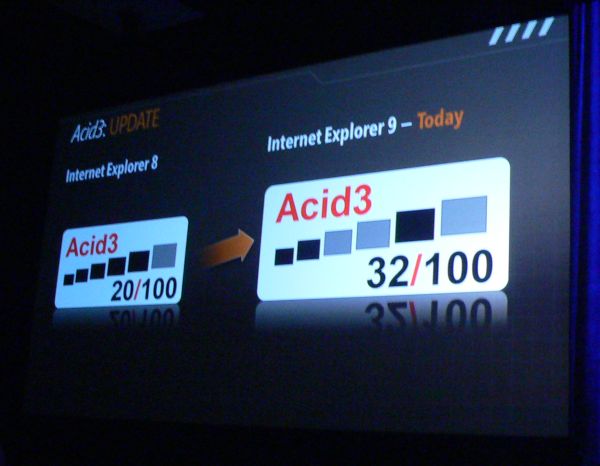
    Internet Explorer 9 posts slightly better scores on the Acid3 test.

    Obviously performance is an issue, and the fact that IE9 is crawling back from the brink is something that developers are taking note of. The proud disclosure that IE9 posted a 32% score on the Acid3 test score, elicited a tremendous groan…a bit like telling the audience that Chris Rock couldn’t make it but Carrot Top could.

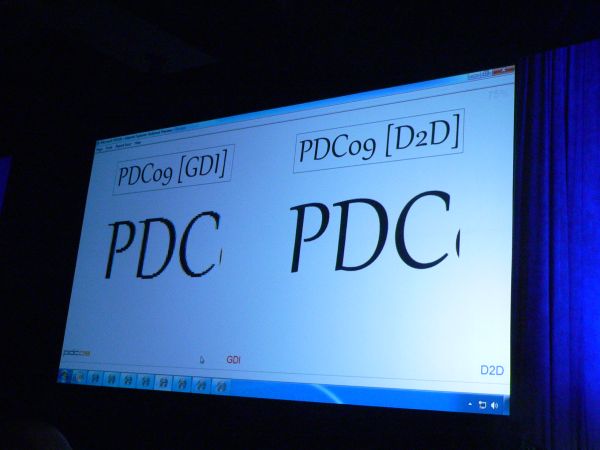
    Demo of Direct2D rendering functionality being added to Internet Explorer 9.

    So the demonstration of Internet Explorer 9 rendering functionality — specifically, moving the rendering engine from the decades-old GDI over to Direct2D — ended up falling a little flat. Even though the need for a smoother rendering engine is crystal clear to any user, especially in IE8, to the developers (a.k.a., the PDC audience), they want to be told what they can do to improve the Web user experience. Being told they don’t have to do anything to improve the experience is no help to them; it’s like telling a professional truck driver he doesn’t have to drive a truck. Then how is he going to make his living? Developers want tools so they can be the ones responsible for improving the IE experience, especially since there’s an obvious needs assessment that says it needs improving.

    The IE9 news made the entire crowd unimpressed, which is why it was perfect (and obviously intentional) timing to take the bad taste out of developers’ mouths with the news of the laptop giveaways. It was a palate cleanser ahead of Scott Guthrie and the Silverlight 4 news, all of which was received very positively.

    More and more, Silverlight is becoming Microsoft’s Web platform — in effect, replacing Internet Explorer in that regard, at least with respect to the company’s product line. Seeing Guthrie’s demo of the HTML control being housed inside the Silverlight-based frame (so, for example, a custom Silverlight app could host a Bing search or a Facebook application) made it clear that not only developers outside Microsoft, but the ones inside Microsoft, are paying attention to the possibility of Silverlight becoming the Web apps host of choice as opposed to Internet Explorer.

    Just as Betanews readers have been saying, IE is becoming old news. Trouble is, the older that news becomes, the more of it there is.

    A long string of interviews is next for us here at the conference, and we’ll report on what we’ve learned from them later tonight and throughout the week.

    Copyright Betanews, Inc. 2009


    Add to digg
    Add to Google
    Add to Slashdot
    Add to Twitter
    Add to del.icio.us
    Add to Facebook
    Add to Technorati


  • OS 5 for the BlackBerry Curve 8520 leaked

    CrackBerry and BlackBerryOS are reporting a leaked OS 5.0.0.348 for the BlackBerry Curve 8520. RIM have said that it won’t be longer than 2010 before we start seeing OS 5 rolled out across a larger gamut of devices so it shouldn’t be long until this is official. So if you want it now, and you’re okay with some third party apps not working, then go ahead and give it a try. Usual caveats apply.

    Download OS 5.0.0.348 from MegaUpload.

    If you’re getting the error “File Temporarily Unavailable”, all you have to do is keep refreshing the screen. It took me about 15 refreshes to finally get the download to work.

    © Kyle for BlackBerry Cool, 2009


  • Puppet Charlie Sheen Educates Puppet Barack Obama About Puppet 9/11

    Charlie Sheen's make-pretend conversation with President Obama concerning his 9/11 conspiracy theories, acted out by puppets. That has be the funniest thing ever, right?

    Actually, no, it doesn't have to be…

    Why so serious, puppets? Hasn't anybody ever told you that you're puppets?

    Part 2 is over here (if you were even capable of making it to the end of Part 1)

    (via Videogum)

  • With Chatter, Salesforce Takes a Facebook Approach to Collaboration

    Salesforce.com today announced Salesforce Chatter, an application that provides a social network for enterprise businesses. Salesforce Chatter incorporates social networking and real-time connection features as well as integrates Facebook and Twitter status updates, making it unique from other enterprise collaboration offerings from Cisco and Microsoft, which revolve more around traditional IM screens, video conferencing and presence awareness inside an email program. For internal use, Salesforce Chatter gives employees profiles, feeds and groups. With the Salesforce Chatter platform, developers will be able to build social enterprise applications that can contain status updates, create Facebook apps, and hook into APIs from Twitter so enterprises can track comments about their brand or from their employees. As employees use more social-networking applications while at work, the security of those applications and how to harness them for corporate use have become increasingly common concerns in IT.


  • We See Your ‘Copyright Contributes $1.5 Trillion’ And Raise You ‘Fair Use Contributes $2.2 Trillion’

    The copyright industry lobbyists absolutely love to throw around the bogus and debunked stat that copyright contributes $1.52 trillion to the economy. That number is derived by taking any business that kinda sorta maybe touches copyright (including things like furniture and jewelry) and then assuming that all of the revenue they make is entirely due to copyright. Yes, that’s ridiculous. But, if the copyright lobbyists are going to use such bogus methodology to push their agenda, it seems only fair for those on the other side to use the same methodology. Last week, we wrote about a biased editorial by two newspaper industry lawyers in the WSJ (who failed to note the conflicts of interest), claiming that Google violated copyright law, and attacked the concept of fair use.

    In response, Ed Black, from the Computer & Communications Industry Association wrote a letter to the editor highlighting those lawyers factual mistakes as well as the importance of fair use throughout the industry (thanks to Yano for sending this in). Most of the (short) letter discusses all the wonderful things that fair use allows, and then has this wonderful line at the end:


    Businesses dependent upon exceptions to copyright contribute $2.2 trillion to the U.S. economy. They are responsible for one in eight jobs, for a total payroll of $1.2 trillion in 2006. Fair use is serious business; it is the glue that holds the Internet and new technology together. It is worth protecting.

    This is fantastic. Of course, the number is just as bogus as the $1.52 trillion used by copyright maximalists, but I think that if they’re going to use their methodology to make such ridiculous claims, it’s only fair to do the same for the contributions to the economy of exceptions to copyright, and as the CCIA clearly demonstrates, the businesses that rely on weaker copyright contribute significantly more to the economy than those that rely on copyright. Thus, by the copyright maximalists own logic (and numbers), shouldn’t we be fighting to expand the exceptions to copyright law?

    Permalink | Comments | Email This Story


  • Only 46 Percent of Twitter Users Visit the Site

    One of the main reasons for Twitter’s success has been the openness towards third-party developers. While the core service has stayed mostly true to its minimalistic approach, users can get most of the features they need from all of the services and apps that cater to Twitter. In fact, these apps are so popular, that less than half of the Twitter users actually visit the site to keep up or send out a tweet according to new data from Sysomos.

    “So, how do you use Twitter? That’s the question we wanted to answer with our latest report focused on the applications to use Twitter. We analyzed a sample of more than 500 million tweets collected over the past five months to determine the most popular applications to use Twitter,” the social media analytics firm wrote.

    The study found that Twitter.com was, by far, the most popular way of posting a tweet, with 46 percent of the users preferring it. TweetDeck comes in a distant second place, with just 8.48 percent, followed by the popular iPhone apps Tweetie and Twitterific, with 2.83 percent and 1.63 percent, respectively. Seesmic, which has just launched a native Windows client, came in fifth, with 1.11 percent.

    In Sysomos’ last report, Twitter.com was employed by 45.7 percent of the users, so the website managed to keep its mark… (read more)

  • Nokia N900 now available in the US

    We’ve got news, both good and bad. What do you want first? We’ll start with the bad news first. It’s easier that way, you know?