Blog

  • Request for Help: Acquisition Security Related Policies & Issuances Chart

    acquisition_policies.jpg
    The graph Acquisition Security Related Policies & Issuances Chart (acq.osd.mil, PDF version) by the Office of the Director, Defence Research and Engineering is meant to increase the awareness of existing policies, in order to improve compliance, and to get policymakers to reflect about writing “one more policy” now that they are able to observe the huge existing “heap” they actually contribute to. The chart’s designers are interested in your constructive feedback to make it better (and maybe help your country at the same time?).

    The chart organizes acquisition security policies and guidance by purpose and the responsible offices. It shows all policies a typical acquisition program may need to comply with, and links them directly to the appropriate texts. The bins or categories for the policies emerged during the creation process itself: some policies clearly spanned multiple bins, and were placed appropriately, by overlapping across multiple bins.

    The creators of the graph (3 people who worked over a period of more than 3 months) claim they have gotten positive feedback from the “operational crowd”, that is the people who actually “use” this to do their work. The target audiences are DoD “acquisition program managers” and “security people” who are responsible for complying with these policies, and DoD “acquisition security policy makers” who contribute to this rich policy universe.

    The chart was designed in Microsoft Visio, which enabled including hyperlinks from policy boxes to their full texts, making the graph interactive and more “than just wall art”. In the future, they like to make the chart more interactive such that users could tick certain criteria and only the relevant policies would stay visible.

    Any ideas for improvement?


  • T3’s “Netpad” puts a few new twists on the tablet format

    top
    Product differentiation is getting more and more difficult these days. The lozenge-shaped, touch-enabled, all-purpose computing device is fast on its way, and while things like the Courier are still serving up surprises, you could be forgiven for thinking most of these big blank screens are pretty similar. That’s why I was pleasantly surprised to see some smart additions to the tablet form factor in this concept design by T3. While I think a lot of these additions might be very difficult to get right, I don’t see why we shouldn’t give them a shot.

    KeyboardA slide-out keyboard, for instance. It’s going to be a battle over the next few years whether to include a hard keyboard or not. I personally like a hard keyboard smaller devices like mobiles, but it’s possible that a soft keyboard will be perfectly usable on larger tablets like the CrunchPad and that Apple one. A slide-out keyboard would have to be a compromise, because there’s almost no room for key depression. But a little give is better than none.

    The “control strip” is a great idea. With little OLED displays like those the Optimus Maximus and G19 keyboards becoming more common, I don’t see why we shouldn’t have a little context-sensitive strip like that. You kind of saw what it could do in that four-screened laptop from a few months back, but that was pretty over the top. We’re talking media controls, Wi-Fi and Bluetooth toggles, that kind of thing. Putting it on the slanted edge there separates it physically but not visually and really is a great solution.

    lid

    Multi-purpose, convertible casing: if someone can pull this off, it’d be awesome. An integrated screen protector that doubles as a stand? God damn, sign me up. If it’s reliable, it’d really simplify the accessory situation.

    The trouble, of course, is that this little “Netpad,” as they call it, would cost a mint. The many moving parts, expensive materials (carbon fiber, magnesium), and multiple touchscreen surfaces would probably propel the final price to… I’d guess about $2000 at least. And since part of the selling point of tablets is their simplicity and low cost, you’d have trouble making money with the thing, cool as it is. Still, if any of these features make it into the next generation of tablets, I’ll be pumped.

    More info over at T3, where hopefully they’ll continue updating this thing.


  • Omega-3s in GMO Plants

    This is an interesting article from New Scientist about some companies that are working on producing EPA, DHA, and STA in plants:

    US FDA says omega-3 oils from GM soya are safe to eat

    Excerpt:

    “BASF has inserted five genes from algae that naturally make EPA and DHA into the canola genome. Its product is still in development.

    “Monsanto has taken a different approach. It inserted two genes into the soybean genome, one from a plant related to primrose and one from a fungus. The modified soybean produces stearidonic acid, or SDA. Like ALA, SDA is converted into EPA in the body, but in much higher proportions….”

  • The World is Now on Course for IPCC’s Worst-Case Scenario in Terms of Warming Temperatures – 6C by End of the Century

    ArtistsImpressions-HumanPerturbationOfCCycle-1mb

    2009Nov17: The world is now on course for the IPCC’s worst-case scenario in terms of climate change, with average global temperatures rising by up to 6C by the end of the century, according to the 31 researchers from seven countries involved in the Global Carbon Project. The Global Carbon Project study was led by Professor Corinne Le Quéré, of the University of East Anglia and the British Antarctic Survey (Independent.co.uk ).

    Reference: Independent.co.uk http://www.independent.co.uk/environment/climate-change/world-on-course-for-catastrophic-6deg-rise-reveal-scientists-1822396.html

    Read the CSIRO media release. 2009Nov17. Available online at Global Carbon Project http://www.globalcarbonproject.org/carbonbudget/08/press-releases.htm

    Image Description: Artist impression of the human perturbation of the global carbon cycle. Credits: © Global Carbon Project I Glynn Gorick Image Location: Global Carbon Project http://www.globalcarbonproject.org/carbonbudget/08/images.htm Image Permission: Illustrative Photos (available free for Carbon Budget editorials if credited as specified).

  • Review: Literature and Happiness

    The article reviewed here is ‘Literature and Happiness’ by Norman Holland and published in the journal Psyart in 2007. Psyart publishes articles which examine psychological perspectives on the arts. In the abstract (headnote), Holland writes that

    I maintain that we do literature because it is fun, because it makes us happy. And it makes us happy because the act of experiencing literature mimcs the brain processes of successful living

    I was intrigued to read a little more to see what Holland meant by this. He begins by looking at the origins of the word happiness and an overlap with terms such as luck in indoeuropean languages. He then describes a modern meaning in which the pursuit of happiness is validated in a western society. Indeed this features in the positive psychology movement (see review here). He writes about reading for pleasure and as a literary critic and then discusses psychologist Mihalyi Csikszentmihalyi’s description of happiness in flow – equivalent to absorption in a task. He then equates the first type of reading – the reading for pleasure with the activation of a wanting and liking system – the neurological correlates of which are the mesocortical and mesolimbic systems. He refers to a Seeking model described elsewhere with regards to the wanting and liking systems. This is where he draws the analogy with ’successful living’ as he suggests that the cycle of wanting and liking are routine and exclusive drivers of our behaviours. With regards to literary criticism he relates this to activity within the peri-aqueductal grey matter (PAG). The connection he makes is with a theory of ‘personal style’ described elsewhere in which the PAG plays a prominent role.

    In terms of other articles reviewed previously this has a different tone far removed from papers describing studies with quantitative and qualitative methodologies. The article is essentially an essay in which a structured hypothesis is described. There are various methodologies that could be used to explore this model in further detail ranging from focus groups through to surveys and imaging studies. Nevertheless this ‘top-level’ informal-at-times discussion is just as valid as rigorous qualitative or quantitative studies in that it disseminates a speculative model which can lead to further discussion. There are many reasons for reading and many functions that it may satisfy as well as numerous brain regions or systems that may be involved in the process quite apart from the PAG, mesolimbic and mesocortical systems although each should start with a suitable evidence to justify their inclusion in the model. Is my peri-aqueductal grey matter helping ‘me’ to write this review? I’m not entirely sure, but until I’d read this paper I wouldn’t have entered my stream of consciousness. There at least it has already had some success.

    References

    Holland N. Literature and Happiness. Psyart. Gainesville. 2007. I page. ISSN: 10885870.

    Twitter

    You can follow ‘The Amazing World of Psychiatry’ Twitter by clicking on this link

    Podcast

    You can listen to this post on Odiogo by clicking on this link (there may be a small delay between publishing of the blog article and the availability of the podcast).

    TAWOP Channel

    You can follow the TAWOP Channel on YouTube by clicking on this link

    Responses

    If you have any comments, you can leave them below or alternatively e-mail [email protected]

    Disclaimer

    The comments made here represent the opinions of the author and do not represent the profession or any body/organisation. The comments made here are not meant as a source of medical advice and those seeking medical advice are advised to consult with their own doctor. The author is not responsible for the contents of any external sites that are linked to in this blog.

  • The Fraction of CO2 Emissions that is Absorbed by Terrestrial and Marine Carbon Sinks Probably Decreased Between 1959 and 2008

    shutterstock_30072571_1mb

    2009Nov17: “On average only 45% of each year’s [carbon] emissions remain in the atmosphere. The remaining 55% is absorbed by land and ocean sinks. However, CO2 sinks have not kept pace with rapidly increasing emissions, as the fraction of emissions remaining in the atmosphere has increased over the past 50 years. This is of concern as it indicates the vulnerability of the sinks to increasing emissions and climate change, making natural sinks less efficient ‘cleaners’ of human carbon pollution,” said Global Carbon Project Executive Director and CSIRO’s Dr. Pep Canadell, who is co-author of “Permanent storage of carbon dioxide in geological reservoirs by mineral carbonation”, a paper that appears in Nature Geoscience.

    Reference: CSIRO media release. 2009Nov17. Available online at Global Carbon Project http://www.globalcarbonproject.org/carbonbudget/08/press-releases.htm

    Read the article abstract – Permanent storage of carbon dioxide in geological reservoirs by mineral carbonation http://www.nature.com/ngeo/journal/vaop/ncurrent/abs/ngeo683.html

    Image Description: Industrial pollution. Photo by Martin Muránsky. Image Location: Global Carbon Project http://www.globalcarbonproject.org/carbonbudget/08/images.htm Image Permission: Illustrative Photos (available free for Carbon Budget editorials if credited as specified).

  • Company Trademarks The Pirate Bay Logo

    Quite a few people have pointed to the story about a Swedish company that has trademarked The Pirate Bay logo, and plans to sell USB keys with the logo included. The company claims that this is fine because The Pirate Bay had not registered the trademark itself. In the meantime, some folks associated with The Pirate Bay are saying they’re going to try to overturn the ruling.

    I don’t know how Swedish trademark law works, but at least in the US there is a concept of a “common law trademark,” which is supposed to prevent others from registering a mark on a brand that someone else is using — even if they haven’t registered it. It would seem like quite a silly trademark law if the Swedish trademark law doesn’t include anything like that.

    As for those who think it’s ironic or even hypocritical that The Pirate Bay guys are somewhat bothered by this, you need to understand a few things. First, they clearly state that they have no problem with anyone doing anything else with The Pirate Bay logo. So, if this company just wanted to sell those USB keys by itself, it could do so. The issue they have is with this company “locking up” the trademark so others can’t use it. That seems entirely in support with what they stand for.

    Separately, it’s worth pointing out (yet again, because some people still get confused by this) that trademarks are wholly different beasts than copyrights or patents. Trademarks are not about protectionism, but about preventing consumer confusion over who actually made or offers a specific product. It’s a very different concept.

    Permalink | Comments | Email This Story


  • Kingston’s new DataTraveler DTLocker+ is secure, they say

    kingstondt
    There’s no shortage of secure devices out there, but if you happen to be a Kingston-only type of guy, you’re in luck. They’ve just put out a new USB stick that, like other secure drives, requires a password before you can access the data. It’s encrypted with a 256-bit key so I don’t think anybody will be brute-forcing that information any time soon. And if they put the wrong password 10 times… poof, formatted.

    Personally, I still like the Lenovo secure drive I reviewed; having an actual keypad made it seem high-tech and reliable. Of course, I nearly have a panic attack whenever I have to use it because my “usual” password isn’t all numbers and I forget things easily.

    Anyhow, you can rely on Kingston to have a decently fast, well-built little secure USB key, though they are a bit expensive. $36 for 4GB up to $200 for the 32GB? Cruel! I guess it’s not that far off from their other drives. In fact the only real difference is the swivel bit. Hey, slow news days aren’t my fault!

    [via Electronista]


  • Corrupción en el mundo de hoy según Transparencia Internacional

    Según el índice de corrupción anual de TI, o Transparencia Internacional, publicado hoy, Nueva Zelandia, Dinamarca, Singapur, Suecia, Suiza y Finlandia encabezan la lista de los países menos corruptos.

    El índice de TI incluye a 180 países y se basa en datos provistos por 10 organizaciones.  Como siempre, algunos países en conflicto son percibidos como sumamente  corruptos, como Afganistán, Iraq, Sudan, Chad y Somalia.  Pero también quedan clasificados como sumamente corruptos los gobiernos de Birmania, Irán, Guinea Ecuatorial, Venezuela, Turkmenistan y Uzbekiztan…                                                                                                        
    Obviamente, dentro de las Americas, tanto Haití como Venezuela son calificados en forma muy negativa, mientras que Chile y Uruguay se ubican entre el grupo cercano a los mejores del mundo, compartiendo el puesto 25, seguidos de Costa Rica (43) y Cuba (61).

    Hay que ser cauteloso con estos números y ‘puestos’.  Todos los indicadores de gobernalidad son imprecisos; tienen un margen de error.  Por ejemplo, dados los problemas con los datos, hay alta probabilidad de que Cuba, que ha sido calificado por el índice de TI en el puesto 61, en realidad podría estar ubicado cerca del puesto 75 o un poco mas abajo (aunque de ninguna manera entre los peores, en cuanto a corrupción se refiere).

    En general, este tipo de indicadores (incluyendo los nuestros sobre varias dimensiones de gobernabilidad) no debería ser utilizado para ‘correr la carrera de caballos’ y pretender que un país le ‘gana al vecino por una nariz’.  Los indicadores son para tener una perspectiva mas general e inicial sobre cuan extensa es la percepción de corrupción pais en un marco global.

    Por ejemplo, cuando hay una diferencia de 5 o 6 puestos entre dos países, como por ejemplo entre EEUU y Chile en el de TI de hoy, en realidad se trata de un empate estadístico.  Uno no es superior al otro en controlar la corrupcion si se toma en serio la estadística.  Los dos estan calificados relativamente bien, aunque comparten desafios importantes en el futuro proximo (no son ni Finlandia ni Nueva Zelandia…).  Pero cuando la diferencia entre paises sobrepasa los 25 o 30 puestos, eso es serio.

    Por lo tanto hay que ser muy transparente y preciso sobre el grado de imprecisión en todos estos datos e indicadores.  Al ser claro al respecto, este tipo de indicadores, incluyendo el publicados hoy por TI, permite un analisis cauteloso, correcto, y de gran utilidad.

    Estudiando todos los indicadores de gobernabilidad y corrupción en el mundo, queda claro que gran parte de América Latina no ha avanzando como ciertas naciones en Asia Oriental (incluyendo los tigres) o como los de la nueva europa (los ex-socialistas) — los cuales como promedio sobrepasaron a América Latina en una docena de años.   Cabe preguntarse porqué.

    Varios de estos temas los acabo de abordar en entrevista que me acaba de hacer Juan Carlos López para el noticiero de hoy en la noche en CNN en Español.

    Según el índice de corrupción anual de Transparencia Internacional publicado hoy, Nueva Zelandia, Dinamarca, Singapur, Suecia, Suiza y Finlandia encabezan la lista de los países menos corruptos.
    El índice de TI incluye a 180 países y se basa en datos provistos por 10 organizaciones.  Como siempre, algunos países en conflicto son percibidos como sumamente  corruptos, como Afganistán, Iraq, Sudan, Chad y Somalia.  Pero también quedan clasificados como sumamente corruptos los gobiernos de Birmania, Irán, Guinea Ecuatorial, Venezuela, Turkmenistan y Uzbekiztan…
    Según el índice de corrupción anual de Transparencia Internacional publicado hoy, Nueva Zelandia, Dinamarca, Singapur, Suecia, Suiza y Finlandia encabezan la lista de los países menos corruptos.
    gg
    El índice de TI incluye a 180 países y se basa en datos provistos por 10 organizaciones.  Como siempre, algunos países en conflicto son percibidos como sumamente  corruptos, como Afganistán, Iraq, Sudan, Chad y Somalia.  Pero también quedan clasificados como sumamente corruptos los gobiernos de Birmania, Irán, Guinea Ecuatorial, Venezuela, Turkmenistan y Uzbekiztan…

  • Review: Big Buck Hunter Pro TV Game

    bbh

    Short Version: A faithful recreation of the arcade classic, Jakks Pacific’s Big Buck Hunter Pro TV Video Game is a nice alternative when you’re too lazy, broke, or inebriated to make it out to your local watering hole to play the real thing.

    Features:

    • Plugs directly into your TV via RCA cables attached to shotgun controller
    • Full game is built into the controller itself
    • Wireless sensor bar sits on top of your TV
    • MSRP of $39.99

    Pros:

    • Pretty close recreation of the arcade version
    • Easy enough for just about anyone to pick up and play
    • Good value for around $40

    Cons:

    • Gun controller is a bit small, resulting in underwhelming pump action
    • On-screen aiming cursor’s slow reaction time is distracting

    Review:

    Ah, sweet memories of being in my early twenties. My friends and I would have just had our asses handed to us twice in the double-header softball league we somehow thought we’d be able to conquer year after year, our postgame analysis short-lived at the dive-bar-turned-cougar-hangout called Bunny’s on Excelsior Boulevard in the Minneapolis suburb I called home for years and years. All of it was simply a warm up to the marathon session of Big Buck Hunter that’d inevitably take place until closing time week in and week out.

    Now I’m 30 and living in Boston. A dull heartache comes and goes in early May of every year as my Minneapolis friends work out their attack positions and flanking maneuvers for the upcoming softball season (if anyone in a semi-serious Boston softball league needs a first baseman or outfielder, please let me know). Most of my friends have kids now and last I heard, Big Buck Hunter’s been replaced by a quick beer or two from a cooler after the game interspersed with discussions about mortgage rates and paid time off.

    But I digress. You probably want to hear about this game now.

    It’s good. Well worth the $40, in my opinion. I’ll admit that I haven’t played the very latest arcade versions of Big Buck Hunter, but this play-at-home game feels pretty close to the original arcade version as well as Big Buck Hunter II.

    The gun controller is a little bit on the cheap side but feels like it ought to be able to withstand some manhandling. My main gripe with it is that the barrel’s pretty short, which makes the pump action of the fore-end somewhat unsatisfying. Other than that, though, it’s a decent – not as nice as the arcade version but, hey, this thing costs $40.

    The on-screen aiming cursor is the main weak point of the entire package. Its slow reaction time makes your main objective – trying to shoot moving animals – a bit frustrating. I eventually overcame this by training myself to ignore the cursor and use the sight on the gun barrel. Even though the cursor’s slow to react, the game will indeed register where the gun’s aimed when fired, not where the cursor happens to be located.

    Those minor gripes aside, this Big Buck Hunter fan has been a happy camper. For roughly the same amount of money that you’d spend playing the arcade version for a few hours, the home version provides a similar enough experience to make the purchase worthwhile.

    Big Buck Hunter Pro TV Video Game [Jakks Pacific]


  • 2009 Holiday Gift Guide: Eyeball 2.0 from Blue Microphones

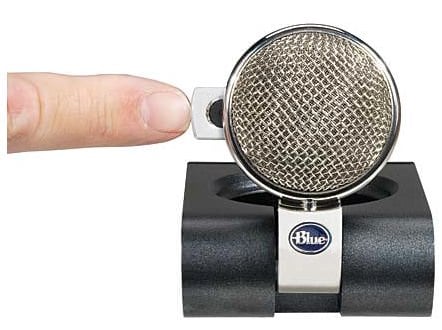
    Blue Eyeball 2.0

    Okay, with the economy what it is, you may be looking to spruce up your desktop or notebook computer setup, rather than replacing the thing. For that, you’ll need some great accessories, and when it comes to a nice upgrade for a microphone and webcam, we’ve gotta go with Blue Microphones Eyeball 2.0. It’s sleek and stylish, so you’re iChat and Skype called will feel just a bit more dignified. You get a high-fidelity microphone and 2-megapixel video camera all in one device. You can sit it on your desk, and anchor it to your monitor or notebook with ease. You can even turn the camera off if you need to hide your face for whatever reason. The Eyeball 2.0 retails for $119, but Amazon has it for $79, a full 33% off!


    Tags:
    ,
    ,
    ,
    ,
    ,
    ,
    ,
    ,
    ,
    ,

    2009 Holiday Gift Guide: Eyeball 2.0 from Blue Microphones originally appeared on Gear Live Holiday Gift Guide on Tue, November 17, 2009 – 3:13:51


  • Samsung overtakes Vizio as top LCD seller

    samsung
    Samsung and Vizio have been playing a game of leapfrog the last couple of years. It seems every couple of financial quarters, the manufacturers switch between the number one and number two spots on the top LCD sellers chart. But as of right now, Samsung is king of the mountain again.

    Vizio’s Q3 sales accounted for only 15.7% of the US’s total, while Samsung managed to move 16.8%. iSuppli credited Samsung’s LED backlighting push for the higher sales. LED backlight means thinner TVs. The rest of the manufacturers, LG, Toshiba, and Sony only managed a 8.1%, 7.8%, and 7.8% respective market share.

    But here’s the thing, only LG saw its numbers actually increase from the second quarter of 2009. Everyone else, including the top dogs, watched less TVs ship out. Of course that shouldn’t be a problem for the fourth quarter of the year as people pick up TV sets as household holiday gifts.


  • Say Hello To Nosh’s Mini-Me, The “Noshtopia iPhone Food Pics” Blog

     Noshtopiaiphonepics

    Okay everyone, I have something really fun to share with you all in an effort to expand Noshtopia’s deliciousness. On the right sidebar, you will see a button that says, “Noshtopia iPhone Food Pics” Gallery. What that button links to is a new micro-blog featuring food pics I take with my iPhone 3GS.

    It’s no secret that I LUV my iPhone, but what blew me away is how good the camera can take pictures also considering that it’s a mobile phone. Of course, I won’t be taking DSLR quality pictures, but for on the go, it’s pretty darn good and the quality gap is shrinking.

    Looking at Noshtopia from a Pro blogger perspective

    I wanted to separate out the iPhone pics from Noshtopia the main blog for these reasons:

    • I take LOTS of iPhone pics, and I would like to post all of them all the time, and if I did that on Noshtopia it would just get obnoxious because most times, it’s just a picture I want to post and say, “Hey isn’t that cool.” Giving the iPhone pics it’s own place, gives you my readers breathing room and choices.
    • Instead of posting pics on a third party picture hosting site like Twitpic (no offense guys), I’d like to get the traffic for my blogs. When I tweet, I like to attach pictures which again may not be appropriate for Noshtopia. On the new micro-blog, I can post whatever I want and get people to come visit a Noshtopia blog.
    • I can talk more about photography tips and things I learn without infringing on the food. I’m really getting into photography particularly telling visual stories.
    • The idea of being one of the best iPhone food photographers sounded like a really fun idea over a bottle of Shiraz one Saturday night. Hey, I became famous on Twitter because of a hydration nudge, so why not become famous for taking awesome food pictures on an iPhone? My whole social media career started because I wanted to wear my skinny jeans again. Sillier things have happened which is why I <3 being a blogger.

      Bread_mayfield_2

    TypePad comes to my aid thanks to synchronicity

    I’ve been thinking about doing the iPhone Food Pics gallery for awhile now, but wasn’t sure how I was going to tactically do it. Perhaps the universe heard me because a solution arrived in the form of an email from @miz_ginevra, TypePad’s Community Extraordinaire.

    Today, Six Apart announced a new service called TypePad Micro. I got in a bit early because I’m an avid TypePader.I started playing with TP Micro and created Noshtopia iPhone Food Pics literally in less than 24 hours…minus some snooze time. It was really easy, not perfect, but very low on the stress.

    Normally, I don’t use pre-canned themes because the artsy in me wants to do something original, but I like the Chroma design because it’s easy, and I like the look and feel. When I can figure out how to do some CSS, I will change the background of Noshtopia iPhone Food Pics to match Noshtopia.

    A couple things about using the Chroma theme with TypePad Micro:

    • The theme will generate a 3-choice color palette based on the color theme of the picture you upload to your banner. At first I was confused on how the palettes worked because I wanted to change it and couldn’t figure out how. So, to get a background color that matched Noshtopia, I had to find a picture that had a similar shade to the Nosthopia color theme. Thus, I picked the raspberries.
    • You don’t have to use Chroma to create a Micro blog. You can just start from scratch and create a customized blog, and use the Micro features. Micro using Chroma is basically another way for those new to blogging or for those wanting to take their “socializing” to another level somewhere between blog and tweet.

    One day, I may do the custom Micro, but for now, I’m good with Chroma because you can do some CSS an get creative. You just need someone to help you figure out what CSS you need if you’re like me and don’t do code. I’m a cut & paster.

    • In Chroma, I like how the community aspect is built in. Now I can tap into the wider TypePad user community which I haven’t before.

    Noshtopia iPhone Food Pics will have its own RSS feed, and it’s own url which is basically a subdomain of Noshtopia. I hope you enjoy the new micro-blog, as I will be posting pictures like crazy!

    And as usual, please let me know your thoughts and suggestions 🙂


  • Australian Patent Lawyers Claim Patenting Genes Is Necessary For Biomedical Research

    Here in the US, there’s an important legal battle going on over whether or not you can patent genes. Not surprisingly, we’re very much against such a system, which gives a total monopoly to certain companies on doing certain types of genetic testing. It also makes no sense at all, as patents are supposed to be about promoting invention — not finding something in nature that others can also find. Down in Australia, however, there’s a similar debate going on, but in the legislative branch, rather than the judicial. Reader sinsi alerts us to the news of a recent panel discussion in Australia where a bunch of patent attorneys predicted the virtual collapse of the biotech industry in Australia if firms weren’t able to patent genes.

    This is, of course, ridiculous. First of all, much of the research on these things is often done via government and university funding — and it’s often done for reasons other than locking up a monopoly on the technique. Reasons such as helping people live better lives (*gasp* — what a concept!). Or, more to the point, it’s done so that firms can sell an actual product. If they have to compete in the marketplace, that’s a good thing, as it pushes them to be more efficient and offer a better overall service, rather than just jacking up prices. And how do they offer a better overall service? Oh yeah, often by continuing to do more research and creating new breakthroughs.

    These sorts of claims of industries collapsing are moral panics and folk devils put forth by patent attorneys who are really afraid that it’s going to hurt their own business. There’s simply no evidence at all that it harms the overall biomedical profession if they can’t patent the finding of naturally occurring genes.

    Permalink | Comments | Email This Story


  • Update on Cellcrypt voice encryption for BlackBerry

    The last time we wrote about Cellcrypt, they were showcasing their secure mobile voice encryption software for BlackBerry at WES 2009. The company and BlackBerry app have come a long way and we got to talking with them last week at BBDC.

    Since WES, the company has received FIPS 140-2 certification, a standard approved by the US National Institute of Standards and Technology. At BBDC, the company announced that their product is available for the BlackBerry Bold 9700, as well as Curve and Pearl series devices.

    Cellcrypt’s product has become more relevant than ever with the ongoing media coverage behind a group of hackers looking to crack the standard GSM network. The hackers say they’re doing this in order to send a message that 2G GSM calls lack proper security encryption, and they could make their code book available to anyone via torrents. While the process is purely academic, and not likely an imminent threat, it still demonstrates a need in the industry for greater voice security.


    © Kyle for BlackBerry Cool, 2009


  • Everyone needs a pink UMID mbook

    mbook_lg
    It’s pink. It’s tiny. It has a webcam and a five-hour battery. Just tell me, who wouldn’t want a pink mbook? No one, that’s who.

    Dynamism claims the computer is the world’s smallest PC and, well, it very well might be. It sure is tiny at only .69 lbs and 6.3 x 3.7 x 0.7 inches. An Atom CPU powers the device and a microSD card slot provides backup to the 8GB SSD hard drive. The screen is only 4.8-inches but that’s probably large enough to update Facebook and read email anyway. Plus it’s pink. Everyone loves pink. Except for dudes.


  • Winners Of Yahoo Yodeling Contest Announced

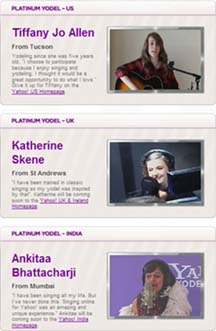
    About one month ago, Yahoo launched a new campaign to get people excited about its brand, and as part of the exercise, asked individuals to put their spin on the famous Yahoo yodel.  This afternoon, Yahoo identified the three people who stood out from the crowd.

    We should note that these three people stood out in a positive way; not every yodel was easy on the ears.  A post on Yodel Anecdotal encouraged adventurous types, "Be sure to check out the honorable mentions area of http://yodelstudio.yahoo.com to experience a wide range of yodeling genius – from R&B to country duets to death metal, no musical stone was left unturned."

    Anyway, Tucson’s Tiffany Jo Allen was declared the U.S. winner of the yodeling contest.  Katherine Skene of St. Andrews came out on top in the U.K.  Then, Mumbai’s Ankitaa Bhattacharji rounded out the winning trio by prevailing in India.

    Recordings of the three ladies’ yodels have been put where lots of people are sure to hear them: their countries’ respective Yahoo homepages.  All it takes to listen is a visit to the page and a click on the exclamation point in the Yahoo logo.

    Congratulations to the winners.

    Related Articles:

    > Yahoo Expands "It’s Y!ou" Campaign With User Yodeling

    > Yahoo Challenges YouTube On Music Video Front

    > Yahoo Provides Homepage Overhaul Stats

  • Doctors Fear Reform Angst Is Tainting Medicare Payment ‘Fix’

    Dr. Nancy Nielsen, the immediate past president of the American Medical Association, urged lawmakers Tuesday to permanently eliminate the looming cuts to Medicare’s physician payments – something her organization has demanded for years.

    The combination of a deepening budget crisis, Democrats’ plans to enact sweeping health reform and troves of baby-boomers approaching Medicare age will make the problem harder to resolve in the future, she said during a conference call.

    At issue is a 12-year-old formula – passed as part of a broader bill passed by a GOP Congress and signed into law by President Bill Clinton – that requires Medicare to squeeze physician payments when they outpace broader economic growth, which they have since 2003. Congress has intervened to block such cuts to doctors’ pay in each of past last seven years. But, those “Band-Aids,” as Nielsen calls them, are temporary.

    House Democrats are expected to consider a bill this week that would dispose of the formula and, instead, give doctors modest pay increases for the next decade, at a cost of $210 billion. A similar, $247 billion bill flopped last month in the Senate, where lawmakers viewed it as an unfunded threat to the deficit.

    In past years, lawmakers from both parties supported blocking such temporary fixes. This year, though, the measure has become tied to Democrats’ broader ambitions to overhaul the health system. A proxy fight is now shaping up around physician payment. Democrats have an incentive to answer Nielsen’s call and push a permanent solution through Congress.

    Doctors supported the Democrats’ broader reform legislation, giving it critical momentum as it cleared the House earlier this month. But the doctors’ lobby has been noncommittal about whether that endorsement will stand if lawmakers can’t deliver on the so-called “doc fix.”

    Asked Tuesday whether the AMA’s support would continue if the doc fix falls through, Nielsen responded with a question of her own: Should people believe Congress’ promise to expand health care to more Americans as part of reform “if they can’t fulfill existing commitments?”

    Meanwhile, Republicans have lined up in opposition to the effort. The Senate effort was opposed by all 40 Republicans – as well as a dozen Democrats and an independent. Senate Minority Leader Mitch McConnell said in a statement, “Hopefully it’s a sign of things to come in the health care debate ahead.”

    GOP lawmakers are hoping to force Democrats to address the Medicare physician payment schedule in their sweeping reform legislation rather than a stand-alone bill. They say addressing the issue separately – the strategy House leaders now appear to be adopting – allows Democrats to conceal the total cost of reform.

    Nielsen, who still expects the House to pass its version of the bill, cast lawmakers’ choices in terms of dreams and nightmares. If lawmakers don’t act now, she said, the situation “will become a fiscal nightmare going forward.”

    When Congress blocks cuts under the current formula, the planned cuts roll into the next year. The strategy avoids immediate budgetary impacts, but the blocked cuts add up over time. Medicare planned to cut about 5 percent of physician payments at the end of last year until Congress stepped in. Next year, physicians would face a 21.2 percent cut unless Congress acts again.

    Because most think it’s unlikely Congress will actual enforce such drastic reductions, Nielsen and other advocates, including some lawmakers, say those spending increases only matter on paper.

    In September 2006, for instance, the Congressional Budget Office, Congress’s fiscal scorekeeper, estimated that physician payment reform would cost $218 billion – just more than the House version up for consideration this week – suggesting that Congress has managed to keep over $200 billion in federal spending off the books for years.

    “When I was a little girl, I used to pretend I was a princess or could fly,” Nielsen said of the lawmakers. “Adults don’t have to do that.”

  • Google’s Chrome OS Will Be Shown This Week

    Rumors have been swirling for days about the possible delivery of a beta version of Google’s much-discussed Chrome OS this week, as we noted last Friday. I pinged a few people at Google to get some clarity, and while they didn’t provide me with a specific answer as to whether the download will arrive this week, they did send me an invitation to a press event at Google’s Mountain View campus on Thursday morning, billed as “an update on our progress with Google Chrome OS.” In other words, it sounds like we’ll get to try it very soon.

    According to the invitation, Google VP of Product Management Sundar Pichai will be speaking along with Matthew Papakipos, engineering director for Google Chrome OS. There will be demos shown and an overview of “launch plans for next year.” Chrome OS, of course, is squarely aimed at the netbook market, but it could head in other directions, too (Gigaom Pro, subscription req’d.).

    That last bit about launch plans next year doesn’t rule out a beta arriving soon. When releasing an operating system, getting working drivers for peripheral devices, making deals with hardware makers and many more issues come into play, so if we do see a downloadable version arrive this week, it’s likely to be a very early stab at the final OS. However, Microsoft has proved resoundingly that by putting more early versions of its new OS in the hands of beta testers, it can deliver a better finished product. Perhaps Google will go that route as well, and it would be in keeping with their usual “long beta” strategy. We’ll update you with more details on Thursday.


  • Security A Concern For Online Holiday Shoppers

    As Americans prepare for the holiday shopping season, online security plays a major part in consumers’ purchasing decision, according to a new poll by the National Cyber Security Alliance (NCSA) and Symantec.

    More than half (63%) of online shoppers said they did not complete a purchase because of security concerns. The most common reasons for not making an online purchase include:

    •   41 percent said the site requested more information than necessary for the transaction
    •   46 percent were worried about providing the information requested
    •   32 percent said it wasn’t clear about how the site would use personal information
    •   62 percent simply were not sure the site was secure

    Some online retailers are concerned that adding more security measures to their sites would decrease purchases. Just over 75 percent of online shoppers said they would still make a purchases even if a website required more information than a username and password to verify their identity.

    "Americans are extremely focused on protecting their personal information and their identities," said Michael Kaiser, executive director of the NCSA.
    Michael-Kaiser
    "Skepticism is a front-line defense and it is heartening to see that Americans are actively engaged in making critical decisions when shopping online. This poll should alert online retailers that there is direct relationship between security and revenue."

    The NCSA recommends the following tips for secure online holiday shopping:

      Update Core Protections: Take a few minutes to update your core protections — anti-virus, anti-spyware, and firewall — before you get on the information superhighway. Also make certain they are set to automatically update against new threats.
      Shop Secure Sites: Is there a closed padlock on the browser’s status bar? Does the Web site’s address (URL) change to shttp or https when you are asked to provide payment information? If so, you know the vendor has secured their payment process.
      Check Sellers Out: Conduct independent research on a seller’s reputation before you buy from a seller you have never done business with.
      Passwords Are Key: Create long unique passwords incorporating symbols and numbers to increase your security against hackers and others trying to access online accounts.
      Always Ask WWW: When providing personal information for any purchase, always ensure that you know who is asking for the information, what information they are asking for and why the need it.
      Not All Money is Created Equal: Credit cards are generally the safest option because shoppers can seek a credit from the issuer of the card if the item isn’t delivered or not what was ordered.
    Related Articles: 

    > Spam Is Getting More Malicious

    > Online Retailers To Have Better Holiday Season

    > Beware Holiday Emails