Blog

  • Six Strikes Copyright Alert System Launches This Week [Report]

    For the past year, we’ve seen delay after delay for the Center for Copyright Information’s six strikes Copyright Alert System. For a while, it looked like it would never become a reality. Not it looks like the system is finally in place, however, and it may be launching today.

    The Daily Dot reports that the CCI plans to launch the six strikes Copyright Alert System across all the major participating ISPS – AT&T, Cablevision, Comcast, Time Warner and Verizon – this week. Each ISP will reportedly launch on a different day this week which Comcast reportedly launching its system today.

    A small recap for those unaware, the Copyright Alert System is a joint operation between ISPs and major content holders around the country. In essence, these content holders will be scanning Internet connections looking for people downloading pirated content via BitTorrent. If you’re caught, the content holders will send your a notice through your ISP. There are three tiers of warning with two warnings per tier, hence the six strikes.

    The first two warnings are “educational alerts” that tell consumers they’ve been caught. The email will then direct them to legitimate sources of content with the hopes that the early warnings are enough to scare people into buying content.

    The next two warnings step it up a notch with what’s called “acknowledgement alerts.” The first two alerts were simply emails, but these next two will actually hijack your browser. You will be hit with a message telling you that you’ve been caught yet again, and must acknowledge that you’ve been caught before you can start browsing again.

    The next two tiers, and presumably every alert afterwards, will be “mitigation measures.” In essence, the ISPs will begin throttling your bandwidth or blocking Web sites you frequently visit. The ISPs will not be able to cut off your Internet connection under the plan.

    Of course, the real fun of all of this is that the copyright holders have all the power in this relationship. They can simply accuse you of piracy with little proof, and the ISPs must hit you with whatever tier of alert you’re on. Sure, you can appeal the accusation, but it costs you $35 up front and goes before the American Arbitration Association. In short, it’s not worth fighting, and the content holders know it.

    Despite being anti-consumer and potentially damaging to small businesses, the CCI wants you to know that it’s your friend. The group put together a small video that says it only wants to be your friend as long as you purchase all your content legally.

    I’m sure that the CCI will announce that P2P sharing is down in a few months from now, but we’ll know what’s really up. The number of VPN subscriptions in the U.S. is already on the rise, and more people will presumably start using Mega, Usenet and other non-P2P networks.

    Nonetheless, It will be interesting to see the response from Internet users not aware of these programs once the first alerts start rolling in. The response may be so vitriolic that ISPs and the CCI call it off until it can formulate another plan. The consumer is king in the U.S. and corporations have been known more than once to back down when programs like this only serve to piss off their most loyal consumers.

    [h/t: TechDirt]

  • ASUS unveils Fonepad and PadFone Infinity Android tablets

    Today the festivities at Mobile World Congress in Barcelona, Spain kicked off. Nokia announced the new Lumia 520 and Lumia 720 Windows Phone 8 devices aimed at the entry-level and mid-range smartphone market and earlier ASUS unveiled two Android tablets dubbed Fonepad and PadFone Infinity.

    The Fonepad is a 7-inch tablet that features built-in 3G support for cellular voice and data. The device sports a 7-inch 10-point multitouch IPS display with a resolution of 1280 by 800 and at a first glance it’s quite similar to the Nexus 7, which is also manufactured by ASUS, bar the phone functionality.

    The Fonepad, however, is powered by Intel’s Z2420 processor and runs Android 4.1 Jelly Bean. Other specs include a microSD card slot, which can extend the storage capacity by 32GB on top of the 8GB or 16GB built-in storage, 1.2-megapixel front-facing camera capable of 720p video recording as well as a 3MP back-facing shooter. The tablet sports a “metallic design”, which usually implies plastic, that keeps the weight down to 340 grams. ASUS did not provide exact measurements, but says that thickness comes in at 10.4mm.

    As usual the Taiwanese manufacturer also bundles its own branded app suite, including Floating App, SuperNote and WebStorage Office Online. With the purchase of the Fonepad users will receive 5GB of “free lifetime” cloud storage via ASUS WebStorage.

    The Fonepad will be available from March with price starting from EUR219 for the 8GB version. ASUS also offers two accessories, a VersaSleeve 7 cover that features a folding design and a Turn Case hardshell case with a soft interior designed to clean the surface of the screen and provide a built-in stand. The former runs for EUR19.99 while the latter goes for EUR39.99 (MSRP pricing).

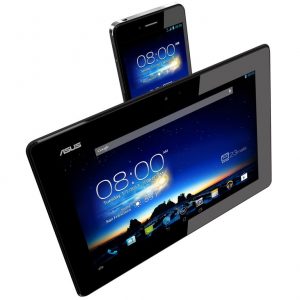
    The PadFone Infinity is touted as a Swiss Army Knife, when coupled with the PadFone Infinity Station. The former is a 5-inch smartphone, but when docked to the latter it becomes a 10.1-inch tablet. The heart of this all-in-one solution is the PadFone Infinity — it features a 5-inch display with a resolution of 1920 by 1080 and runs Android 4.2 Jelly Bean.

    Power comes from a 1.7GHz quad-core Qualcomm Snapdragon 600 processor. In this regard the PadFone Infinity is similar to the HTC One and the LG Optimus G Pro, both of which also feature 2GB of RAM. The ASUS-made device also sports 64GB of built-in storage, a 13MP back-facing camera with a f/2 lens that can capture 100 sequential photos and shoot 1080p video. Battery life is quoted at up to 19 hours of 3G talk time, with the docking station capable of fully-recharging the smartphone up to three times.

    Like with the Fonepad, ASUS also adds its own app suite which includes SuperNote 3.1, Story and ASUS Echo. Combined, the PadFone Infinity and the PadFone Infinity Station will run for EUR999 (MSRP).

  • Retouch Pilot Lite brings old photos back to life

    Enhancing a regular digital photo isn’t too difficult, at least at a basic level. Even an editing newbie will quickly get used to tweaking brightness, contrast, color balance and so on, and these image-wide adjustments alone will often be enough to make a huge difference.

    Scan some old photos, though – maybe some ancient family shots which have been in someone’s attic for 50 years — and you’ll face a very different challenge. Issues now are likely to include spots, scratches, dust and other defects. And while you could in theory clean these up with just a basic paint tool, life will probably be very much easier if you install Retouch Pilot Lite.

    The program installs easily (it’s adware-free), and on launch displays a panel with links to tutorials for various tasks. This may be useful if you’re a beginner, but otherwise isn’t necessary, so it’s generally best to click “Close” and move on to the main interface.

    This is fairly basic, though more or less as you’d expect. There are menus where you can open and save files, zoom in and out, undo your various actions and so on. A toolbar on the right gives access to some basic image editing features (resize, crop, rotate, brightness and contrast adjustments, and so on). But the real value here is the Scratch Eraser, which will help you to clean up your image.

    Select this tool, move your mouse cursor over the image, and it’ll change into a small circular brush. Move this so that it surrounds the spot or scratch you’d like to eliminate, then either just click, or click and drag, and the defect should disappear while everything else remains intact.

    Does it work? We tried it on a few old black and white images with lots of tiny spots, and the results were generally very good. Zoom in on an area, adjust the Scratch Eraser brush to an appropriate size, and we really could eliminate a huge number of defects at very high speed.

    If you try to work on photos that are more detailed, though, or have larger defects, then problems appear. Retouch Pilot Lite becomes less and less able to generate an image which matches with its immediate surroundings, and the results quickly become entirely unusable.

    If you’re already an experienced graphics editor, then, familiar with a clone brush and used to repairing minor problems, Retouch Pilot Lite has little to offer.

    But, if you’re not sure how you’d remove tiny spots and scratches from an image, or you’re going to have to remove a lot of them and need a quick way to do it, the program may prove useful, and it’s certainly worth a try.

  • MasterCard Introduces MasterPass Digital Wallet, Partnership With mFoundry

    MasterCard introduced MasterPass today at Mobile World Congress, calling it the “future of digital payments”. The service lets people use any payment card or enabled device to “discover enhanced shopping experiences”.

    MasterPass includes checkout services for merchants, and connected wallets for users.

    “Every device is becoming a shopping device,” said Ed McLaughlin, chief emerging payments officer, MasterCard. “MasterPass brings together all of the ways we pay for things, from traditional plastic cards to digital wallets, and gives consumers the ability to make a payment from wherever they are and with one simple experience.”

    MasterPass will be integrated into mFoundry’s nearly 900 bank customers, integrating it into mFoundry’s mobile banking solutions, which have millions of customers.

    “Consumers will now shop and pay in whatever way best fits their needs and lifestyles, from every device they have. MasterPass gives them the ability to make a payment from wherever they are, with one simple experience,” said Ed Olebe, Group Head, MasterPass Services, MasterCard. “Integrating with mFoundry’s solution embeds the power of MasterPass into an industry-leading mobile banking platform and enhances both the payment and banking experience for consumers.”

    “Together, mFoundry and MasterPass deliver an outstanding customer experience by integrating mobile banking and mobile payments into one, seamless solution,” said mFoundry CEO Drew Sievers. “By bringing together both, financial institutions can transform their mobile banking experience and achieve the broader goal of turning mobile into their most valuable channel.”

    MasterCard announced PayPass nearly a year ago, and says MasterPass is an evolution of it. mFoundry will create a digital wallet service using its APIs, and the service will be available early next year. Pilots are expected to launch later this year.

  • Unleash Your Applications with Cloud-aware Application Delivery

    Kavitha Mariappan is director of product marketing (Stingray Business Unit) Riverbed Technology.

    Kavitha-Mariappan_tnKAVITHA MARIAPPAN
    Riverbed

    The evolution of cloud architectures and their ability to deliver a greater level of efficiency and flexibility has been a hot topic recently. So why put your apps in the cloud?

    Why Should I Use the Cloud?

    Ultimately, business priorities should drive the decision, not simply some arbitrary need to streamline IT resources. It’s evident that the business advantages of moving to the cloud are significant and provide sustaining benefits. There are good reasons for this. One of the most compelling is elasticity—IT resources can automatically scale up and down as required by the business. The risks of under-provisioning and the costs of over-provisioning evaporate.

    Running applications from an enterprise-grade cloud eliminates the need to sink excessive capital into complex and expensive hardware and other infrastructure components. Additionally, it eliminates the recurring and cumulative costs—a kind of tax, really—of maintaining hardware-based, on-premise infrastructure components. And, the cloud, no longer novel, has been widely utilized and is mature enough to support a large variety and scale of applications.

    Shedding much of the costs of delivering services enables you to provide your customers with a much richer user experience and access a greater variety of apps and services. In the cloud, developers can put their ideas to the test sooner and potentially mitigate issues that otherwise might arise only after the application has been moved to production.

    Cloud computing isn’t limited to a collection of virtual machines and storage you rent by the hour in a location far away from your data center. Mature cloud providers offer the ability to extend existing on-premise infrastructures into cloud facilities, creating a unified architecture with the benefits of instant infrastructure. Applications can span both, and users need not notice the difference.

    To better understand the business benefits of deploying applications in the cloud, let’s examine three compelling aspects:

    1.) Reduced complexity. Deploying applications in the cloud reduces the burden of hands-on system administration and allows you to spend more time thinking strategically. Application developers experience greater agility to innovate and contribute to your bottom line and avoid the wastefulness and boredom of day-to-day heavy lifting.

    2.) Reduced costs. The two biggest savings realized by many organizations that move to the cloud come from economies of scale and a usage-based pricing model. Pay-as-you-go brings true capital cost savings, eliminating the need to invest in unused capacity while ensuring that spikes in demand don’t cripple your business. As their processes mature, enterprises minimize operational costs by automating rote tasks using repeatable and standardized components and blueprints.

    3.) Increased flexibility and agility. The cloud offers increased agility, dynamic scalability, and faster speed to market. Imagine a scenario in which your IT department no longer sits idle while waiting for the UPS truck to arrive and no longer camps out in your data center during the weekends to install new hardware. Cloud resources can scale to match demand at any point in time. Automation allows you to simplify and streamline formerly manual and cumbersome IT processes.

    What Should I Worry About in the Cloud?

    Performance, availability, and security top the list of concerns that our customers mention. Notably, these same concerns apply to on-premise implementations, too. Our customers expect that they will receive similar levels of service, efficiency, performance, and security as their applications migrate to the cloud.

    Together, these requirements constitute a certain degree of measurable business continuity. How can a shared platform, not under your control, deliver the same or better response times? How can it protect your applications from security threats? How can it ensure continued customer satisfaction, revenue growth, and productivity when network latency varies from one location to another?

    In reality, these questions apply to any IT infrastructure, whether on premise or in the cloud. Deployment practices that alleviate these concerns work in any environment – traditional data centers, virtualized private clouds, public clouds, and hybrid clouds.

    How Do I Deploy Effectively in the Cloud?

    As you start to deploy business applications in the cloud, take some time to consider—or reconsider—your application delivery infrastructure. Does it provide the performance, flexibility, cost savings, and agility that you need, now and in the future?

    Legacy load balancers sit in front of web and application servers. They accept requests on behalf of external users and manage the dialog with the application. They traditionally focus on enhancing reliability of the back end of the data center, by ensuring availability and also scalability of applications. They implement features such as server offload and content caching to reduce application server costs. Traditional load balancers deal with problems that arise from traffic surges and spikes but with a server-side focus.

    Applications undergo constant evolution, and one rapidly emerging property is a high degree of distributed processing across multiple locations. Application delivery solutions must similarly evolve to meet the requirements of large-scale distributed processing readily available in the cloud. Such requirements include:

    • Enhancing efficiency and response times of applications and services
    • Improving availability between instances that span multiple geographic zones and regions
    • Solving latency problems with content optimization and acceleration tools
    • Ensuring proper protection, using intelligent layer-7 inspection, against known and unknown threats
    • Scaling resources to provide encryption and compression services without affecting performance

    Yesterday’s load balancers and legacy application delivery controllers are not designed for the cloud. The mismatch is clear. Only a modern, cloud-ready application delivery solution can truly help you make this shift – software-based application delivery controllers (ADCs) have emerged as the right solution for cloud-based application deployments.

    Software ADCs are natively designed for virtualization and cloud portability. Pure software solutions are intended for the widest variety of deployments and enable a more flexible application delivery strategy. It’s the foundation of a true Opex-centric resource model.

    Industry Perspectives is a content channel at Data Center Knowledge highlighting thought leadership in the data center arena. See our guidelines and submission process for information on participating. View previously published Industry Perspectives in our Knowledge Library.
  • Snooki Selling Car On eBay: Bids Exceed $70,000

    Snooki, the diminutive star of MTV reality show “Jersey Shore”, has sold her custom Cadillac Escalade on eBay as a chance to “own a piece of pop culture history”, and she managed to get quite a bit of dough for it despite the fact that it was clearly tailored for her own personal tastes.

    The pink-trimmed black Caddy features ambient lighting and custom wheels, and the winning bidder scooped it up for just $77,510 after all was said and done. Of course, that price included an autograph across the hood by Snooki herself.

    From the eBay description: This 2011 Cadillac Escalade is currently owned by Nicole Snooki Polizzi. It is the actual car that she has driven in many of her television appearances. The vehicle has been completely wrapped and has been customized with many add ons to her taste and specifications, such as custom wheels and ambient lighting. It has been autographed across the hood by Nicole. This is not a vehicle that you can buy everyday, it is an opportunity to own a piece of pop culture history!

  • ASUS Unveils 7-Inch Tablet, New Padfone

    Mobile World Congress is in full swing this week and it seems that the mini-tablet product category is set to be flooded in the coming months.

    ASUS today announced three new devices, a 7-inch tablet and a 5-inch phone that can be docked within a 10-inch tablet.

    The 7-inch tablet, dubbed the Fonepad, features a 1280 x 800 resolution screen and an Intel Atom processor. It will come with either 8GB or 16GB of internal storage and has an SD card slot. The front camera is 1.2 MP and the “optional” rear camera is 3 MP.

    The Fonepad, in general is similar to the iPad Mini and the just announced Galaxy Note 8 from Samsung. ASUS is pricing the device competitively compared to the iPad Mini, starting a €219 ($249).

    The other devices (or device) is the latest dock-able smartphone and tablet in ASUS’ PadFone lineup. The PadFone Infinity will be the successor to the PadFone 2, which was only just announced back in October 2012.

    The Infinity’s 5-inch smartphone will have a 1.7GHz quad-core processor, 64GB of internal storage, and a 13-megapixel rear camera. Docking the device within the 10-inch “Infinity Station” will display the smartphone’s contents stretched to fit the tablet. ASUS claims the device will get up to 19 hours of 3G talk time before needing to be recharged.

    The Infinity will be quite expensive, as the MSRP is €999 ($1,325, converted, though ASUS hasn’t stated a dollar price).

  • Oscars Stats From Google, Twitter And Facebook

    A flood of stats about Sunday night’s Oscars ceremony has been unleashed upon the web. Among these stats are some looks at trends from Google, Twitter and Facebook.

    Google

    Here are the top five most searched Oscar nominees, according to Google:

    Most searched oscar nominees

    “At the end of the show, Best Picture winner ‘Argo’ held the #6 spot, followed by Ang Lee, Christoph Waltz, ‘Silver Linings Playbook’ and Halle Berry,” notes Google software engineer Nemo Tamir.

    Google also shared the most searched red carpet dresses:

    Red Carpet dresses

    “This year’s Oscars brought with it a number of unexpected moments that grabbed our attention,” said Tamir. “Early in the show, Seth MacFarlane was visited by William Shatner in full Captain Kirk regalia, come from the future to save Seth’s monologue; at 8:36pm ET, searches for [kirk] spiked to almost 1,500 per minute. Later in the show, ‘Zero Dark Thirty’ and ‘Skyfall’ tied for sound editing, and people flocked to the web with questions. Searches for [tie] spiked to more than 5,000 per minute, with many people wanting to know [has there ever been a tie in the oscars]. And in a final surprise, First Lady Michelle Obama introduced the Best Picture nominees and opened the winning envelope for ‘Argo.’ Searches for [michelle obama] spiked to 4,500 per minute.”

    Twitter

    “All in all, there were 8.9 million Tweets about the 85th Academy Awards: 2.1 million during the red carpet, and 6.8 million during the awards show. People at home (and in the audience) tweeted as the night’s most exciting and entertaining moments unfolded,” says Twitter’s Fred Graver.

    More Twitter stats:

    Best Picture award for Argo: 85,300 TPM
    Adele performs “Skyfall”: 82,300 TPM
    Best Actress in a Leading Role for Jennifer Lawrence: 71,600 TPM
    Best Original Song for Adele: 64,000 TPM
    Best Actress in a Supporting Role for Anne Hathaway: 60,400 TPM

    Facebook

    Facebook says Oscars buzz was at an all time high on the social network this year. According to the company there were 66.5 million Oscar-related interactions on Facebook.

    “The event scored a 7.17 on the Facebook Talk Meter, trumping last year’s awards ceremony, and we saw the most buzz in the Northeast (New York, Massachusetts, New Jersey and Connecticut) followed by California,” says Facebook data analyst Allie Townsend. “‘Oscars’ received three times more mentions this year, while the Best Picture nominees racked up twenty times more mentions than 2012. ‘Les Miserables’ had the most Likes of this year’s top films, and despite being set in France, the film’s largest body of fans are in London. It was also the favorite film among women and people ages 13 to 17.”

    Django Unchained, however, got the most mentions, Townsend says. It was the “clear Best Picture Choice” among men, she says.

    “Best Picture ‘Argo’ was the most-talked about winner of the night, as mentions of the film increased by 2,460% and mentions of Ben Affleck increased by 23,500% as the director, star and producer made his acceptance speech,” says Townsend. “Affleck also launched his new Instagram account from the red carpet and shared behind-the-scenes photos throughout the night, including this one of his name being engraved on Oscar trophy itself.”

    Facebook put out the following infographic looking at the trends:

    Facebook Oscars Trends

  • Don’t hold your breath for that Nokia tablet

    There are rumors flying around about the possible existence of a Nokia-made Windows 8 tablet. Based on what Nokia CEO Stephen Elop said Monday, though, it looks like a release for such a device is way off.

    Acer Iconia W510In a roundtable Q&A at Mobile World Congress in Barcelona today, Elop said that tablets may fit into Nokia’s mobile-centric strategy, but he seemed to be more thoughtful than decisive on the matter. He noted that all the assembled journalists had traditional notebooks. Not so, I said, unclipping the tablet part of my Acer W510. What did I think of Windows 8, he asked. A mixed bag, I replied. Another piece of feedback for his fact-finding mission.

    What is Elop waiting for in the tablet space, another journalist asked. Three things, he said: Nokia is watching the tablet market evolve; it is “watching the specific platforms and where they stand in terms of maturity”; and it is focused on “understanding and seeing with [its] engineers the ability to differentiate under those conditions”.

    Now the prevailing wisdom is that Nokia would go with Windows RT/8 in the tablet space. Is that platform mature? Heck no. Could Nokia differentiate on it? Never say never, but Microsoft is still trying to get its customers to wrap their heads around the RT-desktop user interface split – do we really want to see further customization confusing people at this point of initial education?

    How about Android? As a tablet platform, Android still isn’t there yet — that’s a function of its paucity of tablet-optimized apps, rather than any intrinsic flaw. True, Nokia probably has more opportunity for differentiation there, but it’s an extremely tough market, what with Samsung ruling the roost as it currently does. There’s no analogy to be drawn with Nokia’s work on Windows Phone, which no-one dominated when Elop dived in.

    No other tablet platform is anywhere approaching maturity – with the exception of iOS, of course, though that’s not an option. And so, while Nokia is probably testing Windows RT/8 and Android tablets in its labs — it would be crazy not to be doing so — by the criteria laid down by its leader we can make a pretty educated guess: that we should not expect Nokia to launch a tablet anytime soon.

    Related research and analysis from GigaOM Pro:
    Subscriber content. Sign up for a free trial.

  • Smartphones will be half of the total phones shipped in 2013: Ericsson CEO

    MWC 2013 Barcelona Ericsson

    “By the end of 2013, more than 50% of phone shipments will be smartphones, driven by more affordable models,” said Ericsson President and CEO Hans Vestberg, who was speaking at a press conference at Mobile World Congress 2013 currently under progress in Barcelona. “As we have the internet in our pockets, our virtual and real worlds are coming together. Online interaction enriches our living, working and entertainment and breaks down barriers of time and place. By the end of 2013, there will be more mobile internet users than fixed internet users.”

    Related research and analysis from GigaOM Pro:
    Subscriber content. Sign up for a free trial.

  • Stop Trying To Make WebOS Happen. It’s Not Going To Happen

    image001341547197020eudxdw

    We need to face facts: WebOS is dead. Barring the unwavering support of the enthusiast community, the former mobile OS will never become a commercial product and, LG investment or no, the possibility of WebOS surviving a sale is nil.

    WebOS is no more, has ceased to be, is bereft of life, and it rests in peace. It is an ex-OS.

    HP is going through the same doldrums all PC makers are facing. Had they put a modicum of energy into updating the TouchPad and the WebOS mobile line, they probably could have made it out of the horse latitudes of the downturn, but as it stands they jettisoned an amazing amount of valuable cargo, including support for the WebOS team. What LG is supposedly buying is a readymade stack for their smart TV offerings and not a real OS. What HP is selling is dead weight.

    TV operating systems are about as low as you can go in the graphical environment game. TVs face a snails-pace upgrade cycle, are orphaned by their makers, and are nearly invisible to the consumer. Slapping WebOS into a TV is tantamount to sticking it onto a medical device – you’re assured a slow and steady obsolesce.

    The last big news out of WebOS came over a year ago, with the release of 3.0.5. The Community Edition wiki was last updated in August. If there is such a thing as a zombie OS, this is it.

    It’s over. Even if the rumors are true, that LG would even consider picking this thing up over, say, using a ready-made Android stack is a testament to the fire-sale price HP would consider and, more important, LG’s efforts to grab some of that enthusiast cool. After all, LG is fighting Samsung for mind and market share and a little WebOS magic could (but won’t) pull them partially out of a deep hole. But don’t bet on it.

  • Is Your Sales Organization Good or Great?

    What separates great from good sales organizations? After working with over two-hundred different companies, the evidence suggests that the best business-to-business sales organizations share specific patterns of organizational structure and behavior. These similarities can be defined into the seven different attributes listed below. Conversely, underperforming or weaker sales organizations tend to be missing some or all of these critical characteristics.

    1. Strong Centralized Command and Control with Local Authority. There is no single greater influence over the success of the sales organization than how the sales leadership creates the sales culture and environment for the people who will work for them. In this regard, the best organizations have strong leaders who exercise authoritarian control, dictate team direction, and establish the codes of behavior that all team members must abide by. Although these tenets are similarly used within military units to enforce chain of command, sales leaders prefer to use motivation and the force of their personal character before employing the power associated to their title.

    In addition, the senior leadership team typically does not micromanage their sales teams below. Instead, there is independent and autonomous local decision making that operates within the guidelines and protocols established by the leaders above. But rest assured, the actions of the lower levels of the organization always take into account the goals and desires of the senior leaders.

    2. Darwinian Sales Culture. There are two different aspects of a Darwinian sales culture. The first is in regards to hiring. In essence, the next hire by the organization is of such high quality and capability that it actually “challenges” the more tenured sales team members to perform at the highest level (so that they are not resting on their laurels). The second aspect is that the sales organization is continually “culling the herd” and comparing each member’s performance against stringent criteria. Weaker sales team members who do not contribute their revenue share are quickly let go.

    3. United Against a Common Enemy. I have found the best sales organizations, those who are driven to succeed against all obstacles and odds, have an archrival competitor whom they both resent and fear. This is actually a very important differentiator since it drives individual behavior. As a result, there is a higher win ratio because accounts are pursued with greater preparation, higher intensity, and a life or death seriousness.

    4. Competitive but Cohesive Team. In one sense, a sales organization is an amalgamation of cliques. For example, a sales organization may be comprised of three areas that include North America, Asia-Pacific, and Europe/Middle East/Africa. Furthermore, North American sales may include three regions: east, mid-west, and west. In great sales organizations there is more than a friendly rivalry between the various regions. Each region is on a mission to prove it is the best. Although all the salespeople and their sales leaders are intensely competitive individuals by nature, they will support their area and regional teammates when needed. It is highly likely that the key sales management leaders have worked with each other before at prior companies. They know, like and respect each other.

    5. DIY Attitude. Many underperforming sales organizations share something in common. The sales organization tends to blame the other areas of the organization (engineering, marketing, support, etc.) for the own failings. Members of top performing sales organizations not only take ownership for their own success, they have a “Do It Yourself” attitude. For example, they will not solely rely on marketing to provide their leads but build their own pipeline without any expectations of leads from marketing. When troubles arise at customer accounts, they will spearhead problem resolution efforts.

    6. They Suspend Negative Belief Systems. Sales is a career that experiences tremendous highs and lows. Circumstances change very quickly in sales. A competitor’s new technology may leapfrog yours. The company whose account you worked so hard to close may want its money back because the product isn’t working right. The funnel of deals you may have been counting on for months could disappear in a few minutes. The sales team members in great organizations live “in the moment,” meaning they do not fixate on negative thoughts that prevent them from moving forward and taking action. They are not debilitated by bad news or self-defeating rumors heard through the grapevine.

    7. There is Energy and Esprit de Corps! While all sales organizations can be defined as a collection of individuals trying to succeed as a team, there is a tremendous amount of peer pressure inside great sales organizations. If a member doesn’t achieve his revenue targets, not only did he fail personally, but he also let his team down. On the other side of the coin, when sales team members post great numbers, they are honored and respected by the team. This type of sales culture is very different from an individualistic “every man for himself” environment because it fosters team cohesiveness, morale, and a continually high energy level.

    The members of great sales organizations don’t believe they are in sales by happenstance. They are professionals who believe they are fulfilling their own destiny. Collectively, as an organization they are united for a greater purpose than themselves. While the company’s goal may be to go public or reach certain revenue milestones, the greatest sales organizations are on a never-ending mission to prove to the world that they are the best.

  • Latisys Adding More Space, Power at California Campus

    Latisys-Ashburn

    The interior of a Latisys data center in Virginia. The company has announced plans to expand its data center campus in Irvine, California. (Photo: Latisys)

    Latisys is expanding its west coast hub, adding 12,000 square feet of raised floor and 1.8 megawatts of power to its OC2 data center in Irvine, California, which currently features 20 megawatts of power capacity and 93,000 square feet of data center space. The new space is expected to be available to customers by the end of the second quarter of 2013.

    In addition, Latisys also announced that it has purchased its OC1 data center, a 50,000 square foot facility next door to OC2, in a strategic move to control existing assets for the long term.

    “Southern California continues to grow as a destination of choice for outsourced IT infrastructure services and as a gateway to Asia Pacific,” said Tom Panarisi, Regional Sales Director for Latisys. “Latisys has been an active participant in the Orange County business community for several years and we take our role as the region’s trusted provider for outsourced IT solutions very seriously. We have come to know the most dynamic large and mid-size enterprises—not just in Orange County but across the U.S.—and we are proud to serve as an extension of any organization’s critical IT team.”

    National Demand for IaaS Solutions

    Latisys’ growth in Southern California reflects increasing national market demand for data center, hosting and cloud services, with Gartner predicting the Infrastructure as a Service (IaaS) market will grow by 47.8% through 2015.

    The Irvine data center serves as the west coast hub of Latisys’ national IT Infrastructure as a Service (IaaS) platform – which also includes Denver as an ideal disaster recovery site, along with Chicago and Northern Virginia as gateways to Europe and Latin America.

    “Every day we see accelerating demand for high performance, highly secure, hybrid Infrastructure as a Service,” said Pete Stevenson, CEO of Latisys. “And because that demand is national, Latisys continues to invest in our platform so we can ensure that businesses continue to have multi-site deployments across most flexible, secure and resilient infrastructure solutions optimized for today, and scalable for tomorrow.”

    Latisys’ national expansion has been ongoing through 2012 and into 2013.  Recent announcements include DEN2—Latisys’ newest state-of-the-art data center in Denver— along with the DC5 and CHI2 data centers that added an additional 22,000 and 10,000 sq. ft. of secure, ultra high-density raised floor in Northern Virginia and Chicago respectively.  Latisys’ total data center platform now exceeds 343,000 square feet across seven data centers in four major markets.

    OC2 is tied directly to a variety of fiber carriers, monitored 24x7x365 by on-site NOC personnel and systems, and operated under SOC 2 Type II and SOC 3 audited controls.

  • Nokia brings the new Here apps — Drive Beta, Maps and Transit — to other Windows Phone 8 devices

    Nokia’s augmented reality, map and navigation apps for Windows Phone just went through a name change, and now bear the HERE branding. As interesting as that may sound (which it doesn’t, really) there is an even bigger announcement. HERE Drive Beta, HERE Maps and HERE Transit, which were formerly exclusive to Nokia devices, are now available for “any Windows Phone 8 smartphone”.
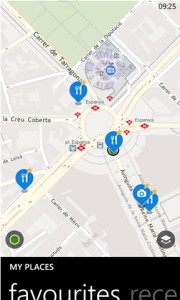
    Well, not for any Windows Phone 8 smartphone — the three apps are only available for users in Canada, France, Germany, Italy, Mexico, Spain, UK and US. That said, I have installed HERE Maps outside of a supported location and it works fine, without any apparent limitation. HERE Drive Beta and HERE Transit report an unsupported location and as a result neither works for me.

    HERE Maps is similar to the built-in Windows Phone 8 Maps application. It uses the Nokia maps and features online and offline services and turn-by-turn navigation, the latter in over 90 countries according to the Finnish manufacturer. Where the two offerings, from Nokia and Microsoft, mostly differ is in nearby locations (Nokia calls them “places”) such as hotels, restaurants, pubs (or bars depending on which side of pond you live) and shopping centers to name a few. Where Maps would show no results, HERE Maps provides a generous POI list (Point of Interest) in the close proximity to my location.

    HERE Drive Beta features turn-by-turn voice navigation, with support for offline guidance. There is also support for POIs, speed limits and other features. Nokia’s maps apps (HERE Drive Beta and HERE Maps) can save maps of entire countries, regions or states (depending on the location) for offline use.

    HERE Transit is designed for (let’s say) eco folks who want to avoid personal (and modern) transportation (also known as cars) and choose to go down the bus, train, tram or ferry route. The app displays nearby stations and stops as well as departure times. All HERE apps are synced, allowing users to switch between them for the best results.

    Moving back to the HERE branding, John Jackson, Research VP, Mobile & Connected Platforms, IDC says that: “These announcements firmly establishes HERE as a horizontal brand and thoughtfully-tiered service offering. It should benefit broad developer communities, generate significant new value for Nokia, and let Nokia retain the ability to differentiate its Lumia products with unique experiences”.

    With that in mind, his standing appears somewhat influenced by half of the HERE announcement. If Nokia keeps up the pace and continues to reinforce its support for the Windows Phone 8 ecosystem by offering more branded apps to non-Lumias the advantage of owning a Nokia smartphone fades, at least in terms of software.

    Currently three out of four HERE branded apps are available for other Windows Phone 8 devices, including HTC’s Windows Phone 8X and Windows Phone 8S and Samsung’s ATIV S.

    HERE Drive Beta, HERE Maps and HERE Transit are available to download from the Windows Phone store.

    Photo Credits: Andy Dean Photography/Shutterstock

  • Pearson: FT digital subs overtake print; ebooks hit 17% of global sales

    Pearson released its 2012 annual report Monday. The company had worldwide revenues of £6.1 billion (USD $9.2 billion). Some digital highlights:

    • As previously reportedFinancial Times digital subscriptions overtook print subscriptions for the first time in 2012. The FT now has “almost 316,000″ digital subscribers, compared to about 286,000 print subs, and “mobile devices now account for 30% of FT.com traffic and 15% of new subscriptions.” The company said it expects advertising to remain weak, “with profits reflecting further actions to accelerate the shift from print to digital.” Pearson CEO John Fallon denied rumors that the company is selling off the FT.
    • The Economist isn’t nearly as far along in the digital transition: Total print and digital circulation was 1.67 million, “of which 150,000 customers bought digital-only copies.”
    • At Penguin, ebooks accounted for 17 percent of global book revenues, up from 12 percent in 2011, and “almost 30 percent” in the U.S., compared to 20 percent in 2011. Penguin’s total revenues worldwide were £1.053 billion (USD $1.59 billion), up 1 percent over the previous year. Global app sales were up by 200 percent, but the company didn’t break out app revenues.

    Related research and analysis from GigaOM Pro:
    Subscriber content. Sign up for a free trial.

  • “DWTS”: “Idol” Contestant Signs Up To Dance

    Many fans of “Dancing With The Stars” are also fans of “American Idol”, so news of a crossover will be a nice surprise.

    Former “Idol” contestant and country star Kellie Pickler has reportedly signed up to appear on the dance competition’s upcoming season, and fans are thrilled. Of course, nothing is official yet; the cast roster will be announced on Tuesday’s edition of “Good Morning America”. However, several sources are reporting that Pickler is indeed in the lineup.

    Among the other contestants rumored to have a spot on the show are fellow country singer Wynonna Judd and Baltimore Raven Jacoby Jones.

    Pickler earned some headlines last fall when she shaved her head in support of her best friend, Summer Holt Miller, who was diagnosed with breast cancer. She also appeared on the cover of men’s magazine Maxim last summer and spoke about her USO tours with her band.

  • Facebook Partners With Operators For Free/Discounted Access To Messaging

    Facebook announced partnerships with over 18 operators in 14 countries to provide users with free or discounted data access to Facebook messaging.

    Users on Android, iOS and Facebook for Every Phone (which the company notes is now optimized for chat) will be able to take advantage in the coming months.

    “Messaging on Facebook lets people connect with friends and contacts on the go, regardless of what device they are using,” Facebook says in its announcement. “Three out of every four people on Facebook send a message on the platform each month, making messaging one of the most popular activities on Facebook. Today, Facebook messaging and chat can be accessed from more than 6,000 mobile phones via Facebook Messenger, Facebook for iOS and Android, Facebook for Every Phone, m.facebook.com and across other devices with Facebook integration.”

    The participating operators include: MN in Portugal, Three in Ireland, Airtel and Reliance in India, Vivacom in Bulgaria, Backcell in Azerbaydzhan, Indosat, Smartfren, AXIS and XL Axiata in Indonesia, SMART in Philippines, DiGi in Malaysia, DTAC in Thailand, Viva in Bahrain, STC in Saudi Arabia, Oi in Brazil, Etisalat in Egypt, and Tre in Italy.

    Facebook has done a lot in recent months to make Facebook Messaging a preferred method of chat. Last month, they rolled out free VoIP calling to U.S. Facebook Messenger users, and in December, they started letting users sign up with just a phone number.

  • Barnes & Noble Founder Plans To Buy Retail Operation

    Barnes & Noble looked like it was on its way back to relevancy after a number of quarters of profitability thanks to its Nook tablets. That all ended last year as the company began posting losses, and it looked like its Nook business was starting to come up short against Amazon. Now the company may be breaking apart its various businesses in a bid to save the company.

    Leonard Riggio, founder of Barnes & Noble, Chairman of the Board and largest shareholder, announced this morning that he plans to buy the brick and mortar retail business of the book store. There’s nothing set in stone just yet, but it would be the second time in the past few months that an ailing business was bought by its founder. The first, of course, being the acquisition of Dell by its founder Michael Dell for $24.4 billion.

    Riggio’s plan is to only buy the company’s retail business. The Nook business was spun off last year so where does this plan leave that? According to a report from The New York Times, the company is looking into winding down its Nook business.

    It doesn’t mean that the Nook brand, which was spun off from the retail business last year, will be dead. It only means that Barnes & Noble might stop making its own hardware in favor of licensing its own Nook software to other manufacturers. In essence, we’d see tablets and eReaders from other manufacturers running the Nook software. The company would also presumably focus on its software presence on other platforms like Windows 8, iOS and Android.

    If Riggio is successful in his bid to buy the retail operation, it could give Microsoft an opening to purchase the Nook operation. Nook is already closely tied to Windows 8 after Microsoft pumped $300 million into the business last year. Nook is already the best eReader app on Windows 8, and further cultivation at the hands of Microsoft could turn it into a worthy competitor to Apple’s iBooks and Amazon’s Kindle.

    All of this is purely speculation for now, and the Barnes & Noble board may not even approve Riggio’s bid to buy the company’s retail operation. Still, it does look like the company will at least be winding down its Nook hardware operations. A focus on its digital business could just be what Nook needs to become profitable again.

    [h/t: The Verge]

  • 79-Year Old Shot Dead, Stray Bullet To Blame?

    A 79-year old man was found dead in his Brooklyn apartment on Sunday, and police are trying to figure out exactly what happened.

    James Jackson was found with a gunshot wound to the neck after his wife–who is blind and wears a hearing aid–reported to a neighbor that she couldn’t wake him. Neighbors say he had no enemies and investigators found no evidence of a break-in, prompting them to believe he might have been the tragic victim of a stray bullet. Jackson’s wife would have been asleep at the time without her hearing aid, making it plausible that she never heard the shot.

    “She said, “Joyce could you come down here, I can’t wake up Tyrone”, he was laying in the couch in a puddle of blood,” a neighbor said.

    Jackson is described by those who knew him as a kind man who was quick to help anyone who needed it.

    “He was a good person,” said neighbor Eric Turner, 47. “If you needed something, he’d always give it to you.”

  • Samsung Galaxy Note 8 Mini-Tablet Announced

    Samsung this week officially announced its newest tablet device, the Galaxy Note 8.

    The 8-inch mini-tablet is the Korean manufacturer’s answer to the popularity of Apple’s iPad mini. The Note 8 features a similar size and hardware to Apple’s latest offering.

    The Note’s screen features a 1280 x 800 resolution with 189 pixels per inch – slightly more than seen in the iPad mini.

    On the inside, the Note 8 has a 1.6GHz quad-core processor and 2GB of RAM. Different amounts of internal storage will be available, up to 32GB, and the device also has a microSD card slot. The front camera is 1.3 MP, while the back is 5 MP. The battery is 4,600mAh. There will be a Wi-Fi-only version of the Note 8 available, and a more expensive version with wireless data capabilities.

    Since the hardware is so similar to the iPad Mini, Samsung is trying to differentiate the Note 8 by highlighting the difference in software. The Note 8 will, of course, come running a Google’s Android 4.1.2 mobile OS and come packed with all of Samsung’s proprietary software, such as the ChatOn app and Dual View, which allows users to use multiple apps simultaneously.

    The Galaxy Note 8 will also ship with Samsung’s “S Pen” stylus. The tablet will feature heavy integration with the stylus using software that can detect the S Pen and offer contextual menus. The stylus can also be used to hover over different screen options to activate mouse-over-like capabilities.