Blog

  • Google Chrome OS To Launch Within A Week

    Google’s Chrome OS project, first announced in July, will become available for download within a week, we’ve heard from a reliable source. Google previously said to expect an early version of the OS in the fall.

    What can we expect? Driver support will likely be a weak point. We’ve heard at various times that Google has a legion of engineers working on the not so glamorous task of building hardware drivers. And we’ve also heard conflicting rumors that Google is mostly relying on hardware manufacturers to create those drivers. Whatever the truth, and it’s likely in between, having a robust set of functioning drivers is extremely important to Chrome OS’s success. People will want to download this to whatever computer they use and have it just work.

    We expect Google will be careful with messaging around the launch, and endorse a small set of devices for installation. EEE PC netbooks, for example, may be one set of devices that Google will say are ready to use Chrome OS. There will likely be others as well, but don’t expect to be able to install it on whatever laptop or desktop machine you have from day one. Google has previously said they are working with Acer, Adobe, ASUS, Freescale, Hewlett-Packard, Lenovo, Qualcomm, Texas Instruments, and Toshiba on the project.

    We’ve seen convincing and not so convincing screenshots of Chrome OS over the last several months. The good news is the speculation is about to end, and you can try it out yourself. If you have one of the supported devices, that is.


  • Democrats Insist Obama Trip To Asia Won’t Slow Health Care Bill

    Roll Call reports that President Obama’s eight-day trip to Asia “will have little effect on Democrats’ ability to move health care legislation through the Senate, according to Senate and White House aides.” When news first broke that he would be gone for an extended amount of time, many Democrats met the news with “consternation,” but it now appears that Obama won’t be missing the “crunch time.” The Senate is still preparing to take up debate on the bill. “And he is unlikely to make any public pitches for health care while in Asia” (Koffler, 11/12).

  • Samsung Behold II landing on T-Mobile November 18th

    samsung-behold-ii

    T-Mobile Android junkies that aren’t digging the carriers current offerings from HTC might want to go through their desk, grab a Sharpie and circle November 18th on their calendars  for that’s the day T-Mobile has officially announced the Samsung Behold II will go on sale. Pricing is still a sekret, but we sincerely hope for T-Mobile’s sake that it will keep the price on this sucker really low, say under $199.99. For all we know that’s why pricing hasn’t been announced, they’re probably still negotiating the subsidy with Samsung. Hit the jump for the press release.

    T-Mobile USA Launches the Samsung Behold II on November 18

    Multimedia Powerhouse Joins Broad Selection of Android-Powered Smartphones for T-Mobile Customers

    BELLEVUE, Wash., and DALLAS — Nov. 13, 2009 — T-Mobile USA, Inc., the wireless leader in offering the broadest selection of Android™-powered smartphones in the United States, today announced that the Samsung Behold® II will be available beginning Nov. 18. The full touch-screen Behold II is a multimedia powerhouse with fast Web and data supported by Wi-Fi® and T-Mobile’s high-speed 3G network.

    Available exclusively from T-Mobile USA, the Behold II is the first phone from T-Mobile to feature a 3.2-inch AMOLED screen for crisper colors and wider viewing angles, which is paired with a 5 megapixel camera with autofocus, zoom, flash, five shooting modes and video capabilities. Samsung’s intuitive cube menu also provides quick access to six top multimedia features: music, photos, videos, the Web, YouTube™ and Amazon MP3 for music downloads.

    “With its first-rate multimedia capabilities front and center, the Samsung Behold II adds an exclamation point to T-Mobile’s already impressive Android lineup for the holidays,” said Wendy Piñero-DePencier, vice president, brand and calendar marketing, T-Mobile USA. “The combination of 3G speeds, its high-resolution touch-screen, and access to loads of entertainment features is sure to make the Behold II into a holiday hit.”

    The Android-powered phone is equipped with Samsung’s innovative TouchWiz™ user interface for easy customization through movable widgets and one-touch access to commonly used features and applications. The Behold II offers three different home screens to organize multiple workspaces with favorite widgets and application shortcuts.

    “The Behold II raises the bar to the next level to create a rich, customizable set of different user experiences,” said Omar Khan, senior vice president of strategy and product management for Samsung Mobile. “Combined with Samsung’s advanced AMOLED display technology, innovative TouchWiz user interface and the Android platform, users can create and enjoy a mobile experience unique to their needs.”

    The Behold II features built-in Google™ mobile services, including Google Search™, Google Maps™, Gmail™, YouTube and Google Talk™, as well as thousands of applications and games available for download from Android Market™. The Wi-Fi-enabled Behold II also supports personal e-mail and corporate e-mail with Exchange ActiveSync, as well as instant messaging, and text, picture and video messaging. Additional features include assisted GPS, Bluetooth® 2.1, visual voicemail that allows for easier access and response to voice mail, support for up to 16GB of external memory, and includes a 2GB microSD memory card.

    With support for T-Mobile’s rapidly expanding 3G network, Behold II customers can take advantage of a reliable wireless connection and fast download speeds when browsing the Web or downloading applications from Android Market. T-Mobile’s 3G network is currently available in 240 cities across the country. By the end of 2009, T-Mobile USA expects its 3G network to be available to reach approximately two-thirds of the U.S. population.

    The Samsung Behold II will be available nationwide at T-Mobile retail stores, select authorized dealers and online at http://www.T-Mobile.com beginning Nov. 18, 2009.


  • Police Allowed To Hang Onto Seized Computers For Anti-Piracy Group, Despite No Gov’t Prosecution

    We were just noting that the IFPI thinks it’s going to start seizing computers directly to get evidence of unauthorized file sharing, and wondering how that would work. At least in the UK, they may have just received some legal support. Over the summer, we wondered why an anti-piracy group in the UK was given access to and allowed to keep computers from a criminal investigation into an online service, called Surfthechannel, accused of unauthorized file sharing. The police seized the computers, but decided not to pursue criminal charges. It never made much sense that private, industry-backed anti-piracy group FACT was a major part of the criminal investigation, as they’re quite the biased party. They were given seized computers as a part of this investigation — and once the police decided not to pursue criminal charges, FACT kept the machines, saying it was considering a civil suit. However, the lawyers for Surfthechannel noted that the police and FACT had no right to keep the seized machines after the decision was made not to pursue criminal charges.

    Apparently (and unfortunately) a judge disagrees. A reader alerts us (via comments on a totally separate story, rather than a submission — not sure why) to the news that the judge in the case has said that police have every right to retain seized computers, even after they’ve decided not to pursue criminal charges. The judges noted that the law allows police the retain anything seized “so long as is necessary in all the circumstances” and then ruled that the potential of a civil suit from FACT was one of those “circumstances” that qualified. It’s difficult to see how that makes any sense, but so ruled the court.

    Permalink | Comments | Email This Story


  • BlackBerry App World will offer carrier billing

    BlackBerry App World isn’t perfect. It’s sometimes slow, sometimes not intuitive, and sometimes makes it difficult to find certain applications. (For instance, a search for PressReader came up empty yesterday from my handset, but it was there on the website.) There was even an issue yesterday where it was not working for a while. The main complaint I’ve heard, though, is that PayPal is the exclusive purchasing platform. Some people just don’t like PayPal, or otherwise don’t want to go through the hassle of setting up an account and adding funds. Thankfully, that will soon change. At the BlackBerry Developer Conference, co-CEO Jim Balsillie noted that carrier billing is coming in 2010. Soon you can make all the impulse purchases you want, and you won’t see the bill until the end of the month.

    * Usually we save newsy posts for News From The Wire, but I didn’t see this until after it was posted and thought it was worthwhile. Stay tuned. The BBGeekcast is coming up soon.

    This post originated at BBGeeks.com – home to all things Blackberry! Also a great source of info about AT&T BlackBerry.

    BlackBerry App World will offer carrier billing

    This post originated at BBGeeks.com – home to all things Blackberry! Also a great source of info about AT&T BlackBerry.

    BlackBerry App World will offer carrier billing


  • Is WCM fundamentally broken?

    Last week I attended the J. Boye Aarhus 2009 conference in Aarhus Denmark. For me, the highlight of the event was the opportunity to kick off the Web Content Management track by serving on a panel with Janus Boye (a.k.a., @janusboye) and LBi’s Jon Marks (a.k.a., @mcboof). The theme of this panel was "How do we fix WCM?" The session even had a Twitter hashtag – #fixwcm – where Jon crowd-sourced the Twitter community for their ideas.

    While my fellow panelists brought up many cogent arguments for why web content management is broken, the most poignant moment of the session was when a gentleman in the front row of the audience told a story of picking a Web CMS and only after the implementation had started realizing that the organization had picked a system incapable of doing what they wanted to do. He told how his company did not do adequate research and due diligence when selecting the product and described the disaster that resulted when the project ultimately had to be stopped and delayed by two years and untold thousands of dollars.

    Surely, this is an example of how WCM is broken, right? I say no.

    WCM can be broken if an enterprise picks a system that is designed for different scenarios. WCM can be broken if a WCM vendor misleads potential buyers by embellishing their products’ capabilities. WCM can be broken if a client’s requirements or budget are unreasonable. WCM can be broken if an implementer or systems integrator doesn’t configure, customize, or extend the system properly.

    Web CMS TiersBut, WCM is not inherently broken. Heading into 2010, the WCM marketplace is more vibrant than ever. In our recently released WCM research, we broke up 42 of the most significant WCM players into 5 tiers of systems: Complex Enterprise Platforms, Upper-Range Platforms, Mid-Range Platforms, Mid-Range Products, and Simpler Products. In each of these tiers, buyers have varying license, deployment, and technology options.

    Buyers today can choose between platforms and products; traditionally installed, hosted, or pure SaaS deployment models; traditional license or the many flavors of open source; one of many pricing models; and a variety of vertical-specific expertise.

    There is healthy competition among vendors and unlike some other markets, there is no one system dominating the WCM world. The web content management system buyer has a plethora of choices and options. I, for one, think this is a good thing.

    We talk to a lot of Web CMS customers on a regular basis.  Each story is different, and there’s a spectrum of satisfaction with the choices they’ve made.  Many customers are frustrated, but just as many can point to success stories.  Implementing content management in a fast-changing web environment is hard, but not impossible. 

    So, is WCM perfect? No. But it is not broken either.

  • Forbes Identifies America’s Ten Dirtiest Vehicles

    Forbes and Yahoo have compiled a list of the ten dirtiest vehicles on the road, and surprisingly this list is NOT dominated by pickups. Instead, the list identifies a handful of SUVs and uber-expensive luxury cars that are “dirty” – as in “most polluting.”

    Their calculation is pretty simple – they take the EPA’s emissions score for each vehicle and add it to the EPA’s greenhouse gas score. Both scores are a number from 0 to 10, 10 being the best. The lowest scoring vehicles rank as “dirty.”

    The ten dirtiest / highest polluting cars are (according to the list here):

    10. Dodge Durango

    9. Dodge Ram

    8. Dodge Dakota

    7. Chrysler Aspen

    6. Mercedes-Benz S600

    5. Mercedes-Benz CL600

    4. Chevrolet Trailblazer

    3. BMW M6

    2. BMW M5

    1. Jeep Grand Cherokee

    There are some problems with this list. First, the Aspen and the Durango are essentially the same vehicle. Same goes for the S600 and the CL600 – mentioning the same platform twice results in a “double count” for these manufacturers. The list also doesn’t include heavy-duty trucks like the Ford SuperDuty or Dodge Ram 2500 (this class of vehicles are likely the dirtiest vehicles on the road).

    Still, the data is interesting in that some of the vehicles with the worst fuel economy aren’t found. The Jeep Grand Cherokee with the 420hp 6.1L Hemi – which gets 11 mpg in the city and 14 mpg on the highway – is less of a polluter than the 4.7L (see below).

    The article is also particularly hard on Chrysler. According to Forbes, the Grand Cherokee is a perennial member of this list, as are many other Chrysler vehicles.

    Diving into the EPA’s scoring system, the pollution score is based on 4 categories of tailpipe pollutants:

    • NOx – Nitrous oxides (abbreviated NOx or just NO)
    • CO – Carbon monoxide
    • NMOG – Non-methane organic compounds (the chemical pre-cursor to actual smog)
    • PM – Particulate matter

    The data table below shows the difference between the pollutants produced by a 2009 Jeep Grand Cherokee and the 2009 Toyota 4Runner. Both vehicles feature a 4.7L V8, making the comparison pretty close to equal.

    Comparing the pollution scores of the 09' 4Runner and the 09' Grand Cherokee

    Comparing the pollution scores of the 09' 4Runner and the 09' Grand Cherokee

    About the data – the numbers in the NO, CO, NMOG, and PM categories are represented as grams per mile.

    If you take a look, you’ll notice that the Grand Cherokee pumps out almost twice as much particulate matter, nearly three times the amount of nitrous oxides, and 30% more of the chemicals that directly lead to smog. Despite the fact that these two vehicles have roughly the same fuel economy (the EPA gives them both a 15 mpg “combined” rating) the Jeep somehow manages to be a much bigger polluter.

    The next obvious question is “Why?” The Jeep 4.7L does produce more horsepower (305) than the Toyota’s 4.7L (260), and the Jeep’s engine may be tuned more towards HP than pollution. It could also be that the Toyota has a better set of catalytic converters. Without all the data it’s hard to know for sure, but what is certain is that there’s a very big difference in pollution between these two.

    If you’re interested in seeing the pollution scores of some other vehicles, check out the EPA’s Green Vehicle search system.

    Special thanks to TXTee (a frequent commenter and a member of TundraNetwork) for sending us a link to this story. If you have an idea for an article you’d like to see here on TundraHeadquarters.com, please contact us.

    Read user reviews of Tundra Accessories.

  • First Edition: November 13, 2009

    On this Friday the 13th, the headlines offer an array of health policy views — from the possibility of including a Medicare payroll tax in health reform legislation to continuing analysis of the overhaul’s winners and losers as well as the CDC’s new estimate of the far-reach of the swine flu.

    In Rural Kentucky, A Surprising Twist On The Health Care Debate
    From a strip-mined bluff at the edge of this famous mountain town you can see one of the most concentrated and diverse sets of medical facilities in rural America: a general hospital, a psychiatric hospital, a university-based rural health care center and clinics for primary care, cancer, urology, cardiology, addiction and ear-nose-and throat problems. This story has four related videos featuring local health care experiences and perspectives: Cathy Nance, Gerry Roll, Annie Fox and Beverly May (Kaiser Health News, 11/13).

    Reid Mulls Medicare Tax Increase For High Earners
    The Senate majority leader, Harry Reid, is considering a proposal to increase the Medicare payroll tax on high-income workers to help offset the costs of providing health insurance to millions of Americans, Senate aides said Thursday (The New York Times).

    Reid Weighs Rise In Medicare Tax
    Senate Majority Leader Harry Reid, seeking a new source of funding for the health-care overhaul legislation the Senate could begin debating next week, is considering a proposal to raise Medicare payroll taxes on couples who make more than $250,000 a year, according to people familiar with the discussions (The Wall Street Journal).

    Polls Suggest Healthcare Debate A Boon To Senate Candidates
    The healthcare battle appears to be helping Republicans running for the Senate. Two Quinnipiac polls released Thursday show the leading GOP candidates in Connecticut and Ohio growing their leads (The Hill).

    Number Of Insured Varies By Bill
    When the Senate unveils its health-care bill, all eyes will be on the price tag. But an equally significant number may be how many people get health insurance under the legislation (The Wall Street Journal).

    Children’s Hospitals Object To Proposed Funding Reductions
    The nation’s children’s hospitals are lobbying Congress to change a provision in the pending health care legislation that industry leaders say will reduce their federal funding by as much as $876 million (USA Today).

    Insurer Enlists Employees To Fight Health Reform
    The nation’s largest health insurance carrier is urging its employees to lobby the Senate against reform proposals that would hurt the firm’s bottom line, according to copies of e-mails released Thursday by a liberal advocacy group (The Washington Post).

    Powerful Health Care Groups Offer Optimism On Overhaul
    Two powerful health care interest groups yesterday urged lawmakers constructing a sweeping health care overhaul to focus on cost containment and affordability (The Boston Globe).

    Women Face Tough Choices On Abortion Coverage
    Millions of American women will face tough choices about abortion coverage if restrictions in the House health care bill become law, both sides in the abortion debate agree (The Associated Press).

    Shinseki Measures Scope Of Veterans’ Mental Issues
    In his first nine months as head of the Department of Veterans Affairs, retired Gen. Eric Shinseki has spent hours just listening to veterans talk. Shinseki tells NPR’s Steve Inskeep that he feels a strong obligation to “give back” to the men and women he once served with (NPR).

    For Many Ill With The Flu, Staying Home Isn’t An Option
    Though President Obama has declared H1N1 flu a national emergency and federal health and labor officials have urged sick workers to stay home, for many that’s not an option. A third of the nation’s workers don’t have paid sick days — about 51 million people, according to U.S. Department of Labor estimates last spring. That percentage rises to about 40% in California, according to a study last year (Los Angeles Times).

    CDC’s Swine Flu Toll: 4,000 Dead, 22 Million Ill
    Estimates of deaths caused by the swine flu have grown to nearly 4,000 since April, roughly quadrupling previous estimates. But that doesn’t mean swine flu suddenly has worsened (The Associated Press/The Washington Post).

    Sign up to receive this list of First Edition headlines via email. Check out all of Kaiser Health News’ email options including First Edition and Breaking News alerts on our Subscriptions page.

  • Google Ad Planner Gets Several New Enhancements

    Google has released several new features for Google Ad Planner. Google says these are aimed at providing a more granular view of where your audience can be found. Features include subdomain data, ad placements, and reach and relevance at a glance.

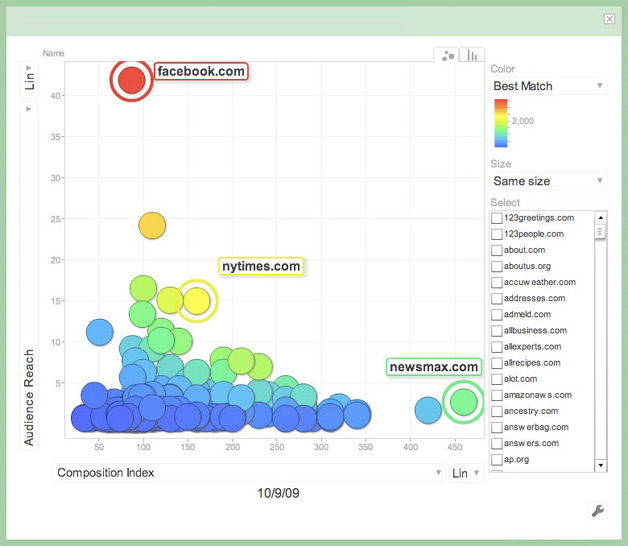
    When Google says reach and relevance at a glance, it is referring to a new interactive graph feature, which lets advertisers see which sites in their plan provide the best reach and relevance.

    "In its default setting, the graph will compare sites in your search results by audience reach and composition index," explains Google’s Katrina Kurnit. "Sites with the most reach will appear in the top-left quadrant. Sites with the most relevance will appear in the bottom-right quadrant. Sites near the top-right quadrant will have the best combination of both reach and relevance."

    Users can customize the graph in a number of different ways. The feature is discussed in more detail on this page.

    Google Ad Planner - Comparison feature

     Google has added subdomain data that gives you more detailed views of sites. It can help users refine their media plan by providing more info on specific pages. It lets usres search for subdomains, view the top subdomains based on total domain traffic for a site, view traffic, demographics and other data for the subdomain itself, and add subdomains to their media plan.

    The Ad Placements feature consists of specific sections of a site where advertising can be purchased. This feature allows advertisers to review placement data for sites in the Google Content Network, and beta test publishers using Google Ad Manager. Google says more placement data will be coming soon.

    Google says publishers and site owners can now use Google Ad Planner to share more Google Analytics data points like page views, unique visitors, total visits, average visits per visitor, and average time on site.


    Related Articles:

    > New Google Tool Benefits Both AdWords and AdSense Users

    > Google Improves Traffic Estimation with Ad Planner

    > Google Launches New Ad Planner


  • TV Broadcasters Suing Songwriters’ Org SESAC Over Pricing Power

    Missed this one when it first came out, but Copycense points us to the news that TV broadcasters have sued SESAC, one of the collections agencies for songwriters and composers (the smallest, after ASCAP and BMI), claiming that SESAC is violating antitrust laws in how it prices music used in television shows — especially for syndicated shows. The details are really quite fascinating. Local stations quite often run syndicated shows (such as sitcom reruns). When they buy the rights to run those syndicated shows, the package includes all of the related copyrights except for performance rights for any of the music included. Those have to be purchased separately by the broadcasters themselves. Now, for SESAC, representing the songwriters, this presents a golden opportunity. It’s the only thing standing between the broadcaster and being able to show the syndicated shows — and thus, it can ask for extremely high prices, or — more commonly — pressure the broadcasters into a high-priced “blanket license.” Since the broadcasters can’t change out the music (it’s in the shows already), they generally have no choice but to go along. So, the argument goes, SESAC effectively has a monopoly position, and is abusing it.

    Of course, the real “monopoly” here is copyright. At a quick glance, it certainly looks like SESAC is doing exactly what copyright allows — but the structure of licensing for syndicated TV content allows SESAC to make life difficult for the broadcasters. So, I’m not really sure SESAC should really be faulted here, as it seems to be doing exactly what it was enabled to do thanks to overly broad copyright laws. At the same time, it also makes you wonder why the broadcasters don’t go back to the TV program owners themselves and demand that they bundle the music performance rights as well, since there’s more negotiating power there. So, while it does seem unfair for the broadcasters as the market is currently structured, I’m not sure it’s an antitrust violation on SESAC’s part. More a problem with how the industry licenses are set up, combined with copyright being way too broad in such situations.

    There’s also a separate interesting element to this lawsuit — which is why it’s SESAC being sued rather than ASCAP and BMI. ASCAP and BMI are both already limited due to previous antitrust fights and consent decrees against them, whereas SESAC has been more or less free to act this way. Either way, it’s yet another lawsuit concerning aggressive use of copyright to try to demand as much money as possible, even for music that is a small part of an overall presentation of content.

    Permalink | Comments | Email This Story


  • Barcode Revolution: Unique Japanese Barcode Designs

    barcode_art.jpg
    The firms Bar Code Revolution [barcoderevolution.com] and D-Barcode [d-barcode.com] use a unique process that allows for an original design element to be integrated into a traditional barcode. While retaining the functionality of the barcodes themselves, their visual appearence are augmented with beautiful iconography or outlined in larger graphic patterns.

    More barcode design collections are available at creattica and ESBlog. Via Fast Company.

    See also Barcode Plantage and Barcode Art.


  • Visualizar’09 Kick-Off: Discussing Public Data, Data in Public

    visualizar09.jpg
    The 3rd version of Visualizar started yesterday at the Medialab-Prado in Madrid. The 2-week workshop annex seminar is directed by José Luis de Vicente and counts with a team of well known tutors, which this year includes Ben Cerveny, Aaron Koblin, Andrés Ortiz, Santiago Ortiz and Manuel Lima.

    The first day was dedicated to discuss the theme chosen for the current edition: “Public Data, Data in Public”. Authors from different parts of the world presented the projects to be developed within the next weeks. Themes of these projects vary from piracy and patents, to water usage and diseases. After the project presentations, collaborators and the Medialab team presented themselves. This session was a warming up for the formation of teams that will happen on Saturday morning, when the projects will start to be designed and developed.

    After the traditional Spanish 2 hour long lunch pause, it was time for the first lectures. The lawyer Eva Moraga gave a very insightful talk about the legal issues involved in the access and reutilization of public data in Europe. She explained recent agreements that attempt to define rules for such utilization, while pointing out to practical issues such as the organisms that provide such information, and steps involved in the process. Questions such as if all entities involved in a political system should make their data available, or if every person should know how exactly governments apply their money, were raised.

    In the following lecture it became clear that having the right to access information is not enough in order to make such data public. According to José Manuel Alonso, it is necessary to put the information where people are looking for it – e.g. the Library of the Congress that published photos on Flickr. He presented the benefits of making public data available through structured formats instead of through official portals. In this way information can be turned into well used applications, such as Facebook.

    The last talk was given by Liz Turner from the Open Knowledge Foundation (OKFN), a community focused on promoting the use, reused, and redistribution of information. Liz presented the practical problems that a designer faces while developing visualizations of public data.

    All seminars of Visualizar are streamed live, which can be accessed here.

    This post was written by Larissa Pschetz and Miguel Cardoso.


  • Running The Clock Backwards To Judge Technological Progress

    Kevin Donovan points us to a short but interesting essay by Steven Pinker, on technological progress. In it, he discusses the popularity of moral panics over new technologies, and claims by folks who say that Google/text messaging/the web/email/etc are “making us stupid.” He suggests a rather simple test for determining how silly those are, which includes seeing whether or not you’d exchange what you have today for what you had in the past:


    I would suggest another way to look at the effects of technology on our collective intelligence. Take the intellectual values that are timeless and indisputable: objectivity, truth, factual discovery, soundness of argument, insight, explanatory depth, openness to challenging ideas, scrutiny of received dogma, overturning of myth and superstition. Now ask, are new technologies enhancing or undermining those values? And as you answer, take care to judge the old and new eras objectively, rather than giving a free pass to whatever you got used to when you were in your 20s.

    One way to attain this objectivity is to run the clock backwards and imagine that old technologies are new and vice-versa. Suppose someone announced: “Here is a development that will replace the way you’ve been doing things. From now on, you won’t be able to use Wikipedia. Instead you’ll use an invention called The Encyclopedia Britannica. You pay several thousand dollars for a shelf-groaning collection of hard copies whose articles are restricted to academic topics, commissioned by a small committee, written by a single author, searchable only by their titles, and never change until you throw the entire set and buy new ones.” Would anyone argue that this scenario would make us collectively smarter?

    The reason technology progresses the way it does is because it is progress. Otherwise, people wouldn’t be using it. We use Wikipedia because it has many features that make it more useful. We use email/Twitter/text messaging/mp3s and other technologies for the same reason. They make life better in some way. Otherwise, they wouldn’t get used at all.

    Permalink | Comments | Email This Story


  • Hikari iFrame: Japan gets Android-powered, inexpensive tablet PC

    techcrunch_iframe

    NTT, Japan’s biggest telecommunications company (its subsidiary NTT East, to be more exact) has unveiled the Hikari iFrame [JP] yesterday, an Android-powered tablet PC that’s supposed to be extra-easy to use and doubles as a digital picture frame. NTT East has already set up a dedicated product web site [JP] for the iFrame, marketing it as a lifestyle product of sorts.

    The device features a 7-inch touch-panel display, an internal battery, a speaker, an alarm clock, a USB port and an SD memory card slot. And yes, it can be used to access the web via Wi-Fi. In an attempt to appeal to casual web users, NTT East says it will make heavy use of widgets that just need to be tapped to display various content like the weather, recipes, or the latest news.

    techcrunch_iframe2

    The Hikari iFrame will be released in Japan only (initially, at least) in the first half of fiscal 2010, which under the Japanese system means sometime between April and September next year. It will cost between $220 and $330, with NTT East saying the use of Android as the OS resulted in reducing costs by 20-30% per unit. The company is currently looking for test users residing in Japan, mainly targeting women in their 20s.

    This video shows the tablet in action:

    Via TechCrunch Japan [JP]


  • Book Review:Generation Text

    iStock_000004257988Small

    The audiobook reviewed here is ‘Generation Text’ by Dr Michael Osit and narrated by Dan John Miller. The narration is clear with effective intonation helping to convey the material in an engaging style that keeps the attention of the audience. Osit writes about the impact of technology on children and offers advice to parents of children from the ‘text generation’. Osit doesn’t focus on research in this area but instead uses his experience as a child psychologist as well as his insights as a parent. As this is a relatively long work – the audio was over 10 hours long – the book explores a number of issues. Osit discusses some of his observations of the effects of trends in technology applications in society on child development. He supports these observations with case scenarios. On the basis of his experience as a child psychologist, he discusses some of the difficulties that children and adolescents face and offers parents guidance in this area. Thematic throughout the book is his suggestion that parents use a systematic process for parenting and this is supported by examples of behaviour that Osit recommends so that the reader can model this behaviour if they agree with it. A particular strength of Osit in this book is his ability to identify some of the wider technological trends in society that could impact on development, to identify possible problems and to suggest solutions. As the book covers many areas it will be interesting to see the results of research in this area as it becomes available.


    References

    Michael Osit. Generation Text. Narrated by Dan John Miller. Brilliance Audio. 2008.

    Twitter

    You can follow ‘The Amazing World of Psychiatry’ Twitter by clicking on this link

    Podcast

    You can listen to this post on Odiogo by clicking on this link (there may be a small delay between publishing of the blog article and the availability of the podcast).

    Responses

    If you have any comments, you can leave them below or alternatively e-mail [email protected]

    Disclaimer

    The comments made here represent the opinions of the author and do not represent the profession or any body/organisation. The comments made here are not meant as a source of medical advice and those seeking medical advice are advised to consult with their own doctor. The author is not responsible for the contents of any external sites that are linked to in this blog.

  • PSN downloads: Dragon Age: Origins DLC on top

    Topping the download list of the week ending November 11th on the PlayStation Store is The Warden’s Keep DLC for Dragon Age: Origins. The wacky kids f…

  • Al Jazeera becomes leading Mideast sports broadcaster with ART buy

    According to Gulf Times, the Arabic satellite news station Al Jazeera is poised to become the largest sports broadcaster in the Arab region with its reportedly billion dollar purchase of the Arab Radio and Television (ART) network. According to the article, the deal has not yet been announced formally, but it will give Al Jazeera exclusive rights that will likely see it become the leading sports network in the region. Last week, the UAE daily the National reported that the head of ART’s public relations Nawaf Tamimi, said there was no rights deal, following press reports claiming ART had sold its extensive library to Al Jazeera Sports channel. “Rumors have been swirling around the Middle East media water cooler for a while now that the two pay-TV players that weren’t a part of this summer’s merger between Orbit and Showtime — that is, Arab Radio and Television (ART) and Al Jazeera Sports — are up to some kind of merging of their own,” writes Keach Hagey. Looks like they are, just as AJ Sports celebrates its sixth year.

  • A DVD that lasts 1000 years (but is it scratch resistant?)

    cranberriesNew kid on the block Cranberry claims that their new DVD will last 1,000 years. Of course no one will be around to dispute that claim, and by then we’ll be using some kind of organic memory light data cell, but hey! Who knows, maybe future generations will want to see those vacation photos you took of Grandma Rhoda and Aunt Suzy.

    Seriously though, I can see this as being a good thing at the corporate level. The DiamonDisc is a standard capacity DVD that can be read with a normal drive. Where it gets interesting is that the disc is resistant to heat (up to 176 degrees), UV, and normal material degradation. No word on if it will survive being microwaved though.

    Don’t expect the technology to be cheap though. The discs will cost you $35 each, but the price does go down for larger quantities. You have to send your information to Cranberry to be written to the disc, and then they ship the discs to you. It is possible to buy one of the special burners required to write to the discs yourself, but that drive will set you back a cool $4995.

    [via Computerworld]


  • Dell Black Friday ad

    dbfdThe good news is, with this one you don’t even need to get dressed. You can probably hit these “door busters” in your pajamas. Dell spent quite a bit of time on their full color ad, it’d be a shame not to look at it.

    Computer Accessories

    Microsoft Natural Ergonomic 4000 USB Keyboard – $19.99

    Computers

    Dell 10.1″ Inspiron Mini 10V Netbook w/Atom 1.6Ghz Processor N270 – $249.00

    Dell 14″ Inspiron 14 Notebook w/Intel T4300 Processor, 4GB RAM, 320GB Hard Drive – $599.00

    Dell 14″ Studio XPS 13 Notebook w/Intel P7450 Processor, 4GB RAM, 500GB Hard Drive – $999.00

    Dell 15.6″ Inspiron 15 Notebook w/Intel T4300 Processor, 4GB RAM, 320GB Hard Drive – $549.00

    Dell 15.6″ Studio 15 Notebook w/Intel T6600 Processor, 4GB RAM, 250GB Hard Drive – $699.00

    Dell 16″ Studio XPS 16 Notebook w/Intel P7450 Processor, 4GB RAM, 500GB Hard Drive – $999.00

    Dell 17″ Studio 17 Notebook w/Intel T4300 Processor, 4GB RAM, 500GB Hard Drive – $749.00

    Dell 20″ Studio XPS 8000 Notebook w/Intel i5-750 CPU, 6GB RAM, 750GB Hard Drive – $899.00

    Dell Inspiron 537s Desktop w/Intel Pentium Dual-Core E5300 Processor, 4GB RAM, 320GB Hard Drive – $349.00

    Dell Inspiron 537s w/Intel E5300 Processor, 4GB RAM, 500GB Hard Drive, w/20″ LCD Monitor – $499.00

    Dell Inspiron w/Intel Core 2 Duo T6600 Processor, 3GB RAM, 320GB Hard Drive – $499.00

    Dell Studio Desktop w/Intel E7500 Processor, 6GB RAM, 500GB Hard Drive, w/18.5″ LCD Monitor – $699.00

    Dell Studio Desktop w/Intel Q8300 Processor, 6GB RAM, 640GB Hard Drive, w/20″ LCD Monitor – $749.00

    Dell Studio Slim Desktop w/Intel E5400, 4GB RAM, 500GB Hard Drive, w/18.5″ LCD Monitor – $599.00

    Digital Cameras

    Fujifilm FinePix A170 10.2 Megapixel 3x Optical Zoom Digital Camera (Silver) – $59.99

    Kodak EasyShare C180 10.2 Megapixel 3x Optical Zoom Digital Camera w/Kodak P820 8″ Digital Picture Frame – $99.99

    DVD Players

    Sony BDP-S360 Blu-ray Disc Player – $149.99

    GPS Navigation Systems

    Garmin Nuvi 255W Portable GPS Navigation System – $129.99

    Hard Drives

    Dell 8x DVD+/-RW External USB Drive – $59.99

    Monitors

    Dell S2209W 21.5″ Full HD Widescreen Monitor – $144.00

    Dell SP2309W 23″ Full HD Widescreen Monitor w/Webcam – $219.00

    MP3 Players

    Microsoft Zune 120GB MP3 Player – $199.99

    Television

    Sharp 42″ 1080p LCD HDTV (Model # LC42SB45UT) – $599.00

    Sony Bravia 40″ 1080p LCD HDTV (Model # KDL40V5100) – $989.00

    Vizio 55″ LCD HDTV w/Blu-ray Player Bundle – $1649.99

    More Black Friday deals…