Blog

  • New playlists: “Spoken-word fireworks” and “That’s absurd!”

    spoken_word_fireworksTED playlists are collections of talks around a topic, built for you in a thoughtful sequence to illuminate ideas in context. This weekend, two new playlists are available: Spoken-word fireworks and That’s absurd!

    That’s absurd!
    5 quirky talks remind us that life is funny, weird, sweet, absurd. Watch talks by Improv Everywhere’s Charlie Todd and Postsecret’s Frank Warren, and more.

    Spoken-word fireworks
    7 brave and beautiful expressions from some of the world’s most talented spoken-word performers — like Anna Deavere Smith, Sarah Kay and Rives — who weave stories in words and gestures.

  • Google’s plan to eat Amazon’s lunch and dominate retailing

    Marc Andresseen, the kingmaker of Silicon Valley,  is fond of pointing out that “software is eating the world.” Google’s recent purchase of Channel Intelligence, a data management platform for retailer inventory, underscores its unstated, Borg-like goal of slowly gobbling up every industry it encounters.

    This particular move, though, is a not-so-subtle signal to the marketplace that Google intends to become the dominant player in global ecommerce – which in the U.S. alone is already a $186 billion goldmine. Yes, for Google this is not just about going deeper into the ads business. The ever-expanding behemoth’s intention is to take a bite out of retailers margins too, starting first with those generated by ecommerce websites.

    The first stop for shoppers

    The Channel Intelligence purchase adds to the buzz that Google created back in October when it shifted its Google Shopping property to a fully paid ad marketplace, which by many accounts generated some $1 billion in the fourth quarter. And a Conductor study says that Google already influences over a quarter of all e-commerce transactions through its little search engine. These recent moves indicate that it seeks not only to go toe-to-toe with Amazon, but also to sneak up on other retail giants that sell both online and in stores.

    Channel Intelligence (now part of Google) has a robust set of leading retail advertisers, which provides Google access to detailed retailer pricing and inventory data. Even more importantly, Google will get more valuable data on how those retailers convert browsers into customers. The ability to use its vast data resources to better understand retailer margins ultimately gives Google more pricing power for its ads.

    Being able to offer retailers an easier way to deliver product inventory into its search engine will make Google a more formidable player in online shopping. Judging from the growing volume of retail-driven search on both Google and Amazon, it is clear that users are choosing to go to one of those spots to get the most up-to-date pricing and product availability. This is a two-way battle to be the consumer’s first stop. The winner of this battle will become the gatekeeper of the consumer through which all retailers will have to go to sell products.

    Evolution to a digital store shelf

    With the advent of today’s on-demand culture, Google is betting that it no longer matters who actually sells the product. Consumers are squarely in control and Google will increasingly help them find that product they are looking for, and do so at the right location for the right price. This was traditionally the role of ecommerce players like Amazon and massive offline retailers like Wal-Mart and Target.

    However, with the growth of Google Shopping and the integration of those results into its core search engine, Google is quickly becoming the “digital store shelf” that it had always promised. For example, Google web search results today for retail queries tend to have at least 10 to 15 product images in addition to the traditional blue links. As Google starts to aggregate retailers’ local inventory – a probable next step on its roadmap with Channel Intelligence – it will be able to compete more aggressively in the mobile commerce space as well, directing consumers to physical stores in exchange for more ad dollars.

    Not just ecommerce but all commerce

    Make no mistake about it, Google is making a play for all retail with its recent moves and every retailer should be worried about the implications. (Rumors are swirling this week that the company has plans for its own branded retail outlets.) However, while Google is dominant in search, it is not the global ecommerce leader yet. It does not own significant pieces of the customer relationship (e.g. shipping, customer support, and retention marketing) and retailers can remain competitive by investing in areas that will stave off commoditization. Because as we all know, once you are a commodity, you will be traded like pork bellies and sold to the highest bidder. And that’s no place for a great retail brand to be.

    The promise of e-commerce is having informed consumers finding the products they need from the brands that they love. Here are a few things marketers should employ to fend off Google’s advances:

    • Focus on your brand’s value proposition and how it will be perceived in a Google search and other ad channels. Highlight what makes you unique so that you don’t become just another slot in a price list.
    • Stay away from Google’s tools that track revenues/profits. Otherwise you’re simply handing over your business’s most valuable data.
    • Develop mobile sites and apps that are a first stop for shoppers on the go, offering a better alternative to a Google search for prices.
    • Devote resources to customer experience and personalization as a way of differentiating and bettering a basic search that’s more challenging for consumers.

    Jason Lehmbeck is CEO and co-founder of DataPop, an online advertisement optimization company that works with retail, travel and automotive brands.

    Photo courtesy of Anneka/Shutterstock.com.

    Related research and analysis from GigaOM Pro:
    Subscriber content. Sign up for a free trial.

  • Wireless charging platform Qi lands its second automaker

    The Wireless Power Consortium’s Qi charging technology will be making its way into Korean automaker Ssangyong’s future vehicles. Ssangyong isn’t revealing which car model it will embed the wireless charging surface in, but at Mobile World Congress this week the WPC is demonstrating how the technology will be implemented in Ssangyong’s future interior console designs.

    Ssangyong doesn’t have quite the international pedigree of the WPC’s first car partner Toyota, but in an automotive market that traditionally takes years to plan and develop its products, the fact that Qi is making headway with any carmakers is nothing to scoff at. While the Qi platform has seen interest from many automakers, some are going to faster than others in adopting the technology, said Peter Hoehne, VP of sales and marketing for Leggett & Platt, which designed the automotive charging system.

    Some are introducing Qi at the beginning of the design and development process, meaning their Qi-enabled cars won’t be out for several years, Hoehne said. Meanwhile, others are choosing to include the technology into vehicles relatively late in their development processes, he said. That was the approach Toyota adopted for the Avalon, getting the technology into its most recent 2013 model for the North American market.

    Instead of relying on a cord, Qi uses induction to transfer an electric charge to your mobile phone. Typically users buy a separate charging pad they can place their phones, but in a few cases the technology is getting embedded directly into furniture and on other surfaces people are likely to place their phones. There are now 36 different Qi-integrated or Qi-ready devices, according to the WPC. Many of them, like the Samsung Galaxy S III, don’t support the technology out of the box, but require customers to buy a separate battery back plate embedded with the Qi receiver coils.

    Related research and analysis from GigaOM Pro:
    Subscriber content. Sign up for a free trial.

  • Want a smarter spell checker? Try Ginger

    Everyone makes spelling mistakes from time to time, and if it’s just the occasional typo on an internet forum then most people aren’t going to care.

    If you’re prone to more regular errors, though, even when you’re working on more important documents, then this could lead to problems. And that’s where Ginger comes in.

    The program is a cloud-based spell checker which works with Office 2003, 2007 and 2010, as well as Firefox and IE (other options, including an Android app, are apparently coming soon). And unlike most of the competition, Ginger doesn’t just detect errors by checking individual words. It also looks at the context of the current sentence, and adapts itself accordingly.

    Suppose you type “were are you?”, for example. There’s no spelling error here, but Ginger will recognise there’s an issue with context, and know that you really meant “where are you?”.

    The program can detect missing words, too, spotting a missing “the” in “the dog chased cat”.

    Split words aren’t a problem, with “I went in side” becoming “I went inside”.

    And in some cases you can watch this process at work, while you type. Enter the phrase “Juzt tipe sum words”, for instance, and Ginger will highlight the first two words, which it knows should be “Just type”. But if you then end the sentence with a full stop, it will also highlight “sum”, which although spelled correctly is clearly used out of context.

    Whatever your errors happen to be, correcting them is very straightforward. There’s no need to work through the errors individually: just hover your mouse cursor over one of the highlighted words, and Ginger displays a pop-up alert containing what it believes to be the correct sentence. If you’re happy, clicking this will update your document immediately. And a second editing option allows you to delete some corrections, while keeping others.

    Ginger also has a few issues. It really needs to cover a wider range of programs, for instance. The program is cloud based, so you need an internet connection for it to work. And it’s heavier on system resources than we expected. Apart from installing an Office addon, browser extensions and so on, it also adds a couple of background processes which grabbed around 90MB of RAM on our test system.

    These aren’t critical problems, though, and on balance Ginger remains a capable and effective spell checker.

    Photo Credit: Creativa/Shutterstock

  • Chromebook Pixel is a status symbol

    Google’s first computer isn’t about sales but status. Critics who lambast Chromebook Pixel as an over-priced web browser wrapped in pretty hardware miss the point. Badly. The laptop will sell, but not in mass-volume because it’s not meant to. Is Lamborghini about sales or style? I ask not seeing much commentary about how the Italian sports car is a failure because Ford sells millions more Explorers.

    Chromebook Pixel is the luxury car of computers running Chrome OS and perpetually connected to the cloud. Google’s beauty is a status symbol for people willing to plunk down $1,299 or $1,449 and makes, along with newer Nexus devices, a bold brand statement: Google is a premium brand and the company a real innovator. For the people who love the brand and want to identify with it, like all those fanboys adoring Apple with their cash, Chromebook Pixel is an easy sell.

    Consider Apple, which engages in a tried-and-true retail practice, with pricey, attractive Macs. Many people see tech gadgets as accessories — statements of their coolness, superiority — as much as useful products. They’re willing to pay more for good design, for style, like anyone choosing, say, sports car over minivan.

    It’s good business. Clothing stores take a similar approach. There are teens who must have the newest wears from Aeropostale, American Eagle, Gap or Hollister at full price; they can’t wait for sales. They want to be cool. They pay for fashion.

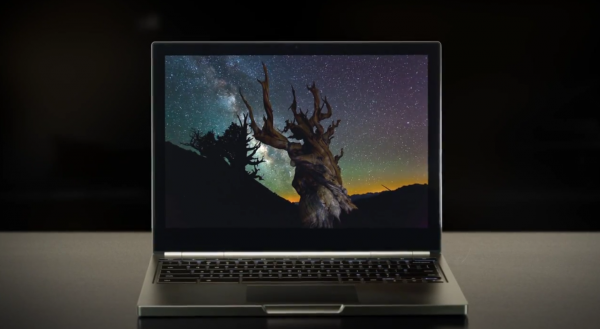
    Google joins Apple and Sony selling pricey, fashionable PCs. Chromebook Pixel is beautiful inside (that breathtaking display) and out (fine design and lightbar). The computer is a pricey fashion statement for those who can use it, and the cloud lifestyle sets them apart from others — quite literally high above them. For people who live the Google lifestyle and want the world to know, Chromebook Pixel is their proclamation.

    Status is More Than Cool

    But there are other measures of status. Chromebook Pixel promises to do for the Chrome OS platform what Nexus devices did for Android smartphones and tablets: Establish a reference design for OEM partners and provide developers base system to create apps for. The laptop is the status quo for future Chrome OS applications and hardware.

    Google sees touch as integral to future computers running Chrome OS, for example. No other laptop offers touchscreen with super high-resolution display. Apple really should change its MacBook Pro product page, which claims: “The highest resolution ever. And the second highest”. Chromebook Pixel is second: 2560 by 1700 compared to MacBook Pro 13-inch’s 2560 by 1600 (The 15-inch MBP is still higher at 2880 by 1800). Google can claim highest-resolution touchscreen.

    Google’s laptop is also status for the future. This is something I’ve come to really appreciate while reviewing the computer, and I had to change my thinking during the process by taking a different view of usage scenarios.

    Earlier Chromebooks, particularly those released for holiday 2012, appealed for their value. The $199 Acer and $249 Samsung models are easy purchases, and, based on Google+ and other social network posts, many people use these Chromebooks as companion PCs — not their primary one. I’m among a smaller set of users making a Chrome OS device my full-time computer.

    Chromebook Pixel is meant to be used as a primary computer. Design, processor, touchscreen and price say Pixel is the machine used everyday, all day long. To that end, Google’s premium portable must be able to replace something else.

    This aspect, in conjunction with pricing, is primary source of short-sighted criticism, and there is lots of it around the InterWebs, much here in BetaNews comments. The major complaint: Chromebook Pixel can’t provide the same utility as, say, MacBook Pro or Windows notebook costing hundreds of dollars less. That’s reasonable thinking if Google’s laptop is meant to be used as primary, or only, PC, which it is.

    But that rationale misses the point. You don’t get it! Open your eyes and think. True innovation is delivering something that you don’t know you need but once you get it realize that “Yeah, I could have used that all along”. Comparisons to the existing way are meaningless in this context. You have to think differently.

    For What’s Next

    Chromebook Pixel promises to change the computing paradigm — all those cheap Chrome OS models are but Trojan Horses. The primary cost is hardware, up front, that is used for years, while software is minimal investment, or free. That’s reverse the commodity model that exists right now, where, particularly for businesses, PC hardware investment is less (well, except for Macs), and software and cost maintaining it is so much more.

    Chrome OS is a paradigm shift in key areas, both regarding the cloud: Where and how people use applications — app services, really — and how much less they cost. Chromebook Pixel is the status device for this future, and the critics just don’t get it.

    This isn’t the first time, with respect to Google. I remember Android and Chrome critics in late 2008 and throughout most of 2009 poo-pooing the products. Yet look where they are now, particularly the mobile OS. The majority of smartphones and tablets shipped today have Android, according to IDC. In tablets, Google’s green robot stripped iPad’s early, massive market share lead in about two years. Half-decade ago, Android and Chrome were in many ways where Chrome OS is today.

    Chromebook Pixel isn’t just for now but what’s to come. Look at Google’s marketing tagline: “For what’s next“. That’s a powerful statement about the product being just the beginning and insinuates something for anyone used to Chrome OS every-other-month updates: There will be ongoing improvements. The hardware foundation is solid, and Google can — and will — make Chromebook Pixel better over time.

    Google’s marketing tagline is also a statement of purpose that signals dramatic changes ahead. People often ask, and I have been among them, why Google pursues a two-operating system strategy. Why continue with Chrome OS at all when Android is so successful? The answer is a question: Where do you consume Google services? Most certainly they’re more in the browser than apps. Chrome is the hub, the gateway, to these cloud services. Looked at that way, Pixel foreshadows a Chrome OS tablet, or laptop hybrid. Consider touch, which Chromebook Pixel shares in common with Android tablets. But the paradigm shift is much bigger than new hardware, but we work and play and the context surrounding them.

    Chromebook Pixel is a status symbol — for people wanting the coolest thing, for future Chrome OS applications and devices and “for what’s next”. This seemingly pricey laptop is so much more than what it appears to be, which is one major reason why this post is the prologue to my forthcoming Chromebook Pixel review — presented in two parts.

  • Caterham Racing Fever – Pure Adrenalin!!

    Caterham Racing

    They can be had with a host of different engines, weigh in at under 2,000 lbs. and have the ability to put the hurt on cars costing 5 times as much. This is a Caterham R300 that’s owned and driven by one Vincent Beltoise during the Grand Challenge 2011 in Alès, France. A mixture of gravel and tarmac, the course is one that tests all aspects of a drivers skill and prowess behind the wheel. Beltoise however not only makes it look easy, but ends up finishing 1st decimating the entire field.

    Source: Youtube.com

  • YouTube brings in creators like Freddie Wong and DaveDays as residents

    I recently entered a world where gamers attend their own private high school for the study of pwning — the halls are lined with lockers, video game art, and vending machines filled with fictional junk food. Later, as  you find yourself walking into the dorm rooms of Video Game High School, you get the same sense of unreal reality that you get walking onto the set of any major network sitcom.

    That’s what happened last week, when I visited the YouTube Space in Playa Vista, CA as it hosted the set of Video Game High School.

    Freddie Wong and Matt Arnold on the set of "VGHS" Season 2.

    Freddie Wong and Matt Arnold on the set of “VGHS” Season 2.

    The second season of the Kickstarter favorite is currently being filmed inside the the 41,000 foot square foot facility that once housed a Hughes helicopter factory.

    VGHS is not the only project happening there, though, thanks to the YouTube Residency program, one of the methods by which YouTube has reached out to creators to help raise the level of content being created for the site.

    Anyone can apply to be a part of the YouTube creator class, a group of 20 or so YouTubers brought in every quarter to work on their own projects and develop their video creation skills. During one of my visits to the Space, for example, I met Nikki Limo of trickniks, one of the participants of the Creator Class for the first quarter of 2013, who was editing for the very first time with some help from a YouTube staff member.

    YouTube residencies are a different beast, however, and involve directly engaging with YouTube staff to pitch potential projects. The first two residents — VGHS director Freddie Wong and musically-focused YouTuber DaveDays (AKA David Joseph Colditz) — got access to the space after they’d proposed series concepts they’d want to film there, and in addition agreed to play mentor to the Creative Class.

    “The idea was to do something really big and ambitious, giving [creators] those extra resources to help them reach the next level — a runway to experiment,” Kathleen Grace, Manager of Production and Programming at YouTube Space LA, said via phone.

    Colditz’s Writing Room is currently shooting and should premiere in April. It teams up YouTube musical artists whose focus is on doing cover versions of songs with professional songwriters, so that the artists, who may lack experience in creating their own songs, can get the experience of writing original music. Music videos for each song created during the process will also be released.

    “Not only is Writer’s Room inherently collaborative, but it takes [DaveDays] to a new level too — it makes him a producer and a leader. It’s a growth opportunity for him and those he’s collaborating with,” Grace said.

    There aren’t many rules for the content being created inside the YouTube space — the primary ones, according to Grace, are that it has to be copyright-cleared, and anything filmed there must premiere on YouTube.

    The helicopter outside YouTube Space LA. Fun fact: It was actually built in the space (back when the space was a helicopter factory).

    The helicopter outside YouTube Space LA. Fun fact: It was actually built in the space (back when the space was a helicopter factory).

    This means that VGHS, which premiered episodes of its first season on the proprietary platform Rocket Jump before putting them on YouTube, will have to have a different release strategy for Season 2: According to Wong, the series will premiere simultaneously on YouTube and Rocket Jump.

    But beyond those restrictions, creators have access to a wealth of resources — the YouTube Space hosts several studios, three green-screens, a 4K projection theater, and other production resources including cameras and recording equipment, all available to the YouTube community for the low low price of free.

    Check out the YouTube Space Los Angeles in this video tour or continue reading below.

    The purpose? To help raise the production value of YouTube content for every creator. “We don’t believe in competition,” Wong said during our interview. “A better quality of video is better for everyone.”

    “It’s a very chill environment — I love that it’s really all about the YouTube community,” Colditz said. His only regret is that while he was in the same space as Freddie Wong, he didn’t pop into the background of VGHS. “I don’t know why I didn’t photobomb them — I should have,” he said.

    Related research and analysis from GigaOM Pro:
    Subscriber content. Sign up for a free trial.

    • Here’s HP’s comeback tablet: the steel-framed, Android-based Slate7

      HP is back in the non-Windows small tablet game, and this time Android is the platform. The company’s webOS-based TouchPad may have been loved by some, but not by enough to help HP battle the iPad. Now, after a year of licking its wounds, HP has returned with the Slate7.

      The Slate7 is HP’s new entry-level tablet, a cheap-ish 7-inch Android device that has two main selling points: its shell is stainless steel, and it features Beats Audio, just as the TouchPad did. The choice of materials means the Slate7 is not the lightest in its class – at 368g, it outweighs the 340g Nexus 7 and 308g iPad mini — although it is lighter than the 395g 7-inch Kindle Fire HD. As for Beats Audio, well, it should produce decent bass.

      The tablet runs on an ARM dual-core 1.6GHz processor and has a 3-megapixel camera on the back and a VGA camera on the front for Hangouts and Skype There’s no word yet on screen resolution or the possibility of a mobile-broadband-equipped version – the initial announcement is of a Wi-Fi-only affair that will go on sale in “selected” countries in the EU, Middle East and Africa for €149 ($196).

      Multi-platform strategy

      HP’s mobility chief, Alberto Torres, joined the company in September last year – he was previously in charge of the MeeGo project at Nokia. In a statement today, he laid out HP’s new mobility strategy pretty plainly:

      ”To address the growing interest in tablets among consumers and businesses alike, HP will offer a range of form factors, leveraging an array of operating systems. Our new HP Slate7 on Android represents a compelling entry point for consumers, while our ground-breaking, business- ready HP ElitePad on Windows 8 is ideal for enterprises and governments.”

      Also taking into account HP’s Pavilion Chromebook and its Envy X2 Windows 8 tablet, it is clear that HP is hedging its bets in both the tablet and notebook spaces. A major question now is which platform the company chooses for its smartphone strategy, which CEO Meg Whitman hinted at last year.

      And across all these platforms, we still need to see what HP’s big differentiators will be. Hopefully I will get my hands on the Slate7 at Mobile World Congress in the coming days, so we can see if HP is counting on style alone to set itself apart from the plethora of 7-inch rivals.

      Related research and analysis from GigaOM Pro:
      Subscriber content. Sign up for a free trial.

    • TED2013 springs to life as Fellows arrive!

      A cosmologist from South Africa. A found-object artist from Kenya. A neuroscientist from Palestine. A crowd fitting this description (and that’s just the tip of the iceberg) can only mean one thing: TED Fellows. The new class of TED2013 Fellows, as well as 2012 and 2013 Senior Fellows, converged in Long Beach on Friday to start their own pre-TED conference. This video gives a glimpse of the first get-to-know-you gathering and introduces a few new faces. To discover more about this year’s Fellows and what they do, download the gorgeous Fellows program guide. And stay tuned for our coverage of the TED Fellows speaker sessions, happening on Monday, February 25.

    • A futuristic gesture: PointGrab aims to bring remote motion control to iOS devices

      You can use remote gestures to control your laptop, your video game console and your TV. So why not the device you use more than any other?

      In a similar fashion to how Microsoft’s Kinect brought gesture controls to the Xbox, PointGrab, using a different technology, is trying to bring hands-free, gesture-based control to iOS games and apps. Gestures can be easily learned and perhaps even more natural than learned input mechanisms like tap to zoom or pinch to enlarge, PointGrab CEO Assaf Gad argues.

      “The same way we as people interact with each other, we can allow devices to understand our body language,” he told me via Skype from PointGrab’s headquarters in Hod Hasharon, Israel last week.

      For example, he said, all children know the finger-to-lips “shush” gesture that means “quiet down.” So, rather than hunting for a button or volume menu to lower the volume, why can’t our devices know that action means we want the sound muted?

      Motion control can be natural and fun — hands-free Angry Birds, anyone? — but occasionally necessary too: devices that understand remote gestures would let you, for example, scroll down the recipe you have open on your iPad while your hands are still wet or covered in raw egg.

      How it works

      PointGrab doesn’t require additional hardware to make this happen — it uses the device’s own camera. PointGrab’s technology uses motion-detecting algorithms to identify the X and Y coordinates of a person’s hand through the camera. Gad says the software can detect a single finger up to 17 feet away. Here’s a video Laptop Mag shot at CES 2013 of a free app PointGrab created simply to demonstrate its technology on an iPhone or iPad.

      You can also download that app, called CamMe, from the iOS App Store yourself. I tried it out and it works as promised although it’s occasionally a bit slow: if you want a self-portrait or group photo but don’t have Inspector Gadget arms, you can use this by setting your device on something, raising your hand to turn on the camera from a couple feet away and closing your fist when you’re ready. The app counts down three seconds before snapping the photo. The downside is you’re using the front-facing camera, which isn’t as good as the iPhone’s rear camera.

      Gad emphasizes that this isn’t supposed to replace a touchscreen altogether but is for use in certain cases: “We’re extending a user interface for specific scenarios in mobile.”

      A gesture-controlled future

      But there’s growing momentum in this space. In the living room, it’s already moved from futuristic fantasy to Thing Normal People Use, thanks to Microsoft’s success with the Kinect. And Samsung, the world’s largest TV maker, wants to replace your remote with your hand when controlling its new smart TVs.

      CamMe_iPadBut the most high profile up-and-comer now trying to make gesture-based computing happen for a broader user segment is Leap Motion, whose mission is to bring 3D motion control to computers. (Its website contains the rather cheeky phrase, “Typing? Seriously? That’s fine for writing a novel.”) It recently got $30 million in venture funding to try to pull this off.

      PointGrab, meanwhile, has been around since 2008. Its gesture-control software has been in Fujitsu laptops since 2010, and the company has worked with Asus and Samsung on laptops too. But PointGrab is looking past laptops now; it wisely sees the future is more mobile and is attempting to get developers interested in using the technology in their iOS apps.

      The thing LeapMotion has going for it that PointGrab does not yet is active third-party developer interest — there are 12,000 developers working with LeapMotion’s SDK. But PointGrab hopes to change that soon. This week at Mobile World Congress in Barcelona, PointGrab is for the first time opening up its SDK to anyone who wants to give it a whirl.

      Gad is particularly hoping for forward-thinking developers who aren’t satisfied with only touch or voice-based control of the iPhone or iPad. “I think existing applications always try to find another way for interaction or another way to suggest new features to the user. I believe our technology will ad another capability.”

      PointGrab’s SDK will be free at first for those who have “good ideas” for how to apply the software to their apps.

      Related research and analysis from GigaOM Pro:
      Subscriber content. Sign up for a free trial.

    • ICYMI: PlayStation Snore, the Internet of cool things and social tools for the enterprise

      Looking for something to listen to as you relax this weekend? Or to pass the time before the Oscars? Get caught up on all the tech news and analysis you need to know with our podcast recap!

      In our weekly wrap-up, we talk about Sony’s PlayStation 4 event, Google’s Chromebook Pixel and Tesla’s earnings.

      (download the weekly wrap up)

      Stacey Higginbotham launched a new podcast series on “The Internet of Things,” an emerging trend that is going to be huge.

      (download the Internet of Things show)

      And from GigaOM Research, a look at the social business tools for enterprise

      (download the GigaOM Research show)

      Related research and analysis from GigaOM Pro:
      Subscriber content. Sign up for a free trial.

    • This week in cloud: Cloud as job creator, crazy times for Microsoft Azure storage

      It was another busy week in cloud. Amazon continued its enterprise push with the delivery of its promised Redshift data warehouse service and announced OpsWorks, an application configuration and management tool based on the Chef framework which competes to some degree with third party tools like Rundesk, Scalr and Rightscale. 

      Rackspace CTO John Engates

      Rackspace CTO John Engates

      Shocker:  cloud computing can increase headcount

      One fear among IT people is that the move to cloud computing will mean job cuts. But that may not really be the case, according to a new Rackspace-backed survey. Among 1,300 U.K. and U.S. companies surveyed by the Manchester Business School, found that more than half (62  percent) said they actually increased headcount or boosted wages and bonuses using IT savings they realized from their move.

      “We really think [cloud deployment] can create jobs under the right circumstances,” Rackspace CTO John Engates said in an interview. “It leads to innovation and that … opens up the floodgates and gives people access to tools for more innovation — it’s a virtuous cycle.”

      Of course,”if you’re the guy who punches the button on the server every day, you might have to retool your skill set,” he added.

      Cloudtech has more on the survey.

      Best and worst of times for Microsoft Azure storage

      Windows AzureMicrosoft Azure storage had an up and down week: On Tuesday, it beat out Amazon S3, HP, Rackspace, HP and Google as the best cloud storage provider after performance testing by Nasuni. On Friday suffered an embarassing worldwide outage after letting an SSL certificate expire.

      Rackspace moves to tiered pricing

      Rackspace_Logo_08_07_2012[2]On Friday, Rackspace cut prices on its content deliver network (CDN) services and said it would move to tiered price model for other services. Most reporters (including yours truly) saw this as a competitive move against Amazon Web Services.

      Rackspace CMO Suaad Sait said the move does not signal a race to the bottom in cloud service pricing. “We’re not trying to start any crazy price war,” he said in an interview.

      He characterized both the CDN price cut and the tiering move as a response to customer input. “If you look at our bandwidth pricing, it was out of whack compared to what surrounded it.

      Net, net, he said, there has been no change from Rackspace’s “fanatical support” mantra nor its goal of being the proven premium provider. 

      More cloud news from around the web

      Storage kingpin Seagate joined the OpenStack Foundation and Open Compute Foundation. OpenStack is an open-source cloud effort pushed by some 150 vendors.  OpenCompute was initiated by Facebook last year to push the design of standard, energy-efficient hardware for webscale data centers.

      U.S. CIO Steven VanRoekel says the federal government has barely scratched the surface of cloud-big data convergence opportunities. 

      Telecompaper, citing a new KPMG Cloud Monitor survey, reports that more than a third of German companies surveyed use cloud computing.

      Upcoming: Structure:Data, Mar. 20-21, 2013, New York, Register by March 1 and save $200! More upcoming conferences.

      Related research and analysis from GigaOM Pro:
      Subscriber content. Sign up for a free trial.

    • Last week on Pro: disrupting the university and energy efficient data centers

      It was a big week for Google and Tesla, as new information about Google Glass stirred up fresh buzz for the device, and the electric vehicle company recovered from its New York Times snafu and projected it would become profitable next quarter. Meanwhile, on GigaOM Pro, our analysts gave their own opinions on Google’s wearable device, and looked ahead at education and digital learning – the next big disruption in tech?

      Note: GigaOM Pro is a subscription-based research service offering in-depth, timely analysis of developing trends and technologies. Visit pro.gigaom.com to learn more about it.

      Cleantech: Three trends that could transform the energy efficient data center
      Adam Lesser

      Analyst Adam Lesser takes a look at energy-efficient data centers, which have recently become the pet projects of internet giants like Facebook, Google and Amazon. But more companies (both large and small) are turning to data centers and exploring the best options for establishing energy-efficient practices and investments. Lesser sits down with Clemens Pfeiffer, a data center infrastructure management expert, to analyze the latest trends and technologies that could disrupt this space in the near-term future.

      Mobile: Fashion shouldn’t be a high priority for Google Glass — at least not yet
      Colin Gibbs

      In a brief, fun blog post, analyst Colin Gibbs offers his opinion on Google Glass – and its latest collaboration with hipster eyewear company Warby Parker. As Google’s device heads to the consumer market, the intersection of fashion and design will play a central role in the wearable device market. But Gibbs still remains skeptical about mainstream adoption of Glass, especially given its price point.

      Social: Disrupting the university: near-term opportunities in the digital-learning market
      Shannon Arvizu

      Analyst Shannon Arvizu looks at the rapidly-evolving digital education market, especially at the post-secondary level. IT spending for U.S. universities is projected to reach $10 billion in 2013 alone, leaving a huge opportunity for education technology startups to make true headway in the industry. Arvizu analyzes which startups, technologies, and qualities will be necessary in order to truly disrupt the ed-tech sector, including what types of learning and educational content may be most effective and influential.

      Related research and analysis from GigaOM Pro:
      Subscriber content. Sign up for a free trial.

    • Ice Driving in 911 Rally Cars – CHRIS HARRIS ON CARS

      Below Zero Ice Driving

      Growing up in New York State meant that we were privy to wonderful hot summers and terrible, snow-covered winters. However as a teenager with a fun, rear-wheel drive car at my disposal, those winters were the stuff that drifting dreams were made of. Get a little packed snow, drop my then 1984 300ZX in 2nd gear and PRESTO! Fun for hours. Chris Harris recently took my adolescent antics to the 100th degree when he traveled up to Sweden to partake in the Below Zero Ice Driving School. Click through and check it out.

      Source: Youtube.com/DRIVE

    • Mobile World Congress 2012 Flashback: Jerzy Drozd Basses (Video)

      Jerzy Drozd

      Yours truly won’t be attending the Mobile World Congress this year, but I found a story I wrote last year about a little excursion I took on the last day of the Barcelona-based mega trade show in 2012. So I guess this is not really about the GSMA trade show itself, but rather is about Barcelona, the city. However, the story reminded me of the hopefully obvious truth that technology can work hand in hand with designers and artists and that the marriage of an artistic approach and technical delivery, can make all the difference in product design and creation.

      Up a steep hill, far away from the hustle and bustle of the Plaça d’Espanya in Barcelona is a small Luthier shop called Jerzy Drozd Basses.

      I had heard of the bass guitar maker before and really appreciated his complex, unique designs and aesthetics, but hadn’t really paid attention to where his shop was located.

      Last year in February of 2012, as my travels to Barcelona approached for the Mobile World Congress, I realized that Jerzy Drozd was actually based in Barcelona. What luck and what a shame it would be to travel 8000 round-trip miles  and not see the shop of this most interesting Luthier.

      The Hike
      With the news cycle dead by the last day of the Mobile World Congress, I ditched the Fira early that Thursday and headed up the hill to the north part of Barcelona.

      Hill is possibly somewhat of an understatement. In fact, the walk up to the Horta-Guinardó district was steep enough to have an “incline track car” that I unwisely dismissed as unnecessary.

      30 minutes later, I arrived at Jerzy’s studio, drenched in sweat, out of breath and late to my appointment, yet exhilarated to have seen a beautiful view of what seemed like the “real” city of Barcelona to me.

      After a few moments, Jerzy emerged from the depths of the studio and easily forgave my tardiness stating that “everyone is always late” finding the studio in the remote streets at the top of Montressa. We started a tour of his fantastic wood shop/studio.

      The New Approach
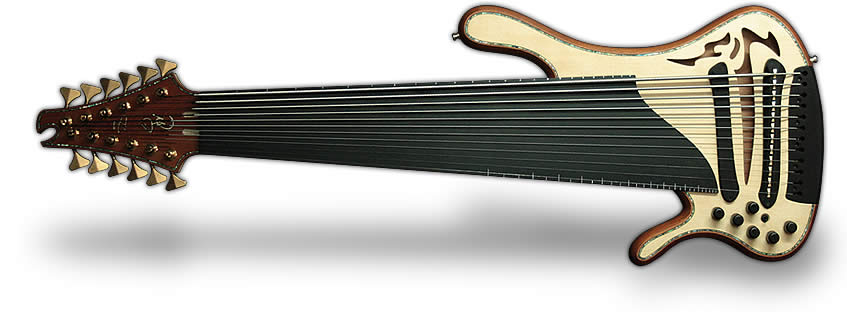
      I had seen Jerzy’s basses before in magazines, and their marvelous, organic shapes are easy to remember. This guy makes bold, innovative and daring concepts come to life (check out the 12 string model he once created — that’s 12 string bass, not guitar.

      Obvious comparisons to the architecture of Antoni Gaudi come to mind when looking at the undulating organic shapes of his basses. I asked about this however Jerzy told me that if that if there is a relation between his bass designs and modernism of Gaudi’s colossal influence on Barcelona, it is unintentional. He just follows his gut when designing.

      To look at the finished products, you would think that these bass guitars are built completely by hand – soup to nuts – however I was shocked and impressed to find out that Jerzy is as much a technologist as a craftsman.

      While Jerzy used to build all his basses completely by hand, he has been able to evolve his methods using technology in a way that allows him to keep the same aesthetic and quality, but cut down on the time he spends on the less intricate portions of the labor in making a bass. This actually allows him to focus more effort and time on the craftsmanship parts like inlays and custom bodies and detail work.

      I want to emphasize here that he is using technology as part of his art and not replacing it. It is a modern approach to craftsmanship and he has been able to increase his throughput, while still maintaining an independent shop he runs by himself.

      Design and Wood Shop
      Jerzy uses software by Rhinoceros and MecSoft (VisualMill) to design the initial bodies of most of his bass guitars these days and has his cutting machines in the lower area of his studio networked directly to his computer workstation.

      His basic designs are mechanically hewn from the wood and then he works the gorgeous details and inlays (of which there are many) by hand. With this approach he is better able to meet increased demand for his basses.

      The Sound
      There was no way I was getting out of his shop without playing one of his basses. His Obsession 4-string model was in the foyer of his studio and I played it. Jerzy ran the camera while I showed off a bit.

      The video doesn’t accurately communicate all of the tonal qualities of the bass, but trust me, the lows were rich and the highs cut through easily. Light and sturdy, the bass was a dream to play and the extra detail Jerzy puts into his bass guitars is noticeable in the feel of this instrument. It has a unique, comfortable, feel.

      So What Am I Really Saying Here
      It’s not unique that Luthiers use mechanized, computer aided tools these days, even at a small scale or in independent shops. It’s the contemporary way to produce. But for some reason, it is surprising to me that Jerzy’s basses are started this way — these just aren’t your every-day instruments. What I mean is that they just don’t look like this could come from a machine. And I guess they don’t really come from a machine. They come from Jerzy’s mind. The palette of his tools is just a modern way of working and evidence of his ability to innovate and adapt while hanging on to his vision — the mark of a great craftsman.

    • Move over iPad mini, Samsung unveils Galaxy Note 8.0

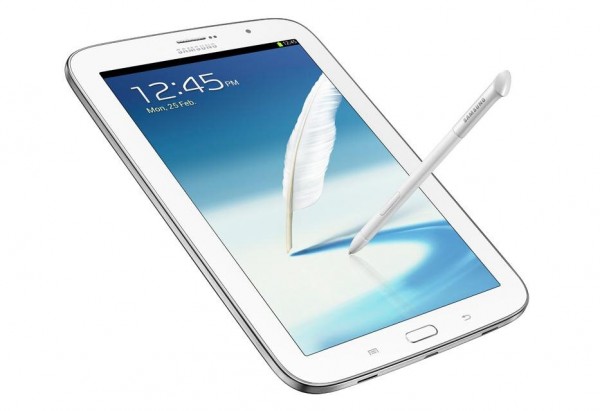
      Late February means another Mobile World Congress, and the rush to make big, splashy product announcements before the show starts. Samsung jumped in early today, by announcing an 8-inch tablet with stylus — Galaxy Note 8.0. The slate is about the same size as Apple’s iPad, with comparable screen resolution, but features the S Pen and supporting software. Why just touch and type when you can draw, too?

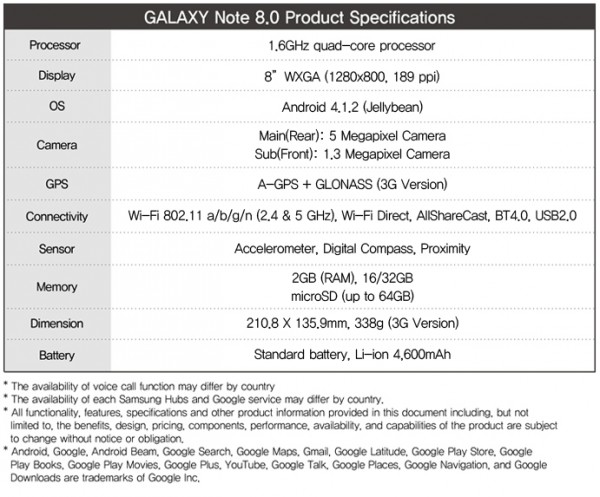
      Samsung’s slate joins the Galaxy Note II smartphone and 10-inch tablet, with stylus being the compelling feature that market leader Apple doesn’t offer on any iOS device. Like the recent update for its siblings, Galaxy Note 8.0 comes with a split-screen, multi-window function. The tablet runs Android 4.1.2 customized with TouchWiz UI.

      Galaxy Note 8.0 is slightly larger than iPad mini — 210.8 X 135.9mm, 338g vs 200 x 134.7mm, 312g, respectviely. Apple’s tablet has 7.9 inch display, with 1024 x 768 resolution and 163 pixels per inch, compared to the Note 8.0’s 1280 x 800 and 189 ppi. Samsung plans to start selling the new Note in second quarter.

      “Back in 2010 the launch of the first Samsung Galaxy Tab with 7 inch screen opened a new chapter in the mobile industry”, JK Shin, president IT & Mobile Communications Division, asserts. “The Galaxy Note 8.0 breaths fresh life into the category as it delivers the perfect fusion of portability and everyday productivity — the result is a pioneering, pocket-sized solution that enhances and enriches our everyday lives, whether at work or play”.

      Apple and Samsung are the industry leaders in the tablet market. During fourth quarter, iPad shipment share fell to 43.6 percent from 51.7 percent annually and from 46.4 percent sequentially. Samsung’s share rose to 15.1 percent from 7.3 percent year over year.

      Samsung has a long way to go to catch Apple, but the market is changing. During third quarter, Android tablet share pushed past 50 percent, snatching iPad’s early lead, according to IDC.

      “I think the big picture is that for many years people insisted that there wasn’t a tablet market, just an iPad market”, Tom Mainelli, IDC research director for tablets, says. “The last few quarter have shown that there is indeed a market for tablets beyond the iPad, although that product continues to be quite dominant from a vendor market share perspective”.

      Samsung’s renewed push into smaller slates is timely. According to NPD DisplaySearch, market demand shifts towards smaller, and lower-cost models. The firm forecasts that slates with 7-7.9-inch displays will account for 45 percent of shipments this year. By contrast, 9.7-inchers will fall to 17 percent — that’s the size of iPad. Apple introduced iPad mini in late October, in response to changing market conditions and consumer demand for small sizes.

    • Samsung Galaxy Note 8.0 preview

      Samsung Galaxy Note 8.0 Hands-on
      Samsung’s (005930) Galaxy Note 8.0 tablet has been one of the worst-kept secrets in recent memory, as rumors and leaks floating around the Web over the past few weeks have painted a fairly comprehensive picture of Samsung’s latest Note. But the Galaxy Note 8.0 is now finally official, and we met with Samsung on Saturday to take a look at its new slate ahead of the Mobile World Congress trade show, which kicks off on Monday.

      Continue reading…

    • Galaxy Note 8.0 Features Air View-Enhanced Flipboard App, Free Awesome Note For Android, And Other Content Perks

      note8-3

      The Galaxy Note 8.0 — the newest device in Samsung’s many-sized range of tablets, unveiled today at Mobile World Congress in Barcelona — has just managed to trump Apple’s iPad Mini in the small tablet category with one-tenth of an inch more of screen space (more on the device in our hands-on). At the same time, Samsung is also introducing a few new services and features — including expanded hovering capabilities and more apps, which it hopes will also help it gain more consumer ground against the world’s biggest tablet maker. The extra features show that Samsung sees improved services and content this as key to improving its market share in the tablet space.

      Don’t touch, just hover

      Samsung’s S Pen stylus has been upgraded to work both on the touchscreen of the Note 8.0 as well as with the physical navigation buttons, and Samsung is also extending the functionality of the pen in other ways. And the Air View feature, where users can initiate previews by hovering their pen over something without touching the screen, is now getting expanded to third party apps. The first of these is a new version of the Flipboard social newsreading app, where users can select and expand a tile by hovering the pen over a selection.

      Yes, you can argue that this is more of a gimmick than a useful element at this point: why, exactly, do you need to hover the pen over the over a tile when it’s just as easy to tap and select? And isn’t the point of the touchscreens that you can “touch” them? But I can also see how this could become more useful as the feature develops and gets used elsewhere. For example, one of the annoying issues with touchscreens are accidental clicks, such as those made on ads when you are trying to navigate around an app.

      Companies like Google are introducing ways of reducing accidental clicks; others are even playing around with the touchscreen to de-sensitize them for those with less precise fingers. But the hovering pen — whose pin of light needs to rest for a brief moment to select an item — could be another way to select what you want to see and do.

      In addition to the Flipboard app, the hovering already works with file folders, email, gallery views of photos and videos, a spokesperson notes, and it will also work with more apps in the future, as developers upgrade them to recognize and respond to the S Pen’s proximity to the screen.

      New apps, and new features in older apps

      With the Note 8.0, Samsung is also ushering in a couple of new developments on the apps front, in addition to the new version of Flipboard.

      In keeping with Samsung’s original vision of the Note acting as a kind of organizer and productivity device — more screen than a phone for planning; but smaller than a tablet to make it portable — Samsung has scooped an exclusive on a new Android app launch. Awesome Note, a note-taking that lets you track progress and make lists across different categories, has up to now only been available for iOS devices, where the full edition of the app for iPad retails at $4.99.

      Now developers Bird are releasing an Android version, and while this will also be sold as a paid app in the Google Play store, Samsung will be bundling it as a free app on the Note 8.0 “for at least a year,” according to Michael Lin, marketing manager, Samsung Electronics.

      Other apps that will be preloaded on the device include the newest version (2.0) of Chat-On, Samsung’s cross-platform, cross-media group and direct messaging service; Reading Mode that modifies the screen brightness for reading; and Smart Remote, Samsung’s universal remote control and electronic program guide, playing into the fact that nowadays a lot of consumers (80% in the U.S., claims Samsung) use a second device like a tablet while watching TV.

      Talk to me, but not everywhere

      The camera features, as Chris pointed out, are not brilliant on the Note 8.0 — and so we may not see too many people doing this with them:

      Nor, it seems, will we see many people in some parts of the world using the Note 8.0 to do this:

      Although the Galaxy Note 8.0 is incorporating, as Lin says, “all of the capabilities of a smartphone into a tablet,” the phone feature will be disabled on the device when it launches in the U.S., both in the initial WiFi version as well as in the 3G/LTE versions. Whether this is because carriers have asked Samsung to remove this to keep the device from cannibalizing handset sales, or whether it’s because of consumer taste, or for another reason entirely, is not clear.

      It’s a pity, because while you may not want always to talk on your tablet, it can come in useful as an occasional phone, both for video and voice calls. Our test of the phone found the voice quality decent.

      The voice calling feature will be included in the device when it launches in other parts of the world, Samsung says.

      Nortre Dame cathedral photo: Tumblr

    • Samsung sets sights on iPad mini with new Galaxy Note 8.0 tablet

      Samsung Galaxy Note 8.0 Release Date
      Samsung (005930) is finally gaining some momentum in the tablet market after a slow start with the original Galaxy Tab, which launched in late 2010. The South Korean consumer electronics giant now has a number of slates available in the 7- and 10-inch ranges, but Apple’s (AAPL) 8-inch iPad mini opened new doors for mid-size tablets following its release this past November. Samsung was already putting a mid-range tablet together when the iPad mini debuted last year, and now the company is finally ready to take the wraps off its latest Note series device: The Galaxy Note 8.0.

      Continue reading…

    • Samsung’s Galaxy Note 8.0 Will Make Its International Debut In Q2, We Go Hands-On

      note8-2

      That Samsung was tinkering with a slightly smaller Galaxy Note tablet shouldn’t come as a surprise, but consider this the final word if you still weren’t a believer. Samsung has just officially revealed that the Galaxy Note 8.0 is indeed a real product, and that it’s planning on rolling the tab out across the globe starting in Q2 2013.

      Though the company didn’t have anything firm to share when it came to release dates or pricing, it did have plenty to talk about in terms of hardware. The Note 8.0 tablet runs a TouchWiz’d version of Android 4.1.2 Jelly Bean, and sports a Exynos 4 Quad processor clocked at 1.6GHz, 2GB of RAM, and (you guessed it!) an 8-inch TFT LCD display running at 1280 x 800. Perhaps it’s not the most surprising spec sheet we’ll see here at MWC, but it’s certainly plenty of horsepower for a tablet this size and it shows (more on that later).

      Sadly, there’s no word yet on what the Note 8.0 will cost, though Samsung representatives were quick to peg the device as being “affordable.” Naturally though, that will all depend on the configuration you’re looking at — Samsung will be selling Wi-Fi and 3G models with either 16 or 32GB of internal flash storage. The company also confirmed that an LTE-friendly version of the Note 8.0 was in the works, and that it would eventually grace the United States thanks to some crucial carrier (yet unspecified) partnerships.

      TechCrunch got to take the Note 8.0 for a test drive earlier today, and it’s clear that Samsung has been doing some fine-tuning since the last time it release a Note tablet.

      In terms of design though, the Note 8.0 doesn’t really bring anything new to the table. As Darrell pointed out when the first batch of leaked images started making the rounds, it resembles a blown-up Note 2 phablet with its portrait orientation, physical home button, and soft key placement more than it does a Note 10.1 tablet. It’s significantly slimmer than the last pint-sized tablet Samsung pushed onto the market too/, which makes holding it with one hand is slightly more comfortable even though it has a larger display.
      Click to view slideshow.

      As you might expect, I was able to whip through homescreens, dive in and out of apps, and (most importantly) doodle to my hearts content with nary a hint of lag. I wasn’t able to run any benchmarks to prove my point conclusively, but the whole package felt snappier and more responsive than the Note 10.1 tablet. Part of that perceived performance boost can probably be attributed to Google’s Project Butter enhancements, but the snappy chipset and the fact that the pre-release software build was largely unfettered by cumbersome widgets and visual cruft didn’t hurt either.

      Cameras built into tablets very rarely impress, and that’s exactly the case with the Note 8.0’s 5-megapixel rear camera and 1.3-megapixel front-facer. Colors tended to be a little lifeless and washed out overall, and images snapped with the front-facing camera were grainy and unsatisfying. They’ll certainly do in a pinch if you absolutely have to take a photo, but it’s very likely that your phone’s camera would outshine the Note 8.0 any day.

      Speaking of software, the Note 8.0 is loaded up with the now-standard slew of S Pen-friendly apps and features, albeit with some nifty updates. Multi-window multi-tasking (my favorite feature on the Note 10.1) now lets users split screen their phone calls, and the S Note app has been updated with new templates and notably improved handwriting detection and recognition. It’s still not perfect, but the Note 8.0 was generally able to decipher my chicken-scratch with more accuracy than the last Note tablet.

      With the Note 8.0, Samsung has finally gotten around to cleaning up one of the Note series’ most annoying quirks. Despite being devices that leaned heavily on the S Pen to differentiate them from their competition, owners of the original Note and Note 2 phablets couldn’t actually use the pen to trigger the capacitive touch buttons. Thankfully, that’s no longer the case — better late than never, I guess.

      Like the Note 10.1 before it, the Note 8.0 also sports an IR blaster and a remote control/channel guide application courtesy of long-time partner Peel. It’s no secret that Samsung (like so many others these days) is looking to solidify itself as a force in the living room, and continuing this little trend is yet another way for Samsung to highlight the value of buying into its hardware ecosystem.

      And, perhaps most curiously, the 3G-friendly version of the Note 8 allows users to place voice calls. To my utter surprise, it actually worked very well: the Note 8’s microphone was sensitive enough to deliver reasonably crisp, loud audio even in a room full of eager, chatty tablet tinkerers. I can’t imagine many people taking advantage of this little feature (if only because you’ll look more than a little silly if you do), but that won’t be an issue for everyone — Samsung has said that the voice call feature won’t feature to make it to every region where the Note 8.0 will be sold.