Blog

  • Is the SharePoint bubble going to burst?

    My colleagues Tony Byrne and Shawn Shell (the lead analysts for our SharePoint Research ) recently reported on the hysteria generated around product announcements for SharePoint 2010 earlier this month in Las Vegas.

    As subscribers who received our latest SharePoint advisory paper know, there is plenty to be excited about in SP2010, especially if you belong to the SharePoint channel of resellers, consultants, developers, and system integrators. But over the past few weeks I have been noticing something of a shadow side to this excitement.

    I may well be wrong, but I am starting to get the distinct impression that the SharePoint bubble is about to burst. Or at the very least, that enthusiasm for SharePoint is waning and demand for the platform set will begin to plateau.

    Discussions with a number of ECM practice leads at major SIs (System Integrators) have told me that SharePoint is no longer perceived as a silver bullet by larger enterprise customers. SIs report that many purchased licenses have not gotten deployed, and that some hard lessons were learned when SharePoint was allowed to grow at viral rates. Once bitten twice shy.

    Without doubt SharePoint still has its fans within large organizations, but there is enough real world experience floating around now to recognize both SharePoint’s strengths and its limitations. Many large deals that would have simply defaulted to Microsoft and SharePoint a year or two ago, instead go out to competitive tender. These are not my only data points, but they start to paint a picture.

    SharePoint has been with us in one form or another for nearly 10 years now, longer if you consider SiteServer as its foundation point. It has been a huge success for Microsoft, and has without doubt transformed and invigorated not just the document management space, but at various times the portal, search, and collaboration sectors too. In terms of desktop integration and meeting the needs of end-users SharePoint has raised the bar.

    But time moves on, and SharePoint is not the only horse in the race (to mix a metaphor). SharePoint’s various features have never has been best-of-breed, and still aren’t today. For the SMB market SharePoint will remain a leader for a long time to come, and it will continue to play a key role in larger organizations. But SharePoint is a product just like any other, and subject to the same laws of fashion that all IT products endure, and I am getting the distinct impression that rather than trailblazing in 2010, SharePoint will subsist among the ranks of many other worthy ECM competitors.

  • Psychiatrist Delivers High-Risk Meds, Poor Care In Chicago Nursing Homes

    ProPublica/The Chicago Tribune examine the case of a controversial psychiatrist who delivered an anti-psychotic medication to thousands of Medicaid patients in Chicago’s nursing homes. “Dr. Michael Reinstein is one of the most prolific providers of psychiatric care in Chicago-area nursing homes and mental health facilities. But he is trailed by lawsuits and complaints while getting government reimbursement for seeing a large number of patients.”

    Reinstein received payments totalling nearly $500,000 over 10 years from the drugmaker AstraZeneca, and published several studies promoting its drug Seroquel. “During that period, Reinstein also faced accusations that he overmedicated and neglected patients who took a variety of drugs. But his research and promotional work went on, including studies and presentations examining many of the antipsychotics he prescribed on his daily rounds.”

    According to ProPublica/Tribune, several physicians have questioned the results of Reinstein’s studies. “Dr. Jerome Kassirer, a professor at Tufts University School of Medicine and a former editor of the New England Journal of Medicine, read the AstraZeneca e-mails at the request of ProPublica and the Tribune. He concluded that editors of medical journals should investigate Reinstein’s published studies. ‘Once you know that he has done a study that has been discredited,’ Kassirer said, ‘you have to ask yourself about all other studies done’” (Jewett and Roe, 11/10).

  • Health Reform Has Fiscal, Political Burdens For States

    “Bills in both the Senate and the House of Representatives would make more people eligible for Medicaid, the health insurance program for the poor that states administer with reimbursements from the federal government,” Reuters reports. The news service also notes that a mandate that people get coverage could mean rolls swell for the state-run programs that insure the poor. That could leave states “staring at spending millions of dollars they do not have to provide insurance to more people, officials said on Tuesday.” In California, officials are already concerned that the state can’t afford the program at its current scope (Lambert, 11/10).

    Meanwhile, The New York Times reports that “In the two weeks since the Senate majority leader, Harry Reid, embraced a proposal that would allow states to opt out of a new government health insurance plan, state leaders have begun debating whether to take part, and the question has emerged as a litmus test in some campaigns for governor. The proposal, which is being woven into the Senate health care bill, would shift some power to the states and would foist upon state leaders the burden of a choice that, in some cases, could pit principle and politics against pragmatism. States would be given the right to opt out of only the public plan, not from the tax increases needed to subsidize coverage for the uninsured.”

    Many governors – including Republicans – “see little to gain from denying constituents an insurance option that could help slow the growth of premiums at no immediate cost to the state… But in some conservative states, the public option… is such an anathema that lawmakers and governors may choose to stand against it” (Sack, 11/10).

    While national plans may impose some burdens on states, going it alone on health care can also be tough. In a separate article, The New York Times reports: “Maine is the Charlie Brown of health care. The state’s legislators have tried for decades to fix its system, but their efforts have always fallen short: health insurance premiums are still among the least affordable in the nation, health care spending per person is among the highest and hospital emergency rooms are among the most crowded. … But like the Peanuts character, the state keeps trying” (Harris, 11/10).

  • Apple Fans Respond To The “Droid Does” Advertising Campaign

    The Motorola Droid advertising campaign is in full swing, and I’m sure by now you’ve seen the commercials, if not you can see the commercial below. Basically, the campaign is all about taking digs at the iPhone while showing Motorola’s support for the Android OS.

    If you’re un-familiar with the Droid, it’s the first Android-based smartphone that will be sold exclusively by Verizon Wireless. Why is this fact important? Verizon currently has more than 86 million wireless subscribers, and will be the largest wireless carrier to date to support an Android-based device.

    Is Motorola’s Droid an iPhone killer? Let us know your thoughts

    Some Apple fans aren’t taking the "Droid Does" campaign very well, as they’ve created their own take/spoof of the commercial, you can see it below.

    Can the Droid succeed, by knocking off the iPhone, where so many other smartphones have failed (I’m looking at you Blackberry Storm and Palm Pre)? Let us know what you think.

    Related Articles:

    iPhone Vs. gPhone

    Top Mobile Searches, Viral Videos of 2008

    Staying On Top Of Android And The Mobile Market

    Android Users Outspending iPhone Counterparts

    Google Product Search For Mobile Goes To More Devices

    Google’s Panoramio Gets an iPhone App

  • The HTC HD2 gets torn apart, violated, and photographed

    htc
    Here it is, the HTC HD2 dissection. You knew someone was going to do it. After all, it is the hotest Winmo phone ever constructed. Click through for about 7.5 seconds of enjoyment as you skim the rest of the pics.


  • Bipartisan Support Emerging On Hill For Commission To Control Health Costs

    Kaiser Health News staff writer Eric Pianin reports on the growing Capitol Hill interest in a commission to control health costs. “The drive on Capitol Hill to create a bipartisan entitlement and tax reform commission to help ‘bend the cost curve’ of health spending and address mounting deficits picked up momentum yesterday, as Senate Minority Leader Mitch McConnell and a handful of moderate Democrats and Republicans voiced support for the effort (11/11). Read entire story.

  • Lake Capital Sells Archstone Consulting

    Lake Capital has sold Stamford, Conn.-based Archstone Consulting to The Hackett Group Inc. (Nasdaq: HCKT). No financial terms were disclosed.

    PRESS RELEASE

    The Hackett Group, Inc. (Nasdaq:HCKT), a global strategic advisory firm, today announced the acquisition of Stamford, Connecticut based Archstone Consulting, LLC (“Archstone”). Archstone is a leading strategy, operations and CFO advisory consultancy with primary focus in the consumer goods, retail, manufacturing, pharmaceutical and utility industry sectors.

    This acquisition brings many strategic synergies to Hackett. Through its 130+ highly skilled associates throughout the U.S. and Western Europe, Archstone will provide Hackett with new industry-focused supply chain and procurement consulting capabilities which will strongly complement Hackett’s existing offerings. Additionally, Archstone adds CFO centric capabilities which will significantly expand Hackett’s Enterprise Performance Management transformation capabilities and which will strongly complement Hackett’s existing Hyperion/Oracle EPM implementation offerings. Archstone will also further enhance the IT Strategy and BPO Advisory capabilities within Hackett.

    The Hackett Group brand is recognized globally for its ability to use our proprietary benchmarking data and best practice implementation capabilities to help clients achieve sustainable performance improvement. Archstone uses their strong industry understanding to transform client organizations through the design and implementation of scalable operations and CFO centric solutions. As one combined company, Archstone will now broaden Hackett’s ability to serve clients across the entire enterprise.

    With approximately 80% of its revenues and associates located in the U.S., Archstone significantly expands Hackett’s service delivery capabilities in the Northeast, Midwest and Western regions of the USA. Additionally, Archstone will further expand Hackett’s presence in the UK and in the Netherlands.

    Todd Lavieri, CEO of Archstone, will lead the new Global Industries and Strategic Account Management effort for Hackett. “The Archstone – Hackett combination offers our clients a significantly expanded set of offerings along with our rich industry perspective and collaborative client service focus,” stated Lavieri. “Having access to Hackett’s proprietary intellectual capital allows us to further enhance our value proposition and serve clients in a way that is truly unique to Hackett.”

    “Archstone adds many strategic dimensions to our organization,” said Ted A. Fernandez, Chairman and CEO of The Hackett Group. “In addition to a very talented group of principals and associates with strong industry focus, we are acquiring a leading consulting brand in the strategy, operations and CFO areas which strongly complement our existing offerings. We are also delighted to welcome Terry Graunke, Chairman of Lake Capital and Archstone’s largest shareholder, to the Board of Directors of The Hackett Group.”

    About The Hackett Group, Inc.

    The Hackett Group, Inc. (NASDAQ: HCKT), a global strategic advisory firm, is a leader in best practice advisory, benchmarking, and transformation consulting services, including shared services, offshoring and outsourcing advice. Utilizing best practices and implementation insights from more than 4,000 benchmarking engagements, executives use The Hackett Group’s empirically-based approach to quickly define and implement initiatives to enable world-class performance. Through its REL brand, The Hackett Group offers working capital solutions focused on delivering significant cash flow improvements. Through its Hackett Technology Solutions group, The Hackett Group offers business application consulting services that help maximize returns on IT investments. The Hackett Group has worked with 2,700 major corporations and government agencies, including 97% of the Dow Jones Industrials, 73% of the Fortune 100, 73% of the DAX 30 and 50% of the FTSE 100.

    Founded in 1991, The Hackett Group was acquired by Answerthink, Inc. in 1997. Answerthink was renamed The Hackett Group, Inc. in 2008. The Hackett Group has global offices in the United States, Europe and Asia/Pacific.

    More information on The Hackett Group is available: by phone at (770) 225-7300; by e-mail at [email protected]; or on the Web at www.thehackettgroup.com.

    About Archstone Consulting, LLC

    Archstone Consulting is a leading Strategy and Change, Operations and CFO Advisory management consulting firm, specializing in the consumer products, retail, life sciences and general manufacturing industries. Archstone Consulting helps companies restructure and reduce their costs, while improving their business processes and operations. Headquartered in Stamford, Connecticut, Archstone Consulting has offices in Amsterdam, Chicago, New York and San Francisco. For additional information, please visit us at www.archstoneconsulting.com.

    ShareThis


  • Tiburon Adds On

    Tiburon, a Gores Group portfolio company focused on automated public safety and security solutions, has acquired the data applications business of Positron Public Safety System. No financial terms were disclosed.

    PRESS RELEASE

    The Gores Group has announced its acquisition of the Positron Data Applications business through an affiliate of its portfolio company Tiburon, Inc. This acquisition strengthens Tiburon’s dedication to increasing and improving next generation technology solutions for public safety agencies, both expanding the breadth of product offerings to clients as well as increasing Tiburon’s ability to serve additional markets, including international markets. The newly acquired business is renamed as Positron Front Line. Terms of the transaction were not disclosed. The transaction does not include the Positron Call Handling business.

    Positron Front Line intends to make significant investments in next generation integrated 9-1-1 solutions, including computer aided dispatch (CAD), records management and mobile solutions.

    “Tiburon’s commitment to providing industry leading solutions for public safety remains paramount to us,” said Jeffrey P. Stone, president and CEO of Tiburon. “Tiburon continues to build on our core competencies in dispatch, records management, mobile and corrections solutions. We continue to invest in our current product line, organic growth in Tier 2 and with this acquisition – smaller public safety agencies, international opportunities and next generation 9-1-1.”

    “This acquisition offers a great opportunity for Tiburon, but also provides stability, investment and focus to the Positron Front Line business. It is a significant boost for existing and potential clients and Tiburon will be a welcome partner to over 220 additional agencies that will now be served by Gores and Tiburon,” said Ian Archbell, general manager of Positron Front Line.

    More than 60 million citizens across the U.S. rely on the services of public safety organizations that Tiburon serves and more than 375 agencies have chosen the company due to the performance, scalability, reliability and interoperability of its technology solutions. Tiburon and Positron Front Line together now serve more than 500 agencies worldwide.

    About Tiburon

    Established in 1980, Tiburon is the industry-leading provider of automated public safety and security solutions to meet the demanding and complex needs of law enforcement, fire and rescue and corrections agencies. Tiburon offers fully integrated solutions including computer aided dispatch, records management, mobile data and communications, field reporting and corrections management solutions. From mission-critical conditions to daily operations, across complex multi-agency and multi-jurisdictional environments, Tiburon’s integrated solutions have set the industry standard for capability, scalability and reliability for more than 29 years. For more information, visit www.tiburoninc.com or call 800-428-5534.

    About The Gores Group, LLC

    Founded in 1987, The Gores Group, LLC is a private equity firm focused on acquiring controlling interests in mature and growing businesses which can benefit from the firm’s operating experience and flexible capital base. The firm combines the operational expertise and detailed due diligence capabilities of a strategic buyer with the seasoned M&A team of a traditional financial buyer. The Gores Group, LLC has become a leading investor having demonstrated over time a reliable track record of creating substantial value in its portfolio companies alongside management. The firm’s current private equity fund has committed equity capital of $1.7 billion. Headquartered in Los Angeles, California, The Gores Group, LLC maintains offices in Boulder, Colorado and London. For more information, please visit www.gores.com

    ShareThis


  • James Collins Joins Roark Capital

    James Collins has joined Roark Capital Group as a vice president focused on franchise investments. He previously was a principal with Stone Tower Equity Partners.

    PRESS RELEASE

    After closing three deals in the past two months, Roark Capital Group, an Atlanta-based private equity firm specializing in the franchise sector, announced today that it has hired a new vice president to support their franchise investment team. Vice President James L. Collins will be primarily responsible for sourcing, evaluating and executing franchise investments at Roark.

    “James joins us at an ideal time as our pipeline of potential franchise opportunities continues to grow,” said Neal Aronson, founder and managing partner at Roark Capital Group. “His extensive experience in multi unit, consumer and retail industries, along with his professional character and leadership skills, makes him a valuable asset to our team.”

    In September 2009, Roark announced it acquired its 15th franchise brand, Pet Valu, Canada’s leading small-format specialty retailer and distributor of pet food and supplies. A few weeks later, Roark closed on a $100 million investment in Waste Pro, one of the Southeast’s leading non-hazardous solid waste management companies. In October 2009, Roark announced that it increased its investment in its portfolio company PSC Info Group to support PSC’s acquisition of outsourced data management services company North Shore Agency, Inc.

    Prior to joining Roark, Collins was a Principal at Stone Tower Equity Partners, a $2.5 billion private equity firm. Previously, Collins was a Director at Parish Capital Advisors, as well as a Principal at Bruckmann, Rosser, Sherrill & Co. Collins started his career at Bain & Company before joining Bowles Hollowell Conner & Co.

    “Joining Roark provided me with a tremendous opportunity to work alongside a talented team of professionals who are held in high regard throughout the franchise industry,” Collins said. “I have a great deal of respect for Roark’s strong core values, best practices and investment philosophies.”

    Collins graduated magna cum laude from Howard University in Washington D.C. with a BBA in Accounting and received his MBA from the Harvard Business School in Boston, MA. He currently serves on the board of directors of Children for Children, a non-profit organization dedicated to teaching the value of civic engagement and demonstrating that, no matter how young, everyone has something to give.

    Earlier this year, Roark announced the addition of former Cinnabon President Geoff Hill, also as a Vice President, to build on its team of professionals with more than 100 collective years of operating and investment experience in the franchise industry.

    About Roark Capital Group
    Roark Capital Group is an Atlanta-based private equity firm that specializes in business and consumer service companies with attractive growth prospects and revenues ranging from $20 million to $1.0 billion. Roark focuses on middle-market investment opportunities through familyowned business transfers, management/corporate buyouts, recapitalizations, going-private transactions, and corporate divestitures. Roark has acquired 15 franchise/multi-unit brands that collectively have more than 45,000 points of distribution, 2,600 franchisees, and $3.7 billion in system-wide revenues across 50 states and 36 countries. Its current franchise portfolio includes such well known brands as Carvel, Cinnabon, Schlotzky’s, Moe’s Southwest Grill, Seattle’s Best Coffee International, McAlister’s Deli, Money Mailer, Fast Signs, Batteries Plus, Primrose Schools and Pet Valu. The firm has more than $1.5 billion of equity capital under management.

    For more information, visit www.roarkcapital.com.

    ShareThis


  • Cavium Buying Montavista Software for $50 Million

    Cavium Networks (Nsdaq: CAVM) has agreed to acquire MontaVista Software Inc., a Santa Clara, Calif.-based provider of Linux operating systems and development tools. The deal is valued at $50 million, including $16 million in cash and around $34 million in Cavium stock. MontaVista has raised over $90 million in VC funding since 1999, from firms like Alloy Ventures, Aplix, NEC, US Venture Partners and Siemens Venture Capital. 

    PRESS RELEASE

    Cavium Networks (NASDAQ: CAVM), a leading provider of highly integrated semiconductor products that enable intelligent processing for networking, wireless, storage and video applications, today announced that it is has signed a definitive agreement to acquire MontaVista Software for $50 million, comprised of approximately $16 million in cash and approximately $34 million in Cavium Networks common stock. The deal is expected to close in December 2009. This acquisition will significantly increase Cavium’s software and services revenue, and is expected to be gross margin and non-GAAP earnings accretive in 2010 and beyond.

    Today embedded Linux is fast becoming the operating system of choice for hundreds of millions of devices ranging from very large carrier grade equipment to consumer electronics. Traditionally embedded devices used a proprietary OS or commercial real-time operating system. However, there is a major trend towards using embedded Linux. This rapid adoption of Linux in embedded networking, wireless, consumer electronics, mobile devices and storage is driving the demand for a high quality, commercial grade embedded Linux along with support for multi-core processors and embedded virtualization.

    MontaVista Software is a leader in multi-core embedded Linux operating systems, virtualization, development tools and professional services with a broad array of Tier-1 customers. As the first commercial embedded Linux vendor, MontaVista provides the industry’s leading Carrier Grade Linux that has been widely adopted by industry leading companies that include Alcatel-Lucent, Cisco, Ericsson, Fujitsu, NEC, Nokia-Siemens, NTT, Motorola, Samsung and many other Tier-1 vendors. MontaVista is also the innovation leader in the embedded Linux market segment with deployments in Tier-1 Consumer Electronics manufacturers such as Sony, Samsung and Philips; MID and Mobile vendors such as NEC and Garmin; Industrial Automation vendors such as HP, Kyocera-Mita and Fuji Xerox and leading Automotive infotainment suppliers. One of MontaVista’s signature, high profile deployments includes Dell’s latest innovative enterprise notebook the Dell Latitude ON™ that uses MontaVista’s Montabello software platform.

    “Software is becoming an increasingly important part of the total solution with the rapidly increasing adoption of multi-core processors,” said Syed Ali, President and CEO of Cavium Networks. “This acquisition will complement Cavium’s market leading processor portfolio with world-class software expertise and will enable us to deliver highly compelling and differentiated solutions to the market.”

    “Embedded Linux is poised for rapid growth,” said Rusty Harris, President and CEO, MontaVista Software. “By becoming part of Cavium Networks, MontaVista can confidently continue to offer industry leading commercial grade embedded Linux, support and services to our customers and partners.”

    After the acquisition, MontaVista Software will run as a separate operating unit and will retain the MontaVista brand name. In addition, Cavium Networks will continue the MontaVista business model and support embedded Linux on multiple architectures from multiple processor vendors. MontaVista will maintain its own dedicated and focused engineering, sales and product management staff. MontaVista’s customers and partners will see no change in customer facing field operations and the web-based support and product download sites will be maintained.

    “MontaVista is a leader in embedded Linux support and is a key software partner in the ARM® ecosystem,” said Warren East, CEO, ARM. “We believe as part of Cavium Networks, an existing ARM Partner, MontaVista will continue to deliver innovative Linux solutions optimized for current and future energy-efficient ARM processors and the range of silicon platforms which are based on them. This strategy is closely aligned with ARM’s approach of enabling a broad ecosystem with the flexibility and choice needed to fuel differentiated market solutions across a range of application areas.”

    “MontaVista and MIPS have been close partners since 2001,” said John Bourgoin, President and CEO of MIPS Technologies. “The combination of Cavium Networks and MontaVista is extremely promising for the continued availability of commercial and carrier grade Linux on the industry leading MIPS-based processors. We look forward to working together to enable the availability of MontaVista Linux on all licensed MIPS cores.”

    Conference Call

    Cavium Networks will broadcast a conference call today, November 10, at 2:00 p.m. Pacific time (5:00 p.m. Eastern time) to discuss more details regarding this acquisition. The conference call will be available via a live web cast on the investor relations section of the Cavium Networks website at http://www.caviumnetworks.com. Please access the website at least a few minutes prior to the start of the call in order to download and install any necessary audio software. An archived web cast replay of the call will be available on the web site for a limited period of time.

    About Cavium Networks

    Cavium Networks is a leading provider of highly integrated semiconductor products that enable intelligent processing in networking, communications, storage and security applications. Cavium Networks offers a broad portfolio of integrated, software compatible processors ranging in performance from 10 Mbps to 20 Gbps that enable secure, intelligent functionality in enterprise, data-center, broadband/consumer and access & service provider equipment. Cavium Networks processors are supported by ecosystem partners that provide operating systems, tool support, reference designs and other services. Cavium Networks principal offices are in Mountain View, CA with design team locations in California, Massachusetts and India. For more information, please visit: http://www.caviumnetworks.com.

    About MontaVista Software

    MontaVista Software, Inc. is a leader in embedded Linux commercialization,helping embedded developers get the most out of open source by adding commercial quality, integration, hardware enablement, expert support, and the resources of the MontaVista development community. Because MontaVista customers enjoy faster time to market, more competitive device functionality, and lower total cost, more devices have been deployed with MontaVista than with any other Linux. To learn more, please visit www.mvista.com

    ShareThis


  • Downloadable PC Full Version Freeware Real-Time Strategy (RTS) League of Legends

    [Placeholder post for my review of this game.]

    This DotA clone is from Steve “Guinsoo” Feak, one of the creators of DotA All-Stars.

    Download links after the jump.

    The installer installs the latest DirectX components and Adobe AIR. After installation, the game automatically searches for updates. Cool.

    >>>Get the downloadable PC full version freeware real-time strategy (RTS) game here (UK version)

    >>>Get the downloadable PC full version freeware real-time strategy (RTS) game here (US version)

    >>>Get the gameplay walkthrough movie from here

  • Ingenix Buying CareMedic

    Ingenix has agreed to acquire CareMedic, a St. Petersburg, Fla.-based provider of healthcare revenue management software. No financial terms were disclosed. CareMedic has raised over $25 million in VC funding, from firms like Wellmark, CB Health Ventures, Oak Investment Partners, Pappajohn Capital and Iowa Seed Capital Corp.

    PRESS RELEASE

    TripleTree is pleased to announce that its client, CareMedic, an industry leader in revenue cycle management (RCM) solutions, will be acquired by Ingenix, a leading health information, technology and consulting company, in a cash transaction.

    TripleTree acted as the exclusive financial advisor to CareMedic.

    With the acquisition of CareMedic, Ingenix will offer solutions that address each major component of the hospital revenue cycle: patient registration, eligibility verification, financial clearance, coding and compliance, bill submission, denials management, and remittance processing. Ingenix and CareMedic’s combined products and services will create a comprehensive suite of solutions for hospitals to manage the revenue cycle and improve financial performance – from the time a patient begins the registration process with a health care provider to the time payment for that care is received. This will be the industry’s only enterprise-wide solution that identifies inefficiencies as they occur, so clients can take practical actions to receive appropriate reimbursements and reduce costs throughout the process.

    CareMedic provides hospitals with an enterprise platform of enabling technologies and services that optimize revenue cycle efficiency and improve cash flow, margins and productivity. The Company’s products and services include the Electronic Financial Record (eFR®) platform, which makes nearly real-time patient financial information accessible across departments within a hospital, helping clients take the right actions at every step of the revenue cycle to receive payments faster and more efficiently. With the eFR platform, CareMedic provides the industry’s most complete, historical view of a patient’s consolidated financial record with a provider organization. CareMedic’s capabilities will complement Ingenix’s coding and compliance expertise and automated credit balance resolution provided by its INTELLIJET® platform.

    Sheila Schweitzer, CEO of CareMedic, said, “With Ingenix’s expertise in reimbursement, health information management and consulting, and our expertise in enterprise-wide RCM, we will create a unified solution that makes hospitals more efficient at managing cash flow and enhances our commitment to helping clients get paid. As part of Ingenix, we will be able to provide clients with additional services and continued innovations that help them use capital more effectively and improve operational efficiency.”

    Andy Slavitt, CEO of Ingenix, said, “Innovation and talent are key to solving health care’s biggest challenges. We’re combining the great teams at CareMedic and Ingenix to deliver innovation with the common vision of simplifying the system, reducing waste and centering health care around the patient.”

    “Caremedic is the only company in the industry with a true-end-to-end RCM data and process integration capability that leverages a patient-centric data model. In combination with the coding, content, and transformational services of Ingenix, the combined company will be a significant competitor in the provider RCM sector,” said Scott Tudor, TripleTree Managing Partner.

    The CareMedic transaction has been announced on the heels of TripleTree’s representation of Anodyne Health Partners in its sale to athenahealth. TripleTree has now closed over $1.5 billion in RCM, HIT, and HC BPO transactions over the last four years.

    About TripleTree, LLC

    TripleTree, LLC is an independent investment banking firm focused on mergers and acquisitions, financial restructuring, principal investing, and strategic advisory services for healthcare and technology companies. The firm specializes in growth businesses, vertical industry specialization, and disruptive technology delivery models. For more information, go to www.triple-tree.com

    ShareThis


  • VC-Backed Alder Biopharma Signs $1 Billion Deal with Bristol-Myers

    Bristol-Myers Squibb Co. (NYSE:BMY) has signed an agreement with Bothell, Wash.-based Alder Biopharmaceuticals Inc., for the development and commercialization of a novel biologic that has completed Phase IIa development for the treatment of rheumatoid arthritis. The deal includes an $85 million up-front cash payment, and up to $764 million in additional milestone payments.

    Alder Biopharmaceuticals has raised around $67 million in VC funding from firms like Delphi Ventures and TPG Biotech co-led the round, and were joined by return backers Sevin Rosen Funds, Ventures West, H.I.G. Ventures and WRF Capital.

    PRESS RELEASE
    Bristol-Myers Squibb Company (NYSE:BMY) and Alder Biopharmaceuticals, Inc.,today announced a global agreement for the development and commercialization of ALD518, a novel biologic that has completed Phase IIa development for the treatment of rheumatoid arthritis.

    Under the terms of the collaboration agreement, Alder will grant to Bristol-Myers Squibb worldwide exclusive rights to develop and commercialize ALD518 for all potential indications except cancer, for which Alder will retain rights and grant Bristol-Myers Squibb an option to co-develop and commercialize outside the United States. An upfront cash payment of $85 million, potential development-based and regulatory-based milestone payments of up to $764 million across a range of indications, potential sales-based milestones which, under certain circumstances, may exceed $200 million, and royalties on net sales are payable to Alder by Bristol-Myers Squibb. Alder has an option to require Bristol-Myers Squibb to make an equity investment of up to $20 million in Alder during an initial public offering. “With its novel mechanism of action, ALD518 has the potential to offer an exciting new option for patients with rheumatoid arthritis,” said Brian Daniels, M.D., senior vice president, Global Development & Medical Affairs, Bristol-Myers Squibb. “We are pleased to have the opportunity to develop this novel monoclonal antibody. As part of our String of Pearls strategy, this transaction provides Bristol-Myers Squibb with the opportunity to strengthen our immunoscience pipeline, and leverage our company’s experience in developing and delivering novel biologics to help patients prevail over rheumatoid arthritis and, potentially, other autoimmune diseases.”

    “Bristol-Myers Squibb and Alder share the vision that ALD518 could become an important part of treating patients with rheumatoid arthritis,” said Randall C. Schatzman, Ph.D., president and chief executive officer of Alder Biopharmaceuticals. “Bristol-Myers Squibb’s extensive development and commercial experience in immunology translate into an exceptionally good fit for Alder, especially at this stage of our corporate development.”

    The effectiveness of the collaboration agreement is subject to antitrust clearance by the United States Federal Trade Commission and Department of Justice, under the provisions of the Hart-Scott-Rodino Antitrust Improvements Act of 1976, and other customary regulatory approvals.

    About ALD518

    ALD518 is a humanized, monoclonal antibody, designed to block a pro-inflammatory molecule called interleukin-6 (IL-6), which plays a key role in the inflammatory cascade leading to the inflammation, swelling, pain, and destruction of large and small joints associated with rheumatoid arthritis. Based on the strong association of IL-6 with inflammatory disease, inhibition of IL-6 with ALD518 represents a promising new anti-inflammatory mechanism that could result in bone and joint preservation. ALD518 has completed Phase IIa development for rheumatoid arthritis. ALD518 is also being studied by Alder for the treatment of cancer and in cancer supportive care.

    About Rheumatoid Arthritis

    Rheumatoid arthritis (RA) is a systemic,(1) chronic, autoimmune disease characterized by inflammation in the lining of joints (or synovium), causing joint damage with chronic pain, stiffness, swelling and fatigue.(2) RA causes limited range of motion and decreased function as a result of affected joints losing their shape and alignment.(3)

    RA affects about one percent of the world’s population,(4) including more than one million people in the United States.(1 )The condition is more common in women than in men, who account for 75 percent of patients diagnosed with RA.(2)

    About Bristol-Myers Squibb

    Bristol-Myers Squibb is a global biopharmaceutical company committed to discovering, developing and delivering innovative medicines that help patients prevail over serious diseases. For more information, please visit www.bms.com.

    About Alder

    Alder Biopharmaceuticals, Inc. uniquely identifies, develops, and manufactures novel antibody therapeutics to alleviate human suffering in the autoimmune and inflammatory disease areas. Alder’s management team combines decades of industry experience with a proven track record for identifying and developing novel antibody therapeutics and enabling partners through the out-licensing of its technologies. In addition to Bristol-Myers Squibb, partners include Schering-Plough, Seattle Genetics, Genmab, and two non-disclosed large pharmaceutical companies. For more information, visit www.alderbio.com.

    ShareThis


  • Apple tops Nokia in cell phone profits

    new-iphone-3g-in-stores

    Perhaps it would be better to rename it the iPhone 3G$? Do you see what we did just there? Today, Reuters is reporting Apple overtook Nokia as the handset company with the highest total operating profit in the September quarter; the last time Nokia did not hold this title was Q3 of 2007. What does this mean? The iPhone generates a lot of revenue for the Cupertino computer maker. Apple sold 7.4 million iPhones in the July to September quarter to generate sales of $4.5 billion, Nokia on the other hand sold 108.5 million handsets and generated sales of $10.36 billion. Apple nudged out Nokia in revenue mainly due to other financial obligations and the economic downturn. You don’t need an abacus to figure out the iPhone is a huge part of Apple’s earnings. No panic out of the Nokia camp however, with the release of the N900 they’re confident in their ability to take back the top spot on the podium. One thing is for certain, we’ll be purchasing several of these Linux powered, A8 processor havin’, numbers. How about you?

    Read

  • The EU takes a signficant step forward by committing to articulate the “Protect, Respect and Remedy” framework at the EU level

    “The European Union and its Member States should take a global lead and serve as a good example on CSR when building markets, combating corruption, safeguarding the environment and ensuring human dignity and human rights in the workplace”. This is the opening statement of the joint declaration the Swedish EU presidency and the Spanish upcoming one have made public today (November 11th) in Stockholm.

    JPG - 77.8 kb
    Professor John Ruggie, Ewa Björling, Swedish Minister for Trade and Juan José Barrera Director General Labour Ministry, Spain
    Photo: Katarina Tracz/UD

    The declaration comes a result of a 2 day conference organised by the EU Swedish presidency and the European Commission with the objective to move forward on the operationalisation of the “Protect, Respect and Remedy” UN framework on the issue of Business and Human Rights at the EU level.

    The declaration can be found here and also attached below.

    Participants in the conference have discussed at length the implications of the “Protect, Respect and Remedy” framework in the EU context.

    The European Coalition for Corporate Justice has welcomed the Swedish initiative and has actively participated in the conference by speaking in the panel dedicated to “The state as a regulator”.

    Find ECCJ’s intervention below.

    More information about the conference, the opening speeches by keynote speakers such as John Ruggie, Mary Robinson or the Swedish Trade minister Ewa Björling can be found here.

  • Consumers Are Looking for Offers on Social Networks

    Razorfish has released a wealth of interesting data about consumer online behavior, and a good deal has to do with social media and brand interaction. For those struggling to find the right use of social networks for their business, the data is worth paying attention to.

    The data is based on a survey of 1,000 consumers in the US, about half male and half female. They cover four major age groups and 10 major cities.

    "To avoid duplicating the more broad-based work of Pew, Forrester, and other research firms, our goal was to survey what we call "connected consumers,’" Razorfish explains. These connected consumers have broadband access, have spent at least $150 online in the past six months, have visited a "community site" (MySpace, YouTube, Facebook, Yelp, etc.), and have consumed or created some form of digital media like photos, videos, music, or news.

    "Based on previous Razorfish consumer research, we have found that these ‘connected consumers’ roughly mirror the U.S. population with broadband access. According to the Pew Internet & American Life Project, about 63% of all Americans today have a high-speed Internet connection, up from only 55% in 2008. This translates to roughly 200 million people, based on a July 2009 population estimate from the CIA World Factbook (total population 307,212,123, July 2009 estimate)."

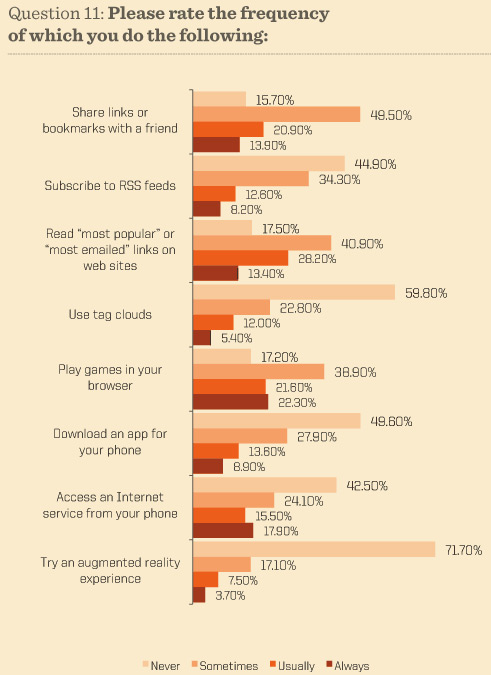
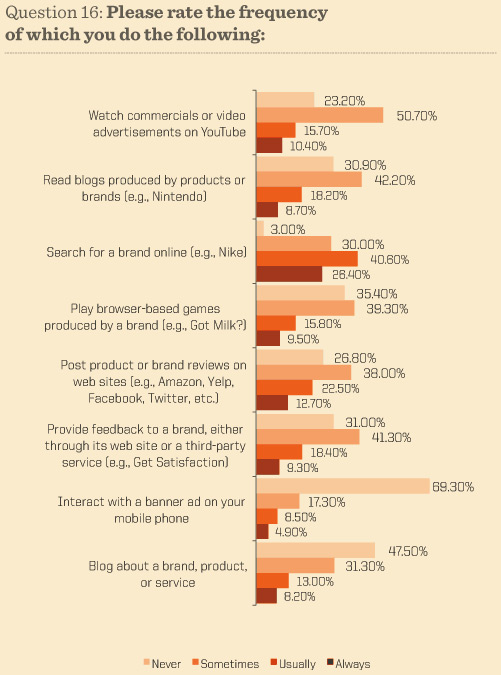
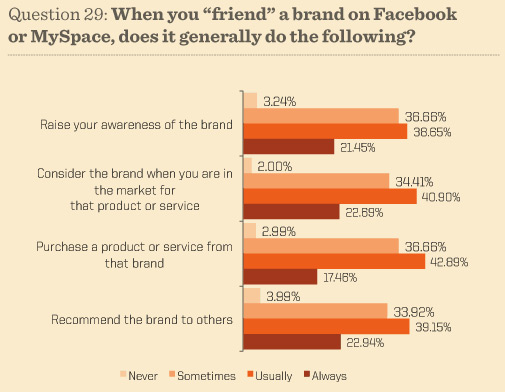
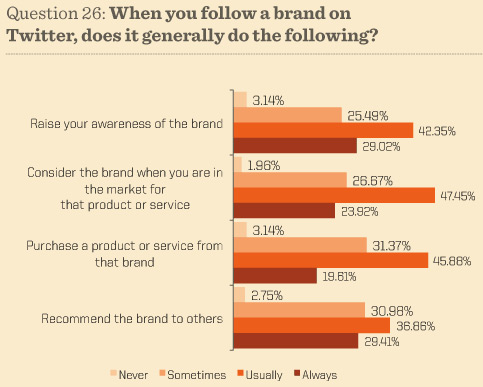
    In other words, pay attention to the results. You can find them all here. I wanted to highlight a few of the particularly interesting ones here, which pertain to social media use. They paint a pretty good picture of what consumers are looking for from brands on social networks (although these are certainly not the limits of what companies can do with them).

    Razorfish - How often do you do the following?

    Razorfish - How often do you do the following?

    When you friend someone on MySpace or Facebook

    When you follow someone on Twitter

    Beyond the data in the above graphs, another point worth mentioning derived from the research is that for Facebook, MySpace, and Twitter, those who follow brands are mostly looking for exclusive deals or offers. This mentality will likely increase moving forward as deals get more personalized as well.

    Like Jeremiah Owyang recently discussed with WebProNews, sites can connect with existing networks like Facebook, Twitter, etc. (think Facebook Connect and similar services), and in the future, people may be able to log-in to corporate sites with their Facebook (or whatever) account, which will bring up their profile information for companies to serve personalized content (or perhaps personalized deals).

    The point is, consumers are clearly more than willing to interact with brands through social media, and this will likely become increasingly true as social networks themselves gain more users. It’s not only about pushing your offers out there and hoping people bite. People are becoming friends/fans of brands hoping you do give them special offers.

    Interesting new marketing opportunities are going to continue to present themselves moving forward as networks get more advanced and more brands figure out new ways to use them.

    Related Articles:

    How Big Brands Use Social Media

    Some Brands Have Good Ideas For Social Media. Do You?

    Forums Are Relevant in Social Media Marketing

    Using Facebook Traffic to Drive Brand Loyalty

  • IBM, Lucene, and the future of search

    I’ve been covering IBM‘s search technology (for our Search and Information Access Research) for two years now, and I confess that I’ve never quite totally understood the strategy (if there is one) behind IBM OmniFind Yahoo! Edition (OYE).

    OYE is the free, Apache Lucene-based search application that IBM has offered since 2006. IBM does have customers who pay for commercial support for OYE, and according to Big Blue there have been over 50,000 downloads of OYE to date. But OYE isn’t something IBM pushes heavily, and Google’s search appliance business hasn’t suffered appreciably in the face of competition by OYE.

    One wonders, then: Why bother offering something like OYE at all? What’s the point in putting the "IBM OmniFind" moniker on a technology that is really mostly Lucene on the back end and Yahoo on the front end? It seems (on the surface) like rather a quick-and-easy way to try to get some of the "cool factor" from Lucene to rub off on OYE — a kind of coolness by association.

    It now seems likely that OYE was (among other things) an IBM testbed project for Lucene development, ahead of the eventual, inevitable Lucenization of the entire OmniFind family of products. And in fact an IBM rep told me that Big Blue will indeed be moving OmniFind Enterprise Edition to a Lucene-based core architecture eventually. This is big news from a number of standpoints. It’s a huge endorsement (if Lucene needed any, at this point) of the open-source search engine’s maturity and soundness; and it can only solidify Lucene’s position of dominance in the open-source search firmament. It also brings Lucene and UIMA (Unstructured Information Management Architecture) closer together, hinting at the emergence (though not right away) of an industry-standard text analytics architecture.

    A lot is at stake for IBM, too: The key pieces of IBM’s information-access strategy — including InfoSphere Content Assessment (ICA), InfoSphere Content Collector (ICC), and InfoSphere Classification Module (ICM) — all employ the OmniFind Enterprise Edition search infrastructure in various ways. With Lucene and UIMA occupying center stage, IBM is betting a lot on this technology. 

    What does it mean to you, the technology buyer? First, expect to see further significant investment in Lucene by the IT world — and further blossoming of the technology ecosphere around Lucene — as Lucene becomes the key enabling technology underneath a variety of content-analytics applications. A year from now, Lucene won’t simply mean "search" — it could become the enabling technology for content-analytics apps of various kinds (including some kinds that haven’t even been envisioned yet).

    Secondly, it may prompt the much-prophesied (but never realized) advent of a broad secondary ecosystem around UIMA: an ecosystem of parsers, annotators, and pluggable business rules.

    Thirdly, we may see the emergence of a new wave of prospective standards around things like index formats, relevance, and tokenization.

    And finally? Expect to see interesting arguments from the likes of Microsoft and Autonomy as to why their proprietary search solutions are better for you in the long run than more open architectures. It should make for an interesting discussion. Subscribers, stay tuned.

  • Spam Will Not Keep You Away from Email

    With all of the spam out there and the increasing amount of malice that comes with it, it’s easy to look at the situation and think that email must be dying. Combine the overwhelming amounts of inbox spam and the ever-increasing popularity of communication tools like Twitter and Facebook, and you may ask yourself why you even need email.

    Well, I’ve got ten answers for you
    here.

    Don’t get me wrong. Email will evolve. In fact, it’s already begun to. But email as a utility is currently in no danger of going away. This is a view that Pro Blogger Darren Rowse appears to have in common with me, as he implied in a recent interview with WebProNews.

    more likely to give up television.

    What would Generation Y give up?

    For all of the unwanted marketing messages and spam out there flooding inboxes, email is still the preferred channel of communication by consumers for receiving marketing messages, according to a different survey.

    Spam is going to flood every channel that achieves the usage of the masses. It’s been going on longer than we’ve had a name for it. As long as I’ve been alive, I’ve been forced to sit through commercials I had no interest in seeing, while trying to watch television. Granted, they couldn’t give my television a virus, but they have always been intrusive to some extent.

    Now that social networks are rising to popularity, the spam is sure following there. It’s unavoidable. People will spam you no matter what you’re using. But you’ll still use it.

    Related Articles: 

    > Spam is Getting More Malicious

    > 10 Reasons Social Media isn’t Replacing Email

    > People 18-24 Would Rather Give Up Social Networks Than Email

  • Vegan Barley Flour Cookies

    Barley Flour Cookies

    Barley flour is quite a new addition in my kitchen pantry. This cookie recipe is my first experiment with barley flour and I’m happy to tell that it’s a huge success. Unlike whole wheat, barley flour did not impart a raw smell and taste in the cookies. It’s finely ground so there is no grittiness too. I found Bob’s Red Mill Whole Barley flour in the organic aisle of the grocery store. Like any other whole grain flour, barley flour too should be stored in the freezer. Be sure to bring it to room temperature before baking. Barley flour is less glutenous, so if you want to experiment with it start with cookie recipes first. Since cookies need very less or no rising at all, substituting upto half the quantity of all purpose flour in a cookie recipe should be fine.


    The following cookie recipe uses only barley flour and we couldn’t tell it at all. Be sure to use whole grain barley flour. Some grocery stores carry a pure white color flour under the name barley flour but it’s not whole grain. It’s made from pearled barley.

    Ingredients

    Peanut Butter 1/4 cup

    Margarine 1/4 cup

    Brown Sugar 1/3 cup

    Granulated Sugar 1/3 cup

    Vanilla Extract 1/2 teaspoon

    EnerG Egg Replacer 1 and 1/2 teaspoons

    Water, lukewarm 3 tablespoons

    Whole Barley Flour 3/4 cup

    Baking Soda 1/2 teaspoon

    Salt 1/4 teaspoon

    Rolled Oats 1/2 cup

    Rice Krispies 1/2 cup

    Walnuts 1/2 cup

    Carob Chips 1/4 cup

    Dried Cranberries 1/4 cup

    Water 1 teaspoon

    Yield: 20 cookies

    Procedure1 Preheat the oven at 375F (190C). Grease with non stick spray or line baking sheets with parchment paper.

    2 In a large mixing bowl add peanut butter, margarine and sugars. Beat together well until smooth and creamy.

    3 In a blender (I used the small jar of my Magic Bullet), blend together the egg replacer and warm water until it’s frothy.

    4 To the creamed sugar mixture add the egg replacer liquid and vanilla. Beat once again until it’s combined well.

    5 To this add the barley flour, baking soda and salt and stir well.

    6 Add remaining ingredients and mix well.

    7 Spoon the batter onto a cookie sheet and bake for 10 to 12 minutes. I took mine out after 11 minutes.

    8 Leave the cookies on the sheet for 5 minutes. Then transfer it to a cooling rack for the cookies to cool completely. Transfer the cooled cookies to an airtight container.

    Taste These barley flour cookies taste very much like chocolate chip cookies. It was qutie crisp after an hour of baking but became chewy the next day. It still gets a light crunchiness from the Rice Krispies cereal. We didn’t feel any difference in taste due to the use of barley flour. I was surprised that it tasted just like cookies made out of all purpose flour.

    I’m not a peanut butter fan, but I used it to just finish it off. So I was very happy because the presence of peanut butter was not at all felt from the 2nd day onwards.

    I bought very little amount of carob chips and used it in this recipe instead of chocolate chips to make it completely vegan. When tasted it by itself, I found that there was a slight difference in taste when compared to chocolate chips. I didn’t like it that much. But I literally couldn’t feel any difference (maybe a little or it was just psychological) when I tasted the cookies and my son didn’t find it. The original recipe had called for 1/2 cup of chocolate chips, since I was using carob chips I used only 1/4 cup of it and I used 1/4 cup of dried cranberries. However I’m not sure if I would substitute carob chips for chocolate chips in a chocolate chip cookie recipe. Maybe it would be too much. I think the better bet is to try other dairy free vegan chocolate chips instead.

    My Notes1 For the margarine I used Fleischman’s Non Hydrogenated no salt added margarine.

    2 The original recipe mentions to use cornflakes. I used Rice Krispies because I had only that in hand.

    3 Similarly you could use all nuts, or all chocolate chips or any dried fruits etc. Just be sure to keep the measurements same though.

    4 At first I thought the quantity of sugar was more in the recipe with 1/3 cup each of brown sugar and granulated sugar, but it was perfect when we tasted the cookies. Maybe it would have been even sweeter, had I used 1/2 cup of chocolate chips and raisins instead of cranberries.

    5 The cookies don’t spread like the usual chocolate chip cookies. So I think if you flatten it with a fork you may get crispier cookies but you would have to adjust the baking time. Also I overlooked the 1 teaspoon of water in the recipe. Maybe if I had added that the cookies would have spread a little bit.

    6 I have mentioned this a couple of times, but writing it once again. If using a dark coated non stick pan, stay alert and take the sheet out of the oven 2-3 minutes earlier because the bottoms burn quite quickly. The same thing happened in this recipe too. Even after being careful and lining the cookie sheet with parchment paper the bottom of the cookies went black. Maybe double lining the sheet would help. I’m going to try it the next time.

    These vegan barley flour cookies go to my Whole Grain (Eggless) Baking Event – Barley.

    Share/Bookmark

  • Google Maps Adds NYC Subway Layer

    Last night on "30 Rock," Alec Baldwin’s character got lost within New York’s subway system, and due to being covered in bedbugs, received no help from his fellow passengers.  But if the same thing happened to him (or a non-fictional person) today, Google Maps could have come to the rescue.

    A post on the LatLong Blog announced this afternoon, "[Y]ou can now see New York’s subway lines drawn out directly on Google Maps as part of the transit layer.  To turn it on, just point Google Maps to somewhere in New York, click on the ‘More…’ button at top-right, and select ‘Transit.’"

    Then, "When you click on any station name, a bubble pops up with the names of the line that service the station, and all the other lines on the screen fade out."

    And the transit layer is accessible through Google Maps for BlackBerry, Windows Mobile, and Symbian S60, by the way, so people should be able to take advantage of it while they’re on the go.

    Lots of New York tourists – and/or GE execs who have been barred from using company cars – are likely to wind up being quite grateful for this offering.

    Related Articles:

    > Google Maps Takes Another Crack At Real Estate

    > Google Launches Analytics For Mobile Apps

    > Google Search By Voice Learns Chinese (In Limited Fashion)