Blog

  • Disney Princess Web Cam

    UWCAM003600_02_L
    First, I doubt this is an officially licensed Disney product. Something tells me Brando doesn’t have that kind of pull. Second, this thing is $52. I’m pretty sure you can buy a cheap webcam and put a mirror next to it for the same price. Third, wouldn’t this look great next to my Beanie Babies? Like totally! I could put Weenie and Tiny on both side of it, like protective lions! OMG are you doing NaNoWriMo? I am totally doing it and I’m doing a vampire story but about kid vampires who go to high school at a special vampire school in England. I KNOW!

    And there won’t be ANY sex in it.

    From the product page.

    Disney Princess USB Web Cam is not only a Mirror, but also a web camera. Now, you can always look beautiful when you are videoconferencing with your friend. The mirror contains 7 LED lights surrounding. When it gets the connection, the LED lights and sound will be turned on. It can also be used as a spy web cam since it looks like a funny gadget more than a webcam.


  • Public consultation on the nanotech research code of conduct

    Nanofabrication process of a polymer prepared with colloidal lithography in order to produce a sensor for the study of protein interaction

    The European Commission has opened a public consultation in order to receive input from all people and organisations involved or interested in nanosciences and nanotechnologies research in Europe, and notably researchers, policy makers, industry, media and civil society organisations.

  • The Samsung Intrepid: A nice phone, if you can accept Windows Mobile

    By John P. Mello, Jr., TechNewsWorld

    Business users whose lives revolve around their mobile phones won’t be disappointed with Samsung’s Intrepid smartphone. The handset, which uses Sprint’s 3G network (EV-DO Rev.A) domestically and also connects to 3G networks abroad, is packed with features aimed at the pinstripe crowd.

    Intrepid (USD$149.99, excluding taxes, with two-year service agreements, $50 instant savings and $100 mail-in rebate) runs under the latest version of Microsoft’s cellphone operating system, Windows Mobile 6.5 Professional.

    One improvement in this edition of Windows Mobile is a customizable Today screen. It displays frequently used features, the arrival of new text and e-mail messages, missed calls, and calendar appointments. You can also dial calls from the keyboard when that screen is displayed. Typing numbers from the keyboard ordinarily requires the use of the “Fn” key. That would make keyboard dialing very awkward. In Today mode, though, numbers can be dialed without using Fn.

    Built for road warriors
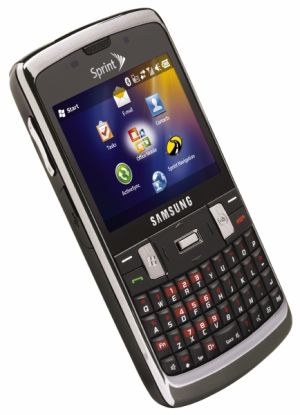
    Intrepid Windows Phone by SamsungIntrepid is designed for power-hungry business users. It has Microsoft Office Mobile for editing Word and Excel files and viewing PowerPoint presentations. Email is handled through Windows Mobile e-mail. Other features include stereo Bluetooth and Wi-Fi, microSD card support, and easy access to social networking sites like Facebook, Flickr and Twitter, as well as instant messaging and threaded text messaging.

    The unit is a one-piece mobile phone along the lines of the Palm Pixi or Treo Pro.

    On the unit’s front is a QWERTY keyboard and 2.5-inch display. Between the keyboard and display are controls for starting and ending calls, accessing the Windows Mobile operating system, navigating around the screen and giving the OK to perform a function. In addition, there are two “soft” keys which change function from task to task.

    Comfortable keyboard

    The phone’s 320-by-240 pixel display is sharp and bright, but text in smaller fonts is difficult to read. Items displayed in the screen can be manipulated via touch or a telescoping stylus that is conveniently stored in the side of the phone. The addition of the stylus is a necessary one since some of the icons on the screen are so small, poking them with a finger can very difficult. Generally, the display is responsive to tapping by digit or stylus — although less so compared to something like an iPhone or iPod touch — but from time to time multiple jabs are necessary.

    The QWERTY keyboard is comfortable to use for thumb typists. Because the keys are rounded slightly, they can be securely pressed without accidentally hitting an adjacent key. Some of the keys do double duty on the keyboard. These secondary functions appear as red characters above the QWERTY ones and can be accessed via an Fn key. The typography for the secondary characters is very small and largely difficult to see.

    Designed for convenient use

    On the left side of the Intrepid is the volume control and charger. On the right side of the unit are the power and camera buttons and the compartment for the stylus. At the back of the unit is the lens for its 3.2-megapixel camera, a speaker and a reflective button. The button can be used to frame self-portraits or arms-length shots. On top of the phone is a jack for a headphones.

    As sophisticated as the Intrepid is, it’s designed for convenient use. Need to make a call? Press the green talk button. A telephone keypad pops up on the screen. You can start poking in numbers or use screen icons to access your address book or a log of recent calls. If you start punching in numbers, as you do so, the phone automatically checks the address book and call logs for the digits and dynamically displays corresponding matches on the screen. This technique greatly speeds up the process of making a call.

    When you’ve found the number you’re looking for, you can poke an onscreen send button to make your connection. Once connected, more buttons appear that allow you to turn your speaker on or off, access your call log, make a note about the call or mute the phone. The speaker button is especially opportune because it eliminates the need to hunt for the speaker control when you’re making a call.

    Office in a pocket

    Both still images and video can be captured with the Intrepid. Its 3.2 megapixel still camera produces images in four sizes from 640-by-480 to 3,048-by-1,536 pixels and has a number of advanced features for a phone cam. For instance, shots can be over- or under-exposed with exposure compensation. Multiple images can be garnered rapidly in continuous capture mode. It even has smile recognition, where the camera won’t fire its shutter until it detects the subject smiling.

    The phone’s video camera also has exposure compensation. It has three video qualities — high, normal and economy — in two sizes (320-by-240 and 176-by-144 pixels) as well as a variety of white balance settings (auto, tungsten, fluorescent, daylight and cloudy), metering choices (center weighted, spot and matrix) and special effects (black and white, sepia, aqua and negative).

    The Samsung Intrepid is stuffed with features that enable a businessperson to carry around an office in her or her pocket. However, although the latest version of Microsoft Mobile is improved over previous editions, it still lacks the intuitiveness of its newer competitors. It feels like a desktop operating system downsized uncomfortably to run on a small screen. That kind of compromise, however, may be irrelevant to Windows shops looking for some robust hardware that gives their users a familiar interface on both their big and little screen devices.

    Originally published on TechNewsWorld

    © 2009 ECT News Network. All rights reserved.

    © 2009 BetaNews.com. All rights reserved.

    Copyright Betanews, Inc. 2009


    Add to digg
    Add to Google
    Add to Slashdot
    Add to Twitter
    Add to del.icio.us
    Add to Facebook
    Add to Technorati


  • Mozilla Celebrates The Fifth Birthday Of Firefox

    Mozilla is celebrating the fifth birthday of its Firefox browser today.

    Mozilla says in the first four days of launch, more than 1 million people had downloaded Firefox 1.0 Now that number is at 330 million users globally, accounting for almost a quarter of all Internet users.

    Currently Firefox is available in more than 70 languages and offers users more than 7,000 add-ons to customize their browsing experience.

    The Mozilla Blog provides more details. "From your desktop to your mobile device, Mozilla is committed to building an open and participatory Internet. We’ve come so far in the past five years and we’re incredibly excited about the next five."

    "To celebrate this milestone, Mozilla communities are hosting parties all over the globe in a special campaign called ‘Light the World with Firefox‘ – shining the Firefox logo from Tokyo to Rome, from Paris to San Francisco, and more. For full details on parties in your area or to check out other ways to join in the celebration, head to http://www.spreadfirefox.com/5years/."
     

    Related Articles:

    >Internet Explorer Losing Market Share In Europe

    >Mozilla Aims To Integrate Social Media And Email Into One Inbox

    >New Google Chrome Release Includes Bookmark Sync

  • God of War Collection Trophies made easier…ish

    If you’ve played the first two God of War games, you know the moves, you know the tricks, so having a walkthrough for God of War Collection would seem…

  • CVS Settles With New York Over Expired Product Sales; North Carolina Gets Grant For High-Risk Pool

    New York Attorney General Andrew Cuomo announced Tuesday that CVS, the drug story chain, has agreed to pay $875,000 to settle charges that it sold products years after their expiration dates, Reuters reports. The out-dated products, sold at 142 different stores, included “over-the-counter drugs, baby formula, eggs and milk,” and in some cases items were sold more than two years after expiring (Stempel, 11/10).

    “A CVS spokesman says the company is committed to keeping expired products off shelves and that the settlement doesn’t include any admission of wrongdoing,” The Associated Press reports. “Cuomo reached a similar settlement with Rite Aid in 2008” (11/10).

    In North Carolina, the federal government is giving that state a $1.5 million grant to provide monthly subsidies to people to aid participation in the state’s high risk insurance pool, North Carolina News Network reports. “The state’s high risk pool provides health care coverage for those who cannot find affordable insurance in the private market” (Reinhardt, 11/11).

  • Make community service a part of higher education

    …President Obama spoke directly to the students in the audience (at Texas A&M University) and on other campuses around the nation, reminding them that community service is among the oldest American traditions, an activity that “binds us to each other — and to our communities and our country.”

    … Organizations such as Texas Campus Compact and the National Youth Leadership Council provide expertise in designing and sustaining service programs.

    Read the entire article in the Houston Chronicle


  • Lawmakers Call For Emergency Sick-Leave Requirement

    Lawmakers are calling for new legislation that would require businesses to provide paid emergency sick-leave because of the swine flu pandemic. The Los Angeles Times reports: “Sen. Christopher J. Dodd (D-Conn.), chairing a health subcommittee hearing Tuesday, said that requiring businesses with 15 or more employees to offer seven paid days off a year would end a dangerous choice ‘between staying healthy and making ends meet.’” Some conservative lawmakers argue, though, “that Democrats are using a public health crisis as momentum for faulty legislation that would harm businesses by inviting abuse by workers. … There currently is no requirement for businesses of any size to provide paid sick leave” (Markman, 11/11).

  • Health Insurance Industry Profits Examined

    The characterization of the health insurance industry as high-profit is “a little mystifying” and “rather silly” given that their profit margins are thin compared to other industries, according to analysts interviewed by ABC News.

    “Insurance companies are not money trees. They (go) out into the market and buy health care services and resell those services at some markup at health care consumers. I would argue that markup is not that much,” one analyst said. ABC reports, “the profit margins the health insurance companies report — often below 5 percent — pace some industries and lag behind many others” (Gomstyn, 11/10).

  • Google Latitude Introduces Location History, Smart Alerts

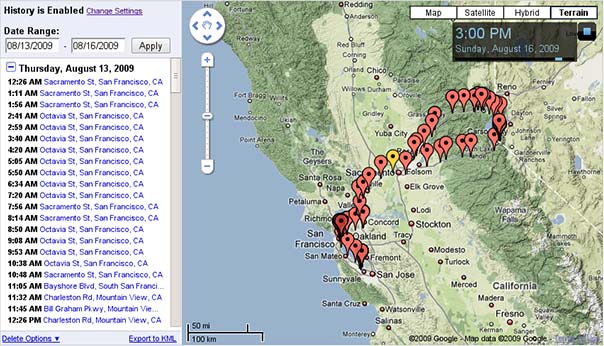
    A quick, but important, note: the stuff we’re about to discuss is only available on an opt-in basis.  So there’s no need to stop halfway through this article and drown your phone or tape it to a neighbor’s car.  Now, with that out of the way, let’s move on to the news that Google Latitude’s gained two features called Google Location History and Google Location Alerts (which is in beta).

    Google Location History may be either the less cool or the less creepy offering, depending on one’s point of view.  A post on the Google Mobile Blog explained that, with it, you can "store, view, and manage your past Latitude locations."  Then, "You can visualize your history on Google Maps and Earth or play back a recent trip in order."

    In another nod to personal privacy, it’s possible to delete part or all of your location history, too.

    As for the second feature, it builds on the first and tries to intelligently connect you with acquaintances.  According to the post, "Location Alerts can recognize your regular, routine locations and not create alerts when you’re at places like home or work.  Alerts will only be sent to you and any nearby friends when you’re either at an unusual place or at a routine place at an unusual time."

    You can enable these offerings here if they suit your style.  And should you later change your mind, Google promises that you can disable them rather than head for the nearest sink or roll of duct tape.

    Related Articles:

    > Google Puts All Of Your Personal Info In One Place

    > Google Tracks User Data To Monitor Load Times

    > iPhone Finally Gets A Google Latitude App

  • Family Guy’s “Something Something Something Dark Side” trailer


    Everyone agrees that the first Family Guy Star Wars parody, Blue Harvest, was TV at its finest, right? It was such a big hit that Fox is going to release the second one on DVD on December 22 before airing it on TV with the hope fans will actually spend money and buy the damn thing. If the trailer is any indication of the episode’s awesomeness, some people might actually do just that. Who knows, maybe even me.


  • P4P May Be Coming to a Network Near You

      Several Internet service providers in the U.S. and around the world (including a large Chinese ISP) are currently implementing P4P technologies on their networks to help alleviate congestion caused by peer-to-peer files, and they will soon be joined by other ISPs doing the same. Indeed, P4P efforts that were showcased in August 2008 are taking on more relevance as broadband demand escalates and the FCC tries to regulate the principles by which carriers can deal with congestion on their networks.

    In the August 2008 tests, which were performed by Comcast, Verizon, Yale and Pando Networks, users reported seeing see an 80 percent improvement in speed for P2P files using the technology, while it reduced traffic on the ISP network by 34 percent. That’s nothing to scoff at considering P2P traffic still accounts for 38 percent of global Internet traffic. So after more than a year of relative quiet, I checked in to see where the much-vaunted P4P efforts currently are.

    The good news is that P4P is alive and well and several researchers and ISPs are testing its use for P2P downloads such as BitTorrent as well as for P2P streaming, which could help alleviate two of the largest anticipated sources of congestion on the web.  Some popular P2P streaming applications consumers may have encountered are Spotify, the UK music service, and Octoshape, the company that streamed the Obama inauguration and still works with CNN.

    The P4P standards-setting process is still underway at the IETF (the topic will be discussed at a meeting in Hiroshima this week) so there’s no official P4P protocol to report on yet, but we’re “halfway through a 2-3-year process,” said Marty Lafferty, the CEO of the Distributed Computing Industry Association, which works with the P4P working group.

    The lack of an industry standard isn’t stopping anyone from testing out P4P technology in their own networks, however. Robert Levitan, CEO of Pando Networks, which participated in the August trials, says companies are already coming to Pando to implement P4P-like technologies. One large U.S. and one international ISP are using P4P technology commercially on their networks, he said, and a Chinese ISP is testing it as well. However, the technology has its difficulties, namely how it might be used.

    Peer-to-peer file sharing is pretty much code for pirating content, and rights organizations aren’t keen on losing ISPs as an ally in their fight against P2P file-sharing. Another issue is the coming net neutrality debate in the U.S. Lafferty says that ISPs are so focused on fighting these rules that they have little time  to collaborate on solving network congestion problems through technologies such as P4P. There’s also a question as to whether prioritizing P2P files as P4P does would violate future net neutrality principles. However, at a time when network congestion is already a topic of federal debate, getting more information out about ways to relieve it can only be a good thing.

  • Disability Plan Could Be Another Roadblock To Health Reform Bill

    The Washington Times reports that an “insurance plan championed by Sen. Edward M. Kennedy that would help elderly or disabled people avoid nursing homes ironically adds yet another sticking point to the comprehensive health care reform plans” in Congress.

    Moderate Democrats and Republicans worry the Community Living Services and Support Act will increase the deficit and make the federal government responsible for another insurance program. “Under the proposal in the House-passed version of the overhaul, the CLASS Act fund would collect monthly premiums, estimated to be $65 in 2011, from the wages of all working Americans, unless they elect to opt out — a technique used to help drive participation. Once they pay premiums for five years, participants would be eligible for cash benefits to help them buy in-home care, if they can no longer care for themselves.” Several senators have expressed concerns that purported savings on the plan don’t start until 2016 and that benefits paid will outweigh premiums gathered (Haberkorn, 11/11).

  • Google Programming Language on the “Go”

    Update: Philipp Lenssen notes that someone has already developed a language called Go! (with an exclamation point). There is a book on it here. The author wants Google to change the name. This could get confusing for developers looking to use Go, although, it could also help sales of the Go! book. It wouldn’t make for very happy customers, however.

    Original Article: Google has open sourced its own programming language, which it simply calls "Go." The company still calls Go experimental. Google’s Go Team describes the language:

    Go combines the development speed of working in a dynamic language like Python with the performance and safety of a compiled language like C or C++. Typical builds feel instantaneous; even large binaries compile in just a few seconds. And the compiled code runs close to the speed of C. Go lets you move fast.

    Go is a great language for systems programming with support for multi-processing, a fresh and lightweight take on object-oriented design, plus some cool features like true closures and reflection.

    Go comes with built-in support for concurrency, what Google calls a "novel" type system, and as mentioned above, it is apparently really fast. Google says most builds take well under a second.

    The following clip provides some more info about the language:

    The Go site offers a number of documents, such as a tutorial, a FAQ page, a tech talk, language specification, memory model, and more. There are how-tos for installing Go and contributing code. There is command documentation, package documentation, and source files. If you’re a developer itching to mess around with a new language, go dig in.

    Related Articles:

    Google Developers Produce New Programming Language

    Open Android Alliance Poses Problem For Google

    Google Gives Android Developers a Donut

  • Cost Control Issues Take Center Stage In Health Care Reform

    Cost issues continue to receive attention as bipartisan support emerges on the Hill for a commission to control health care costs. Kaiser Health News reports: “The drive on Capitol Hill to create a bipartisan entitlement and tax reform commission to help ‘bend the cost curve’ of health spending and address mounting deficits picked up momentum yesterday, as Senate Minority Leader Mitch McConnell and a handful of moderate Democrats and Republicans voiced support for the effort. The commission would draft proposals to control the long-term costs of Medicare, Medicaid and Social Security, which together account for 40 percent of all federal spending other than interest on the debt. The recommendations would require a swift up or down vote by a supermajority of members of Congress, to assure bipartisan support for unpopular measures to cut sensitive spending programs or to raise taxes if necessary.”

    The measure’s chief architects, “Senate Budget Committee Chairman Kent Conrad, D-N.D., and Republican Sen. Judd Gregg of New Hampshire, say they will attempt to attach their plan to must-pass legislation raising the government’s debt ceiling in the coming weeks. … McConnell, R-Ky., said he would have to see the composition and mandate of a commission before signing on, to make sure Republicans were adequately represented. But his comments echoed those of Conrad and others who believe a commission may be the only way to force Congress to come to grips with unsustainable spending on entitlement programs, the major cost drivers in the federal budget. … The government is on track to accumulate deficits totaling $9 trillion between now and 2019, according to the Treasury and the Office of Management and Budget. … Experts say that these problems are not being addressed as part of the health care overhaul bill passed by the House last weekend or the plans being considered in the Senate” (Pianin, 11/11).

    On the News Hour, Judy Woodruff interviews Peter Orszag, director of the White House’s Office of Management and Budget, who says premiums “will go down” under the health bill (Woodruff, 11/10).
    In a separate segment on the News Hour, Woodruff interviews Gail Wilensky, a former administrator of the federal Medicare program, to examine whether health care reform can change the system and cut costs. Wilensky describes her two wish list items to control costs, the tax treatment of high-cost Cadillac plans and pilot programs.

    Wilensky says: “‘It’s absolutely true we don’t know how to get from a — a system where most physicians are paid on a fee-for-service basis, each individual service that’s provided, to paying for taking care of somebody with diabetes, or to pay all the physicians that take care of somebody who is having a bypass procedure or a hip replacement. That’s called a bundled payment. We need to experiment how to do it. But our history with pilots is that, if there is not the authority up front to implement the pilots that work, they’re not likely to actually find their way into action. And that’s a big problem’” (Woodruff, 11/10).

    The Wall Street Journal reports on Congress’ history of reversing Medicare cuts and notes: “That history shows why some critics believe billions of dollars in budget savings Congress is promising through its health-care overhaul might never materialize. Under both Democrats and Republicans, Congress repeatedly has waived curbs it has tried to place on spending” (McKinnon, 11/11).

    Meanwhile, The New York Times column “The Economic Scene” explores why the House bill fails to live up to its goals. It is “important to step back and understand precisely what health experts mean when they argue for reforming the delivery system. It is not simply about bending the curve, or slowing the growth, of Medicare’s projected spending. … Making the medical system more efficient is, in short, about saving lives and giving Americans a long overdue raise. It is arguably the single most important step that the federal government could take to improve people’s lives. And the bill that the House of Representatives passed last weekend simply does not get it done” (Leonhardt, 11/10).

  • How sets intersect via Beach Boys

    This is definitely a great way many information and computer science concepts could be taught.

    Permalink

    | Leave a comment  »

  • Google Wave Simplified: How it Basically Works

    As you may know, Google has been sending out Google Wave invitations for a little while now. Many people are still finding these hard to come by, but others have been lucky enough to be selected and get their hands dirty.

    Those who have been granted access to Google Wave have the ability to nominate people for invitation, but not directly invite people themselves. So in other words, you’re not getting in unless Google wants you to. They have to approve your nomination.

    Unfortunately, that means those outside of the tech-savvy developer crowd and those who can actually access Google Wave, there is still a lot of mystery around the service. People want to know how it works.

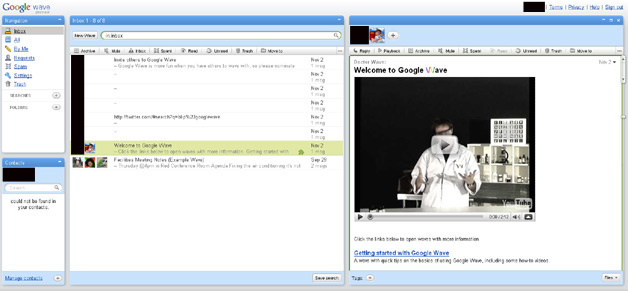
    Google Wave

    The preview comes with a wave featuring a video from "Dr. Wave," or Product Manager Greg. The video is embedded below, but he points to different features within the interface, so imagine that it is placed as it is in the above screenshot.

    Google Wave brings its own terminology to the table. For one, a wave itself is a collection of messages. Those messages within a wave are "blips." Blips can be edited and replied to. Anyone that is in the wave at the same time can see replies and blips being typed live in real time. That’s live. You can see the characters appear as they are typed.

    If you really want to see how Google Wave works, watch this series of videos that Google provides in the preview (they’re all very short):

    There are other videos that appear in the preview, but these are probably the most useful ones for showing how Wave works.

    Now the version of Google Wave that people have access to is just a "preview." It doesn’t even come with a beta tag. It’s still quite early. Even parts within the preview version are clearly marked as under construction (things like key settings).

    The videos provided do not begin to scratch the surface of the potential of Google Wave. With Google allowing developers to create apps or "gadgets" for it, the possibilities will likely be limitless. But as a general "getting to know you" for the common user, the videos provided pretty much explain the core of Google Wave.
     
    Have you used Google Wave yet? Share your thoughts.

    Related Articles:

    Will Google Wave Shape the Future of Online Communication?

    Is Google Wave Getting An App Store?

    Google Wave Invitations Roll Out/span>


  • Health Care Sector Leaves Small Environmental Footprint

    The Associated Press reports that the first estimate of health care’s carbon footprint has found that the industry “emits less than its share of the gases that promote global warming, compared to its size in the economy.”

    “Hospitals, nursing homes, drug companies and the rest of the sector contributed 8 percent of U.S. emissions, according to an analysis in Wednesday’s Journal of the American Medical Association. Health care makes up 16 percent of U.S. gross domestic product.” The analysis was done by the University of Chicago based on 2007 federal health spending data and takes power consumption and emissions into account. Many hospitals are trying to reduce their emissions (Johnson, 11/10).

  • Young Adults Don’t Welcome Health Insurance Mandate

    Young people who don’t view health insurance as a priority are wary of health-overhaul legislation now in Congress that would require them to buy it or face a penalty. For instance, “Poor and bludgeoned by debt accrued over four years of college – but otherwise healthy – medical insurance just isn’t in the cards for aspiring-artist Joanna Zobjeck,” the Oshkosh (Wis.) Northwestern reports.

    The bill requires insurers to cover people with pre-existing conditions, bans them from adjusting prices based on health factors or gender, and limits the amount plans can charge older people – all provisions that will cost insurers. “Young adults are the balance to the new rule, which also forces those least likely to need medical care to participate in a health plan in order to keep prices from inflating” (Rodewald, 11/11).

  • PlayStation’s daddy has a new baby

    Ken Kutaragi, the man known as the Father of PlayStation, also has creds under his belt apart from his phenomenal consoles. Back in 2007, he pushed …