Blog

  • Test Drive: 2010 Volkswagen GTI

    gti

    The new 2010 Volkswagen GTI is a stylish and versatile piece of machinery. This latest installment in the GTI’s nearly three-decade existence has been restyled to provide the driver with a sleek exterior, a comfortable interior, and plenty of power for moving around in the daily grind.

    VW wanted us to drive test out this new car so bad, I was flown out to San Fran and put up in a swanky hotel for three nights where I was wined and dined. It was hard leaving my blue-collar routine in Detroit, but someone has to do it.

    gti2You know what though, I was thoroughly impressed with how the 2010 GTI performed during normal everyday driving and not-so-normal parking lot autocross racing. VW was even kind enough to provide me with one of their TDI cup drivers, Perry Richardson, to show me how to put the Mk VI GTI through its paces.

    The two courses provided were set up thusly: a slow speed course that was very technical with numerous tight corners and switchbacks. Then there was a high-speed course, which featured a couple of good sweeping corners and a slalom at the end of it. Perry took me through both courses, explaining his technique to navigate through the sea of orange cones as he drove.

    gti3Then it was my turn. While a total blast to drive, my driving skills were not on the same level as Perry’s. Nonetheless, this event displayed just how powerful Volkswagen’s direct injected turbocharged 2.0L four cylinders are that making 200 SAE hp at 5,100-6,000 rpms and 207 lbs-ft. of torque from 1,800-5,000 RPMs. The 16-valve DOHC engine and six-speed manual transmission propels the GTI to a respectable 0-60 time of 6.8 seconds. The standard transmission allows the GTI to achieve a decent 21 city/ 31 hwy. MPG (EPA est.).

    gti6

    Now, as much fun as a manual gearbox is to drive, VW’s optional six-speed automatic with DSG (Direct Shift Gearbox) gives the driver the ability to just get in drive and go, or put it into manual mode and control the up shifts and down shifts. The DSG automatic utilizes a computer to control the dual clutch system, telling one clutch to engage the next gear while the other clutch releases the current gear. The result is a smooth, crisp shifting, better acceleration (0-60 in 6.7 seconds), and improved fuel economy (24 city/32 hwy.).

    A very neat feature on the automatic gearbox is the launch control. All you have to do is set the transmission into manual mode in first gear. Then turn off the traction control, put one foot on the brake and the other one the accelerator pedal. Release the brake pedal and let it fly! All this power is transmitted to either the standard 17 inch x 7 inch or the optional 18 inch x 7.5 inch wheels and “European-tuned” suspension.

    gti4While the wheels were stylish enough, I thought the suspension was almost too firm for a daily driven vehicle. Don’t get me wrong, I like a firm, responsive ride, but I felt like I was home in the pothole-riddled state of Michigan while driving around the surface streets of San Francisco. It’s not a bad ride, I just think they could improve on it some more.

    Then there is the interior. It’s clean, functional, and easy enough to access the back in the two-door models. The front seats are very sport-minded and hold you in place during various… let’s just say fun maneuvers throughout your drive.

    I love the fact that an integrated an iPod connection into the car. This makes jamming your favorite tunes a breeze on either the standard touchscreen radio or the optional navigation system with a 30 GB hard drive (20 GB of which can be devoted to music). Both of these radios support Bluetooth, so you can keep in touch with everyone hands-free.

    How much is it, you ask? The base starts out at $23,290 and goes on up from there. It is available in six different colors: Deep Black Metallic, Candy White, Tornado Red, United Gray Metallic, Carbon Steel Gray Metallic, and Shadow Blue Metallic. Let me suggest checking out what 25-years of GTI heritage has created.


  • Google aquires Gizmo5, VoIP for Google Voice on the horizon?

    Gizmo-logo2The implications of this deal are exciting. Google has purchased, in cash, the internet VoIP company Gizmo5 for a cool $30 million. The deal brings a true SIP/VoIP provider into the Google fold — the potential to merge the acquired technology with Google Voice and/or Google Talk is staring us right in the face. Last month there were rumors that perhaps Skype, due to legal issues with its own VoIP technology, might purchase Gizmo5 as a backup plan of sorts. However, that deal went south after Skype’s creators settled with eBay over future licensing of the core technology behind the popular service. So what do you think? Will Gizmo5 go the way of Orkut and fade into the internet oblivion? We’re hoping it will be more like GrandCentral…built into something we all love and the wireless service providers hate!

    Read

  • EJI Argues Sullivan v. Florida at United States Supreme Court

    Today EJI argues at the United States Supreme Court on behalf of Petitioner Joe Sullivan in Sullivan v. Florida, which challenges the imposition of life-without-parole sentences on young adolescents.

    read more

  • Internet Most Popular Source For Sports News And Information

    While TV is the most common way for people to watch sports, the Internet is the most popular way for both men and women (36.1% and 32.7% respectively) to get sports news and information, according to a new report by Burst Media.

    The Internet is trailed by local TV programming (23.7%), national TV networks (15.1%), local newspaper (6.7%), national newspaper (3.6%), and sports radio (2.9%).

    Among the key age segments, 18-24 years and 25-34 years, the Internet far outweighs both local and national TV coverage as the main source of sports and news information. Adults 55 years and over still turn to local TV news over the Internet.

    Among all respondents sports content is in demand regardless of which media is cited as their primary source. Nearly one-half (49.2%) of respondents use the Internet to check sports scores and 41.3 percent read sports-related news stories online.

    Interestingly, nearly as many women as men use the Internet to check sports scores (47.3% vs.50.5%), read sports stories (39% vs. 42.8%) and visit professional team sports sites (25.2% vs. 26.2%). The Burst survey also found over half (55%) of all respondents indicated they have never watched live streaming game coverage on the Internet.

    "It’s abundantly clear that men and women of all ages are active consumers of sports content online," said Chuck Moran, Chief Marketing Officer for Burst Media. "This provides marketers an opportunity to expand the reach of their campaigns targeted to sports enthusiasts by adding an online component".
    Chuck-Moran
    "Also, by utilizing a multichannel strategy of combining Internet and TV, advertisers can surround their target audience with coordinated messaging for greater impact."

    The survey also found that although the Internet is the most popular media source for sports content, it is not seen as the best source. Overall, national TV sports networks, such as ESPN, are viewed by respondents as the best place to get sports and information news. However, men believe national TV sports networks and Internet sports content sites offer equivalent sports content (30.1% and 28.7% of men, respectively).

    Related Articles:

    >NFL Players Get Official YouTube Channel

    >UFL Debuts Tonight, Partners With AOL

    >Social Media: A Day In The Life Of An NFL Player


  • New Final Fantasy XIII Esper scans: Alexander and Chocobo

    The guys at FinalFantasyXIII.net got their hands on the latest issue of Shonen Jump and we now have new scans for Final Fantasy XIII (Xbox 360, PS3). …

  • Great, Seattle middle-schoolers are making shanks now

    Photo 5
    I just came across this story in the neighborhood newspaper. I can’t find it anywhere online. What is wrong with our seventh-graders that they are using their DIY skills to make shanks instead of putting together a cool fort or at least a more creative weapon? They couldn’t, I don’t know, modify Nerf arrows with metal caps so they hurt when they hit?

    If they’ve got some violence in the system, as many kids do, they need to work it out. Most kids do that through video games these days, yet why do I get the feeling that somewhere in the Seattle school district tonight, somebody will be cursing the same games for making kids more violent?

    Luckily, no one was hurt in this incident. The kids involved were expelled, but beyond that nothing is known. I think that going to an inner-city high school and being held up at gunpoint a couple times has made me a more well-rounded person all told, but I wouldn’t wish a shank on anyone.


  • Video: Chinese iPhone clone looks like Apple, smells like Android

    You’re stuck in quite the conundrum. You want the chic elegance of the iPhone – but you want unbridled flexibility that comes with the Android platform. Whatever are you supposed to do?

    If you’re able to read Chinese and are absolutely insane, there’s a solution: the APhone A6. Straight out of a Chinese handset cloning workshop, the APhone A6 is built to walk the walk of Apple’s finest, but talk the talk of Google’s.


  • Martin Gibson Joins Accel Partners

    Martin Gibson has joined Accel Partners as a venture partner in the firm’s London office. He had previously been a London-based partner with Atlas Venture, but left earlier this year as a part of a personnel restructuring after Atlas closed its eighth fund well below target.

    Go here to find out where other ex-Atlas pros ended up.

    ShareThis


  • Firefox turns five: Thanks for giving us a choice

    By Carmi Levy, Betanews

    Birthdays in the world of tech normally aren’t that big of a deal for most folks. We tend to feel as much nostalgia toward hardware, software and services as we do toward flu shots and oil changes for the car. But even if you don’t use Firefox — and by the numbers, that’s over 60% of you — it’s difficult to underestimate this once-upstart browser’s impact on the way we experience the Internet, and how our software is developed in the first place.

    Replacing monopoly with choice

    Before Firefox came along, Internet browsing was Microsoft’s game to lose. The company had successfully used its ability to bake IE into the fabric of its dominant operating system, to none-too-subtly force mainstream internauts to overlook the alternative. If IE was already sitting on the average user’s desktop, the logic went, why would he or she even bother to download Netscape?

    The strategy worked, as Netscape began a long, slow slide into oblivion. Users by the millions simply stuck with what their OS came with. I’m keenly aware of the fact that Betanews readers can download and install a browser in the time it takes to change the channel. Yet I’m also keenly aware that our tech savvy readers are far outnumbered by the kind of Internet users who, for a while anyway, didn’t understand what a browser was, and who thought “The Internet” was the glowing IE icon on their desktop.

    Carmi Levy: Wide Angle Zoom (200 px)Microsoft got this, too. Whatever your view on the company, it’s easy to see that this fundamental understanding of its audience helped it recover from almost missing the browser bandwagon altogether. Antitrust cases notwithstanding, Microsoft’s recognition that most everyday end users wouldn’t bother (at least in the chaotic early days of the commercialized Internet) to take the time to download something as mundane as a browser, helped it drive a large chunk of the Internet agenda for the better part of a decade. Although we scoff at the notion of default desktop real estate today, it mattered immensely when Windows 95 first hit the market.

    The shift toward download-your-own

    But getting and keeping a monopoly are two entirely different things. As Microsoft eventually learned, product innovation matters, and its inability to focus on that growing market need left the door slightly open for an alternative.

    By failing to move the bar once it wrested control, Microsoft virtually guaranteed that increasingly sophisticated and demanding mainstream users — who by then had figured out how to customize their desktops with their own software choices — would eventually take the time to download and install a new browser. By 2004, there were enough of them who were ticked off with IE’s dominant market position, its bloat, its disrespect for the Web standards of the day, and its sock-it-to-me reputation as a target for hackers that IE’s days as the default choice were numbered.

    It’s easy to forget that Firefox wasn’t always a flexible upstart. It was born out of the ashes of Netscape’s Mozilla Project, a bloated failure that stands as an example of too many features and not enough thought devoted toward making them work with each other…or for the end user. The project’s rebirth under the Mozilla Foundation as a broad-scale open source collaboration allowed it to return focus to the singular browser. It also gave it the edge needed to position itself as a viable alternative to the then-dominant IE.

    Firefox introduced a number of features that we now take for granted: Tabbed browsing, add-ons and extensions, integrated search, themes, consistent support for Web standards, download management, pop-up blocking, and best of all, speed. And while age has helped more recent competitors like Google’s Chrome begin the process of turning yesterday’s David into today’s Goliath, Firefox remains a formidable platform with enough developer and end-user support to ensure it won’t soon meet Netscape’s fate.

    Of course, nothing is a given in the world of tech. And despite its vaunted success in hacking out a growing base of fans (over 24% of all users, according to October 2009 data from NetApplications) and taking on a company many saw at the time as unbeatable, Firefox the browser isn’t immune to the creeping ailments of age. It’s gotten bigger and slower with each successive generation, and its prodigious use of memory and system resources remains a widespread source of irritation. But as the first truly successful example of an open source product that went mainstream, Firefox has helped build the business model by which software that’s given away for free can become the basis of an industry.

    An intensifying market

    As version 3.6 gets set to go gold, the core developers are already filling in the blanks on a roadmap that stretches years into the future. Google, which was an early and ongoing Firefox supporter, now wants its own piece of the action as it aggressively improves Google Chrome and uses the browser as the basis for its first full-blown desktop operating system, Google Chrome OS. The broader client market is evolving as well, as the desktops that defined the bulk of our online activities in 2004 give way to increasingly mobile form factors and uses. Firefox’s mobile project, known as Fennec, is expected to deliver a working product in 2010. None of this would have happened without Firefox 1.0.

    No one quite knows where any of this will end up. And whatever features and performance the various players pile in to their respective offerings in the coming months and years, they’ll all owe a debt of gratitude to a product…more accurately, to an open source project that saw the potential in shifting the market away from dominant offerings from commercial players that limited choice and stifled development.

    In that respect, Firefox was less a product than a revolution in how software is developed and used, and how sustainable markets are built around these products. I can’t wait to see what the next five years have in store.

    Carmi Levy is a Canadian-based independent technology analyst and journalist still trying to live down his past life leading help desks and managing projects for large financial services organizations. He comments extensively in a wide range of media, and works closely with clients to help them leverage technology and social media tools and processes to drive their business.

    Copyright Betanews, Inc. 2009


    Add to digg
    Add to Google
    Add to Slashdot
    Add to Twitter
    Add to del.icio.us
    Add to Facebook
    Add to Technorati


  • Martin’s Point Health Care achieves 1,185% ROI with IBM Cognos Business Intelligence

    Business intelligence competency center reduces reporting demands, improves productivity

    BOSTON – November 10, 2009 – Nucleus Research analysts examined the deployment of IBM Cognos BI at Martin’s Point Health Care and found a 1,185% return on investment (ROI) with payback in one month.

    Martin’s Point Health Care is a not-for-profit regional health care provider operating nine facilities in Maine and New Hampshire. The agency also administers the US Family Health Plan in northern New England and New York, as well as Medicare Advantage health plans and health management services in Maine.

    Martin’s Point Health Care needed a more efficient way to make information available to its employees. The company did not have a unified approach to reporting and data publication, plus the updating of reports was labor intensive and costly. The approach to make custom reports for each end-user in support of operational and financial decisions prevented the company from benefiting from better analytics and data management. Martin’s Point Health Care decided to address this issue by realigning the informatics team and building a unified view of the agency’s data and interactive functionality built upon its existing IBM Cognos BI solutions. As a result they built a new Business Intelligence Competency Center (BICC).

    The new BICC reduced the costs of report creation and improved the productivity of data users. In selectively fulfilling report requests, Martin’s Point Health Care has reduced report building by 20%. The company has further improved productivity by being able to spend far less time locating and manually analyzing information from various reports and databases.

    “This deployment shows how a BICC can leverage existing software investments. The BICC initiated a cultural shift around reporting and persuaded people to better utilize existing end-user driven reporting and analysis tools. As a result, report request volumes decreased significantly and data users became more productive,” said David O’Connell, senior analyst, Nucleus Research.

    All Nucleus Research ROI case studies are independent assessments, evaluating the costs and benefits from the IT deployment. The case study is available at www.NucleusResearch.com

    About Nucleus Research

    Nucleus Research is a global provider of IT research and advisory services that provides CFOs, CIOs and their staffs with the real-world information they need to maximize business returns from their technology investments, including successfully executing their IT deployments and determining the business value of their initiatives. For more information, visit NucleusResearch.com.

  • Zune Pass troubles? Users report Zune purchases are busted (update?)

    zune_error_01
    Zune down! The Zune support forums are awash with users claiming various issues with Zune subscription media. Songs are not showing up, or if they do, they aren’t playing. Sounds like an authentication issue to me, and those happen every once in a while — but for weeks on end?

    Any of you fine folks out there having trouble? I’ll see if I can scare up any info from the Zune team and post an update later. [Thanks, Aditya]

    Update: My Zunepal tells me that the DRM reset tool might work, though that’s all the information he volunteered. Anybody brave enough to try it?


  • Report Indicates Google Bought Gizmo5

    Not long ago, Eric Schmidt estimated that Google would start making monthly acquisitions.  Today, it’s almost looking like the dial got bumped up to hourly, since following this morning’s confirmed acquisition of AdMob, a report has indicated that Google’s bought Gizmo5, too.

    Gizmo5 is a VoIP firm.  Two recent company blog posts are titled "Introducing GizmoVoice – A Free Phone Line Using Google & Gizmo5" and "Add Gizmo5 Calling Directly To Gmail!" so it’s clear that there are some strong links between it and Google.

    Two less obvious details also make them a good match, since the Gizmo5 homepage is dotted with the word "free" (as we all know, Google rarely charges for things) and the Gizmo5 site is available in nine languages (Google loves to serve lots of countries).

    Anyway, Michael Arrington, who was the first to write about the rumored acquisition, predicted that Gizmo5 will fill a vital role.  "Gizmo5 will be the glue that puts Google Voice and Google Talk together into a single product," he stated.  "And that product looks a lot like a Skype competitor."

    Arrington put Gizmo5’s price at $30 million (in cash).  Gizmo5’s site has since become quite slow, but we’ll keep an eye out for official confirmation.

    Related Articles:

    > Google Buys Mobile Ad Firm For $750 Million In Stock

    > eBay And Skype Settle Litigation

    > Schmidt Forecasts Monthly Acquisitions

  • Jenzabar Says That Google Blog Post Is ‘Hearsay’, Not Official Google Statement

    Last month, we wrote about the highly troubling efforts by the head of software firm Jenzabar to abuse trademark law to stifle criticism of that company’s founder and CEO (who, earlier in her life, was famous for “leading” part of the student uprising in Tiananmen Square). She was upset at the makers of a documentary film that was somewhat critical of her, and she tried to use trademark law against them, after an attempt at defamation failed. There is simply no trademark violation at all in this situation… but it is a company with lots of cash suing some independent documentary film makers, so it has all the appearances of filing a lawsuit just to cause trouble for the filmmakers.

    Our posts were based on some blog posts by Public Citizen, criticizing Jenzabar and its founder/CEO Ling Chai. Rather than recognizing that it’s going too far, Jenzabar apparently decided to go on the attack. Public Citizen’s Paul Alan Levy alerts us to the news that Chai and Jenzabar are now claiming that Public Citizen’s blogging about the case is illegal.


    Specifically, the complaint from Jenzabar is that Levy pointing out that Google has stated that it does not use metatags in its search algorithms is not admissible and will “cause prejudice,” because it is not an official statement from Google. That, of course, is silly. Google has made it clear for a while that it doesn’t use metatags, but this particular announcement came from Google’s Matt Cutts (disclaimer: an acquaintance/friend of mine) and was on Google’s official blog, and Matt regularly speaks for Google on these sorts of issues. Yet, Jenzabar claims that it’s “hearsay.” That seems like a pretty difficult position to take. Jenzabar really wants to keep insisting that Google uses metatags, even as Google is making clear it does not? And it wants to force the court to censor blog posts to keep living in that fantasy world? Good luck with that…

    Permalink | Comments | Email This Story


  • Archipelago Learning Sets IPO Terms

    Archipelago Learning Inc., a Dallas-based provider of online education tools and services, has set its IPO terms to 6.25 million common shares being offered at between $15 and $17 per share. It would have an initial market cap of approximately $427 million, were it to price at the high end of its range.

    The company plans to trade on the Nasdaq under ticker symbol ARCL, with BoA Merrill Lynch and William Blair & Co. serving as co-lead underwriters. Providence Equity Partners acquired a majority stake in Archipelago Learning in January 2007, for $84.5 million. It currently holds a 70.1% position. www.archipelagolearning.com

    ShareThis


  • If Microsoft sites lead time online, pigs can fly

    By Joe Wilcox, Betanews

    On Friday, ComScore reported that in September, worldwide, Internet users spent more time at Microsoft sites than at Google, Yahoo or even Facebook. It’s an amazing statistic that has questionable street cred. ComScore has presented the data in a favorable way to Microsoft but which doesn’t accurately represent exactly how Internet users really spend time on popular Websites.

    Time-spent-online data is hugely important to Microsoft and other popular destinations, such as Facebook, Google or Yahoo. While bloggers and news organizations obsess over every pageview, time spent online is a much more important metric. People coming and staying for hours is potentially more valuable to online advertisers than Internet users who click in and click out, which too often is the only measurable value of pageviews.

    How people spend their time online is important, too. There — when read between the lines — ComScore’s data has some value for Microsoft. Are site visitors reading blog posts or news stories? Banner advertising and contextual search keywords could be effective. Are they playing interactive games with other Internet users? Contextually relevant ads within games could be better. Are they chatting with friends via IM or social status updates? Banner ads and interactive surveys might be more effective.

    Time after Time

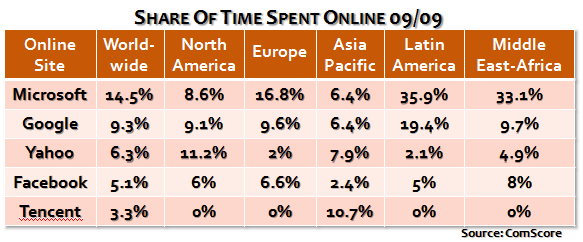
    ComScore claims that worldwide during September, Microsoft sites accounted for 14.5 percent of the time spent online, followed by Google at 9.3 percent. What a strange perspective. After so many months — years — of Microsoft trailing Google by huge amounts, roles are decidedly reversed. But in the United States, Google and Yahoo led Microsoft, which overwhelming dominated online time in Europe,Latin America and Middle East (see first chart), ComScore claims.

    The ComScore report is big on “What?” or “How much?” but offers scant reasons on “Why?” that makes the data relevant. The reasons are hugely important for understanding how consumer Microsoft marketing and new product releases could be paying off. Additionally, the phenomenon could show where Microsoft could leverage against Google and how Yahoo might be fumbling. I couch with “could” and “might” because of the caveats coming in the next two paragraphs.

    Time Spent Online 09/09

    The ComScore data, while important for Microsoft, is incomplete. ComScore excludes Internet cafes, public computers and smaller mobile devices, such as cell phones, PDAs and smartphones. Internet cafes could be good for Microsoft because of some emerging markets, where the MSN and even Windows Live brands are strong; ditto for Yahoo. Public computers, if these count education institutions, could be good for Google. Cell phones and smartphones are a grabbag.

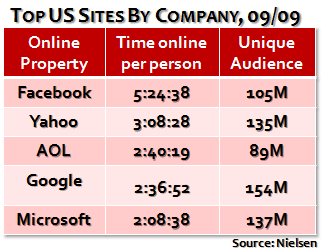
    The data also is unspecific in a crucial area: How much actual time did individuals spend online. ComScore findings are in aggregate. For perspective, back in February, AOL and Yahoo led with most time online per Internet user, according to Nielsen. Per individual: 3:58:22 (hours, minutes, seconds) for AOL but only 2:16:54 for Microsoft. Caveat: Nielsen’s data only measures United States, while ComScore offers worldwide view. That said, U.S. data is inconsistent between the online analysis firms, too (see both charts).

    Nielsen’s most recent data, also for September, shows Microsoft sites as No. 5 not No. 3 in the United States (see chart 2). Nielsen’s data is inconsitent with ComScore’s findings. AOL, which ComScore ranks No. 3 in the United States doesn’t show up at all in ComScore’s US rankings. Most startling, ComScore puts Facebook at No. 4 for time spent online among US Internet users, while Nielsen ranks Facebook as No. 1.

    Facebook’s placement is hugely significant. In February, the social networking site didn’t even make Nielsen’s US top five. Now Facebook is tops, with time-spent-online per individual a whopping 5:24:38. Right, almost five-and-a-half hours per Internet user. Something else: Nielsen shows time online at Microsoft sites going down by about 8 minutes between February and September. By comparison, time online at Google sites rose about 40 minutes, nudging ahead of Microsoft.

    Means to a Measure

    Metrics and measurement mean everything for online data such as this. But to companies like Facebook, Google or Microsoft, marketing matters more. Microsoft will gain immeasurable PR value from ComScore’s study. But Nielsen’s consistency tracking time online — and measurement per individual — is more credible. Then there is the “Why?” ComScore does give, which makes sense of its approach to measuring time spent online at various Websites. Quoting the ComScore press release — a rarity for me:

    Mearly 27 billion hours were spent on the Internet globally by a record online population of 1.2 billion Internet users age 15 and older. Microsoft Sites accounted for 14.5 percent of total minutes spent online in September, making it the most engaging global property, with Microsoft’s Windows Live Messenger representing nearly 70 percent of time spent on the property during the month.

    Whoa. Seventy-percent came from Windows Live Messenger? Exactly how does usage of Microsoft’s desktop IM client count as time spent on the company’s sites? Surely only a fraction of Live Messenger users come through the the Web-based version, based on Microsoft data about client downloads. I ask again: How does time spent in Live Messenger count as time at Microsoft sites? Windows Live log-ins perhaps?

    Time Spent Online 09/09 Individual

    Maybe Safeway or Trader Joes should tally everyone using one of their shopping bags in monthly store customer counts. Perhaps Visa should count everyone using its cards to buy products as visitors to its Website. How about beauty product companies like Clinque, Mac or Sephora count every free product sample as customer purchase.

    Something about ComScore’s data — at least as presented — doesn’t make sense.

    Still, behind the measure, Microsoft can gain valuable insight. Windows Live Messenger is an arguably hot on-desktop/online property. It’s real estate Microsoft could connect to other properties, particularly broader Windows Live services or Windows 7.

    To reiterate, ComScore’s data is questionably valid as presented (other than for Microsoft marketing purposes) because:

    • ComScore ignores public PCs, Internet cafes, PDAs and smartphones
    • The measurement is aggregated rather than for individual time spent online
    • Windows Live Messenger accounts for 70 percent of the time spent at Microsoft sites
    • Nielsen data, which does track individual time spent online, is more consistent over many months and contradicts some ComScore’s findings.

    So, Betanews readers, I have to ask: Where do you spend most of your time online? Gulp, I would hope it would be Betanews. Comments are open for your answer.

    Copyright Betanews, Inc. 2009


    Add to digg
    Add to Google
    Add to Slashdot
    Add to Twitter
    Add to del.icio.us
    Add to Facebook
    Add to Technorati


  • First reviews of Modern Warfare 2 published: Two perfect scores

    mw2reviews

    So to recap: nobody has been given permission to sell Modern Warfare 2 early. It’s a crazy Internet rumor that has no basis in reality. But it’s happening like whoa. What is based in reality is that the first reviews of the game have started appearing online, and they’re all from UK newspapers. A strange place to see the first reviews of what’s probably going to end up being the biggest game of the year (with all due respect to Assassin’s Creed II).

    Both The Daily Telegraph and The Guardian (my favorite British paper, if only for its football coverage) gave the game perfect scores. I’ll quote each review’s final paragraph, because it’s easy and my head still aches like nobody’s business.

    The Daily Telegraph:

    All told, Modern Warfare 2 crosses into the must-have category of video games effortlessly. It offers an unmatched shooter experience, a compelling story mode, a slick package of mini missions and a multiplayer which is pretty much unparalleled in depth. It’s sure to satisfy the demands of its fan base, and anyone who considers themselves a fan of shooters in general should definitely pick up a copy. It may be debatable as to whether Modern Warfare 2 is objectively the best release of 2009, but it’s certainly the finest game in its genre, as well one of the truly great games of this or indeed any year.

    The Guardian:

    All in all, MW2 is exactly what fans were expecting. Yes, it carries a hefty price-tag, a shortish single player campaign and only adds a handful of genuinely new elements to the prequel, but you won’t find a more polished, intelligent FPS this year. For non-stop action, superior AI and perfectly balanced weapons, it’s a worthy chart-topper that hammers a nail into any hope of the COD franchise returning to its WW2 roots anytime short of the next round of console upgrades. And, on this evidence, you won’t find too many complaints about that.

    Sounds to me that if you’re even remotely a fan of the FPS genre, then you’ll probably at least like the game.

    Look for more exciting reviews to hit the Web in the coming hours.


  • Twitter Analytics Service Gets Off To Great Start

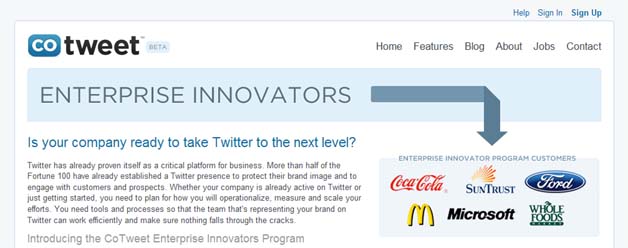
    CoTweet, a company that helps businesses use Twitter, released some details about a new service today, and in doing so, demonstrated that there’s a real demand for such things.  The CoTweet Enterprise Innovators Program already has at least six major customers despite costing $1,500 per month.

    Coca-Cola, Ford, McDonald’s, Microsoft, SunTrust, and Whole Foods are among the early adopters, which is quite impressive.  Another interesting detail is that CoTweet isn’t exactly begging for clients; the program’s existence was discovered by Wall Street Journal reporter Andrew LaVallee, and businesses in fact have to request an invitation to scope out the new offering.

    As for what their interest (and monthly payments of $1,500) will net them, the CoTweet Enterprise Innovators Program offers engagement, influence, and reach analytics, along with archives of customer interactions and a couple other things.

    Anyway, this development could provide a number of clues concerning the future of Twitter.  One point in the site’s favor is that corporate users are so fascinated by it.  This should give Twitter some staying power.

    Also, although the launch of the CoTweet Enterprise Innovators Program might seem like yet another missed revenue opportunity (Twitter’s indicated before that it might try to make money by selling premium accounts and analytics services), Twitter could still presumably join the game at any point in time.

    The interesting thing is that these well-connected companies didn’t wait for it to do so.  Microsoft and the others almost surely would have heard if Twitter had a service in the pipeline, and then would have held out another couple of weeks or months to use it.  So any sort of official offering may be quite a ways off.

    One last item of note: a post on the CoTweet Blog made clear, "The CoTweet public beta remains free for consumers and enterprises."

    Related Articles:

    > 20 Goals For Business Social Media Use

    > 8 Reasons You Need To Stop Ignoring Twitter

    > A Suggested Users List For Twitter That You Can Actually Use

  • Nokia’s ‘limited number’ of recalled chargers exceeds 14 million

    By Tim Conneally, Betanews

    Leading mobile phone maker Nokia today announced a recall of three types of Nokia-branded phone charger which were found to be a shock hazard.

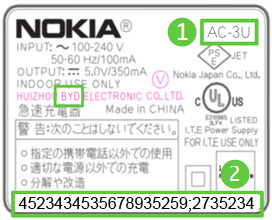
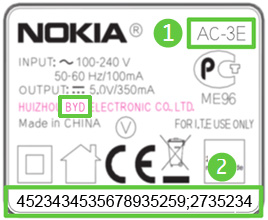
    The chargers were manufactured by Chinese mobile phone component firm BYD International Electronic Company this year. Nokia today said that the plastic covers of these chargers could come loose and open up to expose the internal components which could shock the user if handled improperly. Nokia said it was not aware of any injuries or incidents related to these chargers.

    Nokia is offering a free replacement to affected units, which carry the model numbers AC-3U, AC-3E, or AC-4U. Since these were all made within the last six months, if you purchased a Nokia charger before June 15, 2009, you are not impacted by this recall.

    Nokia Charger Recall
    Nokia Charger Recall
    Nokia charger recall

    Nokia has not detailed the breadth of this recall, saying in the recall statement that only “a limited number” of chargers are affected. In Nokia’s blog, the company was equally vague, noting that it’s only “a limited number of chargers manufactured over a short period available in a select number of countries.”

    The US Consumer Product Safety Commission has not yet issued a warning for consumers in the United States, which would indicate exactly how many units were affected in the US, if at all. Several sources have reported that the recall encompasses 14 million units, but that has not been officially declared by Nokia.

    We contacted the company this morning to confirm this number and find out which devices shipped with these adapters, but the company has not yet responded.

    Copyright Betanews, Inc. 2009


    Add to digg
    Add to Google
    Add to Slashdot
    Add to Twitter
    Add to del.icio.us
    Add to Facebook
    Add to Technorati


  • Final day for the Halloween Costume Contest Vote-Off!

    Happy post-Halloween! Thanks for sending in your costumes and thanks, most of you, for following the rules. That said, I’m proud to show you the 11 best costumes in this line-up, as judged by all of us at CG. I added one extra because we just couldn’t bear to choose between the various Iron Men we saw.

    Here’s how to vote:


  • O2 UK to Officially Unlock iPhones Following Competitor Launch

    o2-logoO2 just announced what seems like a fairly magnanimous gesture on its part today, in preparation for the launch of the iPhone on other UK carriers and the end of iPhone exclusivity in that country. That should mean that O2 customers who want to take their business elsewhere can have their phones unlocked as early as tomorrow, since Nov. 10 is the stated launch date for Orange UK’s iPhone offerings.

    The news, which comes via The iPhone Blog, is a promising sign for all iPhone users. If Apple is at all a party to the decision to allow unlocking of its devices in countries where the iPhone is available on multiple networks, then hope exists for countries like Canada, too, where the iPhone recently became available on Bell and Telus, as well as Rogers, the original carrier.

    O2 CEO Matthew Key describes in an interview with the Times Online how customers will be able to unlock, though that won’t relieve them of their contractual obligations:

    Once the iPhone becomes available on other UK networks, we will allow O2 customers to unlock their iPhones, although of course they will still need to honor any outstanding contract period they have. At the end of their contract period, they are entirely free to move to another operator — though naturally we hope they won’t want to!

    It isn’t clear how the unlocking procedure will actually work. Will users have to physically visit an O2 store, or can it be done over the phone using iTunes at home? Whatever the method, O2 is doing the right thing by providing its customers a choice, which is a good faith gesture which should end up building customer loyalty and avoiding resentment. No word yet on whether or not other UK carriers will be offering the same service for their iPhone devices.