The always thorough DPReview has finally published its epic review of the Canon 7D. Their conclusion? Brilliant. While in the end your purchase probably will rely more on your investment into the Canon, Nikon, Pentax, or whatever ecosystem, the 7D performs incredibly well and should be considered among the very best available. Not much else to say except I wish I had two grand burning a hole in my pocket so I could pick one up.
Blog
-
A 31-page 7D review for your consideration
-
Murdoch Reconsidering Paywalls? Delaying Implementation
Is Rupert Murdoch flip-flopping on paywalls again? Way back when (i.e., two years ago) Murdoch was a big believer in the idea that news should be free online, and that he could more than make it up with other business models. But, then, earlier this year, he did a complete flip-flop, declaring that all his publications would put up paywalls, saying that free content is bad, and accusing aggregators and search engines of “stealing” content. Some speculated that it was all a ploy to get others to put up paywalls. Though, others just think Murdoch’s getting a little senile. Either way, it looks like he’s stalling a bit. Jay Rosen points us to the news that Murdoch is “postponing” the date for when he wants his papers to have paywalls. It’s not clear if the delay is due to technical difficulties in implementing a paywall, or if he’s actually reconsidering. Either way, it doesn’t look like the great big paywall is going up any time soon.
Permalink | Comments | Email This Story
-
Free Conferencing CEO Asks FCC to Keep on Google Voice
Even though less than 1 percent of the population uses Google Voice, David Erickson, president of the Free Conferencing Corp., a conference call company whose numbers are blocked by the service, is pretty aggrieved. So he met with the FCC and filed a letter urging the regulatory agency to get Google to play fair. He also offered to help Google find lower rates for its rural call termination fees. “Google shouldn’t be able to tell consumers where they can call and where they can’t,” he said in an interview with The Hill, a trade publication.
Actually, I’m with him on this issue. Erickson’s company may be taking advantage of a legal loophole that the telecommunications companies and now Google want closed, but it’s not clearly illegal (although the loophole is closing). And by providing voice service for customers even as an “Internet application” Google’s decision to limit certain aspects of the service because of the costs might be reasonable for a restaurant owner running a buffet, but is less so for someone providing a telecommunications service.
Such so-called traffic pumping is an issue the FCC has known about for a while, so clearly companies like Erickson’s, which appear to be benefiting from an arbitrage play that boosts costs for carriers that have to terminate calls on higher-cost rural lines, haven’t been morally repugnant enough to get the FCC or Congress to take definitive action to stop them.
Erickson doesn’t think the FCC should step in at all on the issue of overhauling the pricing schemes that result in higher termination costs on rural lines (and generates sales at his company), he says in a letter filed this week with the FCC, but he does request more scrutiny over Google Voice. He’s lost me at this point. If you’re gonna run to a regulator to force someone to play your game, you can’t get upset when the regulator wants to make sure the rules by which you play that game are fair.

-
Bad news, good news: Eee Keyboard delayed, but it’s getting the old touchscreen back

I amaze myself sometimes. You see, I have so much power as a writer on this invincible and influential blog that sometimes I can change an entire industry with but a word. Case in point: apparently my recent post on Eee’s decision to change the touchscreen to resistive on their Eee Keyboard was so crushing that they’ve altered their entire business plan and delayed the device to accommodate it. O Mighty Blogger! Thou humblest the world!
Actually, I’m guessing they did some focus groups and found that the trade-off of “lower price and crappier touchscreen” with “people actually wanting the device” was unacceptable. At any rate, the device (which had an original internal release window of August-ish) may not make it in time for the holidays. It’s not rare that we see a device at CES that doesn’t make it during the next year, but I really had hopes for this thing. -
IP Czar Focused On Protecting Jobs, Not Promoting Progress?
We were already somewhat concerned about the nomination of Victoria Espinel for the IP Czar job in the administration (forced on the administration by the silly and pointless “ProIP” Act from last year). On Thursday, she had her confirmation hearings where she said pretty much what we expected about how important intellectual property is, and how she viewed her job as coordinating different government agencies to crack down on infringers. Much of her (brief) testimony (pdf) talked up the usual industry claims about the importance of intellectual property on the economy, not recognizing how misleading they are. These are stats that simply credit anything covered by intellectual property laws, as if the only reason those industries exist is because of those laws. That’s a mistake.
But more troubling? Espinel made it clear that her job is not to do as the Constitution requires, and make sure that intellectual property laws are properly “promoting the progress of arts and the useful sciences” (she never mentions this part), but, instead she claims her focus is cracking down on infringement to protect jobs:
If I am confirmed as the United States Intellectual Property Enforcement Coordinator, I will work side by side with agencies, Congress, stakeholders and the public to ensure that jobs that depend on intellectual property are not compromised by others’ unwillingness to respect and enforce the rule of law….
But intellectual property law is not about “protecting jobs” it’s about encouraging innovation. Innovation can be disruptive. Jobs can get shifted around. Protecting jobs is not encouraging innovation. It’s the opposite.
Better and smarter protection and enforcement of intellectual property rights will create more jobs…
There’s simply no evidence to support that. Shouldn’t our IP Czar rely on actual evidence rather than broad industry claims that are unproven?
Then, on being questioned she appeared to support Hollywood’s position that any net neutrality laws won’t apply to mandating content filters on ISPs. It’s looking like — just as was initially feared — this position is really to get Hollywood’s own representative in the White House. What a shame. If you must have an “IP Czar” shouldn’t it be someone who’s actually focused on making sure progress is being promoted, rather than someone who wants to blindly crack down on infringement with no thought towards whether or not it makes sense?
Permalink | Comments | Email This Story
-
Glenn Beck Not Allowed To Rape And Murder An Internet Meme
Back in September, we wrote about Glenn Beck’s misguided attempt to gain control over the domain name used as part of an internet meme that is critical of Glenn Beck, GlennBeckRapedAndMurderedAYoungGirlIn1990.com (it’s a dead site now, keep reading). If you’re unfamiliar with the meme, it’s mocking a favorite tactic of various cable news talk show hosts, to “ask questions” that are accusatory in nature, whether or not there’s any substance to back them up. Glenn Beck didn’t accuse the site of defamation or anything, but filed a domain name complaint, saying that it violated his trademark. As we noted at the time, the trademark claim was really questionable — and, of course, only served to draw more attention to the site and the internet meme.
The site brought on lawyer Marc Randazza who filed one of the most brilliant responses (pdf) to a legal threat that you’ll ever see. It’s quite amusing. Randazza takes the old “moron in a hurry” test up one level, using the “abject imbecile” test. And then there was this:
We are not here because the domain name could cause confusion. We
do not have a declaration from the president of the international
association of imbeciles that his members are blankly staring at the
Respondent’s website wondering “where did all the race baiting content
go?” We are here because Mr. Beck wants Respondent’s website shut
down. He wants it shut down because Respondent’s website makes a
poignant and accurate satirical critique of Mr. Beck by parodying Beck’s
very rhetorical style. Beck’s skin is too thin to take the criticism, so he
wants the site down.
Apparently, Randazza’s letter worked wonders. The WIPO Arbitration Panel has rejected the attempt to take the domain, saying that it was a legitimate use of Beck’s name:
In the present context, this Panel considers that if Internet users view the disputed domain name in combination with a visit to Respondent’s website, the “total effect” is that of political commentary by Respondent, capable of protection as political speech by the First Amendment under the Hustler Magazine standard. Respondent appears to the Panel to be engaged in a parody of the style or methodology that Respondent appears genuinely to believe is employed by Complainant in the provision of political commentary, and for that reason Respondent can be said to be making a political statement. This constitutes a legitimate non-commercial use of Complainant’s mark under the Policy.
Either way, now that the site’s owner has prevailed, he apparently feels he has made his point, and has agreed to voluntarily hand over the domain (pdf), along with an explanation in the First Amendment and how not to respond to internet memes:
It bears observing that by bringing the WIPO complaint, you took what was merely one small critique meme, in a sea of internet memes, and turned it into a super-meme. Then, in pressing forward (by not withdrawing the complaint and instead filing additional briefs), you turned the super-meme into an object lesson in First Amendment principles.It also bears noting, in this matter and for the future, that you are entirely in control of whether or not you are the subject of this particular kind of criticism. I chose to criticize you using the well-tested method of satire because of its effectiveness. But, humor aside, your rhetorical style is no laughing matter. In this context of this WIPO case, you denigrated the letter of First Amendment law. In the context of your television show and your notoriety, you routinely and shamelessly denigrate the spirit of the First Amendment….
Permalink | Comments | Email This Story
-
Secretary Solis: Combating Unemployment
This morning the Department of Labor released its Employment Situation report for October and while the numbers are disappointing, they are not surprising. Analysts have known for some time that the unemployment rate could reach this level, but it remains an unacceptable situation.
When this administration began its work in January 2009, the economy was in a freefall, shedding 700,000 jobs a month. We met these challenges head on by immediately putting a plan into action to create jobs and drive economic growth. As a result, housing markets are now showing signs of recovery, credit is flowing again and just last week we saw that the economy is growing, rather than shrinking, for the first time in a year.
Unfortunately, there are still millions of Americans who want employment but cannot find it. We are committed to supporting these Americans as they look for work and struggle to raise their families and pay their bills.
Earlier today, the President signed legislation that expands unemployment benefits as well as provides an additional tax cut for struggling businesses to help save and create jobs. Extended UI benefits will strengthen our economy further. By helping struggling families pay for groceries and other household needs, economists say that these benefits are one of the best ways to stimulate economic activity.
In addition to this extension, we’ve worked over the past months to revolutionize the unemployment insurance (UI) system. The Recovery Act made $7 billion available in incentives to states to modernize their UI systems. As a result, more workers, including part-timers, and people upgrading their skills are now eligible for benefits for the very first time. These efforts have not only have strengthened the safety net but make it possible for unemployment insurance to be a stepping stone to a better future for millions of Americans.
To be sure, we have a long way to go. There are still millions of Americans who need and want work but can’t find it. There are still too many families struggling. But you can’t have job growth until you have growth in economic output. That is what the policies of this Administration are designed to create and I will make sure that the Department of Labor is supporting workers every step of the way.
Hilda Solis is the Secretary of Labor
-
Statinators spill the beans
Oftentimes people become so fixed in their thinking – and in their belief that everyone else thinks the same way – that they unwittingly raise the curtain and expose the wizard of their flawed thinking, showing it for what it really is. Statinators have done just that in an article in the current issue of the Journal of the American College of Cardiology (JACC).
The study, Effects of High-Dose Modified-Release Nicotinic Acid on Atherosclerosis and Vascular Function, compares the increase in carotid artery plaque over a 12-month period in subjects taking niacin versus those taking a placebo. It turns out that those subjects taking the niacin experienced a shrinkage of their plaque whereas plaque grew larger on those taking the placebo. The revealing hitch in this study is that both groups were on statins, which means the group on statins alone was the placebo group. Therefore the data from this study shows that statins alone do not reverse the growth of plaque (at least not plaque in the carotid arteries) despite lowering LDL levels. Taking the logic a little further, the data from this study gives weight to the idea that a lowered LDL doesnt reduce plaque growth.
There is a lot we can glean from this study and the from the authors commentary on it.
Lets take a look.
Researchers randomized 71 subjects–all of whom were on statins and all of whom had low HDL-C and either a) type II diabetes with coronary artery disease or b) carotid or peripheral atherosclerosis–into two groups. The researchers did magnetic resonance imaging (MRI) studies of the carotid arteries of both groups, then started the subjects in the study group on niacin while the subjects in the other group got a placebo. Subjects in both groups continued with their statin therapy. At six months and one year later, MRI studies determined the degree of carotid atherosclerosis and whether it had increased, decreased or remained the same.
After one year, it was found that the subjects receiving the niacin along with their statin significantly reduced their carotid atherosclerosis as compared to those subjects on placebo. And remember, the placebo group of subjects were also on statins and still experienced an increase in their carotid atherosclerosis.
Almost 90 percent (63) of the 71 subjects were males with an average age of 65. As Ive discussed previously, there is no evidence that statins provide any benefit in terms of decreased overall mortality to females of any age or to men over the age of 65 regardless of their state of health. The only group that statins has shown to provide any benefit for in terms of decreases all-cause mortality (the only statistic that really counts) is men under the age of 65 who have been diagnosed with heart disease. Even in that group, benefit is so small as to be questionable. Knowing this, we can say (assuming an equal distribution of under 65 and over 65 to get an average of 65 years old for the group as a whole) that the majority of people in this study were taking statins unnecessarily. Those males in the study who were under 65 and who had been diagnosed with heart disease were really the only ones who (according to all published research) may have received long-term benefit from the statin therapy. This aside has nothing to do with study or its outcome, its simply my commentary on the widespread overuse of statins. So back to the study…
The authors reported on changes in blood values, blood pressure and body weight between the groups:
In the NA-treated [niacin-treated] group, mean HDL-C increased by 23% and LDL-C was reduced by 19% at 12 months. Triglycerides, apolipoprotein B, and lipoprotein(a) were significantly decreased by NA compared with placebo. CRP was decreased by NA compared with placebo (p = 0.03 at 6 months, p = 0.1 at 12 months). Adiponectin was significantly increased at both 6 and at 12 months (p < 0.01). From the safety perspective, minor transient elevations were noted in creatine kinase and liver enzymes, but no significant, sustained elevations (>3× the upper limit of normal for 2 weeks) were observed in any subjects. Fasting glucose did not change significantly, but glycated hemoglobin showed a small increase in the NA group versus placebo (p = 0.02 at 6 months, p = 0.07 at 12 months). Blood pressure and body mass index did not change significantly in either group.
As any of you who have taken niacin will understand, about 10 percent of the subjects dropped out because they couldnt tolerate the flushing, itching and GI side effects of the niacin. (Some people have had good luck with taking niacin as inositol hexanicotinate, marketed as ‘No-flush Niacin’ though the tolerance for this form isn’t perfect either.)
Those subjects who were able to tolerate it had niacin (nicotinic acid) added to their statin dose and experienced a slight decrease in carotid plaque volume. Meanwhile those on statins alone had their plaque volume increase. Below is a representative MRI showing the difference:

To the untrained eye, these kinds of studies are difficult to read. Even to the trained eye, they can be misread, so there have been computer programs designed to calculate the plaque area so that it can be quantified. You can see the results graphically below:

Before we all start thinking the combination of statins and niacin (nicotinic acid in the graph) is the second coming as far as atherosclerosis treatment is concerned, lets be aware of a couple of facts. First, these differences in plaque volume dont really mean squat in terms of blood vessel functionality. As the authors stated:
Neither aortic distensibility nor flow-mediated dilation of the brachial artery was significantly altered by [niacin] treatment.
The terms “aortic distensibility” and “brachial artery dilation” are measures of arterial function, and neither changed. Also, as you can see from the MRI above, the differences in plaque size dont seriously compromise the open area in the artery through which blood flows.
The fact that none of these indicators of functionality changed and the plaque shrinkage didnt make a measurable dent in the blood-carrying capacity of the arteries means that none of these subjects really got any short term benefit from the therapy in terms of true risk reduction. Maybe subjects who were worse would have, but we dont know. And maybe if the therapy continued for the long term, really remarkable changes between the two groups would begin to become manifest. But we dont know that for sure, either.
What I found the most interesting about this study is what it didnt say. Or, I guess, a better way to put it is what it said, but probably didnt intend to say.
If you were to ask any statinator worth his/her salt what it would take to really significantly reduce the risk for heart disease, he/she would tell you to try to get LDL-cholesterol levels below 100 mg/dl. If you then asked, “Well, what about if we got those levels to 80 mg/dl, what then?” You would be no doubt told that the risk for heart disease would then be minimal.
Well, the subjects on placebo – those on the statin alone – in this study had their LDL-cholesterol levels below 100 mg/dl. In fact, at baseline their LDLs averaged 84 mg/dl and fell to 80 at six months and one year. Yet their plaque continued to grow.
We can conclude from this study that reducing LDL to these low levels doesnt stop plaque growth. We might also conclude that LDL levels may not have a whole lot to do with heart disease. We cant really make that conclusion definitively from this data, but it sure adds strength to that hypothesis.
In an JACC editorial (available by subscription only) about this study, the author begins thus:
Despite the substantial clinical benefit offered by potent low-density lipoprotein (LDL)-reducing therapeutics such as statins, a majority of patients will still experience major cardiovascular events.
Hmmm. Lets tease out all the information loaded into this one sentence.
Despite substantial clinical benefit provided by statins means the substantial treatment of lab values, i.e., LDL-cholesterol lowering. Statins lower LDL-C; no one denies that. But to what end? The last half of the sentence tells us: A majority of patients will still experience major cardiovascular events. If what youre trying to do is reduce LDL levels, sounds like statins are the drug of choice. But if what youre trying to do is reduce heart disease, maybe not.
We know for certain that statins reduce LDL, so the sentence also tells us that LDL may not have squat to do with heart disease, since significantly lowering it obviously doesnt accomplish a lot.
Now, heres how the authors of the paper started out in their introduction:
Atherosclerosis is a systemic condition in which coronary, carotid, and peripheral arterial disease frequently coexist. In patients with atherosclerotic disease, low-density lipoprotein cholesterol (LDL-C) reduction with [statins] has consistently shown reduction in major cardiovascular events and mortality. However, treatment of LDL-C with statins prevents only a minority of cardiovascular events.
Another few sentences filled with interesting truths. What the authors say about statins reducing major cardiovascular events and mortality is true as long as the word mortality is associated with cardiovascular. In those who take them, statins do indeed reduce the incidence of cardiovascular events and deaths due to cardiovascular events. What isnt said in this sentence is that the decrease in cardiovascular deaths the statins prevent is more than made up for by deaths from other disorders that statins likely cause. As far as your risk for death is concerned, taking statins is a zero-sum game: you dont die from heart disease but you do die from something else within the same period. What you want to do is not to die. Or at least not for a long time. You want to decrease your all-cause mortality, i.e., deaths from all causes, not simply switch from one form of death to another.
Also in the above paragraph, the authors – statinators to a man (or woman), Im sure – state that treatment with statins prevents only a minority of cardiovascular events. From this last sentence, we can once again draw the conclusion that – at least in the minds of true believers of the lipid hypothesis – lowering LDL doesnt do diddly to reduce heart disease. Yet they all continue to try to treat it by lowering LDL.
Im glad researchers are looking at niacin as a supplement to be used in the treatment of heart disease. As Ill discuss below, they have ulterior motives in doing so, which is why they combined niacin with a statin instead of having an arm of the study with niacin alone. About 12 or 13 years ago MD and I found ourselves FAB (flat-a**ed broke) after sending three children through expensive private universities. We had just written and published Protein Power, but it hadnt started to sell, and we didnt know if it ever would. Our agent approached MD (who can write like the wind) about being the ghostwriter for one of the major university family medical guides (I cant tell you which one, but its one of the Harvard-, Johns Hopkins-, Mayo Clinic-type of giant family medical guides than many of you may have in your homes) for a nice chunk of change. She didnt want to do it, and I didnt want her to do it, but we decided that she should because it would probably make Protein Power a success. Why did we decide this? Because thats how fate works. We reasoned that if we didnt take the deal, Protein Power would die on the vine, and we would be wishing that we had taken it. If we took it and Protein Power took off, then we would be wishing that we hadnt taken the ghost writing deal and could buy our way out. We took it, Protein Power took off (thank God), and MD bought out of her contract after having written about four fifths of the book.
During this awful project, I did a lot of the research and MD did all the writing. Plus MD did all the teleconferences with the major university honchos whose names are actually on the book. After each of these conferences she would run for the wine, because these guys (all were guys) were so detached from reality that it was impossible to deal with them. They were so hidebound in their mainstream way of thinking that no amount of reasoning could dissuade them. Which is why MD didnt want her name anywhere on the book. She didnt want to be associated with such idiocy when she had had years of hands-on clinical practice teaching her that most of what these people – who probably hadnt treated patients in years, if ever – believed was bunk.
Where this dreary tale is leading is that during the research for this book, we determined from all the published data out there that niacin was the only substance that had ever been shown to actually reduce all-cause mortality in cardiovascular patients. That was in the mid-to-late 1990s and now theyre just getting around to evaluating it again.
So why after all these years are they now looking at niacin in conjunction with statins in this study?
Follow the money.
Robin Choudhury, in whose lab this study was done, is on the payroll of several statin manufacturers, including Merck. The study was underwritten by Merck, the maker of Mevacor and Zocor. Okay, so why would statinators and statin manufacturers want to add what is basically a nutritional supplement to their beloved statins? A discussion in an online cardiology site tells the tale.
From heartwire (requires free registration):
The paper comes as anticipation builds for the ARBITER-HALTS 6 study results. ARBITER-HALTS 6 is an imaging study comparing changes in carotid intima-media thickness in patients treated with ezetimibe (Zetia, Merck/Schering-Plough) or extended-release niacin; market analysts are already predicting a win for niacin. As previously reported by heartwire, ARBITER-HALTS 6 was stopped early: full results will be presented Monday, November 16, 2009 at the American Heart Association meeting in Orlando, FL.
So, it appears that extended-release niacin is going to kick tail when compared heads up to Zetia, or at least thats the way the market is betting it. And thats usually because the market has info that the rest of us dont. If niacin is the clear winner, the press will be all over it and many people (and their physicians) will be wanting to switch from other cholesterol-lowering drugs to niacin.
With this study in hand, Merck and the other statin manufacturers can say, “Dont give up your statins; the science shows that statins plus niacin is the effective combo.” Just keep your statin and add some niacin. And prescription niacin, to boot, so it all stays in the Big Pharma family.
Which is why – as heartwire reported – this paper is coming out now: to beat the rush.
We’ve learned a couple of things from this study.
First, we’ve learned that we have here a randomized, double-blind, placebo-controlled study showing that statins reduce LDL but don’t stop the progression of atherosclerosis, which, after all, is why we would take them.
And we have learned from reading between the lines in this study that statinators dont really believe their own hype. As Samuel Johnson said about second marriages, the statinators reliance on statins as a cure all for heart disease is a triumph of hope over experience. Things havent really changed since MD wrote the family medical guide. If youre worried about heart disease, take some niacin, the only substance yet that has been shown to decrease all-cause mortality. And it doesnt have to be the prescription variety.
-
Verizon doesn’t seem to know what “unlimited” means in Droid contracts
Remember when you’d argue with your friends about how many of this or that you had or did, and someone would always trump you by saying they had infinity? And do you remember the inevitable retort? “Oh yeah, well I’ve got infinity plus one.” Seems someone at Verizon decided to put that childish little witticism into practice as a service plan for the Droid. -
Court Says Telenor Doesn’t Need To Block The Pirate Bay
I’m heading over to Norway in the next few days to give a talk at the Nordic Music Week event, and it’s nice to see that the courts in that country seem to recognize how silly the IFPI’s demands that major ISP Telenor block access to The Pirate Bay are. Telenor was smart enough to fight back, and the courts have now said that Telenor is not liable for what its users do, and should not have to block access to a site like The Pirate Bay. From TorrentFreak on the ruling:
The court ruled that Telenor is not contributing to any infringements of copyright law when its subscribers use The Pirate Bay, and therefore there is no legal basis for forcing the ISP to block access to the site…. In making its decision, the court also had to examine the repercussions if it ruled that Telenor and other ISPs had to block access to certain websites. This, it said, is usually the responsibility of the authorities and handing this task to private companies would be “unnatural.”
Good to see a court recognize that the entertainment industry doesn’t own the internet, and shouldn’t be the one to determine what is and what is not legal online.
Permalink | Comments | Email This Story
-
Come on, everyone, of course Nintendo is working on the Wii HD
Nintendo’s generally vocal president, Reggie Fils-Aime, made headlines today when again he denied that Nintendo was working on the Wii HD. He said, “I don’t know how forcefully we can say there is no Wii HD.” That’s pretty clear, but it’s also mostly a lie. What do you expect the man to say two months before Christmas? “Psst, don’t buy the $200 Wii for your kid this year. We’ve got something real special coming in a few months. You’re going to want that instead.”Does anyone seriously think that Nintendo is not building a high-def capable system? You can’t even buy a SD TV larger than 20 inches anymore. Reggie probably told the truth when he said “there is no Wii HD” as it’s probably not named Wii HD, but there has to be some sort of high-def gaming system in the works. If there isn’t, Nintendo is in trouble.
Nintendo made the right decision to make the original Wii not powerful enough to run HD graphics and therefore less expensive. It became an instant success because of not only the novel motion controller and easy-to-like bundled game, but also the relatively low starting price of $250 when compared to the Xbox 360 and PS3. If Nintendo had built a more powerful system, one of those points would have given way and events might have been a tad different.
Plus, back when the Wii came out, HDTVs were still a luxury. They were only available in larger sizes and a higher prices. Now tube TVs are all but gone and increasingly small LCDs are reaching 720p resolutions. By next year, 1080p will probably be the standard resolution for 32-inch or larger screens and every TV will be at least 720p; Nintendo will need to put out a system accordingly.
Of course this next-generation system will employ a motion control scheme. It’s not like Nintendo is going to take a step backwards. This system might not be called the Wii HD, but it’ll follow the Wii philosophy and be high-definition.
Even if Nintendo outs a system next year that’s as powerful and cheap as a nettop today, it will be able to handle at least 720p graphics with a good graphics driver. Nintendo has proved that gameplay and accessibility are more important in the marketplace than graphics, but as time passes and more households upgrade to high definition, it’s becoming the standard, and Nintendo will have to work within those parameters.
Reggie would never tell us a lie. He’s not like that. However, you can bet that Nintendo is working on a low-cost, but also high-def capable, Wii successor as we speak.
-
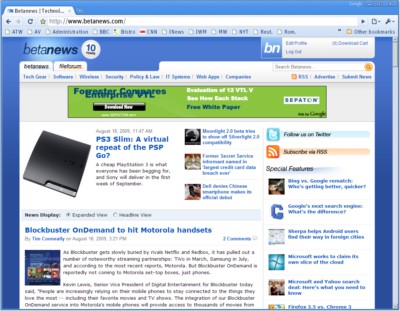
Google Chrome 4: Yes, it’s fast, but is it usable?
By Scott M. Fulton, III, Betanews

If, as Google says, a Web browser is not so much an application but a platform upon which a new class of applications may be built, then that platform must provide support. It needs to give its users the ability to accomplish tasks, and to devise new and better ways to accomplish them better. For as we all know now, “browser” is an inappropriate word for the thing we use to communicate with the Web using HTTP, because the Web is becoming a space for everyday applications deployment. Especially in the content industry, active work takes place within the browser, much more so than passive amusement.To that end, a browser may serve either as a springboard or a plank.
Despite Google Chrome’s achievements, the crucial element of support remains missing. For all the spotlight we’ve given Chrome for being the fastest Web browser on Windows, it does not yet serve the purpose of supporting users and helping them to make their online tasks more efficient. This is why Google’s expert tuning of its V8 JavaScript engine for Chrome is so important, because the browser has truly evolved into a JavaScript platform rather than an HTML platform.For everyone I know who has, over the last year, made the switch from Microsoft Internet Explorer to any other browser, the reasons have had less to do with security than in the past. People who are compelled to switch are tired of how slow IE has become, and the sinking feeling that it’s getting slower — a feeling which Betanews confirmed this week with actual facts. If you’re the manufacturer of a competitive browser, and you have the opportunity to offer your customer a free alternative that’s close to 21 times faster overall than IE, and your brand is not only one of the most recognized in the world but the only one analysts believe can truly challenge Microsoft, you’d think there would be an exodus of mass proportion.
There has been no such exodus. The reason is because, despite the number “4” on the version currently under development, Chrome gives one the feeling that it’s never been finished once.
In a way, it doesn’t make sense to have a JavaScript engine that’s as good as it is, running a platform that is so minimalistic. As the manufacturer of any set-top box can tell you, a viewer’s entire experience in front of his TV can be ruined if the functionality of the program guide isn’t solid. A browser user’s bookmarks list is the counterpart of the program guide; it’s “what’s on,” and it’s also how to get there.
Not that a list of folders and bookmarks is anywhere near as informative as an STB’s program guide. But for years, Firefox has had the good sense to enable users to open the bookmarks list in their sidebar, to open and close it with a keystroke (Ctrl-I) and scroll through it using a scroll bar. For IE8, Microsoft added an appealing and versatile Favorites menu that opens with the same keystroke (as part of an effort to win back refugees to Firefox). This menu starts off life as a pop-up, but can then be pinned to the left side as a sidebar. Then it too can be switched from Favorites (bookmarks) to RSS Feeds and browsing history. It’s a versatile feature that Microsoft has thought through, and that performs well.
SEE THE FIREFOX/CHROME SHOWDOWN FROM THE TOP:- Firefox 3.5 vs. Chrome 3 Showdown, Round 1: How private is private browsing?: Firefox 3.5 (1), Chrome 3 (0) after 1 heat
- Firefox 3.5 vs. Chrome 3 Showdown, Round 2: Are bookmarks outmoded?: Firefox 3.5 (2), Chrome 3 (0) after 2 heats
- Firefox 3.5 vs. Chrome 3 Showdown, Round 3: Finding a place for more tabs: Firefox 3.5 (2), Chrome 3 (1) after 3 heats
- Firefox 3.5 vs. Chrome 3 Showdown, Round 4: Finding a place for more tabs: Firefox 3.5 (3), Chrome 3 (1) after 4 heats

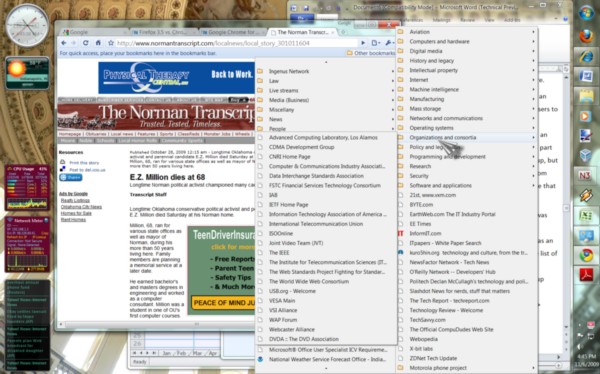
In Chrome 3, the Bookmarks Bar was only part of the New Tab screen, and was actually provided by a Google Web page. With Chrome 4, the Bookmarks Bar becomes a feature of the actual program (along with curious re-additions such as an actual button for the home page, a recent Google discovery). But the complete list of bookmarks is only available through an “Other Bookmarks” menu on the right. Clicking on this button pulls up a drop-down menu, whose folders in turn pull up other pop-up menus. So you’re not perusing a folder tree as with Firefox or IE; instead, you’re scrolling through pop-ups. And you’re scrolling slow…ly… because these are classic menus; there are no scroll bars. So if you have a long bookmarks list, you’re not going anywhere fast.
That I’m no fan of Chrome’s bookmarks system is nothing new — I first called attention to this last June. Back then, Chrome 3 was on the “beta” and “dev” tracks, while Chrome 2 was the version declared stable. Here I noted that Firefox 3.5 was more adept at searching for stored bookmarks by various criteria than Chrome, the browser from the company that’s supposed to be known for search.
But I’m not exactly the only one screaming for functionality out here. Our own Fileforum features reviews from testers over the months who have explicitly asked why Chrome seems to be all chassis and no interface. “It’s as useful as a chocolate fireguard,” wrote madmike; “very bland, short on features, but competent,” wrote bobad; and, “I wish they could make it look and act like Firefox,” wrote CyberDoc999.
Next: Shelving basic functionality under “Other…”

Shelving basic functionality under “Other”
That the Google Chrome user might only keep eight or so Web sites on her New Tab page, plus a handful of “Other Bookmarks” in a menu that should never grow large enough to have to be scrolled; that History is a separate page and not a function you can use side-by-side with other pages; that Chrome lacks the ability to even add the searching, researching, and translating functionality that Google makes for its own Toolbar for IE and Firefox; and that the button for the home page is a new feature that’s just now being tested, are all indications that Google only projects its browser will be used lightly and occasionally, by folks who’ll do a Google query, read the result, and come back to Google. If that’s truly the case, one wonders why Google actually bothers making its underlying JavaScript engine as good as it is — effectively mounting a V8 engine to a tricycle.
In fairness, Mozilla Firefox also lacks that functionality. But Mozilla knows how to help users make Firefox more functional: through a wide array of add-ons, along with a developers’ community that’s nurtured and educated in the ways of making proper software without so much initial trial-and-error.
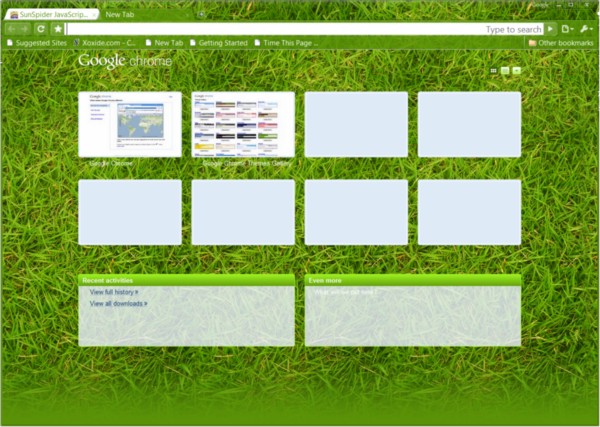
Plug-ins and add-ons to Chrome do exist, and forums such as this one have cropped up in anticipation of a burgeoning market in these things at some future date. But for now, the theme of these sites appears to be stuck with themes. Even now, when skinning of some applications has become an art form that has brought forth its own grass-roots competitive “Olympics,” Chrome themes are a throwback to the Netscape Navigator era, sometimes comprised of celebrity photos cropped so that their faces fit just inside the tab area, decorated like the bedroom of some Disney Channel star.

Tell me you’d actually intentionally make your own Web browser look like a just-fertilized lawn.
While Internet Explorer is dog slow, and now slower by the month, version 8 has functionality and, for the first time in IE’s existence, a reasonable degree of versatility. It also is relatively stable — crashing is not its problem. Crashing is a Firefox trademark — to this day, the “stable” version crashes on average 1.5 times per day for me, a fact which this “Firefox user” is not proud to share.
Yet even though it does exhibit greater stability, Chrome lacks the functionality that makes it adaptable to users’ everyday purposes, and that enables them to take it beyond the realm of “general purpose” into “heavy duty.” Google’s complete inability to make that jump, to get the clue, to provide evidence of having listened to the smallest portion of tester sentiment, bewilders me completely as to whether the company has any realistic notion of what “beta” means anyway.
With Mozilla, the newest code is developed under a private track, which only means that the developers aren’t taking comments from the public about it, even though it’s publicly available. When it’s developed enough to demonstrate in public, then it enters the “beta” track, which Mozilla code-names “Shiretoko” for 3.5 test code and “Namoroka” for 3.6. When Mozilla delays the rollout of a new build to the stable channel, it gets groans and moans from folks like me…but it’s generally because real beta testers have found real problems, or have advised some really good ideas.
A full-featured browser chassis capable of running thoroughly debugged JavaScript add-ons that won’t crash, and that contain the basic functionality that Microsoft and Mozilla discovered as far back as 2005, coupled with the proven superior V8 JavaScript engine, would clinch the alternative browser market in maybe one year’s time. But that year has already passed for Chrome, which is already gaining a reputation as a browser that makes up for its performance superiority with slow and cumbersome functionality. As long as Google continues to not get this message, then we all need to face up to the fact that Google isn’t exactly open, is it?
SEE THE FIREFOX/CHROME SHOWDOWN FROM THE TOP:- Firefox 3.5 vs. Chrome 3 Showdown, Round 1: How private is private browsing?: Firefox 3.5 (1), Chrome 3 (0) after 1 heat
- Firefox 3.5 vs. Chrome 3 Showdown, Round 2: Are bookmarks outmoded?: Firefox 3.5 (2), Chrome 3 (0) after 2 heats
- Firefox 3.5 vs. Chrome 3 Showdown, Round 3: Finding a place for more tabs: Firefox 3.5 (2), Chrome 3 (1) after 3 heats
- Firefox 3.5 vs. Chrome 3 Showdown, Round 4: Finding a place for more tabs: Firefox 3.5 (3), Chrome 3 (1) after 4 heats
-
Myka announces its latest Linux-based ‘net top box’
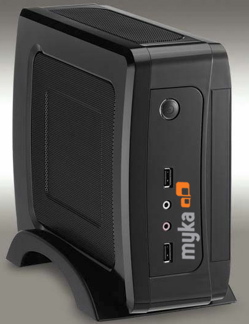
Early in the summer, IPTV startup Myka delivered an impressive Linux-based device which was not quite a set-top box and not quite a home theater PC (HTPC). Though the device’s identity was sort of nebulous, the company’s goal was crystal clear: to easily make the tons of different types of Internet video content viewable on the TV.This week, the company has announced its second device, the Myka ION, which pushes itself up against the HTPC category. Because it’s equipped with a 1.6 GHz dual core Intel Atom 330 CPU, it could even be called a “net-top box.”

Whatever you want to call it, Myka is really charging toward its goal of making the vast spectrum of Web video available in an easy and compact way. Since the ION is effectively an Ubuntu 9.10 mini ITX PC, it can run popular media manager software Boxee and XMBC alongside the Hulu desktop client — a bit of useful software which neither Boxee nor XMBC can actually run themselves.
In case the name didn’t already give it away, the Myka ION is equipped with an Nvidia ION GPU which supports DirectX 10 graphics, and full 1080p HD video without overtaxing the CPUs. The company expects it to be shipping in about four weeks, and it will be available in various configurations, with different capacity hard drive sizes (up to 1 TB) and with additional options like a Blu-ray drive, and 802.11n wireless.
We’ll give it a closer look when it becomes available before the holidays.
-
Netflix Instant Streaming for PS3 works, is shown on YouTube
Well, Netflix streaming on the PS3 works. Of course, you need to use the special disc (can’t just download the software eh? how quaint). But it appears to be working correctly. Check out the video above, which demonstrates that it’s working, and working smoothly.I’m actually glad that the PS3 has Netflix streaming now. It’s a nice addition to a really great Blu-ray player. If I owned a PS3, I’d totally get the disc and stream my heart out…
You know, like I have been doing since 2008 on my 360.
-
Google Highlights Searches For Black Friday Deals
With Thanksgiving just a few weeks’ away consumers are already starting to search for deals online.
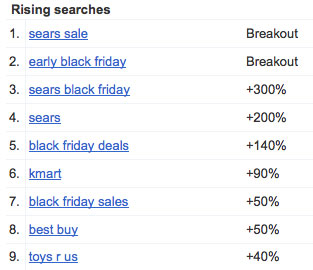
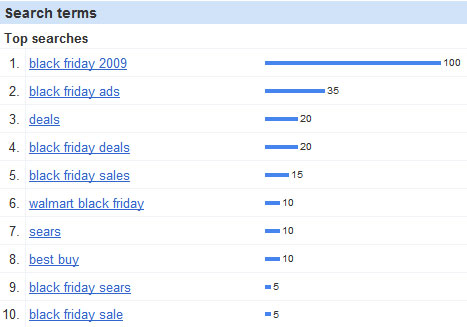
Over the last seven days fifty percent of the top "Black Friday" related search terms include ads, sales and deals, according to Google Insights for Search.

The Google Retail Advertising Blog provides more details. "Interestingly, when we look at Black Friday rising searches over the last 7 days, we see that ‘Early Black Friday’ is the second rising search term, meaning it has grown over 2,000% during this time period with respect to the previous time period."
"It also may indicate that consumers are not only leveraging ‘Black Friday’ and searches to locate promotions on these days, but may be seeking out similar types of promotions and offerings even before Thanksgiving weekend."

Google also offers advice on what types of ads will appeal the most to bargain shoppers. "Text ads should highlight specific price points, discounts, coupon codes, and special promotions. Also, remember to keep an eye on search trends in your own category by leveraging Google Insights for Search."
Related Articles:
>Cyber Monday Tips From The Google AdWords Crew
>Consumer Online Spending To Grow 24%
>Black Friday Online Sales Better Than Anticipated
-
Update On Choruss: Universities Not Talking, Mysterious 10,000 Students Still Nowhere To Be Found
We’ve been pretty big critics of the music tax concept, that was being pushed by Jim Griffin’s Choruss along with Warner Music (who had hired Griffin to create this program). Of course, we’ve only been able to criticize what bits and pieces have leaked out from those who have seen Griffin’s presentations. That’s because, despite a busy conference schedule, Griffin never seems to publicly describe what Choruss really is. So, every time we hear some new info about Choruss, and explain why it’s bad, we get angry emails from Griffin calling me all sorts of insulting names, and insisting that I’ve mischaracterized Choruss. So, we ask for more details, and we don’t get them. Instead, we’re given amorphous descriptions about how it’s “an experiment.” But what is the experiment? Well, it will be lots of things. As soon as we narrow in on an example, however, and explain why it’s bad, we’re attacked because the plan might not include that particular example. But we haven’t yet heard an example that makes sense.
Griffin had agreed (as part of an angry email) to answer questions from the Techdirt community, and we obliged by sending him a long list of questions. Griffin had some personal issues to deal with over the summer, which was totally understandable, but we still haven’t heard any answers. I’m beginning to wonder if we ever will.
But the biggest question I had was if he could explain who the “tens of thousands” of students were who Griffin told a conference in June would be using Choruss this fall semester. It seemed odd to find out that so many students had signed up for something when we still weren’t being told what it was. As the fall semester started, we asked to hear from students who were using Choruss, and got silence — which seemed odd. Apparently, it’s because those tens of thousands of students hadn’t signed up for the fall.
However, as a bunch of you have sent in, now the claim is that six college campuses will be testing Choruss this spring semester, but Griffin won’t say who they are and the campuses won’t admit to participating. They claim that they’re afraid of backlash from folks like us — but that makes me wonder. If the concept is so good, why not stand up and defend yourself for being a part of the program? If you can’t defend the reasons for testing the program, it makes me wonder why you’re doing it in the first place.
The article at the Chronicle of Higher Education provides a few new details that don’t sound particularly appealing. Rather than (as some had suggested earlier, but since Griffin never made it clear, we just don’t know if this was ever true) a system that would let students share files freely under some sort of blanket license, it sounds like “yet another limited music service.” It will allow unlimited downloads, but you have to use the Choruss service (again, perhaps the article is wrong, but that’s what it says). Similar services have been tried on various campuses and failed, so we’re curious to hear what’s so special about Choruss that will be different.
It still seems like Choruss is trying to solve a problem that doesn’t exist. We’re seeing more and more smart musicians put in place business models that work. They work in a way that lets fans choose to send money to the artists they want to support directly, without a big middleman. Choruss appears (from all we’ve heard) to be an attempt to set up a big middleman that will take big chunks of money and then use some magical process to figure out how to dole it out. But why do we need that overhead? The market is figuring stuff out. It doesn’t need another middleman.
Permalink | Comments | Email This Story
-
Ubuntu 9.10 Review
Right after Ubuntu’s fifth birthday it was time to celebrate once more, because a Karmic Koala was released, and it brought with it a lot of reasons to upgrade. If Ubuntu 9.10’s smart looks haven’t convinced you yet, maybe the fast boot times and overall enhanced performance will. You still don’t know what Ubuntu 9.10 (Karmic Koala) is all about? Then read on, we will clue you in.While writing this review, I tried to put myself in the “shoes” of a new Ubuntu user. This meant that I didn’t go on to installing my favorite programs or setting up everything as I like right after installing the operating system, but instead I tried to make do with what Ubuntu provides in the default installation. Also, I tried to stay away from the terminal and, largely, succeeded in doing so. We’ve tested Ubuntu 9.10 over a period of one week on the following systems:
[tablec][row][col]· AMD K8 nForce 250Gb Motherboard
· AMD Sempron 2800+ Processor
· Nvdia GeForce FX5500 Video Card
· 512 MB RAM
· IDE HDD 80 GB Maxtor
· LG CD-RW/DVD-ROM Drive
· 17″ LG Flatron L1730S LCD[/col]
[col]· Intel Gigabyte GA-965P Motherboard
· Intel Pentium 4 3 GHz
· Nvidia Leadtek Geforce 7300GS 256 VRAM
·… (read more) -
Strikeforce will be the ‘premier’ MMA league in EA Sports MMA

Strikeforce (UFC’s closest competitor here in the U.S.) promotes one of the bigger fights of the year tomorrow in Fedor vs. Brett Rogers. It takes place in Chicago, which explains why EA Sports just held a press conference there to reveal more details of its upcoming MMA game, entitled EA Sports MMA. EA Sports says that Strikeforce will be the “premier” mixed martial arts league in the game, and that well-known referee “Big” John McCarthy will be in the game.
The game, which is due out for the Xbox 360 and PS3 next year, will, as such, feature Brett Rogers and other Strikeforce fighters.
In-game commentary will be provided by Frank Shamrock and Mauro Ranallo. I haven’t played an EA Sports game in three years, so I have no idea who good the commentary is these days.
Other fighters confirmed to be in the game include current UFC star Randy Couture, Gegard Mousasi, Renato Sobral, and Cung Le. (Check Wikipediafor the full list of confirmed and rumored fighters. Hopefully Alistair Overeem makes the cut. You’d think he would, being that he’s the Strikeforce heavyweight champion, even if he hasn’t defended the belt in two years.)
Presumably EA Sports MMA will now be colloquially referred to as “the Strikeforce game.” Hopefully EA can work in plenty of Dream fighters, as well as the Dream arenas.
Oh, the first trailer of the game will debut during tomorrow night’s Strikeforce show that airs on CBS at 9pm. And if you’re interested in a little backstory, check out Showtime’s 30-minute documentary on both Fedor and Rogers. Fun stuff.
-
Sony Ericsson’s 720p shootin’, S60 runnin’ Kurara leaks out
A year ago Sony Ericsson’s prominence was dropping faster than Kirstie Alley could pound back Quarter Pounders, but its most recent offerings have been successful in generating buzz in a way that the Japanese-Swedish phone maker hasn’t experienced in quite some time. Fast forward to today where pictures of the companies second Symbian S60 device have leaked out by way of Russia and again we have some buzz, this time about how its 8.1 megapixel camera might be able to record videos at resolutions up to 720p. It’s codenamed Kurara and is said to have a 3.5″ AMOLED display, but other than that we really don’t know anything about it, other than it’s likely to come sometime within the next 6 months. More pictures are available after the break.
Thanks to everyone that send this in!


-
Stimulus Funds for Green Energy Projects Going Offshore along with Other U.S. Manufacturing
The Obama Administration sold its $787 billion stimulus plan on the basis of improving the economy through investing in green energy and by doing so, increasing employment in the United States. But what is actually happening, particularly with wind and solar projects, is that the majority of the manufactured components are being built offshore in either Asia or Europe, resulting in foreign countries capturing a good deal of our stimulus funds and finding a lucrative haven for their products in the United States.
Green Stimulus Money Going Overseas
Since September 1, 84 percent of the $1.05 billion in clean energy grants has gone to foreign wind companies. Foreign countries benefiting from stimulus funds for wind technology are Spain (57%), Germany (12.6%), Japan (9.5%), and Portugal (5%).[i] Companies began applying for grants at the end of July and awards were announced by the two joint administrators of the program, the Energy and Treasury Departments, beginning on Sept. 1. In the first round of the grants, 77% went to foreign wind developers, followed by 84% in the second round. Of the 11 wind farms that received grants, 695 of the 982 installed turbines were manufactured by a foreign company.[ii]
Further, there are few restrictions on how the grants can be used. According to the Investigative Reporting Workshop at American University, over $800 million were provided to wind farms that were already producing electricity. As required by law, all 11 wind farms started operating after January 1, 2009, but before the grants were awarded.[iii]
Turbine Manufacturing Dominated by Foreign Competitors
The U.S. currently has the most installed wind capacity in the world, but it is not a leader in the manufacture of turbines. The Investigative Reporting Workshop reported that of the turbines currently under construction in the U.S., 67 percent are slated to be purchased from foreign-owned turbine manufacturers.[iv] According to U.S. customs data for 2008, and the U.S. Trade Commission, the U.S. imported $2.5 billion worth of wind turbines last year—up from $365 million in 2003.
In the future, wind turbines and/or their component parts may be coming from China where lower labor costs have allowed Chinese-made products to dominate many manufactured goods in the U.S. GE, a major U.S. wind turbine producer, already owns three facilities in China that produce turbine components. GE is also planning a factory in Vietnam that will employ 500 local workers and export 10,000 tons of components to GE Energy assembly plants around the world.[v]
China is already beginning to develop its own strong hold for wind power in the U.S. A joint venture between China’s Shenyang Power Group, the U.S. Renewable Energy Group, and Cielo Wind Power LP to develop a 600 megawatt wind farm on 36,000 acres in West Texas, costing $1.5 billion, was announced on October 29, 2009.[vi] A-Power Energy Generation Systems Ltd., a provider of distributed generation systems in China and a fast-growing manufacturer of wind turbines, will supply the turbines. A-Power Energy entered the wind power industry last year.[vii] Delivery of wind turbines for the West Texas wind farm is scheduled for March 2010.[viii]
Solar Cells Manufactured Overseas
Not only are wind turbines mostly manufactured in countries overseas, but so are photovoltaic (PV) cells. Florida Power & Light (FPL) started operating its 25 megawatt photovoltaic solar plant in southwest Florida in conjunction with a visit to the plant by President Obama on October 27. [ix] The DeSoto plant in southwest Florida is the first of a total of 110 megawatts of solar capacity that FPL will install at 3 different sites by the end of 2010. Although Obama praised FPL’s work in the solar arena, he did not tell the American public that the components of the DeSoto plant are from foreign countries. While the PV cells were provided by a firm from California, they were made in the Phillipines. The steel PV frame holding the cells was produced in Canada, and the electrical parts and boxes were made in Germany, where solar power has been given heavy subsidies by the German Government. While German manufacturers have been producing PV technology for their country’s solar expansion, they are now concerned that China will take over their market due to costs that are 30% lower.[x]
Conclusion
The Obama Administration has told the American public that it will produce jobs and stimulate the U.S. economy through green energy technology. He has also touted that stimulus funds will be used for goods made in America. Yet, the the Investigative Reporting Workshop at American University finds that this is not the case. And, more examination of green energy development in the U.S., shows Asian and European countries well established here in providing the component parts for green energy technology.
The problem is not with international trade per se. In a genuinely free market, where politicians do not pick winners or losers, the most efficient firms would capture market share, be they American or foreign. The result would be the best products at the lowest prices for American consumers.
The real problems are a government “stimulus” plan and efforts to centrally plan a “green economy.” The government can only “stimulate” by spending money that it has first taxed or borrowed from the private sector. It would be bad enough for the government to destroy jobs in American fossil fuel industry while spending money on domestic producers of “green energy.” But it is particularly absurd for the U.S. government to cripple American industry while shoveling the lion’s share of the pork into the hands of foreign beneficiaries.
[i] “Overseas firms collecting most green energy money”, October 29, 2009, http://investigativereportingworkshop.org/investigations/wind-energy-funds-going-overseas/[ii] Ibid.
[iii] Ibid.
[iv] Ibid
[v] “Vietnam’s first turbine component plant underway”, May 13, 2009, http://www.vietnewsonline.vn/News/Business/Companies-Finance/6072/Vietnams-first-turbine-component-plant-underway.htm
[vi] www.reuters.com/article/pressRelease/idUS200008+29-Oct-2009+BW20091029
[vii] “Lone Star, Meet Red Star: China’s $1.5 Billion Wind-Power Deal in Texas”, October 30, 2009, http://blogs.wsj.com/chinarealtime/2009/10/30/lone-star-meet-red-starchina%e2%80%99s-15-billiob-wind-power-deal-in-texas/
[viii] www.reuters.com/article/pressRelease/idUS195122+29-Oct-2009+PRN20091029
[ix] http://www.instituteforenergyresearch.org/2009/10/26/highest-cost-generating-plant-comes-on-line-in-florida-to-obama-fanfare/
[x] “Solar-Power Incentives in Germany Draw Fire,” Vanessa Fuhrmans, Wall Street Journal, September 28, 2009, http://online.wsj.com/article/SB125383541153239329.html