Blog

  • Video: Netflix on PlayStation 3

    By Tim Conneally, Betanews

    As a PlayStation 3 owner, I did not have the luxury of Netflix Instant streaming through my video game console until today. Now, with the aid of Blu-ray’s BD-Live and a free Netflix disc which must remain loaded in the PS3, I now have access to an experience similar to the one Xbox Live Gold subscribers had on their 360s.

    These discs shipped out to subscribers this week and started landing in mailboxes today.

    Since last year, I have used one of the Roku streamers to watch Netflix on my TV. It’s a $99 investment I’ve gotten a lot of mileage out of, especially with the inclusion of Amazon On Demand, which gets a number of titles that Netflix does not. Unfortunately, for as handy and affordable as the Roku device has been, it does not allow movie titles to be browsed directly on the television. Users had to build an instant queue on their PC and only that content could be browsed.

    With Netflix on PlayStation 3, not only can the Instant streaming catalog be browsed, but also lists of titles recommended for the user based on his viewing habits.

    Copyright Betanews, Inc. 2009


    Add to digg
    Add to Google
    Add to Slashdot
    Add to Twitter
    Add to del.icio.us
    Add to Facebook
    Add to Technorati


  • Reggie: New Super Mario Bros Wii to outsell Modern Warfare 2 on a single platform, no Wii HD

    Nintendo of America president Reggie Fils-Aime has thrown down the gauntlet. In the newest GTTV episode, he predicted that New Super Mario Bros. Wii w…

  • Retailers Still Want New Laws Blaming eBay For Shoplifting; Law Enforcement Isn’t So Sure

    A group of brick-and-mortar retailers have been pushing for years to pass laws that put liability on online sites, like eBay, if stolen goods are sold through the sites. This really has nothing to do with preventing theft from their stores, as they claim. Instead, it’s really an effort to attack online competitors and second-hand sellers to try to boost the primary market. Studies have shown that the number one source of theft in stores is actually employees. If the retailers were serious about cracking down on theft, they would do more to watch their own employees… but instead, they’ve been trying to create a moral panic by claiming that the use of eBay leads to crime because people get so addicted that, after they run out of their own stuff to sell, they start ripping off stores just to keep that eBay high going. Just look at their own words:


    “Thieves often tell the same disturbing story: they begin legitimately selling product on eBay and then become hooked by its addictive qualities, the anonymity it provides and the ease with which they gain exposure to millions of customers. When they run out of legitimate merchandise, they begin to steal intermittently, many times for the first time in their life, so they can continue selling online. The thefts then begin to spiral out of control and before they know it they quit their jobs, are recruiting accomplices and are crossing states lines to steal, all so they can support and perpetuate their online selling habit.”

    Uh huh. Only problem? Actual stats show that such retail theft is on the decline. But, of course, that won’t stop the lobbyists from these stores from pushing — and that means we’ve now got the fourth such law introduced just this year to deal with. With the introduction of the new bill, the House Judiciary Committee held hearings with law enforcement officials who did claim that retail theft was a problem, but according to Thomas O’Toole, they also said no new laws were needed. What are the chances of that happening? Apparently, the law enforcement folks said that the online websites like eBay are actually quite cooperative, and the only problem is they need more money and resources — not more laws. Somehow, that seems unlikely.


    Permalink | Comments | Email This Story


  • Hoyer Says Health Vote Could Be Delayed

    “House Majority Leader Steny Hoyer (D-Md.) said ‘delay tactics’ could prevent the vote from occurring at the 6 p.m. Saturday scheduled time,” and “suggested the debate could go into Sunday or next week,” The Hill reports. “But he also acknowledged that leaders do not yet have the 218 votes they need among House Democrats to pass the bill.” The Hill reports that “House leaders are expected to incorporate any compromise on abortion into the bill Friday in the Rules Committee. Republicans have said that doing so violates the pledge by Hoyer and House Speaker Nancy Pelosi (D-Calif.) to have the complete text of the bill available to the public for three full days prior to consideration of the bill” (Soraghan and Allen, 11/6).

    USA Today: “‘Unless there are delaying tactics,’ Hoyer said on the call, organized by Families USA, ‘I think we can finish debate by tomorrow night.’ But, he added, the House would consider the bill ‘to (its) conclusion’ and added that “Monday and Tuesday is a possibility” (Fritze, 11/6).

    The Associated Press: “Hoyer sought to pin the blame for any possible slippage on delaying tactics expected from Republicans, who unanimously oppose the health care remake. ‘Nice try Rep. Hoyer, but you can’t blame Republicans when the fact is you just don’t have the votes,’ said Antonia Ferrier, spokeswoman for House Republican Leader John Boehner of Ohio. Republicans could stall the bill by demanding roll-call votes on parliamentary matters (Werner and Alonso-Zaldivar, 11/6).

    The Boston Globe: “House leaders are trying to rush the bill — one of the largest and most complex pieces of legislation considered in recent years — through the lower chamber quickly. They fear that with every passing hour, more issues could arise and create obstacles to passage. Hoyer said discussions are ongoing over two side issues, abortion and immigration. … If the House and Senate both pass legislation, Hoyer said — rather ominously — that he expects a ‘relatively lengthy and difficult conference’ given the major differences between the House and Senate and the complexity of the bill” (Wangsness, 11/6).

    The Wall Street Journal: “Signaling the unease of some freshman Democrats in swing districts, Rep. John Adler of New Jersey said Friday he will vote against the bill. Mr. Adler, who won his first term in 2008 with 52% of the vote, said the House bill ‘does not do enough to contain costs.’ He added, ‘Congress should not pass a bill that costs more than $1 trillion’ over 10 years. New Jersey was the scene of a big Republican victory on Tuesday, when Chris Christie defeated Democratic incumbent Jon Corzine in the state’s gubernatorial race” (Yoest and Vaughan, 11/6).

    Meanwhile, “[t]he House will not vote on a liberal Democratic plan to have a fully government-run ‘single-payer’ healthcare plan, House Speaker Nancy Pelosi announced Friday,” The Hill reports in a second article. “Pelosi (D-Calif.) declined to pursue a single-payer plan in the healthcare overhaul. But Rep. Anthony Weiner (D-N.Y.) secured a commitment from leadership in July to have an ‘up-or-down vote’ on the single-payer approach during floor debate…The amendment almost certainly would have lost, but would have demonstrated what support there is among Democrats for single-payer. But as the vote, now planned for Saturday, has neared, Pelosi has seemed increasingly reluctant to open the bill up for any amendments, even from her own party” (Soraghan, 11/6).

  • Half-Staff

    This morning the President gave some brief remarks in the Rose Garden, and before discussing the news on job numbers that also concern all Americans, gave an update on his response to the tragic incident at Fort Hood yesterday:

    THE PRESIDENT:  Good morning.  I want to begin by offering an update on the tragedy that took place yesterday at Fort Hood.

    This morning I met with FBI Director Mueller and the relevant agencies to discuss their ongoing investigation into what caused one individual to turn his gun on fellow servicemen and women.  We don’t know all the answers yet and I would caution against jumping to conclusions until we have all the facts.

    What we do know is that there are families, friends and an entire nation grieving right now for the valiant men and women who came under attack yesterday in one of the worst mass shootings ever to take place on an American military base.  So from now until Veterans Day I’ve ordered the flags at the White House and other federal buildings to be flown at half-staff.  This is a modest tribute to those who lost their lives even as many were preparing to risk their lives for their country.  And it’s also recognition of the men and women who put their lives on the line everyday to protect our safety and uphold our values.  We honor their service, we stand in awe of their sacrifice, and we pray for the safety of those who fight and for the families of those who have fallen.  And as we continue to learn more about what happened at Fort Hood, this administration will continue to provide you updates in the coming days and weeks.

    President Obama on Fort Hood

    President Barack Obama remarks about the shootings at Fort Hood in Texas and the rise in the unemployment rate while speaking to the media in the Rose Garden of the White House. November 6, 2009. (Official White House Photo by Chuck Kennedy)


    UPDATE: The President has just issued the following proclamation:

    Honoring the Victims of the Tragedy at Fort Hood, Texas
    – – – – – – –
    By The President of the United States of America
    A Proclamation

    Our Nation’s thoughts and prayers are with the service members, civilians, and families affected by the tragic events at Fort Hood, Texas. The brave victims, who risked their lives to protect their fellow countrymen, serve as a constant source of strength and inspiration to all Americans. We ask God to watch over the fallen, the wounded, and all those who are suffering at this difficult hour.

    As a mark of respect honoring the victims of the tragedy at Fort Hood, Texas, I hereby order, by the authority vested in me by the Constitution and the laws of the United States of America, that the flag of the United States shall be flown at half-staff at the White House and upon all public buildings and grounds, at all military posts and naval stations, and on all naval vessels of the Federal Government in the District of Columbia and throughout the United States and its Territories and possessions until sunset, Tuesday, November 10, 2009. I also direct that the flag shall be flown at half-staff for the same length of time at all United States embassies, legations, consular offices, and other facilities abroad, including all military facilities and naval vessels and stations.

    IN WITNESS WHEREOF, I have hereunto set my hand this sixth day of November, in the year of our Lord two thousand nine, and of the Independence of the United States of America the two hundred and thirty-fourth.

    BARACK OBAMA

  • Venezuelan Government Blames Video Games For Violence, Implements Widespread Ban

    Via Game Politics we hear about the situation in Venezuela, where the government is apparently blaming video games for the widespread violence in the country, and has issued a ban on the import, production or sale of any video games that include weapons. The link above is a rather heartfelt writeup, by someone in Venezuela, discussing the many problems the people in that country face, and making it clear that it’s not violent video games that are the problem. It’s long, but is a worthwhile read. Here’s just a small snippet:


    This situation is painful to behold. Even if I barely game at all these days, I am a gamer at neocortex. I spent countless hours solving puzzles, riddles and fighting monsters in dungeons. I rescued Toadstool many times, only to be told that thanks, but my Princess was in another castle, later I joined Link and rescued Zelda from Agahnim and Ganon, using the Master Sword and the Silver Arrows. I got the Zantetsu sword and cut metal, I summoned Ifrit, Odeen and Behemoth. From Dragoon, I became a Paladin. I sneaked on Big Boss’ fortress in Zanzibar and stopped doomsday with Solid Snake. I fought along a Double Dragon trapped on a Final Fight, using my Killer Instinct in a Mortal Kombat in which only the greatest Street Fighter would come alive. I was Linked to the Past by a Chrono Trigger, my Soul Blazing, as I lived my Final Fantasies, Wandering from Ys, arriving to a Lagoon, to learn about the Secret of Mana, and finally understood that there is Ever More to life.

    These games are a cherished part of my life, they helped to shape my young mind, they gave me challenges and vastly improved my English, opening the door to a whole new world of literature, music and people from all around the world. What I have achieved, all my research, how I have been able to travel even though I’m always broke, the hard work I’ve done to convince people to fund a start up for cheap biotech for developing countries and regular folks, none of that would have been possible hadn’t I learned English through video games.

    Now, thanks to the tiny horizons of the cast of morons who govern me, thanks to the stupidity and ham-fisted authoritarianism of the local authorities, so beloved of so many liberals, my 7 year old brother’s chances to do the same could be greatly impacted.

    Permalink | Comments | Email This Story


  • The White Unibody is the Second-Best MacBook Ever, So Why Do I Feel So Let Down?

    macbook_unibody

    The new plastic unibody MacBook is arguably the second-best MacBook model Apple has produced yet (trumped only by the late 2008 aluminum unibody MacBook). So why am I finding myself unexpectedly underwhelmed and disappointed with it?

    When rumors began circulating in late summer about an imminent new unibody MacBook in polycarbonate plastic. Being a consummate Apple laptop aficionado, I was excited. Speculation that it would sell in the $700 – $800 range further whetted my anticipation but I was also expecting something insanely great. After all, Apple could build on what it had learned making polycarbonate MacBooks for three and half years (the best-selling Mac model ever) combined with the unibody engineering of the MacBook Pros adapted to plastic materials.

    Instead of Insanely Great, We Get…OK

    However, instead of insanely great, we get OK — or perhaps just a bit more than OK. I like it a lot better than the original MacBook, but there’s nothing really exciting or special to get up in the night and write home about. It’s just a good, solid-performing machine with better case engineering and build quality than its predecessor, and better-looking, but alloyed with some strange compromises that undermine its desirability and the “must-have” factor.

    The case aesthetics are definitely a major step up from the iBook-esque previous model, whose looks were getting tired after eight and a half years. I like white computers and I like glossy finishes, and this has both, although I think Apple is blowing an opportunity by not offering it in black as well, and the high gloss is proving quite controversial with some.

    I think the MacBook’s all-white keyboard looks more attractive and inviting, and will be easier to see (I’m not a touch typist), than the black keys on my aluminum Macbook, which are probably my unfavorite element of its generally pleasing appearance.

    As for robustness, I haven’t got my hands on one yet, being out here in the Nova Scotia backwoods 150 miles from the nearest Apple reseller, but reportedly this new unibody machine has a solid feel, with no case flexibility or squeaks and rattles, and excellent panel fits, which is what I would expect based on my own aluminum unibody machine. Actually, the new MacBook’s rubbery-coated bottom panel is an aluminum stamping.

    True Mediocrity Rears its Ugly Head

    On the downside, true mediocrity rears its ugly head in the context of I/O connectivity and expansion, with an impoverished port array comprised of two USB ports (only one fully powered), Ethernet, a mini DisplayPort a combo headphone/line-in port (you can’t use both earphones and a microphone at the same time) and a security slot. No FireWire and, most bizarrely, no SD card slot (“Pro feature?” — get real Apple). No HDMI either.

    FireWire and no expansion headroom are the big disappointments to me. I’m living daily with the vicissitudes of FireWirelessness with my aluminum unibody MacBook, and I’m not cheerily disposed, but Apple seems determined to dump FireWire wherever it can get away with it. When USB 3.0 is finally incorporated, maybe there will be a case for dropping FireWire, but USB 2.0 is an abominably lame and crippled substitute at this point. I’m dumbfounded that Apple didn’t learn its lesson from the chorus of boos when it tried that with the aluminum MacBook (OK, so I bought one anyway, and I like it almost unreservedly except for the FireWire crippling, but that really rankles).

    No Legitimate Excuse

    As for no expansion, there’s no legitimate excuse. Even the humblest tiny little $300 PC netbooks comes equipped with SD Card readers, and often three USB ports as well. There’s no satisfactory excuse for Apple leaving the SD Card slot out of the new MacBook and providing a measly two USB ports — only one of them delivering full bus power. My speculative deduction is that it’s just Apple contriving to put some distance between the MacBook and the more expensive 13″ MacBook Pro specs-wise.

    Ample Power

    In the positive column, the new MacBook’s internals pretty much match the current base 13-inch MacBook Pro’s: a 2.26GHz Core 2 Duo with a 3MB L2 cache, a 1066MHz frontside bus and 2GB of standard RAM, and the ubiquitous NVIDIA GeForce 9400M integrated graphics chipset, as well as a similar LED backlit display — the only difference being that the Pro has a 60 percent greater color gamut. Power-wise, I would find it more than satisfactory, having no complaints in that department about my 2.0GHz MacBook.

    Then there’s the built-in, non swappable battery, which I have definitely mixed feelings about. Apple rates it at seven hours runtime, but a real-world four-to-five hours will be experienced more typically, after which you have to find a power outlet. I prefer swappable batteries.

    In summary, while I want to like this new MacBook, I don’t find its $200 lower price nearly compelling enough to even tempt me to not opt instead for the $1,199 13-inch MacBook Pro with its SD card slot, FireWire port, brighter, better color gamut display backlit keyboard, and aluminum case, Certified Refurbished examples of which should be available for about the same price as a new unibody MacBook.

    If this machine sold for, say, $799, it would be a whole different value equation — an opportunity missed in my estimation, although it’s harder and harder to argue with Apple’s pricing and marketing strategy given its latest quarterly financial results. I think the new MacBook will continue to be a strong seller for Apple, but I wish it would have tried a little harder with this one, though. Don’t you?

  • Ford does the unthinkable, announces the $650 car

    Holy cats, Ford is going downmarket. Way down. Way, way down. Daniel Grossman, VP of Ford Motor Company, just announced to ONN the $650 car, which will be the least expensive, and cheapest, car available in any market. That’s right. A car I can afford to buy on my salary. My wife will be so excited. Watch the video announcement after the jump.


  • AT&T gets FCC approval for purchase of Centennial Wireless

    att-centennial

    If you’re a big telecommunications company there is the hard way to add 893,000 customers to your portfolio — by working to provide hardware and services that people value and want — then there is the easy way. Cutting a check. Today, the FCC gave AT&T the final go ahead to purchase US wireless carrier Centennial Wireless for a cool $944 million. The acquisition will bolster AT&T’s presence in the midwest, southwest, and Puerto Rico, although we’re not sure how, if at all, it will impact their 3G footprint. Centennial’s stockholders will receive $8.50/share for their troubles and AT&T is saying it will have Centennial’s stores re-branded by January of 2010. Any Centennial customers out there excited about being folded into Ma Bell?Read

  • Vint Cerf Plugs His Plucky Space Web Protocol Into Android

    Google evangelist Vint Cerf, who many people think of as one of the fathers of the Internet, has his eyes on some interesting Earth-based applications that can work with his long-standing interplanetary extensions of the Net. He announced at the Open Mobile Summit this morning a software stack that sits on top of the open-source Android operating system that could strengthen wireless network communications through his DTN (Delay Tolerant Netorking) Interplanetary Net protocol.

    Cerf has been working with NASA since 1998 to develop DTN as a way to overcome limitations in the TCP/IP protocol when fast, one-to-one communications aren’t possible, especially over long distances. NASA has already show DTN to be effective for communications between Earth-based networks and outposts in deep space.  Can the protocol greatly increase the coverage and service reliability of our mobile networks and devices?

    The protocol uses a store-and-forward, rather than a continuous communication model, to reliably communicate packets back-and-forth over long distances, as explained in this NASA note on its successes with DTN:

    Unlike TCP/IP on Earth, the DTN does not assume a continuous end-to-end connection. In its design, if a destination path cannot be found, the data packets are not discarded. Instead, each network node keeps the information as long as necessary until it can communicate safely with another node. This store-and-forward method, similar to basketball players safely passing the ball to the player nearest the basket means information does not get lost when no immediate path to the destination exists. Eventually, the information is delivered to the end user.

    DTN is also slated for many applications involving communications between Earth-based networks and satellites, and even long-distance underwater communications tasks. Cerf also has his eyes squarely on high-reliability DTN deployments for use with Earth-based wireless networks, as The Register’s Cade Metz reports:

    “Mobile operations are highly stressed,” Cerf said. “Mobiles are used where people congregate…In a sense, mobile is already a dense and hostile environment. We all know that when you drive around, coverage isn’t very good. It’s so hostile, it’s clear that mobile could take advantage of these more-resilient protocols. TCP/IP is very brittle.”

    Cerf’s work on DTN has been space-focused for many years, but, just as the Android operating system is open source and forking into many new types of deployments, DTN is moving beyond Cerf’s initial intent for it. Given its roots in space applications, doesn’t an operating system dubbed Android have the perfect name for it?

  • The White Stripes, The Damned, No Doubt on Rock Band Store next week

    Brother/sister (no, not really) duo The White Stripes will be making their Rock Band debut next week via a track pack featuring three of their songs. …

  • Crunch Time for Time Warner

    By Lloyd Grove
    DailyBeast.com

    His publishing unit is trouble. The spinoff of AOL is at hand. CEO Jeffrey Bewkes talks exclusively with The Daily Beast’s Lloyd Grove about the future of the media business.

    Jeffrey Bewkes seemed eager to unveil a brand-new business strategy for Time Warner Inc., the careworn media giant he’s been running for the past 22 months.

    “Actually we’ve been hiding this, and you should be the one to break the news,” Bewkes told me in an exclusive interview with The Daily Beast. “We are going to buy and roll up all the railroads in the United States. Then we’re going to put flat screens in all of the freight boxcars, because we think that anybody in a recession like this, who’s actually hitching a ride on a boxcar, could become a very loyal viewer of some of our programming. And later, we might be able to sell them something. That’s our theory.”

    Warner’s 57-year-old chairman and chief executive was joking, of course—giving his facetious take on the supposed synergy that results from marrying content to distribution. Comcast’s quest to buy NBC Universal is only the latest example. In a wide-ranging conversation, Bewkes also:

    – declared himself bullish on Big Media—especially (no surprise here) Time Warner’s prospects and the “branded multichannel cable networks” with distinct programming personalities, such as Fox News, MTV, and HBO.

    – suggested that mass-audience broadcast networks such as ABC, CBS, and NBC have a business model that’s “increasingly becoming not viable.”

    – reiterated his defense of Time Inc., the company’s troubled publishing unit, and stoutly denied rumors of plans to turn the magazines (with the exception of People and Sports Illustrated) into purely digital enterprises. “Absolutely not,” he said.

    – predicted widespread paid content for news Web sites within the next two years. “I think what is not viable—literally not viable—is advertising-support-only free content in journalism.”

    Bewkes predicted that people will soon become accustomed to using a variety of technologies, both paid and free, to view movies, read magazines and newspapers, watch television and otherwise consume their favorite media. . . READ FULL STORY

  • Early build of Moblin 2.1 improves connectivity, but not device support

    By Tim Conneally, Betanews

    Until recently, netbooks seemed to be computers designed by a subtractive process. That is, you start with a notebook design, and you scale back on the cost by equipping it with lower-power processors, less on-board storage, smaller screens, and either open source software or truncated desktop operating systems.

    There really hasn’t been a powerful example of a “netbook experience” that was built from the ground up to differentiate the devices from their full-powered counterparts.

    In March, Betanews contributor Joe Wilcox wrote a column for eWeek called “The Problem with Netbooks” where he described two paths that the form factor could take: one leading to success, the other leading to a quick demise.

    These paths differed depending on where you began.

    To get on the path to success in the United States, netbooks would have to be fully integrated with mobile broadband carriers who heavily subsidize them, and they would have to have a specially designed version of Windows that isn’t a stripped down desktop version or a built-up mobile version.

    But in Europe, it’s a different story altogether, and the devices are already on the right path. Carrier subsidies there are stronger, the devices fall more in line with smartphones than notebooks, and Linux-based operating systems are more popular.

    And this is why Moblin has begun to look so promising. The Linux Foundation’s open source operating system designed specifically for Intel Atom-powered devices was bumped up to a project release of Moblin version 2.1 for netbooks/nettops yesterday. This release knocks out several hundred bugs and adds a number of features critical to netbooks.

    The most essential of the upgrades are related to wireless data connections. Support for Ericsson’s 3G mobile broadband modules has been added, and the Connection Manager now supports Ethernet, Wi-Fi, WiMAX, and 3G connections. Bluetooth discovery and pairing has also been added, which will allow users to tether their Bluetooth phone to their netbook as a 3G wireless modem.

    However, Moblin has a critical shortcoming in that it doesn’t yet support the Nvidia, ATI, or GMA-500 integrated graphics processor made by Imagination Technologies. The latter of these is used in all Atom Z500 series devices, also known as “Poulsbo.”

    While these graphics processors are found mostly in devices that wouldn’t exactly fit in the netbook category — they’re MIDs, convertables, and “X-series” notebooks — it’s also used in the Nokia Booklet 3G, a 10-inch pseudo-netbook that could be a lock in Europe, and seems a perfect fit for Moblin.

    Betanews sent an inquiry to the Linux Foundation asking about support for the device in Moblin 2.1, to find out whether it’s been tested, whether it has to run in a reduced graphics mode or simply cannot run at all, or if there is a plan for a custom Moblin build as an alternative to Windows 7. We’ll let you know what we hear back.

    Copyright Betanews, Inc. 2009


    Add to digg
    Add to Google
    Add to Slashdot
    Add to Twitter
    Add to del.icio.us
    Add to Facebook
    Add to Technorati


  • Review: HP MediaSmart Server EX495

    hp-ex495-1
    Short Version: HP sure knows how to make a Windows Home Server. The company has been at it for years now and the latest model does just about everything better than the previous models. That’s how it’s suppose to be.

    Pros:
    • Powerful hardware
    • Easy to use custom WHS user interface
    • Nearly complete OS X support

    Cons

    • Overpriced for storage size
    • HP software bordering on bloatware status

    Features

    • Intel Pentium Dual Core 2.5 GHz 64-bit CPU
    • 1.5 TB of included hard drive space
    • OS X Time Machine support
    • HP Media Collector
    • MSRP of $699

    Review:

    If you’ve been following along with previous versions of the HP MediaSmart Server, you know what the device does. It runs Microsoft’s Windows Home Server, but HP equipped it with a slightly different user interface to make it accessible to the non-tech crowd. Nearly anyone looking for a backup and central storage solution should be able to use this guy.

    hp-ex495-5Instead of the stark WHS setup screen, new users can use HP’s software pack that guides them through setting up remote backups, assigning permissions to users, and finding media spread out over a network. It still has the same media collecting, iPhone-streaming and transcoding software in previous models, but the Media Collector works a lot better on Macs now.

    What is new is the dramatically more powerful machine and better OS X support.The latest builds also ditches low voltage, and low power, CPUs in favor of a 2.5 GHz Dual Core Pentium. Boy does it help, too. I’ve been using WHS for a while now and it’s just not a backup device for me.

    My torrent client lives on the box and unRARing huge files takes time on an Atom or Celeron processor, but the Pentium speeds things up a lot. The 2GB of memory also helps dramatically when running, let’s say, a torrent client, a couple of DLNA servers, and iTunes for the Home Sharing function. The hardware updates made this server a respectable little box.

    hp-ex495-6HP started with the OS X support last January, but it wasn’t the greatest. The backup didn’t allow for a full restore and users still had to search out third-party solutions to access the device remotely via OS X.

    But no more. Now OS X can be fully backed up and restored just like a PC by using a separate restore disc. It works just like it’s supposed to and is a valid alternative to Apple’s own backup device, the Time Capsule.

    Plus, the server now ships with a OS X WHS management tool. It’s essentially a repacked remote desktop client, but it gets the job done. Because of these updates, an HP MediaSmart server can live comfortably on an all-Mac network.

    hp-ex495-3All this extra software HP has thrown in is bordering on intrusive though. Window Home Server is an amazing system all by itself and anyone that’s been around computers for a while should be able to use it without any extra help. The HP stuff is cool, but to be honest, I never used it past simple testing.

    I would love to see an installation or setting to turn off the HP software, but that won’t happen. HP needs to justify why its servers cost a bunch more than other option, which is really my only beef with the EX495. It’s too expensive for the amount of storage you get.

    hp-ex495-4Outside of the extra HP software that a lot of people might not use and the more powerful hardware, you can get countless other WHS for far less. It seems obvious to me that the most important buying point of a file server is the storage capacity. You can expand the storage capacity to nearly anything you want with the HP MediaSmart line, but for $699 I expect to start with more than 1.5TB. The Acer easyStore costs $389 at Newegg and comes with a 1TB drive installed. For $750 you can build a 5TB system around the Acer using 2TB hard drives, which is a lot better deal if can live without the extra HP software (you probably can).

    The HP MediaSmart EX495 is a quality rig. I don’t have anything against the system besides the aforementioned pricing. If you don’t mind paying a premium for software, buy it without hesitation.

    Product Page: HP MediaSmart EX495

    Giveaway: Want this server? Well, not this used one, but rather a brand new one? Yeah, I have one to give away. Click over to this post for all the details.


  • Contest: HP MediaSmart Server EX495

    hp-ex495-7

    This is nice. HP is letting me give away a brand new EX495 MediaSmart Sever to go along with my review. To win the 1.5TB Windows Home Server server, you’re going to have to play a little game. Don’t worry, it’s easy. No scavenger hunt this time.

    All you need to do is guess the total storage capacity of the CrunchGear staff. There’s seven of us, and we’re counting hard drives and flash drives. This includes game console and DVR hard drives, but not blank media like CD-Rs and DVD-Rs.

    Don’t read to much into this. We’re estimating too, but I can tell you the answer is north of 10TB. Simply place your best guess in the comments below. Any questions can be directed to contest AT crunchgear DOT com.

    Rules:

    • One entry per person
    • First closest answer win (if two or more people guess the correct number, the first person who guessed correctly wins)
    • Entry deadline is November 12, 2009 at 11:59 P.M. PST
    • No begging, just guess

    Update: 75.164.73.17, you’re out. You guys think we don’t check?


  • LogMeIn Files for Secondary Stock Offering

    LogMeIn Inc. (Nasdaq: LOGM), a Woburn, Mass.-based provider of user remote connectivity and support services, has filed to sell three million shares of common stock. The value would be nearly $60 million, based on Wednesday’s closing share price of $19.90 per share.

    LogMeIn itself will sell 100,000 shares, with the remainder being offered by existing shareholders. Company backers include Prism VentureWorks (17.55%), Polaris Venture Partners (13.24%), 3TS Capital Partners (8.98%), Integral Capital Partners (5.05%) and Intel Capital.

    The company raised $106.7 million via its IPO in late June, pricing at $16 per share.

    ShareThis


  • eBay And Skype Settle Litigation

    eBay said Friday that the investor group led by Silver Lake has reached a settlement agreement with Joltid Limited and Joost N.V. that gives Skype ownership over all software licensed from Joltid and ends all litigation against the investor group and eBay at the closing of the acquisition.

    As part of the settlement agreement, Joltid and Skype founders Niklas Zennstrm and Janus Friis will join the investor group, contributing Joltid software and making a significant capital investment in exchange for a 14 percent stake in Skype. As a result, Silver Lake and other investors including Andreessen Horowitz and the Canada Pension Plan Investment Board (CPPIB), will together hold 56 percent of Skype and eBay will retain 30 percent.

    eBay will receive $1.9 billion in cash when the sale is complete and a note from the buyer worth $125 million. The deal, which values Skype at $2.75 billion, is set to close in the fourth quarter of 2009.
    John Donahoe
    "Skype will be well positioned to move forward under new owners with ownership and control over its core technology," said eBay Inc. President and CEO John Donahoe.

    "At the same time, eBay continues to retain a significant stake in Skype and will benefit from its continued growth. We look forward to closing the deal and focusing on growing our core ecommerce and payments businesses."

    The investor group will no longer include Index Ventures. The Skype founders had filed a lawsuit charging Index and its partner Michelangelo Volpi of using confidential information in their bid to purchase a 65 percent stake in Skype.
     

     Related Articles:

    >Skype Founders Reportedly Close To Settlement With eBay

    >eBay’s Q4 Earnings Not Apocalyptic

    >eBay Sells Skype, Which Is Worth $2.75 Billion


  • Facebook Most Widely Used Network Among Businesses

    Webinars and podcasts are the most popular social media resources for business people, used by 69 percent of those who turn to such channels for business information, according to a new study by Business.com.

    Facebook is the primary social network on which consumer-focused companies maintain one or more profiles, cited by 83 percent of respondents compared with 45 percent for Twitter. Business-to-business companies maintain a presence on both social sites with 77 percent maintaining a profile on Facebook and 73 percent on Twitter.

    Among those using social media for business purposes in their jobs, 62 percent visit company or brand profiles on social networking sites and 55 percent search for business information on these sites.

    Use-of-Social-Media

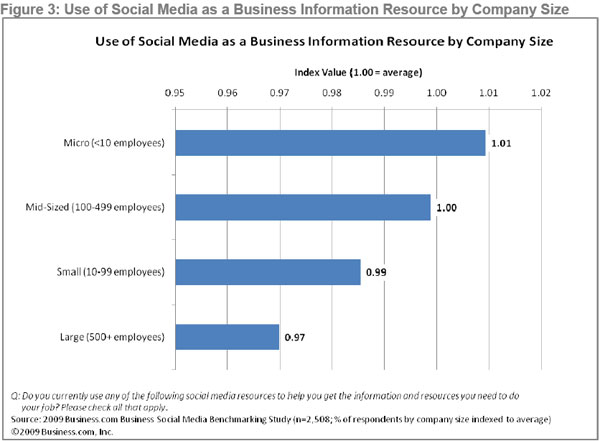
    Consultants and marketers are the most active users of social media as a resource for business information, particularly in micro (less than 10 employees) and small businesses (10-99 employees). IT professionals have the lowest participation rate.

    The average company in this study was planning, developing or running seven different social media initiatives; 65 percent of respondents staffing those initiatives, and 71 percent of companies themselves, have less than two years of experience with social media for business.

    Building brand awareness and brand reputation are two of the top social media success metrics, but nearly two-thirds of companies focused on these metrics have little insight into performance via standard or easily accessible reports.

    "We are constantly analyzing trends to determine exactly what tools business professionals leverage most for purchasing," said Ben Hanna, Ph.D., vice president, marketing, Business.com

    "This survey was a way for us to benchmark where businesses, and business people, are finding value in social media."


    Related Articles:

    > Thinking Beyond Facebook And Twitter For Social Relevance

    > Facebook,Foo Fighters To Pair Up Tonight

    >Twitter Expands Into More Than Just 2 Languages


  • Fortress Posts Third Quarter Loss

    NEW YORK (Reuters) – Fortress Investment Group LLC (FIG.N), a listed hedge fund and private equity giant, posted a third quarter loss on Friday as management fees tracked a decline in total assets.

    Fortress shares were down 5 percent or 23 cents at $4.34 in morning trading.

    Fortress said its net loss attributable to Class A shareholders was $59 million, or 43 cents a share, in the quarter, compared with a loss of $57 million, or 66 cents, in the year-earlier period.

    Revenue came in at $143.7 million, down from $185.2 million a year earlier, mainly on lower management fees. Analysts had expected revenue of $123 million, according to Thomson Reuters I/B/E/S, and pretax distributed earnings of 9 cents a share. Pretax distributed earnings were 11 cents a share, the company said.

    Like other hedge fund firms, Fortress was hit hard last fall as waves of cash-strapped investors tried to withdraw their money. At the end of the quarter Fortress managed $32 billion in assets, down from $34.3 billion a year earlier as it tried to block redemptions.

    On a conference call with analysts, Fortress Chief Executive Daniel Mudd was upbeat, noting its assets under management were 21 percent higher than their low of $26.5 billion at the end of March. “After all the gloom and doom, I think we may be going into a golden age of alternatives,” he said.

    Other hedge fund managers have also reported the return of new money as markets rebounded this year. Many industry watchers say last year’s worst-ever returns and record redemptions are safely behind them.

    The stock has plunged 81 percent since going public at the peak of the buyout bubble in early 2007, though it has surged fourfold from a record low in December last year.

    (Reporting by Joseph A. Giannone and Ross Kerber; Editing by Derek Caney, Phil Berlowitz)

    ShareThis


  • Turnaround Funds Eye UK Liquor Retailer Threshers

    LONDON (Reuters) – Funds specialising in turning around troubled companies are among the favourites to buy the stores of British liquor chain Threshers from administrators, people familiar with the matter said on Friday.

    Private equity firms, convenience store operators, rival off-licence chains and retailers are all poring over First Quench’s stores, which include Threshers and other chains, as its administrator KPMG looks to secure a speedy sale, the people said.

    R Capital, the owner of Little Chef, the roadside restaurant chain that called in Michelin-starred chef Heston Blumenthal to revitalise the menu at the chain, is looking at the business, as is private equity firm Rutland Partners, sources said.

    Hilco and Endless, which also specialise in turning around distressed companies, are interested in all or parts of First Quench’s network, sources said.

    The firms declined to comment.

    KPMG said on Thursday that it planned to close 373 loss-making First Quench stores, out of its 1,200 store network, at a cost of about 1,700 jobs. 

    The stores, which include the Wine Rack, Victoria Wine, Bottoms Up and The Local brands, have been losing around 20 million pounds ($33.2 million) a year, hit by competition from large retailers and small convenience stores.

    “We have had a range of interested parties considering everything from one store through to a very large number of stores,” said Ian Corfield, a joint administrator at KPMG.

    Indicative offers are due by Nov. 13 with KPMG hoping to sew up the process by Nov. 26.

    RETAIL INTEREST

    Large multiple retailers are also on the list of parties requesting further information, though First Quench’s stores are viewed as too small for the likes of Tesco (TSCO.L), Asda (WMT.N) and Sainsbury’s (SBRY.L), one source said.

    Convenience store chain Costcutter and rival off-licence Bargain Booze are also considering offers, but their franchise model makes them more likely to be interested in First Quench’s small franchise arm, numbering some 86 stores, the source said.

    “The franchise business may well be a very attractive proposition for somebody to take on as a unit; we are certainly exploring with various parties whether that will be of interest,” said Corfield, though he declined to comment on individual interested parties.

    Costcutter’s majority owner Bibby Line Group and Bargain Booze’s private equity owner ECI Partners both declined to comment.

    KPMG’s preferred option is to find a buyer for a large part of the business but it may consider offers for individual brands or even individual stores, Corfield said.

    But carving out a brand could present difficulties in separating the business’ supply chain, back office function, logistics and IT, one source said.

    “It’s not beyond the wit of man, but it’s not the easiest option either,” the source said. ($1=.6025 Pound)

    By Simon Meads and Tom Freke
    (Editing by Karen Foster)

    ShareThis