Blog

  • ReelDirector: Full-featured Video Editing Comes to the iPhone

    reeldirectorDespite some predictions to the contrary, the iPhone 3GS launched without a portable version of iMovie for editing of clips. Yes, you can scrub and trim video you shoot on the device in the native Camera app, but beyond that, you can’t do much. New app ReelDirector changes all that, for the relatively low price of $7.99.

    It sounds like a decent deal, but I decided to download the app and find out just what the first real video editing app for the iPhone was capable of. Might I be able to become the next film ingenue sensation with only my 3GS?

    Features

    First of all, let me tell you right off the bat: This isn’t just a warmed-over version of the built-in Camera app, like so many photo effect apps tend to be. It not only allows you to stitch different clips from your device together, it also allows you to use 27 different transitions between them, including various wipes and fades.

    reel_transitionYou can also add text to your clips, including opening and closing credits and titles, and provide transitions for both. Only four font styles currently exist, but you change position to achieve different visual effects. Hopefully more styles will be added in later updates, or maybe as in-app purchases down the line.

    reel_detailsInterface and Usability

    The interface for ReelDirector isn’t going to win any design awards, but it is simple, fairly clean, and well-suited to its purpose. My main complaint is that while the app automatically switches to landscape view, which could be useful, there’s no toggle to prevent that from occurring, something I think every app should provide, including Apple’s own.

    reel_clipsAs for usability, ReelDirector generally performs well, but with a few issues that really prevent it from being an absolutely problem-free experience. For example, when you insert a video clip into your movie project, you have the option of trimming it, but once it’s in, you can’t go back and re-edit the clip itself. All you can really do at that point is change the transitions between clips. You also can’t live preview your movie in its entirety until you “Create” it, which can be a time-consuming process. The good news is, you can still go back and make changes after you output your movie.

    Conclusion

    It isn’t a replacement for iMovie by any stretch of the imagination, but ReelDirector is the first real movie editing solution for the iPhone 3GS, and for a pioneer, it actually works remarkably well. You probably won’t be taking home any awards at Cannes, since the app still lacks pretty basic elements like audio editing capabilities, but for home movies that look as good or better than the ones your uncle used to edit on his hulking early model DV cam, ReelDirector is more than capable.


    In Q3, Uncle Sam was the green IT king maker. Read the, “Green IT Q3 Wrap-up.”

  • Video: Chuck Norris and his Beard, coming to an iPhone near you

    Screen shot 2009-10-21 at [ October 21 ] 11.29.27 AM

    Gameloft just sent over this teaser trailer for an upcoming title, “Chuck Norris: Bring on the Pain”. Sure, Chuck’s a bit late to the iPhone game if he’s looking to milk this meme for all it’s worth – but we had to share the video with you, or he’d burst through our office wall and roundhouse kick us in the face. We didn’t want that to happen.


  • T-Mobile to employees: don’t you dare open this until October 25th

    What not to do if you are a large company and have a secret project — ship a box full of relevant collateral to a retail locale with a stern looking label that reads “Don’t Open Until 10/25″. A new connect has come through with some pricing details on T-Mo’s Project Dark, and as usual, we’ve ripped it apart and deciphered it. Pics and pricing after the bounce.

    Thanks, justfinethanku!

    T-Mo Darkness

    Individual Plan – No 2-year commitment

    • 500 Minutes  – $30
    • 500 + Unlimited Text – $40
    • 500 + Unlimited Text  + Unlimited Web – $60
    • 1000 Minutes – $40
    • 1000 + Unlimited Text – $50
    • 1000 +Unlimited Text  + Unlimited Web – $70
    • Unlmited Talk – $50
    • Unlimited Talk + Unlimited Text – $60
    • Unlimited Talk +Unlimited Text  + Unlimited Web – $80

    Family Plan – Includes 2-lines + 2-year commitment

    • 750 Minutes – $60
    • 750 + Unlimited Text – $80
    • 750 + Unlimited Text + Unlimited Web – $140
    • 1500 Minutes – $80
    • 1500 + Unlimited Text – $100
    • 1500 + Unlimited Text + Unlimited Web – $160
    • Unlimited Minutes – $100
    • Unlimited Talk + Unlimited Text – $120
    • Unlimited Talk + Unlimited Text + Unlimited Web – $180

  • Altec Lansing announces Rock Band speakers

    RockMonitor_3QTR_524Why be a video game rockstar if you can’t hear it? Have you always wanted to put your foot on something while you power chord-ed your way to stardom? For those of you who are using the stock speakers in your TV to play Rock Band, Guitar Hero, or Harmonica Hero, first off, shame on you.

    The Stage-Gig speaker system is being debuted at the College Music Journal (CMJ) music festival in New York City. Modeled as a stage monitor, the Stage-Gig gives you a 6.5″ woofer, silk tweeter, all with 40 watts of output power. It has two sets of RCA plugs so you can theoretically chain as many of these units are you could possibly want.

    If you don’t have any better speakers, these offer you a simple, plug-and-play upgrade for your game console. XBox, Playstation, Wii, anything that uses RCA audio outputs will work. Look for it in early November and expect to shell out $99.95.


  • Small Businesses Slowly Embracing Twitter

    Only a small percentage (9%) of small and medium-sized businesses (SMBs) currently use Twitter to market themselves, according to a new study by BIA/Kelsey.

    In addition, 32 percent of SMBs report they plan to include social media in their marketing plans in the next 12 months by establishing a presence on social sites such as Facebook, LinkedIn or MySpace.

    Stephen Marshall, BIA Kelsey, Director of Research and Consulting
    Stephen Marshall,
    BIA Kelsey,
    Director of Research
    and Consulting

    More than a third (39%) of SMBs plan to include customer ratings or reviews on their own websites in the next 12 months, and 31 percent plan to include links or ads placed on social sites or blogs.

    "Social media is clearly gaining traction among SMB advertisers," said Steve Marshall, director of research and consulting, BIA/Kelsey. "As local consumers increasingly gravitate to social networks, local businesses understand they need to be part of the conversation."

    "This opens up a market opportunity for local media companies that offer products and services that enable local advertisers to easily integrate social media into their marketing efforts."

    The study found the adoption of social media by SMBs is more widespread among younger businesses. The percentage of SMBs by age of business currently using Twitter for promotion is as follows:

    •   16 percent of SMBs in business three years or less
    •   11 percent of SMBs in business four to six years
    •   6 percent of SMBs in business seven to 10 years
    •   2 percent of SMBs in business 11-plus years

  • FCC Will Probe Managed Services As Part of Net Neutrality Push

    600px-US-FCC-Seal.svgUpdated: Both the telecommunications industry and proponents of a free and open Internet have put the rhetoric machine into overdrive in the run-up to the release of a series of proposed rules on network neutrality by the Federal Communications Commission tomorrow.  Telecommunications firms are even getting their employees involved (a fairly common tactic with AT&T).

    Sources in Washington tell me that the hyperactive response is driven not by the FCC’s plan to codify the four broadband principles regarding non-discrimination of certain types of traffic and add two more, but by the fact that the org plans to ask a bunch of questions about managed services that travel over carriers’ pipes.

    In general, managed services are ill-defined, but most carriers will tell you they include features that customers pay extra for and as such, require guaranteed levels of service — things like IPTV or virtual private networks back to a corporate office. For example, AT&T allocates a chunk of its pipe for delivering IPTV and won’t let other web traffic interfere with that. In practice, this means a set percentage of AT&T’s pipes are walled off from regular web traffic so customers paying for the telco TV product get a great service. But it also means that when the percentage allocated for the regular web is congested, regular service degrades. If a subscriber is trying to watch web video such as Hulu, for example, they may get a subpar experience. Update: AT&T tells me the “walls” can be porous if there is enough capacity on the IPTV network and the best-effort traffic needs more, it will allow the best-effort traffic to bleed over into the IPTV traffic.

    However, this practice isn’t inherently bad, as no one paying for telco TV wants to let VoIP calls or Hulu interfere with the Big Game when they’re watching it on U-verse. But the FCC apparently wants to know how far carriers can take that. If taken too far, then carriers could protect their revenue streams and get around any net neutrality provisions by allocating more of their network for managed services rather than for the public Internet. The FCC is worried that a neutral public Internet that gets forced through a smaller pipe so that carriers can invest more on upgrades and capacity for managed services won’t be able to support the innovations of tomorrow.

    In his speech last month before the Brookings Institution, FCC Chairman Julius Genachowski made mention of the managed service issue, saying:

    “I also recognize that there may be benefits to innovation and investment of broadband providers offering managed services in limited circumstances. These services are different than traditional broadband Internet access, and some have argued they should be analyzed under a different framework. I believe such services can supplement — but must not supplant — free and open Internet access, and that we must ensure that ample bandwidth exists for all Internet users and innovators. In the rulemaking process I will discuss in a moment, we will carefully consider how to approach the question of managed services in a way that maximizes the innovation and investment necessary for a robust and thriving Internet.”

    So we expect the FCC to ask some probing questions aimed at exposing how the carriers view this managed services, as well as how, from a technical perspective, they currently wall such services off. In his speech at the Supercomm trade show today in Chicago, Verizon CEO Ivan Seidenberg not only spoke out against net neutrality, but cited a handful of offerings that could be optimal managed services, saying:

    “If we can’t differentiate between packets, we can’t prioritize emergency communications for first-responders…telesurgery or heart-monitor readings for digital medicine…videoconferencing over spam for telecommuters. The truth is, we have never provided ‘dumb pipes’ — and as more and more commerce takes place on the Internet, customers will rely even more on the quality of service, reliability and product differentiation that network operators provide.

    More broadly, if we can’t earn a return on the investments we make in broadband capacity, our progress toward a connected world will be delayed, if not halted altogether. This is ironic, in that the same digital elites and Silicon Valley investors who advocate net neutrality regulations are also pushing for faster mobile connections, more broadband deployment, and faster progress toward a 100-megabit society.”

    The FCC’s attention on managed services is an effort to make sure that the fat pipes the carriers are building will be available for innovations that aren’t delivered through a carrier-created and controlled managed service. The threat of ensuring a quality-of-service guarantee for some offerings means, at its heart, that certain traffic is shunted aside when traffic deemed to be a priority comes through.


  • How the Web Is Changing — Event Videos & More Analysis

    GigaOM Pro screenshot stacey video Earlier this week, we hosted our “What’s Next for the Web?” event here at our office, dividing the discussion along three basic topics: context, consumption and serendipity. After taking a few days to digest all the conversations and comments, we’ve now posted two long analyses over on our GigaOM Pro research service (subscription required). We have also posted the videos of the event; you can find them below the fold.

    The first report is entitled “Call it Real-Time, Squared or NewNet, the Web Is Changing.” In it, we discuss how information overload, end-user privacy and enterprise security are going to reshape the web — and our expectations of it.

    The second is called “Improving Search With Serendipity — and Cashing In.” In this analysis, we talk about the need to build systems that surface valuable and actionable information from an ever-expanding ocean of data. In addition, we talk to well-known author and technologist John Hagel about how to monetize serendipity.

    In order to sign up for GigaOM Pro, click here. The service costs $79 a year.


  • Look! It’s John Biggs! On CNN!


    John thinks he’s a major media figure on the Internet, but we all know that he’s just a dude that likes to review sex toys. Good thing CNN didn’t know that when they showed up at his front door with a camera and a list of Windows 7 questions. His spot starts at 1:38, btw.


  • Rumor: DSi Speak Channel in the works?

    It looks like “OBJECTION!” won’t be the only thing people shout into the DSi mic soon. A Nintendo error code spotted on the official Nintendo customer…

  • Final Fantasy XIII Famitsu scanfest reveals new character

    Japanese gaming mag Famitsu comes up big once again with a whole bunch of images from the scene’s hottest. Kotaku managed to get their hands on a wh…

  • Google Preparing For Future With 10 Million Servers

    If McDonald’s ever goes out of business, perhaps Google can buy up its empty buildings and use them all as data centers.  A representative of the search giant recently stated that he’s working on a storage and computation system capable of accommodating 10 million servers.

    If Google ever gets its hands on 10 million servers, that means it’ll have one for every person in New York City and Phoenix, Arizona.  Or if you want another point of comparison, we found out earlier this month that Facebook only has around 30,000 servers.

    Google’s not necessarily planning to take over the tech world, though.  Jeff Dean, a Google Fellow in the Systems Infrastructure Group, is the man who mentioned 10 million servers while speaking at an Association for Computing Machinery conference, and he said that’s a design goal.

    What’s more, the lower limit of the design goal is 1 million servers, and earlier in his talk, Dean said it’s important to “ensure your design works if scale changes by 10X or 20X,” so he may be intentionally overshooting the mark.

    Still, we’ll just keep an eye on Google’s data center plans and see where this heads.

  • Tokyo Sky Tree keeps growing to make sure it’ll be the world’s tallest building in 2012

    tokyo_sky_tree

    The Tokyo Sky Tree broadcast tower, currently under construction, has been announced as the tallest building in the world once it’s completed (which will most probably be the case in the spring of 2012). But now Japan obviously fears to lose this (future) title to a tower currently under construction in Guangzhou Province in China, which seems to achieve a height of 610m.

    The problem for Tokyo: This is the same height the city planned for Tokyo Sky Tree. And now Tobu Railway, the main company behind the building, plans to extend the height of the Sky Tree by 24m to 634 meters to really make it the tallest tower in the world.

    From the beginning, the Sky Tree was designed to support a height of 640 meters, which means it won’t pose a problem for Tobu to just make the base that supports the antenna a bit taller.

    The company says the new plan will neither delay the planned opening nor increase construction costs (which stand at $717 million).

    Via Asahi Shimbun


  • Borderlands PS3 co-op riddled with problems, Gearbox working on a fix

    If you picked up a copy of Borderlands for the PS3 hoping to get some co-op time with your friends, you may have to wait a while. Early purchasers hav…

  • Nanda’s Alarm Clock Not Only Runs Away From You, It Runs Away From eBay Too

    It looks like more tangible product companies are trying to pretend they can restrict what you do with legally purchased products post-sale (perhaps they’re jealous of content companies). Case in point: my brother received the Nanda Clocky as a gift awhile back — it’s a pretty novel alarm clock, when it goes off, its wheels turn on, and it jumps off your dresser, forcing you to climb out of bed to turn it off. Since he already had an alarm clock that worked for him, he decided to sell it on eBay. A few days before his auction was supposed to close, he got a notice that his listing was removed for a “Trademark Violation – Unauthorized Item.” Yes, for a legitimately owned product. The email stated:

    “Nanda Home Inc. is the owner of the intellectual property rights pertaining to these listings. By listing the ‘Clocky’ product you are in serious violation of the company’s rights. Additionally, Nanda Home does not permit the re-sale of any of their brand product on eBay. There are no authorized Nanda Home re-sellers on eBay. If you continue to list our items, further legal action may be taken.”

    Clearly, Nanda has a gross misunderstanding of the right of people to re-sell their own property. While it’s true that it is against the law to sell counterfeit copies of a product, re-selling your own goods and representing them as “real” is completely within the bounds of the law, and eBay policy. To make matters worse, the condescending tone of the email also suggests that:


    “You may need to take a tutorial. The next time you sell, you may be asked to take the tutorial, if it’s required. Once you’ve completed the tutorial successfully, please review your account status for any other possible concerns. If there are no other issues, you should be able to sell again.”

    Or, perhaps Nanda and eBay should take a tutorial on the right of first sale. In the aforementioned tutorial, eBay clearly understands the right to re-sell (in fact, a huge part of its business relies upon this fact). Yet, to make matters worse under eBay policy it’s still a laborious process to get the item relisted — even with the bogus takedown notice. As a seller of an incorrectly taken down Clocky listing, you have to contact Nanda and have them specifically authorize your product to be re-listed. Yes, even though it’s Nanda who issued the incorrect takedown in the first place. So much for frictionless commerce.

    The even bigger problem is in the process in which such listing takedowns are handled. Under the guise of rooting out counterfeit products, Nanda is able to unfairly reduce the number of its own secondhand goods in the marketplace. Other manufacturers have tried to do this in the past for everything from shampoo to radar detectors. And, much like the DMCA process, this “guilty until proven innocent” approach ultimately hurts the consumer, who now has unfairly reduced access to many products that were to be sold completely legally.

    That said, my brother followed the eBay process to get his Clocky relisted. They sent him an email apologizing for their error and authorizing him to relist, which he did. Guess what? In an effort to punctuate how ridiculous this policy is, one day later, he got an email, “Trademark Violation – Unauthorized Item.”

    Anyone want to buy a Clocky?

    Permalink | Comments | Email This Story


  • Google’s Panoramio Gets an iPhone App

    Google has released a new iPhone app for Panoramio, which lets users upload photos right from their iPhone.

    "Tens of millions of mobile users own a device with a good camera and GPS," said Fernando Delgado of Panoramio. "We realize that a lot of these users may want to share photos of places with the rest of the world via Google Maps and Google Earth."

    Panoramio for the iPhone

    "The philosophy behind the app is to keep it simple: sign in (only the first time), pick a photo from your device or take a new photo, and upload it straight to Panoramio," explains Delgado. "If available, the geoposition will be automatically set, and you can optionally add a title to the photo."

    This is the first time Panoramio has released a mobile app, but Google says it is working on an Android application to compliment it.

    Panoramio photos are used on Google Earth and Google Maps as photo layers, where people all over th world can see them. The service lets users tag their photos under categories like art, buildings, etc.

  • Google to Add Full-Song Streams, Not a Full Music Service

    googleUpdated to note Imeem: Google will soon launch a search product dubbed “OneBox” that will better organize results around music artists and provide music streams from Lala.com, MySpace-owned iLike.com and other services — including full-song streams, according to one of my sources who’s seen it firsthand. That would make it a modest innovation in user search experience, but not a game-changer that will upset iTunes or compete in the mobile sphere as some early reports have speculated. So modest, in fact, that it sounds a lot like what Yahoo has been doing since last fall with RealNetworks’ Rhapsody.

    We’ll know more when Google lifts the curtain next week, but for now color me doubtful that Google is interested in either selling downloadable songs or providing a large-scale free streaming service that would compete with Spotify’s. If Google were interested in selling content, it probably wouldn’t favor the incredible shrinking music business, and the economics of free streaming are apparently unsustainable. If anything, Google might buy rather than build, as it did with still-money-losing YouTube, but such a deal seems a long way off given the lack of anything close to a proven model in this arena. (Google, for example, wasn’t the one that bought iLike this summer — MySpace did.)

    More likely, Google’s new product will resemble one of its other enhanced search products, perhaps a sort of “Rich Snippets” with full-song streams from its partners. A Google search for a musician usually yields YouTube videos and photos from external providers, but often includes links to a Wikipedia entry or an official site that direct the user away from Google. A better product could keep users around a little longer — all the better to sell ads to them — and could include a rev-share agreement for the stream provider. (Google already has a relatively well-hidden music search product that could also use a rethink.)

    If Google has anything more earth-shattering than that to announce — such as a separate rumored Google Audio product that requires deeper licensing conversations with major labels and others — we’ll know soon enough. For now, though, this appears to be a relatively minor improvement on Google’s search presentation, a boon to Lala.com and iLike.com, and something of a blow to smaller streaming music providers. I’m expecting to hear more soon, and will update the post. Update: A source that asked not be named tells me that Imeem’s song streams will be integrated into the search results as well, although an Imeem spokesman would not confirm this. It remains unknown how many streaming music providers will appear in Google’s new search product.


  • House Committee Votes To Strip Health Insurance Industry Of Federal Antitrust Exemption

    The House Judiciary Committee Wednesday “voted to strip the health insurance industry of its exemption from federal antitrust laws as senators announced plans to take the same step,” The Associated Press reports. The committee voted “20 to 9 to repeal a 1940s law that exempted the health insurance industry from federal controls over certain antitrust violations including price-fixing.”

    The developments “signaled a growing determination by Democrats to punish the insurance industry for its criticism of President Barack Obama’s health care overhaul agenda. … In the Senate, Majority Leader Harry Reid announced plans to repeal the antitrust exemption as part of its health care legislation” (10/21).

    Dow Jones: “Democrats said the bill will improve competition in the insurance industry and expressed hope that the measure would be added to legislation to overhaul the health-care system. ‘We can open up our health insurance markets to real competition and make an important contribution to the health reform efforts underway in both houses of Congress,’ said Rep. John Conyers (D., Mich.) the chairman of the committee.

    Republican opponents said the bill could add a confusing new layer of federal regulation that would interfere with traditional state regulation of insurance. Rep. Bob Goodlatte (R., Va.) said the bill would harm small insurers and he accused Democrats of being motivated by a desire to score points against the insurance industry. ‘This bill is being brought up to weaken the insurance industry’s opposition … to the health care bill,’ he said” (Kendall, 10/21).

  • Steve Jobs Top Tech CEO: Survey

    Two nights ago I finished reading, Inside Steve’s Brain by Leander Kahney and last night started reading the updated version of The Little Kingdom: The Private Story of Apple Computer by uber VC, Michael Mortiz, who a long time ago was a fabulous writer/reporter. The two books have enough anecdotes to point to the fact that working for Apple’s Steve Jobs is nothing short of climbing a glass wall.

    Despite that, Apple employees think he is awesome. According to a survey by Glassdoor.com, a Sausalito, Calif.-based company that that tracks employee satisfaction, Jobs is the #1 CEO, ahead of Google’s Eric Schmidt, Adobe Systems’ (a ADBE) Shantanu Narayen and Netflix’s Reed Hastings. (Full list below the fold.)

    In sharp contrast to Jobs, Dell CEO Michael Dell was ranked 23 with 44 percent approval, while Steve Ballmer had 41 percent approval rating from his employees. eBay’s John Donahoe had an approval rating of 20 percent.

    Company CEO Approval Rating as of Oct. 09
    Apple Steve Jobs 90%
    Google Eric E. Schmidt 87%
    Adobe Shantanu Narayen 78%
    Netflix Reed Hastings 76%
    salesforce.com Marc Benioff 73%
    Citrix Systems Mark B. Templeton 72%
    Rackspace A. Lanham Napier 72%
    QUALCOMM Paul E. Jacobs 69%
    NVIDIA Jen-Hsun Huang 68%
    Intuit Brad D. Smith 68%
    Oracle Larry Ellison 62%
    Intel Corporation Paul S. Otellini 62%
    EMC Joe Tucci 60%
    SAP America Bill McDermott 58%
    Nokia Olli-Pekka Kallasvuo 56%
    Novell Ron Hovsepian 56%
    Texas Instruments Rich Templeton 54%
    Yahoo! Carol Bartz 54%

    Photo courtesy of Whatcounts via Flickr


  • Is Twitter Smart to Ditch the Suggested User List?

    Twitter CEO Evan Willams made some comments at the Web 2.0 Summit in San Francisco that have some Twitter enthusiasts in debate. He reportedly said that he wants to retire the Suggested User List (SUL) as the company prepares to launch its highly anticipated "Lists" feature.

    The Lists feature would let people create lists of Twitter accounts, or group together certain accounts that they follow. The feature is very overdue, and could go a long way in making Twitter more useful and reducing "noise."

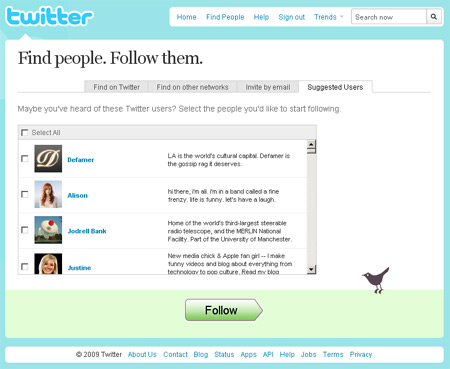
    The SUL, is a feature that lists users, which Twitter thinks new users of the service may be interested in following. The idea has always been that it would be a good way to help new users understand what they could get out of Twitter. Earlier this year, Twitter co-founder Biz Stone wrote about it on the company blog.

    Twiter Suggestions

    At the Web 2.0 Summit, Williams said the feature was initially meant as a way to help new users, but it’s been controversial, and he wants to ditch it, or possibly "evolve" it. He says that whatever comes after the SUL, should be "Twittery and democratic."

    "This is a big deal for Twitter," says Patricio Robles with Econsultancy. "According to Nielsen, approximately 60% of new Twitter users quit within a month. And of those who stick around, a considerable numbers remain small-time consumers of content."

    "The implication for Twitter: giving people a reason to stick around is really, really important," adds Robles. "And, given the numbers, it’s clearly a challenge. So how to do this? Well, obviously the SUL isn’t going to perform miracles (it’s not working wonders now if Nielsen’s figures are to be believed) but it is one tool that Twitter has to help new users find the most interesting people to follow."

    Some have viewed the SUL as a possible moneymaker for the company as well. Earlier this year, Jason Calacanis tried to purchase a spot on it. He said that in five years the top 20 spots would be worth a million a year. Being on the list can do wonders for a Twitterer’s follower count.

  • Now we know why Disgaea is such a grindfest

    There’s nothing like coming out of the Item World holding a shiny new overpowered piece of equipment. Anyone who’s ever played Disgaea is well aware…