Blog

  • Speedrun: Back to the Future in 60 seconds

    Back to the Future

    Almost 30 years has gone by since Back to the Future hit the big screen in 1985. Back then cars were slow, fashion was terrible and cocaine was all the rage. Thankfully time has marched on, and while most of the 1980′s has been forgotten, I’d be lying if I said I wasn’t thankful that Back to the Future still remains. Oh, and for those of you who have never seen it before, here it is wrapped up into a 60-second montage.

    Source: Youtube.com

  • How much would you pay to watch YouTube in Windows 8? $999.99?

    A couple of days ago I described the Windows Store as being like a Bangkok night market, filled with nothing but knockoffs. You can’t get an official app for Facebook, Twitter, or Gmail on there, but you can get lots of third-party alternatives, many of which are of dubious quality.

    One of the biggest names missing from the Windows Store is YouTube. Google says it has no plans to create an app for Windows 8, but fortunately an enterprising publisher called T.O.K. has got you covered with his exciting sounding “Youtube Player Deluxe”, which really must be deluxe given its $999.99 asking price.

    So what do you get for your thousand dollars? Well I haven’t actually purchased it myself, but according to the description, the app will let you “watch a stream, share videos and access your personal content from Youtube. Everything included in the great user interface of Windows 8”.

    The full list of features reads:

    • Share videos with your friends, family …
    • Search on Youtube or watch videos from the “standardfeeds”
    • Clear, simple and beautiful design (blue theme)
    • Connect with your Youtube Account to get access to your personal content
    • Comments, related videos, author-pages…
    • Livetile
    • No advertising

    The absence of adverts will be very pleasing to prospective cash-rich purchasers I’m sure.

    The website of the publisher gives no clue as to the sky-high price, (although it does say the app is currently broken and an update is planned), so it’s possible it’s just a mistake. It’ll be interesting to know if the developer manages to sell any apps at that price. After all, eight people purchased the “I am Rich” iOS app (described by its developers as “a work of art with no hidden function at all”) for $999.99 back in 2008, before Apple had a chance to remove it from the store.

    Photo Credit: ARENA Creative/Shutterstock

  • Weekly Radar: Bernanke, Berlusconi and bumps on the road

    Financial markets have had one of those weeks of frenetic activity when each asset class blames the other for driving direction, few agree on an overall driver and it’s hard to square relative moves.  What seems to be true is that idiosyncratic and locally-focussed factors are back in vogue – witness the lunge in sterling as the BoE nods at more QE and higher inflation, or the sudden dive in commodities even as global stock markets nudged 5-year highs. Micro or national issues are getting more play as the stress busting of recent months seems to have reduced cross-market correlations  that characterised every ebb and flow of the overarching ‘global crisis’ for years.

    To be sure, the longer-range theme of global reflation, the return from “safe haven” bunkers, and a gradual rotation out of low-yielding bonds remains the big backdrop and has helped explain the buoyancy of stock markets to date, the relative weakness of sterling and the yen as persistent  money printers into the recovery, and the rise in core US/German/UK government borrowing rates alongside a sturdy bid for Italian and Spanish bonds.

    But the week has thrown several curve balls into the mix. Fed minutes showed its policymakers musing yet again over when to wind down QE while euro area business surveys disappointed recovery hopes yet again in February. Commodities have retreated sharply on the perceived demand shock, with the dollar sharply higher on hopes the greenback presses will be turned off well before  sterling or yen equivalents at least. But it gets more difficult to square some of the rest – gold’s nosedive this week could be argued as a haven exit perhaps, but its inflation-hedge role seems at odds with Britain and Japan actively pumping up prices. A more hawish Fed and dollar rise might be a better guide. And the drop in oil, metals and world equities (latterly) seems to riff off that too, for all the coalface talk of fund liquidations, supply boosts and chart hoodoos etc. Yet if the Fed slows QE – which would slow its bond buying — then bonds should surely be falling too? Not so – 10-year Treasury yields have slipped back below 2 percent all of a sudden. So is the bond market getting a dollar boost or is it worried about demand slowdown from the risk of a March 1 sequestration? If it’s the latter and that’s justified, then you can expect Fed chairman Ben Bernanke to sound a very different tone at his congressional testimonies next week. But what then of the supposed demand shock from the FOMC minutes? hmmm. It all starts to get a bit circular.


    Maybe Europe has more answers. The latest business survey funk won’t be helped by messy Italian elections at the weekend and the delayed Cyprus bailout. The by-now merciful retreat of the euro, especially as the nervy market interest rate rise on LTRO paybacks looks set to dissipate –  may be itself be a driver by pushing the dollar higher and disturbing global positioning.

    Otherwise, the end of the shortest month next Thursday may simply be creating its own wobbles.  Next week will see flash Chinese PMI for Feb and likely upward revisions to both US and UK Q4 GDP, correcting the suggestion from early estimates that the entire G7 contracted in Q4 last year. Flash euro zone and German CPI will keep the inflation watchers on the boil, while a useful contrast with euro-wide, German and Japanese jobless figures.

    And so as March comes into view, the effervescent January for global markets has turned a bit flat in February. Year-to-date global equity gains remain about 4.5 percent – still significantly loaded in developed markets as emerging market indices have underperformed yet again. Yet if 2013 is to be another bullish year, the February pause may be a useful speed limit. If the two-month average rise were to continue all year, then gains for the year would be less than the 30%+ record years of 2009 and 2003. Back on planet earth.

    Global events and econmic releases to watch:

    Italy parliamentary elections Sun

    Cyprus Presidential election run-off Sun

    China HSBC Feb flash PMI Mon

    Reuters Summit on euro zone future, Brussels Mon-Weds

    APEC finance/cenbank meeting Jakarta, Tues/Weds

    Bernanke’s semi-annual testimony Tues/Weds

    US Feb consumer confidence, Jan new home sales, Tues

    EZ Feb biz/consumer confidence Weds

    French Feb consumer confidence Weds

    Swiss Feb KOF confidence index Weds

    EZ Jan money supply/credit Weds

    UK Q4 GDP revision Weds

    SAfrica budget presented to parliament, Weds

    US Jan durable goods Weds

    French Jan consumer spending/PPI Thurs

    German Feb jobless/inflation Thurs

    US Q4 GDP revision/Feb Chicago PMI  Thurs

    Japan Jan spending/CPI/jobless/capex Fri

    Global Feb manufacturing PMI Fri

    EZ flash Feb inflation/Jan jobless Fri

    UK BOE Jan mortgage/credit Fri

    US Jan consumer spending/saving, Feb UMich sentiment Fri


  • Write E-Mails That People Won’t Ignore

    Your clients and colleagues don’t have time to engage fully with every e-mail they get. Some of them receive hundreds of messages per day. That’s why they start with the ones they can deal with quickly. They may never get around to answering — or even reading — the rest.

    So how do you earn their attention? Try these tips:

    Stick to standard capitalization and punctuation. Conventions of good writing may seem like a waste of time for e-mail, especially when you’re tapping out messages on a handheld device. But it’s a matter of getting things right — the little things. Even if people in your group don’t capitalize or punctuate in their messages, stand out as someone who does. Rushed e-mails that violate the basic norms of written language bespeak carelessness. And their abbreviated style can be confusing. It takes less time to write a clear message the first time around than it does to follow up to explain what you meant to say.

    Get straight to the point (politely, of course).
    Be direct when making a request. Don’t butter up the recipient first — although a brief compliment may help (“Great interview. Thanks for sending it. May I ask a favor?”). Spell out deadlines and other details the recipient will need to get the job done right and on time.

    Be brief — but not too brief. People find long e-mails irksome and energy-sapping. The more they have to scroll or swipe, the less receptive they’ll be to your message. They’ll probably just skim it and miss important details — or skip it altogether. So rarely compose more than a single screen of reading. Focus your content, and tighten your language.

    But as you’re trimming the fat from your message, keep the meat intact. When giving a project update, for example, supply enough background information to orient your readers. Consider your message from their perspective. They aren’t as immersed in your project as you are, and they probably have many other things going on. So remind them where things stood when you last sent an update, and describe what’s happened since then.

    Plot out what happened, and when. When a serious dispute arises at a company, the lawyers will typically ask their clients to produce a “chronology of relevant events,” detailing the most important incidents leading up to the dispute. This document helps everyone involved think more clearly about how things unfolded. Try taking a similar approach when writing your e-mails. It will help you organize your thoughts into a coherent narrative. A story with a clear beginning, middle, and end will hold your readers’ interest more effectively than jumbled facts interspersed with opinions.

    Add a short but descriptive subject line. Before hitting “Send,” check your subject line. If it’s generic or blank, your message will get lost in your recipient’s overstuffed inbox. Are you asking someone to take action? Highlight that in the subject line. Make your request easy to find — and fulfill.

    Copy people judiciously. Include only those who will immediately grasp why they’re on the thread; don’t automatically click on “Reply All.” Your correspondent may have been over inclusive with the “Copy” list, and if you repeat that mistake, you’ll continue to annoy the recipients who shouldn’t be there. And avoid using BCC unless you are quite sure it’s necessary. It could get you a bad reputation as being indiscreet.

    This is the third post in Bryan A. Garner’s blog series on business writing.

    Post 1: Don’t Anesthetize Your Colleagues with Bad Writing

    Post 2: A Well-Crafted Letter Still Gets the Job Done

  • Fighting Back: Big Data Center States Push for More Tax Incentives

    dlr-loudon-exchange

    This is the newest data center building at Digital Realty’s northern Virginia campus. State legislators in Virginia recently passed additional tax incentives for data centers to stay competitive. (Photo: Rich Miller).

    Financial incentives have been popular among states looking to build a reputation as data center destinations, and to compete with neighboring states. It looks like the growth of incentives is now prompting the traditional data center hubs to beef up their tax breaks. Both Virginia and Texas, already two of the most active data center markets, have recently passed or are working on bills to attract more of these high-tech facilities.

    Individual states recognize that data centers are good business, and they’re an increasingly important component of site searches for data center projects. Several states have customized incentives programs for data center operations, which focus on full or partial exemption of sales/use taxes on equipment, construction materials, and in some cases purchases of electricity & backup fuel.

    Virginia is for Data Center Lovers

    Just a year after revising their existing offerings, Virginia legislators are working on new incentives yet again. Barbara Comstock introduced legislation House Bill 1699, which aims to promote and expand Virginia’s data center industry by providing tax incentives. The bill is intended to “create a separate classification, for purposes of permitting localities to set a lower personal property tax rate, on computer equipment and peripherals used in a datacenter.” It passed in the House of Delegates 95-5 on February 5th.

    Senate Bill 1133, identical to the above, introduced by Republican Senator Ryan Mcdougle, was passed in the house 94-4.

    “The data center industry is projected to grow by hundreds of millions of dollars in the coming years. This bill will help Virginia continue to be a leader in this 21st century marketplace,” Comstock said in a statement. “Data center jobs and investment are a critical element in diversifying Virginia’s technology economy and attracting private sector jobs as federal spending and procurement decreases.”

    Loudoun County recently announced that 3 million square feet of new data centers are under contract or construction. Loudoun is already home to 5 million square feet of server farms, and estimates that as much as 70 percent of the world’s Internet traffic passes through the county.

    Virginia passed its data center incentives in 2009, partly to remain competitive with North Carolina, which has been competing aggressively for major data center projects. The original incentive package had a 2017 sunset date for the expanded sales tax exemptions, but in early 2012 those incentives were updated to extend the tax benefits to 2020 – a key consideration for companies looking to build or lease data centers with an expected lifespan that will include several server refresh cycles.

    Comstock has continued to work with the Northern Virginia Technology Council and the tech community to build upon her bill passed last year. The updated incentives passed last year were cited as a key factor in a Capital One project, as well as being a factor in several large leases for DuPont Fabros Technology (DFT).

    Tax Incentives Bigger in Texas

    Texas has been a strong market in recent years, but apparently feels the need to play defense as other states enact generous exemptions and other incentives for data center owners and operators.There was a lot of talk of potential new tax incentives at the end of last year, and now there is a draft.  Bill HB 1223 was filed on Feb. 12.   

    The bill would provide refunds to qualifying data centers on any taxes on the purchase of “tangible personal property,” including electricity, power and cooling equipment, backup generators, servers, storage devices, networking gear and software. The refund is eligible to data cener owners, operators or tenants who create at least 20 jobs and spend at least $150 million in Texas on power and improvements to equipment installed at the data center over a four-year period after initial construction or refurbishing of the facility. Qualifying jobs must pay 120% of the county average weekly wage. Republican Harvey Hilderbran from district 53 is the primary on the bill.

    Tax incentives remain an integral part of site selection. The moves on the part of both Virginia and Texas suggest that these states can’t rest on their leadership laurels, but need to position themselves as attractive options compared to rival states.

  • Wells Fargo Backs Imagine H2O

    Wells Fargo announced a three-year philanthropic investment in Imagine H2O, a nonprofit focused on innovation in the water sector. Imagine H2O will use the funding to expand its activities, which includes an annual business plan competition and an accelerator program.

    PRESS RELEASE
    Imagine H2O, a nonprofit supporting entrepreneurship and innovation in the water sector, today announced a three-year philanthropic investment from Wells Fargo to expand its program offerings, including its annual business plan competition for water innovation and the Imagine H2O Accelerator Program, which helps participating entrepreneurs turn their plans into real-world solutions.

    “Supporting entrepreneurial solutions to water challenges aligns with Wells Fargo’s commitment to providing capital for clean technology companies,” said Andrew Kho, head of Wells Fargo’s Clean Tech Commercial Banking Group. “Imagine H2O is building an exciting accelerator for water solutions and we’re eager to see the results of our more comprehensive, three-year commitment.”

    Since 2009, Wells Fargo has contributed hundreds of volunteer hours and funding to Imagine H2O’s efforts to establish and run a global program for water startups.

    Since its inception in 2008, Imagine H2O has:

    – Attracted over 200 water startups from more than 15 countries to its competition program

    – Provided over $1 million of in-kind services and cash awards to more than 25 new businesses

    – Helped its portfolio companies attract over $15 million in investment from angel investors, venture capital funds and project finance funds

    – Offered campus water entrepreneurship workshops to over 1,000 students

    “Imagine H2O is a global conduit for water entrepreneurship and innovation,” explains Tamin Pechet, the organization’s Chairman and Co-Founder. “Our programs support entrepreneurs who establish financially viable solutions while creating jobs and generating economic activity. It’s a great fit to have a global finance leader such as Wells Fargo supporting our work.”

    A leader in reducing its own greenhouse gas emissions and building sustainably, Wells Fargo has been recognized by the Carbon Disclosure Project and the U.S. Green Building Council. Since 2006, Wells Fargo has provided more than $11.7 billion in environmental finance, supporting sustainable buildings and renewable energy projects nationwide. This includes investments in more than 260 solar projects and 34 wind projects that generate enough clean renewable energy to power hundreds of thousands of American homes each year. The company is a member of the Ceres network of companies and was listed as one of the 2012 “Best Corporate Citizens” by Corporate Responsibility Magazine. For more information, please visit. www.wellsfargo.com/environment.

    About Imagine H2OImagine H2O inspires and empowers people to solve water challenges and turn them into opportunities. We offer annual competitions for water innovation with focused, specific challenges including Water Efficiency (2009), Water-Energy Nexus (2010),Wastewater (2011) and Consumer Innovations (2012). In addition to cash prizes for the best ideas, the Imagine H2O Accelerator helps participating entrepreneurs turn their plans into game-changing, real-world solutions. To learn more about Imagine H2O’s global ecosystem for water innovation and connect with water entrepreneurs from around the world, please visit www.imagineh2o.org.

    About Wells Fargo Wells Fargo & Company WFC -0.11% is a nationwide, diversified, community-based financial services company with $1.4 trillion in assets. Founded in 1852 and headquartered in San Francisco, Wells Fargo provides banking, insurance, investments, mortgage, and consumer and commercial finance through more than 9,000 stores, 12,000 ATMs, the Internet (wellsfargo.com), and has offices in more than 35 countries to support the bank’s customers who conduct business in the global economy. With more than 265,000 team members, Wells Fargo serves one in three households in the United States. Wells Fargo & Company was ranked No. 26 on Fortune’s 2012 rankings of America’s largest corporations. Wells Fargo’s vision is to satisfy all our customers’ financial needs and help them succeed financially.

    The post Wells Fargo Backs Imagine H2O appeared first on peHUB.

  • This New Apple Patent Could Be The Design For A Radical iWatch With A Wraparound Display

    13.02.21-Wearable-3

    Apple has a number of patents on wearable computing, but a new application spotted by AppleInsider blends some old and some new tech to provide a vision of what it might conceivably look like as a shipping product. The patent in question describes a wrist-mounted flexible screen, built on a support structure that closely resembles the “slap bracelets” children of the nineties will likely recall. When worn, the screen could provide an unbroken display that wraps all the way around the wearer’s wrist.

    Apple even uses the slap bracelet directly as an example of how the device would work in its patent filing. Besides provoking nostalgia in people my age, the design would make it possible to use the device in both curled (worn) and flattened forms, acting as a different kind of display in either scenario. When on the wrist, Apple describes a sensor that would allow the watch to recognize where the end is, so that it can manage universal sizing while still wrapping a display around the wrist without any overlapping visuals.

    The patent describes some software functionality, which begins to get at what an Apple iWatch might offer that others building smart watches can’t or don’t yet do. It could be used to “adjust the order of a current playlist,” review “a list of recent phone calls,” type out a message reply via a “simple virtual keyboard configuration across the face of the flexible display.” Apple even suggests using it as an input device for controlling and navigating apps like Maps. If you had trouble conceiving how an iWatch might actually revolutionize wearable computing, this patent’s description of features begins to answer that.

    Apple’s patent describes making use of solar power and kinetic energy to help prolong battery life, and it includes provisions for a number of other ways to affix it to a user’s wrist, including snaps and velcro, meaning the slap bracelet look could give way to something much more in keeping with traditional watch design. But what’s most interesting is the functionality described in the patent: it shows how Apple, working with its own hardware and software in ways that third-party manufacturers aren’t able to could greatly extend the usefulness of a wrist-mounted, smartphone connected device.

    The iWatch is rumored to be in production, with reports from Bloomberg, the New York Times and the Wall Street Journal all surfacing recently. We’ve seen iWatch-related patents before, including ones that describe elements of this slap bracelet system, but this is the most complete patent to date and the timing feels more than coincidental as a result.

  • Red Hat Adds Storage Plug-in to Apache Hadoop Community

    Slide from presentation by Ranga Rangachari, vice president and general manager, Red Hat Storage Business Unit, presented during webcast of announcement.

    Slide from presentation by Ranga Rangachari, vice president and general manager, Red Hat Storage Business Unit, presented during webcast of announcement.

    Red Hat announced it will contribute its Red Hat Storage Hadoop plug-in to the Apache Hadoop open community to add another component to the big data ecosystem.

    “The big data market is ripe for disruption,” said Ranga Rangachari, vice president and general manager, Red Hat Storage Business Unit. “Big data is more than just Hadoop to most enterprise customers. We are taking a broad view of big data.”

    RedHat already has a large share of the big data and cloud markets. According to Rangachari, 72 percent of big data workloads run on Linux and Linux is the primary platform for the majority of cloud-based applications.

    Red Hat intends to make its Hadoop plug-in for Red Hat Storage (gained through the acquistion of Gluster, an open source object storage firm) available to the Hadoop community later this year. Currently in technology preview, the Red Hat Storage Apache Hadoop plug-in provides a new storage option for enterprise Hadoop deployments that delivers enterprise storage features, while maintaining the API compatibility and local data access the Hadoop community expects. Red Hat Storage brings enterprise-class features to big data environments, such as Geo replication, High Availability, POSIX compliance, disaster recovery, and management.

    Users will have have a unified data and scale-out storage software platform to accommodate files and objects deployed across physical, virtual, public and hybrid cloud resources. The enterprise big data analysis is supported by RedHat’s approach, with “the ability to create workloads in private cloud and move to public cloud, back and forth, without retooling the applications,” said Rangachari.

    Red Hat is also building a robust network of ecosystem and enterprise integration partners to deliver comprehensive big data solutions to enterprise customers.

    • Big Data Ecosystem Partners – To provide a comprehensive big data solution set to enterprises, Red Hat plans to partner with leading big data software and hardware providers to offer interoperability. Development of certified and documented reference architectures are expected to allow users to integrate and install comprehension enterprise big data solutions.
    • Enterprise Partners – Red Hat anticipates enabling the delivery of a comprehensive big data solution to its customers through leading enterprise integration partners utilizing the reference architectures developed by Red Hat and its big data ecosystem partners.

    Keep up on Data Center Knowledge’s cloud computing coverage, check the Cloud Computing channel.

  • Reuters – Forstmann Little Puts IMG Up for Sale

    Private equity firm Forstmann Little & Company has decided to put its sports and modeling talent agency IMG up for sale and is in the process of picking an investment bank to lead the effort, Reuters reported. The decision to shop IMG, which represents top tennis player Novak Djokovic and supermodel Gisele Bundchen and owns the rights to numerous sports leagues, is being driven by the trustee that runs the estate of Teddy Forstmann – IMG’s former chairman and chief executive who died in 2011.

    (Reuters) – Private equity firm Forstmann Little & Company has decided to put its sports and modeling talent agency IMG up for sale and is in the process of picking an investment bank to lead the effort, three people familiar with the matter said.

    The decision to shop IMG, which represents top tennis player Novak Djokovic and supermodel Gisele Bundchen and owns the rights to numerous sports leagues, is being driven by the trustee that runs the estate of Teddy Forstmann – IMG’s former chairman and chief executive who died in 2011, the people said.

    IMG, which Forstmann bought for $750 million in 2004, could now fetch more than $2 billion in a sale, two of the people said, asking for anonymity because the matter is not public.

    Several investment banks including Goldman Sachs, JPMorgan Chase & Co, Morgan Stanley, The Raine Group and Perella Weinberg Partners are competing to win a mandate to run the auction, the people said. A bank is expected to be selected in March, they added.

    The sale is expected to draw interest from big entertainment players ranging from Creative Artists Agency and William Morris to French media group Lagardere, according to the people familiar with the matter. Large private equity firms and billionaires are also expected to participate, the people said.

    Goldman Sachs, JPMorgan and Perella Weinberg declined to comment. Representatives for Morgan Stanley and Raine Group were not immediately available for comment.

    Mike Dolan, chairman and chief executive of IMG said recently that a potential sale by owner Forstmann Little is not an issue for IMG to focus on as it concentrates instead on the day-to-day running of the business. An IMG spokesperson did not have further comment.

    A representative for Forstmann Little was not immediately available for comment.

    Forstmann Little has been holding on to the IMG investment for longer than a typical investment period for private equity, and has for years rebuffed overtures from prospective buyers. Buyout interest increased following Teddy Forstmann’s departure in April 2011 as IMG Chairman and CEO, and his death later that year.

    Notable buyers that had approached Teddy Forstmann included former Yahoo CEO Terry Semel, who was willing to pay $1.5 billion for IMG in 2008. Sources told Reuters at the time Teddy Forstmann wanted at least twice the amount.

    Akin Gump Strauss Hauer & Feld litigation partner Mark MacDougall and corporate practice co-chair J. Kenneth Menges, Jr., are managing the wind down of Teddy Forstmann’s private equity empire. The firm recently tried to exit its investment with 24 Hour Fitness last year but the process has since stalled.

    The post Reuters – Forstmann Little Puts IMG Up for Sale appeared first on peHUB.

  • Why Are Gasoline Prices High and Rising?

    “Motorists are paying more for gasoline at this time of year than they’ve ever paid,” according to AAA spokesman Michael Green  

    As of February 18, 2012, gasoline prices in the United States are averaging $3.75, 13 percent higher than a month ago and are the highest on record for this time of the year. The purpose of this post is to explain why this increase is occurring.eia-gaspump

    Gasoline prices are composed of four main components:

    • the price of oil determined on world markets;
    • refining costs to transform oil into gasoline;
    • taxes that are levied by federal, state, and local governments and
    • distribution and marketing costs that include the costs of the retailer who provides the gasoline at the pump.

    The largest component of the price of gasoline is the price of oil, which makes up almost 70 percent of the price at the pump. This is followed by taxes that represent 13 percent of the price, distribution and marketing costs at 11 percent, and refining costs at 8 percent. The cost distribution varies with seasonal changes as refineries retool to switch from winter grade to summer grade gasoline, perform regular maintenance on their facilities, and fix any break-down of equipment.

    Currently, several refineries are down for maintenance or equipment failure that is a result of normal operations. With limited refinery capacity in the United States, the removal of some refineries from the production of gasoline results in higher prices. Along with these refinery outages and associated gasoline price increases are higher prices for oil on world markets due to increasing world demand, production quotas by OPEC countries, an embargo on Iranian crude as a result of sanctions by the United States and the European Union to make Iran abandon nuclear weapons development and the dollar’s continuing devaluation.[1]  The result is the gasoline price increases we have seen over the past several weeks.

    Lowering world oil demand or increasing world oil supplies would lower oil prices, but the United States can neither affect the oil demand of other countries nor can it increase the supply of oil from other oil producing countries.  Besides reducing oil demand or increasing oil supply, U.S. gasoline prices can be lowered by lowering refining costs, decreasing gasoline taxes, or decreasing marketing and distribution costs, but as the figure above shows, these components of the cost of gasoline are small compared to the price of oil.

    1)     Supply and Demand for oil

    a)     World Oil Demand Growth:  World crude oil and liquid fuels consumption grew to the highest level ever in 2012, with an estimated 89.2 million barrels per day (bpd) consumed in total.[2] The Energy Information Administration (EIA) projects that total world oil consumption will grow by 1.05 million bpd during 2013 and 1.4 million bpd in 2014 with countries outside the Organization for Economic Cooperation and Development (OECD) comprising most of the growth in consumption.[3] The largest increases in oil consumption will be non-OECD Asian countries, which are using increasing amounts of oil to pursue rapid economic growth.  By comparison, U.S. liquid fuels consumption has declined since 2010.

    China, in particular, has a large role in the increased global demand for oil. China likely consumed nearly half of the global 2 million barrel per day increase in world oil consumption since 2010.[4] According to the Energy Information Administration, China increased its petroleum consumption by almost 500,000 barrels per day in 2011, and preliminary estimates are that China added another 420,000 barrels to its daily consumption in 2012. China is the second-largest consumer of oil behind the United States and as of 2009, China became the second-largest net importer of oil. In 2011, Chinese crude oil imports were 5.52 million bpd[5]—up 8.2 percent from 2010 levels.

    If world demand for oil rises faster than oil companies can produce the crude, oil prices will go up, which is what is occurring now.

    b)     Domestic Supply: According to the EIA, the U.S. produced 6.4 million bpd of crude oil in 2012,[6] up from 5.6 million bpd in 2011—the largest one year increase since the first oil well was drilled before the Civil War.   The EIA expects production from the Federal Gulf of Mexico (GOM)—which produced 28 percent of U.S. oil in 2010—to produce only 19 percent of U.S. oil production in 2013.[7] There are two reasons for this. First, hydraulic fracturing on private and state lands is rapidly increasing total domestic oil production. According to the Congressional Research Service, 96 percent of the increase in domestic oil production since 2007 has come from non-government lands.  Second, oil production in the Gulf of Mexico is predicted to fall by 10 percent from production levels in 2010 mainly due to government policies that restricted drilling in the Gulf.[8] Only 2 percent of offshore federal lands and 6 percent of onshore federal lands are leased to oil and gas drilling and permits for drilling in those areas where it is allowed have fallen dramatically. More domestic oil could be produced if the federal government permitted it and if their regulatory procedures were commensurate with state regulation that is more conducive to exploration and drilling.

    c)     OPEC Production Restraints:   About 23 percent of our oil product supply in 2012 arrived from the twelve OPEC countries:[9] Algeria, Angola, Ecuador, Iran, Iraq, Kuwait, Libya, Nigeria, Qatar, Saudi Arabia, United Arab Emirates, and Venezuela. These twelve oil-exporting nations possess much of the world’s known conventional oil reserves, and as such, have excess production capacity. However, in order to maintain favorably high oil prices to fund their governments, these nations agree on production targets that curtail the supply of oil from member states.   For instance, in December 2008, the 11 members bound by quota restrictions, all but Iraqagreed to a 4.2 million bpd production cut to keep oil prices high. In December 2012, OPEC agreed to cut production by 465,000 bpd to maintain high oil prices.[10]

    In addition, oil prices are buoyed due to unrest in the Middle East and the boycott of Iranian oil[11] in an attempt to make Iran abandon development of nuclear weapons. Recently, Iran agreed on “some points” in talks with U.N. experts. If an agreement is reached and sanctions are removed, the $10-$15 per barrel risk premium could lower oil prices very quickly.[12]

    The mere potential of an outbreak of a major war in the Middle East keeps oil prices artificially high, as oil traders factor in the chance of a major disruption in exports from the region. Along with growing demand from China, lower oil production from Saudi Arabia and potential and real supply disruptions in Venezuela, Nigeria, North Africa and the Middle East have put markets on edge.[13]

    d)     Expansionary U.S. Monetary Policy: Since 2009, commodity prices (like food and fuel) have risen with   Federal Reserve interest rate cuts and the various rounds of “quantitative easing.” This increase is precipitated by investors choosing to secure their finances with non-income generating real assets, like oil and precious metals, in the face of inflation and the threat of a devalued dollar. In particular, oil prices surged along with other commodity prices when the Federal Reserve Board revved up its second burst of quantitative easing in 2010-2011 and stabilized when QE2 ended.

    In recent months, the Federal Reserve Board has again signaled its commitment to near-zero interest rates first through 2013, and then through 2014. Oil and other commodity prices have begun another surge and hedge funds are again betting on commodity plays.

    e)     Oil Imports and North American Oil Supplies: Petroleum is a globally-traded commodity. On net, the United States imported 41 percent of the crude oil it consumed in 2012.[14] The United States exports some crude oil and petroleum products due to geography and location and ownership of refineries. For example, the United States purchases crude oil from Canada, its largest foreign supplier, and sells Canada a small amount of crude oil produced in Alaska. The United States also purchases crude oil from Mexico and sells Mexico gasoline in return. Also, Venezuela owns three CITGO refineries in the United States and ships some of the products refined in the United States back to Venezuela.

    Canada, our neighbor and ally to the North, has the third largest reserves of oil in the world at 175 billion barrels. It currently sells us almost 3 million barrels per day and could easily sell us more if the transportation infrastructure were in place to move it to U.S. refineries. However, with the federal government stalling on the Keystone pipeline, more expensive forms of transportation are moving some of this oil to U.S. markets, such as rail. Because Canadian crude is currently land-locked, its price is low, about half that of Brent crude, making more expensive rail transportation economic.

    U.S. crude oil that is land-locked in North Dakota and at Cushing, Oklahoma storage terminals also is lower priced than foreign overseas oil. Ships could be used to move this lower priced oil to East Coast markets where overseas oil is used if the 1920 Jones Act were repealed. The Jones Act requires that shipments from one U.S. port to another be carried on vessels built in the United States, owned by U.S. citizens, and operated by a U.S. crew. [15]

    2)     Federal and State Taxes

    The second main cost of the price of gasoline is federal and state taxes. In December 2012, federal, state and local taxes accounted for 13 percent of the price of gasoline.[16] The federal tax on gasoline accounts for 18.4 cents per gallon, while the volume-weighted average state and local tax is 30.4 cents per gallon as of January 2013. This amounts to a 48.8 cent nationwide average tax on gasoline.[17]

    3)     Refining Costs

    The third cost to factor into the price of gasoline is the refining process, where crude oil is “cracked” and formulated into its chemical components and made into gasoline. In December 2012, refinery costs comprised 8 percent of the retail price of gasoline.[18] This figure varies regionally because different parts of the country require different additives and processing steps in their gasoline formulations. The figure of 8 percent would also vary in other months, owing to seasonal changes in refinery operations. For example, in the spring when refineries need to retool to produce summer-blend gasoline and to meet summer gasoline demands, the cost of refinery operations is higher.

    Currently, gasoline production is at a low because plants like Chevron’s El Segundo refinery near Los Angeles and LyondelBassell Industries NV’s Houston site in Texas are offline, undergoing routine maintenance[19], which points to the lack of excess refining capacity in this country.  Since the 1990s, 66 U.S. refineries have been shuttered due mainly to increasing regulatory costs. Since 1990, refineries have spent $128 billion to comply with federal environmental regulation.

    Refinery costs are set to increase even more as a result of a number of federal regulations including new ozone national ambient quality standards, greenhouse gas emissions regulations, Tier III gasoline mandate, EPA’s mandate to buy commercially unavailable cellulosic biofuel, among other regulations.

    4)     Distribution and Marketing Costs

    The last component of the price of gasoline is the retail dealer’s costs and profits, which constituted a combined 11 percent of the cost of a gallon of gasoline in December 2012.[20] From the refinery, most gasoline is shipped first by pipeline to terminals near consuming areas and then loaded into trucks for delivery to individual stations. Ethanol must also be transported by truck or train since it cannot be transported by most pipelines prior to delivery.

    Even though many gas stations are branded as Shell, Exxon, BP or another major oil company, the major oil companies actually own less than 5 percent of gas stations.[21] The vast majority of gas stations are actually independent businesses that purchase gasoline for resale to the public. In addition, some retail outlets are owned and operated by refiners.

    The price at the pump reflects both the retailer’s purchase cost for the product and the other costs of operating the service station. It also reflects local market conditions and factors, such as the desirability of the location and the marketing strategy of the owner.

    Conclusion

    Gasoline prices are high and increasing because world oil demand growth is outpacing oil supply output, thereby increasing oil prices and gasoline prices. This is despite increasing U.S. production and decreasing U.S. consumption. Further exasperating world markets are the sanctions on Iran and unrest in other oil producing regions that have traders adding a risk premium to oil prices. Gasoline prices are further being boosted because of lack of refining capacity to compensate for outages due to equipment failure and routine maintenance, keeping supplies of gasoline low. Environmental regulations on refineries have shuttered plants over the last several decades and new regulations will be increasing the cost of refining crude which will be passed onto consumers of oil products in the future.


    [1] Forbes, The Weak Dollar Is Getting Caught in a Currency War Pincer, February 19, 2013, http://www.forbes.com/sites/briandomitrovic/2013/02/19/the-weak-dollar-is-getting-caught-in-a-currency-war-pincer/

    [2] Energy Information Administration, Short Term Energy Outlook: February 2013, http://www.eia.gov/forecasts/steo/tables/pdf/3atab.pdf .

    [3] Energy Information Administration, Short Term Energy Outlook: February 2013, http://www.eia.gov/forecasts/steo/tables/?tableNumber=9# .

    [4] Washington Post, The boom in U.S. oil drilling hasn’t lowered gas prices, February 11, 2013, http://www.washingtonpost.com/blogs/wonkblog/wp/2013/02/11/the-boom-in-u-s-oil-drilling-hasnt-lowered-gas-prices/

    [5] Energy Information Administration, China: Country Analysis Brief, Oct. 16, 2012, http://www.eia.gov/countries/country-data.cfm?fips=CH&trk=c

    [6] Energy Information Administration, Monthly Energy Review January 2013, Table 3.1 Petroleum Overview,  http://www.eia.gov/totalenergy/data/monthly/pdf/sec3_3.pdf

    [7] Energy Information Administration, Short-Term Energy Outlook—February 2013, Table 4a. U.S. Crude Oil and Liquid Fuels Supply, Consumption, and Inventories, http://www.eia.gov/forecasts/steo/tables/?tableNumber=9#  .    

    [8] See Energy Information Administration, Short-Term Energy Outlook—February 2013, Table 4a. U.S. Crude Oil and Liquid Fuels Supply, Consumption, and Inventories, http://www.eia.gov/forecasts/steo/tables/?tableNumber=9#   .

    [9] Energy Information Administration, Monthly Energy Review: January 2013, Table 3.3c Petroleum Trade: Imports From OPEC Countries,  http://www.eia.gov/totalenergy/data/monthly/pdf/sec3_10.pdf .

    [10] PennEnergy, Saudi Arabia keeps oil production steady as OPEC maintains ceiling

    [11] Zaida Espana and Dmitry Zhdannikov, Analysis: Oil price rise raises specter of global recession, Feb. 26, 2012, http://www.reuters.com/article/2012/02/26/us-oil-recession-idUSTRE81P0JA20120226?feedType=RSS&feedName=topNews&rpc=71

    [12] Wall Street Journal, Crude-oil Futures Trade Higher in Asia, February 14, 2013, http://professional.wsj.com/article/BT-CO-20130214-705069.html?mg=reno64-wsj

    [13] Reuters, As U.S. gasoline prices soar, hedge fund oil bets near record, February 12, 2013, http://www.reuters.com/article/2013/02/12/us-oil-speculators-gasoline-idUSBRE91B1L520130212

    [14] On a gross basis 60 percent of U.S. oil demand is imported from foreign countries. There is a difference between the gross and net imports because the U.S. exports some oil and refined products.


    [15] Wall Street Journal, Oil and the Ghost of 1920, September 13, 2012, http://professional.wsj.com/article/SB10000872396390444433504577649891243975440.html?mg=reno64-wsj  and Americans for Tax Reform, Repeal the Jones Act, Reduce the Price of Gasoline, February 18, 2013, http://www.atr.org/repeal-jones-act-reduce-price-gasoline-a7477

    [16] Energy Information Administration, Gasoline and Diesel Fuel Update, Feb. 11, 2013, http://www.eia.gov/petroleum/gasdiesel/

    [18] Energy Information Administration, Gasoline and Diesel Fuel Update, February 11, 2013, http://www.eia.gov/petroleum/gasdiesel/

    [19] Bloomberg, Retail Gasoline Sets Season Records as Plants Shut, Oil Rises, February 12, 2013, http://www.bloomberg.com/news/2013-02-12/retail-gasoline-sets-seasonal-record-as-plants-shut-oil-surges.html

    [20] Energy Information Administration, Gasoline and Diesel Fuel Update, Feb. 11, 2013, http://www.eia.gov/petroleum/gasdiesel/

    [21] Associated Press, Exxon to sell all of company’s gas stations, Jun. 13, 2008, http://www.nbcnews.com/id/25126563/ns/business-oil_and_energy/t/exxon-sell-all-companys-gas-stations/  .

  • Element Partners Promotes Three

    Energy, industrial, and environmental technology private equity firm Element Partners announced three promotions. Sam Gabbita becomes managing director and Charles A. Silio and Nitin Gupta have been promoted to principal.

    PRESS RELEASE

    Element Partners, a leading energy, industrial, and environmental technology private equity firm, announced today the promotions of Sam Gabbita to Managing Director and Charles A. Silio and Nitin Gupta to Principal.

    David Lincoln, Managing Partner of Element, said, “We are pleased to recognize Sam’s, Charlie’s and Nitin’s contributions with these promotions. Over the past several years, they have all played increasingly key roles for the firm: sourcing and closing new investments, working with the management teams of our portfolio companies, and taking on increasing responsibilities and leadership roles within the firm. These promotions reflect our continued commitment to them and the development and growth of our team.”

    Sam Gabbita joined Element in 2006. Most recently, he led the firm’s investment in Agility Fuel Systems and has been actively involved in investment themes such as clean transportation, environmental services, energy efficiency and specialty waste. Sam currently serves as a director of Agility Fuel Systems, Five Cubits, and Wasatch Wind, and as a board observer with ARXX Building Products. He previously worked in the restructuring advisory group of Lazard, as an Associate with private equity firm Nautic Partners, and as a Financial Analyst with Salomon Brothers.

    Nitin Gupta joined Element in 2007 and has been actively involved in Element’s investment activity in water services, energy infrastructure, industrial automation, and building products. Nitin currently serves as a director of 212 Resources and as a board observer at Quench USA. He previously worked as an investment banking Analyst at Lazard and as a technology consultant at PricewaterhouseCoopers.

    Charlie Silio joined Element in 2009 and has been actively involved in Element’s investment efforts in business services and software serving the energy, environmental, and supply chain end markets. He currently serves as a director of Agility Fuel Systems and as a board observer with Environmental Drilling Solutions. Charlie was previously an Associate in the private equity group of D. E. Shaw & Co., an Associate with private equity firm GTCR, and an investment banking Analyst at Lazard.

    About Element Partners

    Element Partners is a leading growth equity firm dedicated solely to companies providing innovative products, software, and services to the global energy, industrial, and environmental markets. Element has a long history of providing companies with the financial resources, industry contacts, and strategic insights necessary to maximize growth and shareholder return. Element’s team has successfully managed over $1.25 billion in capital commitments spanning six investment partnerships.

    Contact:
    Patti Szczepaniak: 610.964.8004

    The post Element Partners Promotes Three appeared first on peHUB.

  • Find new ways to open file types with OpenWith Enhanced

    If you’re wondering how to open a particular file on your PC, then right-clicking it and selecting Open With may provide some options — but only if you’ve already installed an application which can handle that particular file type.
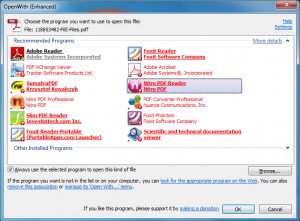
    OpenWith Enhanced takes this idea a step further, replacing the standard Windows with an extended version which not only displays your installed programs, but also lists other popular options, both commercial and free, and links directly to their download page.

    The program installs quickly and easily, with no adware to worry about. When we immediately tried right-clicking an image and selecting Open With…, though, the standard Windows dialog was displayed: it turned out we needed to restart before OpenWith Enhanced would work.

    With that done, though, everything ran very smoothly. We right-clicked an image, selected Open With > Choose default program, and our installed graphics software was listed. And a couple of seconds later, additional recommendations appeared (highlighted in red to show they’re not installed yet) for Picasa, IrfanView and XnView for Windows. Hover a mouse cursor over any of these and you’ll usually a few sentences describing the program, as well as its popularity with other OpenWith Enhanced users. And if you decide you’d like to try the program, double-clicking it opens a browser window at the download page.

    There are plenty of programs supported here, at least for some file types. Try OpenWith Enhanced on a PDF file, say, and you’ll be told about Foxit Reader, SumatraPDF, Nitro PDF Reader and Foxit Reader, as well as commercial options like Nitro PDF Professional and Adobe Acrobat.
    And there are a few interesting bonus extras, including options to disable particular file associations, remove a file type, or manage its “Open With” menu.

    The program does also have some limitations. You may choose “Open With” on a video because you’d like to edit it, for instance, but what you’ll see is a list of media players. And while this isn’t always the case, there is more focus here on finding applications to view a file type, than process it in more advanced ways.

    Of course this can still be very useful, though, whether you’re presented with an unusual file type, or would just like another way to view something more standard. And as it’s also free, lightweight and generally easy to use, OpenWith Enhanced will probably be a welcome addition to most people’s PCs.

  • ZTE will launch Nvidia Tegra 4-based smartphones, but not soon

    Qualcomm’s new Snapdragon processor lineup has cast a shadow over Nvidia’s Tegra 4 ever since its CES 2013 unveiling in Las Vegas. Especially thanks to new smartphone releases such as LG’s Optimus G Pro and HTC’s One flagship, which both feature Qualcomm’s Snapdragon 600 processor. So where does Nvidia fit in the new mobile scene?

    Accustomed to having its Tegra products used in flagship Android devices generally unveiled with much fanfare, Nvidia’s latest partnership with Chinese telecommunications company ZTE seems bland by comparison, and almost flew under the radar. On Thursday, ZTE announced that it will release “the first super phones powered by the Nvidia Tegra 4 mobile processor”, without going into too much detail as to what prospective customers can expect.

    The first smartphones to hit the market using the Tegra 4 processor will be released in China before the second half of 2012. He Shiyou, ZTE EVP and Head of the Terminal Division says: “This is a clear demonstration of ZTE’s ability to quickly develop, and bring to market, market-leading devices running the industry’s latest technologies”. However “quickly” is not that quick — it will take up to five months to release a Tegra 4-based device on the market.

    Qualcomm unveiled the Snapdragon 600 at the same trade show as Nvidia and already there are two smartphones coming based on that processor. The LG-made Optimus G Pro launches this week in South Korea and the HTC-made One hits the market starting in March. Before the second half of 2013 sounds later than March.

    ZTE also revealed that not all of its Tegra-4 based smartphones will feature the optional Icera i500 chipset, which delivers 4G LTE voice and data. The Chinese company announced that only one such device is in store, suggesting that the majority of Tegra 4-based smartphones will be part of a 3G-only affair.

  • Reuters – TPG Raises $305m from Shriram Share Sale

    US private equity firm TPG Capital has raised $305 million by selling about half of its stake in Indian commercial vehicle financier Shriram Transport Finance Co Ltd, writes Reuters. TPG, which owned about 20 percent of Shriram Transport before the sale, sold the shares at 715 rupees each to a large number of overseas and domestic institutional investors, writes Reuters.

    Reuters – U.S. private equity firm TPG Capital has raised $305 million by selling about half of its stake in Indian commercial vehicle financier Shriram Transport Finance Co Ltd, a source with direct knowledge of the matter said on Thursday.

    TPG, which owned about 20 percent of Shriram Transport before the sale, sold the shares at 715 rupees each to a large number of overseas and domestic institutional investors, the source said.

    The private equity firm had launched the share sale late on Wednesday in the price range of 715 rupees to 755.95 rupees per share, according to a term sheet seen by Reuters.

    Shares in Shriram Transport were trading down 7 percent at 702.70 rupees at 0735 GMT, while the main Mumbai market index was down about 1 percent. (Reporting by Sumeet Chatterjee and Indulal P.M.; Editing by Jijo Jacob)

    The post Reuters – TPG Raises $305m from Shriram Share Sale appeared first on peHUB.

  • Reuters – Wells Fargo Ramps Up PE Despite Volcker Rule

    Wells Fargo is ramping up its private equity business in spite of the Volcker Rule, writes Reuters. The bank invests in buyouts and venture capital deals largely on its own, with capital only from Wells Fargo itself and some employees, writes Reuters.

    Reuters – When former Wells Fargo & Co Chief Executive Dick Kovacevich joined Norwest Bank in 1986, he had reservations about its private equity investments as he did not think it was the kind of business a bank needed to be in. He got over it.

    “I was skeptical, met with the people and became convinced that they absolutely knew what they were doing and that this was a business we could manage and do well,” said Kovacevich, who became CEO of Wells Fargo when it merged with Norwest in 1998, and retired as chairman of the fourth-largest U.S. bank in 2009.

    U.S. lawmakers shared Kovacevich’s skepticism about private equity when they crafted the Dodd-Frank financial reform bill in 2010. In a section of the law known as the “Volcker Rule,” they blocked banks from making big bets with their capital, including sizable investments in private equity funds, fearing taxpayers would be left on the hook when wagers soured.

    The fine print of the Volcker Rule – named for former Federal Reserve Chairman Paul Volcker – is expected to be finalized as soon as this year. Major banks such as Bank of America Corp and Citigroup Inc are already pulling back from private equity investments ahead of the rules.

    But Wells Fargo is taking a different path. The bank invests in buyouts and venture capital deals largely on its own, with capital only from Wells Fargo itself and some employees. By avoiding equity from outside investors, the bank is considered to be engaging in “merchant banking,” an activity that is likely to be exempt under the Volcker Rule, lawyers and people familiar with the matter said.

    Wells Fargo’s private equity investments show how even button-down, staid banks are looking for loopholes in financial regulations as they seek to boost their profits.

    Their decisions may run counter to rulemakers’ efforts to make the financial system safer. The merchant banking that Wells Fargo is embracing is riskier than investing in private equity funds with outside investors, where a bank shares any losses with others. Some critics warn that the Volcker Rule is banning the safer of the two activities, and allowing the one that could lead to bigger losses for a bank.

    Some argue that banks should be blocked from any form of private equity investing. Sheila Bair, the former chairman of the Federal Deposit Insurance Corp, which guarantees the deposits of banks like Wells Fargo, said private equity and merchant banking are too far removed from regular banking.

    “Is that really what you want institutions that have safety net support doing? Is that an appropriate use for a government backstop?” she told Reuters.

    Wells Fargo declined to comment for this story, noting that the regulations are not yet final. But the bank has said publicly it expects to continue to back its main private equity-type funds – Norwest Equity Partners and Norwest Venture Partners – that buy stakes in or take over smaller companies.

    “We believe that we will continue to be able to invest, and we continue to invest today, in Norwest Venture Partners and Norwest Equity Partners, which we believe will be allowed under the Volcker Rule,” Wells Fargo Chief Financial Officer Tim Sloan said on a recent conference call.

    The Norwest funds account for most of the bank’s $3.7 billion of private equity assets, which represent a little more than 3 percent of the bank’s Tier 1 regulatory capital.

    In the fourth quarter, private equity was a key business for the bank, earning about $715 million before taxes and boosting the bottom line by about 10 percent. The above-average gain came from selling a seed treatment company to chemical maker BASF for $1.02 billion.

    Other banks are looking at ways around the Volcker Rule, too. Goldman Sachs Group Inc, for example, had about $16.8 billion of private equity investments as of Sept. 30, representing about a quarter of its regulatory capital. Some assets are merchant banking investments, meaning Goldman may use the same Volcker loophole as Wells Fargo. A Goldman spokesman declined to comment.

    FUNDS WITH BENEFITS

    Wells Fargo’s private equity business is small relative to the bank’s overall assets, but it grew 8 percent in 2012 from the prior year, and is more than double its level in 2005. Norwest is still making investments using funds it received from Wells in 2008, and the bank contributed another $250 million to a Norwest pool in 2011, a person familiar with the funds said.

    The lure of private equity to companies like Wells Fargo is not only profitable investment returns, but also new business for other parts of the bank. The funds work with small- and mid-sized companies that often also need loans, treasury management, and other financing and services, former CEO Kovacevich said.

    In January 2012, for example, Norwest Equity Partners bought rifle maker Savage Sports, teaming up with the company’s management. Wells Fargo also arranged senior debt financing for the purchase, which according to Crain’s Detroit Business cost the buyers more than $100 million.

    Business can go the other way, too – companies that borrow from Wells Fargo can get equity from Norwest Equity Partners.

    “It’s good for the bank, and it’s good for the economy,” Kovacevich said. “If you do something well for 50 years why would you not continue doing it?” The funds were founded in 1961.

    The business can be good for the bank’s shareholders – Wells Fargo’s private equity unit has produced gains every quarter for the last three years – but it can also be a negative. In 2008 and 2009, Wells Fargo took $1.27 billion in losses from its private equity holdings over the course of three quarters as the financial crisis hit hard and it absorbed assets from Wachovia.

    Some Norwest investments have also turned out badly more recently. Norwest turned over Deep Rock Water Co to the bottled water company’s creditors before it was sold in 2011, the person familiar with the funds said. The Savage Sports deal may also end up performing poorly, the person added, after the Newtown, Connecticut, school shootings in December hit gun makers’ shares. Savage and Deep Rock Water did not return calls seeking comment.

    Losses in individual companies are not unusual for a private equity business, but during tough times, the value of the whole portfolio can drop. Bank of America, JPMorgan Chase & Co , and others took big charges on their private equity portfolios in the third quarter of 2011 as stock markets sank.

    ‘IT’S GOT RISK’

    The Volcker Rule says that banks cannot hold more than 3 percent of their Tier 1 capital in private equity funds, but the details of the regulations are still being finalized and banks could have as many as 10 years to comply with the regulations.

    Inside the Norwest funds, some employees wonder whether regulators will be sanguine about the business as it grows, the source familiar with the funds said.

    Tim Keehan, senior counsel with the American Bankers Association, said it appears merchant banking won’t be covered by the rule, but it’s still unclear until the rules are final.

    “The reason it still is a concern is we don’t have any sense of boundaries on these definitions,” Keehan said. “That’s why I think you’re seeing some banks go one way, and some banks go the other way.”

    Kovacevich said Wells Fargo’s private equity business has had a solid track record, but the bank should be careful.

    “I would never want it to be big,” he said. “I don’t consider it something you must be in if you are a commercial bank or should be in if you don’t know what you’re doing. It’s got risk to it.”

    The post Reuters – Wells Fargo Ramps Up PE Despite Volcker Rule appeared first on peHUB.

  • Emerging Policy: Turkey bakes

    Turkey took another step in the currency battle this week, cutting two of its three main interest rates to prevent speculative flows, yet also raising reserve requirements to cool domestic loan growth.

    Policymakers in both the emerging and the developed worlds have been keeping monetary policy loose to stop their currencies rising to uncompetitive levels, even though G20 finance ministers last weekend said there would be no currency war, and made a commitment to refrain from competitive devaluations. The mood does appear to be softening, with the Fed’s minutes yesterday showing a number of officials think the central bank might have to slow or stop buying bonds.

    The latest rate move by G20 member Turkey was largely expected, but it still took the lira to a low for 2013 on Thursday – aided by the Fed minutes – and took two-year Turkish bond yields close to record lows.

    The Turkish central bank, however, wants its moves to be seen as policy tightening because of the reserve requirement hikes, according to Tim Ash at Standard Bank.

    This is a hugely complex monetary policy framework, but they seem to feel comfortable making minute adjustments here and there across the range of tools to get to their objectives…guess it’s like baking a cake and figuring out what shelf to put it on, how hot the oven should be, and maybe how long to bake it for… but this is like a new mix that no one has ever used before, and maybe they are cooking two different cakes in the same oven, a souffle and perhaps a nice date and walnut number…

    Thailand, meanwhile, kept rates unchanged at 2.75 percent yesterday, fending off government pressure for a cut to curb those same pesky speculative flows. But with price pressures seen rising later this year, some analysts are talking about a rate rise there.

    Analysts at Capital Economics are less convinced:

    Many now believe that the next move will be a rate hike. In our view, though, the global recovery is likely to falter and put rate cuts back onto the table. Note that the manufacturing sector accounts for some 40 percent of Thailand’s GDP and export weakness would quickly feed into this sector.

    Over to Latin America, where expectations are pretty clear cut for a 25 basis point rate cut in Colombia on Friday to 3.75 percent, to spur growth in the region’s fourth largest economy.

    And for next week, economists will have time to mull things over – the only emerging economy to decide on rates is Angola.


  • View, fix, or delete broken shortcuts with ShortcutsMan

    There are many ways to break a shortcut. Moving an important file might do it; manually deleting a program is another possibility; and of course too many uninstallers will leave application shortcuts behind. And because there’s no visible sign that a shortcut is broken it’ll just stay there, cluttering your system, until eventually you click it and discover the problem.
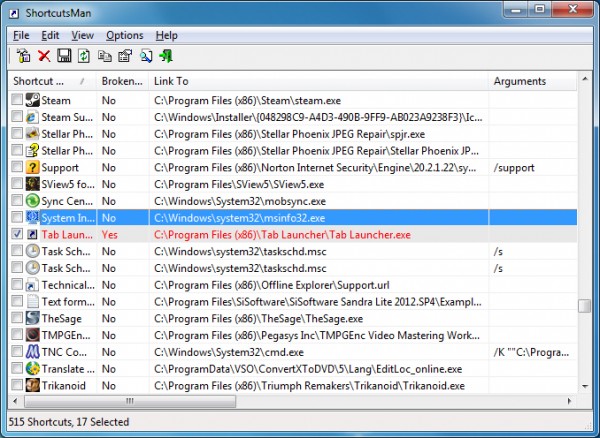
    If you’re tired of junk shortcuts, though, ShortcutsMan offers an easier way to control them. It’s a lightweight and portable application which quickly provides a very detailed report on your system shortcuts, highlights any that are broken, and allows you to fix or resolve these with a click.

    As usual with NirSoft tools, ShortcutsMan is amazingly small (the 32-bit download is a mere 39KB). There are no annoying extras or dependencies, either, so the program will even work on ancient Windows 9x systems.

    This doesn’t mean the program is lacking in power, though. Launch ShortcutsMan, it’ll scan your Start Menu, desktop and a few other areas, and immediately you’ll see a very detailed report on every shortcut it’s found: their name, command line arguments, window style (normal, minimized, maximized), hotkey, location, date, any custom icon file, and more.

    And this kind of information can be interesting in itself. Seeing which applications take command line arguments might be useful, for instance, as you can then explore their documentation, find out what other switches are available. Being reminded of system hotkeys (like Ctrl+Alt+N) is also helpful. And ShortcutsMan can even save these details as a report if you’d like to preserve them for posterity.

    The big plus point here is that ShortcutsMan will also detect and highlight any broken shortcuts, though. And you can scroll through the list to view these, or click the “Broken Shortcut” column header to group them all together.

    Choose particular shortcuts of interest (or click Edit > Select Broken Shortcuts to select them all) and you’re then able to delete them all.

    And alternatively, the program provides a Resolve option which tries to find the missing object and update its shortcut accordingly. Which sounds good, but proved oddly inconsistent in our tests. We moved one file, for instance, breaking two identical shortcuts, selected them and clicked File > Resolve. The first one was fixed correctly, but the second one was unchanged.

    ShortcutsMan has one or two problems, then, but don’t let that put you off. We’re not sure why the Resolve function had some issues, so perhaps it’ll work for you, but even if it doesn’t there’s more than enough functionality here to justify the tiny download. And so if you’d like to know more about your shortcuts, this is an excellent way to get started.

    Photo Credit: iQoncept/Shutterstock

  • SumUp adds American Express to its mobile point-of-sale terminal roster

    And so the European mobile point-of-sale (POS) terminal wars continue. With iZettle, Payleven, Adyen, mPowa and SumUp all trying to replicate Square’s dongle-based model in the EU, the various stages in this scramble for the mobile merchant tend to involve the signing of distribution partnerships or the support of new cards or card technologies.

    Yesterday it was iZettle adding chip-and-pin capabilities — as happened earlier this month with Payleven — and partnering up with Banco Santander, and today it’s SumUp’s newfound support for American Express cards.

    SumUp is still working on the technical implementation for the deal, and its merchants will start being able to take payments from AmEx cardholders in the second quarter of the year in the UK, Germany, Ireland, Austria, France, the Netherlands, Spain and Italy. Belgium and Portugal should follow, though SumUp is still in negotiations with American Express on that point.

    This is not the first such firm to sign with AmEx – after all, American Express has actively invested in iZettle. However, according to SumUp, the deal means the company “will accept more types of cards in more regions than any other mobile point-of-sale technology provider worldwide”. Co-founder Stefan Jeschonnek told me SumUp has “several tens of thousands of merchants” now using its terminals, and “several thousand” are joining each week.

    SumUp does have an extra trick up its sleeve, too: later this year it will be bringing out the slightly Square Wallet-ish SumUp Pay, which will let end-users pre-approve a participating merchant through an app, then pop up on that merchant’s system as soon as they walk into their shop – the idea there is to allow purchases based on a simple verbal interaction with the merchant, without the need for even taking the phone out.

    And according to Jeschonnek, SumUp will be able to exploit its growing installed base of merchants to crack the classic chicken-and-egg problem associated with mobile wallet schemes:

    “We’re making payments smoother today with the card reader, but we’re thinking about how things should work in the future. We are building technology to make that real-world interaction possible again… The difference this time around is that we already have a pretty large and fast-growing merchant base. For our merchants to accept SumUp Pay will be as simple as updating their app.”

    He added that SumUp Pay would also provide a nifty way around Visa’s stringent authentication procedures, which have previously proved a stumbling block for the likes of iZettle, when it launches later this year.

    It’s good to see companies innovating in the financial technology space, and SumUp’s focus on in-house technological development theoretically places it well there. That said, with the mobile POS wars as heated as they are in Europe right now, I would not be in the least bit surprised to see a rival try to beat SumUp to its frictionless payment goal.

    Related research and analysis from GigaOM Pro:
    Subscriber content. Sign up for a free trial.

  • Co-infections and neglected tropical diseases

    The 12th February was a busy day. In addition to a meeting with a delegation of Ugandans (see here), who were in the UK to launch an Alliance with Health Institutions, I spoke at a meeting on Neglected Tropical Diseases, held at the Wellcome Trust.

    Co-infection Conference

    The meeting was organised by the International Society for Neglected Tropical Diseases, and focused on  co-infections between neglected tropical diseases and other diseases.The Neglected Tropical Disease link above gives a list of this group of diseases, which includes things like worm infections, river blindness, and guinea worm. Many of these diseases, which are most common in tropical climates co-exist in areas where diseases such as HIV/AIDS, TB and Malaria are also major problems (there is a link to a European Commission site on the three diseases here). It has been suggested that we need to develop rapid intervention packages to treat neglected diseases as part of the response to HIV/AIDS, TB and Malaria (here). A highlight of the meeting was a video address from the Minister of Health of Rwanda, Dr Agnes Binagwaho.

    An effective response to any disease requires political ownership and leadership, and it was really good to see Dr Binagwaho’s presentation and then hear from Emil Ivan, on malaria and helminthic (worm) co-infection in HIV positive pregnant women. In Rwanda, there is clearly a recognition of the need for integrated services to tackle the full range of health problems, using targeted funds in ways which strengthen the overall capacity of health services.

    My interventions at the meeting highlighted this important issue of strengthening the health system as part of any targeted disease response. I highlighted in my blog on the Global Fund New Funding modality (here), that resources mobilised to fight the three diseases also need to invest in human resources and the key building blocks of good health services. The same is true for interventions which aim to tackle any of the neglected tropical diseases, the final push to eradicate guinea worm will be far more cost effective if it also addresses issues of water and sanitation and strengthens the capacity of health workers more generally. Unless we build health services which can meet the most pressing health needs of the whole population, the interventions being delivered will not be sustained over the long term, which is essential if we want to improve health.

  • Mobile Payments Startup SumUp Adds Support For American Express Payments In 8 Of Its 10 European Markets

    SumUp Amex

    SumUp, one of the myriad of European mobile card reader startups taking advantage of Square’s continued absence in the region to build out a business, is adding support for American Express. Its mobile card reader system already accepts Mastercard and Visa payments but today the startup said it has signed a deal with American Express to process Amex card payments in all “major regions” in which it operates. Its merchants will be able to start accepting Amex in Q2.

    SumUp now operates in 10 European countries. It confirmed to TechCrunch Amex payments will be supported in eight of its markets initially — namely: Germany, France, the UK, Ireland, Italy, the Netherlands, Spain and Austria. The two markets where negotiations are ongoing, with a view to also adding Amex support in future, are Belgium and Portugal.

    SumUp also confirmed its per transaction fee remains the same, with no premium for merchants to process Amex. Merchants using SumUp to process a transaction are charged a flat 2.75% per transaction fee.

    With the addition of American Express, SumUp said it will be able to accept “more types of cards in more regions than any other mobile point-of-sale technology provider worldwide”. SumUp Co-founder Stefan Jeschonnek said Amex support is a “big deal” for it, and for the tens of thousands of merchants in Europe who use its technology.  ”SumUp is about enabling small businesses to grow and for our merchants being able to accept card payments from all the major brands is a big deal,” he added.

    Commenting on the tie-up in a statement, Werner Decker, Senior Vice President, American Express, said: “We see SumUp as a smart and convenient way for small businesses to further enable commerce by accepting card payments.”

    SumUp added that American Express will also be included as a payment option in its forthcoming consumer payment app — called SumUp Pay — which it demoed at Finovate Europe last week. The app will allow consumers to link their credit card to it and pre-authorise payments with trusted merchants. The payment process does not involve a physical card reader — rather the buyer’s phone is identified as it enters the store, using geofencing technology, and the merchant can then process the payment when the buyer confirms what they want to order.

    As yet, there’s no confirmed launch date for SumUp pay.

    SumUp’s Amex release follows below.

    SumUp to accept American Express

    SumUp broadens range of payment options for merchants in major European markets


    London – 21th February 2013SumUp, the company that enables merchants to take debit and credit card payments with their smartphones, has signed a deal with American Express that will allow it to process American Express card payments in all major regions in which it operates. The deal means that SumUp merchants will soon be able to take payments from American Express Card members.

    In December 2012, SumUp extended its service to merchants giving it a presence in ten European countries.  SumUp’s ability to process American Express payments means that it will accept more types of cards in more regions than any other mobile point-of-sale technology provider worldwide.

    Any small business using SumUp will soon be able to accept card payments from all the major card brands for an affordable and transparent fee and without any monthly costs.

    Daniel Klein, CEO of SumUp, commented: “It’s extremely frustrating for a merchant when they miss out on making a sale because they can’t accept the type of card a customer wants to use. The only person it’s more frustrating for is the customer who goes away empty-handed. That’s why we’re delighted that we will be able to process American Express card payments on behalf of our merchants and to the advantage of American Express’ thriving and deeply loyal customer base.”

    – ENDS –

    About SumUp

    SumUp is the easiest way for small businesses and sole traders to accept credit and debit card payments securely, even on-the-go.

    Using only a free, supremely portable card reader and an app available for iPhone, iPad and Android, artisans, taxi drivers, cafes, restaurants, shops and many other merchants are now able to accept credit and debit card payments anytime, anywhere.

    SumUp only takes a fee of 2.75% per transaction made using the SumUp card reader, meaning that businesses no longer have to worry about additional costs, expensive terminals or high monthly fees. The transaction fee is the same for American Express, Visa and MasterCard. SumUp is Europay, MasterCard, and Visa (EMV) compliant and PCI-DSS certified, ensuring that payments are processed in accordance with the highest security standards.

    The company was founded in 2011 and already has over 140 employees, and major offices in Berlin, London, Dublin, Madrid, Milan and Amsterdam. SumUp has been available in the UK, Germany, Ireland and Austria since August 2012, in the Netherlands, Spain, and Italy since November 2012, and in France, Portugal, and Belgium since December 2012.

    Website: www.sumup.co.uk