Blog

  • Apple Hacked with Same Attack That Hit Facebook, Will Release Anti-Malware Tool for Infected Macs

    Facebook isn’t the only high-profile tech company reporting that hackers have targeted them. This time, it’s Apple.

    According to Reuters, Apple was hit with the same Java exploit that targeted Facebook employees last month (although the company didn’t release that info until last Friday).

    “Apple has identified malware which infected a limited number of Mac systems through a vulnerability in the Java plug-in for browsers. The malware was employed in an attack against Apple and other companies, and was spread through a website for software developers,” said Apple in a statement.

    Like Facebook, Apple claims that there is no evidence that any data was compromised.

    Apple says that the malware has affected other companies, but would not disclose any more on the topic. Reuters says that someone knowledgable of the investigation says that the attacks hit hundreds of companies, “including defense contractors.”

    The malware targeted Mac computers at Apple HQ, as well as the other companies hit.

    “This is the first really big attack on Macs,” said Reuters’ source. “Apple has more on its hands than the attack on itself.”

    According to Apple, the company will release software some time on Tuesday that they say will allow Mac users to purge the malware used in these attacks. We’ll update when/if Apple releases an official statement and/or the aforementioned software.

  • Samsung storms into Silicon Valley with plans to build ‘massive’ semiconductor campus

    Samsung Silicon Valley Presence
    While Samsung (005930) has traditionally been a Korean company through and through, it may now want to put more of an American stamp on its operations. The Los Angeles Times reports that Samsung has been aggressively expanding its presence in Silicon Valley recently by building its own innovation center, by launching a $100 million venture fund for Silicon Valley startups and by building “a massive new semiconductor campus with a distinctive design destined to compete with Apple’s proposed spaceship-like campus for the title of Silicon Valley’s most distinctive architectural landmark.”

    Continue reading…

  • Prince Michael Jackson: Job At “ET” To Precede Acting Career?

    Prince Michael Jackson, the 16-year old son of late pop icon Michael Jackson, recently landed a gig with “Entertainment Tonight” as an on-air correspondent.

    The teenager got to sit down with the stars of “Oz The Great And Powerful” for his first job–including director Sam Raimi and actors James Franco and Zach Braff–and got some advice on how to pursue his goals, which he says include becoming a well-rounded screenwriter, producer, actor, and director.

    Franco said, “I always tell people, just go out and try, and stop waiting around or dreaming it’s going to happen. Just go and start doing things on your own.”

    Jackson and his younger sister, Paris, have both expressed an interest in going into the entertainment industry in some way, and Prince Michael seems to have his goals clearly outlined. The teen credits his father for any attributes that are complimented, such as the adult way he handles himself despite his young age.

    “That’s what most people say. That was all thanks to my dad. He raised me right,” he said.

  • UCLA scientists develop new therapeutics that could accelerate wound healing

    In “before” and “after” photos from advertisements for wound-healing ointments, bandages and antibiotic creams, we see an injury transformed from an inflamed red gash to smooth and flawless skin.
     
    What we don’t appreciate is the vital role that our own natural biomolecules play in the healing process, including their contribution to the growth of new cells and the development of new blood vessels that provide nutrients to those cells.
     
    Now, UCLA researchers led by Heather Maynard, a professor of chemistry and biochemistry and a member of UCLA’s California NanoSystems Institute, are working to take advantage of our body’s ability to heal itself by developing new bio-mimicking therapeutics that could be used to treat skin wounds.
     
    Among the key players involved in natural wound-healing is a signaling molecule known as basic fibroblast growth factor, or bFGF, which is secreted by our cells to trigger processes that are involved in healing, as well as embryonic development, tissue regeneration, bone regeneration, the development and maintenance of the nervous system, and stem cell renewal.
     
    bFGF has been widely investigated as a tool doctors could potentially use to promote or accelerate these processes, but its instability outside the body has been a significant hurdle to its widespread use, Maynard said.    
     
    Now, Maynard and her team have discovered how to stabilize bFGF based on the principle of mimicry. Relying on the growth factor’s ability to bind heparin — a naturally occurring complex sugar found on the surface of our cells — the team synthesized a polymer that mimics the structure of heparin. When attached to bFGF, the new polymer makes the protein stable to the many stresses that normally inactivate it, rendering it a more suitable candidate for medical applications.
     
    The research is published Feb. 17 in the online edition of the journal Nature Chemistry and will appear in an upcoming print edition of the journal.
     
    UCLA co-authors of the research include graduate students Thi Nguyen and Caitlin Decker, former postdocs Dr. Sung-Hye Kim and Dr. Darice Wong, and Joseph Loo, professor of chemistry and biochemistry.
     
    The research was federally funded by the National Institutes of Health and the National Science Foundation.
     
    Our ability to heal from wounds is essential to our survival. When those natural healing processes are compromised, serious wounds can lead to infection and other health problems. People with diabetes, for example, can have wounds that heal very slowly. The resulting chronic wounds are debilitating and can lead to loss of limbs or even death. Yet, despite the need for wound dressings that can stimulate the body to heal wounds, very few are curative.
     
    “This very important clinical need is the motivation behind our research,” Maynard said.
     
    The importance of fibroblast growth factor was recognized in 1973, when biologist Hugo Armelin discovered that this previously unknown chemical, extracted from the pituitary gland, successfully caused cells to divide. Since then, researchers have applied fibroblast growth factor to wounds such as foot ulcers resulting from diabetes, but the treatments have not been very effective. What scientists now recognize, Maynard said, is that these growth factors typically lose their activity quickly in storage.
     
    Knowing that other key biomolecules have been stabilized before with the help of polymers, Maynard and her team developed a strategy to maintain bFGF activity by taking advantage of its known structure and binding capabilities. Their new polymer, p(SS-co-PEGMA), mimics heparin’s natural ability to stabilize the growth factor. 
     
    After showing that p(SS-co-PEGMA) was non-toxic to human cells important in wound healing, they used it to conjugate bFGF and demonstrated that they could keep the growth factor active outside of the body for extended periods of time, even after it is exposed to heat, cold, enzymes that would normally break it down, and acidic conditions like those found in the wound injury setting. Moreover, they showed that this bound bFGF functions just like normal bFGF to trigger the same signaling pathways involved in the healing process.
     
    The advance is an important step in the use of growth factors for therapy. The ability to stabilize bFGF means that it can be potentially stored, shipped and made available for use by doctors and patients when needed any time and anywhere, Maynard said.
     
    The group is testing their new material with dermatologists Dr. Lloyd Miller, an associate professor of dermatology at Johns Hopkins University, and Dr. Jenny Kim, an associate professor of clinical medicine and dermatology at the David Geffen School of Medicine at UCLA, a member of the CNSI, and chief of dermatology for the Veterans Affairs Greater Los Angeles Healthcare System. The group is also researching ways to stabilize other proteins involved in wound healing and ways to make bFGF more active.
     
    “This stable bFGF–polymer conjugate may also be useful in diseases other than wound healing — for example, vocal chord repair, cardiac repair and bone regeneration,” Maynard said. “More generally, we think that this idea of making polymers that mimic natural stabilizers is useful in a wide range of fields.” 
     
    The California NanoSystems Institute is an integrated research facility located at UCLA and UC Santa Barbara. Its mission is to foster interdisciplinary collaborations in nanoscience and nanotechnology; to train a new generation of scientists, educators and technology leaders; to generate partnerships with industry; and to contribute to the economic development and the social well-being of California, the United States and the world. The CNSI was established in 2000 with $100 million from the state of California. The total amount of research funding in nanoscience and nanotechnology awarded to CNSI members has risen to over $900 million. UCLA CNSI members are drawn from UCLA’s College of Letters and Science, the David Geffen School of Medicine, the School of Dentistry, the School of Public Health and the Henry Samueli School of Engineering and Applied Science. They are engaged in measuring, modifying and manipulating atoms and molecules — the building blocks of our world. Their work is carried out in an integrated laboratory environment. This dynamic research setting has enhanced understanding of phenomena at the nanoscale and promises to produce important discoveries in health, energy, the environment and information technology. 
     
    Fore more news, visit the UCLA Newsroom and follow us on Twitter.

  • Ubuntu tablet challenges Android, BlackBerry, iOS and Windows

    Developers looking for Ubuntu on smartphones will get a second treat on February 21. Today, Canonical revealed a build for tablets. Supported testing devices for both platforms: Galaxy Nexus, Nexus 4, Nexus 7 and Nexus 10. Ubuntu replaces Android, not runs alongside or dual-boots with it.

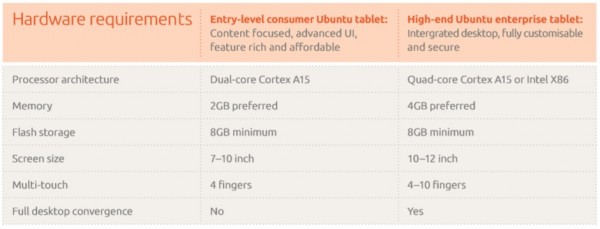
    “Ubuntu tablet” supports multi-touch slates running dual-core ARM A9 processor with 1GB of RAM and 8GB storage. However, Canonical’s ambitions are greater for commercially-shipping products: dual-core A15 processor and 2GB RAM for 7-to-10 inch tablets and quad-core A15 or x86 processor and 4GB of RAM for 10-to-12 inch slates. The specs reveal plans to compete with touch ultrabooks or tablet hybrids like Microsoft Surface Pro. The operating system supports up to 20-inch tablets. However, lower-end tablets will be a priority.

    Like Apple, Google or Microsoft, Canonical talks a four-screen strategy. In October 2011, CEO Mark Shuttleworth promised Ubuntu would appear on smartphones, tablets and TVs, in addition to PCs. The company formally announced the smartphone OS in January.

    The difference: Canonical claims a unified user experience across devices. None of the aforementioned competitors deliver that today, although Google is closest. “The tablet is the next step in our mission to create one unified experience for all personal computing”, Shuttleworth boasts.

    Related: Canonical touts a write-once, run-on-any-device benefit for developers. Again, Google is closest to offering something similar. Information about the Touch Developer Preview for phones and tablets already is available, as well as a preview SDK. To reiterate: Software releases Thursday.

    “We have both rich native applications and web applications that run side-by-side as equal citizens on the tablet”, Shuttleworth says.

    While the first commercial smartphones and tablets are expected this year, Canonical doesn’t plan to unify all form factors into a single platform until 14.04 LTS releases early next year. Ubuntu will be the same across devices, but not the user interface. For example, on smartphones the UI is primed for one-handed operations and two on tablets. Says Shuttleworth about phones: “All the goodness of Ubuntu perfectly shaped to your hand”.

    Like Android, Ubuntu tablet supports multiple users, and like Chrome OS a guest mode. Favorite apps launch from a left-pull toolbar, and a swipe opens the full apps page. “Swipe through the right edge and you reveal phone apps running on your tablet”, or The Sidestage, Shuttleworth says. Split-screen presents phone and tablet apps running side-by-side.

    The Sidestage and right-top pull-down menu also let users socially interact or access additional services while maintaining the larger content menu for, say, watching a movie.

    Ubuntu tablet supports modular designs. A phone docked to a slate displays content in The Sidestage, while the tablet becomes a PC with mouse and keyboard.

    Canonical expects OEMs to ship devices running Ubuntu tablet, although partners announcements, along with chipsets, are forthcoming. Support for Nexus devices is meant for developers, but judging from the reaction I see on social networks, gadget geeks will grab and mod, too.

    “I want an Ubuntu tablet now!” Christopher Bowley posts to Google+. “Don’t even need a desktop/laptop anymore. Assuming it’s as powerful as the desktop os, which seems like the case. As long as it has external USB support. My external drive, phone, and Tascam pocket studio (which connects as an external drive) is all I need to connect. Seems doable”.

    Brett Daugherty: “Liking the +Ubuntu tablet. Gonna flash my phone to the mobile OS Thursday to give that a shot, wouldn’t mind being able to flash my tablet to that too to get the full experience”.

    Will you, too?

  • Google Talks About Phone Number Spam Again

    Nearly a year ago, Google’s Matt Cutts took to Google+ to discuss phone number spam.

    “I wanted to clarify a quick point: when people search for a phone number and land on a page like the one below, it’s not really useful and a bad user experience. Also, we do consider it to be keyword stuffing to put so many phone numbers on a page,” he said. “There are a few websites that provide value-add for some phone numbers, e.g. sites that let people discuss a specific phone number that keeps calling them over and over. But if a site stuffs a large number of numbers on its pages without substantial value-add, that can violate our guidelines, not to mention annoy users.”

    This is the image he was referring to:

    Phone Number Spam

    Today, Google released its latest Webmaster Help video, which features Cutts talking about the subject once again. It’s short and sweet, and basically serves as a reminder that Google will take action on this kind of thing:

  • CitusDB: Today, SQL on Hadoop. Tomorrow, the world!

    Database startup Citus Data on Tuesday joined those trying to enable fast SQL queries on Hadoop data, but it has much larger goals. It thinks it can be the only analytic database that anyone needs, able to query data wherever it’s stored across a company’s environment — in relational databases, Hadoop, MongoDB, Amazon S3 and elsewhere.

    Big data has opened companies’ eyes to the importance of analytics and alternative data stores, but combining the two often means learning new languages, using multiple tools and probably sacrificing the performance they’re used to from analytic platforms.

    Citus Data’s flagship product, called CitusDB, is actually built atop PostgreSQL and its first iteration was designed for Google Dremel-like scale and speed on relational data. Thanks to a feature called “foreign data wrappers,” though, it’s able to run SQL on numerous data types (e.g., CSV, log and JSON files) that don’t comport with how Postgres formats data natively. So, while CitusDB now officially supports the Hadoop Distributed File System in addition to Postgres, it is by no means limited to them.

    Matt Ocko, managing partner at Data Collective and one of Citus Data’s early investors, says the database can technically support any data source with an ODBC driver, and even could query something like log files straight from a data store. In fact, Citus is working on extending its support to MongoDB — a capability that’s in beta right now. Ocko is also particularly impressed with CitusDB’s ability to act like a fabric connecting all these data sources rather than making users query each independently and then manually join the data. He cited a demonstration in which CitusDB carried out a query that required executing a join across Postgres and Hadoop.

    The other big thing about CitusDB is that it’s not just flexible but fast, too. Ocko said CitusDB has outperformed Oracle’s vaunted Exadata machine on a TPC-H benchmark test with data stored primarily on hard disk. That Postgres-Hadoop query he referenced completed in just a few seconds while running on the Amazon EC2 cloud.

    CitusDB is so fast, Citus Co-founder Umur Cubukcu told me, because of how it’s architected. It moves the computation to where the data is rather than trying to move data across the network, and it has some impressive load-balancing the resource-management abilities baked in. If, for example, it needs data housed on a slow-running node in order to complete a task, the software will look for that data elsewhere rather than just wait for the congested resource to free up.

    In the case of Hadoop, MapReduce brings the computation to the data, too, but every job requires a scan over the entire dataset. This is why early SQL-on-Hadoop tools such as Hive are still relatively slow. Citus software engineer Carl Steinbach, who came to the company from Cloudera, said CitusDB is between 3 and 20 times faster than Hive depending on the query type.

    It’s actually much faster for short queries that might be typical in an interactive environment, but he acknowledged those aren’t really what Hive was designed to do.

    Citus_Hadoop_Architecture

    Rather, CitusDB’s real competition is the spate of SQL-on-Hadoop projects, products and startups of which it’s now a part. We’ll have a whole session dedicated to this topic at Structure: Data next month, and there isn’t enough room for everything on the market right now — Aster Data, Platfora, Cloudera (with Impala), Apache Drill, Drawn to Scale and Hadapt, to name several.

    These are impressive technologies (at least in theory where they’re still under development), and Citus would be remiss to ignore them. But, aside from the ability to query multiple data sources, the company has something the others don’t, Cubukcu said: It has the Postgres community and all the features they’ve built into that database already. Things like connectors, authentication, full-text search and PostGIS for geospatial data that go beyond just running fast queries.

    “When you’re talking about an enterprise-class database,” Steinbach said, “you’re talking about more than a query execution engine.”

    Related research and analysis from GigaOM Pro:
    Subscriber content. Sign up for a free trial.

  • Canada’s futile quest to own postal codes: why governments should make data a public good

    It’s already been an embarrassing few months for Canada. First, there was the heist at the strategic maple syrup reserve and then the country printed the wrong national symbol on its money. Now, Canada risks further ridicule by doubling down on a campaign to own basic postal data.

    In case you missed it, Canada Post last year filed a copyright lawsuit against a small company that publishes postal codes (the Canadian equivalent of zip codes) on its website, Geocoder. The company, Geolytics, created a database of codes — such as H4B 5G0 or V6B 6G1 – through crowdsourcing, which it gives away for free to non-profits and also licenses to businesses.

    Critics quickly blasted Canada Post’s lawsuit as an overreaching attempt to assert copyright over basic facts. Nonetheless, the agency continues to push on. This month, it made a concession — but one that appears more strategic than substantial.

    According to the National Post, the agency is now providing access to its database of postal codes — but only the first three digits, which provide broad but not specific locations. Canada Post also insists that anyone who use those digits include a note saying the data was copyrighted.

    While the partial data release may be useful to marketers, Canada Post still won’t drop its claim against Geolytics or others who would use the postal codes. In doing so, Canada Post is going against the grain of a growing belief advocated by The Economist and others that government data is a public good that can foster knowledge and commerce. The city of Palo Alto in California, for instance, is turning all of its data into an open platform that allows anyone to tap into a stream of information about zoning, housing, city finances and more.

    “The rest of the Canadian government is moving directly in the direction of Palo Alto and making data available publicly,” says David Fewer, the director of the Canadian Internet Policy and Public Interest Clinic which is representing Geolytics in the lawsuit.

    Fewer says the agency’s decision to publish the first three letters of the postal codes is likely a “sop” to deflect criticism as it tries to turn its data into a revenue stream.

    “Canada Post clearly regards my client as a direct competitor,” he said.

    While the rest of the Canadian government may support public data, Canada Post can do what it likes because it is an independent Crown Corporation — a peculiar Canadian species of public corporation intended to advance national interests. Canada Post’s attempt to collect copyright revenue may be an effort to avoid the fate of the American postal service which is on the brink of insolvency.

    From a legal perspective, however, Canada Post’s efforts are likely hopeless because it’s not possible to copyright facts. While it is possible to get protection for compilations, Canada Post’s compilation of geolocation symbols does not reflect any creative effort that would merit protection.

    Related research and analysis from GigaOM Pro:
    Subscriber content. Sign up for a free trial.

  • Apple admits ‘widespread cyber-security breach’ by Chinese hackers

    Apple Hacked
    In a move that Reuters calls “an unprecedented admission of a widespread cyber-security breach,” Apple (AAPL) on Tuesday admitted that it was the victim of several attacks by the same group of Chinese hackers who previously targeted Facebook (FB) and other large companies. The hackers were able to infect a “small number” of Mac computers that belonged to Apple employees, although it said that “there was no evidence that any data left Apple.” The company plans to release a software tool later today to protect customers from the malicious software used in the attacks. Facebook revealed last Friday that it was the victim of a sophisticated attack by a group of hackers that were traced back to China.

  • Apple says some employee computers were breached by hackers

    Apple admitted on Tuesday that it was the target of the same hacking attack that hit Facebook last week. A “small number” of Apple employees’ computers were compromised by hackers, the company told Reuters.

    Apple says there is no evidence that “any data left Apple.” The company is said to be working with law enforcement to identify the culprits. Apple released an update later on Tuesday that patches the security vulnerability in Java for OS X that hackers were able to exploit.

    Here’s Apple’s full statement on the matter:

    Apple has identified malware which infected a limited number of Mac systems through a vulnerability in the Java plug-in for browsers. The malware was employed in an attack against Apple and other companies, and was spread through a website for software developers. We identified a small number of systems within Apple that were infected and isolated them from our network. There is no evidence that any data left Apple. We are working closely with law enforcement to find the source of the malware.Since OS X Lion, Macs have shipped without Java installed, and as an added security measure OS X automatically disables Java if it has been unused for 35 days. To protect Mac users that have installed Java, today we are releasing an updated Java malware removal tool that will check Mac systems and remove this malware if found.

    Facebook said last week that last month it was also the victim of a malware attack that it says came from China. The exploit took advantage of a vulnerability in its Java software to gain access to its employees’ PCs.

    Apple’s announcement comes less than a day after the New York Times published evidence that a huge number of hacks emanating from China against U.S. infrastructure and American corporations can be linked to a secret division of China’s army. The Times itself, along with the Wall Street Journal, are also among a high-profile group of U.S. companies to be hit by Chinese hackers that made their way into employees’ computers.

    This post was updated at 10:34 a.m. PT with Apple’s statement and again at 2:02 p.m. PT with the link to Apple’s published update for Java.

    Thumbnail image courtesy Shutterstock user mkabakov.

    Related research and analysis from GigaOM Pro:
    Subscriber content. Sign up for a free trial.

  • Twitter reaffirms commitment to Tweetdeck with improvements to web apps

    Twitter announced a variety of improvements for the Tweetdeck apps for web and Chrome on Tuesday, adding new options for users to filter the content appearing in Tweetdeck columns. The news demonstrates that Twitter is still interested in supporting updates and changes to Tweetdeck, rather than shutting it down or discouraging growth as it’s done with many other third-party Twitter clients.

    Twitter confirmed its acquisition of Tweetdeck in May 2011, but it was unclear if the company would continue to update Tweetdeck or kill it altogether, as my colleague Mathew Ingram wrote at the time of the deal. Twitter’s relationship with third-party client developers has been become fairly fraught, as those clients attempt to replicate the Twitter experience outside of the web, which has only gained importance as Twitter has worked to make money on the web experience through advertising. This past summer, Twitter issued a warning to developers that third-party clients would be forced to adhere to a new system of rules for using tweets that could limit their growth.

    Tweetdeck users of both the Chrome and web apps will now have more options to change the content they view and filters they apply. A Tweetdeck blog post explained the updates:

    “Today we’re releasing a powerful set of column filters for the TweetDeck web and Chrome apps. These allow you to show or exclude specific words and phrases from a TweetDeck column –– especially useful when you want to focus on a particular element of a column. You can also choose to view only Tweets that contain media (images and/or video). This turns any of your existing columns into a media column, making it very easy to scan content and find what you’re looking for.”

    The company notes in the blog post that it’s introduced a variety of updates to Tweetdeck recently, including real-time updating of tweets in columns, keyboard shortcuts and search improvements, among others. In October 2012, Tweetdeck released visual updates to its product, including updated colors and fonts for a variety of platforms including web, Chrome, Mac and Windows.

    Related research and analysis from GigaOM Pro:
    Subscriber content. Sign up for a free trial.

  • Apple Says It Was Targeted By The Same Hackers That Hit Facebook, Will Release Protection Software Tuesday

    Apple-Logo-MacBook

    Apple has revealed that it was attacked by the same group that went after Facebook in a recent attempt to break that network’s security. The company says a “small number” of its employees’ Macs were affected, but there is “no evidence that any data left Apple,” according to a report by Reuters. The company will be issuing software to prevent customers from being attacked in the same manner, Apple said.

    Apple’s report follows the news from Facebook on Friday that it was targeted by hackers apparently operating out of China. Facebook also reported that none of its users’ data was compromised through the attack. Apple is said to be workign with law enforcement on trying to find the source of the hacking attempt, and will be releasing a software tool aimed at its customers to help them protect their own Macs against the malware used by the unidentified assailant.

    The goal for both Apple and Facebook, in being the source of these reports about attacks on their own companies is to be proactive and get out ahead of the news, in order to reassure customers that they’re doing everything possible to ensure the security of any data they hold. The object lesson of Sony’s PlayStation network breach, and the ensuing criticism and lawsuits that resulted from it being perceived as “slow” to notify outsiders of the attack is probably one cause of heightened transparency on the part of companies facing cyber-security threats.

    For Apple, admitting to a security breach is a rare occurrence. The company acknowledged some 400 iTunes accounts were hacked back in 2010 in response to customer complaints, but this kind of pre-emptive move indicates that we’re likely dealing with a different level of security threat altogether. On the plus side, account data seems not to have been leaked, and this means authorities will have the help of two technology giants and their considerable resources in tracking the perpetrators down.

  • ICYMI: Government Hubris Leads to Unnecessary Regulations

    WASHINGTON D.C. — On Saturday, IER Senior Vice President Daniel Kish published an op-ed in The Washington Times titled, Steven Chu and the Hubris of Big Government. In the article, Kish demonstrates how big government and heavy-handed regulations harm Americans:


    Steven Chu and the Hubris of Big Government

    By Daniel Kish — 2/16/2013

    President Obama has been seeing off loyal retainers from his first term, and recently he bid adieu to Steven Chu, his in-house Nobel Laureate and secretary of energy. In doing so, the president praised Mr. Chu for “designing a cap to plug a hole in the middle of the Gulf of Mexico when nobody else could figure it out.” This was in reference to the 2010 BP oil spill known as “Deepwater Horizon.” The problem is, Mr. Chu did not design the containment cap; the hardworking engineers of BP and its private sector contractors did that, working night and day from the moment of the disaster. Any energy business that had expertise offered to help, and many did.

    Mr. Chu is a brilliant man and has done the world a service by his work in optical physics, including his Nobel prize work involving light and atoms. Still, Mr. Obama giving him credit for the cap fits perfectly with the central conceit of liberalism in general, and the dangerous path down which Mr. Obama is leading the nation.

    When the president shouted out, “You did not build that” during the latest campaign, he was echoing a central tenet of the liberal credo: Government — not free citizens or the businesses or works they create — is responsible for the progress that Americans have achieved over the last two centuries. Government can set and enforce rules that enable individuals and businesses to take risks, innovate, invest, succeed and fail. Yet government itself does not build or create wealth; even those things it does build only come from revenues it coercively takes from individuals and businesses to be spent on what politicians deem popular at the moment…


    To read the full article, click here.

    ###

  • Here’s what Ubuntu will look like on tablets, and why enterprise users might be interested

    Ubuntu for tablets is almost here. Canonical has just revealed details of the slate piece of its phone-tablet-PC-TV puzzle, and it’s largely about the enterprise.

    Yes, Canonical’s Ubuntu Linux has run on tablets before, but the upcoming version is the first to be engineered specifically with touch in mind. The idea is to have one code base running across all screens (more on that later), and a developer preview will come out on Thursday that can be installed not only on Google’s Nexus 7 and Nexus 10 tablets, but also on the Nexus 4 and Galaxy Nexus handsets.

    We’ve already seen what the mobile version will look like, and now we know how it will look on tablets. In that form factor, it’s got several features worth mentioning, including voice-control for the heads-up display (HUD), multiple user accounts with full encryption, and the ability to multitask tablet and phone apps at the same time and on the same screen. The tablet can also be used as a thin client in the same way as an Ubuntu desktop can.

    Here’s what Canonical founder Mark Shuttleworth had to say in a statement, and a video too:

    “Multi-tasking productivity meets elegance and rigorous security in our tablet experience… Our family of interfaces now scales across all screens, so your phone can provide tablet, PC and TV experiences when you dock it. That’s unique to Ubuntu and it’s the future of personal computing.”

    Unified code

    Now, about that single code base. Over the weekend, KDE developer Aaron Seigo launched what was by open-source standards a broadside against Canonical, accusing the London-based firm of “duping” developers by claiming to be using the same code for all versions, but not doing so in practice.

    Canonical responded yesterday by insisting the code really would be one-size-fits-all when it’s complete. It went on to say this would hopefully happen by the end of this year, and that the first public release of “the full unified code base” would be in Ubuntu 14.04, in April 2014.

    In other words, what you can install on your Nexus this week is far away from being being the finished product.

    Enterprise focus

    This is partly a consumer play, hence the TV iteration. However, the features Canonical mentioned today should appeal to enterprises, some of which are running Ubuntu on the server and, in the case of a few, on the desktop too.

    In general, businesses currently use Microsoft on the desktop, with Apple’s iPad serving as the tablet of choice. If — and it’s a big if — Canonical can find manufacturers to actually make Ubuntu phones and tablets, the idea of developing once across all these form factors will be extremely attractive, particularly with a big question mark hanging over Windows 8′s place in the enterprise.

    Of course, by spring 2014 there’s a good chance that Microsoft will have released an obligatory service pack (or ‘Blue’ release, or whatever it will be called) that clears up the OS’s various quirks, effectively giving corporate customers the all-clear to dive in. And it’s quite possible that Windows 8 will also prove to be the consumer success that Microsoft hopes it will be.

    But if Windows 8′s enterprise appeal turns out to be more Vista than XP, business customers won’t have many familiar options to fall back on, leaving Canonical in a good position.

    A lot can happen in a year.

    Related research and analysis from GigaOM Pro:
    Subscriber content. Sign up for a free trial.

  • Apple releases iOS 6.1.2 to patch battery-draining Exchange bug [updated]

    iOS 6.1.2 Released
    As we expected to happen this week, Apple (AAPL) has released iOS 6.1.2 to patch a bug related to the Microsoft (MSFT) Exchange Calendar that drains battery life and, in all likelihood, a major security hole in iOS 6.1 that makes it incredibly easy to bypass the iPhone’s unlock screen pass code. Although Apple makes no mention of specifically patching the unlock screen security hole, MacRumors notes that “sources had indicated that it also addresses” the issue in addition to addressing the Exchange bug, so it’s likely that Apple has taken care of both issues in its latest release.

    UPDATE: Ars Technica’s Andrew Cunningham has installed iOS 6.1.2 and has found that the new update does not fix the unlock screen security hole, which is pretty surprising given that it is potentially more serious than a battery-draining bug.

  • The NYT is doing something smart by using Twitter trends to target ads

    We spend a fair amount of time criticizing traditional media players like the New York Times for not being innovative enough, relying too much on paywalls for revenue growth, and other perceived failings — so I think it’s only fair when we recognize things that they do that are innovative and interesting, and a new ad product it has launched definitely falls into that category. In a nutshell, the newspaper is selling advertisers the ability to target their ads based on whether a story is trending on Twitter.

    Michael Zimbalist heads up the NYT’s research and development arm, and described the new advertising venture — which is called “Sparking Stories” — at a conference on big data put on recently by Beet.tv. According to Zimbalist, it came out of a new unit of the NYT R&D lab that is designed to commercialize the research done there, and is based on a social-media analytics tool the Times has been using for some time called Cascade.

    Zimbalist

    In a nutshell, Cascade is the newspaper’s in-house version of Twitter’s trending topics: it allows the NYT to track which stories on its site are being shared heavily through social media, information that is used by both editors and reporters as a way of seeing how much traction their content is getting with readers. The new “Sparking Stories” advertising product gives advertisers the ability to place their ads inside those specific stories. Said Zimbalist:

    “We developed this tool that lets us see what stories are trending, so now we’ve created an API that lets our ad server talk to this tool, and we’ve created an ad product called Sparking Stories, where an advertiser can come in and buy a package of stories that are trending right now on Twitter, irrespective of section or context or topic — just the stories that are really breaking through right now on social media.”

    New York Times Building Day

    Zimbalist notes in his interview with an analyst from Forrester Research that the original head of the NYT’s digital arm, Martin Nisenholtz, had an advertising background before he joined the newspaper, and says he “realized the promise of this medium was going to be targeting based on data,” something the paper has always done through fairly traditional means: namely, separating registered readers based on gender, zip code, age, etc.

    But what Spark allows the newspaper to do is much more interesting: it focuses not on age or gender or zip code — things that may be irrelevant (or at least less relevant) for some advertisers who want to target specific content topics — and instead focuses on what content is being talked about the most. Although Zimbalist doesn’t say what the paper charges for this product, that ability could theoretically be much more valuable than a standard display ad.

    At a time when the advertising business is undergoing a tremendous upheaval, forcing media companies to experiment with everything from affiliate links to sponsored content, it’s nice to see the Times focusing on how it can use technology and data to push traditional advertising into the future a little bit. (Note: We are going to be discussing new forms of monetization for content at our paidContent Live conference in New York on April 17).

    Images courtesy of Shutterstock / noporn and Flickr user Robert Scoble

    Related research and analysis from GigaOM Pro:
    Subscriber content. Sign up for a free trial.

  • Ubisoft, EA Cross-Pollenate Uplay, Origin With Each Others’ Games

    Electronic Arts (EA) and Ubisoft today announced that a few of their published titles will grace each others’ online storefront.

    Ubisoft titles, such as Assassin’s Creed III and Far Cry 3, can now be purchased through EA’s Origin store, with more titles such as Splinter Cell Conviction on the way. Likewise, EA games such as Dead Space 3, FIFA Soccer 13, The Sims 3, and Mass Effect 3 will soon be found in Ubisoft’s Uplay store.

    “Making our biggest franchises like Assassin’s Creed and Far Cry available on Origin is a great way of exposing even more PC gamers to these great titles and giving them another choice in where and how they buy their games,” said Chris Early, VP of Digital Publishing at Ubisoft. “Also, by adding excellent titles from EA to the Uplay shop, we’re taking another important step in making Uplay the most rewarding set of services available to our customers.”

    This is undoubtedly a nice get for both EA and Ubisoft, which will see the quality and number of titles in their stores rise as a result of the deal. Both companies publish multiple AAA games each year that are generally well-reviewed.

    It does raise the question, though, or what exactly these publishers hope Origin and Uplay will become. Since PC DRM for each publisher’s game is tied to their store, gamers will have to have Uplay to play a copy of Far Cry 3 downloaded from the Origin store, or would have to have Origin to play a copy of Dead Space 3 purchased from Uplay. Why bother purchasing either publisher’s titles from the other’s store?

    It’s understandable that EA and Ubisoft want to emulate the success of Steam, but that platform has slowly built success using sales and a burgeoning indie game selection – all on the back of trust Valve has earned through the years. EA does not have the same customer-focused track record, and Ubisoft only just ended its failed experiment with always-on DRM.

  • Canonical Is Bringing Ubuntu To Tablets

    Ubuntu is set to take the world by storm this year by coming to smartphones, smart TVs and more desktops than ever before. Now it’s time for Ubuntu to tackle the final frontier.

    Canonical announced today that its bringing Ubuntu to tablets. The Ubuntu tablet combines the best desktop and smartphone UIs have to offer and combines them into a cohesive interface that offers maximum usability. It’s the continuation of Canonical’s philosophy that Ubuntu should remain the same across all devices with only a changing interface to reflect the platform its currently on.

    Check out a quick video tour of Ubuntu for tablets below:

    The most interesting feature of Ubuntu for tablets is the new “side stage” feature that promises to improve multitasking on tablets. Here’s the breakdown:

    Ubuntu’s unique side stage places a phone and a tablet app on the same screen at the same time for amazing tablet productivity. True multitasking comes to the tablet. Take calls in Skype while you work in a document, make notes on the side while you surf the web, tweet while you watch a movie. Or use apps collaboratively – drag content from one app to another for a super-productive day. We’ve reinvented the tablet as a bridge between phone and PC.

    Ubuntu for smartphones will be out in October of this year, but it’s still unknown which territories it will be initially launching in. I would presume that Ubuntu for tablets would be on a similar schedule, but it’s still up in the air at this point.

    That being said, Canonical is inviting developers to start making apps for Ubuntu on phones and tablets for when they become available. You can grab the preview mobile SDK here.

  • February Shows Advertisers Still Love Broadcast Channels

    February is a special month for network TV. With the Super Bowl (which attracted 108 million viewers this year), the Grammys (28 million this year) and the Oscars (39 million last year), the month is a cornucopia of events that draw in a mass audience. These events show how, even in a world of cable-cutters, video on demand, and streaming movies, the audience for free media is still growing. While the Super Bowl and the Grammys didn’t hit last year’s record highs, ratings for both are up dramatically since 2007; 16% and 40%, respectively (Oscars are up 22% since 2007 using last year’s data).

    Now Super Bowl ratings have gone up consistently for decades. Interestingly, the Oscars and Grammys both experienced meaningful ratings declines from the late 90’s to the mid 2000’s — not a surprise in the Digital 1.0 era, the personal era (DVRs, iPod/iTunes, etc.) But both the Oscars and Grammys sharply rebounded since 2007–2008, a few years after the birth of Facebook, Youtube and Twitter — call it Digital 2.0, the social era. Coincidence? We don’t think so.

    The argument has long been that paid media such as cable television and satellite radio would ultimately fragment the free TV and radio audience away. On television, there’s no debating that the “best” programming is now often found on cable outlets: broadcast TV won just 48% of the Emmy awards for Best Comedy, Drama and Variety Show in the last 10 years, down from 91% in the prior decade. But advertising on broadcast TV remains a $72 billion business, and radio mass advertising constitutes $17 billion in spending.

    A closer look suggests that free media is holding its own. A Nielsen study showed U.S. households who have broadband Internet access but only broadcast (instead of cable) TV jumped 23% to 5.1 million in 2011. This will likely continue as the Hispanic demographic, which over-indexes towards broadcast only and non-DVR households, continues to grow more quickly than other U.S. population segments. And Clear Channel, the leading radio operator, notes that it still reaches 238 million listeners each month, more than ten times as many as Sirius. Continued economic stresses will further enhance the value and distribution of “free”.

    Demand for free media is like anything else: Consumers are asking what benefits they get at what price? As such, there will always be a market for “free”. But there are benefits to “free media” that go far beyond free. We believe the underlying media demand distinction is not free versus paid, but rather social versus personal. This distinction has important implications for consumers and advertisers alike.

    Free media serves fundamentally different “need states” — the reason people seek out a particular experience at a particular time — than does paid media. It’s much easier to have a conversation about media everyone has access to than about paid media. The Showtime program “Homeland” has generated great buzz over the last year, but people without Showtime can’t participate in the “Homeland” debate as to whether Brody is good or bad. By contrast, anyone can talk about Sunday NFL football or sports radio the next day. And because it is generally watched at the time of broadcast, free media represent a communal experience.

    In fact, a media demand study commissioned by CBS, Nielsen and The Cambridge Group identified five media need states — Relax and Escape (preferring shows like Modern Family, Hawaii 5-0, Deliliah’s Adult Contemporary music), Keep Me Informed (News, NPR’s All Things Considered, Conservative Talk Radio), Authentic & Inspirational ( Extreme Home Makeover, This American Life), Action & Sports (ESPN, ESPN Radio) and Family Companion (American Idol).

    Relax and Escape skews heavily towards solo media consumption, which intuitively makes sense, as each of us has a distinct definition of how to relax and where they want to escape to. The other four need states, however, are very social and “discuss around the water cooler”-like in nature, and so cannot be met as readily by media with more restrictive distribution. Insofar as some of these shows are more time sensitive (viewers want to know the winner of American Idol right now), they are particularly attractive to those who like to discuss with work colleagues what they watched the night before.

    If free media is fundamentally about more social need states, we expect it not only to thrive but to innovate in new and unexpected ways. Future TVs may include a new kind of picture-in-picture feature, with a perpetual Twitter feed of those you follow scrolling on the bottom. Or they may resemble Google Hangout, with streaming video on the side of the screen allowing you to see your friends’ reactions to a show in real-time. Imagine if we added fantasy football results at the bottom as well. Live TV experiences will be automatically “sync’d” with content simultaneously viewed on smartphones and tablets. Cars may have one-touch buttons to share time-sensitive content from the radio with friends, or to instruct a station to “alert me with more news” on the driver’s smart phone.

    As technology enables free media to be ever more social, it may make family time even more fun and frequent. And that likely has far greater pricing power than free suggests.

  • StackMob launches new Enterprise Marketplace

    According to Gartner, by 2017 around 25 percent of enterprises will have their own app stores for managing home grown and corporate-sanctioned apps on PCs and mobile devices. Bring Your Own Application (BYOA) is becoming almost as important as Bring Your Own Device (BYOD) in some corporate workplaces.

    StackMob, a cloud-based mobile platform provider, has today launched a new Enterprise Marketplace for third-party services, aimed at offering a simple and effective way for larger organizations to build and deploy their own full-featured mobile applications.

    The new one-stop shop offers enterprise-class modules, APIs, and professional services from prominent charter collaborators in the enterprise space, including ADP, AT&T, Box, Braintree, GoodData, Mashery, New Relic and Rackspace and Salesforce. Firms in need of mobile app development services will now be able to easily integrate their choice of third-party apps into StackMob’s BaaS (Backend as a Service) mobile development platform.

    Enterprises are approaching StackMob looking for ways to unlock innovation inside their company,” Ty Amell, CEO of StackMob said, announcing the new initiative. “StackMob provides consistency and structure that supports a scalable mobile strategy.”

    AT&T will be among the first to offer its APIs to developers within the StackMob Enterprise Marketplace. “We’ve opened up our APIs to the developer community,” Carolyn Billings, Associate Vice President of Product Marketing Management at AT&T explains, “and now we’re looking forward to working with StackMob and their customers to enable richer mobile experiences for enterprise users”.

    Photo Credit: Maksim Kabakou/Shutterstock