Blog

  • Google strikes back at BT with patent suit, but mediation looms

    Google has sued BT, the British telecoms giant, in both the U.S. and the U.K. over alleged patent infringement, but the facts behind this and other disagreements between the two firms remain murky.

    The patents in the U.S. suit (CNET has located a copy of the court documents) mostly originated from IBM – two cover the reservation of system resources for assuring quality of service, and one deals with assigning connection capacity in a multi-tiered data-processing network. A fourth patent, which was originally obtained by Fujitsu, also covers a “gateway for internet telephone”.

    All pretty broad and, according to Google, infringed by BT’s wholesale quality of service products and OneVoice unified communications system. Google is asking the U.S. courts to order BT to stop infringing and to pay Google damages.

    The British suit is somewhat more mysterious. While some reports overnight suggested that BT had not yet been served with that suit, the company told me this morning that this has indeed happened. Beyond that, it refused to comment on the specifics of the suit. It’s worth reminding ourselves here that the British patent system is quite different from that of the U.S. – it is far trickier there to patent “business methods” — so it would be a mistake to assume a direct correlation between the two cases.

    However, I did get some interesting information from a source within BT: firstly, that the company sees this as “predictable” retaliation for BT’s lawsuit against Google (filed more than a year ago), but also that that 2011 case is going to mediation this coming July. In my own analysis, this makes it possible that Google’s suit against BT is intended as leverage for that meeting.

    Google itself has said in a statement that it “always [sees] litigation as a last resort” and is defending itself against both the 2011 suit and BT’s “arming [of] patent trolls” – a clear reference to Steelhead’s January lawsuit against Google (and half the tech industry) using patents it had bought from BT.

    However, BT has always maintained that it has “no involvement” with the Steelhead suit, telling me last month that it sold all the rights to the relevant patents last year and would receive no share of Steelhead’s licensing income. Someone is misrepresenting the facts here, and it may be a while before we find out who that is – if indeed we ever do.

    Related research and analysis from GigaOM Pro:
    Subscriber content. Sign up for a free trial.

  • Entertainment Restaurant Chain Raises Financing

    A regional operator of family dining and entertainment centers (the company) has announced the successful refinancing of its existing senior and subordinated debt financing. The capital was structured as a one stop multi-tranche facility provided by a syndicate of lenders. FocalPoint Securities served as the company’s exclusive financial advisor.

    PRESS RELEASE

    A regional operator of family dining and entertainment centers (the “Company”) announced the successful refinancing of its existing senior and subordinated debt financing. The capital was structured as a one stop multi-tranche facility provided by a syndicate of lenders. FocalPoint Securities, LLC (“FocalPoint”) served as the Company’s exclusive financial advisor.

    The Company’s locations combine the excitement of large amusement parks with a multi-themed casual dining experience. Offering an assortment of quality food options at an affordable price point and more than 100 games and attractions, the Company has successfully established a footprint of 10 locations throughout the Western United States.

    As the Company’s senior debt facility approached maturity, they needed a new capital structure that not only provided additional financing for new location development but one that maximized cash flow after debt service to support the management team’s vision for growth. FocalPoint met the Company’s requirements by bringing together a group of mezzanine lenders to create a non-traditional uni-tranche structure. As part of the senior and subordinated debt refinance, the Company also secured a delayed draw term loan to support new location development.

    The CEO and founder of the Company stated, “We are very pleased to have closed this financing with a very supportive group of lenders. It was important for us to identify lenders that shared our vision to grow what we believe to be an appealing cost-effective dining and entertainment experience for families. Our growth strategy required a capital structure that provided financial flexibility and capital to support the continued expansion. FocalPoint was instrumental in delivering numerous alternatives and then created a capital structure that provided us with best option to fund our vision for growth and expansion”.

    Rajesh Sood, Managing Director at FocalPoint commented, “It was a pleasure to have worked with this management team. While the great recession had a significant impact on the restaurant industry, it is a testament to the skill and tenacity of this management team to have maintained their profitability in the face of such challenges. FocalPoint continues to be one of the most active advisors in the location based entertainment industry.”

    Rod Guinn, Restaurant Industry Coverage Leader at FocalPoint, added, “FocalPoint believes identifying the appropriate investor or lender for clients in the restaurant industry results from our ability to understand and communicate the client’s unique strengths, whether they be menu-centric, operational, strategic, or geographic; in this case, we were able to demonstrate how these unique systems bolstered the brand’s resilience and capacity for growth.”
    About the Company
    Founded in 1997, the Company is a leading operator of buffet-style family dining and entertainment locations. With an average facility size of over 45,000 square feet, it offers high quality food at an attractive price and a wide array of games and activities including: virtual games, laser tag, bumper cars, indoor miniature golf, amusement park rides and redemption games. The Company currently has 10 locations throughout the Western United States.

    About FocalPoint
    FocalPoint, with offices in Los Angeles and Chicago, is an independent investment bank specializing in mergers and acquisitions, private placements (both debt and equity), and financial restructurings/work-outs. The firm’s primary focus is on middle-market companies.

    Please contact Rajesh Sood at (310) 405-7050 or Rod Guinn at (505) 828-4662 at with any questions about this transaction.

    The post Entertainment Restaurant Chain Raises Financing appeared first on peHUB.

  • Zhongpin Enters Into Amended Merger Agreement with Golden Bridge

    Zhongpin, a meat and food processing company in the People’s Republic of China, has entered into an amended merger agreement with Golden Bridge. The merger will be financed through a combination of an equity commitment of $85 million by China Wealth Growth Fund I LP and a $320,000,000 term loan facility from China Development Bank Corporation Hong Kong Branch.

    PRESS RELEASE

    Zhongpin Inc. (HOGS) (“Zhongpin”, the “Company”, “we”, “us” and “our”), a leading meat and food processing company in the People’s Republic of China, today announced that the terms of the previously announced definitive agreement and plan of merger by and among Golden Bridge Holdings Limited, a Cayman Islands exempted company (“Parent”), Golden Bridge Merger Sub Limited, a Delaware corporation and wholly owned subsidiary of Parent (“Merger Sub”) and Mr. Xianfu Zhu, the Company’s Chairman and Chief Executive Officer, dated as of November 26, 2012 and amended on January 14, 2013, have been amended and restated.

    The amended and restated agreement and plan of merger (the “Amended Merger Agreement”) provides that each share of the Company’s common stock issued and outstanding immediately prior to the effective time of the merger will be converted into the right to receive $13.50 in cash without interest, except for shares owned by (i) Parent or Merger Sub, (ii) Mr. Xianfu Zhu, Mr. Baoke Ben, Mr. Chaoyang Liu, Mr. Qinghe Wang, Mr. Shuichi Si and Ms. Juanjuan Wang (collectively, the “Rollover Holders”), who are party to an equity contribution agreement pursuant to which they have agreed to contribute their shares of Company common stock to Parent immediately prior to the effective time of the merger, (iii) the Company or any direct or indirect wholly-owned subsidiary of the Company or (iv) stockholders who have properly exercised and perfected appraisal rights under Delaware law. The Amended Merger Agreement amends and restates the original agreement and plan of merger to, among other things: (i) remove the provisions allowing the Company to initiate, solicit and encourage, whether publicly or otherwise, any alternative transaction proposals from third parties (i.e., the “go-shop” provision); (ii) remove the right of the Company to terminate the merger agreement at any time for any reason (and without payment of any termination fees) on or prior to February 8, 2013; and (iii) reduce the amount of the termination fee payable by the Company in specified circumstances.

    Parent and Merger Sub intend to finance the merger through a combination of an equity commitment of $85 million by China Wealth Growth Fund I L.P. and a $320,000,000 term loan facility from China Development Bank Corporation Hong Kong Branch.

    The Company’s Board of Directors, acting upon the unanimous recommendation of the Special Committee formed by the Board of Directors, approved the Amended Merger Agreement and resolved to recommend that the Company’s stockholders vote to adopt the Amended Merger Agreement. The Special Committee, which is composed solely of independent directors unrelated to any of Parent, Merger Sub or any of the management members of the Company, negotiated the terms of the Amended Merger Agreement.

    The merger, which is currently expected to close in the second quarter of 2013, is subject to the adoption of the Amended Merger Agreement by an affirmative vote of (i) stockholders holding at least a majority of the outstanding shares of Company common stock and (ii) stockholders holdings at least a majority of the outstanding shares of the Company’s common stock other than shares owned by Parent, Merger Sub, the Rollover Holders or any of their respective affiliates at a special meeting of the Company’s stockholders which will be convened to consider the adoption of the Amended Merger Agreement, as well as certain other customary closing conditions. The Amended Merger Agreement may be terminated under certain circumstances, including, among others, termination by mutual agreement of the parties or by either party if the merger is not consummated on or before November 26, 2013. Mr. Xianfu Zhu and the other Rollover Holders have agreed under a voting agreement to vote all of the shares of Company common stock owned by them (which, as of the date of the Amended Merger Agreement, comprises an aggregate of approximately 26% of the outstanding shares of the Company’s common stock) in favor of the adoption of the Amended Merger Agreement. If completed, the merger will, under Delaware law, result in the Company becoming a privately-held company, wholly-owned by Parent. Following the merger, the Company’s common stock will no longer be listed on the NASDAQ Global Select Market.

    Cowen and Company (Asia) Limited and Duff & Phelps Securities, LLC are serving as independent financial advisors to the Special Committee. Akin Gump Strauss Hauer & Feld LLP is serving as United States legal advisor to the Special Committee and O’Melveny & Myers LLP is serving as United States legal advisor to the Company. Skadden, Arps, Slate, Meagher & Flom LLP is serving as United States legal advisor to the buyer group. Credit Suisse is serving as financial advisor to the buyer group. Paul Hastings Janofsky Walker is serving as legal advisor to Cowen and Company (Asia) Limited and Winston Strawn LLP is serving as legal advisor to Duff & Phelps Securities, LLC.

    Additional Information about the Merger
    The Company will furnish to the Securities and Exchange Commission (the “SEC”) a report on Form 8-K regarding the proposed merger, which will include the Amended Merger Agreement. All parties desiring details regarding the proposed merger are urged to review these documents, which will be available at the SEC’s website (http://www.sec.gov).

    The Company and certain of its directors, executive officers and other members of management and employees may, under SEC rules, be deemed to be “participants” in the solicitation of proxies from our stockholders with respect to the proposed merger. Information regarding the persons who may be considered “participants” in the solicitation of proxies will be set forth in the proxy statement and Schedule 13E-3 transaction statement relating to the proposed merger when it is filed with the SEC. Additional information regarding the interests of such potential participants will be included in the proxy statement and Schedule 13E-3 transaction statement and the other relevant documents filed with the SEC when they become available.
    This announcement is neither a solicitation of proxy, an offer to purchase nor a solicitation of an offer to sell any securities and it is not a substitute for any proxy statement or other filings that may be made with the SEC should the proposed merger proceed.

    About Zhongpin
    Zhongpin Inc. is a leading meat and food processing company that specializes in pork and pork products, vegetables, and fruits in China. Its distribution network in China covers 20 provinces plus Beijing, Shanghai, Tianjin, and Chongqing and includes 3,447 retail outlets as of September 30, 2012. Zhongpin’s export markets include Europe, Hong Kong, and other countries in Asia.

    The post Zhongpin Enters Into Amended Merger Agreement with Golden Bridge appeared first on peHUB.

  • Morning Advantage: Heavy Metal Management

    It was only a matter of time before someone would wonder: Can rock music be a metaphor for business? That time came in 2010, reports The Guardian, when two aging Swedish financiers attended Freak Guitar summer camp in bucolic Härsjösand outside Gothenburg. The result, Heavy Metal Management, was Sweden’s best-selling book this past Christmas season, racking up 10,000 electronic downloads in the first two weeks of January alone.

    As often happens with extended metaphors, many of the insights seem vaguely prosaic (like the main one, its “pentagram of six” — “Be epic. Be a master. Be instinctive. Be sensory. Be forever. Be total.”). Still, its message — that intense passion and connecting to your audience (and backers) via storytelling will carry you further than a focus on shareholder value creation — has (dare we say it) struck a chord among the Swedish start-up community. But why take their word for it? The English translation will be out in March.

    POWER TO THE PEOPLE

    Four Ideas to Moderninze the Labor Movement (WBUR Cognoscenti)

    Union membership fell in 2012 to its lowest level since 1916, even in the wake of 30 years of wage stagnation, growing income inequality, and cutbacks in pensions and insurance coverage. Thomas Kochan offers unions four suggestions for restoring their relevance: 1) Develop a national on-line survey that workers can use to rate workplaces, and publish the results widely on a smart phone app. 2) Offer lifetime union membership, so workers who move from job to job and industry to industry can get access to union-sponsored education and retraining. 3) Expose employers who exploit low-wage workers using social media. 4) Focus more on collaborative models of labor-management relations aimed at increasing employee engagement.

    THERE GOES THAT EXCUSE

    What Really Happens When You Miss that Earnings Mark (McKinsey Quarterly)

    Leaders of public companies often cite the pressure to meet or beat consensus earnings estimates as justification for a focus on the short term. But McKinsey’s analysis of hundreds of large U.S. companies over the last seven years shows those fears are unfounded. “In the near term, falling short of consensus-earnings estimates is seldom catastrophic,” McKinsey says, pointing out that more than 40% of the companies did at some time generate earnings below consensus estimates. But missing by 1% led to an average share price decrease of only 0.2% in the ensuing five days. Nor is consistently beating estimates rewarded. In fact, 40% of companies saw their share price move the opposite way they missed their estimates. The only thing that did matter was when a company consistently missed estimates all year in at least four of the seven years.

    BONUS BITS:

    It’s Not Too Late

    Ten Valentine’s Day Gifts for Awkward Love Stages (Your Tango)
    Do Siri and Google Now Mean the End of the App? (Technology Review)
    Why and How Silicon Valley Thrives — From One of its Founding Fathers (Stanford Business)

  • Reuters – Best Buy Founder May Scrap Buyout Bid

    Best Buy co-founder Richard Schulze may scrap a buyout bid and instead line up investors to take a minority position in the electronics retailer, writes Reuters. Schulze originally informed the board last August that he was interested in teaming up with private equity partners to buy the company.

    Reuters – Best Buy Co Inc (BBY.N) founder Richard Schulze may scrap a buyout bid and instead line up investors to take a minority position in the electronics retailer, sources familiar with the situation said on Wednesday.

    The latest twist in Schulze’s months-long quest came two weeks before the deadline set by Best Buy for him to make a bid for the company he founded in 1966.

    Schulze originally informed the board last August that he was interested in teaming up with private equity partners to buy the company. He has been unable to get enough support from banks to finance a deal to take it private, three sources said.

    He is in preliminary talks with investors to take a minority stake in the chain that would be separate from his own existing position of about 20 percent, two of those sources said.

    Schulze said in August that he could acquire Best Buy for $24 to $26 per share, valuing the deal between $8.16 billion and $8.84 billion and if debt was included as much as $10.9 billion.

    “We believe the equity raise required for this deal would be a major challenge for Mr. Schulze given the potential size of the deal and the structural challenges facing the company,” RBC Capital Markets analyst Scot Ciccarelli said. “With that in mind, it doesn’t come as a surprise to us that Mr. Schulze is considering alternatives to his original plan.”

    Best Buy declined to comment on the news, first reported by The Wall Street Journal. Its shares tumbled more than 10 percent on the initial report, then bounced off session lows to close down 2 percent at $15.12 on the New York Stock Exchange.

    Best Buy forced out Schulze’s protégé, Brian Dunn, as chief executive last year amid allegations he was having an inappropriate relationship with a female employee.

    That scandal led to the ouster of Schulze from the board. Best Buy hired restructuring expert Hubert Joly as CEO to turn around the company. Schulze remains Best Buy’s largest shareholder.

    Best Buy, which has struggled to fend off its discount and online rivals, showed the first concrete signs of a turnaround in its U.S. stores recently when it reported flat same-store sales during the holiday season.

    (Reporting By Jessica Toonkel, Dhanya Skariachan and Olivia Oran; Writing by Ben Berkowitz and Dhanya Skariachan Editing by Andre Grenon, Leslie Adler and David Gregorio)

    The post Reuters – Best Buy Founder May Scrap Buyout Bid appeared first on peHUB.

  • For Europe’s spooks, the cloud is a ‘double-edged sword’

    The shift to the cloud does bring with it many security risks – just look at the scary stories being told by security vendors such as Arbor Networks for some examples. But the cloud can also mitigate against certain risks, as the European Network and Information Security Agency (ENISA) pointed out today in a new report.

    ENISA is the agency charged with co-ordinating the fight, across Europe, against various worrisome things prefixed with “cyber-”: “cybercrime”, “cyber attacks” and so on. Europe’s new cybersecurity strategy would make ENISA what security expert Ross Anderson recently called “a classified network of military and intelligence agencies”, but the fact remains that the agency is a relatively impartial observer of the security landscape.

    When it comes to the cloud, ENISA sees the new approach to computing infrastructure as a “double-edged sword”. Its report, entitled Critical Cloud Computing, notes as Arbor Networks did that the concentration of many organizations’ resources in data centers can multiply “the impact of cyber attacks” – effectively, that an attack against one can be an attack against all. It also points to infrastructure-as-a-service and platform-as-a-service as particularly hot targets:

    “The most critical services are large IaaS and PaaS services which deliver services to other IT vendors who service in turn millions of users and organisations.”

    There’s also the issue of critical sectors such as finance, transport and energy increasingly putting their crown jewels into the cloud. However, that’s only one side of the coin. ENISA also sees cloud computing as a pretty good defence against, say, distributed denial-of-service attacks on specific services:

    “Elasticity is a key benefit of cloud computing and this elasticity helps to cope with load and mitigates the risk of overload or DDoS attacks. It is difficult to mitigate the impact of peak usage or a DDoS attack with limited computing resources.”

    With regional power cuts and natural disasters, the agency claimed, cloud computing can also provide “resilience”. That depends on how resources are distributed of course – just ask customers using Amazon’s storm-prone Northern Virginia data center. Nonetheless, ENISA pointed to the 2011 Japanese earthquake as an example of a disaster taking out “traditional IT deployments” but failing to down certain cloud services.

    As for conclusions, ENISA has a series of recommendations for national cybersecurity agencies that includes a focus on making sure IaaS and PaaS providers stay safe, and figuring out just which public services depend on which cloud services. Interestingly, the agency also sings the praises of standardization in the cloud sector:

    “Standardization, especially for IaaS and PaaS services, would allow customers to move workload to other providers in case one provider has suffers a large outages caused by system failures or even administrative or legal disputes.”

    Related research and analysis from GigaOM Pro:
    Subscriber content. Sign up for a free trial.

  • Get your phones ready — The Brit Awards to be Shazam-enabled

    British broadcaster ITV has agreed a deal with Shazam — the popular music identification service — to allow viewers of this year’s The Brits music awards to access exclusive content during the live broadcast — a UK first.

    By using Shazam to tag the show between 8pm and 10.15pm on February 20, viewers will get access to exclusive behind-the-scenes content from performers and guest presenters.

    Making the announcement, David Jones, EVP Marketing for Shazam said: “We are excited that our first live Shazam-enabled program in the UK is one of the biggest nights of the year for the music industry, the BRIT Awards. People who know and love us for music will now get to experience all the great features we now bring to television”.

    The Shazam app, which is typically used to identify recorded music by sampling a few seconds of content and looking it up in its ten million strong song database, is available for a range of platforms including iOS devices, Android, BlackBerry, and Windows Phone.

  • Cedexis Fusion gathers system, cloud data to speed content delivery

    Cedexis, the company behind the Openmix load balancing service, is drilling down into customers’ infrastructure with Cedexis Fusion, an API that integrates with popular New Relic and AppDynamics application performance software. That integration gives Cedexis a deeper look into how customers’ servers and applications are running. It also ties into Akamai, Level3, Edgecast and ChinaCache content delivery networks (CDNs) and SoftLayer’s server management data.

    Big companies — and Cedexis’s customers include EuroDisney, Hermes and Nissan — need to make sure their e-commerce sites run smoothly, that pages load fast, that content gets delivered optimally around the globe. A service that can quickly flag when an application or server is approaching overutilization and automatically redeploy would be a very valuable. The new data from inside customer shops augments data Cedexis already gleans from Radar, a crowdsourced service that collects data about cloud and CDN performance around the world.

    “Fusion Radar collects data from outside all the various clouds … [and] Fusion gives us the inside-out view that you’d normally get from a server vendor or monitoring provider,” Cedexis CMO Rob Malnati said in an interview. The company said Fusion can also tap into Catchpoint, Keynote and Gomez to detect slowing e-commerce processes and sniff out cloud outages early, using data from Amazon, Rackspace, SoftLayer and other cloud service providers.

    If it works as advertised, Fusion could help alleviate operational headaches for enterprise customers.

    cedexisfusion

    Related research and analysis from GigaOM Pro:
    Subscriber content. Sign up for a free trial.

  • Stranded Carnival ‘Triumph’ cruise ship transformed into floating prison as company refuses to evacuate passengers barely surviving in filth and raw sewage

    The stranded Carnival cruise ship in the Gulf of Mexico has tragically proven to be quite an experiment in human behavior. The ship has been stranded for 96 hours following an engine fire. Ship engines also generate all the on-board electricity, so once the engine burned…
  • Flush with cash, lynda.com buys European online learning site video2brain

    One month ago, when online learning site lynda.com announced that it had raised $103 million in its first venture round since launching in 1995, we noted that the company would be well-positioned to buy up other companies in its space. On Wednesday, the Carpinteria, Calif. company said it had started doing just that.

    To reach international learners and provide courses in different languages, lynda.com said it had made its first acquisition, buyingvideo2brain, based in Graz, Austria. Launched in 2002, the company has provided online courses in web design, programming and other computer skills in multiple languages. It has more than 400,000 subscribers who access the courses via DVD or single-course downloads.

    “This is very much like lynda.com, but the lynda.com of Europe and in German, French and Spanish [and English],” said CEO Eric Robison, adding that video2brain was similarly self-funded and shared the company’s culture. Europe’s online learning market isn’t as competitive as in the U.S., but Robison said it is an active space and that video2brain was the dominant player. The company declined to share financial details but said it will add 60 people and about 1,700 new courses in the acquisition.

    For most of the last year, as more startups, like Codecademy, LearnStreet, Treehouse and others have launched to offer online classes on business and computer skills, 17-year-old lynda.com has kept a fairly low profile. But its newly-filled coffers now make it a very interesting company to watch — unlike startups just figuring out its business model, the company has been profitable for most if its existence and has figured out to how to attract a strong subscriber base of individuals, corporations and academic institutions.

    When the company announced its funding last month, Robison indicated that it would ramp up growth internationally and into new content areas. This acquisition addresses both of those goals and shows that the company isn’t biding its time. But as the company continues to eye other international regions and content areas, it could acquire even more.

    Related research and analysis from GigaOM Pro:
    Subscriber content. Sign up for a free trial.

  • Pebble smartwatch can now display all iPhone notifications thanks to free jailbreak hack

    Pebble
    The Pebble smartwatch has been a great success story for a small startup that launched a Kickstarter campaign last year. Pebble ended up breaking records when it raised more than $10 million on the crowd-funding site and it finally began shipping to customers late last month. The smartwatch features some nice iPhone integration out of the box, but a new jailbreak hack released by developer Conrad Kramer allows all notifications to be displayed on the watch’s E Ink screen instead of just notifications for native Apple (AAPL) apps like Messages, Mail and Phone, and a few third-party apps. The “BTNotificationEnabler” tweak is available right now for free in Cydia, the jailbreak equivalent of Apple’s App Store.

  • Verizon now rates apps by how much data, battery life they consume

    Verizon App Ratings
    Score one for Verizon (VZ), which has come up with a clever new way to rate and recommend smartphone applications — by telling you how much mobile data and battery life they suck up. Verizon late last week announced that it was starting a new program to rate the 50 most popular Android apps each month based on “their effect on battery life, security, and data usage.” The carrier is also putting out a quarterly list of 20 “must-have” iOS and Android apps “that offer a ‘best in class’ experience and will help wireless users get the most out of their mobile device.” For any Verizon subscribers worried about running over their monthly LTE data limits, both lists are definitely worth checking out.

  • Google Now widget arrives for Android 4.1 devices

    Google Now Widget
    Google (GOOG) on Wednesday updated its Google Search application for devices running Android 4.1 and higher to include several new features. The application now offers a home screen and lock screen widget for Google Now, the company’s award-winning personal assistant, and also includes access to movie passes from Fandango, ratings and reviews from Rotten Tomatoes, real estate listings from Zillow, a new music button and support for U.S. college sports. The Google Search app is available for free from Google Play.

  • Mobile phone sales shrank in 2012 mainly on Nokia and LG’s big declines

    Mobile Phone Sales Shrink
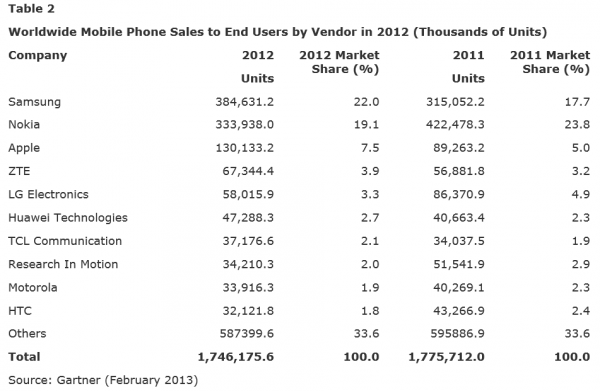
    For all we’ve heard about the “mobile revolution,” in recent years, it may surprise you to learn that mobile phone sales actually shrank in 2012. Gartner reports that total handset sales totaled 1.75 billion units in 2012, a slight drop from the 1.77 billion handsets sold in 2011. Although this may seem puzzling, the reason for this decline becomes clear once Gartner breaks down handset sales by vendors and shows that Nokia (NOK) and LG (066570) are primarily to blame. Overall, Nokia sold 334 million phones in 2012, a 21% decline from the 422 million phones it sold in 2011, while LG sold 58 million mobile phones in 2012, a 33% decline from the 86.4 million it sold in 2011.

    Continue reading…

  • Disagreements on the TED stage: Speaker debates over the years

    Debate-mainTED2013 kicks off in just 11 days and, in the very first session, will be a lively debate between Robert J. Gordon and Erik Brynjolfsson. While Gordon will talk about how our current ecosystem of innovation is too focused on gadgetry, and thus isn’t enough to solve the big problems of the future, Brynjolfsson will share how the digital revolution is propelling us forward rapidly. It’s shaping up to be a fascinating discussion — one that may well change your mind.

    This will hardly be the first time that two TED speakers have verbally jousted oon the TED stage. Here, sets of TED speakers who have disagreed — either in an official debate or in separate talks — to give you a taste of what to expect at TED2013, where the TED Blog will be reporting live every second.

    Paul Zak vs. Molly Crockett: Is oxytocin the moral molecule?

    In these two talks given a year apart, neuroscience experts Paul Zak and Molly Crockett disagree on what we can say about oxytocin.

    Paul Zak: Trust, morality -- and oxytocin?Paul Zak: Trust, morality — and oxytocin?Paul Zak: Trust, morality — and oxytocin?

    Morality is a distinctively human trait and it might be because of the hormone oxytocin. In this talk from TEDGlobal 2011, neuroeconomist Paul shares his 10-year search for what he calls “the moral molecule” and reveals his studies on how oxytocin boosts trustworthiness, empathy and even the desire to give money to charity.
    Molly Crockett: Beware neuro-bunkMolly Crockett: Beware neuro-bunkMolly Crockett: Beware neuro-bunk
    Neuroscientist Molly Crockett wants everyone to spot “neuro-fiction” — claims that overshoot our current understanding of the brain. Crockett evokes Zak’s work with oxytocin. According to Crockett, studies on oxytocin “are scientifically valid and they have been replicated, but they’re not the full story.” She explains, “Other studies have shown that boosting oxytocin increases envy, it increases gloating. Oxytocin can bias people to favor their own group.”

    Peter Diamandis vs. Paul Gilding: What will the future look like?

    Diamandis-debateBecause these two speakers expressed such different views at TED2012, TED Curator Chris Anderson invited the pair onstage for a formal debate.

    Peter Diamandis: Abundance is our future
    At TED2012, activist Peter Diamandis explains that — yes — news reports may sound doomsday, but that we are actually living in the most peaceful and abundant time of human existence. He imagines a future where humans continue to invent and innovate to solve the challenges that face us.
    Paul Gilding: The Earth is full
    Also speaking at TED2012, writer Paul Gilding spoke from a very different viewpoint — saying that humans have not only filled the world with our bodies, waste and things, but that we used up all our resources. He worries that, if we stay on the same path, it could be the end of this civilization.

    Rick Warren vs. Dan Dennett: Do our lives have purpose?

    Dan Dennett couldn’t help but respond directly to Rick Warren at TED2006, after hearing his talk.

    Rick Warren: A life of purposeRick Warren: A life of purpose
    Rick Warren: A life of purpose

    At TED2006, pastor Rick Warren said, “I believe spiritual emptiness is a universal disease.” He explained his belief in God, and how he thinks each one of us is here for a specific purpose that matters, and describes his crisis of purpose in the wake of releasing a best-selling book.
    Dan Dennett: Responding to Pastor Rick WarrenDan Dennett: Responding to Pastor Rick Warren
    Dan Dennett: Responding to Pastor Rick Warren

    Speaking at the same conference, philosopher Dan Dennett suggests that religions are natural phenomenon, evolving over time to survive. Dennett says that life — both ours and that of animals — has been designed by evolution, and lacks an individual purpose.

    Stewart Brand vs. Mark Z. Jacobson: Nuclear energy?

    >

    Before you watch this debate from TED2010, try this experiment: Ask yourself, who do you agree with now? Watch the debate. And then — ask yourself again.

    Stewart Brand: Nuclear energy is our best bet
    During an onstage debate held at TED2010, futurist Stewart Brand explained why he is in favor of nuclear energy — because it is far more feasible on a large scale than either wind or solar power. “If all of your electricity in your lifetime came from nuclear [energy], the waste from that lifetime of electricity would go in a Coke can,” he says.
    Mark Z. Jacobsen: Nuclear energy is short-sighted
    Meanwhile, environmental engineer Mark Z. Jacobsen countered that nuclear power has extreme downsides, producing far more carbon dioxide and air pollution than other alternative energies. To boot, nuclear power plants takes far longer to build, meaning we’ll have to stick with coal power for the foreseeable future. Not to mention that nuclear power could enhance nuclear weapon proliferation.

    Note: This post was originally published on August 6, 2012, and was updated with a new introduction and set of examples on Feb. 13, 2013.

  • There is little room for a third smartphone platform

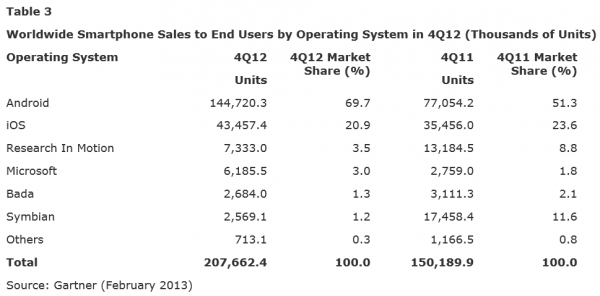
    “We’re No. 3!” will be BlackBerry’s and Microsoft’s rallying cry this year. Android and iOS so dominate the smartphone market, the best — and quite honestly dismal — hope is third; distant at that. Combined, based on actual phone sales, Android and iOS had 90.1 percent share during fourth quarter, up from 74.9 percent a year earlier, according to Gartner. BlackBerry and Windows Phone are neck-and-neck, with lowly 3.5 percent and 3 percent standings, respectively.
    Upstarts want third place, too. Anshul Gupta, Gartner principal research analyst, explains: “2013 will be the year of the rise of the third ecosystem as the battle between the new BlackBerry10 and Widows Phone intensifies. As carriers and vendors feel the pressure of the strong Android’s growth, alternative operating systems such as Tizen, Firefox, Ubuntu and Jolla will try and carve out an opportunity by positioning themselves as profitable alternatives”.

    Looked at differently, BlackBerry and Windows Phone combined-share was less in fourth quarter (6.5 percent) than a year earlier (10.6 percent). That said, while starting from a small base, Microsoft’s platform shows promise, with sales up 124.2 percent year over year.

    Individual vendor performance tells the story differently. Apple and Samsung combined smartphone sales share rose to 52 percent from 46.4 percent during the quarter.

    It’s a free-for-all. “There is no manufacturer that can firmly lay claim to the No. 3 spot in global smartphone sales”, Gupta says. “The success of Apple and Samsung is based on the strength of their brands as much as their actual products. Their direct competitors, including those with comparable products, struggle to achieve the same brand appreciation among consumers, who, in a tough economic environment, go for cheaper products over brand”.

    Samsung and Apple smartphone unit sales rose by 85.3 percent and 22.6 percent, respectively. The fruit-logo company accounts for all iOS, “with Samsung commanding over 42.5 percent of the Android market globally”, Gupta says, “and the next vendor at just 6 percent share. The Android brand is being overshadowed by Samsung’s brand with the Galaxy name nearly a synonym for Android phones in consumers’ mind share”.

    Samsung’s success is mixed for Android as a platform. The South Korean company, and not Google, largely controls customers’ experience via TouchWiz UI and other features. That can further fragment Android. On the other hand, consumers generally identify with uber-brands, like Samsung or Galaxy S III rather than Android 4.2.

    Samsung’s Android lift takes a bite out of Apple. For the second straight quarter, iOS lost smartphone sales share, year over year. Apple’s mobile operating system dropped to 20.9 percent from 23.6 percent during Q4. Meanwhile, Android leaped again, from 51.3 percent to 69.7 percent share. But unit sales jumped more than share suggests: 144.7 million from 77.1 million.

    Unlike most other analyst firms, Gartner measures actual sales to end users, not shipments into the channel. So there is no room for Apple apologists to argue about some disparity between the phone maker’s stated sales and those from others. Like competitors, Apple calls shipments sales. The company reported 47.8 million in Q4. Gartner says actual sales were 43.6 million, or 4.2 million less than the number the company gave last month. So while iPhone 5 still had a big launch quarter, sales missed analyst consensus (50 million) by wider margin.

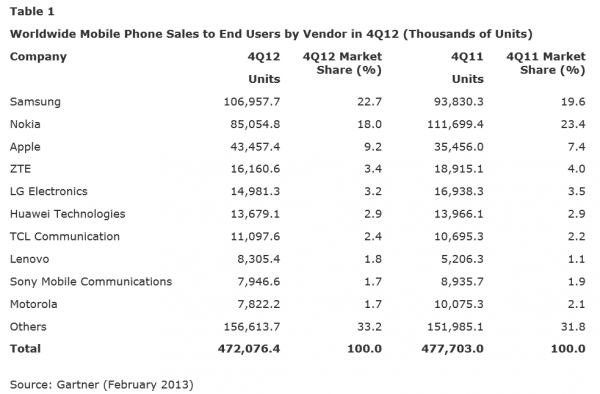
    In the broader phone market, Apple share rose to 9.2 percent from 7.4 percent for the quarter and to 7.5 percent from 5 percent for all 2012. The company maintained its third-place ranking for Q4 and the year. Market-leader Samsung grew share to 22.7 percent from 19.6 percent for fourth quarter and to 22 percent from 17.7 percent for all 2012.

    More broadly, worldwide mobile phone sales dipped about two percent for the quarter and year, to 1.75 billion and 472.1 million, respectively. Smartphone sales surged 38.3 percent in Q4, to 207.7 million. Meanwhile, feature phone sales fell 19 percent to 264.4 million. At this pace, smartphone sales should surpass feature phones within a couple quarters. Respective share in Q4: 44 percent and 56 percent.

    Photo Credit: David Andrew Larsen/Shutterstock

  • Sweden boasts the world’s fastest 4G speeds; US ranks a lowly 8th

    Sweden was the first country to launch an LTE network, and it retains plenty of bragging rights. According to a study by U.K. network-testing firm OpenSignal, Sweden has the fastest 4G networks in the world, averaging download speeds of 22.1 Mbps.

    The U.S. was the second country to deliver commercial LTE networks on the world stage, but it ranks far lower in terms of 4G bandwidth delivered. OpenSignal found that networks in Hong Kong, Denmark, Canada, Australia, South Korea and Germany all performed better. The U.S. placed eighth, averaging downlink speeds of 9.6 Mbps.

    OpenSignal global LTE speeds

    Why the low scores? It probably has to do with the configuration of U.S. carriers’ networks. While most operators around the world secured 40 MHz of spectrum with which to launch their new 4G networks, U.S. carriers have been working with smaller swatches of airwaves. Verizon and AT&T are using 20 MHz for their initial rollouts, while Sprint and MetroPCS are dealing with as little as 10 MHz. If you’re working with half the spectrum, your connections will sport half the bandwidth.

    Based in both London and Laguna Hills, Calif., OpenSignal collects its data through crowdsourcing, aggregating measurements recorded by millions of smartphones users who have downloaded its free Android app. There are a lot of similarities between the OpenSignal and Seattle’s RootMetrics. Root supplements its smartphone data with professional testing (see our video on one such drive test in Chicago), while OpenSignal relies entirely on crowdsourcing, but both have started generating very detailed maps of cellular network coverage and performance in different areas of the world. OpenSignal recently expanded its scope to encompass Wi-Fi.

    What’s particularly noteworthy about OpenSignal’s latest report is just how far LTE has penetrated around the world in the last two years. OpenSignal tracked LTE signals in 62 countries, including multiple African countries and in the central Asian nations of Uzbekistan and Kyrgyzstan.

    LTE image courtesy of Shutterstock user Inq

    Related research and analysis from GigaOM Pro:
    Subscriber content. Sign up for a free trial.

  • Search as Twitter historical archive? More like Twitter’s greatest hits

    Between downloading the archive of all your tweets ever and entering search queries to bring up more-than-a-few-days-old tweets, it would seem like the world, or the historical twittersphere at least, is your oyster. But in reality? It’s a little more complicated, and a little less complete than that.

    Twitter announced last week that historical tweets would now be included in search archives, whereas in the past only tweets from the last few days would appear in results. Twitter has been unfolding its search ambitions over the past year, figuring out how to surface relevant information in a search product that for a long time, hasn’t been all that relevant.

    “Now we’re able to look back at old tweets and think about how they should look and how people can relive past moments on Twitter,” said Sam Luckenbill, a senior engineering manager in charge of search at Twitter. “So you can find specific events in the past that weren’t previously available.”

    Most of the company’s opportunities in search lie with real-time search, since companies like Oreo want to take advantage of current trends, like the Super Bowl, rather than old news, and Twitter’s clearly betting on the service’s value as a second screen to television with the Bluefin acquisition. But a more complete, historical search provides serious opportunities for the company around monetization (marketers can purchase promoted tweets for specific search terms) and intent (knowing that someone is looking certain information is more valuable than passively viewing something, even if you obviously intended to follow that brand or person.)

    But even as the company is now including historical tweets in search results, it’s not all tweets ever that you can uncover — it’s really only a small percentage. The company has worked to develop an algorithm that will figure out which are the most interesting tweets that people would want to revisit, and then ranks those higher than potentially less interesting tweets.

    While the company naturally wouldn’t disclose exactly how the algorithm was put together, they said Twitter is attempting to figure out both the most relevant tweets for a specific person and search term (so likely based on your interest and friend graph) and the most engaging tweets overall (which could be reasonably understood as those with lots of retweets, replies, etc.)

    “You’ll see tweets from people you care about about and topics that you care about even if the word you chose was a bit vague,” Luckenbill said.

    And the filtering doesn’t just apply to tweets that come up in your specific search results — it goes for the tweets Twitter chooses to make available to all searchers as well.

    “We’ve started with a small percentage of tweets, looking at the ones that have been engaged with most. And then we plan to steadily increase the size of the index over time to capture more and more,” Luckenbill said. “We’re going to make more and more tweets available that are older, but it’s not necessarily that we want all the tweets ever to be in the index. Because we don’t want to put tweets that get no engagement ever in the index.”

    Related research and analysis from GigaOM Pro:
    Subscriber content. Sign up for a free trial.

  • Microsoft now sees the Xbox as an ‘entertainment’ console that’s not limited to gaming

    Microsoft Xbox Entertainment
    There’s no doubt that the Xbox 360 is one of the best things Microsoft (MSFT) has going for itself right now — not only has the popular console sold 76 million units, but it’s rapidly moved beyond the gaming sphere to become a well-rounded entertainment center thanks to popular content streaming apps for Netflix (NFLX) and Hulu. Per Engadget, Microsoft Interactive Entertainment Business senior vice president Yusuf Mehdi told the D: Dive Into Media conference on Tuesday that Microsoft really doesn’t see the Xbox as a mere gaming console anymore and now views it as a comprehensive “entertainment console.” And what’s more, Mehdi said that this gives Microsoft a big long-run advantage over Sony’s (SNE) rival PlayStation console since it “isn’t as good of an entertainment console” as the Xbox. It will be very interesting to see how much Microsoft plays up the “entertainment console” aspect when it launches its Xbox 720 later this year and if the company plans to add any features to the device to improve its appeal as a living room hub.