Blog

  • CD Projekt RED Talks Up The Witcher 3: Wild Hunt

    RPG fans everywhere thanked their respective deities when CD Projekt RED announced last week that it would be finishing up Geralt of Rivia’s story in The Witcher 3: Wild Hunt. Now the developers are beginning to divulge details on what next game will bring to the table, and the lessons learned from The Witcher 2.

    As part of being Game Informer’s cover story for this month, the game’s director and lead quest designer sat down with the magazine to talk about The Witcher 3. The seven minute interview comes at you fast with a lot of information that makes The Witcher 3 sound like it’s going to be one hell of a game when it releases on PC and next-gen consoles next year.

  • Dish Holds a Wake For TV Commercials, Launches the “Hopper” Nationwide

    Dish today announced that its “Hopper” DVR with Sling is now available for all customers in the U.S.

    While other DVRs allow TV watchers to fast-forward through annoying ads, the Hopper “autohop” feature allows Dish customers to skip entire commercial breaks with the press of a button. This doesn’t sit well with content creators, and both Fox and CBS have filed lawsuits against Dish due to the technology. CBS went so far as to prevent its website CNET from declaring the Hopper best in show at this year’s Consumer Electronics Show (CES).

    In a satiric bit of irony, Dish has also launched a TV commercial ad campaign that declares the death of TV commercials. In the first commercial, seen below, Dish says goodbye to both commercials and its “Boston Guys.”

    “These lovable characters from Boston helped put the first generation of the ‘Hawpah’ on the map and made nearly three out of four consumers aware of the Hopper,” said James Moorhead, chief marketing officer at Dish. “This campaign takes the Boston family out of the house to show the world that only Hopper with Sling can provide a truly unique entertainment experience.”

  • UCLA study shows promise, offers hope for brain hemorrhage patients

    A new endoscopic surgical procedure has been shown to be safer and to result in better outcomes than the current standard medical treatment for patients who suffer strokes as a result of brain hemorrhages, UCLA neurosurgeons have announced.
     
    The findings from their potentially groundbreaking, randomized, controlled phase 2 clinical trial, which was conducted at multiple medical centers, were presented last week at the International Stroke Conference in Honolulu.
     
    “These exciting results offer a glimmer of hope for a condition that most doctors have traditionally considered hopeless,” said principal investigator Dr. Paul Vespa, professor of neurosurgery at the David Geffen School of Medicine at UCLA and director of the neurocritical care program at Ronald Reagan UCLA Medical Center. “That is a big deal in medicine.”
     
    Stroke is the leading cause of death and long-term disability in America. During a stroke, bleeding becomes toxic and deadly in the brain. Brain hemorrhage that causes stroke is a devastating, critical condition with a mortality rate of 75 percent. If a patient manages to survive, he or she could face a life of severe disability. Nearly 800,000 Americans suffer strokes each year. 
     
    In the past, brain surgery to treat such hemorrhages involved making a large incision to remove the blood. But this method traumatized the brain and failed to improve patients’ quality of life. As a result, open surgery is uncommon for bleeding in the brain.
     
    The new study, led by Vespa and Dr. Neil Martin, chair of neurosurgery at the David Geffen School of Medicine at UCLA, in conjunction with Johns Hopkins University, set out to determine the safety and effectiveness of removing blood using a “keyhole” incision — smaller than the size of a dime — with the aid of an endoscope.
     
    During the procedure, the endoscope, a tiny probe with a light and video camera on the tip, is used to navigate with GPS-like precision. The image-guided system displays CT scans of the brain on video monitors, allowing surgeons to immediately pinpoint and remove the blood.
     
    “Endoscopic surgery has the key advantage of getting the blood out all at once, immediately alleviating the pressure on the brain and setting the stage for ultimate recovery,” Martin said.
     
    Based on the study findings, the procedure appears to be safe, with no further bleeding or harm to the patient. On average, 71 percent of the blood was immediately removed.
     
    The procedure was performed at seven major medical centers with 24 enrolled patients. Eighteen of the patients underwent the endoscopic surgery while six received standard medical treatment. Six months after the operation, endoscopic surgery patients were found to have better neurological outcomes and lower mortality rates than patients in the second group.
     
    The team of neurosurgeons at UCLA determined that the procedure, known fully as intraoperative CT scan–guided endoscopic surgery, or ICES, appears to be a safe and potentially helpful surgical procedure for brain hemorrhage, and it will continue to be investigated in a more definitive clinical trial in the near future.
     
    The UCLA Department of Neurosurgery is committed to providing the most comprehensive patient care through innovative clinical programs in minimally invasive brain and spinal surgery; neuroendoscopy; neuro-oncology for adult and pediatric brain tumors; cerebrovascular surgery; stereotactic radiosurgery for brain and spinal disorders; surgery for movement disorders such as Parkinson’s disease; and epilepsy surgery. For 21 consecutive years, the department has been ranked among the top neurosurgery programs in the nation by U.S. News & World Report, including No. 1 in Los Angeles and No. 2 on the West Coast.
     
    For more news, visit the UCLA Newsroom and follow us on Twitter.

  • Tips On Building A Better Web Site From The Pros

    On February 9, developers from all over the world converged on London for the Edge Conference. The show hosted a number of talks, featuring developers from Facebook, Google, Mozilla and more. The focus was on Web technologies and how to take advantage of these new tools to increase performance on Web sites.

    While there were seven talks at this year’s Edge Conference, Google has only gotten around to uploading the first three. These are all important issues, however, and Web developers would be wise to check them out. You might even learn a few new things on how to make your Web site faster, more stable and more accessible.

  • 10 fun facts about Vancouver and Whistler

    Whistler

    Whistler is the perfect locale for the movers and shakers of TEDActive 2014.

    TED is ready to learn every word to “O Canada.” For TED2014 — our 30th anniversary spectacular themed “The Next Chapter” — we are moving our annual West Coast conference to Vancouver, Canada. There, we’ll enjoy sweeping views of the harbor and North Shore Mountains, a theater custom-built to maximize the impact of talks and the return of 100 beloved TED speakers from the past. While TED2014 takes place in this spectacular city, TEDActive 2014 will be just 90 minutes away in the gorgeous ski resort of Whistler, pictured above.

    With registration just opened for TED2014 and TEDActive 2014, here are some fun facts about Vancouver and Whistler to get you in the British Columbian spirit.

    Vancouver is Canada’s third largest metropolitan area, with a population of 2.3 million. It is also one of Canada’s most diverse cities — 53% of residents do not speak English as their first language. [StatCan]

    Originally known as Gastown, Vancouver sprouted up around the Hastings Mill sawmill and tavern, established in 1867. Twenty years later, the city was incorporated and named after Captain George Vancouver, of the British Royal Navy, who explored the Pacific Northwest, Hawaii and Australia. [Wikipedia]

    Some bands and musicians who’ve called Vancouver home: The New Pornographers, Tegan and Sara, Kid Koala, Bryan Adams, Sarah McLachlan, Heart and Michael Bublé. [Wikipedia]

    Stanley Park, Vancouver’s largest, is 1001 acres—making it 10% bigger than New York City’s Central Park. [Canadian Geographic]

    Vancouver is sometimes referred to as Hollywood North. It is second to Los Angeles in television production and third behind New York and Los Angeles in film production. 21 Jump Street, Fringe, The L Word, Smallville, Hellcats, Battlestar Gallactica, MacGyver, and The X-Files were all filmed there. [Wikipedia]

    In 1971, Greenpeace was established in Vancouver, and the city has its sights set on becoming the world’s greenest city by 2020. [Vancouver.ca]

    Whistler Mountain was once known as London Mountain because of the fog at its base. The name Whistler was inspired by the unique noises made by the hoary marmot, which make their home there. [Whistler’s Base]

    Now visited by more than 2 million annually, Whistler was basically undeveloped until the 1960s. Whistler Mountain opened in 1966 with an eye toward a bid for the 1968 Winter Olympic Games. [Wikipedia]

    Currently, Whistler gets an average of 469 inches of snow a year. [Whistler.com]

    When Vancouver hosted the Winter Olympics in 2010, more than 2,800 athletes were housed at the Olympic Village at Whistler. In that Olympics, Canada set the record for most gold medals won by a country in a single Winter Olympic games — an honor held by the Soviet Union since 1976 and only matched by Norway in 2002. [Wikipedia]

    Vancouver

    The view from the roof of the Vancouver Convention Centre, where TED2014 will be held.

  • Apple CEO Tim Cook is Michelle Obama’s Guest at Tuesday’s State of the Union

    It’s going to be another Apple-heavy FLOTUS box at Tuesday night’s State of the Union address.

    First Lady Michelle Obama will be welcoming Apple CEO Tim Cook as one of her guests at the SOTU. According to the White House, Cook will be accompanied by “military families, those championing immigration reform and those whose lives have been touched by gun violence.”

    Also sitting with Mrs. Obama tomorrow night: Bobak Ferdowsi, better known as the “Mohawk Guy” from NASA that gained an internet following after the Mars Curiosity rover landed successfully on the Martian surface.

    This is the second year in a row that Michelle Obama has tapped someone associated with Apple to be her guest at the SOTU. Last year, her featured guest was Laurene Powell Jobs, widow of Apple co-founder Steve Jobs.

    It’ll be interesting to see just how far the First Lady and Tim Cook are seated from Ted Nugent.

    [via Mercury News]

  • Slender: The Arrival Beta Begins, Pre-Orders Available

    Last year a small indie game called Slender: The Eight Pages terrified gamers and inspired countless YouTube play-through videos. Since then, the developers of Slender have been working to expand upon the game and give it the attention it deserves.

    Today, Blue Isle Studios announced that Slender: The Arrival will be released on March 26. The game is now available for pre-order. The price for pre-orders is only $5 – half the price of what the finished retail game will cost – and all pre-orders come with instant access to the beta version of the game. The game’s developers have some Kickstarter-like pricing options available as well. A $15 version of the game also comes with a soundtrack, and a $25 version throws in downloadable paintings. The $60 “Producer’s Edition” includes a thank-you in the game’s credits.

    The Arrival is similar to the first game, but includes more levels and content not seen in The Eight Pages. Players will complete objectives while doing their best not to look at the slender man lurking right behind them.

  • Google Play now sells Orb wireless charger, but WHY?

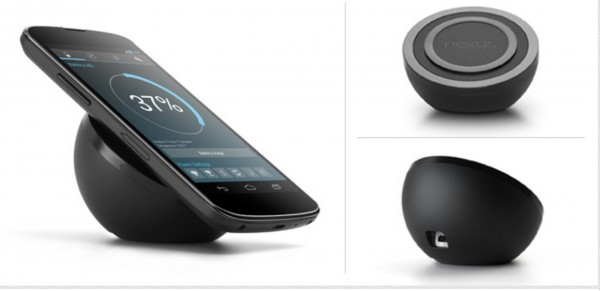
    If you really want to part with $59.99 (plus shipping and tax), the long-anticipated Orb is for sale. Timing coincides with fairly consistent Nexus 4 availability (about time for that) from Google Play. Forgive my total lack of enthusiasm. Gimme a Nexus 10 dock or something else useful rather than just geek.

    My wife and I both now own Nexus 4, but neither of us pines for Orb. One of the phone’s features (I wouldn’t say benefits) is wireless charging. You slap the handset down on the half-sphere, which juices the battery in Stargate Universe-like fashion. I’ve got a chord for that, free with the phone, that charges faster than the four fraking hours Google claims for Orb. That said, there is something Star Trek-cool about using the phone round and about, while charging, without actually being plugged in.

    But real retailers know the big money is in add-ons, and little extras like Orb are sure to sell. But there are peripherals that are cool or geeky and ones you really need. Take the aforementioned Nexus 10 dock, which Google teased in a holiday video. I could use one of those.

    I ordered the official Nexus 7 dock from Adorama Camera for 40 bucks on January 29 (N10 is still MIA). UPS tracking shows delivery on February 12. Now that is an add-on I can use, and judging from the chatter across forums and social networks, that sentiment is shared by many. But, whoa, not from Google Play.

    I’m spending the month using Microsoft’s Surface Pro, which I like way more than expected. But apps just aren’t all there. The group chat service BetaNews uses is MIA in Windows Store and the browser version, like some other products, disconnects when switching IE10 tabs. There’s an Android app, and Nexus 7 is fast-typing for me. Also, I can bang out email replies or social network posts on the little tablet faster than any other device, including a laptop.

    Gotta ask: If a Nexus 4 owner, are you buying Orb? Please explain why or why not.

  • Registration is open for TED2014 and TEDActive 2014: The Next Chapter

    TED2014 graphic

    We’re thrilled to announce the opening of registration for TED2014: The Next Chapter. It’s TED’s 30th anniversary, and we’ll be seeking to understand the most significant developments of the past 30 years … and applying that knowledge to understand what’s ahead. The theme makes it easy for us to reach out to the world’s greatest minds and challenge them to help shape a program better than any in our history — in an unforgettable custom theater designed for talks. Come to Vancouver to help celebrate “The Next Chapter.”

    TED2014 happens March 17-21, 2014, in Vancouver, Canada, with TEDActive at the same time in nearby Whistler, BC, Canada. A pass to TED2014 is $7,500, and TEDActive is $3,750. Learn more about additional membership levels.

    How do you attend a TED? It starts here: Apply to attend. For both TED in Vancouver and TEDActive in Whistler, we’re assembling an audience that is engaged, passionate and diverse. All applications to attend received by March 1, 2013, will be evaluated with equal consideration. (We expect to be oversubscribed for Standard registrations for Vancouver.)

    Learn more about TED2014: The Next Chapter »

  • Google Reader Not Working For A Bunch Of People

    I couldn’t help but notice that Google Reader has been acting very weird, but now I know it’s not just me, as numerous people have been complaining about it, and several publications are now reporting on the issue.

    There’s a Google Group thread here, where people are complaining. It was started on Sunday, when user applmak wrote:

    Reader is unable to display the canonical list of unread posts to me. When I load the page, I see:

    – A shortened list of only a few unread posts (according to the total on the ‘All Items’ filter)
    – A far greater number, but a truncated post list
    – The same number, but filled with old posts
    – The correct list of posts & count.

    The biggest thing I’ve noticed has simply been read items appearing as unread.

    Google’s Matti Nescio chimed in in the thread to say that the Google Reader team has been notified of the issue, and that “someone will be looking into this.”

    It appears that some have been experiencing issues for even longer (as in earlier last week). I used it quite a bit over the weekend, and didn’t notice any issues until this morning.

    TechCrunch is saying, “The GoogleReaderpocalypse is upon us.” I’m not sure it’s as dramatic as that (at least I hope not). The piece suggests that Google doesn’t care much about this product anymore, as it has turned its focus to other things like Google+, despite a continued, solid user base (whose real size can only be speculated upon).

    It is true that Google has done little with Google Reader in recent memory, though I’d say it doesn’t really need much in the way of changes. Hopefully (and I’m sure many would agree) Google isn’t planning on shutting he service down in its next “spring cleaning” announcement.

    Google did add Google Reader to the Google Takeout menu a few months ago. I hope that’s not a sign.

  • Star Wars: The Old Republic “Relics of the Gree” Event Teased in New Video

    Last April, the Star Wars: The Old Republic MMO held its first live in-game event. The Rakghoul Plague event, as it was called, had players running around Tatooine and infecting each other with a deadly plague.

    Of course, that was before it became clear that the game was hemorrhaging subscribers, before the massive layoffs that hit Bioware Austin, and before the game embraced the free-to-play business model.

    This year’s in-game event begins tomorrow, February 12 and lasts until February 26. Titled “Relics of the Gree,” the event will task players with uncovering the mystery of an advanced Gree ship that has appeared in orbit around the planet Ilum. Bioware has described the event as one that will be “recurring” throughout the rest of 2013.

    The new teaser trailer for the content shows plenty of space slugs and a giant wampa for players to slay.

  • Bill Gates Wants You to Bing It On. Seriously.

    Bill Gates has just finished up his first-ever reddit AMA, answering users’ questions for just under one hour. Among the topics of discussion included Microsoft, coding, his wealth, the Bill & Melinda Gates Foundation, vaccines, and yes, Bing.

    Replying to question “Do you guys really use Bing? I mean seriously?” Gates had this to say:

    Seriously Bing is the better product at this point. Try the challenge. I am biased but the work to make Bing better has been amazing.

    So there you have it, folks. Bill Gates thinks you should take the Bing challenge.

    Among the other interest answers given by Gates…

    Since becoming wealthy, what’s the cheapest thing that gives you the most pleasure?

    Kids. Cheap cheeseburgers. Open Course Ware courses…

    What one Microsoft program or product that was never fully developed or released do you wish had made it to market?

    We had a rich database as the client/cloud store that was part of a Windows release that was before its time. This is an idea that will remerge since your cloud store will be rich with schema rather than just a bunch of files and the client will be a partial replica of it with rich schema understanding. (WinFS)

    Can you still jump over chairs?

    Less than I used to. It was part of exercise for snow skiing. I still ski but I am not as hard core…

    How was your relationship with Steve jobs? I always hoped that y’all were really good friends and competitors.

    He and I respected each other. Our biggest joint project was the Mac where Microsoft had more people on the project than Apple did as we wrote a lot of applications. I saw Steve regularly over the years including spending an afternoon with him a few months before he tragically passed away…

    What emerging technology today do you think will cause another big stir for the average consumer in the same way that the home computer did years ago?

    Robots, pervasive screens, speech interaction will all change the way we look at “computers”. Once seeing, hearing, and reading (including handwriting) work very well you will interact in new ways..

    Head here for to read the whole Q&A session.

  • Next Xbox Requires Kinect, Will Always Be Watching You [Rumor]

    Microsoft caused a small panic a while back when it patented a method that would allow it to determine how many people were in a room at any given time. It would presumably use the Kinect camera to block movies from playing if more people were present than what the film license allowed. It’s super creepy, and it may just show up in the next Xbox.

    Kotaku scrounged up some more details on the next Xbox from the guy who tried to sell a Durango development kit last year. He reveals more fascinating details on the console, including the above patent being put to use in the latest Kinect hardware.

    The latest round of rumors confirm once again that Microsoft will be shipping Kinect as a standard peripheral with the next Xbox. The hardware has also been greatly improved to feature better tracking, and can now detect up to six people at once. Better hardware is always good, but Microsoft may be taking Kinect into dangerous territory with its next iteration.

    The rumors claim that the next Xbox won’t even operate unless the Kinect hardware is plugged in and calibrated. The camera will also always be watching you as it’s on to perhaps implement the aforementioned patent, or provide some new gameplay innovation that we can’t even fathom yet. The new Kinect will also reportedly be able to track individual finger movements and detect facial expressions which makes it even creepier.

    Getting away from Kinect, the rumors also reveal that the next Xbox will require every game to be installed on the console’s 500GB HDD. It’s a nice step up from the 20GB HDD the original Xbox 360 launched with, but it has the potential to quickly fill due to next-gen Xbox games shipping on dual-layer Blu-ray discs.

    The most interesting part about this particular rumor, however, is how the games will install. Unlike the current Xbox 360, you won’t have to wait for the game to install before you start playing. The console can immediately start playing the game while installing it in the background. That’s an incredibly useful feature and will hopefully be present across both the next Xbox and the PS4.

    The rumors also address the new controller and how the next Xbox will handle multi-tasking. First, the controller will be a “natural evolution” of the Xbox 360′s celebrated gamepad, but you won’t be able to use the Xbox 360′s gamepad on the new console as Microsoft is using a new proprietary wireless technology.

    As for multitasking, the console can pause a game and let a user access social media or other content while the game remains paused. Users can also suspend games, save their progress in local memory, and jump into a second game without having to actually save within the title. Such functionality has been sorely lacking in current generation consoles, and will hopefully be standard across Microsoft’s and Sony’s machines.

    Finally, the specs released by this newest source match up with the specs released by VGLeaks a few weeks ago. The next Xbox will feature an eight core CPU clocked at 1.6GHz, 8GB of RAM, a D3D11 capable GPU clocked at 800MHz, and built in Wi-Fi.

    It’s important to note that most, if not all of this, is purely rumor for now. The source seems legitimate, but it could all turn out to be bunk. If this is true, however, I fear for Microsoft’s next-generation console. The requirement of Kinect always being on combined with an anti-used game online DRM solution would make the next Xbox a very anti-consumer device that would deservedly be trounced at retail.

    For all our sake, let’s hope the next Xbox keeps the upgraded specs, but ditches the anti-consumer Orwellian tech.

  • PhotoSketcher 2.4.0 supports Windows 8

    Lyon programmer David Thoiron has released FotoSketcher 2.40, a major update to his freeware Windows app for quickly converting photos into works of art with just a few clicks. Version 2.40 debuts an improved user interface, new scripting engine for creating multiple effects and official support for Windows 8.

    FotoSketcher 2.40, also available as a portable build, allows users to import JPEG, PNG and BMP files and – using a simple Drawing Parameters dialog – convert them into different artistic styles, from pencil sketches to full-blown watercolor and oil paintings.

    Version 2.40 debuts a revamped user interface, which includes reorganized menus, new menu icons and no third-party code. It also comes with a brand new script engine – invoked via the [F5] key – that can be used to automatically apply multiple effects to a single image without having to learn any lines of code. The user simply sets up an effect, adds it to the scripting list, then moves on to the next effect or tweak.

    FotoSketcher 2.40’s image merge function has also been made more powerful, with the addition of support for multiplication of both source and target images. DPI support has also been extended to the JPEG file format.

    Users can now save pictures during processing, while the app promises better directory management through keeping track of directories chosen for opening, saving and selecting manual brushes. FotoSketcher 2.40 should also now automatically save the last texture, text and frame parameters used, although Windows 7 and 8 users may have to run FotoSketcher with administrator privileges for this function to work.

    The update is rounded off with official support for Windows 8, new translated terms for the script functions and various unspecified minor tweaks and bug fixes. FotoSketcher 2.40 and FotoSketcher 2.40 Portable are both available as freeware downloads for PCs running Windows XP or later.

    Photo Credit: Picsfive/Shutterstock

  • Lil Wayne Ejected From Game, Tweets Hatred For Heat

    Rapper Lil Wayne claims he was ejected from a Miami Heat game on Sunday night and tweeted about the incident, saying all he was doing was rooting for the Lakers when he was asked to leave by police.

    But a fellow b-ball fan sitting nearby says that Lil Wayne was asked to leave because he made a gun gesture at someone in the crowd, tweeting, “Random guy yelled at Lil Wayne at #MiamiHeat game. Weezy looked back, gave him a mean stare & gestured he had a gun.”

    Wayne has had issues at sports venues before; in June of last year, he took to Twitter to complain he was denied entrance to a Thunder game. Officials said it was only because he tried to enter without a ticket.

  • Accidental Empires, Part 6 — The Airport Kid (Chapter 1c)

    Sixth in a series. Serialization of Robert X. Cringely’s classic Accidental Empires makes an unexpected analogy.

    The Airport Kid was what they called a boy who ran errands and did odd jobs around a landing field in exchange for airplane rides and the distant prospect of learning to fly. From Lindbergh’s day on, every landing strip anywhere in America had such a kid, sometimes several, who’d caught on to the wonder of flight and wasn’t about to let go.

    Technologies usually fade in popularity as they are replaced by new ways of doing things, so the lure of flight must have been awesome, because the airport kids stuck around America for generations. They finally disappeared in the 1970s, killed not by a transcendant technology but by the dismal economics of flight.

    The numbers said that unless all of us were airport kids, there would not be economies of scale to make flying cheap enough for any of us. The kids would never own their means of flight. Rather than live and work in the sky, they could only hope for an occasional visit. It was the final understanding of this truth that killed their dream.

    When I came to California in 1977, I literally bumped into the Silicon Valley equivalent of the airport kids. They were teenagers, mad for digital electronics and the idea of building their own computers. We met diving through dumpsters behind electronics factories in Palo Alto and Mountain View, looking for usable components in the trash.

    But where the airport kids had drawn pictures of airplanes in their school notebooks and dreamed of learning to fly, these new kids in California actually built their simple computers and taught themselves to program. In many ways, their task was easier, since they lived in the shadow of Hewlett-Packard and the semiconductor companies that were rapidly filling what had come to be called Silicon Valley. Their parents often worked in the electronics industry and recognized its value. And unlike flying, the world of microcomputing did not require a license.

    Today there are 45 million personal computers in America. Those dumpster kids are grown and occupy important positions in computer and software companies worth billions of dollars. Unlike the long-gone airport kids, these computer kids came to control the means of producing their dreams. They found a way to turn us all into computer kids by lowering the cost and increasing the value of entry to the point where microcomputers today affect all of our lives. And in doing so, they created an industry unlike any other.

    This book is about that industry. It is not a history of the personal computer but rather all the parts of a history needed to understand how the industry functions, to put it in some context from which knowledge can be drawn. My job is to explain how this little part of the world really works. Historians have a harder job because they can be faulted for what is left out; explainers like me can get away with printing only the juicy parts.

    Juice is my business. I write a weekly gossip column in InfoWorld, a personal computer newspaper. Think for a moment about what a bizarre concept that is—an industrial gossip column. Rumors and gossip become institutionalized in cultures that are in constant flux. Politics, financial markets, the entertainment industry, and the personal computer business live by rumors. But for gossip to play a role in a culture, it must both serve a useful function and have an audience that sees value in participation — in originating or spreading the rumor. Readers must feel they have a personal connection — whether it is to a stock price, Madonna’s marital situation, or the impending introduction of a new personal computer.

    And who am I to sit in judgment this way on an entire industry?

    I’m a failure, of course.

    It takes a failure — someone who is not quite clever enough to succeed or to be considered a threat — to gain access to the heart of any competitive, ego-driven industry. This is a business that won’t brook rivals but absolutely demands an audience. I am that audience. I can program (poorly) in four computer languages, though all the computer world seems to care about anymore is a language called C. I have made hardware devices that almost worked. I qualify as the ideal informed audience for all those fragile geniuses who want their greatness to be understood and acknowledged.

    About thirty times a week, the second phone on my desk rings. At the other end of that line, or at the sending station of an electronic mail message, or sometimes even on the stamp-licking end of a letter sent through the U.S. mail is a type of person literally unknown outside America. He — for the callers are nearly always male — is an engineer or programmer from a personal computer manufacturer or a software publisher. His purpose in calling is to share with me and with my 500,000 weekly readers the confidential product plans, successes, and failures of his company. Specifications, diagrams, parts lists, performance benchmarks — even computer programs — arrive regularly, invariably at the risk of somebody’s job. One day it’s a disgruntled Apple Computer old-timer, calling to bitch about the current management and by-the-way reveal the company’s product plans for the next year. The next day it’s a programmer from IBM’s lab in Austin, Texas, calling to complain about an internal rivalry with another IBM lab in England and in the process telling all sorts of confidential information.

    What’s at work here is the principle that companies lie, bosses lie, but engineers are generally incapable of lying. If they lied, how could the many complex parts of a computer or a software application be expected to actually work together?

    “Yeah, I know I said wire Y-21 would be 12 volts DC, but, heck, I lied”.

    Nope, it wouldn’t work.

    Most engineers won’t even tolerate it when others in their companies lie, which is why I get so many calls from embarrassed or enraged techies undertaking what they view as damage control but their companies probably see as sabotage.

    The smartest companies, of course, hide their engineers, never bringing them out in public, because engineers are not to be trusted:

    Me: “Great computer! But is there any part of it you’d do differently if you could do it over again?”

    Engineer: “Yup, the power supply. Put your hand on it right here. Feel how hot that is? Damn thing’s so overloaded I’m surprised they haven’t been bursting into flames all over the country. I’ve got a fire extinguisher under the table just in case. Oh, I told the company about it, too, but would they listen?”

    I love engineers.

    This sort of thing doesn’t happen in most other U.S. industries, and it never happens in Asia. Chemists don’t call up the offices of Plastics Design Forum to boast about their new, top-secret thermoplastic alloy. The Detroit Free Press doesn’t hear from engineers at Chrysler, telling about the bore and stroke of a new engine or in what car models that engine is likely to appear, and when. But that’s exactly what happens in the personal computer industry.

    Most callers fall into one of three groups. Some are proud of their work but are afraid that the software program or computer system they have designed will be mismarketed or never marketed at all. Others are ashamed of a bad product they have been associated with and want to warn potential purchasers. And a final group talks out of pure defiance of authority.

    All three groups share a common feeling of efficacy: They believe that something can be accomplished by sharing privileged information with the world of microcomputing through me. What they invariably want to accomplish is a change in their company’s course, pushing forward the product that might have been ignored, pulling back the one that was released too soon, or just showing management that it can be defied. In a smokestack industry, this would be like a couple of junior engineers at Ford taking it on themselves to go public with their conviction that next year’s Mustang really ought to have fuel injection.

    That’s not the way change is accomplished at Ford, of course, where the business of business is taken very seriously, change takes place very slowly, and words like ought don’t have a place outside the executive suite, and maybe not even there. Nor is change accomplished this way in the mainframe computer business, which moves at a pace that is glacial, even in comparison to Ford. But in the personal computer industry, where few executives have traditional business backgrounds or training and a totally new generation of products is introduced every eighteen months, workers can become more committed to their creation than to the organization for which they work.

    Outwardly, this lack of organizational loyalty looks bad, but it turns out to be very good. Bad products die early in the marketplace or never appear. Good products are recognized earlier. Change accelerates. And organizations are forced to be more honest. Most especially, everyone involved shares the same understanding of why they are working: to create the product.

    Reprinted with permission

    Photo Credit: San Diego Air and Space Museum Archive

  • Hartsfield-Jackson Airport (ATL) Hits a Million Check-ins on Foursquare (That’s a First)

    Atlanta’s Hartsfield-Jackson International Airport is known as the world’s busiest airport, serving over 250,000 passengers daily and over 900,000 flights in the course of a year. Now, it has another distinction:

    The most popular place on Foursquare.

    Today, Hartsfield-Jackson became the first location (of any type) to ever log 1 million check-ins. As of the writing of this article, Hartsfield-Jackson has 1,001,776 total check-ins from 280,746 different people. Foursquare users have also left nearly 2,500 tips for the airport and uploaded over 7,200 photos.

    In honor of the milestone, Foursquare is sharing some interesting stats about the airport based on its 1 million+ check-ins.

    For instance – Terminal B sees the most traffic, and Mondays is the busiest day to fly. One Flew South is the most popular restaurant inside the airport, and people love to look at a particular collection of Zimbabwean sculptures while they wait.

    Foursquare has also provided a heatmap of check-ins at the airport, no doubt coming from their 500M check-in map project, just launched last month.

    Cool stuff.

    [Photo via]

  • Space Laser Could Detect Counterfeit Foods, Past Life on Mars

    The European Space Agency (ESA) today revealed that a laser developed to measure carbon on Mars could soon be used to detect counterfeit food.

    The device, called a laser isotope ratio-meter, was developed from bulkier laser techniques that needed samples to be collected and brought to them. The new device, developed by the Rutherford Appleton Laboratory (RAL) in England, is small enough that it could be used in space to detect trace gasses in small samples.

    “You take a laser, whose optical frequency or ‘color’ can be continuously adjusted, beam it at a gas sample, and detect the level passing through the gas,” said Damien Weidmann, Laser Spectroscopy Team Leader at RAL Space. “Each molecule, and each of its isotopic forms, has a unique fingerprint spectrum. If, on the other hand, you know what you are looking for, you can simply set the laser to the appropriate frequency.”

    Through an ESA program, Weidmann and his colleagues have been able to demonstrate that the laser can quickly detect counterfeit food. Fake honey made using sugar, for example, would be detected by the laser by scanning the carbon dioxide released from burning only a few milligrams of the product. Likewise, counterfeit olive oil and chocolate could also be detected.

    Though Weidmann said it was important for his project to attract interest from industry, sending the laser to Mars is his real goal.

    “I wanted to develop this to help gather evidence as to whether or not there was life on Mars,” said Weidmann.

    Weidmann stated that using the laser to measure carbon isotopic ratios in methane on Mars could help determine where the hydrocarbon came from.

    “If it’s bacterial in origin, it would mean a form of life occurred on Mars.”

  • Watch The Walking Dead Midseason Premiere Online For Free, Courtesy Of AMC

    On Sunday, AMC aired the midseason premiere of The Walking Dead Season 3. As the network did with the season premiere, it is offering the episode streaming online for free on its site.

    Here’s the link.

    If you’ve already seen the episode, AMC also put out a couple of behind-the-scenes looks at it, as well as a look at next week’s episode.

    If you like to watch the show online, don’t get too excited. They’re only doing this with the first episode. For the rest you’ll have to seek out alternative viewing methods. Amazon charges $1.99 per episode, for example.

    “This is a one-time-only event and will not be happening with future episodes for the rest of this season,” AMC says in a blog post. “Watch it for the first time. Watch it again. Just do so quickly as it will only be available until Sun, Mar. 10.”

    The next episode airs this Sunday at 9:00 PM Eastern on AMC.

    More The Walking Dead fun here.

  • What’s Eating Your Data Plan?

    BlackBerry data plan

    We all love our mobile devices — we bring them with us everywhere from the boardroom to the bathroom. We live, eat, and sleep next to our devices. They are our window to the world – a window we pay to keep open every month. According to a Harris Interactive study published on Time’s Moneyland blog that compares mobile plans to grocery shopping, 21 percent of respondents said they spend more on mobile phone bills every month than they do on groceries! I don’t know about that personally, but what I do know is that most of us would love to be able to do as much as possible on our mobile devices while using less data. Let’s look at a few ways we can make this happen with a few tips for using data more efficiently:

    • Learn to Love Wi-Fi: When we’re on the go, sometimes you just have to jump online using your data plan. The rest of the time, we might be within range of a Wi-Fi hotspot. The Wi-Fi hotspot credentials for work, home, and a couple of local coffee shops are all saved in my BlackBerry Z10 for connecting when I’m there. I also take advantage of these Wi-Fi hotspots when downloading new apps, music, videos or large documents.
    • Know Thy Apps: While we’re talking about apps, a good habit to get into is to know which apps are always running while your device is turned on. Apps that are providing you with real-time notifications can usually be adjusted to update less frequently. Fewer “pings” for new updates equals less data use.
    • Beware the Giant Upload: Those high-resolution pictures you took of your baby going down the slide really should go on Facebook, but remember if you’re on a limited data plan, every megabyte (MB) counts. Wi-Fi is your friend; be aware of what you’re uploading over your mobile network. You can save data by uploading photos when within Wi-Fi range.
    • Use What’s Free: While it still requires you to have a data plan, using BlackBerry Messenger (BBM) to send a message instead of an email or using a messaging app may help you use less data every month. Depending on the size of the messages and the size of your data plan, you could see some serious savings over the course of several hundred BBM messages.

    What are some of the ways you use to save money on your BlackBerry smartphone data plan every month? Do you spend more on your mobile phone bill than groceries? Share your thoughts in the comments.