Blog

  • Reuters – PE Owners Sell Stake in TDC

    The main owners of Danish telecom operator TDC have agreed to sell shares in the company worth about 3.28 billion Danish crowns ($588.67 million) at recent prices, Reuters wrote. NTC Holding – a consortium of investment Apax Partners, the Blackstone Group LP, Kohlberg Kravis Roberts, Permira Advisers and Providence Equity Partners – will sell 80 million shares, or about 10 percent of TDC’s share capital, TDC said in a statement late on Thursday. The former state-owned monopoly operator said it will not receive any of the proceeds of the accelerated offering.

    (Reuters) – The main owners of Danish telecom operator TDC have agreed to sell shares in the company worth about 3.28 billion Danish crowns ($588.67 million) at recent prices.

    NTC Holding – a consortium of investment Apax Partners, the Blackstone Group LP, Kohlberg Kravis Roberts, Permira Advisers and Providence Equity Partners – will sell 80 million shares, or about 10 percent of TDC’s share capital, TDC said in a statement late on Thursday.

    The former state-owned monopoly operator said it will not receive any of the proceeds of the accelerated offering.

    Order books on the sale, for which UBS is acting as bookrunner, are expected to close on Feb. 8.

    NTC bought nearly 89 percent of TDC in the autumn of 2005 and sold 28.8 percent of the stock in one of the biggest share offerings of 2010 for around $2.2 billion.

    NTC has since reduced its stake several times. After the latest sale in November last year they reduced their ownership to 25.9 percent.

    ($1 = 5.5719 Danish crowns) (Reporting by Johan Ahlander)

    The post Reuters – PE Owners Sell Stake in TDC appeared first on peHUB.

  • EM dollar bond investors feeling Treasuries heat

    The recent, steady upward creep in U.S. Treasury yields is starting to have an effect on appetite for high-yield credit, investors’ favourite for over a year.

    Emerging dollar bond funds have suffered capital outflows for the first time since June 2012, waving goodbye to around $300 million in the week to Feb 6, according to EPFR Global, the Boston-based fund tracker.  Global  high-yield bond funds saw net outflows of $1.33 billion, and according to another set of data from JPMorgan, emerging market hard currency ETFs (exchange traded funds)  saw net outflows of $550 million.  JPMorgan notes:

    Amid U.S. Treasury volatility, EM credit has suffered both on total returns as well as fund flows.

    Assets like emerging market debt tend to suffer when Treasury yields, the so-called risk-free rate, rise. Ten-year U.S. yields recently broke over 2 percent for the first time since last April, having risen more than 30 basis points since early December. They have since eased to 1.94 percent but many reckon that signs of economic recovery as well as some inflation fears will lead to a further selloff in Treasuries. JPMorgan for instance expects the 10-year yield to reach 2.25 percent this year.

    Emerging dollar bonds which returned 18.5 percent last year are in the red this year with losses of 1.6 percent while last week alone they lost 0.6 percent, JPM data shows.

    Moves in U.S. Treasuries haven’t entirely soured the emerging markets story, however.  Funds investing in domestic EM bonds, denominated in emerging market currencies, took in $1.3 billion in the past week and year-to-date EM fixed income has received almost $10 billion. And emerging equity funds absorbed a net $3.43 billion in the week to Feb 6, the 22nd consecutive week of net inflows, EPFR notes.

  • Sony details the Android 4.1 Jelly Bean upgrade for Xperia smartphones

    Sony’s Android 4.1 Jelly Bean upgrade for 2012 Xperia smartphones is a long time coming. The Japanese manufacturer announced its plans in mid-October last year, and followed it up with a brief update two months later. Finally, as planned, deployment is set to kick off “this week”.

    The first smartphones to receive the coveted upgrade to the original Jelly Bean iteration are the Xperia T and Xperia, with Xperia TX owners having to wait until next month for the same software treatment. In an attempt to appease impatient users and to drum up some interest, Sony has decided to spill the beans on what Android 4.1 Jelly Bean entails for Xperia users by providing a list of significant changes included in the upgrade.

    One of the most important improvements, carried over from the stock version of Android 4.1 Jelly Bean, is Google Now. The personal assistant delivers contextual cards based on search queries, location or upcoming events and provides Gmail integration as well for flight and hotel confirmations, event and restaurant bookings and packages, among others.

    Sony has revamped the camera interface, which now touts “a more intuitive viewfinder” with auto-scene setting and the option to switch between the two on-board cameras with a single press of a button. Users can search within the application tray to find specific apps, use up to seven homescreens, or take advantage of resizable widgets and expandable notifications. The Japanese manufacturer also includes updated versions of Album and Movies, as well as WALKMAN.

  • Get Aero back in Windows 8

    Windows 8 fans didn’t take Microsoft’s decision to dump the familiar Aero Glass interface lightly. Even though the software corporation has very good reasons for doing so, there are users who are willing to put up with the apparent disadvantages and want to bring the transparency back.

    Microsoft is known for its stance on the matter and it is unlikely that the software giant will be persuaded to bring Aero Glass back in Windows 8 and, therefore, eat its own words about the advantages of the new interface. For this reason, and likely others as well, a developer decided to take matters into his own hands and release a hack that brings back Aero Glass into the Windows 8 Desktop Window Manager.

    The developer, who goes by the userhandle bigmuscle, explains how the simply titled Aero Glass for Win8 works. He says:

    “I have developed DLL library in C++ which is injected into dwm.exe process (no system files replacement is required). Then, the functions used for window border drawing are hooked with my own implementation. This ensures that anytime DWM wants to draw the window border, the code is redirected into my library where I can change the parameters of vertex buffer, blend state and other stuff. Then I redirect back to the original drawing function. Transparent window border is drawn!”

    The implementation used by Aero Glass for Win8 comes with some caveats, as bigmuscle explains:

    “Currently, I implemented only blur effect using Direct2D. My plan is to return glow effect to the window caption, better shadow around the windows, and, if anyone is interested, try to reimplement Flip3D functionality.”

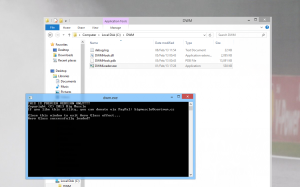
    That said, the hack works and does indeed bring the transparency effects back into Windows 8. Users must extract the provided 7z file into a “DWM” folder within the root of the drive where the operating system is installed, for instance “C:\DWM”, open the “DWMLoader.exe” file and validate any UAC or security software prompts.

    A command prompt window will then open, informing the user that Aero Glass is now enabled. In order to go back to the default Windows 8 interface, the user only has to close the command prompt window. Keep in mind that the hack is currently labeled as a preview build and it may “feature” the occasional bug associated with the early stages of development.

  • Morning Advantage: Is Your Dream Employee Actually a Nightmare?

    So goes the story of Annie Dookhan, one of Boston’s most notorious overachievers. Dookhan, after producing amazing results at a state drug lab for years, is accused of fabricating tests that have left up to 34,000 criminal cases in jeopardy (almost 300 people, many of them drug dealers, have already been released from prison). This past weekend, The Boston Globe’s Sally Jacobs published an in-depth investigation into how the smart chemist was able to dupe her bosses and colleagues for so long. Not surprisingly, she maintained the façade of hard work — being the first one in the office and the last one out, never taking a lunch break — to support her seemingly impossible numbers, which she obtained at least twice as fast as her colleagues. (In 2005, for example, she performed a staggering 11,232 tests; the next closest number from a chemist was 6,053). What’s remarkable is that no one really said anything; she was actually promoted, despite the improbability of her results.

    There are many takeaways from this ongoing case, from recognizing when you’re veering into unethical territory to properly investigating statistical anomalies as a manager. There’s also, of course, the problem of how we define work: just because it seems like someone is pouring everything into a job doesn’t actually mean she’s the best employee. In fact, she could be the worst.

    WITH SUCCESS COMES RESPONSIBILTY

    And Now Let Us Praise, and Consider the Absurd Luck of, Famous Men (The Atlantic)

    It’s tempting to look back on the paths of great innovators — from Bill Gates to Robert Noyce to Mark Zuckerberg — for signs of their superior ingenuity and creativity. That the brilliant decisions they’ve made in response to life events inevitably propelled them into making a mark on the world. But Alexis Madrigal writes, in response to a tweet from Twitter founder Jack Dorsey —”Success is never accidental” — that often it is. Regardless of smarts or work ethic, there are people who run up against frustrations and systems that prevent them from making similar breakthroughs. Madrigal argues that “part of the responsibility of success is to consider the near crashes, the ways the world let you slip by, the mountain of accidents that put you in a certain place at a certain time where you could fly.” People in positions like Dorsey need to “use their power to make similar levels of luck more likely for a wider variety of people.”

    140 CHARACTERS OF CANDOR

    #honestjobdescription (Planet Money)

    Sometimes the most basic questions yield the most insightful responses. The folks over at Planet Money compiled this Storify based on a simple premise: asking people on Twitter to share what they really do for work, hashtagging it in the process. The respondents included everyone from economists (Justin Wolfers: “Write obscure and technically difficult papers that few will read.”) to events planners (“Tell brides on shoestring budgets to rethink the sea bass, gold chairs and six-hour receptions.). It’s a fascinating look at how we understand and communicate our jobs, fancy titles aside.

    BONUS BITS:

    You’ve Got Mail (At All Hours)

    Checking Work Email Outside Of Work Should Count As Overtime, Lawsuit Claims (Huffington Post)
    MIT Builds an Open-Source Platform for Your Body (Fast Company)
    Getting Stuck Can Help You Grow (HBR)

  • Microsoft’s attacks on Google are sad and embarrassing

    After I left school I went into sales. And one of the first things I was taught was this: never disparage the competition. Never say bad things about them — even if what you’re saying is true, or you believe it to be at least — because it makes the firm you’re representing seem petty and small.

    Clearly this is a lesson Microsoft needs to learn. The firm’s marketing department, in particular whoever came up with the Scroogled campaign, is doing its best to turn the Redmond, Wash.-based technology giant into a petty, whining child, complaining about a rival rather than championing its own products. Instead of shouting triumphantly, “Use Outlook.com because it’s great and has all these benefits”, Microsoft is reduced to grumbling, “Don’t use Gmail because it reads your emails”. It’s not an aggressive information campaign as some people have described it. It’s a sad and frankly pathetic strategy.

    I like Microsoft as a company, I like (many of) its products and to see it engaging in these sort of low-level scrappy tactics makes me a little sad. Microsoft is better than that. Or it should be.

    The original Scroogled campaign attacked Google Shopping. Microsoft called out its rival for using a “pay-to-rank” practice that presented users with search results that were neither honest nor fair. The latest Scroogled crusade says people shouldn’t use Gmail because Google goes through users personal emails to sell them ads. When I read that I cringed. It was an old, old issue dredged up in an act that surely resulted in the barrel scraper responsible for it getting a handful of splinters in the process. Sarah Perez at TechCrunch summed it up best for me when she reported the campaign with this opening line: “Hey Microsoft, 2004 called. It wants its privacy outrage debate back”.

    Microsoft’s The Browser You Loved To Hate campaign for Internet Explorer is the opposite of the Scroogled one. It’s clever, funny, pokes fun at the veteran browser and sells the product in the process. It makes you respect Microsoft for acknowledging how people feel about IE, and uses goodwill and positivity to attempt to change public opinion.

    Scroogled is mean-spirited and in the case of the Gmail attack, comes across as desperate.

    What future delights does the Scroogled campaign hold for us I wonder? “Don’t use Android because its ideas and technology are stolen from the iPhone!”, “Don’t use Street View because it’s encouraging Google to look through your living room curtains and leach private data from your Wi-Fi”… Perhaps Microsoft will launch an ad campaign aimed at warning Safari users that Google might have tracked them without their permission and promising Bing won’t do the same thing (oh wait, Microsoft already did that last one).

    Of course Google does bad things from time to time, but Microsoft — hardly the most trustworthy of moral crusaders anyway — isn’t the firm to call them out for it. Leave that to the privacy advocates.

    Instead of attacking Google, Microsoft should finally try to learn from it. Google built (or acquired and polished) products that consumers wanted to use. People switched from AltaVista and other search engines to Google because its site produced the best results. Those same people switched from Hotmail to Gmail because Google had the better email service (and didn’t bombarded users with flashing adverts and spam). Consumers use YouTube because it’s fantastic, and Google Maps, Chrome, Reader, Calendar etc. for the same reasons.

    Sure, Google produces a fair amount of duds, but when it scores a success it’s usually because the product it’s offering is superior to what’s out there and people flock to it.

    I won’t switch to Bing, or Outlook.com full time because they aren’t as good as what I’m getting from Google (I briefly moved to DuckDuckGo for search, but got drawn back to Google as we all are eventually). Scaremongering and the unholy trinity of fear, uncertainty and doubt are unlikely to ever make me switch my search engine or email provider.

    But the promise of a genuinely superior product might.

    Photo Credit: eurobanks/Shutterstock

  • Obituary: Leonard Apt, 90, doctor-scientist who gave gift of vision to millions of children

    Internationally respected UCLA eye surgeon Dr. Leonard Apt, who co-developed an inexpensive antiseptic eye drop that substantially reduced the incidence of blindness in children in developing countries, died Feb. 1 at UCLA Medical Center, Santa Monica, after a brief illness. He was 90.
     
    A founding member of the Jules Stein Eye Institute at UCLA and an emeritus professor of ophthalmology, Apt was the first physician in the world to become board-certified in both pediatrics and ophthalmology. He devoted his career to preventing blindness in children.
     
    Together with longtime collaborator Dr. Sherwin Isenberg, Apt identified povidone–iodine as a safe topical antimicrobial agent. Prior to their research, no previous studies provided a standard for sterilizing the surface of the eye before surgery. Known commercially as Betadine, the eye drop is now used throughout the world to prepare patients for eye surgery and prevent infection. Apt and Isenberg also demonstrated that Betadine was safer, cheaper and more effective than silver nitrate or antibiotics in preventing eye disease in newborns.
     
    “Leonard described himself as ‘a man of firsts,’ and he really was,” said Isenberg, UCLA’s Laraine and David Gerber Professor of Ophthalmology and chief of ophthalmology at Los Angeles County Harbor–UCLA Medical Center. “He had very clever ideas and constantly looked for meaningful ways to improve patient care on a large scale. His prolific research resulted in innovations in pediatrics and ophthalmology that are now used all over the world.”
     
    Born to a wealthy family in Philadelphia on June 28, 1922, Apt entered the University of Pennsylvania at age 14 and graduated with highest honors. After earning his medical degree from Jefferson Medical College in Philadelphia in 1945, he trained in pediatrics at Harvard University and pathology at the University of Cincinnati and completed a National Institutes of Health ophthalmology fellowship at Columbia University.
     
    Apt joined the UCLA faculty in 1961 and founded the first full-time pediatric ophthalmology and strabismus division at a U.S. medical school. He was co-founder and co-director of the UCLA Center to Prevent Childhood Blindness, which ran an extensive preschool vision-screening program.
     
    Over his long and productive career, he invented several diagnostic tests, including the widely used Apt test, which distinguishes between fetal and maternal blood after birth. He was the first to use plastic tubing for blood transfusions, to develop a method for predicting allergy to catgut and collagen sutures prior to surgery, to pinpoint a formula for the eyes’ proper position under anesthesia, and to identify several new diseases.
     
    “Leonard made the world a better place,” said Dr. Bradley Straatsma, a professor emeritus at the Jules Stein Eye Institute who met Apt 50 years ago while a medical resident at Columbia University, where Apt was pursuing an ophthalmology fellowship. “He was a brilliant physician–scientist, a tireless advocate for the eye care of children, a generous philanthropist and a true friend.”
     
    In addition to publishing more than 300 articles that left a major impact on pediatrics and ophthalmology, Apt received many honors and awards, including the American Academy of Pediatrics Lifetime Achievement Award, the UCLA Alumni Association Award for Excellence and the UCLA Dickson Emeritus Professorship Award. To honor him, the American Academy of Pediatrics created an annual lecture that bears his name. In 2010, he was selected National Physician of the Year by Castle Connolly Medical Ltd.
     
    Apt was a passionate UCLA philanthropist and staunch supporter of eye research, the arts, student scholarships, the humanities, college athletics and many other initiatives across campus. He endowed both a chair and a fellowship at UCLA’s Department of Ophthalmology. An ardent Bruins fan, he always had great center-court seats at UCLA basketball games.
     
    “Leonard was a true Renaissance man: a scholar, clinician, educator, scientist, philanthropist, patron of the arts, sports enthusiast and wine connoisseur. His accomplishments and achievements were legendary,” said Dr. Bartley Mondino, director of the Jules Stein Eye Institute at UCLA and chairman of ophthalmology at the David Geffen School of Medicine at UCLA. “On a personal level, he was charming, engaging, humorous and generous.”
     
    Preceded in death by three sisters, Apt is survived by two nephews, Kenneth Rappaport of San Diego and Robert Hersh of Thousand Oaks, Calif. Services were held Feb. 5 in Los Angeles. Donations in his memory may be made to the UCLA Foundation, c/o Gail Summers, Development Office, Jules Stein Eye Institute, 100 Stein Plaza, Room 1-124, Los Angeles, Calif. 90095-7000.
     
    For more news, visit the UCLA Newsroom and follow us on Twitter.

  • Podcast: Ballmer’s in the Dell, do tweets ruin TV? And how ISPs are not like gas pumps

    In this week’s show we delve into the past with news of Dell going private (with Microsoft’s help), peer into the future of TV and Twitter, and examine our present conundrum of how ISPs can’t rely on their meters to measure your broadband usage.

    (Download)

    Subscribe via RSS

    iTunes

    Stitcher Radio

    SHOW NOTES:
    Hosts: Chris Albrecht and Erica Ogg
    Guests: Barb Darrow, Eliza Kern and Stacey Higginbotham

    0:00 – 07:49 – Dell goes private
    07:50 – 19:56 – Twitter buys Bluefin and the future of TV
    19:57 – 32:03 – Bad news about broadband measuring tools

    SELECT PREVIOUS EPISODES:
    Call-in show: BB 10 Data, digital ink on Surface, and consoles v. phone games

    Podcast: Kabam founder on scaling globally and designing for different platforms

    Podcast: Blackberry’s in a jam, no Facebook phone and Netflix’s excellent adventure

    Podcast: RoadMap Re-Run: Kickstarter’s Perry Chen on creativity and crowdsourcing

    Podcast: Do you need a 128 GB iPad? Straight Talk vs. AT&T and Windows RT or Windows 8?

    Facebook’s Graph-ic Search, Open Compute is Kinda Cool, Netflix vs. TWC

    Why Big Data Will Be Even Bigger in 2013

    Related research and analysis from GigaOM Pro:
    Subscriber content. Sign up for a free trial.

  • Need a truly useful dictionary? Try TheSage

    When you need to use a dictionary then the quickest solution is usually to head off online. There are plenty of excellent free services available, and if you’re just looking for a quick definition then they’ll probably do a very good job.


    If you need more, though – more frequent lookups, better searching features, more options and control — then there’s still a case for installing a dictionary application. And TheSage is the perfect example.

    The program is extremely comprehensive, for instance, with 210,000+ definitions (and a thesaurus detailing 1,400,000 relationships between them). It’s free, and unrestricted. And installation is straightforward (there’s even a portable option, if you need it).

    It won’t exactly take long to get started with TheSage, either. Enter a word in the box, click “LookUp” and you’ll get a definition right away. This will include a guide to how the word is pronounced (click this and you’ll hear it spoken out loud), and many of the definitions will also have examples showing you how they’re used.

    Knowing how to spell the word you’re after is often a problem with dictionaries, of course, but TheSage provides multiple tools to help.

    You can just give it a try with your best guess, and the program will intelligently suggest matches (type “dicshunary”, for instance, and it knows that “dictionary” is probably what you meant).

    You can opt to “search as you type”, which is rather like flicking through the pages of a paper dictionary. So as you type each letter, TheSage will display what it thinks is the most likely match, and once you spot what you need then double-clicking it will bring up the definition.

    And you can even use a variety of wildcard searches, very helpful if you’re confident of the spelling in all but one or two places.

    Elsewhere, there’s another handy extra in the Anagram feature. Enter an appropriate word, click Anagram, and you’ll see a list of all the full and partial anagrams it can make.

    And while all this happens locally, no need to be online, the program also recognizes that sometimes the web is the best place to go. So if you enter a word or phrase, and click “Go online”, within a few seconds the program’s internal browser will display tabs with results from Wikipedia, Wiktionary, Google’s Define service, and a regular Google search.

    If there’s a problem here it’s that TheSage tries perhaps too hard to hide most of its functionality. Launch the program and you’ll see only a few basic search options, for instance. To find the Web search you’ll have to spot a tiny arrow in the extreme left of the program window, click it, select “Other Searches”, and click the Internet icon. Which isn’t exactly obvious.

    Take the time to explore everything it has to offer, though, and you’ll find TheSage is an excellent tool, one of the most capable dictionaries around (free or otherwise). And if online equivalents aren’t quite providing the power you need then you really should give the program a try.

    Photo Credit: NinaMalyna/Shutterstock

  • Big Switch Networks Adds Intel Capital As An Investor

    Big Switch Networks said that Intel Capital has joined the company’s Series B funding, bringing the total raised to date to over $45 million. Big Switch investors include Goldman Sachs, Index Ventures, Khosla Ventures and Redpoint Ventures. The company initially announced a Series B of $25 million in October with Redpoint leading the deal. It raised a Series A round of $14 million in 2011.

    PRESS RELEASE

    Big Switch Networks Receives Intel Capital Investment for Software-Defined Networking and Network Virtualization

    Mountain View, CA – February 8, 2013 – Big Switch Networks today announced that Intel Capital has invested in the company’s Series B funding, bringing the total amount raised to date to over $45 million from investors including Goldman Sachs, Index Ventures, Khosla Ventures, Redpoint Ventures and others.

    Cloud computing is driving the convergence of server, storage and network technologies, and there is a growing need for innovative networking solutions to support the dynamic nature of virtualized and Infrastructure-as-a-Service (IaaS) cloud data centers. Software-defined networking and merchant silicon Ethernet switches will enable all new levels of network agility and cost-effective operations for cloud and enterprise scale-out data centers.

    “Data center operators need programmable and cost effective merchant silicon-based networking architectures to meet their data center economic and operational objectives,” said Bryan Wolf, Managing Director of Intel Capital. “At Intel Capital, we’re looking for companies creating the most disruptive data center solutions, and Big Switch Networks Open Software-Defined Networking product suite is a leading solution in data center network virtualization.”

    “Dramatic changes in enterprise and service provider data center networks require novel networking architectures and products,” said Guido Appenzeller, CEO and co-founder of Big Switch Networks. “We are excited to have Intel Capital as a strategic investor to help deliver next generation software-defined networking solutions to the market.”

    In 2012 Big Switch Networks shipped the first platform independent Open Software-Defined Networking(SDN) product suite, including network virtualization and network monitoring applications. Big Switch Networks products suite enables network programmability, flexibility and new levels of network service delivery. The Big Switch Networks Open SDN suite includes:
    •    Big Network Controller (BNC)-the Open SDN platform for network applications which scales to more than a thousand switches and 250,000 new host connections per second
    •    Big Virtual Switch (BVS)-a data center network virtualization application that makes the data center network as agile and dynamic as cloud compute resources and enables up to 50% more VMs per rack.
    •    Big Tap- a unified network monitoring application which provides cost-effective enterprise-wide network visibility

    About Intel Capital
    Intel Capital, Intel’s global investment and M&A organization, makes equity investments in innovative technology start-ups and companies worldwide. Intel Capital invests in a broad range of companies offering hardware, software, and services targeting enterprise, mobility, health, consumer Internet, digital media and semiconductor manufacturing. Since 1991, Intel Capital has invested more than US$10.8 billion in over 1,276 companies in 54 countries. In that timeframe, 201 portfolio companies have gone public on various exchanges around the world and 317 were acquired or participated in a merger. In 2012, Intel Capital invested US$352 million in 150 investments with approximately 57 percent of funds invested outside North America. For more information on Intel Capital and its differentiated advantages, visit www.intelcapital.com or follow @Intelcapital.

    About Big Switch Networks
    Big Switch Networks is the leader in Open Software-Defined Networking. The company’s Open SDN platform embraces industry standards, open APIs, open source, and vendor-neutral support for both physical and virtual networking infrastructure. Big Switch Networks product suite supports a broad range of networking applications, including network virtualization for public and private cloud data centers built upon OpenStack, CloudStack and other platforms. For additional information  visit: http://www.bigswitch.com   or follow   @bigswitch

    Big Switch Networks and the Big Switch Networks logo are trademarks of Big Switch Networks in the United States and other countries. Intel and the Intel logo are trademarks of Intel Corporation in the United States and other countries.
    * Other names and brands may be claimed as the property of others.

    The post Big Switch Networks Adds Intel Capital As An Investor appeared first on peHUB.

  • iPhone cracks against the Great Wall of China

    The Chinese smartphone market is dominated by five top manufacturers, none of them Apple, Canalys reveals. As I’ve warned a couple times recently, despite CEO Tim Cook’s prognostications about China’s importance or his company boasting 2 million first-weekend iPhone 5 sales, competitors rapidly close out the market for costly fruit-logos.

    China is the biggest market for mobiles, largely dominated by smartphones — 73 percent of the total in fourth quarter, up from 40 percent a year earlier. Shipments soared 113 percent to 64.7 million units, or 30 percent of all smartphones globally. Samsung captured the top spot, followed by Lenovo, Yulong, Huawei and ZTE.

    Losing China

    “China is a massive growth prospect, but Apple is not making the market share impact there that it is in other markets”, Nicole Peng, Canalys China research director, says. “The lack of a device on the China Mobile network is a big drawback, combined with high price points. Addressing these issues with the combination of a TD-SCDMA device and a cheaper model would open the flood-gates”.

    China accounted for 13 percent of all Apple revenues during calendar fourth quarter. Referring to sales following iPhone 5’s release, “we saw our highest growth in China and it was into the triple digits, which was higher than the market there”, Cook says (during last month’s earnings call). More broadly: “It’s clear that China it’s already our second largest region as you can see from the data that we have given you and it’s clear, there is a lot of potential there”.

    Yes, but iPhone is the big revenue generator, and the handset faces increased — and fast-growing — competition mainly from Chinese phone manufacturers, many of which ship Android devices.

    Lenovo was the quarter’s big gainer. Shipments grew 216 percent year over year, but mostly to the one country. “China made up 98 percent of Lenovo’s shipments with a handful of emerging markets making up the rest”, Jessica Kwee, Canalys analyst, says. “Its struggle to gain a foothold in markets outside of China means that it may be forced down the acquisition route — as it was with its PC business — hence the speculation about BlackBerry”.

    Holding the World

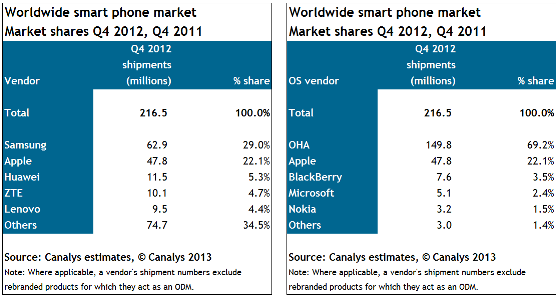
    Globally, Asian manufacturers, mainly from China, dominated the top-5 during Q4. But there, Apple made strong showing, lifted mainly by more mature markets like the United States where smartphone saturation slows sales compared to many other geographies. Samsung led, followed by the fruit-logo company, Huawei, ZTE and Lenovo. Samsung’s lead is solid but tenuous, with 29 percent share to Apple’s 22.1 percent. But the Others category, which includes white-box makers shipping Androids to China and other emerging markets, was larger, with 34.5 percent share.

    Smartphones accounted for 49.4 percent of all handset shipments — 216.5 million and 438.1 million, respectively.

    Android shipped on 34 percent of all handsets during fourth quarter, according to Canalys, compared to 11 percent for iOS. The number is greater for smartphones (69.2 percent). However, the green robot lost share sequentially, from 74 percent, largely due to iPhone 5’s strong first-full quarter of sales. Share of Apple’s mobile operating system rose to 22.1 percent from 15 percent quarter on quarter.

    “When we look at the whole of 2012, Nokia remained the number three smartphone vendor, shipping 35 million units, but Apple in second place shipped 101 million more handsets”, Pete Cunningham, Canalys principal analyst, says. “First-placed Samsung shipped 74 million more than Apple — the gaps are colossal. But there is still a big opportunity as smartphone penetration increases around the world”.

    He emphasizes: “Vendors left in the wake of the top vendors must at the very least improve their portfolios, time-to-market and marketing, as well as communicate their differentiators. Microsoft, BlackBerry and other new OS entrants, such as Mozilla, must make the OS switch as simple as possible and drive and localize their respective app and content ecosystems”.

    Photo Credit: Alex Wolf/Shutterstock

  • Don’t expect too much from Rootkit Remover

    Bitdefender Labs has released Bitdefender Rootkit Remover, a free stand-alone tool for dealing with known rootkits.

    The company report that Rootkit Remover can remove infections from a wide range of threats, including Mebroot, all TDL families (TDL/SST/Pihar), Mayachok, Mybios, Plite, XPaj, Whistler, Alipop, Cpd, Fengd, Fips, Guntior, MBR Locker, Mebratix, Niwa, Ponreb, Ramnit, Stoned, Yoddos, Yurn, Zegost and Necurs, amongst others.

    The program’s emphasis is very much on simplicity. There’s no installation required, no need to worry about compatibility with other security products, and no lengthy running times, either. Just click “Start Scan” and Rootkit Remover checks for specific signs of infection by known rootkits. If anything is found, it’ll be removed; and if your system is clean, the scan could be over in less than a second.

    You shouldn’t expect too much from Rootkit Remover, then. It doesn’t perform any kind of general analysis to help you detect and remove brand new threats, and of course it can’t stop you from being infected in the first place (so is no substitute for a regular antivirus engine). This is really just about providing a single dedicated tool to quickly remove malware which Bitdefender knows about already.

    Still, this isn’t in itself a bad thing. If you think you might be infected by a rootkit and your current antivirus engine hasn’t raised an alert, then there’s no doubt that this new tool provides a very quick and easy way to get a second opinion, and perhaps solve the problem entirely. Especially as the official Bitdefender Labs blog post on the release suggests it’s going to be regularly updated, with support for tackling “new rootkit families… added as they become known”.

    But if you’d like to try it yourself, there are now two downloads available: Bitdefender Rootkit Remover x86, and Bitdefender Rootkit Remover x64.

    Photo Credits: maraga/Shutterstock

  • West Wing Week: 02/08/13 or “What’s Up, Camera Man?”

    This week, the President honored our nation's top scientists and innovators, nominated a new Secretary of the Interior, and worked toward reducing gun violence, enacting immigration reform, and reducing our deficit in a balanced way.


    read more

  • Encyclopaedia Britannica’s Transformation

    An interview with Jorge Cauz, president of Encyclopaedia Britannica. He is the author of the forthcoming article Encyclopaedia Britannica’s President on Killing Off a 244-Year-Old Product.


    Download this podcast

    A written transcript will be available by February 15.

  • Accidental Empires Part 3 — 1991 edition preface

    Third in a series. Editor: In parts 1 and 2 of this serialization, Robert X. Cringely presents an updated intro to his landmark rise-of-Silicon Valley book Accidental Empires. Here he presents the original preface from the first edition.

    The woman of my dreams once landed a job as the girls’ English teacher at the Hebrew Institute of Santa Clara. Despite the fact that it was a very small operation, her students (about eight of them) decided to produce a school newspaper, which they generally filled with gossipy stories about each other. The premiere issue was printed on good stock with lots of extra copies for grandparents and for interested bystanders like me.

    The girls read the stories about each other, then read the stories about each other to each other, pretending that they’d never heard the stories before, much less written them. My cats do something like that, too, I’ve noticed, when they hide a rubber band under the edge of the rug and then allow themselves to discover it a moment later. The newspaper was a tremendous success until mid-morning, when the principal, Rabbi Porter, finally got around to reading his copy. “Where”, he asked, “are the morals? None of these stories have morals!”

    I’ve just gone through this book you are about to read, and danged if I can’t find a moral in there either. Just more proof, I guess, of my own lack of morality.

    There are lots of people who aren’t going to like this book, whether they are into morals or not. I figure there are three distinct groups of people who’ll hate this thing.

    Hate group number one consists of most of the people who are mentioned in the book.

    Hate group number two consists of all the people who aren’t mentioned in the book and are pissed at not being able to join hate group number one.

    Hate group number three doesn’t give a damn about the other two hate groups and will just hate the book because somewhere I write that object-oriented programming was invented in Norway in 1967, when they know it was invented in Bergen, Norway, on a rainy afternoon in late 1966. I never have been able to please these folks, who are mainly programmers and engineers, but I take some consolation in knowing that there are only a couple hundred thousand of them.

    My guess is that most people won’t hate this book, but if they do, I can take it. That’s my job.

    Even a flawed book like this one takes the cooperation of a lot of really flawed people. More than 200 of these people are personal computer industry veterans who talked to me on, off, or near the record, sometimes risking their jobs to do so. I am especially grateful to the brave souls who allowed me to use their names.

    The delightfully flawed reporters of InfoWorld, who do most of my work for me, continued to pull that duty for this book, too, especially Laurie Flynn, Ed Foster, Stuart Johnston, Alice LaPlante, and Ed Scannell.

    A stream of InfoWorld editors and publishers came and went during the time it took me to research and write the book. That they allowed me to do it in the first place is a miracle I attribute to Jonathan Sacks.

    Ella Wolfe, who used to work for Stalin and knows a lost cause when she sees one, faithfully kept my mailbox overflowing with helpful clippings from the New York Times.

    Paulina Borsook read the early drafts, offering constructive criticism and even more constructive assurance that, yes, there was a book in there someplace. Maybe.

    William Patrick of Addison-Wesley believed in the book even when he didn’t believe in the words I happened to be writing. If the book has value, it is probably due to his patience and guidance.

    For inspiration and understanding, I was never let down by Pammy, the woman of my dreams.

    Finally, any errors in the text are mine. I’m sure you’ll find them.

    Reprinted with permission

  • PE firm Asia Growth Capital Advirors Acquires Portfolio of Investments from Credit Suisse and Others

    Singapore-based Asia Growth Capital Advisors (AGCA),a private equity firm, has acquired of a portfolio of private equity investments in Asia from Credit Suisse, its affiliates and other investors in Credit Suisse Private Equity Asia Partners, L.P. AGCA worked with HarbourVest Partners, which was the lead investor in the transaction.

    PRESS RELEASE:

    Asia Growth Capital Advisors (“AGCA”), announced today the acquisition of a portfolio of seasoned private equity investments in Asia from Credit Suisse, its affiliates and other investors in Credit Suisse Private Equity Asia Partners, L.P. (“CSPEA”).

    AGCA worked with HarbourVest Partners, LLC (“HarbourVest”), the lead investor in this transaction. HarbourVest has a long history of private equity investing in the region with deep experience in executing complex portfolio transactions of this nature. In addition, Axiom Asia Private Capital (“Axiom Asia”), which has a focus on private equity investing in the Asia Pacific region, helped to underwrite and consummate the transaction.

    AGCA is a Singapore based private equity firm, that focuses on opportunities in India and South East Asia. The firm was founded in 2010 by Harjit Bhatia and Soma Ghosal Dhar, formerly Chairman & Managing Partner and Partner respectively at CSPEA. Mr. Bhatia has over 38 years investing experience in Asia Pacific region across private equity, industrial lending, corporate finance and investment banking areas from his prior times with General Electric Company, Deutsche Bank, State Bank of India and Ritchie Capital in various leadership roles. Ms. Ghosal Dhar has over 15 years of private equity investing experience and was most recently a Partner at CSPEA where she was responsible for originating and advising on private equity opportunities in India. Ms. Ghosal Dhar’s prior experience also includes stints at Ritchie Capital Management and GE Equity.

    On this transaction, the founders of AGCA, said, “We are very excited about this partnership with HarbourVest and Axiom Asia which will enable AGCA to continue providing its advice to the portfolio companies and help them grow. Furthermore, this partnership, in the future, will allow AGCA to provide a platform for liquidity and secondary solutions to existing private equity investors in Asia, specifically in India and South East Asia”.

    Tim Flower, a Principal at HarbourVest’s Asia affiliate, commented, “We are very pleased to work with AGCA on this transaction. We see a significant opportunity to acquire, restructure and support existing private equity portfolios in India and South East Asia and expect to work together with the team at AGCA in the future on similar secondary direct deals.”

    Alex Sao-Wei Lee, Partner and Head of Secondary Investments at Axiom Asia, recounted, “We are very pleased to be working with AGCA on this transaction and look forward to a successful partnership with them.”

    About the Limited Partners
    HarbourVest Partners, LLC is an independent global private equity firm that invests in venture capital, buyout, mezzanine debt, and distressed debt through primary partnerships, secondary purchases, and direct investments. Since 1986, HarbourVest has been a leading buyer of private equity assets, acquiring $9 billion of assets in over 350 deals of all stages, types, vintages, and geographies and working with many types of sellers, including financial institutions, corporations, pension plans, governmental entities, endowments, and family offices. This flexibility enables HarbourVest to offer sellers of private equity comprehensive liquidity solutions. The firm’s clients consist of 300 institutional investors, including pension funds, endowments, foundations, and financial institutions throughout the U.S., Canada, Europe, Australia, Latin America and Japan. As part of its track record of secondary direct transactions in Asia, HarbourVest also co-led the spin out of the Bank of America Merrill Lynch private equity portfolio in 2011 and is the single largest investor in that transaction. To learn more, please visit www.harbourvest.com .

    Axiom Asia is an independent private equity fund of funds manager focusing on primary fund investments, secondary purchases and co-investments in buyout, venture capital and growth capital opportunities in the Asia Pacific region. With 11 investment professionals based in Singapore, Axiom Asia has one of the largest and most experienced teams dedicated to private equity fund investing in Asia. An active buyer of Asian secondary interests, Axiom Asia has provided efficient liquidity solutions for global investors across a variety of secondary transactions involving Asian assets, from fund positions to portfolios of direct investments.

    The post PE firm Asia Growth Capital Advirors Acquires Portfolio of Investments from Credit Suisse and Others appeared first on peHUB.

  • More Americans take Facebook vacations

    That’s not on the social network but away from it. Bad for Facebook: The youngest, and presumably most active users, are the most likely to step away this year for prolonged breaks, according to Pew Internet.

    “Sixty-one percent of current Facebook users say that at one time or another in the past they have voluntarily taken a break from using Facebook for a period of several weeks or more”, according to report “Coming and Going on Facebook“, which published this week.

    This year, Americans 18-29 are least likely to spend more time on the service (1 percent) and most likely to take a break (38 percent). By comparison, among those over 50, only 17 percent plan breaks, while 4 percent plan do use the social network more. For each group 61 percent and 78 percent, respectively, expect activity to be unchanged.

    Among the 61 percent of Facebook vacationers, reasons vary:

    • Conflicting activities — 21 percent
    • Lack of interest — 10 percent
    • Content not compelling — 10 percent
    • Too much drama, gossip — 9 percent
    • Spending too much time — 8 percent

    Some of the verbatim thoughts from those who took Facebook breaks include the following:

    • “I was tired of stupid comments”.
    • “[I had] crazy friends. I did not want to be contacted”.
    • “I took a break when it got boring”.
    • “It was not getting me anywhere”.
    • “Too much drama”.
    • “You get burned out on it after a while”.
    • “I gave it up for Lent.”
    • “I was fasting”.
    • “People were [posting] what they had for dinner”.
    • “I didn’t like being monitored”.
    • “I got harassed by someone from my past who looked me up”.
    • “I don’t like their privacy policy”.

    While 67 percent of American adults use Facebook, 20 percent of respondents left the service altogether. Some others who stay use it less: “Some 42 percent of Facebook users ages 18-29 and 34 percent of those ages 30-49 say that the time they spend on Facebook on a typical day has decreased over the last year”.

    To emphasize, younger adults are a core demographic for the service and coveted by advertisers. This is not a group Facebook should want to lose, whether they cut back or take a vacation from the service.

    Photo Credit: Robert Scoble

  • LinkedIn Nails its Fourth Quarter, Yearly Earnings

    If there’s one thing LinkedIn is, it’s consistent. The company has slowly built its brand and membership numbers in the crowded social media space where other companies are getting bloodied.

    LinkedIn today announced its fourth quarter 2012 and year-end 2012 financial results, and, once again, the social network for professional networking hit its marks.

    The company pulled in revenue of $303.6 million in the fourth quarter of 2012, an 81% increase over the fourth quarter of 2011. Non-GAAP net income was also up at $40.2 million and its non-GAAP diluted earnings per share rose to $0.35.

    For the whole of 2012, LinkedIn took in $972.3 million, an increase of 86% year-over-year.

    “2012 was a transformative year for LinkedIn,” said Jeff Weiner, CEO of LinkedIn. “We exited 2011 having successfully revamped our underlying development infrastructure. Based on that investment, we said that 2012 would be a year of accelerated product innovation, and it was. The products we delivered throughout the year drove member engagement and financial results to record levels in the fourth quarter.”

    For their fourth quarter earnings, the company cited strong revenues of $161 million from its “Talent Solutions” recruiting products and $83.2 million from its Marketing Solutions products. Subscription revenue from premium memberships to its social network rose 79% to $59.4 million.

    LinkedIn set ambitious goals for itself in 2013, and expects to bring in between $1.41 billion and $1.44 billion.

    “Continued investment in our talent and technology infrastructure drove momentum in both product and monetization, resulting in record revenue, profitability, and cash flow,” said Steve Sordello, CFO of LinkedIn. “As we look forward to 2013, we remain excited about the value LinkedIn will create for members and customers in the coming year.”

  • Watch Industry Figures Talk About The Future Of Gaming At D.I.C.E.

    D.I.C.E. 2013 is well underway. It’s opening keynote was delivered by none other than Gabe Newell of Valve, but other industry figures are on hand to talk about the future of gaming and interactive entertainment. If you fancy yourself a gamer or game developer, you’ll definitely want to check some of these keynotes out.

    First up is Ouya CEO Julie Uhrman. Her company recently announced that it would be shipping out the new Ouya console in June. Listen in to find out what she thinks the future of console gaming holds for us all:

    Next up is David Cage, CEO at Quantic Dream. His studio has been pushing interactive storytelling more so than any other AAA studio with games like Indigo Prophecy and Heavy Rain. Expect a lot of talk on how the industry gets storytelling all wrong:

    Amir Rao, Supergiant Games’ studio director, is up next to talk about Bastion, an indie darling from 2011:

    Rounding out the keynotes is Glen Schofield, founder of Sledgehammer Games. Before helping out Infinity Ward on Call of Duty, he was VP of Visceral Games and creator of Dead Space.

  • Apple Addresses Return Of Cash To Shareholders

    One of the big stories in tech today was that Greenlight Capital sued Apple to block a move that would eliminate preferred shares. Greenlight’s David Einhorn wrote a letter to shareholders calling Apple’s plan to discard preferred stock “an unprecedented action to curtail the company’s options.”

    The New York Times has an extensive report on the matter, including the complaint in its entirety.

    This afternoon, Apple released a statement saying that it is in talks with Greenlight Capital. Here’s what the company had to say:

    By early last year, Apple’s cash balance had built to a point beyond what we needed to run our business and maintain flexibility to take advantage of strategic opportunities, so we announced a plan to return $45 billion to shareholders over three years. As of next week we will have executed $10 billion of that plan.

    We find ourselves in the fortunate position of continuing to generate large amounts of cash, including $23 billion in cash flow from operations in the last quarter alone.

    Apple’s management team and Board of Directors have been in active discussions about returning additional cash to shareholders. As part of our review, we will thoroughly evaluate Greenlight Capital’s current proposal to issue some form of preferred stock. We welcome Greenlight’s views and the views of all of our shareholders.

    As a part of our efforts to further enhance corporate governance and serve our shareholders’ best interests, Proposal #2 in our proxy includes some recommended changes to our articles of incorporation. These changes were recommended independently of Greenlight’s proposal and would not preclude Apple from adopting their concept. Contrary to Greenlight’s statements, adoption of Proposal #2 would not prevent the issuance of preferred stock. Currently, Apple’s articles of incorporation provide for the issuance of “blank check” preferred stock by the Board of Directors without shareholder approval. If Proposal #2 is adopted, our shareholders would have the right to approve the issuance of preferred stock. As such, Proposal #2 has the support of many of our shareholders.

    We remain committed to having an ongoing dialogue with our shareholders to get perspectives around return of capital and driving shareholder value.