Blog

  • Show your love for Bing by breaking up with Google

    For Valentine’s Day, Microsoft shoots Cupid’s arrow elsewhere. Rather than promote the relationship you have, the company cajoles you to seek new love. The marketing campaign deliciously delights. C`mon, who promotes breakups for V Day?

    “This year Bing is challenging people to reconsider their search habit and break up with Google”, Microsoft suggests in a statement. “You wouldn’t keep dating someone who isn’t trustworthy, so why use a search engine known for serving its interests over your own? In fact, a whopping 85 percent of people report that trustworthiness is the most important trait in a mate, beating out good in bed, sense of humor and wealth”.

    Trust is important, but I’m not married to Google. Given how much easier searching for amateur porn is on Bing than Google, surely good in bed might matter more to many would-be switchers.

    The promotion is an extension of the misguided “Bing It On” campaign launched in September. Microsoft lets people compare Bing and Google searches, while making some misstatements about its rival’s search practices — carried forward in the new lovelorn campaign.

    For example, “Not all is fair in love and search”, Microsoft claims. “Whether you’re searching for a cuddly teddy bear or a diamond bracelet for your sweetheart, Google Shopping displays ads only from merchants that pay for ranking. Bing offers honest results so you get the best deals from across the Web”. But Bing Shopping isn’t clean of paid posts, either, just not as dirty.

    Counter-marketing can be effective, but Bing is more likely to make a love triangle than woo away Google searchers. Google US search share was 66.7 percent in December, according to comScore, — 16.3 percent for Bing, or 28.5 percent when combined with Yahoo, which results Microsoft serve.

    This Valentine’s Day Microsoft can more likely expect lovers using Bing and Google.

    Can you say ménage à trois?

    Photo Credit: JoeyBear/Shutterstock

  • Do you want Aero in Windows 8? Fight for it

    Microsoft introduced its “Aero Glass” interface back with Windows Vista and continued the feature in Windows 7. However, after supporting the motif in early builds of the latest operating system, the company elected to pull the plug. Former Windows exectutive Steven Sinofsky explained the reasons behind the decision in an 11,000 word blog post back in May of 2012.

    Sinofsky laid out a number of valid reasons for the decision, including battery life, speed and the new feature set included with Windows 8. However, those are not enough for some customers and that group has found a voice.

    Now, if you still happen to be a bit angry over the decision, you have a chance to let Microsoft know about it. A petition has appeared on the web site change.org that implores Microsoft to bring back the interface.

    The petition is new, and support so far light, but growing — 38 signatures at the time of this writing. However, judging by the comments, Aero had some staunch and vocal supporters.

    G D of France, for instance, posts that “It [Aero] is one of the things that made me love Windows 7. I will not upgrade to Windows 8 for as long as it does not have Aero Glass, the Start Button and the Start Menu”. Hassan Timite states emphatically that “Because AERO was much prettier than this abomination called Metro”.

    Microsoft is probably unlikely to bring back the feature and, honestly, after using Windows 8 for about a year, I can not say that I personally miss it. However, like Windows Media Center, there is always a core group of users for a product who can be very vocal when threatened with the prospect of losing said feature. I know — that is Media Center for me. And heck, the company may be prompted to make Aero an option for those who want it.

    Photo Credit:  tankist276/Shutterstock

  • Get Washboard Abs for a Dollar with Runtastic SitUps Pro for BlackBerry 10

    Runtastic GmbH has made a brand new fitness app for BlackBerry 10. Runtastic SitUps PRO is a sit-up trainer that counts your sit-ups by using your BlackBerry device’s accelerometer. Keep motivated by following a training routine that will eventually draw you a nice hockey-stick-shaped graph: the universal symbol for success.

    Pushups and Situps are some of the easier exercises to do; Everyone can do at least a few and that’s all you need to begin a routine that will eventually lead to you doing many of them. The app develops a routine and gives you game-style achievements for encouragement along the way.

    Click here to buy Runtastic SitUps Pro for BlackBerry 10 for just 99 cents.

  • The next chapter: TED headed to Vancouver in 2014, TEDActive hitting the slopes of Whistler

    TED2014-main

    In 2014, TED will celebrate our 30th anniversary. And to mark this spectacular event, we’re planning something very special. We are moving our annual West Coast conference from Long Beach, California, to Vancouver, Canada. From March 17 to March 21, 2014, TED will be held in this great city, which boasts a thriving spirit of innovation as well as stunning views — the harbor and mountains in the same scenic vistas.

    Vancouver-Convention-CentreTED2014 will be held at the world’s most eco-friendly meeting venue — a convention center positioned directly on Burrard Inlet, which took our breath away upon first seeing it. The Vancouver Convention Centre is connected to three incredible hotels and features a sprawling, six-acre living roof. Inside this center, we’ll be building a new kind of TED theater — one designed to maximize the impact of talks while also taking advantage of the panoramic views of the North Shore Mountains. Our stage designers are dreaming up what this new space will look like as we speak.

    Active2014_whistlerIf you look hard enough from the theater, you may be able to see the new home of TEDActive 2014 — the gorgeous ski resort of Whistler. Just 90 minutes outside Vancouver, the Fairmont Chateau Whistler will host this conference for movers and shakers, which features a full simulcast of TED, its own unique programming and a slew of field trips for adults, all designed to inspire conversation.

    TED2014 will be a time to look forward as well as back. We have decided to hold our base-level pricing to the same as it’s been the past three years. Meanwhile, we’ve opted to scale back our audience size from 1400 to 1200 paid attendees, to strike the right balance of scale and intimacy and allow for more in-depth human connection. Alongside attendees, we’ll also be inviting one hundred of the best TED speakers of all time — to be selected by you. Some will speak on the main stage again, while others will mingle in break-out groups, lunches and dinners. It’s a chance to reflect on the most significant developments of the last 30 years, and to inspire innovation in the next 30.

    Registration for both TED2014 and TEDActive 2014 will open on Monday, February 11, 2013. The theme: “The Next Chapter.” We want you to be a part of it »

    Will this be a next chapter for TED? Quite possibly. From 1984 to 2008, TED was based in Monterey, Calif., before moving to Long Beach with TEDActive nearby in Palm Springs. While we have absolutely loved the past five years there, but as TED has crossed major milestones — our billionth video view last fall and our 6,000th TEDx event last month — we feel ready for a new adventure. Our staff is pumped for TED2013, our grand finale year in Long Beach, and are thrilled to be able to go exploring in 2014.

  • How to Communicate Dissent at Work

    Dissent plays an important role in the workplace. For any organization to thrive, employees need to be able to propose solutions to problems, raise questions about unethical practices and ask how they can work more efficiently and effectively. In places where dissenting opinions are encouraged, employees report greater job satisfaction, and leaders are able to consider a wider range of proposals and options before making decisions.

    There’s only one problem with dissent: a lot of people don’t want to hear it. Accordingly, many employees worry that expressing dissent will cause others to see them negatively, or that it simply won’t make a difference. I’ve surveyed and interviewed hundreds of employees and supervisors to better understand how employees can more effectively express their ideas at work. There are no magic words that will make people listen to you, but I’ve found several things that seem to be consistently associated with positive experiences.

    The question of who should be on the receiving end of your dissent is an important one. To bring about any real change, you’ll need to express your ideas to someone who can actually do something about the problem. For this, many employees will turn automatically to their supervisors, but not all supervisors are able to address all problems. Similarly, they may not be willing as you to ferry complaints up the chain of command.

    Of course, you may have other goals in expressing dissent. If your goal is just to get something off your chest, telling your supervisor will give you some peace of mind, regardless of the eventual outcome. If you’re looking for someone who understands your frustration, your coworkers might make the best audience. Though it is rare that lateral dissent results in change, it may help build a coalition around your position, or better prepare you for subsequent conversations with a supervisor. But be careful how you voice your concerns among coworkers — you don’t want to be labeled a whiner or subversive.

    Rather than simply voicing a complaint or spotlighting a problem, try packaging your dissent with a solution. This makes it more difficult for someone to dismiss you as a petty grumbler or malcontent, and it saves your audience the cognitive effort of devising a solution themselves.

    When you’re both describing a problem and proposing a solution, take care to emphasize the solution in your presentation. If you don’t present your solution clearly and forcefully, your audience is less likely to notice you’ve included one, making it easier to brush off your dissent. In general, presentation strategies that emphasize positive opportunities over negative realties will always help you plead your case.

    Dissent usually arises from an emotional place. Most of us don’t complain about something unless we feel strongly about it. Nonetheless, emotional venting — however honest or well-intentioned — is rarely the best way to share your thoughts. Supervisors and coworkers alike are more likely to lend you their ears when they feel you’re expressing yourself in a rational and calm manner.

    To bolster this impression, be sure to use direct factual appeals in presenting your dissent. Direct factual appeals include supporting information that demonstrates critical thinking and rational analysis, and they have an acknowledged strategic advantage in the workplace, since organizations strive to stay within the bounds of rational behavior.

    Sometimes, however, adding a touch of emotion to your presentation may work in your favor, if you do it in a sophisticated way. One technique that combines emotional and rational appeals is to reference the values under which your organization operates. Few people care to challenge the central aims or purposes of their organization, making your dissent not only more persuasive but less controversial.

    While it may be tempting to use hard, aggressive appeals — such as issuing threats, demands or ultimatums — these approaches very often backfire and are considered extremely inappropriate in a professional environment. Furthermore, every employee is replaceable; threaten to quit, and you just might get your wish. Even in the event that pressure tactics succeed in bringing about a desired outcome, your relationship with others will certainly suffer as a result, hampering your future happiness and success. And if you’re the one who backs down from a standoff, you will assuredly lose credibility.

    There’s another question that you need to answer before making your case: When should you express dissent? When should you rock the boat? Dissent can be risky because no everyone appreciates it when an employee questions a policy or practice. There’s a danger that you could come across as griping or be perceived as a troublemaker. Be sure that you have the organization’s interests in mind. But beyond that, how do you walk the line between “problem solver” and “whiner”?

    First, whether you communicate your ideas or remain silent, never just accept the status quo without thinking critically about it. Yes, there may be good reasons why a particular policy was implemented or a particular practice was started, but that doesn’t mean that there aren’t better means to the same end. As an employee, you should never accept something because “it’s the way we’ve always done it,” or because a manager says it’s the only way.

    But second, there is a threshold, somewhere between mildly annoying and clearly illegal or dangerous, where you need to say something. That threshold will be different for everyone based on your personality, the relationships you have with coworkers and supervisors, and the climate of your organization. If your threshold is too low, you might dissent about everything and be perceived as a complainer. If your threshold is too high, you might not dissent when you see unethical or illegal actions, so you need to be thoughtful about what’s important enough to say something.

    Think critically about your workplace experiences and pay attention to when something crosses your threshold. Then speak up in a way that is more likely to make things better.

  • Microsoft, The Web Is No Longer Good Enough; Windows RT Needs Apps And Fast

    Screenshot (4)

    I loathe using some websites. Twitter and Facebook are horrific on the web when compared to their iOS/Android apps. I simply refuse to use Zillow’s website; I’ll wait until my kids are done with the iPad to look for our new place. The same is true for Tumblr and other sites. The mobile first strategy is in full force and Microsoft needs to hop on board.

    With Windows 8, Microsoft is forcefully pushing the PC into the post-PC era. It’s a touch first interface with the Desktop mode allowing for a more traditional Windows experience. But if Windows is to succeed, apps need to be the top priority and as a user of the Surface RT, it’s clear Microsoft does not agree.

    I’ve been using the Surface RT a lot more recently. I want to like it. I want to have it in my life. I’m a Windows guy and I just wish I had a companion device like the Surface to supplement my desktop. When traveling, I use a MacBook Pro and iPad. They’re a wonderful pair, but so far, I’ve yet to find the same sort of synergy with the Surface RT and Windows 8 desktop mainly because of the lack of compelling apps outside of Microsoft’s ecosystem.

    Three months after launching there still isn’t a reason to buy a Windows 8 tablet.

    Do you want these things on an 11-inch screen with a questionable keyboard?

    Microsoft proponents will tell you that Office is the strongest selling point for Windows 8 tabs. That’s true. It’s the only reason I see as well. But do you need Office? Do you need a full-featured word processor or all-powerful spreadsheet editor? Do you want these things on an 11-inch screen with a questionable keyboard? If so, and I’m sure some people do, an Ultrabook would probably suit their needs better than a Surface RT — they better fit on airline trays anyway.

    As it’s been explained countless times, the Surface RT runs Windows RT, a version of Windows written specifically for ARM processors. Because of this, standard Windows programs do not run on the Surface RT, or any other Windows RT tablet. You cannot install Chrome, Spotify, Scrivener, Steam or any other normal Windows program. Worse yet, the apps that are available in the Store are pure garbage compared to their iOS/Android counterparts — including our TC app. Even Surface fanboys on Reddit show the shallow depth of the Store’s library with this list of favorite apps.

    In short Microsoft has left the Surface RT rot by not supporting its ecosystem.

    Access to the web is no longer good enough. “Pin any website to the home page to make it its own app,” says Microsoft. Remember who else tried that? How did that work out?

    Access to the web wasn’t good enough when RIM launched the Playbook in 2011 without any apps. Instead the company touted its full-feature web browser. It wasn’t until nearly a year later the company made it easy to port Android apps that the tablet finally started to take off. Now, with BlackBerry 10, BB set out on a quest to launch the platform with as many apps as possible. BB10 launched last week with 70,000 apps. Windows RT is three months old and it seems that Microsoft is still behind in terms of app counts.

    It’s been said that BlackBerry went to great lengths to get apps for BB10. We’ve heard that the company went as far to pay developers to port their apps (something that Microsoft has some experience with). We’ve heard from others that BlackBerry did all the work internally to port some apps. Ignore the methods; the company hustled. BlackBerry did what it needed to properly support its upcoming platform. A modern mobile system is only as good as its apps.

    I’m not alone in wanting to like the Surface RT. Surface owners are going to incredible lengths fixing Microsoft’s underwhelming ecosystem. Hopefully Microsoft is watching the self-inflicted pains Surface RT owners are suffering just to keep their devices fresh.

    Surface owners are going to incredible lengths fixing Microsoft’s pitiful ecosystem.

    Surface RT users have taken to jailbreaking the Surface RT to supplement the OS’ lack of compelling apps. There is a community currently porting open applications to Windows RT — but these apps are not/will not be available through the official Windows Store. Quake 2, anyone? Worse yet, they’re classic Windows applications and not touch-first apps. This action will quickly lose its appeal as more and more owners grow tired of the hassle.

    When a product has to be jailbroken, something is wrong. Apple quickly learned this. Hackers beat Apple to the punch and launched backchannel app stores prior to Apple itself. In fact, Apple has closely watched this active community and implemented many enhancements and functions first developed by these users.

    The iPad is a great device not because of the hardware. It’s special because of its access to new content. B&N was the first company to see this and developed the first generation Nook Color to be a portal to B&N content rather than a mobile productivity device. Others including Amazon, Google and BlackBerry followed suit. But Microsoft.

    Listen, the Surface RT, and likewise, the Surface Pro, are fantastic examples of hardware. They feel like devices from the future with their full-size USB ports, microSD card slots, and, in the case of the Pro model, a Wacom active digitizer screen. But past the hardware, there is little reason to get excited because of the inherent limitations of Windows RT.

    Microsoft has yet to get that the consumer electronics game is played with new set of rules. Hardware is no longer good enough. The web is no longer good enough. To be successful products have to provide consumers with a complete experience. That’s why every Apple mobile device since the iPod has been successful. That’s why Android is dominating the mobile wars. And that’s why until Microsoft can attract a large set of app developers to its Windows RT ecosystem, the ARM-based platform will go nowhere.

  • HEARING PREVIEW: IER’s Hutzler to Testify on America’s Energy Potential

    IER Distinguished Senior Fellow and former acting EIA administrator Mary Hutzler will testify on Tuesday, February 5, 2013 at 10:00AM before the House Subcommittee on Energy and Power. The hearing will focus on “American Energy Security and Innovation: An Assessment of North America’s Energy Resources”. Hutzler’s testimony will evaluate North America’s vast energy resources and assail the federal energy policies that continue to deny access to those resources and stifle economic growth and job creation. Highlights from the testimony include:

     ”The United States has more combined oil, coal, and natural gas resources than any other country on the planet. As we used these energy resources over the past 50 years, not only did we grow our economy and improve our quality of life, but we improved our air quality as well.”

    “We are energy rich, not poor . . . The real question is whether the federal government will permit us to have access to our abundant energy resources, not whether sufficient resources exist.”

    “Increased energy production promotes jobs, government revenues from taxes and lease sales, and increased economic activity.”

    “The reason for the boom in both oil and natural gas production in the United States today is that our oil and gas industry was able to revolutionize drilling and production from shale formations by combining hydraulic fracturing and horizontal drilling technology . . . When combined with the incredible advances in computer interpretative capabilities, an energy miracle is afoot.”

    “Lower energy prices benefit the entire economy, but especially the economically disadvantaged and those on fixed incomes. Expanded energy production resulting in lower prices is thus a benefit to society. The increase in hydraulic fracturing, however, has led to attacks on natural gas production. Many special interest groups have launched anti-hydraulic fracturing campaigns, claiming that is a new, dangerous technology that contaminates groundwater. But the reality is far different.”

    “The Keystone XL pipeline would not only move Canadian oil but it would also help to move oil from areas in the United States where it is land-locked, such as shale oil production in North Dakota and crude oil stored at Cushing, Oklahoma . . . . The U.S. government has delayed, denied and delayed again its approval.”

    “Developing oil and natural gas production on federal lands is becoming more difficult and time consuming. As a result, oil production is decreasing in the federally-controlled offshore areas and Alaska, but increasing on state and privately-controlled onshore areas.”

    “If more oil is not allowed to be produced soon from Alaska, the Trans Alaskan Pipeline System, one of North America’s most valuable energy assets, will be at risk. The pipeline, which once delivered 2.1 million barrels of oil per day to the West Coast, now has sufficient underutilized capacity to accommodate twice the amount of oil that is currently being produced in North Dakota, the second largest oil producing state in the Union.  There is no lack of oil in Alaska or off its coasts; the problem is that government policies stand in the way of additional oil production in Alaska.”

    “As technology continues to advance, coal-fired power plants will become even cleaner and air quality will continue to improve . . . An irony of our current regulatory policy may be that China will ultimately become the world’s supplier of the most advanced clean coal plants, despite the U.S. coal resource base which dwarfs their own.”


    To read the full testimony, click here (PDF).

    Tomorrow’s hearing can be seen live on the Energy and Commerce website.

    ###

  • Aliens: Colonial Marines Multiplayer Trailer Released

    One of the best unfulfilled promises when it comes to Aliens games is good multiplayer where some players can take on the role of the xenomorphs. 2010′s Aliens vs. Predator did an okay job with the concept, but it still fell short of that ideal of worried, huddled marines slowly making their way through an alien-infested environment while other players wait for their opportunity to ambush them.

    Luckily for Aliens fans, there is always another game just around the corner, which means another opportunity for a new developer to get things right. Next week, Gearbox will release Aliens: Colonial Marines and show the world what it thinks an Aliens multiplayer mode should look like.

    A new multiplayer trailer for the game shows that at least some thought has gone into the experience. Colonial Marines will have access to a plethora of customizable weapons and explosives. Xenomorphs, on the other hand, will have 3 different classes to choose from: “soldier,” “lurker,” or “spitter.” Each class has customizable attacks, such as camouflage, disorienting smoke, or acid spit. The trailer even shows off a special class called the “boiler,” which can self-destruct its own head to rain acid onto its opponents.

  • Energy Affordability: Short- and Long- Term Trends

    Energy is a crucial ingredient in every aspect of our lives, whether at home, school, or work. Fortunately, over the long-term, energy has become more affordable for Americans, measured in various ways. This is not a surprise, as human ingenuity and (relatively) free markets allow entrepreneurs to multiply the gifts of nature, even for so-called “depletable” resources.

    However, in recent years energy has become less affordable. This too is not surprising, as the federal government has impeded the ability of firms to develop domestic energy resources, and as the Federal Reserve has weakened the dollar. If policymakers wish to raise U.S. (and world) living standards, they should move back in the direction of stable monetary policy and unfettered capitalism. The natural forces of innovation in a market economy will lead to more abundant supplies, in the economically relevant sense.

    Long-Term Trend: Energy Becomes More Affordable

    Viewed over the course of decades, energy has become much more affordable for Americans. In their book It’s Getting Better All the Time, Stephen Moore and Julian Simon document various measures of this fact. For example, they cite William Nordhaus’ calculation that the price of lighting has fallen significantly since the electrification of the nation began in the early 1900s. Originally, the price of 10,000 lumens was about $4, whereas by the end of the 20th century it had fallen some 99.5 percent, down to less than a penny. For another example related to lighting: In 1938, the average fluorescent light bulb lasted 1,500 hours, whereas by 2000 it lasted 100,000 hours.

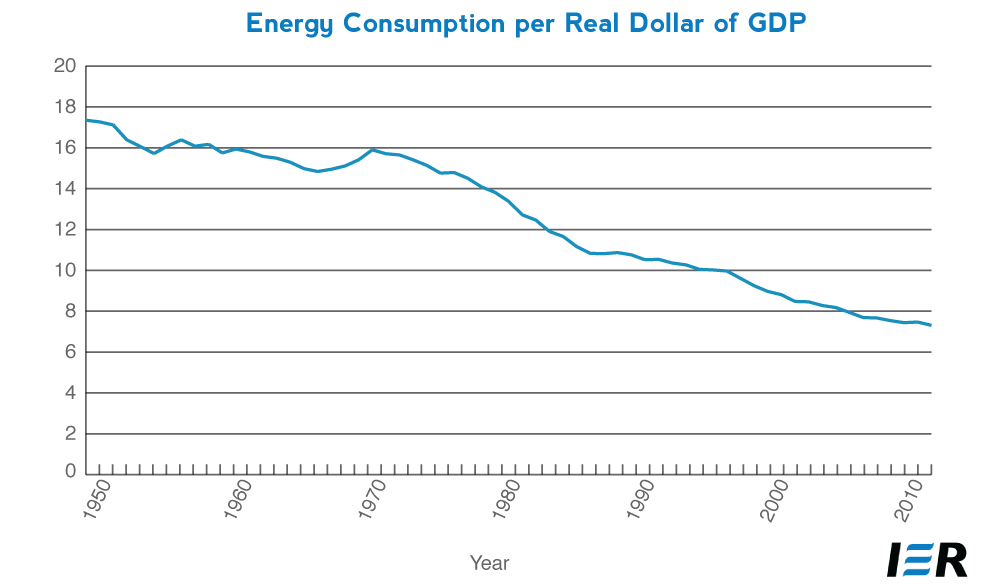
    Over long stretches of time, the U.S. economy has become steadily more efficient in its use of energy, as measured by physical units of energy expended per dollar of real output. From 1949 to 2011, for example, the amount of gross output (in inflation-adjusted dollars) per unit of energy (in BTUs) almost doubled.[1]
     2.1.13-IER-Web-EnergyPricestoWages-GDP-MKM

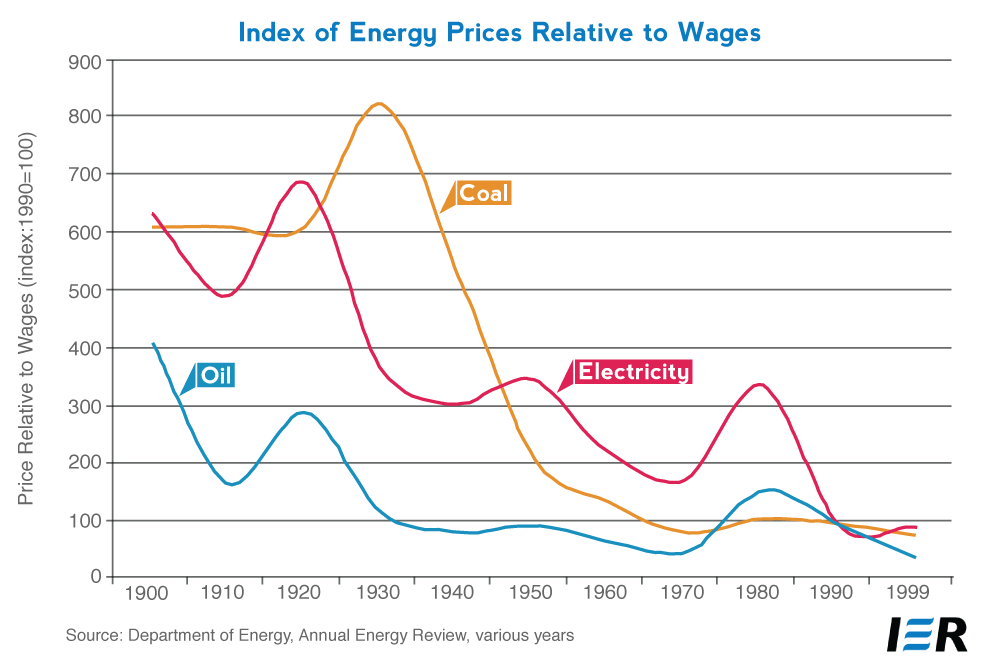
    Another way of seeing the long-term trend is to look at energy prices compared to average wage rates. This indirectly shows how much time a worker needs to spend, in order to make enough to buy a given amount of energy. The chart below shows the astounding improvement:
    2.1.13-IER-Web-EnergyPricestoWages-MKM

    Adopted from “It’s Getting Better All the Time”

    What is truly shocking—at least to those who don’t appreciate the wonders of entrepreneurship in a market economy—is that the economically relevant “supply” of so-called depletable resources has risen over the decades, too.

    To take just one example: We can define how many “years worth of oil” the United States has, by taking the known oil reserves and dividing by current rates of oil consumption. Since there is only a fixed amount of oil on planet Earth, and since the rate of oil consumption has steadily risen since the Industrial Revolution, one would initially suppose that the “number of years left” would constantly shrink.

    And yet, the opposite is true. In fact, the window of oil availability generally improved over the 20th century. At the end of 1944, “proved reserves” of crude oil were 51 billion barrels worldwide. By 2003, the number had grown to 1.27 trillion barrels of proved reserves. Given the annual rates of consumption in the two years, the world went from a proven supply of under 25 years’ worth of oil in 1944 to a supply of about 44 years in 2003.[2]

    For a more modern illustration, consider: In 1944, the U.S. had oil reserves of 20 billion barrels. And yet, from 1949 through 2010, the U.S. produced 167 billion barrels of oil from domestic sources. That means the U.S. produced more than 700  percent of its reserves, starting from 1949. Obviously there is something fishy going on here.
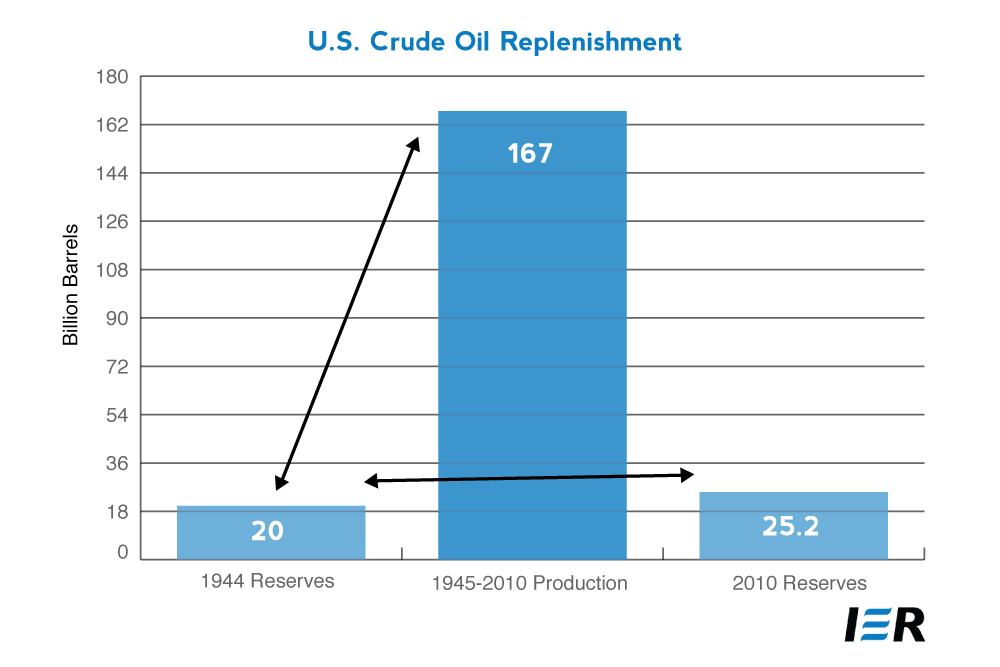
    2.1.13-IER-Web-EnergyPricestoWagesReserves-MKM The explanation for this counterintuitive result is that, even though in a physical sense oil is a finite resource, in an economically relevant sense the amount of oil available for human use can expand, when prices rise. This is because the rising price gives a signal for entrepreneurs to go find more oil. As the above statistic illustrates, the process can work so well that humans actually become more energy-abundant over time, even with a depletable resource.

    The energy doomsayers—who are constantly urging forced conservation and other restrictions on living standards—miss this mechanism. They are analogous to a child who checks the pantry for three days in a row, then announces to his parents that they have to start making sandwiches with only one slice of bread. The parents would explain, with a smile, that before “running out of bread” they would simply go to the store and buy more. It is similar with “oil reserves” and other such categories.

    Indeed, currently there is enough natural gas in North America to power the U.S. (at current rates of consumption) for 175 years. There is enough “technically recoverable” coal to last for 500 years.

    Clearly, the United States does not suffer from a scarcity of natural energy resources.

    Energy Less Affordable in the Short Term

    Unfortunately, although the long-term view is optimistic, over the last few years there have been disturbing trends in energy affordability, with the notable exception of the natural gas boom—which obviously is occurring despite government efforts to stymie it.

     FREDCPIEnergy


    The above chart shows that since 2003, there has been a steadily increasing gap between energy prices, relative to other consumer prices. In other words, energy has gotten more expensive than the rest of the items measured in the Consumer Price Index (CPI).

    There are of course numerous factors explaining relative price movements, but what we can say with confidence is that government restrictions on the development of domestic energy resources, makes energy more expensive than it would otherwise be.

    We can also point to monetary policy as being instrumental in driving at least a portion of the run-up in prices. Many economists believe that in response to perceived “loose” Fed policies, the dollar falls and speculators rush to inflation havens, such as gold and silver but also commodities in general, including oil. Look at the connection between crude oil prices and the various rounds of “quantitative easing” by the Federal Reserve:

     spot oil price FRED

     The fit is not perfect, of course—nothing ever is in macroeconomics—but since early 2009, the movements in oil prices closely follow the movements in the Fed’s balance sheet (approximated here by the “monetary base”), particularly during the two years from early 2009 to early 2011.

    In fairness, one could defend Ben Bernanke by saying that with every round of “quantitative easing,” investors thought the world economy was on the road to future growth, and hence bid up the price of oil. Yet a cynic could equally well argue that the world economy is hardly in a robust recovery, despite literally unprecedented monetary inflation from the Fed and other central banks. A more plausible explanation of the chart above is that commodity prices are being bid up by the flood of liquidity crashing into an economy with very weak fundamentals because of misguided government policies.

    Conclusion

    Over the long term, energy in various forms has become ever more affordable. This is the natural outgrowth of (relatively) free-market capitalism. Even though certain resources are fixed in a physical sense, their “economic” quantity grows over time with innovation in uses and new discoveries.

    However, during a shorter time frame, energy has become relatively more expensive for Americans. This can be partially attributed to government policies that restrict domestic development, and to Fed policies that encourage speculators to flee to inflation hedges such as commodities.


    [1] Energy Information Administration, Annual Energy Review, Table 1.5, http://www.eia.gov/totalenergy/data/annual/pdf/sec1_13.pdf.

    [2] See Robert Bradley and Richard Fulmer, Energy: The Master Resource, page 9 of Chapter 4, “Will We Run Out of Energy?”

     

  • Gain A New Appreciation For The Internet By Checking Out This Underwater Cable Map

    In today’s modern world, the Internet connects us all with each other. That used to be a much harder task before the advent of fiber optic cables in the 1980s. Now cables are being laid all over the world, including under the ocean, to connect us all to the magic of the Internet.

    Of course, we should never take the Internet for granted. We should also appreciate all the hard work that went into making the world an interconnected community with the Internet. A new map from TeleGeography and Telecom Egypt should help puts things into perspective as it lays out all the underwater Internet cables that are currently in existence on this earth. It’s awe-inspiring stuff. Here’s a few of the major underwater thoroughfares:

    Internet Under Water

    underwater internet

    underwater Internet

    You can check out the full interactive map here. It contains a number of interesting stats that should make you really appreciate all the hard work that went into making sure you could communicate with people from all around the world. If you want to learn more about submarine communications cables, check out the Wikipedia article on the subject.

  • Uh-oh, $50 smartphones mean big trouble for Apple

    That sound you hear: Emerging markets sucking the margins out of iPhone. Gartner predicts that Chinese brand and white-box handset manufacturers will dramatically change the smartphone market’s course this year. Android is likely to be the big beneficiary, while iPhone has the most to lose. Economies of scale will bite Apple, which benefits from one of the tightest supply chains anywhere. Chipset integration, for example, will allow handset makers to ship cheaper devices that are good enough, even if less than market leaders.

    “The combination of competitive pricing pressure, open-channel market growth and feature elimination/integration will very soon result in the $50 smartphone”, Mark Hung, Gartner research director, says. “Semiconductor vendors that serve the mobile handset market must have a product strategy to address the low-cost smartphone platform, with $50 as a target in 2013”. That’s right, 50 bucks, not the $650 Apple charges carriers.

    Already, shifting market dynamics forebode big trouble for the fruit-logo company. While iPhone is top-seller in the United States, Androids easily own the world, buoyed much by Samsung’s sales success. The electronics giant has much greater success selling to emerging markets than Apple, picking up many locales once dominated by Nokia. But what’s bad for the American company could be for its South Korean competitor.

    “Global, brand-name smartphone vendors must re-examine their product lineups to determine how their low-end offerings are differentiated from the competitive products offered by low-cost vendors”, Hung warns. “Otherwise, brand-name smartphone vendors may want to cede this market to the white-box vendors and focus on high-end devices”.

    Myopic Analysis

    The problem is something many American analysts, bloggers and journalists don’t see. Their vision is myopic, looking at how handsets are sold here. iPhone 4 is free to a consumer buying locked device with two-year contractual commitment, which obviously is much less than $50. But in many other markets, China and India among them, consumers are accustomed to contract-free purchases — well, except for iPhone. Carriers still pay Apple that six-fifty or more (less for the oldest iPhone available).

    As less-capable smartphone prices go down, features go up and availability expands, buyers in emerging markets will buy what they can afford rather than what they might want. Stated differently: These devices will rapidly expand the low end of the market, where there is greatest growth potential, closing out iPhone, and, should Apple lower prices in response, sap margins.

    Gartner hasn’t yet released fourth-quarter smartphone figures, which tend to be the most accurate. While other analyst firms measure shipments into the channel, Gartner counts actual sales to end users. Past data reveals increasing demand for white-box smartphones.

    Still, based on shipment data now available, emerging markets already favor lower-cost Androids to pricier Apples. For example, in the world’s largest smartphone market, China, Android share reached 86 percent during Q4, compared to 12 percent for iOS, according to Strategy Analytics.

    Emerging Trouble

    “Smartphone shipments surged +64-percent annually in China during the fourth quarter of 2012”, Neil Mawston, Strategy Analytics research director, says. “Android and Android forks together accounted for a record volume of all smartphones shipped in China last year”.

    Apple CEO Tim Cook calls China his company’s most important market, accounting for 13 percent of revenues during the quarter, generated mostly by mobile devices.

    Globally, Android surged to 70.1 percent smartphone share from 51.3 percent, according to Strategy Analytics. iOS share actually retracted, to 22 percent share from 23.6 percent — that during iPhone 5’s launch quarter. For all 2012, Android climbed to 68.4 percent from 48.7 percent, while Apple nudged up to 19.4 percent from 19 percent.

    If Gartner’s prediction proves true, Apple’s global share — and likely margins with it — is likely to retract further. Samsung, which already sells lower-cost smartphones is better-positioned to adapt, also faces trouble, and the company acknowledges risk ahead. In its earnings release late last month, Samsung warns that 2012’s smartphone growth would be “pacified” this year. “Demand for smartphones in developed countries is expected to decelerate, while their emerging counterparts will see their markets escalate with the introduction of more affordable smartphones and a bigger appetite for tablet PCs throughout the year”.

    You won’t hear such warning from Apple.

  • Can the NFL Stop the Goalposts from Moving?

    This year’s Super Bowl, as has become custom, brought Americans together like no other event. There was the game, which in the end turned out to be pretty exciting. There was the power outage, which was pretty dramatic, too. There was Beyoncé’s half-time performance. And there were of course the ads. In an age where TV audiences keep shrinking and fragmenting, the Super Bowl appears to have once again set a viewership record. It is a spectacle that has become so popular that many of us pay attention mainly because everyone else is paying attention, too — a self-reinforcing network effect that can be really hard to break.

    The only hint the Super Bowl’s status might be at all endangered came, interestingly, from a series of ads sponsored by the National Football League. One, showing the development of football rules and safety equipment through the decades, has been running during games for a while. But the league debuted several more on Sunday night, most of them heartstring-tuggers meant to play up our sentimental attachment to the game.

    Clearly, the NFL is worried — and for good reason. The medical evidence that the game extracts a terrible toll on its players has been piling up. As Paul Barrett details in a cover story in the latest Bloomberg Businessweek, some of the same plaintiffs’ lawyers that successfully took on asbestos manufacturers and tobacco companies are now targeting the NFL, accusing it of long covering up the risk of severe brain injuries to players.

    Barrett figures that, since these lawyers want the NFL to keep thriving so it can pay for a big ongoing settlement, the league isn’t in any real danger. But it’s not as simple as that. Norms for what is acceptable behavior (and acceptable entertainment) can shift quickly and unpredictably. Just in the past few decades we’ve seen rapid shifts in public attitudes on, for example, smoking, race, sexual orientation, and seatbelt-wearing. And in the narrower field of sports that pose a danger to noggins, boxing has gone in the U.S. from spectacle with near-universal appeal to somewhat unsavory fringe sport. Surely this could happen to football, too.

    Legal scholar Cass Sunstein, in a fascinating 1996 examination of social norms (that link is to JSTOR; an earlier, free version is here), referred to such shifts as “norm cascades.” He said they were often set off by “norm entrepreneurs” — activists or politicians who by signaling commitment and building coalitions can induce “a ‘tipping point’ when norms start to push in new directions.” Sunstein’s very interesting (if also very 1996) list of norm entrepreneurs: civil rights leader Martin Luther King Jr., conservative thinker William Bennett, Nation of Islam leader Louis Farrakhan, feminist legal scholar Catharine McKinnon, President Ronald Reagan, and religious activist Jerry Falwell.

    This is what has the NFL concerned. If football, in its current form and with its current health risks, were suddenly presented to the American people out of the blue, it’s pretty hard to imagine it catching on. Despite the NFL’s best efforts, it hasn’t really caught on in a big way anywhere outside of North America. In the U.S., the sport has history and ubiquity on its side. Here accepting its risks (at least as spectators; I’ve never played tackle football, and happily my kid has never showed the slightest interest) is the social norm.

    Football can also, I should add, be hugely entertaining. But this fall, despite the fact that two of my favorite teams (the Alabama Crimson Tide and the San Francisco 49ers) had spectacular years, I found myself watching with increasing queasiness. The culprit, I think, was a column I’d read in August by the conservative commentator and baseball fan George Will. “Are you ready for some football?” it began. “First, however, are you ready for some autopsies?”

    Football, Will concluded, “is a mistake because the body is not built to absorb, and cannot be adequately modified by training or protected by equipment to absorb, the game’s kinetic energies.” Now I don’t know that this qualifies Will as a “norm entrepreneur” — it was just one column, and I haven’t noticed him harping on the subject since. But he did begin shifting my norms. I now pay close, dismayed attention to on-field injuries — one of the big attractions of this Super Bowl for me was that there weren’t many of them. And I find it harder and harder to sit through entire games.

    If the NFL can make football less dangerous by improving equipment and changing on-field norms (as it has tried to do with its harsh treatment of the New Orleans Saints after it came out that players got bounties for injuring opposing quarterbacks), the threat to the league will fade. Failing that, though, football remains at constant risk of a norm change. Or, to put it differently, the NFL may find the goalposts being moved on it.

    This phrase has become popular lately in American politics (although it may have originated in the United Kingdom, with reference to rugby). It is usually wielded as a complaint: moving the goalposts is cheating. In football, if moving the goalposts were even remotely practical, it would be cheating. In politics and other social activities, it is actually — if you can get away with it — a sign that you’re succeeding. Norms, be they behavioral, political, social, or of some other sort, play an enormous and underacknowledged role in shaping our world.

    In business, for example, the current norm allows U.S. corporations to go to absurd lengths to avoid paying taxes without facing ostracism from peers or all that much disapprobation from anywhere else. Without a shift in that norm, Mihir Desai argued in HBR last year, it’s hard to imagine a truly successful reform of the corporate tax system. Jonathan Schlefer argued recently on hbr.org that rising income inequality is the product more of changing norms than of economic forces. And then there’s the NFL, currently the most economically successful sports league in the world. Its continued success may rest on what sure seems like a potentially fragile social norm — our willingness to keep supporting an activity that permanently and seriously damages a high percentage of its participants.

  • You’re Doing it Wrong: Russian Crash Compilation

    Russian Crashes

    Here in the United States driving is a privilege, not a right and Americans view their licenses as gold. We study, take courses and ultimately take a long drawn-out drivers test in order to be deemed “competent” to operate a motor vehicle. In other parts of the world though it seems that not only does driver training not exist, but that there are also no negative ramifications for taking out another motorist. The following crash compilation comes to us from Russia, and hot damn if it’s not one of the best we’ve seen to date.

    Source: Youtube.com

  • John McCain Jokes About Ahmadinejad, Monkeys, and Iran’s Space Program on Twitter, Tells Everyone to Lighten Up

    Arizona Senator and former Republican candidate for President John McCain thinks Twitter needs to lighten up and take a joke.

    After reports emerged that Iran President Mahmoud Ahmadinejad is prepared to be the first human sent into space by Iranian scientists, Senator McCain took to Twitter and made the following jab:

    “So Ahmadinejad wants to be first Iranian in space – wasn’t he just there last week?”

    He linked to an article on Iran’s recent monkey-led adventure into space:

    Last week we learned that Iran had sent a monkey into space, and that it had returned safely to Earth – at least it may have made it home alive. Iran’s Space agency confirmed that they used images of two different monkeys before and after the flight, but claim that it’s not an attempt at a coverup and the space monkey is alive and well.

    Either way, John McCain has received some negative feedback for his Twitter joke.

    In response to that, McCain just tweeted this:

    Maybe the Senator’s Twitter account has been compromised. It’s just a joke, but it still feels strange coming from the official Twitter account of a sitting U.S. Senator, even one with a history of being hawkish on the subject of Iran.

  • Google Apparently Testing Product Counts In Search Results

    Matt Storms happened upon an interesting Google feature, presumably in testing. In a “site:” search for Macy’s, he found where the number of items for sale found on pages is showing up in search results as part of the snippet. He highlighted the discovery on Google+:

    Matt Storms

    Interesting SEO find today. If you have this with rel=publisher and schema star rating reviews you can take up some serious SERP real estate. Keep in mind I had to get past the page where you hide dead bodies on in Google which is page 3. Nobody goes to page 8 unless they are a SEO. 

    Search Engine Roundtable’s Barry Schwartz pointed to the above post this morning, saying, “I am not sure if this is a PLA feature or if it is rich snippet related, I cannot reproduce it.”

    Nor have we been able to.

    Additionally, in the same post, Schwartz points to a couple of other apparent, less significant tests Google is doing, such as a font size adjustment on result links and the cached/similar links moved to a drop down box next to result links.

    We’ve reached out to Google for comment, and will update if we receive one.

    The product count feature could be a helpful feature for ecommerce businesses and users who want to browse the biggest selections (or who don’t want to spend time going through too many items).

  • The evasi0n iOS 6.x jailbreak now available

    The lack of an untethered jailbreak for iOS 6.x has been frustrating for many iPhone/iPod touch/and iPad users desperate to liberate their devices, install all their beloved jailbreak apps, and apply their favorite tweaks. A friend of mine is keen to buy an iPhone 5, but hasn’t purely because he’s been waiting to make sure of an iOS 6 jailbreak.

    Well the good news for him, and other users keen to remove the limitations on their Apple devices, is the evad3rs team has rolled out its highly anticipated evasi0n hack for all Apple hardware running iOS6-iOS6.1.

    There are downloads for Windows, Mac OS X and Linux and jailbreaking your device takes five minutes and is very straightforward. Before applying the hack make sure you’ve backed up your device using iTunes or iCloud (triple check everything is backed up before proceeding) and disable the lock passcode feature if on. It’s worth doing a fresh install, updating your device to iOS6.1 via iTunes if you haven’t already done so.

    The evad3rs team warns against using your computer while the jailbreak is going on (especially don’t start iTunes or Xcode).

    If the process halts midway through you can restart the program or reboot your device.

    The important Cydia packages have been updated, so once your device is jailbroken you’ll be able to get the apps you want.

  • Why Innovators Love Constraints

    While dreaming and disrupting has unfettered me in many ways, it has shackled me in others. One of the most unexpected was losing a part of my identity. Once the rush of leaving a name-brand corporation wore off, it began to seep in that I could no longer call someone and say “Whitney Johnson, Merrill Lynch.” It was just Whitney Johnson. I also became reacquainted with the immediate concern of putting food on the table whilst on an entrepreneurial thrill ride to zero cash flow.

    There’s a good dose of cosmic payback in all this. For years I pontificated about the importance of bootstrapping a business without having any firsthand notion of belt-tightening. Nearly a decade later, I find myself almost a fan of constraints. If you, like me, are a foot-dragging devotee, consider the following:

    Fewer resources produce proximity; proximity drives innovation. When I was worked for a bulge bracket Wall Street firm, our family lived in a very large home; had we chosen to, we could literally have lived separate lives and rarely interacted. When I quit my job to become an entrepreneur, we downsized, moving into a home with ¼ of our former living space. No longer having a beautiful space to entertain sometimes makes me wistful. But most days I love our closer quarters. We bump up against one another, negotiate who sits where, who washes the dishes when and who watches what. Proximity can lead to friction, and friction can rub people raw. But it can also light a fire, one that warms and binds us into a family.

    Workplace proximity can be equally productive. High-tech giant Adobe recently opened a striking new building in Lehi, Utah specifically designed to create an ecology of planned and unplanned cooperation and innovation among its employees. 85% of the interior is open workspace with only 15% devoted to offices. The building includes a full basketball court and extensive fitness areas, pool tables, a café and eating/lounging area — all to encourage employees to meet and interact with each other. Adobe hopes that by pushing people out of offices, their employees will run into each other more often, spontaneously generating ideas and solutions.

    A sense of collaboration and immediacy often happens as people who are cash poor or without needed resources (e.g. young professional, entrepreneur, non-profit), are required to barter, to figure out what they have to bring to the table. Barter, I find, drives engagement in a deeper way than when you are simply dealing with money. The truth is we often don’t experience proximity unless we are forced to. If you want to form meaningful bonds that lead to productive collaboration and innovation, make room for more close encounters.

    Constraints lead to faster feedback. Whether they are limits on space, time, money or other resources, constraints can improve our agility and get our synapses firing at lightning speed. Author Daniel Coyle posits that skateboarders are some of the quickest learners in the world, because they receive incredibly fast and useful feedback — every action, every move they make has an immediate consequence. There are numerous instances of coaches in various sports (soccer, swimming, baseball) shrinking the space their athletes train in to increase reps and improve feedback. When there is less of a cushion between oneself and failure, innovation becomes a necessity.

    A compelling example of this in the business world is Lit Motors. Following Eric Ries’ Lean Start-up methodology, instead of going out and raising VC money to manufacture a new electric automobile, Daniel Kim funded his start-up through pre-orders. With a completed prototype in hand, Lit Motors has proven the power of financial constraints. “We’re at the same place that Tesla was at after $7 million in investment after only $780,000. We’ve been incredibly resourceful,” Kim states in a recent interview in The Atlantic. Clearly, Kim has been forced to make smart choices to keep his start-up costs low, and investors are eager to work with him because of it. The fact is that we are always going to be resource-constrained, but a willingness to work with our limitations may make all the difference in getting an idea off the ground.

    Constraints can be an indispensable tool of creation. I like to write — or rather, I like what I’ve written when I finish writing. The actual process is a mental wrestling match, and prone to fits of desperation. The act of writing is much easier (and frequently more interesting) when someone says, “Here’s a topic, now write,” as did my editor with “Instead of Making Resolutions, Dream.” George Eliot writes in Daniel Deronda, ‘Tis a condition apt to befall a life too much at large, unmoulded by the pressure of obligation: Nam deteriores omnes sumu licentiae (with too much freedom, we all deteriorate.)

    When it comes to writing, or building a business, we may chafe against constraints, imposed or otherwise. But without any constraints, we are creating ex nihilo, and can easily lose our way. Paradoxically then, a constraint can become a tool of creation. A beautiful example of this is Ave Maria composed by Charles Gounod. He could have started anywhere, but he chose to begin with the constraint of composing a melody over Bach’s Prelude No. 1 in C Major. By giving himself something to bump up against, Gounod he wrote one of the most beloved and enduring songs of all time.

    A tightly-lidded box can stifle and suffocate. It can motivate us to figure out how get outside the box. To make choices about how we will expend the resources we do have available to us, to find cheaper, more nimble ways of doing something as a person – and as a corporation. Our perceived limitations may give us direction on where we might play, or want to play. Indeed, if we will let them, constraints can (and will) drive us to disruption.

  • Lino Oviedo Dies In Crash: Paraguayan Presidential Hopeful Was 69

    Lino Oviedo, who was a candidate for the Paraguayan presidency, is dead after a tragic plane crash which also claimed the lives of his bodyguard and a pilot.

    Oviedo was reportedly on his way home from a political rally, but few other details are being released. It is believed that bad weather was a contributing factor in the crash, and witnesses say they heard an explosion around the time of the accident. Authorities are loathe to be too descriptive due to the graphic nature of the deaths.

    “One resident who lives near the accident scene said they heard a single explosion Saturday night,” said Defense Minister Liz Garcia, who visited the crash site. “The aircraft ended up disintegrated and out of respect to the families of the victims, I won’t release details about the cadavers.”

    Oviedo belonged to an opposition party known as the National Union of Ethical Citizens and led quite a controversial political career, including helping to overthrow a 35-year dictatorship and facing an indictment after being charged with organizing the assassination of Vice President Luis María Argaña. He served time in prison, but was eventually released and absolved of the charges. Because of his tumultuous career, some in his party believe that the plane crash is simply a cover-up for an assassination by those who would see him out of the political game.

    Oviedo has one child in politics, a daughter named Fabiola Oviedo.

  • SimCity Will Have an In-Game Store

    It’s been known for a while not that the upcoming SimCity will have always-on DRM, though it won’t force players to always play in multiplayer mode. That’s not ideal, and it will likely only end up frustrating users, the way Diablo III’s Error 37 did. If EA and Maxis can manage to provide robust support, though, the DRM is something most dedicated SimCity fans will learn to live with.

    What SimCity fans might not be able to live with, however, is seeing content they believe should have come with the game locked away behind a micro-transaction paywall. A recently leaked SimCity game manual has hit the web, and NeoGAF user dmr87 spotted a section titled “SimCity Store.” The section, in its entirety:

    Click the banner on the main menu to enter the SimCity store. Here, you’ll find special add-ons for sale. Select STORE to view the full list of additional game content (both free and paid) that can provide you with new gameplay possibilities.

    That doesn’t reveal much about what the store will be, but a quick overview of EA’s recent business practices shows that the SimCity store will likely be similar to the store for Maxis’ The Sims 3. The “Digital Deluxe Upgrade Pack,” which adds European City Sets, will almost certainly be in the store on day one.

    To be sure, SimCity is a type of game where a constant stream of new, inexpensive content might make sense. EA, though, is making a habit of placing in-game purchases in AAA games that might normally be considered complete. For example, Dead Space 3 will also have in-game micro-transactions for things such as weapon-crafting materials. That doesn’t necessarily mean the drop rate for materials in the game has been reduced to encourage sales, but such a conflict between good gameplay and micro-transaction sales outside of the free-to-play space is worrying.

  • New Metal Gear Rising Trailer Details Boss Weapons

    When I was a wee lad, I had an epiphany while playing Mega Man 2 for the first time. Obtaining a boss enemy’s weapon after defeating it was the most perfect style of skill progression for a game of its genre. Not many games then or now employ a similar mechanic, but Metal Gear Rising is bringing it back in a limited capacity.

    The latest trailer for Metal Gear Rising: Revengeance reveals that Raiden will be able to obtain boss enemy weapons after defeating them. The weapons shown off in the trailer include a pole arm, a pair of sai and massive pincers. Each provide their own advantages and disadvantages while allowing players to craft their own strategies as they take on enemies large and small.

    Unlike Mega Man, I doubt that Metal Gear Rising will make certain boss weapons effective against future boss enemies. In that way, it loses a bit of the novelty, but the game still has plenty of punch as one of the most exciting action games to be released this year.

    Metal Gear Rising: Revengeance slices its way to the PS3 and Xbox 360 on February 19. As for a potential Wii U release, Platinum Games says its all up to Konami and fan demand.