In our previous blog, Bad Leaders Can Change Their Spots, we described a group of 71 leaders who were able to elevate their leadership effectiveness from the 23rd percentile to the 56th percentile — that is, from being poor leaders to good ones. While many readers were impressed that it could happen, many more were curious (and even doubtful) about how it could happen. Admittedly, not every leader can do this. But all 71 of these individuals (who represented three-quarters of the entire group of poor leaders in this study) did accomplish this seemingly Herculean shift. How?
Using 360-degree feedback data over a 12- to 18-month period, we were able to track what, exactly, the leaders who’d made the most significant progress were doing. We found that practically all of them (more than 80%) significantly improved their ability to executive nine particular leadership skills.
- They improved their communication effectiveness. This was the most common skill that these people improved. Communication skills are highly malleable. For many of these leaders, improvement here was less about learning new skills than about using the skills they already had more often and with more people. (When we talk to groups of leaders and ask, “Who here communicates too much?” we see very few hands rise.) We have also found that when struggling leaders spend time improving presentation skills, the effort can produce an immediately payoff.
- They made an effort to share their knowledge and expertise more widely. Poor leaders tend to be stingy with information and know-how. By sharing their knowledge more frequently and teaching people what they know how to do they can simultaneously impress and develop their direct reports.
- They began to encourage others to do more and to be better. Some leaders believe that if they minimize challenges to their team and expect less of their people, subordinates will see them as better leaders. This is wrong! Fewer challenges is the opposite of what a work group or organization needs. When leaders challenge their direct reports to do more and be better they thought they could be, the leaders are actually perceived to be better themselves.
- They developed a broader perspective. It’s easy for leaders to become preoccupied with work demands and internal politics and become oblivious to what’s happening in the outside world. Getting leaders to stop and look at the bigger picture can help them see potential problems sooner and focus more on strategic and less on tactical issues. This leads to constructive change and innovation.
- They recognized that they were role models and needed to set a good example. It frequently happens that leaders unintentionally (or unknowingly) ask others to do things they don’t do themselves. This never works. Many of our 71 leaders were surprised to discover that they were perceived as hypocritical. They learned to walk their talk (or at least to “stumble the mumble”).
- They began to champion their team’s new ideas. Many of our 71 leaders were also surprised to learn that their teams considered them to be the “Abominable NO man (or woman).” When they shifted from discouraging new proposals to encouraging and supporting innovative ideas and thinking, positive changes occurred.
- They learned to recognize when change was needed. More generally, our successful leaders were those who learned to willingly support and embrace change, and encourage others to do so, as well. How? Essentially, by becoming more proactive — that is, by doing a better job of spotting new trends, opportunities, and potential problems early.
- They improved their ability to inspire and motivate others. Practically all of the actions we’ve already mentioned create a more inspirational environment. In addition, there were two notable things these leaders did to inspire others. First, they did a better job keeping people focused on the highest priority goals and objectives. Second, they made a special effort to stay in touch with the concerns and problems of their teams. When a leader is the last to know that an employee is having difficulties, others interpret that as a lack of concern. Providing support and assistance to an employee in difficult circumstances not only helps that employee, but also reassures others they can expect to receive the same treatment.
- They began to encourage cooperation rather than competition. Many leaders come out of school believing that work is a zero-sum game that creates winners and losers, and so they compete, in an effort to get ahead. Battles are costly and consume a great deal of resources. In the long run, internal competition causes every participant to lose. When leaders look for ways to encourage cooperation and generate common goals, they become more successful.
As you review this list of what our bad leaders did to improve, we believe you’ll agree that what we are describing are common virtues that had not been practiced commonly enough. Our data show that taking these steps are especially effective in increasing the success of leaders who’ve been formerly regarded as poor, but they can improve all leaders. To us, that means that everyone — bad leaders, average leaders, and even good leaders — can change their spots. So, what’s holding you back?


 The Model B Raspberry Pi is hardly expensive, costing just $35 (plus local taxes and shipping/handling fees). But if that’s a little too much for you, or you don’t need fancy features like Ethernet, and 256MB of RAM sounds more than adequate, you can now get your hands on the Model A Raspberry Pi for a bargain $10 cheaper.
 On Monday, the United Kingdom arm of the global telecommunications company Vodafone revealed that, starting February 6, it will carry a

 Open-source password management tool
  When opening the icon picker dialog, KeePass 2.21 ensures the currently selected icon is visible, plus adds OK and Cancel buttons to the dialog. The app also comes with improved importers for other programs including Password Safe and AnyPassword Pro, and prefers the .NET Framework 4.5 if it’s installed on the user’s computer.
 When Windows Explorer doesn’t immediately provide all the information you need on a file or folder, a quick right-click > Properties will give you easy access to assorted other low-level details: attributes, date stamps, metadata and so on. But the standard Properties dialog has several limitations. It doesn’t show all the file attributes, for instance (Hidden and System are missing, others are a little hidden), while details such as file stamps are displayed, but can’t be edited.
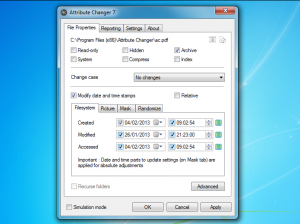 And as you browse the various tabs, so even more options appear. At its simplest, you can use the program to standardize the case of your selected files and folders in various ways (both the name and extension can be in upper or lower case). But if you need rather more power then there are all kinds of configuration options available. So you can have the program include or exclude particular files from modification if they match the criteria you specify, for instance (file names, dates, times, attributes and more).