Blog

  • Assassin’s Creed III “King Washington” DLC Coming February 19

    Since the launch of Assassin’s Creed III, all fans have been waiting for is the provocative DLC that depicts George Washington as a power-hungry tyrant. Today, Ubisoft finally announced that “The Tyranny of King Washington” will be released on February 19 for Xbox 360 and PC. PlayStation 3 owners will be able to download the update starting February 20.

    The DLC released at that will actually be the first of a “three-part tale,” according to Ubisoft. The first installment will be titled “The Infamy,” and show that George Washington has been crowned the king of the United States of America. The other two parts of the story will be coming as their own individual DLC add-on, and will have to be purchased separately.

    “The Tyranny” will cost $10/£8 or 800 Microsoft Points via Xbox LIVE. Assassin’s Creed fans who bought the Season Pass DLC bundle will be able to download the new content as soon as it is available, and all episodes of “The Tyranny of King Washington” will be included in the Season Pass.

    Ubisoft did not set a date for any upcoming DLC for the Wii U version of Assassin’s Creed III. It did, however, promise that all Assassin’s Creed III DLC will be coming to the Wii U in the future.

  • Where Are the Ray Krocs of the Social Sector?

    If you were offered the opportunity to finance a high risk, low return investment, how eager would you be to write a check? That is exactly the premise of most impact investing opportunities today. Until the return outweighs the risk, impact investing will remain a small niche category. To solve more social challenges in a financially sustainable way, we need to create opportunities with safe, dependable social and financial returns. It’s time to bring a proven business model to the social enterprise space: the franchise.

    Franchising has a special place in our economic system. It’s not sexy, but it’s effective. For example, it’s much less risky to franchise a restaurant than to start your own. That’s what Ray Kroc did: He franchised a McDonald’s, bought the company, and grew it to the largest restaurant chain in the world, with over 31,000 locations today, 80 percent of which are franchised. We need to find and support the Ray Krocs of the social sector, who can seek out promising social enterprise ideas sourced by philanthropic capital and take them to scale.

    Right now we’re effectively asking every social business to start from scratch. We conflate inventors with developers of social enterprises and romanticize the celebrity social entrepreneur. Instead, we should be searching for professional managers and investing in their capacity to turn a social entrepreneur’s vision into a scalable, sustainable business. We should package proven social business models that motivated franchisees could copy. These business people would spend their energy building the business in a new market not experimenting with an untested model. This would provide scale to social enterprises and reliable returns to those who invest in them.

    If we want to have an impact on a global level, we must stop using one-off social business models and find ways to replicate what works. Take Groupe SOS in France, one of the largest social enterprises in the world with 10,000 employees, one million beneficiaries, and $750 million in annual revenues. Over the past 28 years, they’ve refined nine different business models to serve traditionally excluded individuals. They’re now actively working to franchise these proven models to other geographies, most promisingly in Seoul, South Korea.

    To bring the franchise model to the social sector, we need to do four things:

    1. Determine which models work. We know there are great models out there but we need to understand which have gone through the proof of concept phase and are ready to be taken to the next level. To determine which are appropriate for franchising, we need to sift through the multiple channels — early-stage impact investing funds, academic field research, entrepreneurial competitions — and find social businesses that are successful and scalable.
    2. Package the essential elements of each model. A restaurant franchise buys the core elements of the business — brand, menu, advertising. But then they adapt those fundamentals to their environment to make it successful. The core pieces of a winning social enterprise model must be packaged in a way that’s portable to different environments. We aren’t naïve to think that one size fits all, but there’s a lot to be gained by bringing best practices and proven strategies to new geographies in thoughtful ways.
    3. Educate and “sell” to franchisees. Once the fundamentals of a working model have been packaged, we must help people find the opportunities. We can equip them with ready-to-launch models and the basic management skills to take them to new markets — everything from impact measurement to supply chain management. We might consider offering a training curriculum within a university or another organization that would educate the franchisee on the business model and effective management, and then provide both start-up and ongoing support.
    4. Support the franchises. Like a restaurant franchise that shares advertising costs, centrally develops new menu items, and shares other resources, we need to provide ongoing support for social impact franchisees. The nature of this support will vary, but this ability to spread the risk, reward, costs, and resources between the home office and independent franchisees is a core benefit. This two-way relationship will also improve the underlying business model as each franchisee provides valuable feedback on what’s worked and what hasn’t in his or her market.

    We need to match the willing, motivated people who can change the world if they’re given a blueprint with the vast amount of investment capital that wants the same. Right now we’re missing a huge opportunity that’s right in front of our noses. Instead of teaspoons of capital being spread across small entrepreneurs all over the world, we need to find proven models, capitalize them, train the management teams, and take them to scale. If we’re willing to let go of the artisanal nature of social enterprise, we can have global impact.

    Follow the Scaling Social Impact insight center on Twitter @ScalingSocial and register to stay informed and give us feedback.

  • McDonald’s Fish Now All-Sustainable

    Ever wondered what type of fish you’re getting when you order “Filet-O-Fish” at McDonald’s? Well, now you’ll know: wild Alaskan Pollack, which is now sustainable.

    The fast-food chain announced recently that they are now serving the Filet-O-Fish sandwich–and will be unveiling “Fish McBites” soon–using only fish that was sustainably caught, making it eco-friendly. The company will pay annual fees to the Marine Stewardship Council for the privilege of placing a bright blue “Certified Sustainable Seafood” label on the containers, which lets customers know that what they’re eating not only meets high standards for quality, it was also taken with care from the ecosystem.

    McDonald’s is set to unveil the Fish McBites in February for a limited time, but if they go over well, the restaurant could keep them on the menu for good. After a tough last quarter–in which sales were down from the same time last year–McD’s brought back the McRib sandwich off-schedule, knowing it would help reign in some diehard fans. Still, they don’t expect the coming year to magically take off, either.

    “By no means do we think 2013 is going to be an easy year,” CEO Don Thompson said.

    McDonald’s is joining competitors Wendy’s and Taco Bell in reinventing their menu, changing up the offerings to include healthier fare after receiving bad press in recent years due to customers complaining of health concerns. They say they’re also revamping stores all across the country, updating the look and offering longer hours.

    Images: Facebook

    mcdonald's fish

  • French Government Ditches ‘Hashtag’ for ‘mot-dièse’

    In an attempt to “encourage the presence of the French language on social media networks” against the influx of English language domination of the web, as well as to just be plain difficult, the French government is suggesting that people quit using the term “hashtag.”

    Instead, they suggest that people use the French term “mot-dièse,” which literally translates to “sharp word” – as in the musical symbol for a sharp. The government isn’t banning its citizens from using the word “hashtag,” but they will be officially replacing it with “mot-dièse” on all official documents and accounts.

    The Legifrance government page has a definition page for mot-dièse:

    Suite signifiante de caractères sans espace commençant par le signe # (dièse), qui signale un sujet d’intérêt et est insérée dans un message par son rédacteur afin d’en faciliter le repérage.

    With the aid of Google translate, that means “Suite signifying characters without spaces starting with # (hash), which indicates a topic of interest and is inserted into a message to his editor in easy identification.” So a hashtag, but not really.

    Some French Twitter users have been quick to point out the the musical sharp symbol is not perfectly swappable with the hashtag, as the sharp symbol has a slightly different lean to it.

    This news comes in the same week that a French court ruled that Twitter must give up the identities of some anti-Semitic users following a scandal involving an offensive hashtag.

    [The Local via Huffington Post]

  • Manage all of your downloads with EagleGet

    Downloading is such a fundamental part of the online experience that you might expect every browser to include a quality download manager by default. The standard offerings are usually a little more basic, though, so if you’d like some help in, say, downloading online videos more easily, then you’ll need to install a specialist download manager like the new EagleGet.
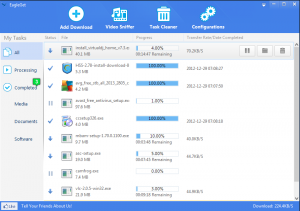
    This kind of tool is notorious for trying to drown your PC in adware during installation, but EagleGet is much more straightforward, for the moment at least: it’ll install itself, and nothing else at all. This might be because the program is still in beta, of course, but at the moment it’s safe to try.

    And the basics of the program seem easy to use, too. It installs add-ons for IE, Firefox and Chrome; intercepts regular download links, as you click them; and then claims its multithreaded approach can increase download speeds by up to 6 times. Any actual performance gains will be rather more variable, but it did work well enough in our tests, and of course can help you to resume a download if the connection has been broken for some reason.

    You need to download a video? That’s straightforward, too. Just browse to it as normal (YouTube, Facebook, Vimeo, all the main sites are supported), start playing, and hover your mouse cursor over the screen. Click the Download button when it appears, choose a file format and size if you’re offered a choice, and it’ll grab a copy for you.

    If you’re at a web gallery, or some other page with several files you’d like to download, then right-click, select “Download all links with EagleGet” and the program will list them for you. Entering a keyword lets you filter just the links you need — MP3, say, or perhaps JPG — and then it can download them all with a click.

    And the program provides other conveniences, including for example monitoring the clipboard, so if you copy a URL there then it’ll pop up and offer to download the file. (You can turn this off if it’s inconvenient, of course.)

    EagleGet is also very new, and still in beta, so unsurprisingly it has its share of issues. And most are trivial, like the number of spelling mistakes throughout the interface, or the way it insists on displaying its tiny status toolbar all the time, even when the rest of the application has been minimized.

    More substantially, though, the program doesn’t provide as much choice when downloading YouTube videos as we’d like. (Sometimes it’ll offer no choice at all, sometimes you’ll get a few file sizes, but it’ll never tell you which size relates to what resolution.)

    And in one significant beta bug, we found we were no longer able to use WordPress in IE with the EagleGet add-on installed; for some reason the browser no longer allowed us to complete multiline text boxes. The problem didn’t seem to affect other browsers, but that’s still totally unacceptable, and hopefully it’ll get fixed soon.

    EagleGet currently has some problems, then, but already it’ll work very well for many users, and it looks like a very promising tool. If you’re unhappy with your current download manager then this is certainly one to watch.

    Photo Credit: Colin Edwards Photography / Shutterstock

  • Linden Labs Acquires Blocksworld

    San Francisco-based Linden Lab, the maker of Second Life, has acquired iPad game Blocksworld. Terms were not released. Blocksworld is a game in which players use cubes, wedges, rockets, wheels, and motors to create 3D models.

    PRESS RELEASE

    Linden Lab, the makers of Second Life®, Creatorverse TM, Patterns TM, and other shared creative spaces, today announced that it has acquired the iPad game Blocksworld. Linden Lab will offer the game globally and will release it for new platforms, as the Blocksworld team joins the company.

    Blocksworld is an iPad game in which players use cubes, wedges, rockets, wheels, motors and more to easily create 3D models of anything they can imagine – from race cars to animals to robots and more. These models come alive with realistic physics simulation, and users can play, interact with, or even explode their creations. As with Linden Lab’s Creatorverse, Blocksworld allows users to share their creations with others to explore, play with, and remix to make them their own.

    “Blocksworld is a great fit with what we do at Linden Lab,” said Rod Humble, CEO of Linden Lab. “It’s a very user-friendly complement to our portfolio of shared creative spaces. We’re happy to have the Blocksworld team join Linden Lab and are looking forward to bringing Blocksworld to the App Store worldwide soon!”

    iPad is a trademark of Apple Inc., registered in the U.S. and other countries. App Store is a service mark of Apple Inc.

    About Linden Lab

    Founded in 1999 and headquartered in San Francisco, Linden Lab makes shared creative spaces that inspire and empower users to explore and share their creativity with others.

    In 2003, the company released Second Life, the pioneering virtual world filled by the unique creations of its users, who can build anything they can imagine, socialize with others from around the world, and share or sell their creations in a thriving real-money marketplace.

    Linden Lab has now expanded its portfolio to include new digital entertainment products, including Patterns, a new 3D universe for users to shape, and Creatorverse, a tablet and mobile game that allows users to set their creativity in motion.

  • Front Flip Inks $3.75M

    Front Flip, a Leawood, Kansas-based loyalty marketing company, has raised $3.75 million in Series B financing. The new round brings Front Flip’s fundraising total to $7.7 million. Front Flip’s Series B funding was led by Jon Darbyshire, executive chairman of the Archer Foundation.

    PRESS RELEASE
    Loyalty marketing company Front Flip (www.frontflip.com) today announced it has raised $3.75 million in Series B funding. The new round brings Front Flip’s fundraising total to $7.7 million.

    Front Flip delivers a fun and exciting loyalty program that helps businesses create profitable, long-term relationships with their customers. Restaurants and retailers use Front Flip to increase visit frequency, boost sales and generate social buzz.

    The company’s client portfolio includes franchise groups from major concepts like Kentucky Fried Chicken, McDonald’s, Wendy’s and Famous Dave’s.

    McDonald’s Franchise Co-Owner Todd Luther has seen sales at his eight Fort Collins, Colo. locations increase by as much as 1.5% since adopting Front Flip. “We’re engaging our customers more than ever, and they enjoy and appreciate it. The extra smiles and sales prove it,” said Luther.

    Using the free Front Flip mobile app, customers scan a unique QR code every time they visit a participating business to unlock a digital scratch card. Every scan is a chance to win an instant promotion. Customers can also receive gifts and rewards in the mobile app and share them with friends.

    Front Flip’s Series B funding was led by Jon Darbyshire, executive chairman of the Archer Foundation. Darbyshire previously founded Archer Technologies, which sold to EMC in 2010.

    “We believe Front Flip has the potential to fundamentally change the way major brands build and maintain loyal relationships with their customers,” said Darbyshire.

    Some of Kansas City’s most prominent and successful entrepreneurs also contributed to Front Flip’s second round of funding. They include:

    Peter Brown, the former chairman, CEO and president of AMC Entertainment Inc.
    Gary Fish, founder, president and CEO of FishNet Security, the largest, independently owned information security solutions provider in the U.S. with revenues of more than $400 million.
    Lance Melber, who founded and sold eSmartloan.com to Capital One for $155 million
    The Brandmeyer family, which founded and sold Enturia to Cardinal Health Inc. for $490 million

    “We continue to add locations for national concepts, regional chains and local businesses to our loyalty program. With this new round of funding, we can provide additional resources to our clients and continue to roll out our go-to-market strategy nationwide,” said Front Flip CEO and Founder Sean Beckner.

    Beckner says the additional funds will also support staff expansion and ongoing feature enhancements to the Front Flip Loyalty Marketing solution.

    About Front Flip
    Front Flip is the next generation of loyalty marketing. We’re not another punch card on a mobile app. Instead, we help businesses create profitable, long-term relationships with their customers through fun experiences, instant promotions, rich customer analytics and targeted mobile campaigns. Front Flip works with local shops, regional chains and national concepts to help them achieve significant jumps in traffic and sales in the first 90 days. For more information, visit frontflip.com or call 855.730.1830.

  • Hennessey Venom GT 0-300km World Record Run – TUNED

    Hennessey Venom GT World Record

    When the guys from TUNED were asked to fly down to Houston, TX and join John Hennessey as he made a record setting run to 186 mph in just 13.36 seconds, they really couldn’t say no. I mean hell, even the guys guy from Guinness World Records was on hand. Click through and check out the video.

    Source: Youtube.com/DRIVE

  • Sony Entertainment Network launches with movies, games and TV shows

    If you are looking to cut the cord to your cable or satellite provider, you have an ever-increasing number of options to fill that sudden void. There’s Hulu, Netflix and the recent Redbox Instant, and that’s just a few of the big players. And now there’s another option. Sony, still a giant in the entertainment business despite lagging profits, has launched its Entertainment Network in the United States, Canada, Mexico, and Brazil.

    Sony has previously made some of its content available via its Crackle service, which can be accessed both online and through a mobile app. However, that service has a pretty limited amount of material, especially when compared to the new Sony Entertainment Network.

    There’s not just movies and TV shows here, but games as well. Movies are available for both rental and purchase and there are even some bonuses — Paranormal Activity 4, for instance, is available for purchase (for $12.99) even though it is not yet out on DVD or Blu-Ray.

    Clicking a movie or TV show displays a star rating, a list of actors and a brief plot synopsis. Games give similar information, and in many cases are available at a discounted price. Little Big Planet Karting, as an example, is regularly sold for $19.99, but priced here for $10. There are also demos and betas to try out.

    Obviously all available material is from Sony — there aren’t currently any partnerships with other studios — however, Sony has a massive catalog, so there’s definitely no shortage of choices here.

  • ViaWest Names Bob Newman COO

    Privately held data center and cloud computing company ViaWest has named Bob Newman as the company’s chief operating officer. Newman joined ViaWest in 2010 as senior vice president of service delivery.

    PRESS RELEASE

    ViaWest, one of the largest privately held data center, cloud computing and managed service providers in North America, announces that Bob Newman has been appointed as the company’s Chief Operating Officer. Newman will be responsible for ViaWest’s operations, including data center management, service delivery, service support, information technology, engineering, security, compliance and customer relations.

    “ViaWest’s commitment to technical and service excellence starts with its people and it’s an honor to lead our Service Management and Support department,” states Newman. “This group goes above and beyond for our customers on a day-to-day basis. 2012 was a standout year for the company, with growth across each of our regions and significant additions to our product portfolio. Building on ViaWest’s strong foundation, 2013 will be a year of continued momentum and growth.”

    “We are excited to elevate Bob to Chief Operating Officer,” says Nancy Phillips, President and CEO of ViaWest. “His extensive experience and expertise will be critical as he spearheads ViaWest’s operations and its customer-centric focus on service excellence.”

    Newman joined ViaWest in 2010 as Senior Vice President of Service Delivery. His previous information technology management experience includes leadership roles at the LDS Church in Salt Lake City and with Infocrossing, a selective IT outsourcing company, where he succeeded in earning positive customer satisfaction ratings while achieving revenue growth and margin improvement.

    For additional information on Bob Newman and other ViaWest executives, please visit http://www.viawest.com/about-viawest/our-people/management.

    For more information on ViaWest’s highly redundant data centers and secure infrastructure services, please visit www.viawest.com.

    About ViaWest
    ViaWest is one of the largest privately held data center service providers in North America, providing colocation, complex hosting, cloud, and managed services to businesses of all sizes nationwide. ViaWest owns and operates 24 enterprise-class data center facilities in Colorado, Texas, Oregon, Utah, and Nevada, delivering high-quality, flexible solutions designed to support customers’ unique business needs. For additional information on ViaWest, please visit www.viawest.com or call 1-877-448-9378. Follow ViaWest on LinkedIn, Twitter or visit their YouTube channel.

  • Reuters – Blackrock Owns 5% of Societe Generale

    U.S. asset manager BlackRock has a stake of just over 5 percent of French bank Societe Generale, French market regulator AMF said on Friday, Reuters reported. The disclosure was made after BlackRock’s holding – acquired on and off the market – rose above the 5 percent threshold at which such disclosures are mandatory.

    (Reuters) – U.S. asset manager BlackRock has a stake of just over 5 percent of French bank Societe Generale, French market regulator AMF said on Friday.

    The disclosure was made after BlackRock’s holding – acquired on and off the market – rose above the 5 percent threshold at which such disclosures are mandatory.

    On behalf of clients and funds under management, BlackRock now has a 5.002 percent stake in SocGen and 4.48 percent of voting rights in the group, according to the AMF filing.

    A BlackRock spokesman in London said the asset manager did not comment on individual company holdings.

  • Citing Sandy, Data Center Firm Adds Disaster Recovery Space

    xand-DataCenter

    A look inside the Xand data center in Westchester County, New York. Xand is adding 35,000 square feet of disaster recovery space. (Photo: Xand).

    Data center and managed services provider Xand has added new disaster recovery space, citing increased demand in the wake of Hurricane Sandy as the impetus for the move. The 35,000 square feet of new dedicated and shared workspace will be added to its facilities in Marlborough, Mass. and Hawthorne, N.Y. The new space will be available to clients as private suites, shared workspace, and combinations of both, and is scheduled to be online during the first quarter of 2013.

    “During Hurricane Sandy, we enabled a multitude of businesses and organizations to rapidly rebound from the devastating effects of the storm,” said Yatish Mishra, Xand’s President and CTO. “With the addition of over 35,000 square feet of brand new workspace, we’re excited to offer even more disaster recovery options for our existing customers, while continuing to welcome new clients who are reassessing their current business continuity needs.”

    1,000 Customers On-Site During Hurricane

    Xand has six facilities, which provided a home to nearly 1,000 customer staff members during Hurricane Sandy, with over half of those folks at the Valley Forge, Pennsylvania facility. The company says it was able to accommodate several new clients, as well whose previous providers couldn’t meet their Recovery Time Objectives (RTOs).

    Xand maintained 100 percent uptime in all of their data center facilities during the storm. All six of Xand’s locations are well-positioned within 30 to 90 miles of New York, Boston and Philadelphia.

    “Everyone in the Northeast has heeded the lessons of Hurricane Sandy and Xand is stepping up to the table as well,” said Mishra. “We’ve seen a strong market demand for disaster recovery solutions, housed not just in secure facilities, but also on our cloud platform. The timing is perfect right now for more expansion to meet this increased customer demand.”

    Xand’s disaster recovery offerings include replication, online vaulting and electronic backups and cloud recovery, as well as traditional tape, physical asset recovery, shared and dedicated workspace and other custom designed applications. In 2011, Xand was acquired by private equity firm ABRY Partners to grow its footprint and market presence.

    Nicole Henderson at theWHIR notes a few other post-Hurricane Sandy disaster recovery moves: Nirvanix offered a “Disaster Avoidance Program” to move customers away from its data center in New Jersey before the storm hit, while Advanced Internet Technologies offered a free month of hosting to any company that experienced downtime or data loss with any other web host caused by Hurricane Sandy.

  • Digital by default – a new reality for development?

    A few weeks ago I went to see the new James Bond film Sky Fall. Without giving away too much, at one point in the film James Bond goes to a remote part of the UK. The area is portrayed as far away from the hustle and bustle of London and as remote from government as possible. Living in Scotland, I immediately recognised the location as the beautiful Glen Coe. But what I found slightly at odds was that although Glen Coe is remote, the fact is that in this day and age I could probably still stay connected to all my government work from there.

    This “new reality” hit me this week when I participated in a flagship event called SPRINT13, organised by the UK’s Government Digital Service (GDS). GDS are a new team that have embarked on a huge set of projects with a range of government departments. The aim of these projects is to go beyond providing open data to make what government does more responsive to citizens, and cheaper.

    The old has left town and a new digital reality is coming to you – January 2012

    For instance, as I heard at the conference, the Department for Environment, Food and Rural Affairs is planning, in less than two years, to administer all support to UK farmers online. This will slash costs at the same time as breaking up the work so that small and medium companies can bid to create and manage the IT system for the payments. Generally, as outlined in this Economist article, transaction costs can be brought down by 20 times if departments “go digital” rather than use paper, by 30 times if they go digital rather than use post, and by 50 times if their online services replace face-to-face transactions.  There are many other examples on the GDS blog, all equally inspiring.

    All this inspiration got me wondering to what extent DFID incorporates these ideas when we work with governments in developing countries.

    We all know the stats – the fact that Africa’s mobile phone market has expanded so much it’s become larger than the EU or US markets with over 650 million subscribers. Hundreds of new broadband cables have been laid across African countries, as this presentation outlines. This infographic provides a great illustration of this transformation, and there is more up-to-date data in this report from the African Development Bank, African Union and World Bank.

    The transformation is something governments in developing countries recognise. Take Kenya, which has a multi-pronged digital strategy. Over 60 villages and schools are benefitting from digitisation, through an initiative known as “Pasha” Centres. A new “sillicon valley” of East Africa called “Konza” is being built. Government data is increasingly being published online. Such changes are happening elsewhere too, and some of the top global apps that help reduce poverty have benefited from UK aid.

    At the same time, there’s a long way to go.  According to World Bank data, here in the UK, 82% of people have access to the internet. So it makes sense that the government is aiming for all of our services that handle over 100,000 transactions per year to be “digital by default” by 2015 – from making farm payments to collecting road taxes, to using the internet to update health records after treatment.  Only 12% of people in Sub-Saharan Africa currently have internet access – the rationale is not the same.  But it is also changing rapidly. A new form of satellite broadband is being developed to bring millions more online. Chinese and UK/France companies are partnering to launch a new browser, cleverly tailored to low-cost smartphones to provide quick access to very familiar apps like Facebook and Twitter in English and Arabic.  This will increase demand. The key, as with the changes GDS has made, is to make the technology “locally relevant” – keeping the citizen, the end user, in mind.

    At SPRINT13, it slowly dawned on me that any government that doesn’t keep up with this new digital reality will not only be left in the dark, it will also face mounting costs.

    A few weeks ago, DFID launched our Digital Strategy, along with several other government departments, which outlines all the work we are doing to take on board this “new reality”. Unlike James Bond, even if we work in remote places, we really don’t want to be difficult to reach.  In fact, we want your creative ideas on how going digital can help us do more for development. So please do feedback below!

  • CCleaner 3.27 adds support for Internet Explorer Metro in Windows 8

    Piriform has released CCleaner 3.27, a minor update for its popular Windows free cleaning tool. CCleaner 3.27, also available in portable form, basically adds updates for major new browser releases, including support for Internet Explorer Metro in Windows 8.

    The release is joined by Speccy 1.20, a minor update of Piriform’s system information tool, which adds version number detection for a number of major apps.

    The key improvements in CCleaner 3.27 are aimed at improving support for Windows 8 users. Version 3.27 adds support for cleaning both the cache and history in Internet Explorer Metro, the full-screen app found in the Windows 8 Modern UI.

    The update also adds support for the latest stable build of Google Chrome — v24 — and improves compatibility with Firefox 17 and newer builds, including the latest stable release. Other enhancements include better compatibility with Google Chrome extensions, improved Unicode text support and a new Burmese translation. The update is rounded off with the usual GUI tweaks and bug fixes.

    The update follows hot on the heels of the release of Speccy 1.20.446, which adds a number of new features, including the ability to detect the versions of Internet Explorer, Java and Windows PowerShell. Speccy 1.20 also claims better detection of SSD and larger hard drives, plus improved anti-virus detection of server OSes.

    Both CCleaner 3.27 and CCleaner 3.27 Portable, plus Speccy 1.20.446 and Speccy 1.20.446 Portable, are available now as freeware downloads for PCs running Windows XP or later.

    Photo credit: Goydenko Tatiana/Shutterstock

  • Data Center Power Loss Hits NJ Government Sites

    Web sites for state agencies in New Jersey were knocked offline Thursday afternoon by a power loss at a data center, disrupting access to state services and causes motor vehicles offices statewide to close early, according to multiple media reports.

    The outage caused “disruptions across many state departments and agencies frequently used by the public,” according to the state Treasury Department, which manages information technology. “The source of the outage has been identified and is now being addressed by the staff and contractors of the State Office of Information Technology, who will work continuously until the problems are addressed,” the Treasury statement added.

    The outage began at about 2 p.m., and state web sites returned to service by about 8 p.m. and appear to be operating fine this morning. The web sites are hosted in facilities operated by the NJ Office of Information Technology near Trenton, N.J.

  • Could the Middle East Fuel the Solar Industry?

    “Ten years ago we met in Saudi and said ‘someday we’ll be sitting in the middle of the desert talking about renewable energy.’ And here we are.” The speaker was an academic at Sydney’s University of New South Wales, and we met last week at a vast trade show in Abu Dhabi called the World Future Energy Summit. On display were wind turbines, systems to control homes and electric grids as one integrated entity, equipment to clean solar panels, and the like, in a space as large as a dozen football fields, lit by powerful LED chandeliers fifty feet above.

    I was there on behalf of Ernst & Young’s Cleantech Center to lead a conversation about how a solar power industry could take shape in the Middle East. While there have long been voices supporting renewable energy in the Gulf, and solar generation projects elsewhere have now demonstrated their efficacy and reliability (reducing the technological risk), major projects have not been undertaken in the region — and those smaller ones that have contain little local content. They are all provisioned and managed by the global companies exhibiting in the hall. The 30 people in our group, about half from the Gulf, were asked to think about what it would take to change that.

    As it happens, while I was there the Financial Times reported on an OECD/WTO study that proposed a major change in how countries’ exports are reported; it said that rather than the whole value of final goods exported, only the portion of value added within a country should be reported. This would mean, for example, that when China shipped an iPhone overseas, the value of that export would not be reported as $176, as it is today, but rather as that amount minus the value of whatever parts had been imported. It turns out China’s value added to the imported parts is $6.50 per unit. (The US parts shipped, by the way, are worth $10.75.) Thus some $2 billion of reported Chinese exports would be reduced to $73 million. One startling implication of the value-added method is that that “for goods produced globally, high tariffs and other barriers on imports act as a tax on exports, jeopardizing economies and jobs rather than protecting them.” Overall, the logic reinforces the argument that free trade, allowing nations to exploit their natural and man-made advantages, leads to the best economic outcomes.

    Accordingly, the E&Y discussion about the Gulf countries focused on what value-adding capability could be the basis of a local solar industry. With the most important output of the region, oil, the value added is in bringing it out of the ground for refining elsewhere.

    Few in this discussion saw much opportunity in solar power’s engineered equipment. The idea that the Saudis or Emiratis, for example, might compete with Taiwan in producing solar panels, or with Germany for developing the control systems, was met with great skepticism. Meanwhile, as targets are set to expand the installed capacity for solar electricity, many foresaw real difficulty in attracting capital to finance the projects that would yield those extra gigawatts. (The Gulf countries’ policy is, broadly, to prefer to invest alongside international financiers.)

    You might wonder why, in a land rich with oil, there is any motivation at all to develop a solar industry. But consider the reward when any of the region’s own use of oil is displaced by alternative energy. A substance that is sold locally for about $5/barrel becomes available to the rest of the world, earning the oil-exporting countries an additional $100/barrel. Thus, as this group recognized, another element of the solar value chain — money — would become more locally abundant. Could it be the component the region could specialize in supplying?

    Today, financing is a critical barrier to solar projects worldwide. The risks have not been standardized in a way that eases participation for traditional lenders and investors. The E&Y discussion put these ideas together, and came up with the notion of a Saudi Solar Bank. (It could be the Gulf Solar Bank, but where’s the alliteration in that?) The vision is for such an institution to become the world’s expert in the risks of solar investment. As in all realms of investment, greater knowledge leads to improved selectivity and thus a reduced risk premium. The SSB would add value through its unique understanding of the solar industry. As a matter of policy, it would not require international investors — it would develop its comparative advantage to the point where it could invest on more favorable terms for solar projects than others would, and still make money, by drilling deeper into the risks, you might say. In the process, it would jumpstart the solar industry worldwide.

    We noted that a formal plan to make this idea reality would not only capitalize on the region’s natural endowments; it would also be consistent with stated aims to increase the knowledge content of its economies.

    In effect, oil producers would launder their non-renewable resource into cash, and then apply those funds to sustainable energy — a growing global solar industry to which they were as important as the Taiwanese solar panel makers. In so doing, they would serve the desire to replace their economies’ non-renewable value-added with a more, umm, refined activity, and achieve local growth goals, too.

  • Apple’s 2013 Supplier Responsibility Report Includes 72% Bump In Audits For 2012, 97% Increase In Training

    accountability_audits_2x

    Apple has released its 2013 Supplier Responsibility Progress Report, and it features a number of updates from last year, including Apple’s decision to join the Fair Labor Association (a notable first), and conduct audits of its suppliers in tandem with that outside watchdog organization. The results seem to be a tightening of Apple’s code of conduct for suppliers all around, in terms of monitoring, penalties and programs to improve conditions.

    Apple conducted 72 percent more audits in 2012 than it did in 2011, for example, totaling 393 audits across facilities employing 1.5 million workers. All types of audits increased for the year, including firs-time, repeat, process safety assessments and specialized environmental audits, but the last one took the biggest jumps vs. previous years. In 2012, Apple conducted 55 focused environmental audits, which is a 293 percent increase over the number it ran in 2011. The Mac maker works with outside associations in this area, too, just as it does with the FLA regarding labor, including the Natural Defense Council, the EPA and the Institute of Public and Environmental Affairs.

    The supplier audits also actually resulted in more severe punitive action than usual. Apple has faced criticism in the past for doling out corrective measures that seem rather toothless – most often putting suppliers “on probation,” meaning they’ll be watched more closely for future violations. But one supplier fell afoul of Apple’s measures to protect against underage labor, with 74 cases counted at a single facility. Apple terminated the relationship with that offending party entirely, proving that there are real consequences for companies that ignore its code of conduct and local labor laws.

    Apple also came down harder on companies for compliance with working hour regulations, and changed its policies and practices in monitoring them to be more effective. In 2012, Apple started doing real-time work hour tracking on a weekly basis for over 1 million of the employees at its supplier companies, and publishing data on its progress every month. That led to a 92 percent compliance rate with its 60 hour maximum work week, as laid out in the Apple Supplier Code of Conduct, and Apple says overall work weeks averaged less than 50 hours.

    Another area of improvement for Apple was in participation in its training and education programs. There were 1.32 million workers trained on local laws, worker rights, health and safety and Apple’s own Code of Conduct during 2012, a 97 percent increase over 2011′s 670,000. Apple also provided more free educational opportunities to workers than ever before, with 201,000 cumulative participants in those programs, up 235 percent from 60,000 in 2011.

    Apple’s transparency definitely improved over the course of 2012 when it comes to its efforts around supplier responsibility and maintaining healthy and safe work environments, and that’s something Apple CEO Tim Cook clearly undertook as a conscious effort. That’s not to say that Apple didn’t have its fair share of labor issues during the year (issues around the demanding requirements for building the iPhone 5 come to mind), but especially in the way that Apple has allowed disinterested third parties to come in and aid with its monitoring efforts, 2012 was definitely the most significant year yet in terms of improvements made to its stance on supplier responsibility.

  • Data Center Links: Limelight Appoints New CEO

    Here’s our review of some of this week’s noteworthy links for the data center industry:

    Limelight appoints new CEO.  Limelight Networks (LLNW) announced the appointment of Robert Lento as chief executive officer, effective immediately. Mr. Lento has been serving as the Company’s Interim CEO since November 2012. With over 30 years of experience Lento spent 14 years at Convergys, serving a decade as the senior sales executive. Lento will be joining Limelight’s board of directors. Former CEO Jeff Lunsford is stepping down as board member and chairman. ”Over the past two months I’ve had the opportunity to work closely with our board and many of our employees,” said Lento. “I’m extremely impressed with the people, products, and services we offer in the market. I’m excited about our future and proud to be part of Limelight Networks.”

    Nirvanix announced that its cloud storage services offering will be available in the Intel AppUp SMB Service, a subscription-based service built on the Intel Hybrid Cloud Platform. MSPs (Managed Service Provider) can nowNirvanix adds cloud storage to Intel AppUp SMB Service. offer their SME and SMB customers enterprise-level cloud storage services for on-demand, secure storage, specifically designed for backup, archiving, and recovery of business data anytime, anywhere, from any device. Leveraging the integrated and easy-to-install solution comprised of Nirvanix CloudNAS gateway software and the Intel Hybrid Cloud Platform, customers can start backing up and archiving data to the Nirvanix cloud in minutes. ”SMB customers are looking for cost-effective ways to manage exploding data growth. With the Intel AppUp SMB Service, we are providing MSPs with industry-proven solutions they can offer their customers,” said Bridget Karlin, General Manager at Intel. “Adding solutions like the Nirvanix service allows us to enable MSPs to offer leading enterprise-class cloud storage as part of their SMB customers’ Intel AppUp SMB Service subscription. This gives customers on-demand, secure, usage-based storage capacity for backup and archiving applications.”

    Nimblestorage selected by Virtacore for cloud services.  Nimble Storage announced that Virtacore Systems, a leading cloud services provider that specializes in virtual infrastructure solutions utilizing VMware, has made the Nimble Storage CS-Series a core element of their cloud infrastructure framework. Using the high-performing Nimble Storage CS-Series, Virtacore expanded their Cloud Services offering to include large databases and performance-oriented workloads including Business Intelligence, Oracle and SQL Server based transactional databases—expanding opportunities for growth. “Nimble Storage is committed to building successful partnerships with the service provider community and helping them succeed,” said Suresh Vasudevan, CEO, Nimble Storage. ”Virtacore is a great use case on how the SmartStack ecosystem delivers highly scalable and efficient to deliver ROI.”

  • Clearview Capital Exits Hillsdale Furniture

    Clearview Capital has exited its investment in Hillsdale Furniture, selling the company to an investor group led by Brookside Equity Partners and management. Louisville, Kentucky-based Hillsdale is a designer, importer and marketer of residential furniture. Clearview’s investment in Hillsdale was made through a 2002 vintage fund. Terms were not released.

    PRESS RELEASE
    Clearview Capital, LLC of Old Greenwich, CT has successfully exited its investment in Hillsdale Furniture, LLC (“Hillsdale”), with the sale of the company to an investor group led by Brookside Equity Partners and management.
    Based in Louisville, KY, Hillsdale is a designer, importer and marketer of residential furniture.
    “Despite an extraordinarily difficult environment for furniture companies that resulted in wrenching change throughout the industry, Hillsdale’s terrific management team achieved market share gains and consistent profitability during the course of our investment”, said Calvin Neider, Co-Managing Partner of Clearview Capital. “We part with Hillsdale knowing the company will continue to thrive with its new equity partners.”
    Clearview’s investment in Hillsdale was made through a 2002 vintage fund which is nearly fully realized. Clearview is now investing through Clearview Capital Fund II,

    LP which seeks to acquire and develop lower middle market companies in sectors including business services, health care services, design/importing, distribution and manufacturing.
    Green, Holcomb & Fisher served as financial advisor and Loeb & Loeb, LLP served as legal advisor to Hillsdale.
    Clearview’s other holdings include Battenfeld Technologies, Inc., a leading designer, developer and supplier of branded shooting and hunting accessories to the outdoor sporting goods industry; GCR, Inc., a professional services firm delivering consulting services and technology solutions to governmental and commercial clients; Child Health Holdings, Inc., d.b.a. Pediatric Healthchoice, the country’s largest operator of prescribed pediatric extended care centers; Pyramid Healthcare, Inc., a provider of in- patient and out-patient behavioral health services; The Results Companies, LLC, a provider of outsourced customer management solutions; QualSpec Group (f.k.a. All Tech IESCO), a provider of inspection and non-destructive testing services to the refining, petrochemical market and other industrial process industries; Rowmark, LLC, a manufacturer and marketer of specialty plastic sheet and related products for the awards/recognition, engraving and signage markets; Senior Care Centers of America, Inc., the country’s largest operator of adult day care centers; and a minority interest in Compression Polymers Group, the leading extruder of thick gauge polyolefin and PVC sheet, including AZEK® brand trim boards.

  • Distil.it Raises $1.8M in Seed Funing

    Distil.it, a maker of a cloud-based enterprise service to protects website content from scraping and malicious bots, has raised $1.8 million in seed financing. The round was led by ff Venture Capital with participation from Correlation Ventures, Idea Fund Partners, CIT, Piedmont RIA, Cloud Power Fund, and TechStars.

    PRESS RELEASE
    Distil.it, the first cloud-based, intelligent gatekeeper for website content protection, announced today that it has secured $1.8 million in series-seed funding. The round was led by ff Venture Capital with participation from Correlation Ventures, Idea Fund Partners, CIT, Piedmont RIA, Cloud Power Fund, and TechStars.

    Distil offers a premium, cloud-based enterprise service that protects website content from scraping and malicious bots while accelerating website performance using their global network. Since completing the inaugural TechStars Cloud class in early 2012, the company has rapidly grown its customer base across some of tech’s most lucrative online verticals including social media, e-commerce, travel, digital publishing, and directories.

    “Companies don’t realize that their websites are being attacked everyday. That they are losing money and sensitive information to web scraping and bot attacks,” says John Frankel, Partner at ff VC, who joins Distil’s board. “Distil.it has proven with top companies, such as cult of mac, that their product can effectively block these attacks, stop the loss of data and enhance revenues.”

    Distil’s Content Protection Network (CPN) protects a business’ web visitors, search engine ranking, and consequently website revenue by making real-time decisions on the validity of each website connection through patent-pending algorithms. Distil’s platform seamlessly distinguishes search engines and human visitors from malicious bots and harmful traffic with no false positives. In addition, the Distil service accelerates content, improving page load times and reducing server load.

    “Rami Essaid is a dynamic CEO. He is a true visionary with demonstrated business, as well as technical skills,” says Lister Delgado, Director of Distil and Managing Partner at IDEA Fund Partners.

    A content protection visionary, Distil Co-Founder and CEO Rami Essaid has been recognized as a ’30 under 30′ and one of Fourteen Entrepreneurs to Watch by Under30CEO. “We saw a fundamental flaw in how data was shared on the internet; it was the wild west with bots harvesting and stealing anything they wanted to,” says Rami Essaid. “Our vision is to allow website owners to regain control of their data and stop bots from menacing the web.”

    Research conducted by Distil indicates that the total web scraping defense market exceeds 1.8 Billion dollars annually. Gartner Research confirms the tremendous opportunity ahead for Distil and their Content Protection Network, asserting, “Demand for Web fraud detection software and services are at an all-time high.” Gartner Research estimates that the web-fraud market grew by 35% between 2010 and 2011.

    For more information please visit distil.it

    About Distil.it

    Distil is the leading Content Protection Network (CPN) and the first cloud-based, intelligent gatekeeper for website content. Distil’s CPN makes real-time decisions and seamlessly distinguishes human visitors from malicious bots. Distil mitigates against duplicate content, improves SEO power, and accelerates the end-user experience – all while reducing server load and infrastructure demand.

    Distil’s mission is to provide enterprise class protection safeguarding commercial and individual content producers. Protect your content, your brand, and your revenue without impacting your end-user experience.

    For more information, visit distil.it and follow us on Twitter @distil.

    About ff Venture Capital

    ff Venture Capital (ffvc.com) is an institutional venture capital investor in seed-stage companies. Since 1999, our Partners have made over 160 investments in over 55 companies. Our exits include Cornerstone OnDemand (IPO, CSOD) and Quigo Technologies (sold to AOL for a reported $340m). ffVC has a dozen employees based in New York and New Jersey and extensive resources dedicated to portfolio acceleration, including strategy consulting, an experienced mentor network, recruiting assistance, a pool of preferred service providers, an executive portfolio community, and in-house accounting services.

    About IDEA Fund Partners

    Headquartered in Durham, NC, IDEA Fund Partners provides seed and early stage equity funding along with company building expertise to IT, software, materials technologies and medical device companies in the Southeast and Mid-Atlantic regions. Currently investing out of its first fund, IDEA Fund Partners has invested in fourteen companies since 2007. Learn more at www.ideafundpartners.com . For IDEA Fund Partners press inquiries please contact: Matt Barber by email at [email protected], or phone 919-941-5600 x104.