
Blog

  • Foursquare Integrates School Stats from ProPublica

    Foursquare has been getting better over the past year or so by adding more information to check-ins. Their list of connected apps has grown to include some pretty useful apps like GeoPollster, which will tell you if the business you just checked-in at supports Democrats, Independent, or Republican candidates with their campaign contributions. Or After Credits, an app that I particularly like which tells you whether or not you need to stay for any bonus scenes after the movie you just checked-into.

    Today, Foursquare is announcing a new connected app – ProPublica’s Opportunity Gap.

    When you check into a school, the app will give you a fact about the school: facts like “did you know 7% of students at PS 234 Independence School receive free or reduced lunch?”

    You can then click through to access a more-detailed set of statistics like the number of students, teachers, AP courses offered, “inexperienced teachers,” and more.

    “With their new Foursquare integration, you can connect your Foursquare account to instantly see statistics for schools you’ve checked in to before. And when you’re out, you can instantly get stats about a school on your phone whenever you check in to one. It’s a great example of how news organizations can use Foursquare to reach their readers with relevant information when they’re out in the real world,” says Foursquare.

    “A year ago when we launched the first version of our “Opportunity Gap” news application, we tightly integrated Facebook in order to make it easy for readers to compare schools and share their school comparisons. Today’s relaunch adds Foursquare, along with adding a slew of new data to the app as well as algorithmically generate narratives by Narrative Science,” says ProPublica.

    Data should be available for around 50,000 schools, they say.

    You can connect your Foursquare account to the app and start receiving school info by going here.

  • New From NAP 2013-01-24 16:20:49

    Final Book Now Available

    This is the 16th Volume in the series Memorial Tributes compiled by the National Academy of Engineering as a personal remembrance of the lives and outstanding achievements of its members and foreign associates. These volumes are intended to stand as an enduring record of the many contributions of engineers and engineering to the benefit of humankind. In most cases, the authors of the tributes are contemporaries or colleagues who had personal knowledge of the interests and the engineering accomplishments of the deceased. Through its members and foreign associates, the Academy carries out the responsibilities for which it was established in 1964.

    Under the charter of the National Academy of Sciences, the National Academy of Engineering was formed as a parallel organization of outstanding engineers. Members are elected on the basis of significant contributions to engineering theory and practice and to the literature of engineering or on the basis of demonstrated unusual accomplishments in the pioneering of new and developing fields of technology. The National Academies share a responsibility to advise the federal government on matters of science and technology. The expertise and credibility that the National Academy of Engineering brings to that task stem directly from the abilities, interests, and achievements of our members and foreign associates, our colleagues and friends, whose special gifts we remember in this book.

    [Read the full report]

    Topics: Biography and Autobiography

  • Microsoft Q2 2013 by the numbers: $21.5B, 76 cents EPS

    Late this afternoon, Microsoft answered a question oft-asked by investors this month: What’s up with Windows 8? The new operating system, which launched October 26, was supposed to lift sagging PC sales and demonstrate the capability to successfully compete with so-called post-PC platforms like Android and iOS. Now we know more. Windows & Windows Live revenue passed Business, making the OS division most-valuable again.

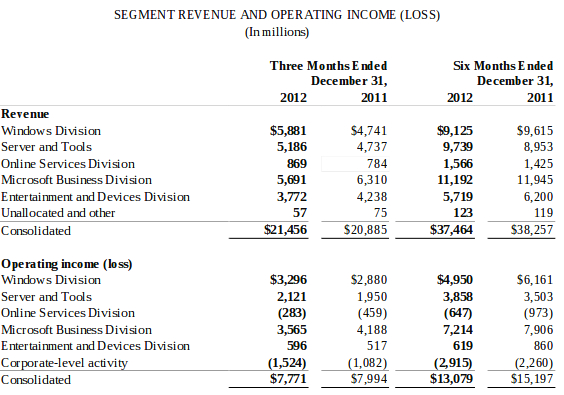
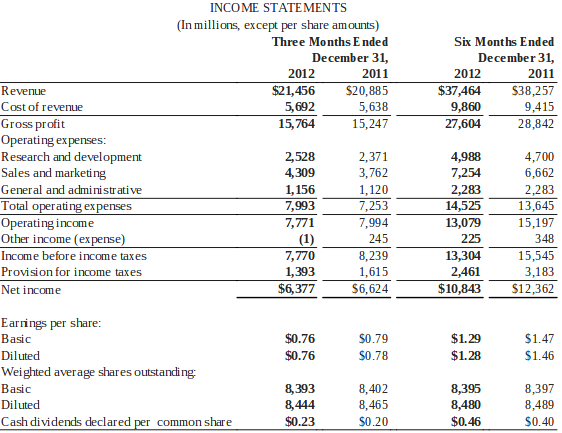
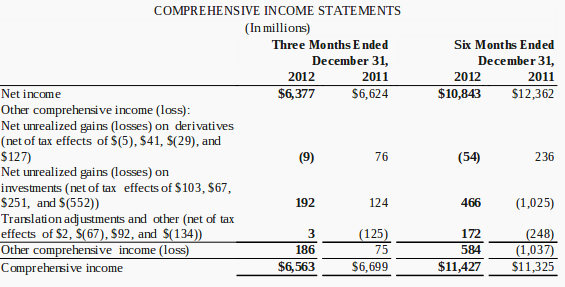
    For fiscal second quarter, ended December 31, Microsoft revenue was $21.46 billion, up 3 percent year over year. Operating income: $7.77 billion, a 3 percent decrease. Net income was $6.38 billion, or 76 cents a share.

    Average analyst consensus was $21.53 billion revenue and 74 cents earnings per share, for the quarter. Revenue estimates ranged from $19.94 billion to $23.32 billion, with estimated year-over-year growth of 3.1 percent — mighty modest for a holiday quarter when new PC and phone operating systems launched and Microsoft released its first tablet, Surface RT.

    Shares dipped by 2 percent in early after-market trading, falling to $27.06 from the $27.63 close. Like Apple yesterday, Microsoft beat earnings consensus but missed on sales.

    When adjusting for the impact of Office and Windows upgrade offers (meaning non-GAAP view), revenue grew by 5 percent to $22 billion, operating income by 4 percent to $8.3 billion, and EPS by 4 percent to 81 cents.

    “Our big, bold ambition to reimagine Windows as well as launch Surface and Windows Phone 8 has sparked growing enthusiasm with our customers and unprecedented opportunity and creativity with our partners and developers”, CEO Steve Ballmer boasts. “With new Windows devices, including Surface Pro, and the new Office on the horizon, we’ll continue to drive excitement for the Windows ecosystem and deliver our software through devices and services people love and businesses need”.

    Windows & Windows Live revenue rose 24 percent year over year to $5.88 billion, buoyed by a deferral from the previous quarter. Without the extra lift, revenue still increased by 11 percent.

    Microsoft’s Perception Problem

    As I’ve oft said, in business, perception is everything. To many people, Windows is Microsoft and the fate of one influences the other. Perception is a devil. Take Apple, for example, which reported $54.5 billion revenue and $13.06 billion net income yesterday. Today, shares closed down 12.35 percent, in part on perception that growth days are over, despite simply huge quarterly numbers. Microsoft’s problem is by no means comparable, but Apple’s situation makes a point. If investors so punish the company for such a great quarter, what can negative or positive perceptions about Windows’ future do?

    Microsoft is no longer bound to Windows, despite marketing hype about “reimagining”. In October, CEO Steve Ballmer described the company’s new direction as “devices and services“. The Business division, with flagship Office, generally generates more revenue than Windows & Windows Live, and last quarter Server & Tools did, too. The company is in process of removing dependence on Windows as top to its hugely successful vertical applications stack built around Office and server software and now extended through cloud services, such as 365,  Azure, Skype and SkyDrive among many others. Windows is still hugely valuable, and anchors a huge ecosystem, but Microsoft can transcend the OS.
    The problem: Public sentiment says something else — that Windows can’t compete in the post-PC, what I call connected-devices, era. If Windows can’t, neither can Microsoft. I don’t agree. Microsoft’s apps, datacenter and server software already are primed to serve multiple devices — not just the PC — and that’s a longstanding development strategy now far advanced. Microsoft is ready to move beyond Windows, and the holiday quarter PC shipments show such a future is inevitable. Windows won’t go away but stand alongside other platforms rather than being the overwhelmingly dominant one.

    Business and Server & Tools succeed for many reasons, and they will continue to do so as long as enterprises stay the course buying annuity contracts. Combined, more than half the two groups’ revenues come from volume-licensing contracts with Software Assurance.

    Companies get the license and annually pay 25 percent or 29 percent of the full price to get upgrades (or even to exercise downgrade rights) over two- or three-year periods. Software Assurance insulates Microsoft from economies’ ups and downs and those for PC purchases. If ever businesses back away in mass from annuity or subscription contracts, that’s the day to seriously worry about Microsoft’s future.

    Whither Windows 8

    Where the flagship operating system matters most is where Microsoft tries to take it: touchscreen devices, such as hybrids and tablets, with Surface RT and Pro serving as reference-designs for OEM partners to emulate. The Redmond, Wash.-based company announced plans to port Windows to ARM processors in January 2011, then followed up with the tile-based Modern UI that unifies ARM and x86 operating systems, including Windows Phone. Pundits poo-poo PC shipments, which stank in Q4, as evidence Surface and Windows 8 are failures. I ask: By what measure? Seems to me, Microsoft already changed Windows’ course to embrace a broader range of devices, with a unifying UI. Transitions like this take time to succeed, or fail.

    There is need. Had Microsoft not made-over Windows, the problem wouldn’t be perception but crisis very real. Three legs support the profit center, and Windows bound to traditional PCs would be one cut off. Instead, Windows 8 holds future device promise. Much depends on the devices the company and its partners produce and apps and services supporting them. Honestly, looking at holiday PC lineup, Surface RT is about the only thing looking good. OEMs failed to deliver compelling products that get people buying.

    PCs continued their more-than-year-long collapse during fourth quarter. Windows 8 gave no meaningful lift. Shipments fell 4.9 percent year over year, according to Gartner. For all 2012: down 3.5 percent. Manufacturers shipped 90.3 million and 352.7 million units for the respective time periods. IDC offers grimmer perspective: PC shipments fell 6.4 percent for Q4 — two points more than forecast — and 3.2 percent for the year.
    Consumers aren’t buying Windows PCs like they used to, and their infatuation with iPad, some other tablets and smartphones, is spreading. “Tablets have dramatically changed the device landscape for PCs, not so much by ‘cannibalizing’ PC sales, but by causing PC users to shift consumption to tablets rather than replacing older PCs”, Mikako Kitagawa, Gartner principal analyst, says, speaking about Q4 PC shipments.

    She no longer believes that PCs and tablets will coexist for a meaningful time. “There will be some individuals who retain both, but we believe they will be exception and not the norm. Therefore, we hypothesize that buyers will not replace secondary PCs in the household, instead allowing them to age out and shifting consumption to a tablet”.

    Combine that with the bring-your-own-device (BYOD) to work movement, and the future looks grim. Or does it? Microsoft already has its apps, cloud and server businesses primed for BYOD, as I’ve written here before. Then there is broader context, for those calling Windows 8 a flop because PC shipments fell in Q4. Apple got hit, too. Analyst consensus was for 5.2 million Macs shipped, but only 4.1 million did. Yesterday, Apple CEO Tim Cook laid blame on late delivery of new iMacs. He said that Mac shipments would have been otherwise higher.

    I don’t find that credible. But let’s assume for a moment he’s right. iMac is an expensive beast, starting at 1,299 and selling for as much as $1,999 in standard config. If Apple can command such selling strength, why can’t Microsoft OEMs? They should, by releasing innovative hybrid desktop and portable designs that capitalize on Windows 8’s best features. I contend they did not in fourth quarter.

    Something else to consider when looking at the PC market and future of Windows. In a compelling rebuttal to claims the PC is dying, Derrick Wlodarz, who owns a computer repair business, makes an observation often ignored: “Whereas customers of mine were getting 3-4 years out of machines back in the early 2000s, they now push their PCs to 4-6 year replacement cycles without much sweat”. Major reason: Older hardware has more than enough processor and graphics power to meet modern needs.
    “Now, a Windows Vista or newer PC could likely run on for five, six, seven or possibly more years without much issue. And this is the untold trend that I see in my customer base”, he asserts. “Solid, secure operating systems installed onto well-engineered computer hardware equals a darn long system life”.

    So if the PC in the den or office is good enough and not in need of replacement, why not buy a new smartphone or tablet? Remember: Microsoft pushes ahead with solutions for both these categories. Then there is fourth quarter to consider, where Windows delivered solid growth — now if only the broader ecosystem could capitalize upon it.

    Division Highlights

    Microsoft reports revenue and earnings results for five divisions: Windows & Windows Live, Server & Tools, Business, Online Services and Entertainment & Devices.

    Windows & Windows Live. Revenue soared 24 percent year over year despite weak PC sales, surely buoyed by low-cost Windows Pro upgrade price that ends January 31. A $622 million deferral helped lift revenue to $5.88 billion. Without it, revenue would have grown by 11 percent.

    To date Microsoft has sold 60-million Windows 8 licenses.

    OEM revenue grew by 17 percent, outpacing the broader PC market.

    Server & Tools. “We see strong momentum in our enterprise business”, Microsoft COO Kevin Turner says. “With the launch of SQL Server 2012 and Windows Server 2012, we continue to see healthy growth in our data platform and infrastructure businesses and win share from our competitors. With the coming launch of the new Office, we will provide a cloud-enabled suite of products that will deliver unparalleled productivity and flexibility”.

    Revenue rose 9 percent, or $347 million, to $5.19 billion. As previously mentioned, the division is insulated against economic maladies, because about 50 percent of revenues come from contractual volume-licensing agreements.

    New bookings increased by 15 percent. Meanwhile System Center revenue grew by 18 percent and SQL Server by 16 percent.

    Business. “We saw strong growth in our enterprise business driven by multi-year commitments to the Microsoft platform, which positions us well for long-term growth”, Microsoft CFO Peter Klein says. “Multi-year licensing revenue grew double-digits across Windows, Server & Tools, and the Microsoft Business Division”.

    Despite touted growth, revenue fell by 10 percent year over year to $5.69 billion. However, when removing adjustments for Office upgrade offer and pre-sales, revenue grew by 3 percent.

    Bookings increased by 18 percent and multi-year licensing by 10 percent. However, consumer revenue fell by 2 percent.

    Like Server & Tools, Business division is largely insulated against sluggish PC sales. Sixty percent of revenue comes from annuity licensing to businesses.

    Online Services Business. Online services revenue rose by 10 percent, or $109 million, to $823 million. However, the division remains unprofitable. Search and display ads drove up online advertising revenue by 15 percent.

    Entertainment & Devices. Microsoft shipped 5.2 million Xbox consoles, down from 8.2 million a holiday quarter earlier. As a platform, Xbox 360 revenue fell 29 percent, or $1.1 billion.

    Xbox Live subscriptions now exceed 40 million.

    Windows Phone sales are up 4 times year over year, which is a polite way of saying they’re not good enough. If they were, Microsoft would say how many.

    Users made 138 billion Skype calls, up 59 percent year over year.

  • Wind Industry Declares War on Plain English in Effort to Expand Subsidies

    The wind industry received a belated Christmas present this year when Congress passed the American Taxpayer Relief Act of 2012 (née fiscal cliff deal). The fiscal cliff deal not only extended the wind Production Tax Credit (PTC) for another year, but expanded the credit to apply to more facilities. But that’s not all. The wind industry now wants the IRS to torture the plain language of the Act to allow even more projects to qualify.

    For the past 20 years, the wind PTC required projects to be placed “in service,” by the end of the year to receive the credit. But the fiscal cliff deal expanded that language to apply to any wind facility “the construction of which begins before January 1, 2014.” Because of this expansion, the Joint Tax Committee estimates that the wind PTC will cost the Treasury $12.1 billion dollars.

    Not content with this victory, the wind industry lobby now wants the IRS to interpret the term “construction of which begins” to have no reference to a physical act of construction, but rather merely mean that construction begins when five percent of the cost of the wind project has been committed.  As the attached white paper will demonstrate, this would be an aberration from the many tax laws that have specified or assumed construction as actual construction work having taken place.

    The Five Percent Rule Tortures the Plain Meaning of the Word “Construction” and Means Delayed Economic Benefit

    If the “five percent” interpretation is implemented, many companies might make that token investment and then wait several years for technology to mature or the economy to improve.  Needless to say, that outcome would be distortionary and wasteful.

    If instead construction “begins” with the physical act of construction, companies that otherwise might have sat on their investments will be incentivized to commence building sooner.  Earlier construction would mean that the economic benefits of construction would be realized more quickly.  While more money might be paid out under the five percent interpretation, more short-term economic stimulus would come from the physical act requirement.

    Senator Mark Udall, a strong supporter of the PTC extension, noted that the extension is meant to “provid[e] a strong incentive for developers to begin projects as soon as possible.” But Udall also understands that the word “construction” should have something to do with physical wok.  As he stated, “So if you put a shovel in the ground on Dec. 31, at the end of this year, the tax credit will apply…”

    That being the case, the policy behind the PTC extension suggests that we should interpret “begins construction” to mean, well, starting physical construction.

    Ample Precedent for the Physical Work Requirement

    The legal precedent is also on the side of the physical work interpretation.  As shown in the attached IER white paper, there is a long history of Congress and administrative agencies interpreting similar phrases (variations on “construction begins”) to require physical work on the project.  To name just a few examples, the common-sense interpretation of beginning construction prevailed in the Tax Reform Act of 1969, the Revenue Act of 1971, the Tax Reform Act of 1976, the Revenue Act of 1978, the Tax Reform Act of 1986, and the American Jobs Creation Act of 2004.  The IRS itself ruled that way many times, including in 2011, 2008, and 2006.

    The Five Percent Alternative

    Against all that precedent, the wind lobby can only offer the American Recovery and Reinvestment Act of 2009, when the Treasury Department interpreted “construction began” as including the five percent rule as a safe-harbor provision. A safe-harbor provision is intended to protect good faith, but unsuccessful, efforts to adhere to a given law.  Similar safe-harbors have appeared in other IRS guidance, but normally as a less-lenient 10% investment rule.

    Bottom Line

    The legal and policy arguments both weigh heavily in favor of the physical work requirement.  Wind industry lobbyists would do well to accept the already-generous PTC subsidy without pushing a dubious interpretation to siphon off even more taxpayer money.

    Adobe_PDF_Icon


     IER’s White Paper on the definition of when “construction begins” is available here.

  • Luigi’s Mansion: Dark Moon Gets 4 Player Online Co-Op

    The first Luigi’s Mansion has often been described as Nintendo’s first and only foray into survival horror. Part of the appeal was that Luigi was all by himself as he attempted to solve the mystery of the mansion and save his brother. The sequel – Dark Moon – retains that same foreboding atmosphere, but players can now take on a new challenge with up to three friends.

    The new mode is called “Hunter Mode” and it has four different colored Luigis clearing floors of a haunted tower called the “Scarescraper.” A report from IGN reveals that players have a set time limit in which they must eradicate all ghosts including boss ghosts within a set time limit. Making it even more challenging is the fact that floor and ghost layouts are completely random each time.

    The multiplayer can be played locally and online with players from across the world. The mode will also support download play which allows players to transfer parts of the game to a 3DS owner that doesn’t have the game. The limitations of this mode are not readily apparent.

    There are more multiplayer modes that have yet to be revealed before the game’s launch on March 24. I wouldn’t be surprised if one of them was similar to the excellent Luigi’s Mansion: Ghost Hunt mini-game in Nintendo Land. In fact, Nintendo would be stupid not to.

  • God of War: Ascension Comes With The Last of Us Demo Access

    Though the announcement of PlayStation 4 launch titles is just around the corner, PlayStation 3 owners still have a lot to look forward to this year. Namely, huge titles such as God of War: Ascension and The Last of Us.

    Sony knows, however, that not every fan of God of War is also a fan of Naughty Dog‘s (the developer of The Last of Us) Uncharted series. So, much like how the demo for Ascension was bundled into the Blu-Ray copies of the Total Recall remake, Naughty Dog today announced that copies of Ascension will come with access to a demo of The Last of Us.

    Luckily for gamers, it doesn’t appear that Ascension will be the stinker that Total Recall was. Their peek at The Last of Us will come with a fully playable prequel to God of War.

    The demo won’t be on-disc, though, and it also won’t be downloadable immediately when Ascension launches on March 12. Instead, gamers will find a The Last of Us listing on the main menu. Following it will lead to instructions on how to access the demo when it finally arrives.

    For God of War fans who haven’t heard of The Last of Us, the game will follow the characters Joel and Ellie as they brave the ruins of civilization following some sort of pandemic. The game wowed crowds at last year’s Sony E3 presentation with its portrayal of brutal and realistic violence.

  • President Obama Nominates Mary Jo White to Run the SEC

    President Obama announced today that he wants Mary Jo White, a former U.S. Attorney for the Southern District of New York, who has built a reputation as a tough and effective prosecutor with a proven record of bringing criminals to justice, to head up the Security and Exchange Commission in his second term.

    As U.S. Attorney, White specialized in investigating and prosecuting large scale white collar crimes and complex securities and financial institution fraud — and won convictions against the terrorists responsible for bombing the World Trade Center and American embassies in Africa, as well as John Gotti, the head of the Gambino crime family. As President Obama said during the personnel announcement in the State Dining Room, "You don't want to mess with Mary Jo."

    read more

  • PNNL awarded $2.8M to keep troops cool while using less fuel

    A new, energy-efficient air chilling system could keep troops on the front lines cool while using about half as much diesel as current systems. The system’s decreased fuel consumption could also save lives by reducing attacks on American soldiers who deliver fuel to field operations.

    The Department of Energy’s Pacific Northwest National Laboratory will receive up to $2.8 million over three years to develop the system, the Department of Defense, Navy and DOE’s Advanced Research Projects Agency-Energy, also known as ARPA-E, announced Wednesday. PNNL’s project was among five awarded a total of $8.5 million to improve the efficiency of battlefield heating and air conditioning systems by 20 to 50 percent.

    “PNNL is looking forward to adapting its ongoing research into advanced, energy-efficient cooling technologies and apply it toward important military needs,” said PNNL Laboratory Fellow and project leader Pete McGrail. “Our team has a strong emotional connection to the success of this project, as it could help prevent American soldiers from being injured or killed while moving fuel in dangerous supply convoys around the battlefield.”

    PNNL is partnering with Oregon State University and Power Partners, Inc. of Athens, Ga. on the project.

    PNNL’s system will be a next-generation adsorption chiller that is specially designed to be smaller, lighter, more efficient and operate under the extreme temperatures experienced at bases on the frontlines, also called forward operations. The chiller will use a novel nanomaterial called a metal organic framework, or MOF. MOFs are crystal-like compounds made of metal clusters connected to organic molecules, or linkers. Together, the clusters and linkers assemble into porous 3D structures. PNNL developed a MOF that can hold up to three times more water than the silica gel used in today’s adsorption chillers. This helps make PNNL’s test adsorption chiller system much smaller and lighter. This project will build on advances in adsorption cooling technology PNNL has already made under ARPA-E’s Building Energy Efficiency Through Innovative Thermodevices, or BEET-IT, program.

    Further improvements for this project will include breakthroughs in microchannel heat exchanger technology and improvements in the MOF’s thermal properties. Both advances will help reduce the size and weight of the chiller further and squeeze out more cooling efficiency.

    “This will be the most advanced adsorption cooling system ever developed, and these advances are needed to meet very demanding military requirements,” McGrail said.

    PNNL’s military system will run off of waste heat coming from a diesel generator. This could reduce the diesel fuel use needed to cool field military installations by up to 50 percent. The planned 3-kilowatt unit will weigh about 180 pounds and take up about 8 cubic feet.

    This isn’t the first time the two systems have received support. PNNL began developing its MOF adsorption chiller for commercial buildings in 2010, when PNNL received ARPA-E funding for the BEET-IT, program. PNNL also received ARPA-E funding in 2011 to adapt the adsorption chiller to heat and cool electric vehicles with minimal impact on driving distance.

  • Which TEDxBeaconStreet audience member lived on camel milk for 9 days? Which gets mistaken for the prince of Norway?

    2137_TedxBeaconStreet_stage2.jpg-628x250

    TEDxBeaconStreet brought you today’s talk from Steven Schwaitzberg, “A universal translator for surgeons,” as well as Colin Stoke’s “How movies teach manhood.” But the organizers behind the event know that the speakers on stage only scratch the surface of the stories to tell in the greater Boston area. “We place equal value on our speakers and audience,” explains organizer John Werner. “We look for proactive ways to build community and broaden the TEDx experience beyond the day of the event.”

    One example: as people registered for TEDxBeaconStreet 2012, they were asked to tell a fun fact about themselves. Facts for almost all of the 1600 attendees were compiled into a gigantic list—more than 12 pages long—which was emailed out before the event. Below, read a small selection of it. Werner says that audience members loved getting to know each other in this way, and that people reached out to him for an introduction to a person whose fact sparked their interest.

    TEDxBeaconStreet-audience-facts

    The TEDxBeaconStreet organizers also asked each attendee to choose words from a list that best described themselves. They then created a word cloud showing the most popular answers.

    TEDxBeaconStreet-word-cloud

    And finally, they asked software engineer Daniel LaLiberte, who currently works at Google on Google Charts, to create a visualization of 400 members of the TEDxBeaconStreet community. Take a closer look at it by clicking through on the image below. Each person at the event is represented by a white circle, and the words they chose to describe themselves are colored circles. Click on a circle to see how that person or word intersects with others in the audience. Take some time to play with this unique tool » 

    TEDxBeaconStreet-visualization

  • eBay Reportedly Bans Django Unchained Toys

    Last week, news came out that NECA’s Django Unchained action figures had been discontinued after drawing controversy from groups like the National Action Network and Project Islamic Hope.

    Since then, naturally, the toys became instant eBay shopper bait. Today, TMZ is reporting, however, that eBay has banned the toys from sale on the site, providing a statement from the company that they were removed because they violate its Offensive Materials Policy. However, you can go to eBay right now and find numerous listings for the toys. Here’s one:

    Django Toy Listing on eBay

    Apparently they haven’t been able to keep the toys off the site. This could end up hurting some sellers, as the company “cautioned sellers not to re-list the items,” according to TMZ, which also shares this quote from an email eBay has been sending sellers:

    “Since the manufacturer of this product has discontinued the item’s sale due to its potentially offensive nature, we are not allowing it to be sold on eBay.”

    Here are some things that are still perfectly acceptable to sell on eBay, according to its Offensive Materials Policy:

    – KKK memorabilia pricing guides
    – News and magazine articles about the KKK
    – Documentaries about the KKK
    – Books about the KKK
    – The film “Birth of a Nation” and the book it is based on, “The Clansmen”
    – Stamps, letters and envelopes displaying Nazi postmarks
    – Currency issued by the Nazi German government
    – Replica or novelty stamps or currency of Nazi Germany

    Listings for the toys are also showing up on other big ecommerce sites. You can currently find them listed on Amazon, Bonanza, and even in Google Shopping, which is now based solely on product listing ads.

  • Sony Hit With $395K Fine Over PSN Hack From 2 Years Ago

    PlayStation fans may remember a dark time from almost two years ago when the PSN went down for almost a month. The cause? A massive cyberattack that crippled the network and led to account details for over 77 million users to be stolen. It could be assumed that Sony has tried to put that nasty business behind it, but it’s being dragged back up as the company is being hit with a fine.

    The UK’s Information Commissioner Office has hit Sony with a $395,000 fine for being in violation of the Data Protection Act. The Office says that the hack, and the resulting fine, could have been avoided if Sony’s server software “had been up-to-date.”

    Here’s the full statement from David Smith, Deputy Commissioner and Director of Data Protection:

    “If you are responsible for so many payment card details and log-in details then keeping that personal data secure has to be your priority. In this case that just didn’t happen, and when the database was targeted – albeit in a determined criminal attack – the security measures in place were simply not good enough.

    There’s no disguising that this is a business that should have known better. It is a company that trades on its technical expertise, and there’s no doubt in my mind that they had access to both the technical knowledge and the resources to keep this information safe.

    The penalty we’ve issued today is clearly substantial, but we make no apologies for that. The case is one of the most serious ever reported to us. It directly affected a huge number of consumers, and at the very least put them at risk of identity theft.

    If there’s any bright side to this it’s that a PR Week poll shortly after the breach found the case had left 77 per cent of consumers more cautious about giving their personal details to other websites. Companies certainly need to get their act together but we all need to be careful about who we disclose our personal information to.”

    So what will Sony do? A spokesperson told IT World that it plans to appeal the fine. If the appeal falls through, Sony can have the fine reduced to $316,000 if it pays by February 13. I’m sure the payment will come with a box of these.

  • ‘Push to Add Drama’ TNT Viral Campaign Gets a Sequel

    Remember when TNT launched in Benelux with that really cool ad campaign that set up a big, red button int he middle of a town square? It said “push to add drama,” and when pushed, set a massive series of dramatically staged events into action?

    If not, check here.

    Anyway, TNT knows drama. That’s their catchphrase. In order to prove that drama can strike anywhere, they’ve released a sequel to that viral ad. “On a cold winter’s day, we placed the famous red button somewhere in a Dutch shopping street,” says TNT Benelux.

    Check it out:

  • Behind the Scenes: What It’s Like to be Surprised by the President at the White House

    It's not unusual for guests on the White House tour to harbor a secret hope that they just might bump into the President, Mrs. Obama or even Bo as they make their way through the historic rooms that serve double duty as home to our First Family. In reality, it almost never happens, which is why these visitors found themselves nearly speechless on Tuesday, when three of the Obamas surprised them with an impromptu welcome in the Blue Room. Check out their reactions, below: 

    read more

  • Healthy Campus Initiative takes shape, thanks to innovative UCLA-wide effort

    UCLA has launched an integrated, campus-wide effort to promote healthy lifestyle choices and develop best practices that may help other communities seeking to do the same.
     
    The UCLA Healthy Campus Initiative, envisioned and supported by philanthropists Jane and Terry Semel, prioritizes the health and wellness of students, staff and faculty.
     
    The multi-pronged program is rooted in UCLA’s long-term commitment to fostering a culture of mental and physical health and wellness. The Healthy Campus Initiative will support the enhancement and expansion of current health and wellness efforts; offer new and interesting approaches to exercise, mental health and eating well; encourage the creation of new projects, programs and policies; foster synergies and coordination among the myriad groups and programs that support health and wellness at UCLA; and provide students, staff and faculty with fun and exciting ways to make it easy to be healthy and fit.
     
    “Reducing preventable diseases has been a vision of mine for a very long time,” said Jane Semel. “This initiative is an important step forward.”
     
    “This initiative is about helping members of the campus community and beyond make informed choices,” Chancellor Gene Block said. “Whether it’s about diet, exercise, transportation or sustainability, our goal is to leverage our unique strengths in health sciences and as a leading research university to encourage healthier outcomes for individuals and for society as a whole.”   
     
    Working groups, led by campus experts in their respective fields, have been established to bolster the program in key areas of emphasis. Among them are: 
    • Nutrition and diet, led by Dr. Wendy Slusser, an associate professor of pediatrics and public health at the David Geffen School of Medicine and Fielding School of Public Health and director of the Fit for Healthy Weight program at Mattel Children’s Hospital UCLA.
    • Physical activity, exercise and sleep, led by Dr. Antronette Yancey, a professor of health policy and management at the Fielding School of Public Health and co-director of the school’s UCLA Kaiser Permanente Center for Health Equity, and Michael Deluca, executive director of recreation and campus life.
    • Mental and emotional health, led by Robert Bilder, the Tennenbaum Family Professor of Psychiatry and Biobehavioral Sciences at the David Geffen School of Medicine and chief of medical psychology–neuropsychology at the Semel Institute for Neuroscience and Human Behavior.
    • Community and environment, led by Dr. Richard Jackson, professor and chair of environmental health sciences at the Fielding School of Public Health.
    The work of these groups has resulted in plans for healthier eating options; improved walkability, bikeability and transit use on and around campus; meetings that incorporate physical activity; upgrades and enhancements to stairways; the expansion of community gardens and urban farming on campus; and the creation of web-based mobile applications to track fitness progress, among other things.
     
    UCLA Associate Vice Provost Michael Goldstein, a professor at the Fielding School of Public Health who serves as chair of the Healthy Campus steering committee, said the initiative is a community-wide approach to change.
     
    “We’re working together to create a social movement around health,” he said. “In much the same way that sustainability and diversity are woven into the fabric of UCLA, there is real interest and desire on the part of campus leadership and the broader campus community to make healthy living part of our campus culture too.”
     
    As one part of the initiative, 14 student groups have each been awarded $1,500 to help make UCLA a healthier place to live, work, study and play.
     
    Funded student projects are expected to roll out this winter and spring. Among them are a plan by the student group Ecology, Economy, Equity to create a container vegetable and herb garden and run gardening and nutrition workshops at the Young Research Library, and “Lunch Beat UCLA,” an opportunity created by the Anthropology Graduate Student Association that encourages students, staff and faculty to get together for a “time out” from school and work to dance, eat lunch and foster togetherness.
     
    Additional projects include “What’s Cooking?”, a series of workshops from the Student Food Collective at UCLA that will cover topics like healthy eating, food justice and farm workers rights, fair trade, and affordable cooking; the “Love Your Body” campaign, a weeklong event designed by the UCLA USAC Eating and Activities Task Force to educate and provide students with resources to live a healthy life, promote positive body image and encourage environmental consciousness; and health and wellness programs geared to underrepresented groups, among others.
     
    “A program like the Healthy Campus Initiative is important at UCLA because it provides accessible, fun workshops and programs to facilitate healthy living to UCLA community members,” said Jamie Schenk, a fourth-year human biology and society major and co-founder and outreach director for the Student Food Collective at UCLA. “Our workshop series will positively contribute to the Healthy Campus Initiative because it will give students tools to lead healthier lifestyles through diet, as well as physical and mental well-being. Good, healthy food serves as the foundation for good health and happiness, which is what healthy living is all about. It is exciting to see that UCLA is taking a great step in making health and wellness a top priority through supporting these student initiatives.”
     
    Representatives from each of the student groups will be on hand Monday, Jan. 28, for the Healthy Campus Launch Fair, which takes place in Collins Court at the John Wooden Center from 11 a.m. to 2 p.m. The fair’s featured event — remarks from Chancellor Block and a hula-hoop workout and giveaway for the first 200 participants — begins at noon. The fair will also include interactive demonstrations and information on the wide range of programs and opportunities offered by UCLA Recreation. Visitors will be eligible for a variety of prize drawings and giveaways. Admission is free, and the event is open to the entire campus.
     
    The Jan. 28 kick-off also marks the first day of free access to the Wooden Center for students, faculty and staff. Complimentary admission is being offered through Feb. 1 to those who present a valid Bruin Card.
     
    In addition to the program’s kick-off, the Healthy Campus Initiative has partnered with a variety of campus groups to offer a host of events and opportunities over the next several months. Each provides an opportunity for the campus community to get involved.
     
    From Feb. 11 to 14, the campus community is encouraged to burn calories, build stamina and spend time with their friends and colleagues during “I ♥ Walking,” a series of walks through campus and Westwood Village. To mark Earth Day on April 22, the UCLA community is invited to an Earth Day fair and celebration of the university’s new status as a tobacco-free campus — a University of California first. This will be followed by the popular annual Bike to Campus Week in May.
     
    The Healthy Campus Initiative website is in development and is expected to be completed in April. For more information about the initiative, visit the program’s Facebook page.
     
    UCLA is California’s largest university, with an enrollment of more than 40,000 undergraduate and graduate students. The UCLA College of Letters and Science and the university’s 11 professional schools feature renowned faculty and offer 337 degree programs and majors. UCLA is a national and international leader in the breadth and quality of its academic, research, health care, cultural, continuing education and athletic programs. Six alumni and six faculty have been awarded the Nobel Prize.
     
    For more news, visit the UCLA Newsroom and follow us on Twitter.

  • Twitter Must Give Up Anti-Semitic Users, Says French Court

    Twitter is once again going to be forced to make a decision on how far they will go to protect the privacy rights of its users, thanks to a ruling made today by a French court.

    The court ruled that Twitter must turn over the identities of users behind a specific set of tweets, after they had been deemed to be in violation of French anti-hate speech laws.

    The whole thing started back in October of 2012 when some Twitter users jumped on a trending hashtag, #unbonjuif, which roughly translates to “a good jew.” Some users posted photos of dust-filled dustpans, among other offensive jokes alongside the hashtag. French anti-racism groups made their displeasure known, and Twitter agreed to remove the offending tweets amidst mounting pressure.

    Although Twitter complied with the requests of the French Jewish Students Union (among others), they balked at the groups’ next request. the UEJF demanded that Twitter turn over the names of the users behind the aforementioned tweets, so that they could be prosecuted under local anti-hate speech laws.

    The UEJF filed a summons in a French court back in November.

    And today, the court has ruled that Twitter must provide the identities of the requested users, as accordance with French law. Twitter has only responded that they are reviewing the decision.

    Twitter definitely reserves the right to give up any information it holds on users if requested by law enforcement or by a court order. But they have, at least in the past, gone to bat to protect user privacy when they sense some government overreach. Back in September, Twitter finally gave in to the Manhattan D.A.’s office and gave up the deleted, inaccessible tweets of an Occupy Wall Street protester – but only after they fought it tooth and nail.

    Any time something like this comes up, the topic of free speech usually accompanies the dialogue. In this case, it comes down to speech vs. hate-speech laws in France.

    Twitter faced backlash from free speech advocates last year when they blocked a neo-Nazi account – but in Germany only. It was the first time that Twitter had utilized a “power” that it gave itself last year, the power to locally censor content if they saw fit.

  • Gorgeous Artwork Made With Only The Artist’s Eyes

    It’s pretty amazing, the things humans are capable of when inspiration and the desire to create are strong enough. One artist, Francis Tsai, has come up with a way to make art using only his eyes after the effects of Lou Gehrig’s Disease took away his ability to draw in a more common way.

    Incredibly, Tsai first learned to draw with his feet after realizing he couldn’t use his hands anymore, but that became too much, as well. Using ground-breaking software from Tobii which allows eye-tracking to be combined with a computer interface, Tsai figured out how to get what was in his head out into the world using only his eye movements.

    According to Tobii’s website: An eye tracker is a device that uses projection patterns and optical sensors to gather data about gaze direction or eye movements with very high accuracy. Most eye trackers are based on the fundamental principle of corneal-reflection tracking. The eye gaze provides a very efficient way of pointing. We do it all the time in interaction with other humans. Eye tracking technology enables us to use our gaze in interaction with computers and machines. It’s fast, intuitive and natural.

    Tsai talks a bit about his journey on his blog; you can buy his prints here. The proceeds go towards his medical care.

    Shoutout to Kotaku for the lead.

    tsai eyeball drawing

    tsai eyeball drawing

    tsai eyeball art

  • T-Mobile Announces New Mobile B2B Solutions

    T-mobile announced today that it intends to ease further into business-to-business (B2B) services with some new service offerings.

    T-Mobile Office Connect is the mobile carrier’s communications solution for businesses. It will integrate T-Mobile’s 4G network to enable “desk phone features on mobile devices. The carrier claims that employees will then only need one number and voicemail box to manage all of their business contacts, and that desk phone to mobile transfers will be smooth. The service will also allow customers to route international calls through “the least expensive option” and bills long-distance calls at business rates.

    T-Mobile is pricing Office Connect at $9.95 per month per line, which includes hardware, software licenses, and installation costs.

    “Today, mobile devices are critical extensions of an organization’s business infrastructure,” said Frank Sickinger, T-Mobile’s SVP of B2B. “Therefore, making and protecting strategic mobile investments are more pivotal than ever before. Our new unified communications and equipment financing solutions demonstrate T-Mobile’s commitment, as the ‘Un-Carrier’, to challenge the status quo for our B2B customers.”

    T-Mobile also announced its Mobile Device Payment Solution (MDPS), a service designed to allow business to finance the cost of devices over time. The carrier claims the service has “competitive rates” and can be offered at no interest with the proper credit approval. Qualified Corporate Liable (CL) businesses will be able to reserve capital and finance upfront costs through third-party lender CFS.

  • 3D Printers Give Boy The Hand He Never Had

    Technology improves lives – we hear it everyday as large companies continue to force feed us the latest technological toys. Sure, these things make our lives more convenient, but does technology really improve lives? It’s a resounding yes for a little boy from South Africa.

    3ders has an excellent story up about a man named Richard and a boy named Liam. Both face the challenge of getting through life without a hand. For Richard, he lost most of his fingers in a woodworking accident. For Liam, he was born with Ambiotic Band Syndrome which means he has no fingers on his right hand. For both, some 3D printing ingenuity is helping to change their lives for the better.

    Richard and a designer from Washington named Ivan both worked on the design of the first “robohand.” Check out the initial design process and Liam using the hand for the first time below:

    Here’s Liam a month later performing more complicated functions with the hand:

    After this, Richard and Ivan got in contact with MakerBot to inquire about 3D printing. The company sent two MarkerBot Replicator 2s, free of charge, to both Richard and Ivan so they could continue refining the design of the “robohand” without having to be physically near each other. The results are pretty amazing:

    As the two men make progress with the “robohand,” they are also hoping to help others with similar handicaps overcome them with cheap, effective solutions via 3D printing. To that end, the design of the robohand has been made open source so anybody can benefit from it. You can check out the design on Thingiverse here.

    As for the project itself, you can continue to follow it at the designers’ Web site. You can also help contribute to the project with a donation. They’re hoping to raise $50,000 over the next year to help “create prosthetic fingers for whoever wants one.”

    Liam’s story is another great example of how 3D printing and related technologies are helping to better peoples’ lives without the major investment required by modern medical technology. As 3D printers become more affordable, expect to see more heartwarming stories like this pop up.

    [Image: Coming Up Short Handed]

  • Host.net Acquired by Canadian Private Equity NOVACAP

    Canadian private equity firm NOVACAP announced the acquisition of US-based Host.net, a network infrastructure services provider that focuses on colocation, cloud computing, virtualization and storage. The deal signifies continued engagement by private equity firms in the internet infrastructure space, NOVACAP’s entrance into the U.S. market, and it is the 100th transaction for DH Capital, which served as exclusive financial advisor to Host.net. Terms of the deal were not disclosed.

    Host.net is based in South Florida, and has over 700 customers ranging from small to large multinationals. Some private equity backing will allow Host.net to continue its growth and expansion. “The transaction will allow Host.net to continue to lead the industry, to grow to the next stage by adding more data centers, and to expand their portfolio of services to remain the industry’s benchmark,” said Ted Mocarski , Senior Advisor at NOVACAP, which has $790 million in assets under management, and is one of Canada’s leading private equity firms.

    NOVACAP will leverage experience acquired in the Canadian market as it expands its investment strategy to the United States. “It is part of a plan to increase our presence in the United States, and this agreement shows that we are a serious player in the market,” said Pascal Tremblay, President of NOVACAP Technologies. “Our expansion will benefit our portfolio of companies, and will help us find additional opportunities throughout North America and in international markets.”

    “We are delighted to be working with NOVACAP, whose insight and investment will definitely benefit Host.net’s growth strategy,” said Jeffrey Davis, Co-Founder & Chief Executive Officer of Host.net, in the release. “Their experience in the industry will bring focus to the strategic steps needed in order to grow the company.”

    Host.net’s management team will remain in place and will be supported by newly appointed board members. “With this new acquisition, NOVACAP wishes to show its confidence in Mr. Davis’ team, ” said Tremblay.

    Host.net was founded in 1996 and is headquartered in Boca Raton, FL. The company operates multiple enterprise-class data centers connected to an extensive fiber-optic backbone delivering Internet, MPLS and layer 2 communications using a wide array of last-mile options. It serves customers in most major metropolitan regions of North America as well as portions of Europe.

  • Yandex Launches Social Search App Wonder Aimed At US

    Russian search engine company Yandex has launched a new social search app for the iPhone and iPod Touch for people in the U.S. It’s called Wonder, and taps into Facebook, Twitter, Instagram, Foursquare, iTunes, and Last.fm to provide answers to questions based on data from your friends, as well as location and music info and options (such as previewing and purchasing songs).

    Take a look:

    Wonder by Yandex Labs from Yandex Labs on Vimeo.

    The app uses natural language voice search first and foremost, but includes a keyboard input option. Right now, it only works in English and understands a few types of questions pertaining to places, music and news. It utilizes speech recognition and text-to-speech technology from Nuance Communications. Here are some examples Yandex provides for the types of questions it works for:

    – If you are looking for a proven sushi place in New York, you can just ask: what sushi restaurants do my friends go to in New York?

    – When you are looking for coffee shops in a new area, you can ask: coffee shops nearby.

    – If you need to catch up with your friends on a Friday night, just ask: where do my friends party?

    – You know your friend John has a good taste for music, ask: what music does John listen to?

    – Feel like listening to electronic music, ask: I wonder what electronic music are my friends listening to?

    – Want to catch up on news, ask: news shared by my friends.

    Wonder’s launch comes at an interesting time, amidst a slow roll-out of Facebook’s own attempt at social search. Of course this is a mobile app, and Facebook’s launch does not include mobile (though that will come in time). It’s unclear whether or not Yandex intends to release Wonder on Android.