Blog

  • Supplemental Nutrition Assistance Program: Examining the Evidence to Define Benefit Adequacy

    Cover imageFor many Americans who live at or below the poverty threshold, access to healthy foods at a reasonable price is a challenge that often places a strain on already limited resources and may compel them to make food choices that are contrary to current nutritional guidance. To help alleviate this problem, the U.S. Department of Agriculture (USDA) administers a number of nutrition assistance programs designed to improve access to healthy foods for low-income individuals and households. The largest of these programs is the Supplemental Nutrition Assistance Program (SNAP), formerly called the Food Stamp Program, which today serves more than 46 million Americans with a program cost in excess of $75 billion annually. The goals of SNAP include raising the level of nutrition among low-income households and maintaining adequate levels of nutrition by increasing the food purchasing power of low-income families.

    In response to questions about whether there are different ways to define the adequacy of SNAP allotments consistent with the program goals of improving food security and access to a healthy diet, USDA’s Food and Nutrition Service (FNS) asked the Institute of Medicine (IOM) to conduct a study to examine the feasibility of defining the adequacy of SNAP allotments, specifically: the feasibility of establishing an objective, evidence-based, science-driven definition of the adequacy of SNAP allotments consistent with the program goals of improving food security and access to a healthy diet, as well as other relevant dimensions of adequacy; and data and analyses needed to support an evidence-based assessment of the adequacy of SNAP allotments.

    Supplemental Nutrition Assistance Program: Examining the Evidence to Define Benefit Adequacy reviews the current evidence, including the peer-reviewed published literature and peer-reviewed government reports. Although not given equal weight with peer-reviewed publications, some non-peer-reviewed publications from nongovernmental organizations and stakeholder groups also were considered because they provided additional insight into the behavioral aspects of participation in nutrition assistance programs. In addition to its evidence review, the committee held a data gathering workshop that tapped a range of expertise relevant to its task.

  • RIM Gets Approved by Visa for NFC Mobile Payments

    RIM has recently announced that their Secure Element Manager (SEM) for NFC based mobile payments has been approved by Visa. The approval of what is known as a very strict process opens the door for secure mobile payments for all future NFC enabled BlackBerry devices.

    Convenience is what what drives consumers to cashless systems and this latest Visa approval is going to open the door to hundreds of carrier payment options across the globe. This marks an important step in the system’s rollout, especially considering that probably all future new BlackBerry devices will sport NFC. I would love to see users set this up as one of the steps when they get a new device.

    Click here to read more about NFC and BlackBerry on the inside BlackBerry blog.

  • Photo Gallery: Behind the Scenes in December 2012

    The White House Photo Office just released its final set of behind the scenes photos from 2012. Images include the President hosting Kennedy Center Honorees, his Twitter session in the Roosevelt Room and his final stops across America.

    Check out the gallery below and find the rest of the best December images on Flickr.

    read more

  • Relationship with Your Ringtone

    BlackBerry ringtones

    “To vibrate or to ring, that is the question…” –Shakespeare, if he owned a BlackBerry smartphone

    Downloading the “Somebody That I Used to Know” ringtone seemed like a pretty solid choice at the time, and even assigning it as my primary ringtone seemed like a fine idea – until I got a call in the middle of a BlackBerry 10 launch planning meeting, and my ringer had been set to full volume. That wasn’t a good way to find out that not everyone is still a fan of that song.

    So, it might be time to change my ringtone to something more generic. There are a ton of options in the BlackBerry App World storefront, but I’m finding myself wondering if I need a ringtone at all. When my BlackBerry Bold smartphone isn’t in my pocket or holster where I would feel it vibrate, I’ve got BeBuzz configured to let me know who’s calling me.

    Yet I still feel compelled to have a ringtone because it’s a reflection of who I am. It says: “I am a proud community manager who likes indie pop music and I don’t care who knows it.” It would almost seem that our ringtones – and even our smartphone choices and configurations – are an extension of who we are or what we want to tell the world.

    Is there a ringtone on your smartphone, or are you strictly a fan of leaving your device on vibrate? Do you see your ringtone as an extension of your personality, or just a random sample of notes?

  • Battling over Keystone XL

    Paul C. "Chip" Knappenberger

    The Washington Post has an article today on the battle over the Keystone XL pipeline.  There is a sense of urgency on both sides as the decision on the project is expected to be fast approaching.

    The Post features arguments from pipeline proponents that the project will provide an economic boost to the state of Nebraska, and from pipeline opponents that the oil carried though it will lead to more carbon dioxide emissions than previously thought, thus upping the impact on global warming and climate change.

    But the numbers being tossed about don’t tell the whole story.

    First, a look at the new economic claims. An analysis from the Consumer Energy Alliance concludes that during the two year construction phase of the pipeline, the economic activity in Nebraska will increase by a bit more than $400 million per year—generating directly or indirectly, about 5,500 new jobs. Sounds impressive, but this boost is short-lived. After that, for the next 15 years, the economic input drops down to about $67 million/yr, supporting about 300 jobs.  A net positive, but not as much as many proponents claim.

    The climate claims are even less significant. In its new report, Oil Change International asserts that the current estimates of the well-to-wheel (WTW) carbon dioxide emissions from oil extracted from the Alberta tar sands have been underestimated. They claim that the State Department failed to fully include carbon dioxide emissions from the burning of the petroleum coke that is produced as a side product of producing oil from the tar sands. This “petcoke” can be burned like coal, and in fact, is cheaper and more energy dense than coal, so it is often preferable.  According to Oil Change International, including the petcoke in the calculation would increase the WTW carbon dioxide emissions by about 13 percent.

    There are several things wrong with the Oil Change International analysis. First is that the State Department actually did include a considerable discussion of the influence of the treatment of petcoke in its assessment.  It concluded, just like Oil Change International, that if the petcoke is burned, it increases the total wells-to-wheels carbon dioxide emissions of Canadian tar sands oil by the same 13 percent.  But what the State Department points out, and which Oil Change International plays down, is that the burning of petcoke to produce energy by and large displaces the use of coal for the same purpose.  So instead of the total emissions, what is important is the incremental carbon dioxide emissions produced from using petcoke instead of coal. And when that number is used, the WTW emissions increase by less than 1 percent—which is why the State Department concluded that the fate of the petcoke really wasn’t all that significant in the overall WTW emissions calculation.

    But whether consideration of petcoke increases the WTW carbon dioxide emissions of the tar sands oil by 1%, 13%, or any number in between, really doesn’t matter anyway in terms of its impact of global warming.  For as I have shown previously, the global warming potential of the Keystone XL pipeline oil is only about 0.00001°C/yr.  Increase that by 13% and you basically get the same environmentally insignificant number.  In fact, you’d have to increase it by several orders of magnitude before it is even worth paying attention to.

    The war over the pipeline will probably rage on until (and even after) a decision is reached in a couple of months. Hopefully, emotion will play a role secondary to facts.

  • The Top Ten Energy Questions for Treasury Dept. Nominee Jack Lew

    President Obama recently submitted his chief of staff Jack Lew’s name to fill the post of Treasury Secretary after Tim Geithner vacates later this month.  Mr. Lew’s long history as an advocate for green energy interests and the Treasury Department’s role in doling out green energy grants mean that he has some important questions to answer.

    10.  The Internal Revenue Service, which is part of the Treasury Department, administers the recently-extended Wind Production Tax Credit (PTC).  The PTC, which will cost taxpayers $12.1 billion or $300,000 for each active wind energy job in the industry over the next year, has led to absurd market distortions.  For example, wind producers produce most of their electricity at the times it is least needed, simply so they can collect the PTC subsidy to make profits.  Given the high cost and terrible effects on the energy market, will Mr. Lew advocate for ending the PTC once and for all after the current extension?

    9.  In order to receive the PTC subsidy, wind companies must begin construction on their project by the end of 2013, a massive expansion of the existing law, which said the units had to be completed in order to be eligible.  While most ordinary people would say that “begin construction” means that physical construction must begin, wind-industry lobbyists want the phrase to be interpreted as meaning that the companies have invested some token amount of money upfront.  Given that the Treasury Department may end up issuing guidance on this question, will Mr. Lew advocate for the plain English meaning of the phrase or the meaning favored by industry lobbyists?

    8.  Lew played an important role in creating the Electric Drive Transportation Association, a lobbying organization promoting electric vehicles.  The Chevy Volt, GM’s highly-publicized (and highly-subsidized) electric vehicle, has repeatedly failed to meet GM’s sales goals. Given that the Treasury Department still owns 500 million shares of GM stock, will Mr. Lew promise American taxpayers that he will not use the Treasury Department’s leverage over GM to promote unpopular and uneconomic electric vehicles?

    7.  During his time at the White House Office of Management and Budget, Lew worked to increase funding for ARPA-E, the Department of Energy’s research program.  Explicitly modeled on the defense technology program DARPA, ARPA-E’s mission is to fund high-risk, high-reward energy research.  However, DARPA funds research for important military applications which the market would otherwise have no inherent reason to support.  Does Mr. Lew believe that there is no incentive for private companies to invest in energy technology?  If so, why has the Obama Administration been playing investment banker in an unprofitable field?

    6.  According to the environmentalist group Alliance to Save Energy, Jack Lew was instrumental in protecting the Department of Energy Building Technologies program from budget cuts.  The program, largely concerned with weatherizing buildings, is justified on the grounds that it will help reduce greenhouse gas emissions.  According to the Department of Energy’s own report on the program’s effects written in April 2012, the specific, confirmed cuts achieved by the Building Technologies program total a paltry 7,046 tons, about a thousandth of a percent of national annual emissions.  What are Lew’s economic standards for success for energy subsidy programs aimed at carbon emission reductions?

    5.  Jack Lew was similarly instrumental in directing funding toward the Department of Energy Industrial Technologies program.  The most recent publicly available report on the results of the program, published in 2010, claimed 206 million tons of carbon emission reductions over the past eighteen years, or about 11,444 tons per year, which amounts to about two-thousandths of a percent of national annual emissions.  If DOE is correct , will Lew advocate for still more funds for this effort?

    4.In its last four budgets, the Obama Administration has advocated increasing taxes on natural gas, oil and coal produced in the United States.  The Treasury justification for increasing taxes is that “to the extent the lower tax rate encourages the overproduction of oil and gas, it is detrimental to long-term energy security and is also inconsistent with the Administration’s policy of reducing carbon emissions and encouraging the use of renewable energy resources.”  Does Jack Lew think we are “overproducing” oil and gas in the U.S. and, if so, why does President Obama continue to herald increased production of oil and gas on non-government lands that has changed the energy outlook in the U.S. and around the world?   

    3.  Recently, the EPA suffered public embarrassment when Administrator Lisa Jackson was found to have conducted EPA business on an EPA email account under the alias “Richard Windsor”.   Mr. Lew was Chief of Staff at the White House at that time.  Given Mr. Lew’s past association with lobbying groups, how can he assure us that such non-transparent practices will not continue on his watch?

    2.  During his stint at Citigroup, Mr. Lew made money betting against the housing market.  Given the scandals surrounding the financial crisis of 2008 and the subsequent bailouts, can American taxpayers trust Mr. Lew to represent their interests in his role at the Treasury Department, and didn’t he, given his long government service, have an obligation to alert the public to the coming disastrous housing collapse?

    1.  In November 2012, Senator David Vitter probed the Treasury Department’s withholding of thousands of pages of emails concerning a potential carbon tax bill in response to a Freedom of Information Act request.   In keeping with President Obama’s vow to create the most transparent administration in history, will Jack Lew ensure that the Treasury Department carbon tax emails are released?

    Jack Thorlin (JD, Harvard ’12) is a 2012-13 legal fellow with the Institute for Energy Research. Thorlin’s first novel, Stand of Knights, tells story of a group of American soldiers fighting to protect Taiwan and preserve a last bastion of freedom in the 21st century.

  • UCLA Health System chosen as a Medicare Shared Savings Program accountable care organization

    The Centers for Medicare and Medicaid Services (CMS) has announced that the UCLA Health System has been selected to participate in the federal government’s Medicare Shared Savings Program as an accountable care organization.
     
    As a participant in the program, the UCLA Health System will work with CMS to provide high-quality service and care to Medicare fee-for-service beneficiaries while reducing the growth in Medicare expenditures through enhanced care coordination.
     
    “Through participation in the Medicare Shared Savings Program and other initiatives, UCLA is taking an innovative approach to health care, focusing on high-value, high-quality care that is truly patient-centered,” said Dr. Molly Coye, chief innovation officer for the UCLA Health System. “UCLA aims to be a leader in transforming health care and reining in uncontrolled health care costs.”
     
    The Medicare Shared Savings Program was created under the Affordable Care Act to help health care providers better coordinate care for Medicare fee-for-service beneficiaries through accountable care organizations, or ACOs — groups of doctors, hospitals and others who collaborate to provide high-quality service and care for their patients.
     
    “UCLA Health System has truly outstanding, high-quality, evidence-based medical programs, and the Medicare Shared Savings Program provides us with an important framework to better coordinate care for our Medicare fee-for-service beneficiaries,” said Dr. David Feinberg, president of the UCLA Health System, CEO of the UCLA Hospital System and associate vice chancellor for health sciences at UCLA.
     
    By creating its own ACO, the UCLA Health System was able to submit an application to participate in the program. UCLA was chosen specifically by CMS to create incentives for health care providers to work together to treat individual patients across care settings — including doctors’ offices, hospitals and other health care facilities.
     
    “Accountable care organizations save money for Medicare and deliver higher-quality care to people with Medicare,” said U.S. Secretary of Health and Human Services Kathleen Sebelius. “Thanks to the Affordable Care Act, more doctors and hospitals are working together to give people with Medicare the high-quality care they expect and deserve.”
     
    The Shared Savings Program will reward ACOs that lower the growth of health care costs while meeting performance standards for quality of care and putting patients first. The participation of health care providers in an ACO is purely voluntary.
     
    ACOs must meet quality standards to ensure that savings are achieved through improved care coordination and the provision of care that is appropriate, safe and timely. CMS has established 33 quality measures on care coordination and patient safety, the appropriate use of preventive health services, improved care for at-risk populations, and patient and caregiver experience of care. Federal savings from this initiative are up to $940 million over four years.
     
    “UCLA Health System is one of only a few academic medical centers to participate in this program,” said Dr. Samuel A. Skootsky, chief medical officer of the UCLA Faculty Practice and Medical Group. “UCLA Health System has a strong foundation in primary care, including a ‘medical home’ initiative to improve care coordination for our patients, in addition to exemplary specialty care. This Medicare Shared Savings Plan challenges hospitals and doctors, together with their patients, to reevaluate and redesign patient care to be more patient-centered and efficient — across all care settings, including at home.”

    The recent announcement was the culmination of a comprehensive selection process that began in the fall of 2011 with the national release by CMS of the Notice of Intent to Apply and application form. The UCLA Health System was selected based on vigorous eligibility criteria and program requirements.
     
    “We have a successful primary care network,” said Dr. Patricia Kapur, CEO of the UCLA Faculty Practice Group. “The framework we currently have in place provides us with a perfect opportunity to work with the federal government’s Shared Savings Program to transform the delivery of excellent medical care.”
     
    The Shared Savings Program is not a Medicare Advantage plan or an HMO. Beneficiaries with fee-for-service Medicare will still have the right to use any doctor or hospital that accepts Medicare, at any time. Find out more about the Shared Savings Program and see a list of the program’s 106 new ACOs announced Jan. 10. 
     
    The UCLA Health System will continue to serve all Medicare fee-for-service beneficiaries, including those in the Medicare Shared Savings Program. The program will support UCLA’s efforts to improve the quality of care it provides, in return for the opportunity to benefit from reduced growth in health care costs.
     
    The UCLA Health System, which comprises the UCLA Hospital System and the UCLA Medical Group and its affiliates, has provided a high quality of health care and the most advanced treatment options to the people of Los Angeles and the world for more than half a century. Ronald Reagan UCLA Medical Center, the Resnick Neuropsychiatric Hospital at UCLA, Mattel Children’s Hospital UCLA, and UCLA Medical Center, Santa Monica (which includes the Los Angeles Orthopaedic Hospital) deliver hospital care that is unparalleled in California. Ronald Reagan UCLA Medical Center is consistently ranked one of the top five hospitals in the nation and the best in the western United States by U.S. News & World Report. UCLA physicians and hospitals continue to be world leaders in the full range of care, from maintaining the health of families to the diagnosis and treatment of complex illnesses.
     
    For more news, visit the UCLA Newsroom and follow us on Twitter.

  • Now is the Time to Reduce Gun Violence in Schools and Communities

    Editor's note: This post was originally published on the official blog of the U.S. Department of Education.

    I have been proud to serve President Obama and this administration since day one, but Wednesday was one of my proudest days. The actions that the President is taking and proposing to reduce gun violence echo what America’s educators say they need to better protect and support students in school and in their communities. I thank the President and Vice President Biden for leading this critical national conversation. America’s schools are among the safest places in our country. The President’s comprehensive approach will make schools and communities safer.

    We will never fully understand why 20 first-graders and six educators were gunned down at Sandy Hook Elementary School—or why still more students and educators lost their lives at Columbine, Chardon or Red Lake high schools, Westside Middle School, Virginia Tech or the many other campuses and communities in our country where guns have cut short dreams and created fear. We can, however, take a number of common-sense steps to help prevent future tragedies.

    As the President called for this week, we can limit access to the deadliest guns and ammunition, and we can put in checks to keep guns out of the wrong hands. We can also provide new resources, so schools can develop and implement comprehensive emergency management plans.

    We can expand student support systems by allowing communities to decide what they need most, including more school resource officers, psychologists, social workers and counselors. A renewed commitment to students’ mental and emotional well-being is key.

    President Obama Listens To Secretary Duncan

    President Barack Obama listens to Secretary of Education Arne Duncan during a meeting in Vice President Joe Biden’s West Wing office at the White House, Dec. 17, 2012. The President dropped by the Vice President’s meeting to discuss the Administration’s effort to develop policy proposals in response to the tragedy in Newtown, Conn. Pictured, clockwise from the President, are: the Vice President; Attorney General Eric Holder; Margaret Richardson, Counselor to the Attorney General for Executive Branch Relations; Sarah Bianchi, Director of Economic and Domestic Policy for the Vice President; and Eric Waldo, Deputy Chief of Staff for Sec. Duncan. (Official White House Photo by Pete Souza)

    read more

  • BlackBerry 10 Launch Coverage From Both New York and Toronto

    We’re going to have people on the ground at both the New York and Toronto BlackBerry 10 launch events so stay tuned for some great coverage. We’re not exactly sure if the two events will be the same or have different content, but we’ll have both covered regardless. If we had to guess, the Toronto event might be a little more “corporate” with RIM executives on hand, and the New York event would probably be more carrier and partner centric, with execs from AT&T being present. We’ll find out in 12 days.

    BB10 launch event

  • Getting Highway Numbers Right

    Randal O'Toole

    “Gasoline taxes and tolls pay for only a third of state and local road spending,” claims a report released yesterday by the Tax Foundation, an independent, nonpartisan group. “The rest was financed out of general revenues.” According to the group’s calculations, users paid just $49 billion of the $155 billion cost of roads in 2010, the last year for which data are available.

    I am the first to admit that highways are subsidized. But do subsidies cover more than two-thirds of the costs of roads? No way. The Tax Foundation, which strives to be “guided by the principles of sound tax policy: simplicity, neutrality, transparency, and stability,” is simply wrong.

    First, the group counts federal aid to states as “general funds.” In fact, 100 percent of that federal aid comes from gas taxes and other user fees such as taxes on large trucks and tires.

    According to the Federal Highway Adminitration’s Highway Statistics table HF-10, the feds collected $35 billion in gas taxes in 2010, of which $29 billion was given to the states for roads. For some reason, the Tax Foundation counts state gas taxes as user fees, it doesn’t count federal gas taxes as user fees.

    (more…)

  • Raisin Farmers Have Constitutional Rights Too

    Ilya Shapiro

    Long-time California raisin farmers Marvin and Laura Horne have been forced to experience firsthand the costs that America’s regulatory state imposes on entrepreneurs, especially innovative members of the agriculture industry. 

    No longer do farmers enjoy the ancient right to sell their produce and enjoy the fruits of their labor.  Indeed, Horne v. U.S. Dept. of Agriculture exemplifies the extent to which all property and business owners are made to suffer a needless, Rube Goldberg-style litigation process to vindicate their constitutional rights.  

    In this case, the USDA imposed on the Hornes a “marketing order” demanding that they turn over 47% of their crop without compensation.  The order—a much-criticized New Deal relic—forces raisin “handlers” to reserve a certain percentage of their crop “for the account” of the government-backed Raisin Administrative Committee, enabling the government to control the supply and price of raisins on the market.  The RAC then either sells the raisins or simply gives them away to noncompetitive markets—such as federal agencies, charities, and foreign governments—with the proceeds going toward the RAC’s administration costs.  

    Believing that they, as raisin “producers,” were exempt, the Hornes failed to set aside the requisite tribute during the 2002-2003 and 2003-2004 growing seasons.  The USDA disagreed with the Hornes’ interpretation of the Agricultural Marketing Agreement Act of 1937 and brought an enforcement action, seeking $438,843.53 (the approximate market value of the raisins that the Hornes allegedly owe), $202,600 in civil penalties, and $8,783.39 in unpaid assessments.  After losing in that administrative review, the Hornes brought their case to federal court, arguing that the marketing order and associated fines violated the Fifth Amendment’s Takings Clause.  

    After litigating the matter in both district and appellate court, the government—for the first time—alleged that the Hornes’ takings claim would not be ripe for judicial review until after the Hornes terminated the present dispute, paid the money owed, and then filed a separate suit in the Court of Federal Claims.  The U.S. Court of Appeals for the Ninth Circuit proved receptive to the government’s reversal.  Relying on Williamson County v. Hamilton Bank (1985)—the Supreme Court case that first imposed ripeness conditions on takings claims—the court ruled in a revised opinion that the Tucker Act (which relates to federal waivers of sovereign immunity) divested federal courts of jurisdiction over all takings claims until the property owner unsuccessfully sought compensation in the Court of Federal Claims.  In conflict with five other circuit courts and a Supreme Court plurality, the Ninth Circuit also concluded that the Tucker Act offered no exception for those claims challenging a taking of money, nor for those claims raised as a defense to a government-initiated action.  

    The ruling defies both law and common sense.  It stretches the Supreme Court’s ripeness rule beyond its moorings and it forces property owners to engage in utterly pointless, inefficient, and burdensome activities just to recover what should never have been taken in the first place.  Having filed an amicus brief that supported the Hornes’ successful petition for Supreme Court review, Cato has again joined the National Federation of Independent Business, Center for Constitutional Jurisprudence, and Reason Foundation on a new brief that urges the Court to affirm its plurality decision in Eastern Enterprises v. Apfel (1998), which held that an unjustified monetary order is inherently a taking without just compensation.  Any ruling to the contrary imposes a pointless burden on property owners, particularly when the government initiated the original proceeding.  

    We argue that the Ninth Circuit’s overbroad reading of Williamson County stretches the ripeness doctrine beyond any sensible reading; it allows the government to initiate a claim and then block an important constitutional defense on the fallacious notion that it has been brought prematurely.  We advocate a rule that is more compatible with the history and text of the Fifth Amendment—that the most natural reading of the Takings Clause demands that compensation be offered as a prerequisite to government action.  Indeed, from the time of Magna Carta, just compensation has been required before property was seized. 

    Moreover, just as the Court wouldn’t permit the government to seize property without some prior “due process of law,” it shouldn’t permit the government to seize property without prior “just compensation.”  The Court has no reason to treat takings claims with less deference than rights anchored in other constitutional provisions.

    Horne will be argued at the Supreme Court on March 20.

  • Looking for a Study Buddy? How About Your BlackBerry Device?

    Study apps for BlackBerry

    For many students, the second semester of school has just started, which means the tough stuff is still ahead. Before being committed to months of “all work and no play” library lockdown, I wanted to share some helpful tips on how BlackBerry smartphones and BlackBerry PlayBook tablets can be used to help with both studies and relaxation. Remember, staying balanced is one of the keys to mental agility during stressful times!

    Here are some great apps available in the BlackBerry App World storefront to help students with their schoolwork (while having a little fun, too):

    • Ignite Study Flash Card by Kenneth Poon: They say we need to see a piece of information three times before it gets committed to memory. With this handy flash card app, users can memorize with ease, accessing study materials while on the go in a fun quiz format! I like that the BlackBerry PlayBook tablet app doesn’t give away answers immediately. Instead, it offers hints, which give it a fun and unique edge to standard flashcards.

    • StudyPal by Nadia Munim: Students can think of this app as a “personal trainer” for their brains. As the saying goes, this app helps with “planning your work and working your plan” in the crux of exams. For someone like me who worries about forgetting little details, a BlackBerry PlayBook tablet app that keeps important information in one place is a huge stress-reliever.
    • Hangman by Spice: Even the hardest working student needs a break sometimes! I recommend having a little fun in between cram sessions by downloading a cult-classic game like Hangman, which is a personal favorite. This version is especially fun because it includes a range of themes, such as Hollywood, Sports and Music—and because it’s available for a BlackBerry smartphone or BlackBerry PlayBook tablet.

    Study apps for BlackBerry

    • My Study Room Theme by VImukti Technologies Pvt Ltd.: While you’re loading up your BlackBerry smartphone with study apps and essentials, why not download a new theme to match? Just looking at these study room wallpapers gets me in study mode!

    Study apps for BlackBerry

    Students (and parents), tell us – which apps will help you during the rest of the school year? Let us know in the comments.

  • Follow First Lady Michelle Obama @FLOTUS on Twitter

    Yesterday, on First Lady Michelle Obama’s birthday, the White House launched its newest Twitter account: @FLOTUS (short for First Lady of the United States). The White House uses Twitter to connect directly with Americans, and now you can get the latest from the Office of the First Lady.

    @FLOTUS followers will get regular updates and photos from the First Lady’s team, plus special messages directly from the First Lady. Tweets signed “-mo”, like this one, are from Mrs. Obama.

    In less than 24-hours, the account has racked up more than 75,000 followers – but we’re just getting started. Here are some of things you can expect to see from @FLOTUS:

    • Behind-the-scenes photos and updates
    • Opportunities to engage directly with the First Lady and the White House
    • News about the First Lady’s initiatives, Let’s Move! @LetsMove and Joining Forces @JoiningForces

    Take a look at some of the most popular tweets from FLOTUS' first day on twitter below, or over on Storify. If you have ideas on the kinds of updates or engagement you’d like to see from the new @FLOTUS account, or feedback about our online program generally, let us know on twitter with the hashtag #whweb.

    [View the story “Follow @FLOTUS on Twitter” on Storify]

    Follow @FLOTUS on Twitter

    On First Lady Michelle Obama’s birthday, the White House launched its newest twitter account: @FLOTUS (short for First Lady of the United States). Take a look at @FLOTUS’ first day on twitter, and follow for updates.

    Storified by The White House· Fri, Jan 18 2013 07:44:53

    The @FLOTUS Office is now on @twitter & will post updates & pics. When it’s her, she’ll sign -mo. PS: RT to wish Mrs. Obama a #HappyBirthdayFLOTUS
    Happy Birthday to the 1st Lady of the U.S., @FLOTUS Michelle Obama, from the 1st lady in line at the Cost Plus sale, Ellen DeGeneres.Ellen DeGeneres
    Wishing @FLOTUS Michelle Obama a #HappyBirthday & a warm welcome to @twitter!Jay Carney (EOP)
    Happy birthday and welcome to Twitter First Lady of the United States, @FLOTUS, the official @WhiteHouse handle for @MichelleObama.Twitter Government
    Happy birthday @michelleobama, a great inspiration as @FLOTUSMelinda Gates
    #TDSBreakingNews the @FLOTUS joins Twitter. Vows to get everyone’s tweets down to a trim 95 characters.The Daily Show
    @FLOTUS Happy birthday to a phenomenal superwoman!!! Thank u for being a light!! Shine shine on!!;-)Alicia Keys
    Happy Birthday, First Lady @MichelleObama! Thanks for advocating healthy lifestyles, supporting military families, inspiring women! @FLOTUSeBay
    The First Lady just met with Inaugural citizen co-chair David Hall ahead of #MLKDay of Service: http://www.2013pic.org/service http://pic.twitter.com/E0vxKz73FLOTUS
    Thanks for the warm welcome & birthday wishes! Join me & Barack for #MLKDay of Service this Saturday. Sign up: http://www.2013pic.org/service –moFLOTUS

    Already following @FLOTUS? Be sure to check out all of our official accounts:

    read more

  • Oil Industry Investing In Rail Depots: An Alternative to Keystone

    A group of oil and natural gas pipeline operators are planning to spend about $1 billion on rail depot projects to move crude oil from land-locked inland fields to refineries on the U.S. coasts. For the first time, oil and gas companies that have traditionally rented rail capacity are buying those assets to move oil from oil sands fields in Alberta, the shale oil fields in the Bakken region of North Dakota, and the Eagle Ford in Texas. Moving oil by rail costs about 3 times as much as moving it by pipeline, but moving oil by rail is profitable because oil from these areas is priced about 20 percent less than imported crude because of the lack of pipeline takeaway capacity. [i]

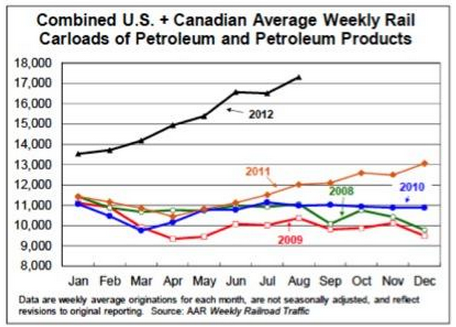
    The price differential between Alberta’s oil sands and imported crude is even greater than the price difference between U.S. shale oil and imported crude. For Instance, prices for Western Canada Select heavy blend have dropped recently to around $50 a barrel, less than half the price of a barrel of imported crude oil.[ii] As a result, Canadian railroads moved 35 percent more petroleum and refined products in November 2012 than November 2011. Increased production in the oil sands and a lack of pipeline capacity to move the crude to market has created bottlenecks that pushed the price of oil from these regions down compared to imported crude. The Keystone pipeline, if approved by the U.S. state department when first requested, would be moving oil sands to U.S. Gulf coast refineries this year.

    According to the American Association of Railroads, total petroleum shipments exceeded 540,000 carloads in 2012, up from 370,000 carloads in 2011. Crude oil shipments alone are expected to exceed 200,000 train cars in 2012, up from 66,000 in 2011 and the most since World War II.  By the end of the third quarter of last year, about 430,000 barrels per day of crude moved out of Bakken fields in North Dakota by rail, up from nearly nothing in mid-2010.[iii]

    Screen Shot 2013-01-18 at 9.58.43 AM

    Source: http://www.desmogblog.com/2012/10/02/oil-tracks-how-rail-quietly-picking-pipeline-s-slack

    About 1 million barrels a day of rail-unloading capacity is being built in the United States, more than double the current level of shipments, which averaged about 456,000 barrels a day in the third quarter. Burlington Northern, which handles about 35 percent of U.S. oil shipments, is planning capital improvements to haul 40 percent more crude in 2013.

    Advantages and Disadvantages of Rail

    While rail transport is more expensive than transport by pipeline, rail traffic is more flexible, reaching into metropolitan areas where new pipes are hard to deploy and where refineries are paying the highest price for oil. As rail-oil infrastructure expands, it should become less expensive. Also, although pipelines are cheaper and more efficient, it is faster to build the tracks, unloading terminals and storage tanks to expand rail capacity than to lay new pipe. Currently, crude oil is carried by 120-car trains that span 1.2 miles, with each car carrying up to 762 barrels of oil. Thus, each shipment can be worth $8 to $10 million.

    In terms of disadvantages, besides higher costs, the rail industry is faced with a shortage of rail cars that can take two years to be built and delivered. The increased movement of oil by tank car means that companies such as Warren Buffett’s Union Tank Car Co. are reaping the benefits of expanded demand for rail tankers.[iv] Further, the Manhattan Institute indicates that oil spills are a greater risk with trains than pipelines. A U.S. railway is about 34 times more likely to spill hazardous materials than a pipeline transporting the same volume an identical distance. This is not to say that rail is dangerous. It is not. The American Association of Railroads touts a 99.997 percent hazmat safety record.[v] According to the American Association of Railroads, railroads have an accident rate two to three times higher than pipelines, but involve smaller amounts in each incident, since trains carry smaller amounts than pipelines.

    The Keystone XL Pipeline

    The bottleneck of moving Canadian oil sands and U.S. shale oil to Gulf Coast refineries was to be aided by the Keystone XL pipeline that was first proposed in 2008 at a cost of $7 billion, but has met with opposition from the Obama Administration and environmentalists that complain about environmental damage from pipeline spills and higher carbon dioxide emissions from the production of oil sands than conventional crude. As a result, the pipeline route and environmental impact have been reviewed and re-reviewed by the State Department, who must determine if it is in the ‘national interest’ and provide a permit since the pipeline which cross a U.S. border. The Obama Administration is supposed to make a determination early this year on a revised route that avoids a sensitive area in Nebraska.

    By not approving or delaying approval of the Keystone pipeline, the Obama Administration is denying Americans an estimated 20,000 jobs and $20 billion to the U.S. economy. However, if the Keystone pipeline is not built, another half-million barrels a day in new rail capacity may be built to deal with the bottleneck. As more rail capacity is built to move oil around North America, railroads should become more efficient. But moving oil by rail causes more carbon dioxide emissions than moving it by pipeline, something which opponents of Keystone XL have failed to address.

    Keystone critics must face the reality that if the United States does not import Canadian oil sands, the oil will be moved by pipeline and rail to the west coast of Canada and then transported by ship to be consumed in Asia. This means higher carbon dioxide emissions in transport over the Pacific ocean. And though current oil sands production techniques result in 15 percent more carbon dioxide emissions than conventional oil from well to wheel, new techniques are emerging that could result in a significant decrease in carbon dioxide emissions from oil sands extraction.  Moreover, regardless whether the Keystone XL pipeline is built or not, Alberta’s oil will be consumed somewhere in the world; it will not remain in the ground.  And, if the railroads are correct about adding rail capacity, oil sands will still be refined and used here in the United States.

    Conclusion

    What drives transportation of energy is its demand. As long as the United States and the world demands petroleum – and there is every reason to believe that will be the case for most of the 21st century — some method of transportation will be used to get the crude oil to refineries and refined products to consumers. The most economical means for transporting crude oil seems immaterial to the Obama Administration, which is not paying the increased cost of rail transport instead of pipeline transport.

    Regardless of the Administration’s stance, however, U.S. ingenuity will work out the impediments as it is doing by shipping crude oil by rail, even though it is less efficient and more expensive than pipeline transport. Favorable price differentials between landlocked crude production in U.S. shale oil basins and Alberta oil sands and coastal refineries due to transportation bottlenecks are covering higher rail transport costs.  This means more money in the pockets of railroads and less money to invest in new oil production in North America, another example of how government action – or inaction in this case – results in the picking of winners and losers.


    [i] Bloomberg, Oil Industry Beats Buffet in Railroad Investment Surge: Energy, January 14, 2013, http://www.bloomberg.com/news/2013-01-14/oil-industry-beats-buffett-in-railroad-investments-surge-energy.html

    [ii] Reuters, Canada heavy oil price nears tipping point, January 15, 2013, http://www.reuters.com/article/2013/01/15/canada-oil-idUSL2N0AKB6O20130115

    [iii] Reuters, U.S. petroleum rail shipments up by nearly 50 pct in 2012, January 3, 2012, http://www.reuters.com/article/2013/01/03/railshipments-crude-idUSL1E9C2A5420130103

    [iv] Bloomberg, Buffett Like Icahn Reaping Tank Car Boom From Shale Oil, January 3, 2013, http://www.bloomberg.com/news/2013-01-03/buffett-like-icahn-reaping-tank-car-boom-from-shale-oil.html

    [v] Oil On the Tracks: How Rail Is Quietly Picking Up the Pipelines’ Slack, October 8, 2012, http://www.desmogblog.com/2012/10/02/oil-tracks-how-rail-quietly-picking-pipeline-s-slack

  • Teaching and Leading as a White House Intern

    The President Smiling with 2012 Interns

    President Barack Obama talks with members of the 2012 Spring White House intern class before a group photo in the East Room of the White House, April 26, 2012. (Official White House Photo by Pete Souza)

    Ed. note: Applications are now being accepted for the Summer 2013 White House Internship Program. This blog post introduces readers to Robby May, a former intern who worked in the Office of Public Engagement and Intergovernmental Affairs in the summer of 2011. When asked about his internship experience, Robby writes:

    Being a White House intern – what an amazing experience! I remember the day I received notification of my acceptance into the program: I was transitioning to teach my fourth period 8th grade Political Science class when my phone buzzed with a call from the White House Internship Program. When I was finally able to pull myself together and tell my students what was going on, they were ecstatic.

    During my time as a White House intern, I had the privilege of working in the Office of Public Engagement and Intergovernmental Affairs. As a Political Science teacher, working at the White House was a larger than life experience. Seeing and being part of what I teach my students every year was truly an amazing experience.

    In the summer of 2011, the Office of Public Engagement began a series of weekly Community Leaders Briefings which brought together leaders and activists from communities all across the country for an opportunity to discuss common challenges and learn how the government can help them as they work to improve their neighborhoods. I’ll never forget one briefing in particular, when the President made a surprise visit to meet and talk with the attending community leaders. As I watched and listened to the President speak with the group, I couldn’t help but be impressed not only by his remarks, but also his compassion and gratitude for the work they were doing in their communities.

    read more

  • iPhone Keeping You Awake at Night? 3 Ways To Cut Out Blue Light

    Do you use your iPhone in bed? Many iPhone users play games, read books, or just flip around websites before they nod off for the evening. Unfortunately, such habits can harm sleep quality.

    To get its bright and vibrant colors, the iPhone emits a considerable amount of blue light. That’s the same light that tells your body that it is daytime, so wakey wakey. Unsurprisingly, then, there have been studies that link nighttime electronics use to poor sleep. It’s hard to fall into a deep slumber when your body has just received a signal that it is daytime.

    The most complete solution is to ditch the pre-bed iPhone habit, but most users won’t do that. We’ve grown accustomed to it, and many people find that it’s a relaxing part of their pre-bed routine. There are ways, though, to cut down on the amount of blue light you’re exposed to with your iPhone. Here are a few ways to do that and hopefully get a better night’s sleep.

    438_3409088

    1. Turn down the brightness

    While you will still be exposed to some level of blue light, you can drastically reduce it by turning down the screen brightness of your iPhone. The process is quite easy. Go to Settings – Brightness & Wallpaper. Move the slider all the way to the left and you’ll have a noticeably darker screen. It might seem difficult to see the screen, but your eyes will adjust.

    If you’re reading, you can add to the effect by going to Settings – General – Accessibility and turning on the Invert Colors setting. That will make the background black in reading apps such as iBooks and Kindle, which means less blue light emission.

    2. Download f.lux (jailbreak required)

    If you have jailbroken your iPhone, you can take advantage of f.lux, an app available via Cydia. The app effectively filters out blue light, so you can use your iPhone in bed without fear that it will keep you up all night. The app works in accordance with sunrise and sunset times, so when the sun goes down you won’t be telling your body it’s daytime (at least from your iPhone).

    You can check out the Stereopsis website to learn more about f.lux. It is also available for Windows, Mac, and Linux (plus your iPad, again if jailbroken).

    3. Buy a blue light filter

    If you don’t have a jailbroken iPhone and don’t want to jailbreak yours (or can’t), you can still take steps to cut out blue light. The company Low Blue Lights has created blue light filters for the iPad and iPhone. You just stick these on your iPhone or iPad at night, and it cuts out the blue light. You can take it off during the day for normal use.

    The Low Blue Lights iPhone filter costs $13. It is, unfortunately, not available yet for the iPhone 5, though they say it should be coming soon. There is also one available for the iPad. They say it’s out of stock, but I ordered one and got it in a few days despite that warning.

    The post iPhone Keeping You Awake at Night? 3 Ways To Cut Out Blue Light appeared first on MobileMoo.

  • West Wing Week: 01/18/13 or “#NowIsTheTime”

    This week, President Hamid Karzai came to the White House, as did nine newly posted foreign ambassadors and the President held the final news conference of his first term before signing executive orders initiating 23 separate executive actions to prevent gun violence.

    read more

  • The Childhood Immunization Schedule and Safety: Stakeholder Concerns, Scientific Evidence, and Future Studies

    Cover imageThe Childhood Immunization Schedule and Safety: Stakeholder Concerns, Scientific Evidence, and Future Studies reviews scientific findings and stakeholders concerns related to the safety of the recommended childhood immunization schedule. This report also identifies potential research approaches, methodologies and study designs that could inform this question, considering strengths, weaknesses as well as ethical and financial feasibility of each approach.

    This report draws on data from existing surveillance systems, such as the Vaccine Safety Datalink, could be used and offers the best means for ongoing research efforts regarding the safety of the schedule. In recognition of this, future federal research approaches should: collect and assess evidence regarding public confidence in and concerns about the entire childhood immunization schedule, with the goal to improve communication with health care professionals, and between health care professionals and the public regarding safety; standardize definitions of key elements of the schedule, and relevant health outcomes; establish research priorities on the basis of epidemiological evidence, biological plausibility, and feasibility; and continue to fund and support the Vaccine Safety Datalink project to study the safety of the recommended immunization schedule.

  • New Government Climate Change Report Yet More “Show Science”

    Patrick J. Michaels and Paul C. "Chip" Knappenberger

    Global Science Report is a weekly feature from the Center for the Study of Science, where we highlight one or two important new items in the scientific literature or the popular media. For broader and more technical perspectives, consult our monthly “Current Wisdom.”

    You can get anything you want

    At Alice’s Restaurant

    -Arlo Guthrie, 1967

    Late last week, the U.S. Global Climate Change Research Program (USGCRP) released a draft version of its latest assessment report on the impacts of climate change in the United States. Updated reports are required by Congressional decree every 4 years or so.  The 2013 report, as it now stands, tips the scales at over 1,000 pages, consequently, we haven’t made our way through it yet, but if the Executive Summary is any indication, this report seems even worse than the one the USGCRP released in 2009.

    This is yet another example of our imperial government’s predilection towards “show science” in order to justify taking people’s stuff.  By analogy, think of the “show trials” in some of history’s more freedom-loving regimes. 

    As of this writing, it’s not clear if they intend to produce another “summary” document, such as the 200-pager they put out in 2009. That one was so bad as to require us to produce an Addendum that represents what the USGCRP report coudda, shoudda, woudda looked like had the author team made a more complete and fair assessment of the scientific literature.

    Admittedly, our Addendum report, which was finalized and released last fall, did include citations from the scientific literature that were published subsequent to the publication of the 2009 USGCRP report, which obviously the USGCRP report authors couldn’t have known about.  But, as our Addendum demonstrates, when these new research results are included, the potential impacts of climate change in the U.S. are substantially tempered.  This leads us to think that the 2013 version from the USGCRP—which seems to hype the impacts of anthropogenic greenhouse gas emissions even more so than the 2009 report did—didn’t do a grand job  in synthesizing the literature.

    Nor does it appear they did a good job with the statistics of climate and climate change in the U.S.

    Here is but one example of your tax dollars at work. From the USGCRP draft report:

    U.S. average temperature has increased by about 1.5°F since 1895, with more than 80% of this increase occurring since 1980.

    This sentence is consistent with the lurid story being told by the authors, but is by no means a robust statistical assessment of the U.S. temperature record.

    The latest version of the official U.S. temperature record (at least for today—the historical data are subject to change daily in the new “data homogenization” (!) routines) is shown in Figure 1.  And indeed, a linear fit through the data indicates that the overall trend is 0.13°F per decade, which, over the 118 years’ worth of data (1895 through 2012) produces about 1.5°F of total temperature rise.


    Figure 1. U.S. annual average temperatures (°F), 1895-2012, as continuously compiled and updated by the National Climatic Data Center, and fit with a linear trend over the entire period of record (Source: National Climatic Data Center).


    But does attributing “more than 80% of this increase” since 1980 make any kind of sense at all?  And how would you even go about doing that?

    Probably the best way to do this would be to simply take the overall rate of temperature rise (0.13°F/decade) and multiply it by the number of decades between 1980 and now (3.3) and then divide by the overall temperature change (1.5°F). When you do this, you get 29% of the overall rise has occurred since 1980.  Since 29% is nowhere close to being “more than 80%,” clearly this is not how the USGCRP authors made their determination.

    Another way to do it would be to find the maximum amount of temperature rise that occurred at any time before 1980 and then determine how much more the temperature since 1980 has risen above that amount. For example, from 1895 through 1940, the U.S. annual average temperature increased at a rate of 0.27°F per decade for 4.5 decades for a total rise of 1.2°F. That only leaves 0.3°F of the total overall rise of 1.5°F left over.  So the maximum proportion of temperature rise that could have occurred since 1980 is 20%. Again, 20% is nowhere close to being more than 80%, so clearly this is not how they did it.

    Another way would be to calculate the linear temperature rise between 1895 and 1979, subtract that from the 1.5°F total rise and assign whatever is left over to the period 1980 to 2012.  When you do this, you get that 77% of the rise occurred since 1980.  At least this is starting to get close to the USGCRP number.

    Or, you could calculate the linear rise from 1980 to 2012 and compare this to the total rise.  When you do this, you find that the rise from 1980 to 2012 was 1.58°F. Or, 105% of the total rise!   105% is definitely more than 80%, so maybe that is what they did.

    Or perhaps the USGCRP authors did something completely different. Who knows?

    Now, before we go any further, let’s get something straight—none of these methods for determining the proportionate amount of warming is statistically sound because the nature of temperature rise in the U.S. during the last 118 years is not strictly linear. Instead, there are multi-decadal periods of rising and falling temperatures (see Figure 1). So attempting to describe the proportional change over some period of time is cherry-picking by design.  As we show in the examples above, you have a wide variety of answers at your disposal depending on your analysis method.  The USGCRP authors clearly wanted to choose a method that produced the appearance of a lot of rise since 1980 (and thereby completely disregarding a more rapid warming from 1910-1940).

    Why? Heck, ask the guy responsible for the report (jmelillo [at] mbl [dot] edu).  We surely don’t know but our guess is that they wanted to make the impact of anthropogenic greenhouse gas emissions seem as large as they possibly could, which is certainly consistent with keeping the 60 authors flying first class.

    And this, in a nutshell, is the feeling we are getting about the entire report.

    That’s just not from our own spot checks, but from other as well (for starters, see comments from Roger Pielke Jr. and Judith Curry).

    Looks like our our Center for the Study of (Show) Science is going to have a good time at Alice’s Restaurant.

  • Taxpayers, Parents, and Compelling Belief

    Andrew J. Coulson

    Zack Kopplin has spent the past five years trying to prevent taxpayers from being compelled to support the teaching of creationism as science. His initial focus was the public school system itself, but he has now added government-funded private “voucher” schools to his campaign.

    Reading about Zack’s efforts, I was reminded of another campaigner for freedom of conscience in education, the now-retired law professor Stephen Arons. Thirty years ago, Arons wrote a remarkable book called Compelling Belief, in which he chronicled education-related conflicts that trampled parents’ freedom of conscience. 

    Like Arons, Kopplin seems to come from the political and philosophical left. And, also like Arons, Kopplin is fighting against compulsion that violates people’s most deeply held convictions. But there is one area in which the two men differ: whom they wish to protect from unjust compulsion. For Kopplin the answer is, exclusively, taxpayers. For Arons the answer was, exclusively, parents. As a result of this difference, their proposed solutions are precisely opposite to one another. Kopplin wants to abolish voucher programs. Arons proposed a nationwide voucher program.

    Which proposal is correct? Whose freedom should prevail? The answers, respectively, are neither, and both.

    Neither proposal is correct because neither safeguards the freedom of conscience of both parents and taxpayers. For anyone truly committed to freedom of conscience, it is unacceptable to throw one group under the bus in order to protect the other.

    Fortunately, there is a policy solution that guarantees freedom of conscience for both parents and taxpayers—under which no one is forced to support beliefs that violate their convictions. That policy solution, as the U.S. Supreme Court has understood, is K-12 education tax credits.