Blog

  • Developers – How Will You Leverage Analytics for Your BlackBerry 10 Games and Apps?

    One of the most critical elements of creating a great app or game is the ability to analyse what your users are doing, and be able to respond and iterate accordingly. Are a lot of users getting stuck with a particular UI element? Time to recode it and make it easier. Are your players finding a particular level too easy? Time to make it harder. It’s through a variety of analytics tools that developers are able to do this. Companies such as Flurry, Google and Kontagent are all available to developers on iOS and Android, but what will BlackBerry 10 developers use? If you’re a developer making apps or games for BlackBerry 10, tell us what tools you’re using or considering. Keep reading for more details.

    Flurry analytics screenshot

    As far as we can tell, there seems to be only one solution for Native BlackBerry 10 developers and that solution is offered by Localytics. The company has a solution because one of their customers implemented Localytics on BlackBerry 10 and since there’s no official support for BB10, the client open sourced it.

    Here is the official response from the Localytics team:

    “Hello,

    At this point Localytics does not have a native BB10 SDK built but as all of our SDKs are provided in source code one of our customers created their own BB10 SDK. As this is not an SDK written by Localytics we cannot assure that it will work 100% flawlessly but it would certainly be worth testing. If you have any feedback about the SDK please feel free to share it with the developer as well as us.

    Please let me know if you have any other questions.”

    Flurry has responded to a request about BlackBerry 10 support and the company has said that it doesn’t have any plans to support BlackBerry 10. Now, that doesn’t mean they won’t support it down the road, it just means that at this exact time it doesn’t look like they’re working on it.

    Since BlackBerry 10 supports a wide range of code bases, there are some apps that will be able to leverage analytics on BB10. For example, Flurry’s Android SDK will work with Android apps that are ported using the Android Player. Also, there’s Adobe AIR support with Flurry so any AIR apps on BB10 will be able to leverage the SDK.

    Also of note, RIM doesn’t even have support for BlackBerry 10 with its own analytics service.

    So we’re curious, if you’re a BlackBerry 10 developer, what are you going to use for analytics?

  • Sneak Peak at BlackBerry 10 and the Future of RIM

    The BlackBerry is like that boyfriend or girlfriend who keeps begging you to take him or her back. They might say they’ve changed, but with history in mind we can’t reasonably take their words for it. Not when they’ve put us through the hell that was the BlackBerry Storm series. Not when they hyped up devices that were 18 months to two years behind the market.

    Yet for many BlackBerry will get another chance in just nine days when, on January 30th, Research In Motion unveils the BlackBerry 10 platform. We already know a lot about the platform. Not only has RIM been fairly public with its development, but it also gave us an idea of what to expect with the BlackBerry PlayBook tablet. And all factors considered, the PlayBook wasn’t all that bad.

    Today the folks at Boy Genius Report have a collection of 100 slides that put BlackBerry 10 on display. Many of them are mundane aspects, such as the setup process and other menus. But it should give you an idea of what to expect when these phones finally hit stores sometime in February.

    As a first impression, it seems that the OS is a hybrid between the old BlackBerry OS and Android. Many of the setup menus are right out of BlackBerry 7. There’s nothing wrong with that; they’re just setup menus. Hopefully that is one among very few aspects borrowed from that OS.

    BlackBerry10HomeScreen

    The beauty of this is you don’t have to take my word for it. You can check out the gallery for yourself, click around, and get a decent impression of what BlackBerry 10 is all about. It does seem that gestures will play a prominent role in how the device operates, and this gives you a glimpse into how that is going to work.

    It does appear that these devices will be priced to sell. Instead of the standard $199 we’ve seen at the launch of nearly every new BlackBerry, BGR hears that it could be down in the $150 range. Many Windows Phones have started here, so it is a decent strategy, especially when many Androids and the higher capacity iPhones run $300 and up. Removing that barrier to entry could prove an effective strategy for RIM.

    The two BlackBerry models we’ll see shortly might be among the last that RIM actually produces for itself. For at least a year now we’ve heard speculation that RIM could sell its handset division, license BlackBerry 10 to other hardware manufacturers, or both. CEO Thorsten Heins recently told a German newspaper that selling and licensing are still possibilities, but that a successful BlackBerry 10 launch plays a big part.

    This makes enough sense. Again, manufacturers have seen RIM through these years. Why agree to buy assets from them, or license their new platform, if there is no interest from the market? BlackBerry 10, launched on devices that RIM has produced, will give other companies a better gauge of what’s going on. For big companies like Samsung, which might want to find alternatives to Android for competitiveness’s sake, BlackBerry 10 could provide a new alternative. But only if the market responds positively.

    It feels as though BlackBerry writers and analysts have been doing speculation pieces for years now. It all builds up to January 30th. We’ll be eagerly awaiting not only RIM’s announcement, but how the market reacts to it.

    The post Sneak Peak at BlackBerry 10 and the Future of RIM appeared first on MobileMoo.

  • Zara not Prada to tempt emerging market shoppers

    By Dasha Afanasieva

    Markets got a fright today when luxury goods maker Richemont reported stagnant Asian sales in the last three months of 2012.  Richemont shares as well as those in its rivals such as LVMH (maker of Louis Vuitton handbags and Hennessy cognac) tanked after the news.

    Like many of its peers in the west, Richemont the maker of Cartier watches, looks to China to drive its growth as the United States and Europe face the stark prospect of stagnation.

    But the fastest growing class of the world’s fastest growing economy will probably not be Cartier-clad.

    By 2030, emerging and developing economies will account for more than four fifths of the world’s middle class, as defined by consumers who spend between $10 and $100 a day, according to consultancy Roland Berger. Fashion, leisure and communication are likely to see growth rates of 30 percent in the next seven years, the report said. According to Bernd Brunke,  a partner at Roland Berger:

     In the next few years, we will see rapid population growth and a major improvement in the standard of living in emerging regions of the world …Accordingly, the consumers in these countries will buy more and demand high-quality products.

    The report does predict a rise in demand for branded products across the developing world. However Roland Berger defines the “global middle class” as those of relatively modest means, meaning their budgets will probably not stretch to designer clobber.

    For example, it says the top selling brands in oil-rich Saudi Arabia are high-street names Mothercare, Next and Zara – not the sorts of brands owned by Richemont or Prada.

    Inditex, the maker of Zara, said last month it would step up expansion in China where it already has almost 350 stores. It  launched the Zara brand online in China last September.

  • Which TED Talks were the hardest to translate?

    translation

    With the help of more than 8,000 volunteer translators, TED Talks have been subtitled and translated into more than 90 languages. But the translators of TED’s Open Translation Project sometimes face difficulties while trying to find the right expression in their language.

    I put the question to my fellow translators: What talk did you have a hard time translating? Sometimes, these talks were hard to translate because the speaker talked quickly, or used long and meandering sentences. Sometimes it was difficult because their talk was in an unusual form — like comedy, song or poetry. Other times, it proved hard to replicate a very literary or scientific speech. And sometimes, these talks simply contained distinctive scientific or cultural terms that needed a lot of research.

    That said, when you pick a talk to translate, you feel a connection to it. And so, as translators, we power through. Below, here are some of the talks that OTP translators noted as especially difficult to translate, but completely worth the hard work.

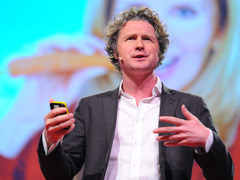
    Ben Goldacre: Battling bad scienceBen Goldacre: Battling bad scienceThe talk: Ben Goldacre: Battling bad science
    The challenge: At TEDGlobal 2011, Ben Goldacre was approached by a group of translators who had listened to the talk he had given earlier that day. He was just a little bit surprised when they told him: “We loved your talk — it’s entertaining and interesting and it was a great presentation. But you talked so fast, it will be a real challenge for translators.”
    Now available in: 37 languages
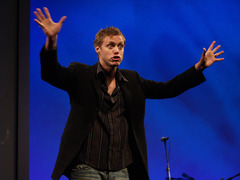
    Ze Frank's nerdcore comedyZe Frank's nerdcore comedyThe talk: Ze Frank’s nerdcore comedy
    The challenge: Polish translator Kinga Skorupska explains why she struggled with Ze Frank’s TED Talk: “He’s talking and at the same time showing slides, and the clash between what we see and what he says makes it funny, but really awkward to translate. I am still not happy with the final result.”
    Now available in: 22 languages
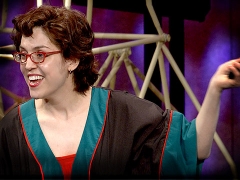
    Erin McKean: The joy of lexicographyErin McKean: The joy of lexicographyThe talk: Erin Mckean: The joy of lexicography
    The challenge: It seems surprising that many of the talks that are difficult to translate are about language. Erin McKean’s is a good example. “It was difficult but at the same time so rewarding for translators because it addressed the beauty of working with the language and how creative you have to be,” says Magda Rittenhouse, another translator from Poland.
    Now available in: 28 languages
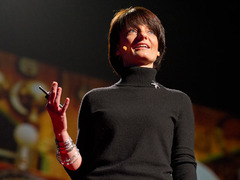
    Regina Dugan: From mach-20 glider to humming bird droneRegina Dugan: From mach-20 glider to humming bird droneThe talk: Regina Dugan: From mach-20 glider to humming bird drone
    The challenge: For Persian translator Soheila Jafari, Regina Dugan’s talk is one of the most challenging talks she has worked on so far. It’s a perfect example of a talk with specialized and unusual terminology. To find the correct words, Jafari did a lot of research in several different fields of science.
    Now available in: 16 languages
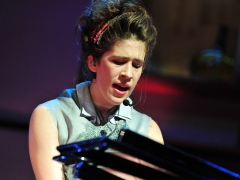
    Imogen Heap plays "Wait It Out"Imogen Heap plays "Wait It Out"The talk: Imogen Heap plays “Wait It Out”
    The challenge: The “E” in TED — Entertainment — can be either a nice gift or a real challenge for translators. Writes translator Katarina Smetko, from Croatia, “For me, translating any kind of poetry or song lyrics is tough … It’s very hard to do this properly without being a bit of a poet yourself — something that I certainly don’t flatter myself to be. That doesn’t mean I haven’t tried, though.”
    Now available in: 26 languages
    C.K. Williams' poetry of youth and age C.K. Williams' poetry of youth and age The talk: C.K. Williams’ poetry of youth and age
    The challenge: Translating poetry is a difficult genre — and especially intimidating if the poet has won nearly every award out there, from the National Book Critics Circle Award to the Pulitzer Prize for Poetry.
    Now available in: 18 languages
    Virginia Postrel on glamourVirginia Postrel on glamourThe talk: Virginia Postrel on glamour
    The challenge: Have you ever tried to find four different words for “glamour” in your language? When a talk is focused on a specific concept, and one that is very culture-specific, translating can turn into a fiddly business.
    Now available in: 19 languages

    This post was written by Katja Tongucer, who translates TED Talks into German. She is passionate about finding the appropriate word and believes that living abroad should be a basic part of anyone’s education.

  • How to Spot a Genuine App Review

    How to spot a real BlackBerry app review

    Recently, I read a story that both shocked and upset me. A study conducted by Gartner found that by the year 2014, 10-15 percent of social media reviews will be falsified information. As you can tell by the App World Wednesday posts I write, I’m a guy who spends a lot of time in the newly-named BlackBerry World.

    The thought of “reviewers” moving in and writing fake reviews to either help or hurt certain apps makes me crazy. While our apps group does its best to police any fake reviews in BlackBerry World, we as consumers and developers can stay sharp and zap fake reviews ourselves, too. Here are five ways to become an app review super-sleuth:

    1. Consider the Source. Does the app you’re looking to download have only three reviews from users “FredFlintstone”, “WilmaFlintstone”, and “BarneyRubble?” You may want to take those reviews with a grain of salt.
    2. Help the Cause. Make sure you’re signed up for a BlackBerry ID and that you’re writing your own honest and fair reviews. Suggest changes the developer can make in a helpful way.
    3. One of These Things is Not Like the Others. If an app has a ton of stellar reviews, then one one-star review stating the app is terrible, you may be looking at a fake review or simply someone who didn’t understand the app. The same thing goes for many bad reviews and one great one.
    4. Trust, but Verify. If an app is poorly reviewed, take a look at some of the other apps the developer has done as well as their reviews. If the app is a rare miss for the developer, there’s a good chance they’ve developed an improved app to replace it.
    5. Contact the Developer. Almost all of the BlackBerry World developers have a way to contact their support team if you have a question. If you’re concerned about the app’s features or price, connect with the developer before you download the app. A good app developer will look to customer feedback for making their product better rather than just sit back and read negative reviews.

    I’m a firm believer in spotting and calling out fake reviewers, and in promoting fairness to our developers who bring great apps to all of us. Help the cause and tell us how you spot fake reviews. And remember to contact BlackBerry World Support if you see something that doesn’t look right.

  • Five of Steve Jobs’s Biggest Mistakes

    It’s a great disservice to everyone, especially young people, that the stories that we often hear about the most accomplished entrepreneurs sound so effortless. The truth is just the opposite, even for visionary creative success stories like those of Mark Zuckerberg, Jack Dorsey, Howard Schultz, Wendy Kopp, and even the legendary Steve Jobs. Like any creative process, any entrepreneur who wants to invent, innovate, or create must be willing to be imperfect and make mistakes in order to learn what works and what does not.

    It took Dorsey years of experimentation before he finally latched onto what ultimately became Twitter. Wendy Kopp started Teach for America, initially as a conference, on a shoestring budget after graduating from college. And Howard Schultz, while he had great foresight to recognize that Americans needed a communal coffee experience like those that existed in Europe, failed on his first try. As I wrote in Little Bets, when his first store opened in Seattle in 1986, there was non-stop opera music, menus in Italian, and no chairs. As Schultz acknowledges, he and his colleagues had to make “a lot of mistakes” to discover what would become the Starbucks we know today.

    Despite what we may have read, Steve Jobs was no different. Here are five of Jobs’s greatest mistakes, all of which history shows he ultimately learned from:

    1. Recruiting John Sculley as CEO of Apple. Feeling that he needed an experienced operating and marketing partner, the then 29-year-old Jobs lured Sculley to Apple with the now legendary pitch: “Do you want to sell sugared water for the rest of your life? Or do you want to come with me and change the world?” Sculley took the bait and within two years, Sculley had organized a board campaign to fire Jobs. Jobs himself would surely consider hiring Sculley as a great mistake.

    2. Believing that Pixar would be a great hardware company. When Jobs was the last and only buyer standing in 1986 when George Lucas had to sell off the Pixar graphics arm of LucasFilms (for $10 million), he never expected the company to ever make money on animated films. Instead, as Pixar historian David Price shows in his excellent book The Pixar Touch, Jobs believed that Pixar was going to be the next great hardware company. Not even a visionary like Steve Jobs could predict what unfolded at Pixar, yet to his great credit, he supported cofounders Ed Catmull and John Lasseter as they pursued their dream of producing a full-length digitally animated film from day one. He protected their ability to make small bets on short films in order to learn how to eventually make a full-length feature film in Toy Story.

    3. Not knowing the right market for NeXT computer. Although Jobs tried to spin NeXT computer as an ultimate success when the assets were sold to Apple in 1996 for $429 million, few in Silicon Valley agreed. The company struggled from the start to find the right markets and customers. If you haven’t seen the video about Jobs describing the vision for NeXT’s customers, you should watch it on YouTube. It’s clear that even Jobs was confused. In it he says, “We’ve had, historically, a very hard time figuring out exactly who our customer was, and I’d like to show you why.”

    4. Launching numerous product failures. The Apple Lisa. Macintosh TV. The Apple III. The Powermac g4 cube. Steve Jobs was brilliant about understanding how technology vectors were evolving, yet even he screwed up royally, and often. The lesson that I take from these defunct products is that people will soon forget that you were wrong on a lot of smaller bets, so long as you nail big bets in a major way (in Jobs’s case, the iPod, iPhone, iPad, etc). Jobs was a market research group of one at Apple, which carries with it great risk, yet it should be noted that his batting average improved over time, which comes as no surprise to those who study the benefits of developing strong creative muscles though deliberate practice.

    5. Trying to sell Pixar numerous times. By the late 1980s, after owning Pixar for four or five years, Jobs tried on multiple occasions to sell the company, just to break even on his investment, which ultimately equaled roughly $50 million. He shopped Pixar to, among others, Bill Gates, Larry Ellison, and numerous strategic partners and companies. No potential buyer bit. It’s a good thing for Jobs, and his legacy. He eventually engineered the sale of Pixar to Disney for $7.4 billion in 2006.

    The lesson, it seems, is fairly simple: Even the great business visionaries and luminaries of our times often fail and have setbacks. Imperfection is a part of any creative process and of life, yet for some reason we live in a culture that has a paralyzing fear of failure, which prevents action and hardens a rigid perfectionism. It’s the single most disempowering state of mind you can have if you’d like to be more creative, inventive, or entrepreneurial. The antidote is to try a small experiment, one where any potential loss is knowable and affordable.

    The revolution will be improvised.

  • These Four Historians Have Some Thoughts About Today’s Inauguration

    Collectively, Doris Kearns Goodwin, Robert Caro, Michael Beschloss, and Douglass Brinkley have written more than a dozen popular and thoughtful books about American presidents ranging from Abraham Lincoln to John F. Kennedy, Theodore Roosevelt to Ronald Reagan. They've won Pulitzer Prizes, the National Book Award, and even an Emmy.

    So we asked them to sit down and discuss the historical significance of a Presidential Inauguration and what it means for President Obama to begin second term.

    The video is worth your time. Check it out:

  • How Big Should Government Be?

    There are a couple of fundamental questions at the bottom of Washington’s ongoing battles over deficits and debt: (1) How big should the U.S. government to be? and (2) How should we pay for it? The answers to both will ultimately have to be political ones — messy calculations based on who pays, who benefits, who votes, and who makes the campaign contributions. But it would be nice to know what the economics are, wouldn’t it?

    It turns out economists have lots of theories of optimal government spending and optimal taxation. This isn’t the same as saying they have reliable or consistent answers. As one critic wrote of Robert Lucas’s American Economic Association presidential address on economic growth in 2003, in which the Nobel laureate cited several studies showing dramatic welfare gains from hypothetical tax cuts in France and the U.S.:

    Such findings have two distinctive features. First, they show big numbers. Second, they are not really findings. Contrary to the words offered so traditionally and casually by economists, none of these authors actually ‘found’ or ‘showed’ their results. Rather, they chose to imagine the results they announced. In every study Lucas cited here the crucial ingredient was a theoretical model laden with assumptions.

    The author of these words is University of California, Davis economic historian Peter Lindert, who hid them among the data appendices in volume two of his epic 2004 empirical study, Growing Public: Social Spending and Economic Growth Since the Eighteenth Century. The books have developed something of a cult following among econowonks across the political spectrum. People on the left love Lindert’s conclusion, contained in this shorter working paper, that the rise in spending (and accompanying taxation) has not carried with it the costs predicted by neoclassical economic theories such as the ones wielded by Lucas. But those on the right love his explanation that this is mostly because countries with high social spending have tax systems that appear to have been designed by a neoclassical economist: with low progressivity, low taxes on capital, and big value-added taxes on consumption.

    Lindert found essentially no correlation between levels of social spending (expressed as a percentage of GDP) and economic growth in wealthy nations in the post-World War II era. During the first big rise in social spending, from 1880 to 1930, there was actually a positive correlation — probably because early poor-relief measures improved workers’ health and productivity. Lindert thinks social spending on health-care and education can still have positive growth effects — and of course government infrastructure and R&D spending, which weren’t a focus of his study, can boost growth as well. But his main takeaway was that the Swedens and Germanys of the world have a “more pro-growth and regressive mix of taxes” (italics LIndert’s) than lower-spending nations such as the U.S.

    So basically, the frequent Republican contention that high government spending is choking economic growth in the U.S. isn’t really backed up the evidence — at about 42.5% in 2010, government spending’s share of GDP in the U.S. (that includes state and local spending) is on the low side among the world’s wealthy nations. But at the same time, if spending is to go higher, or if we simply want to be able to pay for the spending we’re already doing, the Democratic focus on raising taxes on the wealthy isn’t going to get us there.

    Which brings us back to the political discussion in Washington. Republicans have for the past couple of years been going with the mantra that federal spending should be brought down to a “historical average” of 18% of GDP. Since World War II, federal spending has actually been closer to 20% of GDP, but tax revenue has averaged just under 18%, so that is a reasonable starting point (if you go back farther in history, you can of course get it much lower, but it’s not clear what that proves). It’s also possible to run ongoing deficits of 1% or 2% of GDP without major ill effects — as long as the economy grows fast enough and interest rates are low enough that the federal debt shrinks as a percentage of GDP.

    sizeofgovt.gif

    The question is whether it’s realistic to think federal spending can be kept to 20% of GDP (or wise to think it should). Right now it’s at 24%, and while that will decline as the economy continues to recover, the retirement of the Baby Boom generation is going to put upward pressure on spending for decades to come. We’re also going through an era of economic and technological upheaval that probably calls for increased investment in education and research, and may even justify increased social spending. So it’s perfectly reasonable to argue that spending, and taxes, will have to be higher going forward.

    As Peter Lindert’s research shows, this wouldn’t have to hurt economic growth. But as his research also shows, it really can’t be done just by raising income tax rates on the wealthy. The U.S. already has about the most progressive income tax system around. European social democracies tend to have flatter income taxes, plus value-added taxes that hit all consumers. They tax capital gains and dividends at lower rates than regular income, just as the U.S. does, but they also all have lower corporate tax rates than the U.S. This lack of progressivity extends to the spending side: Lindert says social programs are less likely to be means-tested in the big-spending social democracies than in the U.S. or Great Britain.

    The economic logic behind all this is that progressive tax systems and means-tested social programs can carry with them big disincentives to work, particularly near the bottom of the income scale. As for the low taxes on capital and corporate income, that’s partly neoclassical theory (by encouraging investment, you get more growth) but also just realism about enforcement (global corporations and investors can easily get around such taxes).

    This lesson has sunk through to budget experts like Alice Rivlin, whose original deficit-reduction plan with Republican former Senator Pete Domenici included a value-added tax. But it has so far been political poison: Republicans hate any talk of new taxes, and Democrats hate any talk of regressive new taxes. If the U.S. is going to make it safely through the budget challenges of the next few decades, though, both parties are going to have to get over their phobias.

  • Obama’s Inauguration and Why We Still Need Rituals

    I have a picture somewhere of my son and me playing in the living room the day of Barack Obama’s first inauguration as 44th President of the United States. My son was five months old, the ceremony on the TV behind us. I had left work early to watch it. That night, we wrote about it in his baby book.

    It was impossible, even from afar, not to feel the enchantment of that moment, not to grasp its historical significance.

    Two months earlier, the morning after Obama’s election, I had happened to be with a group of fellow leadership academics, a crowd that maintains an affectation of skeptical detachment for all manifestations of unbridled hope in charismatic leaders. (Humans always fall for it. It never ends well.) One, rather out of character, shared that he had cried.

    It will be different, this time around.

    The National Mall will be less crowded and the hope in many hearts no longer of the unbridled kind. Less of a new dawn, more like a second chance. (This, I have argued elsewhere, may be a good thing.) While its significance may be different, however, Obama’s second inauguration will be just as meaningful. Because the ceremony, first and foremost, is not about him.

    It is about us.

    Public rituals often mark the transition of individuals into, or out of, significant roles and life stages. In doing so, they serve a crucial function for a community at large, affirming its ability to renew itself. Far more than displays of vanity and mass celebrations, rituals keep culture alive. They put people into culture and culture into people. This is why uprooted or oppressed communities go to great pains to preserve their rituals. When rituals disappear their culture goes with them.

    Humans have always gathered to perform rituals that tie leaders to their communities and vice versa. Rituals help craft a tie made of belonging without possession, the kind of bond where each side gives the other permission to change them for good. Leaders use rituals to infuse their communities with meaning — to signal what matters, who we are, what we must do and why. Communities use rituals to demand leaders’ allegiance — to signal what norms they must conform to, which principles they are to uphold, who they are meant to serve. Put another way, rituals are reminders that leaders are both shapers and custodians. It is their job to influence as much as it is to represent their people.

    In days like this, it is hard not to wonder where those rituals are in business organizations today. In many, commitment and community have weakened. Loyalty has declined. Rituals have ceased to exist, or they don’t mean much. People may be freer and perhaps less gullible. But they are often also more isolated, connected without belonging. It is perhaps not a coincidence that in those same organizations the trust in leaders, and leaders’ ties to followers, are at their weakest. Rituals are cast as anachronisms or follies, rather than something that governs, binds, and reminds us that good leaders are stewards of a purpose and community, not the other way around.

    Think of the inauguration again. On the one hand, the Obama administration — as every other before and after his — will use its power to shape the event. It has chosen speakers, singers, guests, words, and symbols that present its values, its identity, and its aspirations as those of the American people.

    On the other hand, Obama will swear allegiance to the United States constitution — his hand on two bibles — Abraham Lincoln’s and Martin Luther King’s — with the same formula used by every US President since George Washington. He will be surrounded by representatives of military, political, legal, religious, and economic powers whom he will need as much as they need him, and sometimes more. And he will stand, as leaders always have, before a crowd. Them, his people. And he, theirs.

    Obama, like Bush and Clinton before him, has also demonstrated a capacity for public introspection that we have come to expect of leaders — a performance of authenticity of sorts that turns leaders’ personal experience as a source of legitimacy in the eyes of those who resonate with it. When the boundary between person, work and role — who they are, what they do, and what others expect — is so thin, leaders are most inspired and inspiring. They feel and look “real,” committed, all in. It is also then that they are most vulnerable — to attacks, to losing their role, to becoming obsessed with success, to losing themselves. They are easier to love and easier to hate — depending less on how much we agree and more on how close we feel to them.

    President Obama seems well aware of the opportunities and risk that lie at the boundary between him as a person and his role. Michael Lewis’s recent profile of his is a chronicle of the struggle to remain a human being while also fulfilling the duties of such a demanding, visible, and controversial leadership role. As many leaders these days, Obama is open about the desire, necessity or presumption — depending on how you see it — of having a life while attempting to lead.

    “One of the things you realize fairly quickly in this job,” he told Lewis, “is that there is a character people see out there called Barack Obama. That’s not you. Whether it is good or bad, it is not you.” He continued, Lewis reports, “You have to filter stuff, but you can’t filter it so much you live in this fantasyland.”

    As boundaries between private and public, person and role, become thinner for everybody and for leaders most of all, learning to remain present while exposed — somewhere between detached and overwhelmed — is vital to be well and to do well. Rituals help leaders do just that — show up fully and yet remember that even when you are at the center, it is not all about you.

  • Emerging policy-One cut, two steady

    What a varied bunch emerging markets have become. At last week’s monetary policy meetings, we saw one rate rise (Serbia) and differing messages from the rest. Mexico turned dovish while hitherto dovish Brazilian central bank finally mentioned the inflation problem. Russia meanwhile kept markets guessing, signalling it could either raise rates next month or cut them.

    This week, a cut looks likely in Turkey while South Africa and the Philippines will almost certainly keep interest rates steady.

    Turkey’s main policy rate – the one-week repo rate – and overnight lending rate are widely expected to stay on hold at 5.50 percent and 9 percent respectively on Tuesday. But some predict a cut in the overnight borrowing rate – the lower end of the interest rate corridor, motivated partly by the need to keep the currency in check.   The lira is trading near 10-month highs, thanks to buoyant inflows to Turkish capital markets.  That has helped lower inflation from last year’s double-digit levels.

    Goldman Sachs in fact, reckon the central bank will cut both the borrowing and lending rates by 25bps and also raise the Reserve Option Coefficient (the amount of foreign currency that lenders have to provide for the gold portion of their central bank reserves). They write:

    We believe that the Bank has shifted focus towards the financial stability risks posed by accelerating capital inflows, and away from domestic inflation. We believe a combination of ROC hikes and (more visibly) cuts to the borrowing and lending rates, bringing the interest rate corridor down, will be used to lean against these inflows and their subsequent FX appreciation pressures.

    Analysts at BNP Paribas agree:

    While the current level of the lira is unlikely to be strong enough to elicit an aggressive reaction from the central bank, we still think that a measured 25 basis points cut to the lower end of the interest rate corridor is likely at next week’s central bank’s policy meeting, as a precaution against ongoing capital inflows.

    In South Africa on the other hand, it is the currency’s weakness that is likely to force the central bank (SARB) to hold its hand.

    This is a market that could really do with an interest rate cut — persistent labour unrest means GDP growth is likely to undershoot forecasts for 2.9-3.0 percent this year. But all 23 economists polled by Reuters see the SARB keeping rates  at 5 percent this  Thursday. Data this week expected to show annual price growth close to the central bank’s 6 percent upper limit and that’s partly down to the currency which lost almost a fifth of its value against the dollar last year. In 2013 the rand  is already down 5 percent and the central bank cannot risk weakening it further. Goldman Sachs again:

    If anything, announcements of mine closures, a third sovereign rating downgrade, ongoing rand volatility, and the potential for further widening of the CA deficit are likely to have pushed the hurdle for a rate cut higher than in 2012 second half.

    Philippines in comparison looks lucky. Inflation is close to the lower end of the central bank’s target band while GDP growth is running around 6 percent. The peso appreciated 6 percent last year against the dollar.  No wonder Governor Armando Tetangco is relaxed. He said last week that balanced inflation risks and robust GDP growth suggested the “current policy settings are appropriate.”  Expect rates to be left at a record low 3.5 percent on Thursday.

  • BlackBerry App World Web Storefront is now BlackBerry World

    BlackBerry App World is now BlackBerry World

    Hey #TeamBlackBerry, if you were up at the wee hours of the morning today, you may have noticed a change to the BlackBerry App World web store. It is now simply called BlackBerry World. The naming change reflects a shift in the type of things you can purchase from the store as we transition to BlackBerry 10 and beyond.

    As we mentioned back at BlackBerry Jam Americas, BlackBerry World will have much more than just apps – it will now be home to Videos and Music as well. BlackBerry World is going to be the one-stop shop for all of your mobile entertainment needs.

    With BlackBerry World, there are various ways to browse, download, buy, and manage apps using a BlackBerry smartphone, BlackBerry PlayBook tablet, or desktop or laptop computer,— inspiration is at your fingertips. And if you find something you love and want to tell the world, you can easily share it with your friends over BBM, Facebook and Twitter. Also, you can simply tap smartphones together and invite your friends to download it — just like that.

    The change will happen on the web storefront first and will be rolled out to the BlackBerry PlayBook tablet and BlackBerry smartphones in the coming weeks. (NOTE: Please be aware it may take up to 24 hours for the changes to appear.)

    If you’re asking “what about the BlackBerry World conference?” – worry not, the BlackBerry World conference isn’t going anywhere. Renamed the BlackBerry Live conference, we’ll be on the ground May 14-16 in Orlando, Florida to celebrate all things BlackBerry 10.

    A few sneak peeks into what BlackBerry Live will bring this year:

    • BlackBerry 10 platform demonstrations
    • Meet the BlackBerry leaders behind BlackBerry 10
    • Hear what’s next for BlackBerry
    • And more!

    Check out Luke’s post on the Inside BlackBerry for Business Blog for more information.

  • Follow the 2013 Inauguration, Live!

    Today, President Obama will be sworn in during the 57th Inaugural Ceremony in our nation's history, and you'll be able to keep track of all the festivities on WhiteHouse.gov.

    The Inaugural Ceremony begins at 11:00 ET, but start watching early to catch behind-the-scenes footage from the weekend and a look back at the Administration's work over the past four years.

    Once the ceremony begins, you can watch a livestream, as well as follow social media updates on Facebook and Twitter.

    Later, you'll be able to follow the Inaugural Parade down Pennsylvania Avenue, see photos and videos from the day, and read President Obama's Second Inaugural Address.

    Don't miss it. You can catch it all at WhiteHouse.gov/inauguration.

    You can also check out this gallery of images from the 2013 Inaugural weekend

  • President Obama and Vice President Biden Take the Oath of Office

    Today, in two separate, private ceremonies, President Obama and Vice President Biden were officially sworn into office, marking the start of the second term. (The Constitution mandates that the President takes the oath on January 20. Since that date falls on a Sunday this year, the public inauguration ceremony and festivities will take place tomorrow, January 21)

    Supreme Court Chief Justice John Roberts administers the oath of office

    Supreme Court Chief Justice John Roberts administers the oath of office to President Barack Obama during the official swearing-in ceremony in the Blue Room of the White House on Inauguration Day, Sunday, Jan. 20, 2013. First Lady Michelle Obama, holding the Robinson family Bible, along with daughters Malia and Sasha, stand with the President.

    (Official White House Photo by Chuck Kennedy)

    President Obama took the oath, administered by Chief Justice John Roberts, in the Blue Room of the White House, using a bible that belonged to First Lady Michelle Obama’s paternal grandparents.

    Supreme Court Chief Justice John Roberts administers the oath of office to President Barack Obama

    Supreme Court Chief Justice John Roberts administers the oath of office to President Barack Obama during the official swearing-in ceremony in the Blue Room of the White House on Inauguration Day, Sunday, Jan. 20, 2013. First Lady Michelle Obama, holding the Robinson family Bible, along with daughters Malia and Sasha, stand with the President.

    (Official White House Photo by Lawrence Jackson)

    Vice President Biden was sworn in by Justice Sonia Sotomayor in front of family and friends in a ceremony at the Naval Observatory. Vice President Biden took the oath using the Biden family bible.  

    Supreme Court Justice Sonya Sotomayor administers the oath of office to Vice President Joe Biden

    Supreme Court Justice Sonya Sotomayor administers the oath of office to Vice President Joe Biden during the official swearing-in ceremony at the Naval Observatory Residence in Washington DC, Jan. 20, 2013. Dr. Jill Biden holds the biden family Bible. Also pictured, from left, are: Maisy Biden, Hunter Biden, Naomi Biden, Finnegan Biden, Natalie Biden, Kathleen Biden, Hunter Biden, Ashley Biden, Howard Krein, Beau Biden and Hallie Biden.

    (Official White House Photo by David Lienemann)

    read more

  • First Lady Michelle Obama and Dr. Jill Biden Celebrate the Inauguration with Military Families

    The First and Second Ladies of the United States got an early start on the 2013 Inauguration celebrations at a concert honoring our military families.

    The Kids Inaugural: Our Children, Our Future was hosted by Nick Cannon and featured artists including Katy Perry, Usher, the cast of "Glee," Far East Movement and Mindless Behavior. JR Martinez, the Army hero who won "Dancing with the Stars," also joined Mrs. Obama and Dr. Biden for the event, which was held at the Washington Convention Center. 

    Dr. Biden said the concert was a chance to show military kids how much the country appreciates the sacrifices they make while their parents are serving.

    The First Lady told the crowd that while she loves "every single minute" of the inaugural celebrations, the Kids Concert was the true highlight:

     I have to tell you that my very favorite part of this entire weekend is being right here with all of you. Absolutely. Because for me, this is what inauguration is all about. It’s about celebrating who we are as Americans and all the things that make this country so great. And when I think about who we are, when I think about what makes America great, I think about all of you –our men and women in uniform, our military spouses, and our amazing military kids.

    read more

  • Giving Back on the National Day of Service

    President Barack Obama stains shelves during a National Day of Service

    President Barack Obama stains shelves during a National Day of Service school improvement project at Burrville Elementary School in Washington, D.C., Saturday, Jan. 19, 2013.

    (Official White House Photo by Pete Souza)

    Today, the First Family kicked off Inauguration weekend by participating in the National Day of Service, helping out with some school improvement projects at Burrville Elementary in Washington, DC.

    President Obama asked Americans around the country to take part in the National Day of Service to honor the life and legacy of Dr. Martin Luther King, Jr., whose birthday falls on Inauguration Day this year. The President and First Lady asked that we all remember the importance of giving back and looking out for others – both central to Dr. King’s work – as we celebrate this weekend.

    “This is really what America is about,” President Obama said. “This is what we celebrate.” He said that this Inauguration is “a symbol of how our democracy works and how we peacefully transfer power, but it should also be an affirmation that we’re all in this together and that we’ve got to look out for each other and work hard on behalf of each other.”

    read more

  • Getting Highway Numbers Right: The Tax Foundation’s Response

    Randal O'Toole

    On Thursday, January 17, the Tax Foundation (TF) issued a paper arguing that only 32 percent of state and local highway costs were paid out of user fees, while the remaining costs came from “general funds.” In a post here, I pointed out that, actually, user fees for highways cover 76 percent of the costs of roads and most of the remaining 24 percent come from interest on user fees before they are spend and bond sales that will be repaid out of user fees.

    TF replied, saying “O’Toole conflates taxes and fees.” In fact, TF specifically said that state gas taxes are user fees, but somehow defined federal gas taxes as “general funds.” I simply argued that, to be consistent, TF should count federal gas taxes as user fees as well.

    TF went on to say, “O’Toole suggests we include federal gasoline tax collections in state-local revenue.” Again, TF said that federal gas tax collections are “general funds” and I disagreed with that statement. If state gas tax collections are user fees, then federal gas tax collections are too. They are certainly not general funds, any more than state gas taxes are general funds, since federal law dedicates them to transportation projects and mostly to highways.

    TF said, “O’Toole suggests that we include motor vehicle registration taxes and fees, but not the associated expenses” such as highway patrols. In fact, I said nothing about the associated expenses because, for the most part, those expenses are already included in the reported $155 billion cost of highways.

    TF said, “O’Toole suggests that we include state and local bond sales for road construction, which would double-count revenue.” But nothing I said would double-counting revenues. What I said was that bond sales for highways are not, in any sense, “general funds” if they will be repaid out of user fees.

    TF said, “O’Toole suggests that we include $13 billion in “investment income” on state-local gasoline tax and user fee revenue, but that is not a net interest figure.” What TF means is that some of that interest might come from investments of non-user fees, which is true. But since user fees cover the vast majority of state and local road costs, interest on those user fees makes up the vast majority of interest. Yet TF counted all interest as “general funds.”

    TF said, “O’Toole suggests that we use Federal Highway Administration data rather than U.S. Census Bureau data. We have no evidence that the U.S. Census Bureau is unreliable in this area.” I suggest that the fact that the Census Bureau, which uses secondary data, differs from the Federal Highway Administration, which uses primary data, is itself evidence that the Census Bureau data are unreliable.

    In sum, by TF’s own definition of user fees as being gas taxes and tolls, something like 55 percent of the cost of roads is collected in user fees. Adding vehicle registration fees brings this to 76 percent, and most of the rest is covered by bonds that will be repaid by user fees and interest on those user fees. TF’s reply failed to address my main point, which is that none of these revenues can be considered “general funds.”

  • Young Reporters Ask All the Right Questions About Helping Military Families

    Michelle Obama and Jill Biden with kid reporters, Jan. 18, 2013

    First Lady Michelle Obama and Dr. Jill Biden are interviewed by young reporters during a kids magazine roundtable in the First Lady’s Office in the East Wing of the White House, Jan. 18, 2013.

    (Official White House Photo by Sonya Hebert)

    Yesterday, the First Lady and Dr. Biden sat down with four exceptional young reporters from kids’ magazines to talk about their initiative to support military families, Joining Forces. The reporters – from Highlights, National Geographic Kids, Scholastic and TIME for Kids – asked some great questions about the initiative and how kids can help!

    Some of the takeaways?

    • Mrs. Obama and Dr. Biden talked about how they encourage all Americans to look for ways to honor and support military families, and Dr. Biden said when her son Beau was deployed their church put his name in the bulletin to pray for him, people brought meals over, and someone shoveled her daughter-in-law’s driveway during a snowstorm. 
    • Asked about advice for a military child who moves a lot, Dr. Biden encouraged them to get involved in sports teams and school activities. And as a teacher herself, she talked about how teachers can get involved to reach out to military kids. For example, Dr. Biden’s granddaughters’ teacher put a picture of her dad’s unit outside of her classroom so the entire class would know Beau was deployed. 
    • Mrs. Obama encouraged all the kids’ magazines’ readers to think “what can I do?” for a new kid in school – especially a new military kid. 

    read more

  • Weekly Address: Now Is The Time to Take Action Against Gun Violence

    President Obama reiterates his commitment to do everything in his power to implement a series of common sense measures that would reduce gun violence in America. The President started off that effort with 23 concrete actions his Administration is taking immediately under its existing legal authority. But to have a lasting impact, Congress must join the administration by passing common sense laws like requiring a universal background check for anyone trying to buy a gun, and restoring a ban on military-style assault weapons and a 10-round limit for magazines. If they do that, we can respect the Second Amendment rights of law-abiding citizens while helping to keep the irresponsible few from causing massive harm.

    Transcript | Download mp4 | Download mp3

    Learn more 

  • Weekly Wrap Up: “Now is the Time”

    Watch the West Wing Week Here.

    Here’s a quick glimpse at what happened this week on WhiteHouse.gov:

    President Obama’s Plan to Reduce Gun Violence: On Wednesday, President Obama announced his plan to reduce gun violence and keep our children and communities safe while helping prevent events like Newtown. “For all the Americans who are counting on us to keep them safe from harm.  Let’s do the right thing,” he said. “Let’s do the right thing for them, and for this country that we love so much.”

    After the President’s remarks, we debuted our new page for Americans to learn more about the President’s plan and join the conversation with millions across the country. From children’s letters to coverage in national newspapers, see what Americans have been saying about gun violence.

    read more

  • China: Money Matters

    Steve H. Hanke

    Contrary to what the doomsters have been telling us, China’s economy is not on the verge of collapse. As the Wall Street Journal’s man in Beijing (and my former student), Aaron Back, reported: “China’s economic growth accelerated in the fourth quarter of 2012.” Indeed, China’s fourth quarter GDP growth rate came in at a strong 7.9%.

    What the doomsters and many other Pekingolgists fail to grasp is that money matters. Indeed, it dominates fiscal policy, and nominal GDP growth is closely linked to growth in the money supply – broadly measured.

    China’s most recent acceleration in GDP growth did not catch me flatfooted, because China’s money supply has been surging (see the accompanying chart).

    In fact, China’s M2 money supply measure is 9.7% above the trend level. Money matters.