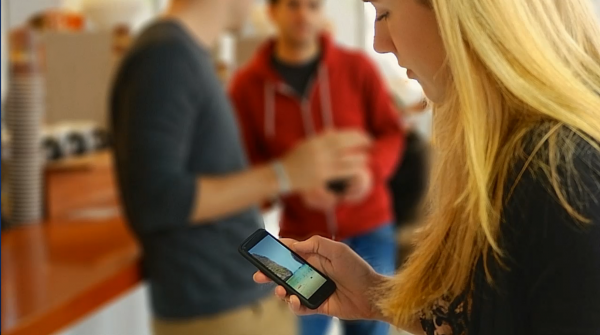
Good news, Steve O’Hear. The physical QWERTY isn’t dead! The BlackBerry Q10 is now available for pre-ordering in the UK and ships at the end of the month.
BlackBerry’s second BB10 device will be available on Vodafone, O2, Orange, T-Mobile, Three, EE, and TalkMobile. Carphone Warehouse lists the device at £579.95 SIM-free or free on a 2-year, £36-per-month, contract. That’s on par with other devices in the UK market.
As for other markets, BlackBerry’s blog posting states “we’ll have details on availability to follow soon.” Whatever that means.
The Q10 is the BlackBerry Bold of the BB10 era. It’s positioned as a top-tier QWERTY device — the best BlackBerry can build. Where the Z10 is a pure touchscreen device, the Q10 is a hybrid, featuring a 3.1-inch touchscreen on top of a QWERTY keypad.
We spent a bit of time with the Q10 at BB10′s launch in January. It’s a worthy successor of the solid BlackBerry Bold. In fact, BlackBerry power users should be more interested in the Q10 than the Z10. It’s that good. But, if that’s you, it would still be wise to play with one yourself instead of simply pre-ordering.
Google held a developer talk about Google Glass at SXSW last month. Developer advocate Timothy Jordan spoke to developers about the Google Mirror API, which is what they’ll use to build services for Glass. He also gave a demo, and talked about guidelines and examples of new experiences that they’ve been building.
“Glass is a very ‘right now’ device,” he says. “So when you deliver data to the user, you want to do it in the moment, and keep it up to date.” It should matter to them based on what they’re doing right now, he says.
Other tips include staying out of the user’s way (it will be interesting to see if Facebook Home makes its way to Glass) and “avoiding the unexpected”.
He shares something they’ve been working on with the New York Times, which shows headlines over top of photos (actually not unlike status updates on Facebook Home), and lets you click to have the article read aloud.
It took nearly six years but T-Mobile has finally managed to add Apple’s (AAPL) iPhone to its smartphone lineup. Beginning on Friday, T-Mobile subscribers can preorder the iPhone 4, iPhone 4S or iPhone 5 on T-Mobile’s website. With the carrier’s new no-contract policy, the iPhone 5 starts at $579.99 for the 16GB model, which can be paid up front or as a $99 down payment plus 24 monthly installments of $20. The iPhone 4S can be had for $69.99 up front and 24 payments of $20 per month, and the iPhone 4 costs $14.99 up front plus $15 per month for 24 months. T-Mobile notes that the iPhone 4S and iPhone 4 are only available in select markets, while the iPhone 5 is available nationwide.
Some of the racks of the ALMA Correlator, one of the most powerful supercomputers in the world, which operates at a remote, high altitude site in the Andes of northern Chile. (Photo Credit: ESO)
High atop the Chajnantor Plateau in the Chilean Andes, at more than 16,500 feet above sea level, a unique supercomputer brings the heavens into focus. Here, at the world’s highest data center, sits the ALMA Correlator, a powerful system that allows a system of high-altitude antennas separated by up to 16 kilometers to work together as a single giant telescope.
The ALMA Correlator is a critical component in a radio telescope system that astronomers are already using to make new discoveries about how planets, stars, and galaxies form. Unlike optical telescopes, which observe visible light emitted by stars, ALMA explores a region of the spectrum of invisible light, the millimeter and sub-millimeter wavelength realm.
How do you operate a supercomputer at 16,500 feet above sea level? It takes some extraordinary engineering and some operational adjustments. The air is so thin that twice the normal airflow is necessary to cool the machine, which draws some 140 kilowatts of power. Computer disk drives won’t work reliably in thin air, so the correlator and its associated computers must be diskless. Seismic activity is common, so the correlator had to be designed to withstand the vibrations associated with earthquakes.
The thin air high in the Andes also affects human performance. While the ALMA Array Operations Site (AOS) Technical Building is expected to be unmanned during routine operations, it took about 20 weeks of human effort there to unpack and install the correlator. “There are thousands upon thousands of cable connections that we had to make, and every one of our cables is the same color blue, so I’m just glad we devised a good labeling system while at sea-level,” said Rich Lacasse of the National Radio Astronomy Observatory (NRAO), leader of the ALMA Correlator Team.
ALMA: $1.3 Billion Project
ALMA is short for Atacama Large Millimeter/sub-millimeter Array, and is operated through an international partnership between North America, Europe, and East Asia in cooperation with the Republic of Chile. The $1.3 billion project was inaugurated last month after several years of construction.
Why build a complex telescope in the mountains? The extreme elevation and low humidity at the site help minimize the interference caused by water vapor in Earth’s atmosphere. The telescope has already provided unprecedented views of the cosmos with only a portion of its full array.
The ALMA correlator’s 134 million processors will continually combine and compare faint celestial “signals” received by as many as 50 dish-shaped antennas in the main ALMA array, enabling the antennas to work together as a single, enormous astronomical telescope. In radio telescope arrays, sensitivity and image quality increase with the number of antennas.
When observing, ALMA’s antennas point at the same celestial object in the sky, gathering faint radio waves. Before astronomers can make detailed images or do other analyses, the information collected by dishes must be extensively processed. The ALMA correlator performs the first critical steps in this data processing. Installation of the correlator was completed in December.
“The completion and installation of the correlator is a huge milestone toward the fulfillment of North America’s share of the international ALMA construction project,”said Mark McKinnon, North American ALMA Project Director at NRAO. “The technical challenges were enormous, and our team pulled it off,” he added.
Cutting Cost With Custom Configuration
One of the challenges facing the correlator design team was cost. “As we confronted this project, we realized that it would have taken, at the time, a billion dollars’ worth of off-the-shelf personal computers to perform the needed calculations,” said John Webber, former head of the NRAO Central Development Laboratory in Charlottesville, Virginia. “We built our own custom machine for about 11 million dollars.”
ALMA’s European partner, led by the European Southern Observatory (ESO), provided 550 “next-generation” circuit boards that increase the system’s ability to distinguish fine shades of color, or wavelength. With these filters, the light which ALMA sees can be split up into 32 times more wavelength ranges than in the initial design, and each of these ranges can be finely tuned.
“This vastly improved flexibility is fantastic” – said Alain Baudry, from the University of Bordeaux, the European ALMA correlator team leader- “it lets us ‘slice and dice’ the spectrum of light that ALMA sees, so we can concentrate on the precise wavelengths needed for a given observation, whether it’s mapping the gas molecules in a star-forming cloud, or searching for some of the most distant galaxies in the Universe.”
For a photo gallery of the worlds highest data center, continue to the next page.
Samsung Electronics (005930) on Friday posted its earnings guidance for the first quarter of 2013. The world’s No.1 smartphone vendor continued on its warpath last quarter as operating profit climbed more than 50% to approximately $7.7 billion, handily topping analysts’ estimates and setting a new first-quarter record. Revenue for the quarter was also up from roughly $40 billion in the first quarter last year to about $45.9 billion in Q1 2013. Samsung’s audited results will be posted in the coming weeks, and the company’s full press release follows below.
It was a busy week in the tech world, and the GigaOM Podcast is here to help you make sense of it all. Eliza Kern and Kevin Tofel invite us over to Facebook’s new “Home” on Android. Then Katie Fehrenbacher gives us a ride through Tesla’s new lease deal. And finally, Janko Roettgers opens our eyes to Rdio’s new video service, Vdio.
SHOW NOTES: This episode of the GigaOM Podcast is brought to you by Squarespace – the best way create a modern and professional website, with all the features you need integrated into one platform. Every Squarespace website is mobile ready, and includes e-commerce, 24/7 customer support, and a free domain name.
Juniper Networks (JNPR) announced new products for enterprise campus and data center infrastructures, to take on the spikes in BYOD, mobile users and new enterprise application deployments. Its new agile, programmable network will enable network operators to respond to business changes and monitor and react responsively to how the network meets application service level agreement (SLA) requirements.
Highly Programmable Switch
The Juniper EX9200 Programmable Switch enables accelerated response to changing business needs, while its built-in ability to support a virtual WLAN controller. the Juniper JunosV Wireless LAN Controller, delivers reliability and flexibility across the enterprise. Built upon the Juniper One Programmable ASIC, the EX9200 prepares enterprises for emerging Software-Defined Networking (SDN) protocols, allowing for network automation and interoperability without the need for additional hardware. Its Virtual Chassis simplifies network architecture and reduces network devices and layers by to to 50 percent. Equipped with 1/10/40GbE interfaces, it is set to deliver 100GbE performance later this year.
“A dynamic and competitive global marketplace requires organizations to be flexible and responsive,” said Bob Laliberte, senior analyst, Enterprise Strategy Group. ”As a result, the underlying IT infrastructure and the network especially needs to be able to evolve with the business. The Juniper EX9200 Ethernet switching platform delivers a level of programmability that will allow enterprises to prepare for emerging protocols and applications. This programmability will also ensure that network operators will have the flexibility to add those future services with limited need for hardware upgrades, thus providing a high degree of assurance and investment protection.”
Tackling BYOD, Wireless and Single Pane Management
Addressing the BYOD trend and seamless integration between wired and wireless networks, Juniper’s virtual WLAN controller is designed to run on any combination of physical appliances, on a virtual machine (VM), or directly on Juniper Networks switches (future). Juniper has made wireless controller functionality a service on the network while offering consistent, industry-leading capabilities such as controller clustering, in-service software upgrades, self-organizing adds, moves and changes, and local switching across the portfolio.
Additionally Juniper launched its Junos Space Network Diretor, a single campus-to-data center management tool, to provide a holistic view into the enterprise network. By consolidating different management tools into a single application, the new software accelerates application deployment time and reduces complexity and operational expenditures.
“Juniper’s EX9200 dramatically simplifies how we provide cost-effective, reliable, high-bandwidth and high-capacity networking to our research and education participants, as well as faculty, students and staff,” said Schyler Batey, lead network engineer at Pacific Northwest GigaPOP. “The advanced programmability of the EX9200 delivers future-ready capabilities that can be easily adapted to support new requirements created by emerging applications, such as SDN and EVPN, while automation features allow us to transform network operations, reducing complexity and overhead.”
After intense lobbying by Kraft Foods Global Inc. and Kemin Food Technologies, the Food Safety and Inspection Service (FSIS), a division of the U.S. Department of Agriculture (USDA), has agreed to reverse existing regulations that prohibit the use of three toxic meat…
How insanely out-of-control has the war on drugs become? Apparently now, if all you do is buy equipment to grow plants and vegetables indoors is reason enough to suspect you of conducting illegal drug activity.
Case in point: State police and sheriff’s deputies in…
Imagine having a food allergy condition so severe that you could only eat a few select foods without vomiting uncontrollably, developing extreme fatigue and becoming gravely ill. This is what young Tyler Trovato of St. James, New York, and a growing number of American…
Spring allergy is commonly used to refer to hay fever, a seasonal allergic rhinitis attack experienced by more than 35 million Americans every year as the season changes and many allergens start to blossom – during springtime. As pollens scatter and travel through air…
I’d wager that most of you reading this didn’t make it out to Austin for SXSW, and even fewer of you still have ever gotten some hands-on time with Google’s ambitious Glass project. On the off chance that you’ve been spending these past few weeks agonizing over all the juicy Glass tidbits you missed out on by not being there, you can rest easy — Google has posted the full video of its 50 minute Glass session on YouTube.
The talk — titled “Building New Experiences with Glass” featured Senior Developer Advocate Timothy Jordan giving attendees (and now you) a brief rundown on what it’s actually like using Google Glass. We’ve seen these sorts of hands-on impressions in the past, but Jordan’s session managed to give attendees a clearer idea of what the Glass interface actually looks like while he’s rubbing away at the side-mounted trackpad or checking out updates from his Google+ pals.
More importantly, Jordan’s session provided those on-site developers a glimpse at what it actually takes to build services for the head-mounted display. In it, he made multiple references to how simple the development process actually was (it’s “not complex,” as he puts it), but there’s more than enough meat here to give potential Glass developers a taste of what they’re in for. In the end though, Jordan was bullish on what Glass means for how we as users interact with our gadgetry — he didn’t go as far as saying traditional touchscreens were “emasculating” like a certain other Google employee, but he pointed out that current modes of interaction tend to separate us from the events and experiences of our lives.
“It feels like tech is often getting in the way more than it needs to,” Jordan remarked. “And that’s what we’re addressing with Project Glass — it’s so that you can still have access to the technology you love, but it doesn’t take you out of the moment.”
Jordan and his employers at Google may think we’ll love Glass, but the real jury has yet to weigh in. While Google is prepping Glass for a widespread consumer release at the end of this year, it has also reached out to thousands of would-be Glass Explorers about claiming their own $1,500 tester units. So far the search giant has been exceedingly careful about who has gotten to play with its vision of the future, but that’s all about to change in short order.
How important is Facebook really? The answer may come soon after April 12, when the social network releases Home to Google Play. The Android add-on usurps the homescreen, putting interactions/people first and pushes apps to the background. This, ah, Home invasion means potential trouble for Apple and Google, but in vastly different ways. Apps anchor both their platforms, curated content and the digital lifestyles users adopt. Facebook bets that between the choice of both ways, human relationships matter more.
For either the fruit-logo company or search and information giant, another question is perhaps more significant: Is Facebook’s mobile experience already good enough? Related: Do most users want to be enmeshed in a constant stream of social updates and interactions most of the time? Affirmative answer to either, or both, spells trouble for the platform developers but most worrisome for Apple, for which Facebook Home affronts and condemns the entire business model.
Apple is a Has-Been
Do you remember Apple’s not-long retired marketing tagline “there’s an app for that”. iPhone, and later iPad and mini, are built around the value of apps and supporting curated content. That’s fine for PCs, but not mobile devices. “Computers have been designed around apps and tasks for more than 30 years”, Facebook CEO Mark Zuckerberg says, today. “Even though the devices that we’re using are a lot nicer now, the UI model is actually largely the same”.
He contends that people matter more to people, and that apps are in the way for devices that are so personal and so tuned to interpersonal communications as mobiles. “Why do we need to go into those apps in the first place to see what’s going on with the people that we care about?” Zuckerberg asks. “That’s because today our phones are designed around apps and not people. We want to flip that around. We want to bring all this content to the front”.
But “many people” doesn’t mean Apple phones or tablets. Facebook Home isn’t available for iOS and probably never will be, because Apple so tightly controls the app-centric user experience. Android gets the big makeover, because Google enables it.
“The great thing about Android is that it’s so open”, Zuckerberg praises. “It was designed carefully so that you can improve almost any part of the system” — everything from the keyboard to the camera to the homescreen. “You don’t need to fork Android to do this — you don’t even need to modify the operating system, really. Android was designed from the ground up to support these kinds of deep integrations”.
By insinuation — and sometimes the unsaid is more poignant and potent — iOS does not. Zuckerberg slaps Apple without ever naming the company: “Because of Google’s commitment to openness, you can have experiences on Android that you can’t have on most other platforms”. He’s absolutely right. Look how Amazon, HTC and Samsung, among others, have modified Android to create unique experiences and, around them, branded digital lifestyles.
Zuckerberg’s statements today, given during the Facebook Home launch event, are as much as anything a statement of purpose and affirmation about the company’s core philosophy — to “give people the power to share and make the world more open and connected…these two concepts are a lot about what makes us human”.
Facebook’s CEO is right. Apps are a tired model that makes little sense on phones. Relationships and tasks matter more — and context. Apple is cut-off from Facebook’s invention. How much or little that’s a problem depends much on how satisfied iOS users are with the Facebook status quo — the app and partial integration into the operating system. If that’s good enough for most users or they really do put apps first, Apple needn’t worry much. If.
Trojan Horse invades Google
Google is a different matter. While Zuckerberg praises the company and Android, both are means to an end. Android’s openness enables Facebook’s larger objectives, while allowing the social network to usurp core UI. Facebook Home is a Trojan Horse that takes control of the Android user experience but far more aggressively and freely than other custom UIs. For example, HTC sense or Samsung TouchWiz are designed for the manufacturers’ devices. By contrast, Home will be available from Google Play store to anyone with a supported device.
“We want to bring this experience to as many people as possible”, Zuckerberg says — and that’s a major reason the company chose not to build a phone or develop an operating system. Facebook is “building something a whole deeper than just an ordinary app”.
I find interesting that among the high-end devices Facebook Home supports — HTC One, One X and One X+ and Galaxy S III, S4 and Note II — none are stock Android Nexus devices that Google directly sells. You have to wonder why? I sure do. Perhaps they can run Home and it’s unstated. Or perhaps openness is a closed door among rivals. Facebook Home so completely takes over the user experience — homescreen, notifications and messaging — there is little room left for Google+. The search and information giant has big ambitions for its rival social network.
Is Google blocking the way Home, or did Facebook simply decide not to go there? Either, or both, is sensible. Considering Nexus device owners are presumably Google enthusiasts, Facebook might not want to invest in them first. The search giant has reasons to keep Zuckerberg and Company off its turf, despite his heaping them praise.
But the Trojan Horse is more insidious. Facebook has launched a Home program for phone manufacturers. HTC is first OEM in line with the appropriately-named First smartphone. AT&T starts selling the device on April 12, but preorders began today. Facebook Home and Instagram are preinstalled, displacing HTC’s own Sense UI.
Google has trouble enough dictating the Android experience now. What if more OEMs load Home and make it the default user experience? Zuckerberg promises monthly updates, which means more features and revenue-generating tie-ins, such as search and advertising that directly compete with Google on mobile. Should enough people really want Facebook to be the first — and major — user experience, should enough Android OEMs preload Home and should Zuckerberg and Company do search, advertising and context right, collision course with Google is inevitable.
Stock Android Jelly Bean already is less-app focused than older versions, but nothing like Home. Google+ integration is tighter with every release and includes supporting apps like Hangouts and Talk. But apps, not people, rule. Google could do something similar, likely better, than Home supporting G+ — on stock Android. That Trojan Horse could go anywhere else, and even Nexus devices if allowed.
If Facebook fails, it won’t be for not trying. If Home succeeds…
Apple (AAPL) CEO Tim Cook has already issued two major apologies in his short time as chief executive at Apple, and the latest came earlier this week. In a lengthy letter, Cook apologized to customers in China, where Apple had been accused of intentionally avoiding warranty replacements for iPhones and Mac computers in order to skirt local laws that would require a new full warranty on the replacement products. The CEO admitted no wrongdoing in his apology, but China’s state-run media was instantly swayed and went from being Apple critics to Apple cheerleaders in the blink of an eye. What was so compelling in Cook’s apology that caused China’s Global Times to sing a new tune so quickly? Via Forbes, the complete translation of Tim Cook’s apology letter follows below.
It may be quite a while before we see it, but we can probably expect Facebook Home to get Graph Search built in sometime in the future.
First, if you haven’t read about Facebook Home yet, go do that.
Graph Search has not even been launched on mobile devices yet, and it remains to be seen how long that will take. You can rest assured, however, that it will come. Facebook said as much when that was introduced. Danny Sullivan at Search Engine Land quotes Zuckerberg today:
“When that’s available, hopefully we’ll be able to make that available here [in Home]. But even Graph Search, Graph Search is not web search. People still need Google or Bing of whatever they use for web search.”
Is Zuckerberg perhaps being cagey, holding back on a secret-uber plan to eventually have Graph Search take over on these devices. Perhaps. And I do think Graph Search is going to come. But really, the impression I got was that search has largely been overlooked with the launch of Home.
In his article, which points out that Facebook Home makes it harder to search, Sullivan also shares a Vine showing that Facebook Home does not prevent the easy use of Google Now.
Graph Search is not the only potential feature for Facebook Home that Zuckerberg hinted at today. He also said ads will come at some point.
Airbnb cofounder and Chief Product Officer Joe Gebbia is one of a new crop of designer founders who have successfully morphed their design careers into building and running breakout startups. And these new designers have been looking to some very non-traditional creators for inspiration. Gebbia told a group of designers at an AIGA event in San Francisco on Wednesday night that the movie Jiro Dreams of Sushi represents what they fundamentally believe at Airbnb.
In case you haven’t seen the documentary, which came out in 2011, Jiro is an octogenarian sushi master who has perfected the art of making sushi at his Michelin three-star restaurant in the Ginza subway in Tokyo. He’s spent decades perfecting simple tasks like selecting, cutting, and preparing the best fish. “Jiro embodies craftsmanship and detail,” said Gebbia, explaining:
One of the responsibilities of designers is to seek out and find the details. If we don’t who else will?
Gebbia, who graduated from the Rhode Island School of Design, says he took his entire product team to Jiro Dreams of Sushi. “At Airbnb we’re trying to build a culture that supports details, celebrates them, and gives our teams creative license to pursue them,” said Gebbia. I’m not interested in the debate about what comes first engineering or design, said Gebbia, “the important thing is designing the farm,” or the environment for these things to thrive.
For example, Gebbia cited a small detail that Airbnb built into its host messaging system. When a host is replying to a guest, the email can be repopulated with a message that the host sent to a former guest, but with the name changed for the current guest. The idea is that a host will commonly be emailing the same things to multiple guests, and the auto population can save them significant time. One host was so happy with the time-saver that they sent a gushing email to the team.
Airbnb might be a $2.5 billion-plus valued company now, but of course it wasn’t always so. Gebbia — who says his first entrepreneurial venture was selling drawings of Teenage Mutant Ninja Turtles to classmates in grade school — remembers the times of rejection quite clearly. Around 2008 we were “staring in the face of rejection,” after attempting to raise funding from venture capitalists in Silicon Valley. “We got 20 email intros to investors, 10 emailed us back, 5 took coffee meetings with us, and zero invested in us,” recalls Gebbia.
Some of the best advice Gebbia says he got in 2009 from Paul Graham, the head of Y Combinator, who accepted the Airbnb founders into his accelerator. Graham gave the company permission to solve problems that wouldn’t scale, said Gebbia, explaining that Graham told his team to “go out and meet your customers.”
The early team started staying in the Airbnb rooms in New York and realized the hosts needed much better photography to show off their housing assets. After spending a weekend renting a camera, photographing host accommodations and publishing them on the site, bookings started growing immediately. The team returned to the Bay Area and reported their findings back to Graham. Graham’s immediate response was: “what are you doing here? Get back to New York.”
Sushi master Jiro is just one newer influence on the design of Airbnb. Gebbia, who studied industrial design at RISD, says his early influences also include Charles and Ray Eames, the furniture and product designer team who are widely cited as helping democratize design. In terms of company culture, the early Airbnb team visited Zappos a few years ago to learn about how to create and maintain a fun company.
Gebbia spoke at our soldout RoadMap 2012 event, which focused on design in the age of connectivity. RoadMap 2013 will take place this coming November and tickets will go on sale shortly. To be the first to know when tickets will go on sale, sign up here.
HP Chairman Ray Lane will step down from his spot heading the computer maker’s board of directors, the company said Thursday. Director Ralph Whitworth will take his spot on an interim basis, while Lane remains on the board. The loss of its chairman is just part of what appears to be an overall cleanup of the troubled company’s board of directors, possibly in response to shareholder activists. Just a few weeks ago, the board fended off shareholder attempts to restructure it, but barely.
Now, it’s clear some of those challenges resonated. Directors John H. Hammergren and G. Kennedy Thompson have decided to leave the board, leaving two slots open for HP to fill. Both directors will continue to serve until the May board meeting, according to the release. Many have blamed HP’s myriad troubles on its inept board, including the CtW Investment Group, an arm of labor federation Change to Win that filed a letter in February asking for Lane to be removed as chairman. The group blamed the retiring directors and Lane for the debacle that is the Autonomy purchase.
Cleaning house might be the first step to getting the company back on track after what has been a tumultuous couple of years since the company deposed Mark Hurd as CEO and Chairman in 2010 after a sexual harassment scandal. Lane’s tenure has been rocky to say the least. He came on as chairman at the same time as former SAP CEO Leo Apotheker was named CEO and presided over the company’s problematic — and extremely expensive — acquisition of Autonomy for more than $13 billion.
That acquisition — which was Apotheker’s baby but got board approval — raised eyebrows even at the time it was announced with many observers calling Autonomy wildly over priced. That assessment turns out to have been true. HP subsequently wrote off more than $8 billion of that purchase and pushed U.S. and U.K authorities to investigate alleged fraud on the part of former Autonomy management. The fact that the purchase passed muster in the first place though focused more eyes on HP’s board.
In a release announcing his move on Thursday Lane said:
“After reflecting on the stockholder vote last month, I’ve decided to step down as executive chairman to reduce any distraction from HP’s ongoing turnaround,” said Lane. “Since I joined HP’s board a little over two years ago, I’ve been committed to board evolution to ensure our turnaround and future success. I’m proud of the board we’ve built and the progress we’ve made to date in restoring the company. I will continue to serve HP as a director and help finish the job.”
The one question some shareholders may have is why Lane, who is a partner emeritus at VC firm Kleiner Perkins Caufield & Buyers, remains involved at HP at all.
YouTube announced the launch of Playbook Guides today. These are described as a set of resources for content creators, and are available for the Sports, Music, Education, Media Companies, and Nonprofits categories.
“The Creator Playbook is a great resource to learn about best practices on YouTube, but wouldn’t you like to get your hands on a Playbook with tailored tips and strategies specific to the type of content you create? After all, each one of you creates something completely unique,” writes YouTube’s Lauren Vilders in a blog post. “As a music creator, maybe you’re wondering how to successfully release an album or song on YouTube. Or, if you’re a sports creator, maybe you’re stumped on how to program your content during the off-season. Don’t worry – we’ve got you covered.”
The guides come in a set of PDFs – one for each category. Inside, you’ll find category overviews, optimization priority lists, guidance for channel launching, branding tips, organizing/uploading instructions, etc.
The guides are graphically rich with plenty of easy to read lists and charts.
YouTube encourages their use alongside of the Creator Playbook.
Roger Ebert, probably the most well known film critic there is, has died at the age of 70 after a long battle with cancer.
The news comes just after Ebert announced that he would be taking “a leave of presence” as his cancer returned. In his post on his blog at the Chicago Sun-Times site, Ebert wrote:
At this point in my life, in addition to writing about movies, I may write about what it’s like to cope with health challenges and the limitations they can force upon you. It really stinks that the cancer has returned and that I have spent too many days in the hospital. So on bad days I may write about the vulnerability that accompanies illness. On good days, I may wax ecstatic about a movie so good it transports me beyond illness.
Some notable remarks from the Twitterverse:
It is with a heavy heart we report that legendary film critic Roger Ebert (@ebertchicago) has passed away
All best thoughts to Roger Ebert who’s undergoing another battle. He’s been a part of my life for my whole career. marquee.blogs.cnn.com/2013/04/03/rog…
Solar thermal company BrightSource has seen two of its contracts — to sell power from its desert solar farms to utilities — cancelled since the beginning of 2013. The situation highlights the hurdles that such large solar thermal power plants face, while rooftop solar panels continue to drop in price and are increasingly being installed.
Solar thermal technology uses mirrors to concentrated the sun’s rays to a liquid-filled collector point, which heats up and produces steam and powers a steam tubine, delivering electricity. Solar panels, on the other hand, convert sunlight directly into electricity.
This week utility PG&E and BrightSource agreed to mutually terminate agreements for PG&E to buy solar power from two 250 MW planned solar power plants, called Hidden Hills, located in Inyo County, near the Nevada border. The projects are estimated to cost a combined $2.6 billion, and the companies said the contract was terminated due to “challenges associated with the project schedule and uncertainty around the timing of transmission upgrades.”
BrightSource has been focused on adding energy storage technology to its projects, which would make its power plants more robust and be able to provide energy when the sun isn’t shining. BrightSource says its Hidden Hills site is a good candidate for a solar farm with the storage technology, but that such a change would require an amendment to the permit application and a reopening of the record to go over the new layout and plan. Suspending the current application saves time and expense, BrightSource spokesperson Keely Wachs tells me.
Back in January utility Southern California Edison and BrightSource also agreed to terminate a contract for a 200 MW solar plant for its Rio Mesa 2 project near Blythe, California. The California Public Utilities Commission had denied an adjacent contract next to Rio Mesa 2 due to cost concerns last year, and BrightSource suspended permitting for both Rio Mesa 1 and 2 earlier this year.
There’s three transmission lines at Ivanpah
BrightSource is completing its flagship solar thermal project called Ivanpah in the desert near Las Vegas this year. Wachs says that BrightSource is also currently focused on its Palen solar project in Riverside County, which has already been permitted by the California Energy Commission.
But still, the hurdles for BrightSource’s solar power plant contracts illustrate some of the inherent difficulties with trying to build massive solar plants, filled with mirrors and trackers and towers. Such large solar farms need transmission lines to shuttle the power to the cities that will use it, but transmission lines can be controversial, expensive and take a very long time to deploy.
Environmental reports can also take many months and a lot of money. Protests from environmentalists have derailed, and added significant costs, to solar thermal projects.
While solar thermal projects face such hurdles, solar panels continue to drop in price and are being deployed at a rapid pace. As GigaOM Pro research analyst explained this week: “3313 megawatts came online in the U.S. in 2012, a 76 percent increase over 2011 with GTM Research predicting that we’ll see continued growth up to 4300 megawatts this year.” And in particular utility-scale solar panel projects grew 134 percent last year and accounted for more than half of installed solar.