Author: Serkadis

  • Why Facebook Home bothers me: It destroys any notion of privacy

    23-remake-of-path-menu One of the great things about attending Facebook’s events is that one gets to see Mark Zuckerberg mature as a chief executive and hone his presentation skills. And today, he didn’t disappoint in his ability to spin a large corpus of media corps. It was all claps for “four-colors on HTC First” and ideas “inspired” by the likes of Amazon Kindle (ads) and Path. But what he did most brilliantly was obfuscate the difference between an app (Home) the user experience layer and the operating system.

    Zuckerberg did that for two reasons: First, to buy his company time to build a proper OS that will come to us in dribs and drabs and then will wash over us suddenly, like a riptide. And secondly, to convince people that ”Home” is just like any other app. Unfortunately, Facebook’s Home is not as benign as that.

    In fact, Facebook Home should put privacy advocates on alert, for this application erodes any idea of privacy. If you install this, then it is very likely that Facebook is going to be able to track your every move, and every little action. It is a future I wrote about a few days ago, and let me explain using that very same context.

    DSC02446

    The new Home app/UX/quasi-OS is deeply integrated into the Android environment. It takes an effort to shut it down,  because Home’s whole premise is to be always on and be the dashboard to your social world. It wants to be the start button for apps that are on your Android device, which in turn will give Facebook a deep insight on what is popular. And of course, it can build an app that mimics the functionality of that popular, fast-growing mobile app. I have seen it done before, both on other platforms and on Facebook.

    But there is a bigger worry. The phone’s GPS can send constant information back to the Facebook servers, telling it your whereabouts at any time.

    So if your phone doesn’t move from a single location between the hours of 10 p.m. and 6 a.m. for say a week or so, Facebook can quickly deduce the location of your home. Facebook will be able to pin-point on a map where your home is, whether you share your personal address with the site or not. It can start to build a bigger and better profile of you on its servers. It can start to correlate all of your relationships, all of the places you shop, all of the restaurants you dine in and other such data. The data from accelerometer inside your phone could tell it if you are walking, running or driving. As Zuckerberg said – unlike the iPhone and iOS, Android allows Facebook to do whatever it wants on the platform, and that means accessing the hardware as well.

    This future is going to happen – and it is too late to debate. However, the problem is that Facebook is going to use all this data — not to improve our lives – but to target better marketing and advertising messages at us. Zuckerberg made no bones about the fact that Facebook will be pushing ads on Home.

    And most importantly it is Facebook, a company that is known to have played loose-and-easy with consumer privacy and data since its very inception, asking for forgiveness whenever we caught them with its hand in the cookie jar. I don’t think we can be that forgiving or reactive with Facebook on the mobile. It is time to ask for simple, granular and easy to understand privacy and data collection policies from Facebook, especially for mobile. We need to ask our legislative representatives to understand that Facebook wants to go from our desktops and browsers, right into our home – place where we need to be private.

    Related research and analysis from GigaOM Pro:
    Subscriber content. Sign up for a free trial.


  • HTC First phones Home

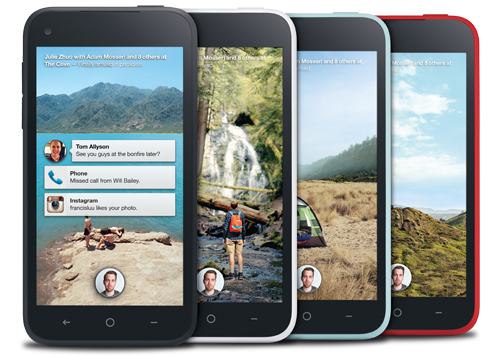
    Well, the rumors were false. Facebook didn’t release a phone today, not that I’m surprised. There are reasons why we write so few rumor stories here at BetaNews — they often are false. “We’re not building a phone. We’re not building an operating system”, CEO Mark Zuckerberg said early this afternoon. But the social network has launched an OEM program for the new Facebook Home, which displaces the default Android start screen. HTC is first partner. Aptly named then, the smartphone is called HTC First.

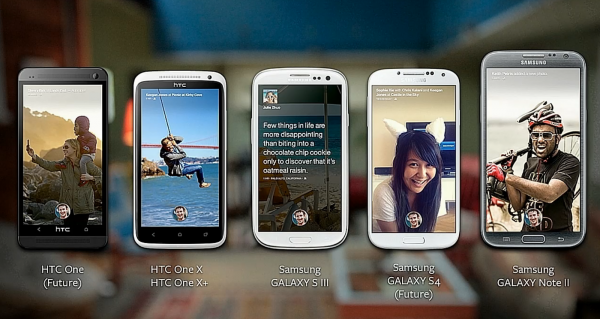
    Preorders start today, and the device will be available exclusively from AT&T, in four colors (black, pale blue, red and white), on April 12. Facebook Home, which also will be downloadable same day for HTC One X and One X+ and Samsung Galaxy S III and Note II, is First’s default experience. Essentially, the social network becomes primary user interface on top of Android.

    First sells for $99.99 with 2-year contractual commitment. By the specs, the smartphone is no screamer. Modest feature set includes 4.3-inch display, Qualcomm Snapdragon 400 dual-core processor, 4G LTE and Android 4.1. The preorder page is, as I write, a dead link. (How can you not laugh at that?)

    HTC First: 4.3-inch display with 1280 x 720 resolution. 1.4GHz Qualcomm 8930AA dual-core processor; 1GB RAM; 16GB storage; 5-megapixel front- and 1.6MP rear-facing cameras; 1080p video recording; 4G: LTE (850/1900 MHz), UMTS/HSPA/HSPA+ (850/900/1900/2100 MHz); GSM/GPRS/EDGE (850/900/1800/1900 MHz); Wi-Fi N; ambient-light and proximity sensors; digital compass; GPS + GLONASS; gyroscope; tri-axis accelerometer; 2000 mAh embedded battery; Facebook Home; and Android 4.1.

    Ralph de la Vega, AT&T Mobility president, claims that the “best device for Facebook Home is the HTC First”. I look at the other supported smartphones, which include HTC One and Samsung Galaxy S4 when available, and wonder: “Who is he kidding?”

    HTC’s listed specs are much better, and I wonder if AT&T can’t get them right or the “exclusive” is less than what other carriers will eventually get. Those specs, as HTC presents them: 5-inch 1080p display. 1.4GHz Qualcomm 8930AA dual-core processor; 1GB RAM; 16GB storage; 5-megapixel front- and 1.6MP rear-facing cameras; 1080p video recording; 4G: LTE (850/1900 MHz), UMTS/HSPA/HSPA+ (850/900/1900/2100 MHz); GSM/GPRS/EDGE (850/900/1800/1900 MHz); Wi-Fi N; ambient-light and proximity sensors; digital compass; GPS + GLONASS; gyroscope; tri-axis accelerometer; 2000 mAh embedded battery; Facebook Home; Instagram; and Android 4.1.

    Those specs look pretty good for a $100 phone with or without Facebook as primary UI. I’ll update when there is clarification that AT&T’s model is less or the PR people are just incapable of getting specs right.

    Update: The preorder page is now live and gives the 4.3-inch screen, and HTC lists both. Strike-outs and changes are reflected above. Features are modest compared to other smartphones capable of running Facebook Home.

    As for the Facebook experience, Home runs atop of Android. Zuckerberg observes that the three-decade-old current computing puts apps first, which, he claims doesn’t make sense for personal devices like smartphones and tablets. What if they were “designed around people not apps?” he asks. “It would feel very different”.

    Home presents Facebookers with Cover Feed, a bleeding edge-to-edge view into the latest posts. Users can view or interact, including tap to Like. There’s a real personal publication feel to the presentation. Cover Feed works in conjunction with Notifications.

    For communications, Home features Chat Heads, which is real-time messaging available from anywhere within the UI. Not to completely dismiss apps, there also is a launcher for accessing them.

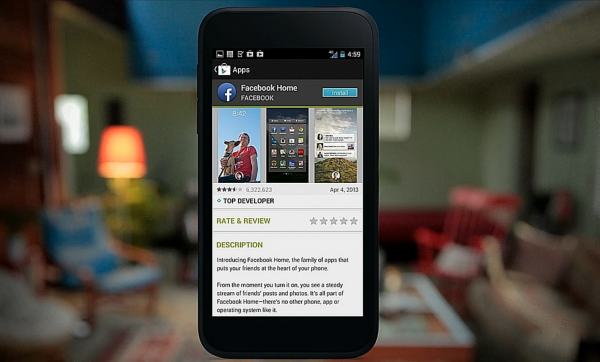
    “With Home available right out of the box, you’re getting the best quality experience for connecting with your friends”, Zuckerberg asserts. But out of the box doesn’t mean out of luck everywhere else. Users of the above-mentioned other supported smartphones can download Facebook Home from Google Play starting April 12.

  • Plummeting Windows RT tablet prices point to potential flop

    Windows RT Tablet Demand
    Microsoft’s (MSFT) Windows RT platform for tablets has not been well received. The media was very critical in early looks at the new operating system, and reviews of Microsoft’s Surface tablet almost unanimously found that the stunning hardware was being held back by mediocre software. Consumer response to products doesn’t always mirror the sentiment of reviewers but in the case of Windows RT, it looks as though the mass market hasn’t shown much interest in Microsoft’s most recent tablet play.

    Continue reading…

  • ‘The Drunken Botanist’ Author Amy Stewart Gives Google Talk

    Amy Stewart, author of The Drunken Botanist, recently gave a talk at Google. The company has now made the video available on its AtGoogleTalks YouTube channel for your enjoyment. So…enjoy.

    The talk is from March 26th.

    More recent @Google Talks here.

  • Oh Yeah, And Facebook Home Will Get Ads Too

    Facebook, as you’ve probably heard by now, introduced Facebook Home today at a press event. This is essentially Facebook’s way of taking over your Android device. You can learn more about it here.

    The main feature of the offering is called the Cover Feed. This sufaces the latest photos and updates from your News Feed on your homescreen, and lets you navigate through them by swiping.

    Facebook didn’t show off any ads when they were demonstrating the product, but at the event, CEO Mark Zuckerberg did indicate that ads will be a part of it eventually. He is quoted as saying, “There are no ads in this yet. I’m sure at some point there will be.”

    Here’s an ad for Facebook Home itself. And for more on the new HTC First phone, which comes with Facebook Home pre-installed, read this.

    Last week, Facebook announced real-time cookie-based Facebook Exchange ads in the news feed.

  • Gartner Seeks to Define Software-Defined Networking

    Gartner defines software defined networks (SDN), Pica8 and NTT partner for SDN solutions, and IBM enhances its SDN approach for virtual environments.

    Gartner defines a SDN taxonomy.  In a new complimentary Gartner report the research and advisory company dives into software defined networking and creates a taxonomy of the topic in order to end the confusion about it. Gartner’s definition of SDN is that it is “a new approach to designing, building and operating networks that supports business agility. SDN brings a similar degree of agility to networks that abstraction, virtualization and orchestration have brought to server infrastructure.” The report covers SDN deployment models based on the associated environment, and where SDN can be leveraged, as a component of the policy driven data center. The report, “Ending the Confusion About Software-Defined Networking: A Taxonomy,” can be found here.

    Pica8 partners with NTT for SDN solutions.  Networking company Pica8 announced that it has partnered with NCLC and NTT Data to offer system integration services for end-to-end SDN solutions. Late last year the company published an open SDN reference architecture, designed as a network development platform for cloud providers. The NTT partnership combines Pica8’s implementation of Open vSwitch (OVS) in its switching operating system with NTT Data’s SDN Framework to create end-to-end solutions.  Together the two companies will provide planning, design, and development of SDN applications along with system integration services. “By developing an application that provides SDN network traffic control and other services, we enable customers to implement SDN quickly and reliably,” said Steve Garrison, vice president of product marketing at Pica8. “Customers can use white box networking products to build out a highly dynamic and programmable network with our solutions.”

    IBM enhances SDN approach. IBM announced the launch of the  IBM Software Defined Network for Virtual Environments (SDN VE) as new software to make it easier for organizations to set up, manage and scale virtual networks for faster delivery of cloud, analytics, mobile and social business services. Setup as a virtual overlay network solution SDN VE automates and speeds the process of setting up SDN networks. Additionally, it enables network administrators to speed up traditionally time-consuming tasks such as network provisioning from days to hours. “Our vision of the Software Defined Environment is one of an intelligent data-driven ecosystem that is easily managed and scaled to meet ever-changing market demands,” said Dr. Inder Gopal, IBM vice president of System Networking Development. “The SDN VE is a solid, necessary step toward that future.” In addition to management and provisioning, the IBM SDN VE, which is based on IBM’s DOVE (Distributed Overlay Virtual Ethernet) architecture, automates network virtualization.

  • Here are the likely specs of AT&T’s $99 HTC First with Facebook Home pre-installed

    At a press event on Thursday, Facebook introduced a custom launcher for Android called Facebook Home. The software will be pre-installed on certain handsets with the initial one being the HTC First, a device for AT&T’s LTE network that arrives in stores on April 12. As expected, it’s a mid-range handset with a price to match: $99.99 on contract.

    What does that $100 and two-year commitment get you? AT&T isn’t providing many details on the handset, but says it has a 4.3-inch display, runs Android 4.1 and uses a dual-core Qualcomm Snapdragon 400 processor, which is the third most powerful of the four newest Qualcomm chips. I did a little sleuthing on HTC’s site and also found the following hardware information, which sounds about right for $99.

    • 16 GB of internal storage
    • 1 GB of RAM
    • Internal GPS antenna + GLONASS, Digital compass
    • 802.11 a/b/g/n Wi-Fi, Bluetooth 4.0, NFC
    • 5 megapixel rear camera, 1.6 megapixel front camera
    • Non-removable 2000 mAh battery
    • 1.4 GHz processor

    I still see little-to-no reason why anyone should buy this device though. For the same price, you can get a better Android phone — say Samsung’s Galaxy S III — and simply install Facebook Home if you want it. It will be interesting to see how other Facebook Home handset partners handle that scenario.

    Related research and analysis from GigaOM Pro:
    Subscriber content. Sign up for a free trial.


  • Steve Johnson Tweet Suggests North Korea Bomb Foxboro (“If y’all do bomb 1st”)

    On Wednesday, Buffalo Bills (and former Kentucky Wildcats) receiver Stevie Johnson tweeted this:

    Then this:

    As you might imagine, some people (particularly Patriots fans) did not take too kindly to this, and Johnson did not follow this guy’s advice:

    The tweet is still there.

    Later, he followed up with:

    Then:

    I’m sure that will be the end of it. Right?

    [via Shutdown Corner]

  • Facebook Home: Here’s A Commercial For It

    Facebook has put out a new video/commercial for Facebook Home, its new Android-takeover experience. During a press event today, Facebook played a different, more humorous video with a tuba playing something vaguely sounding like this Eminem song (which is interesting given the Eminem references on Mark Zuckerberg’s alleged old Angelfire page).

    Anyway, here’s the other one:

    Here’s more on what Facebook actually announced, and of course that “Facebook phone”.

  • Poll: Facebook Home is an Android launcher; will you install it?

    Facebook introduced its Facebook Home launcher on Thursday and its generally what was leaked and predicted. It essentially takes over your lock screen and your Home screen on an Android device, but it’s just a launcher like any other.

    Some partners have agreed to pre-install it: Samsung, Sony, Huawei and HTC were noted. That means Facebook has to convince you that the experience is worth it for you to hit Google Play and install it once it becomes available on April 12. The simple question is: After seeing what that experience is like, will you install it?

    Vote in our poll and be sure to comment if you have more to say. The Facebook Home launcher does support shortcuts for any Android app, so you can essentially use it as your only home screen. And if you’re big into Facebook, you might want to.

    Of course, this is really a play for Facebook to keep you engaged with its services over those from competitors: A smart strategy from Facebook but only if people buy into it and install Facebook Home.

    Related research and analysis from GigaOM Pro:
    Subscriber content. Sign up for a free trial.


  • Verizon CEO says he would happily drop cell phone contracts

    Verizon Service Contracts
    All eyes are on T-Mobile as the carrier embarks on a new journey that will eliminate its standard cell phone service contracts in favor of a more transparent hardware financing model. U.S. carriers in particular will be watching this story unfold quite closely, and the chief executive of the nation’s top carrier recently said he would happily drop the cell phone contract model if Verizon Wireless subscribers express interest in this new model en masse.

    Continue reading…

  • Google Compute Engine Available For Cloud Platform Gold Support Customers

    Google announced today that Computer Engine is now available to Google CLoud Platform’s Gold Support customers. Product manager Navneet Joneja writes on the Google Enterprise Blog:

    Google Compute Engine gives developers everywhere access to Google’s computing infrastructure. Now you can sign up online for Google Compute Engine with the purchase of Gold Support; you no longer need an invitation or a conversation with sales to get access. We’re also further reducing prices for all instance types by an average of 4%.

    Starting at $400/month, Gold support gives you a direct relationship with our experienced support engineers to help you get started or troubleshoot issues across the Google Cloud Platform products.

    Google also announced a 4% reduction on all Computer Engine pricing, as well as some new features.

    For one, Compute Engine now has the option to boot from persistent disks mounted as the root file system, persistent disk snapshots, the ability to checkpoint and restore the contents of network resident persistent disks on demand, and the ability to attach and detach persistent disks from running instances.

    There’s also a new admin console:

    Cloud Console

    Additionally, there are five new instance type families with sixteen new instance types and an enhanced metadata server.

    Two new zones in Europe are now supported.

  • Meet The HTC First, The First Android Phone To Come Preloaded With Facebook Home

    44

    The torrent of leaks these past few days haven’t left much to the imagination, but HTC’s Peter Chou has just officially pulled back the curtain on the first phone to ship with Facebook Home — the HTC First — at Facebook’s Menlo Park headquarters.

    According to HTC CEO Peter Chou the First will be the “ultimate social phone,” though he declined to dig into the device’s specs during his brief moments on-stage. The device will ship in four colors, and will support AT&T’s LTE network right out of the gate. Can’t wait for your chance to take it for a spin? The First will be available for $99 (with a 2 year contract naturally) starting on April 12, and pre-orders for the device kick off today. Those of you outside the U.S. will be able to join in the fun shortly too, as Mark Zuckerberg also noted that the phone would find its way to UK carriers Orange and EE in short order.


    The mid-range First will be available in black, white, red and blue, and sports a 4.3-inch display that jibes with earlier reports. Facebook Home obviously serves to obscure the Android 4.1 Jelly Bean build that’s actually running the show, while one of Qualcomm’s dual-core Snapdragon 400 chipsets (and not the MSM8960 that was previously reported) provides the horsepower from inside that smooth, curved chassis. It’s not a bad looking phone and the internals aren’t quite as lousy as many had expected them to be, but all this begs a very important question — will anyone actually buy this phone when you can fire up Facebook Home on your (supported) Android handset for a whopping zero dollars?

    I mean, c’mon — I’m a sucker for even mildly neat hardware, but so far neither HTC nor AT&T (whose CEOs both appeared on-stage to talk about how darned great the thing is) could provide a compelling reason why it’s worth buying. LTE? A handsome design? Neither of those are exactly hard to come by these days, are they? Facebook has said that the First will feature better integration for all those notifications you’re bound to get than if you had just installed the app, but at this point there’s little way of knowing how big a difference it’ll actually make. HTC knows how to make great hardware and I don’t mean to diminish that, but a lame device that’s been put together well is still a lame device.

    This marks the second time that the social networking giant and the beleaguered Taiwanese OEM have collaborated on a peculiar hardware play. The first, if you’ll recall, were HTC Status (nee Chacha) and the Salsa released back in 2011– their main claim to fame was a dedicated Facebook button for quick access to your friends and feeds. Considering that neither device was exactly a runaway hit, it’s no surprise to see that Facebook and HTC have taken things in a different, more substantial direction with the One. Of course, the First is going to be the tip of the iceberg when it comes to Facebook Home devices — Zuckerberg also pointed to a Facebook Home Program which allows hardware manufacturers to build Facebook Home into their own forthcoming handsets.

  • What is a Modular Data Center?

    This is the second article in the Data Center Knowledge Guide to Modular Data Centers series.  The concept of a modular data center solution has eluded definition, if not comprehension. Through the short history of modular solutions and vendor marketing, a definition and categorization of solutions has emerged. A modular data center can be defined as more of an approach to data center design that incorporates contained units, many times in the form of prefabricated modules. The modular market started with an international standard approach in the shape of an ISO (International Standards Organization) shipping container and has evolved to a fledgling market of vendors that produce everything from containers to a variety of modular designed products and solutions for IT, power and cooling.

    In some ways the shift in IT such as cloud computing has been in parallel with modular data center approaches. Modular elements for both IT and the data center exist in:

     Modular Data Center v2

     Container vs. Modular

    Container:
    A data center product incorporating cus¬tomized infrastructure to support power or cooling infrastructure, or racks of IT equipment. Containers are built using an ISO (International Standards Organization) intermodal shipping container.
    Modular:
    An approach to data center design that implies either a prefabricated data center module or a deployment method for delivering data center infrastructure in a modular, quick and flexible method.

    The primary confusion in terms stems from container versus modular. A data center container is a particular package that is engineered and delivered as such — in an ISO shipping container. A container is not the same thing as modular, but a container can be a part of a modular data center. A modular data center references a deployment method and engineered solution for assembling a data center out of modular components in, many times, pre-fabricated solutions that enable scalability and a rapid delivery schedule.

    After the early development of containers, theories evolved and the hype cycle played out for a data center in a box. Numerous hardware vendors, independent companies and data center providers embraced the modular concept and presented their own engineered solution.

     The complete Data Center Knowledge Guide to Modular Data Centers is available for download in a PDF format and brought to you by IO. Click here to download the DCK Guide to Modular Data Centers.

  • In quest to make every phone a ‘Facebook Phone,’ Facebook unveils Facebook Home for Android

    Facebook Home Android
    Though it surprised no one, Facebook (FB) on Thursday unveiled its highly anticipated “Home” software for Android during a press conference at its California headquarters. In line with earlier reports, Facebook debuted new software that takes over several core functions of Android smartphones and replaces them with features that tie into various Facebook services.

    Continue reading…

  • What is Facebook’s new Home on Android?

    It’s the question many people have asked since the social network announced its April 4 event one week ago. This live blog answers the question.

    Today’s “new Home on Android” follows by nearly a month, a massive user interface redesign, as Facebook unifies the look and feel across devices and puts more emphasis on mobile. Obviously Android is part of that. Paragraphs are reverse order, with newest up top. All times EDT.

    1:45 pm. Finished. That was quick.

    1:44 pm. Given how many people around the globe still don’t have the Internet or PCs, the definition of a computer isn’t set for anyone, or even most everyone. “A lot of that definition will be about people first”.

    1:42 pm. Zuckerberg is back, saying that in one sense Home is just an evolution of the Android app. But it’s more, flipping around the PC paradigm of apps first to people first, which makes more sense today.

    1:41 pm. HTC First sales start April 12 for $99.99. AT&T preorders begin today.

    1:38 pm. Facebook Home is preloaded and optimized for HTC First, which is available in four colors.

    1:37 pm. AT&T and HTC execs on stage. HTC First is the Facebook Home phone.

    1:36 pm. Wow. It’s an OEM program for Facebook.

    1:35 pm. “We’ve created the ‘Facebook Home Program’”, Zuckerberg says. AT&T and HTC have built the first phones with the experience.

    1:33 pm. Facebook Home initially will be available April 12 for HTC One and One X and Samsung Galaxy S III, S4 and Note II. Well, so much for my Nexus 4.

    1:31 pm. Zuckerberg is back. “We think this is the best version of Facebook there is”.

    1:30 pm. Facebook will update Home monthly.

    1:28 pm. Home will be available from Google Play. The Facebook skin will be available for phones first and tablets within a few months.

    1:27 pm. “You can manage multiple conversations with a single tap”.

    1:26 pm. Texts and Facebook messages “share the same Chat head design”.

    1:25 pm. “You can quickly pop into these conversations” — over the app currently being used.

    1:24 pm. “With Chat Heads, you can talk to whoever, wherever you are in your phone.

    1:23 pm. Joey Flynn takes the stage to discuss the new messaging experience. “You should be able to talk to your friends wherever you are in your phone”.

    1:21 pm. Apps are still important, so there is a launcher to reach them.

    1:21 pm. Next up is Notifications. Idea is to shift focus away from apps to people, Mosseri says.

    1:20 pm. Mosseri calls Cover Feed the foundation “for what we’ve done”. The screen is beautiful, bleeding edge everything.

    1:18 pm. Adam Mosseri is on stage. Cover Feed anchors Home, when the phone is turned on.

    1:15 pm. He’s talking about something called Chat Heads. “Messaging is treated just like another app. We all want to talk to people not apps”. Chat Heads is available anywhere from Home.

    1:13 pm. “With Home you see your world through people, not apps”.

    1:12 pm. Facebook is introducing a new homescreen called “Home”. It’s a skin, but much more.

    1:11 pm. Zuckerberg spends some time praising Android for its openness and how that allows Facebook to extend from the core platform.

    1:10 pm. “We’re not building a phone. We’re not building an operating system”.

    1:08 pm. Facebook doesn’t want to build a phone that only a few people will use. “We want to build the best experience…on every phone”.

    1:08 pm. “We want to flip that around” — and bring people forward before apps.

    1:07 pm. “We have our phones with us all the time”, Zuckerberg says. “That’s being human”, he says referring to how we use phones to connect and communicate.

    1:06 pm. Zuckerberg asks what if phones were “designed around people not apps? It would feel very different”. He explains that the priority has been apps first, which no longer makes sense.

    1:05 pm. Twenty percent of time spent on phones is in Facebook, 25 percent when adding Instagram, Zuckerberg says. “We spend our lives sharing and connecting”.

    1:04 pm. CEO Mark Zuckerberg is on stage, talking about the new thing.

    1:03 pm. We’re late. I have audio music only so far.

  • Gartner says the PC has no future

    Today, Gartner offers grim prognostications for the PC’s future, which is not surprising. That the analyst firm took so long disturbs and reveals much about how all these consultants seek to preserve client contracts before anything else. I’ve warned for years that connected-devices would diminish the personal computer’s relevance, much like the mainframe’s decline three decades ago. The PC era is over, as I asserted here 26 months ago. On Halloween 2008, I asked in a Microsoft Watch post: “Will your next PC be a smartphone?” What took Gartner so long? The “new device religion” analysis still misses the mark, too.

    Following IDC’s lead, Gartner now combines PCs, smartphones and tablets into a single forecast. By that measure, in 2012, Android worldwide device shipments (497 million) exceeded Windows (346.5 million) and will more than double (to 1.07 billion) by 2014. Analysts warn the operating system that defined the PC era will struggle with Apple iOS and OS X to be the second dominant platform. By many measures, the circumstance looks grim for Microsoft and Windows, and that’s already the popular sentiment today among blog posts and news stories about Gartner’s forecast. Don’t believe them.

    Two Trends

    “While there will be some individuals who retain both a personal PC and a tablet, especially those who use either or both for work and play, most will be satisfied with the experience they get from a tablet as their main computing device”, Carolina Milanesi, Gartner research vice president, asserts. “As consumers shift their time away from their PC to tablets and smartphones, they will no longer see their PC as a device that they need to replace on a regular basis”. Tell us something new.

    Larger businesses hold onto PCs longer, rather than upgrading, because they can; what they’ve got is good enough. Meanwhile, they allow more employees to bring their own devices to work but don’t pay for them. Weak global economies are major factors driving both trends.

    According to “Good Technology’s 2nd Annual State of BYOD Report”, 76 percent of enterprises with more than 2,000 employees have programs in place, and the total is expected to reach 88 percent this year. However, in half the companies with BYOD programs, employees pay for devices and supporting services, such as cellular data for cell phones, tablets and some laptops. You want a new laptop, or to use smartphone or tablet — “bring your own” is the new trend. The devices are cheaper to manage than to buy.

    There’s nothing new in this trend. Analysts suddenly shift their “tablets won’t replace PCs positions” because of something else they can no longer deny to clients. PC shipments in emerging markets erode faster than many analysts previously predicted. “In emerging markets, consumer spending typically starts with mobile phones and, in many cases, moves to tablets before PCs”, Megha Saini, IDC research analyst, says. “The pressure on the PC market is significantly increasing and we can see longer replacement cycles coming into effect very soon and that, too, will put downward pressure on PC sales”.

    Ranjit Atwal, Gartner research director, agrees: “Growth in the tablet segment will not be limited to mature markets alone. Users in emerging markets who are looking for a companion to their mobile phone will increasingly choose a tablet as their first computing device and not a PC”. This isn’t a new trend, just one accelerating — as often is the case when one thing replaces or displaces something else. Gartner, IDC and other analyst firms are just too slow making public prognostications.

    Worldwide Devices Shipments by Segment (Thousands of Units)

    Device Type

    2012

    2013

    2014

    2017

    PC (Desk-Based and Notebook)

    341,263

    315,229

    302,315

    271,612

    Ultramobile

    9,822

    23,592

    38,687

    96,350

    Tablet

    116,113

    197,202

    265,731

    467,951

    Mobile Phone

    1,746,176

    1,875,774

    1,949,722

    2,128,871

    Total

    2,213,373

    2,411,796

    2,556,455

    2,964,783

    Problem is this: Most analyst firms count things, which data they can sell clients and around which they offer consulting services (I know having worked in the industry). But numbers deceive, and as we’ve seen from repeatedly revised forecasts, the major consultants do a piss-poor job counting smartphone and tablet shipments. Look how many times IDC revised tablet forecasts, for example. The numbers aren’t trustworthy, and they mislead about future trends.

    Context is King

    What matters more: How all these devices are used, and there Gartner and IDC combining counts could someday shed something meaningful. For now, counting is insufficient, because the so-called post-PC era is a fiction, as I explained here in November. We’ve entered the contextual cloud computing era. The companies that succeed will transcend platforms, because all devices connecting to cloud services are relevant. During the PC era, the personal computer acted as the hub connecting devices. Its role shifts to one of many with cloud services as the hub.

    The early inference being taken by some people writing about Gartner’s data is that the PC, Microsoft and Windows are doomed. The analyst firm feeds this by calling out new category, ultramobile, into which Surface Pro is placed. The PC isn’t dead, nor will Android be the platform sweeping developers away from Windows, as is the interference emerging among some bloggers and couch-chair analysts today. History and current events tell a different story.

    Worldwide Devices Shipments by Operating System (Millions of Units)

    Operating System

    2012

    2013

    2014

    2017

    Android

    497,082

    860,937

    1,069,503

    1,468,619

    Windows

    346,457

    354,410

    397,533

    570,937

    iOS/MacOS

    212,899

    293,428

    359,483

    504,147

    RIM

    34,722

    31,253

    27,150

    24,121

    Others

    1,122,213

    871,718

    702,786

    396,959

    Total

    2,213,373

    2,411,796

    2,556,455

    2,964,783

    In the 1980s computing and informational relevance shifted from the mainframe to the personal computer in part because of lower costs and greater availability. PCs cost much less than mainframes and made information more available, essentially more mobile, to more people. Similar transition is happening today, as cloud-connected mobile devices make more information available to more people in more places than do PCs. Computing and informational relevance shifts once again. The mainframe didn’t go away because of the PC era, the mainframe’s relevancy simply declined. The PC won’t go away, but its relevance is declining.

    Cheaper tablets accelerate the trend. “Lower prices, form factor variety, cloud update and consumers’ addiction to apps will be the key drivers in the tablet market”, Atwal asserts. But, again, that statement ignores context and how businesses and consumers will use different devices in many ways depending on where and when and what for.

    As early as tomorrow, I’ll follow up with an analysis explaining why Microsoft can maintain computing relevance in the next computing era, even while IBM couldn’t with mainframes.

    Photo Credit: Fer Gregory/Shutterstock

  • First entry-level BlackBerry 10 smartphone possibly revealed in new leak

    BlackBerry R10 Release Date
    Preliminary specs for BlackBerry’s (BBRY) first entry-level BlackBerry 10 smartphone may have just been revealed. BlackBerry blog BlackBerry Empire points to multiple unnamed sources in claiming knowledge of the upcoming “R-Series” BlackBerry phone, which will reportedly resemble a smaller BlackBerry Q10. Apart from the QWERTY keypad, the site claims BlackBerry’s first low-end BB10 phone will feature 8GB of internal storage, an SD card slot, 1,800 mAh battery and a price tag between $300 and $400 before taxes and subsidies. The phone will reportedly launch in the late summer or early fall and a sketch of the back of the R-Series handset follows below.

    Continue reading…

  • Chrome OS file manager could get integration with Dropbox, other cloud drives

    Are you interested in seeing Dropbox, SugarSync, SkyDrive or other cloud storage services integrated in the Chrome OS file manager? As a heavy cloud user, I know I am. It appears someone on the Chromium project is too, because eagle-eyed Craig Tumblison, noticed a Chromium feature enhancement was filed to add this type of integration in Chrome OS.

    Here’s the full request description, which is an API to allow for extensions to integrate directly in the Chrome OS file manager:

    The basic idea is to allow an extension behave as a ‘drive’ in the file manager app in ChromeOS. Currently the file manager has “Downloads” and “Drive” in the left column, and additional USB flash drives and temporary zip archives will appear. The extension will appear here and provide the list of files through the new API.

    I’m already using Dropbox and Amazon’s Cloud Drive on the Chromebook Pixel, but it’s not an integrated experience. The Dropbox extension for example, is simply a link to the Dropbox website where I can then download, upload or modify files through the browser page. Sending files to Dropbox isn’t done through the Chrome OS file manager, making for a clunky experience.

    If the request is approved and developed, however, the native file manager in Chrome OS would look something like this image found on the OMG!Chrome! enthusiast site.

    Chrome OS cloud integration

    Will Google’s Chromium team open up the Chrome OS file manager to other competing cloud storage services? From a business standpoint, it could shy away from such a request, but if it wants Chrome OS to be a serious competitor to traditional operating systems, I think it has to allow for this. I’ll be keeping an eye on the request going forward in hopes of an approval.

    Related research and analysis from GigaOM Pro:
    Subscriber content. Sign up for a free trial.


  • Mike Rice Video (The Taiwanese Animation Version)

    Rutgers basketball coach Mike Rice was fired this week after a video of him kicking and shoving players (and using gay slurs) during practice was made public.

    And where there’s scandal, there’s Taiwanese animation studio Next Media Animation, which always offers an entertaining slant on current events. Here’s NMA’s take on the Mike Rice firing:

    According to Fox News, Rice is due a $100,000 bonus.