 |
A massive switch over to wind power may actually be worse for global climate systems than current catastrophic levels of greenhouse gas emissions, according to a study conducted by researchers from Harvard University and published in the journal Environmental Research… |
Author: Serkadis
-
Wind power will worsen climate, scientists find
-
Upcoming technology would let citizens buy drone countermeasures that interfere with drone missions

In physics, there is an axiom that goes something like this: For every action, there is an equal and opposite reaction. The same principle can be applied to virtually every other aspect of life, including issues dealing with freedom and liberty. As more and more Americans… -
Naturally eliminate cancer with the Gonzalez therapy

Cancer patients need to know there is an effective (all-natural) way to completely heal from a cancer diagnosis. Now, according to conventional oncology, “intelligent” people should only treat cancer with surgery, chemotherapy and radiation. But, scientific evidence… -
Bitter melon juice potently suppresses pancreatic cancer growth with no side effects

A new study has shown that the juice of bitter melon, a commonly eaten vegetable in Asia and Africa, markedly suppresses the growth of pancreatic tumors in mice by disrupting the cancer cells’ metabolism of glucose, and literally starving them of the sugar they need… -
Thousands of dead pigs discovered floating in Shanghai river that provides drinking water to millions in China

The bodies of 13,000 dead pigs have been founds in the rivers and streams that supply the Chinese metropolis of Shanghai with its drinking water. The carcasses are believed to have floated downstream from the city of Jiaxing in the Zhejiang province, although the deputy… -
Pollinating insects disappear as GMOs proliferate: What will become of our food supply?

A pair of studies recently published in the journal Science raises fresh and dire warnings about the continued decline of crop-pollinating insects all over the world, and what this means for the future of the world’s food supply. Both studies highlight the fact that… -
Christiane Northrup, MD discusses physical illness and hidden emotions on Mental Health Exposed
Join Mike Bundrant and Christiane Northrup, MD on Mental Health Exposed this week – the March 20, 2013 episode. Dr. Christiane Northrup is known around the world for her leadership in women’s health. As a medical doctor, she is paving the way to greater self-awareness… -
Certified Naturally Grown (CNG), the grassroots alternative to certified organic

With so much uncertainty surrounding the integrity and future of the certified organic label, grassroots alternatives that offer fresh new ways of identifying healthy, chemical-free foods are gradually gaining ground. One new program, known as Certified Naturally Grown… -
The dangers of ingesting processed sugar

Sugar in itself is not at all bad. As a matter of fact, the body can benefit from it in some way. However, the horror comes from too much ingestion of foods that contain processed sugar. Too much consumption can lead to many health dangers including obesity, diabetes… -
Farewell to the freedom of speech in the UK

For the first time in 300 years, politicians managed to interfere with press freedom in the UK, producing the foundations for a new watchdog, which will essentially have the power to “decide what is factual and what is true”, reminding dangerously of the infamous Ministry… -
Dealing with rejection from your ‘un-family’ of origin

Some families are not close and supportive, were never set up to be close and supportive. Rather, they are dysfunctional. This is not pessimism, but a hindsight view of families based on research that some family conflict is perpetual. It has no resolution, because… -
Cyprus government’s rejected seizure of private bank accounts may still set off ‘systemic consequences’ across Europe

If you still believe European-style socialism is the correct course for America, as President Obama and progressive Democrats seem to, what is currently happening in Cyprus – and what could soon take place across the Eurozone – ought to finally convince you of the fallacy… -
Google’s Play Store Android App May Soon Get Another Facelift

Google’s been awfully busy these past few weeks, but it seems that between sunsetting Reader (and pissing off most of the Internet in the process) and rolling out new services like Google Keep, the company has been working on a redesigned version of the Google Play Store for Android. That’s what the folks at Droid-Life claim, anyway. They appear to have obtained and installed the unreleased 4.0 version of the Google Play Android app ahead of a wider release.
The Play Store’s current mobile design first rolled out in July 2012, and while Google has seen fit to rebrand and tinker with a few things since then, more than a few bits look essentially the same as they did back then. If this is the real deal (and I strongly suspect that it is), then Google Play is about to get quite a facelift. Gone are the gloomy blacks and dark grays that used to permeate the app. This new version returns to a lighter color scheme that’s highly reminiscent of the old Android Market days. On the whole, the new app also looks much cleaner and more spacious than the Play Store that so many of us have gotten used to.
It’s not hard to see some similarities between the updated Play Store app and the Google Now design — there’s a more pronounced focus on bigger images and italicized text. What’s more, individual app listings are separated into little cards rather than being displayed in a more traditional list, yet another sign that Google’s Play Store developers are cribbing UI flourishes from Google Now. If anything, the unification of design between these two services makes me wonder just how far Google plans to go here. After all, Google Now and the Play Store are cornerstones of the Android experience. It wouldn’t be a huge shock to see the next version of Android take a similar approach to aesthetics.
At this point there’s no firm word on when (or if) this update is slated to go live, but it’s very possible that Google could wait until I/O to officially pull back the curtain on a redesigned Play Store app. In the meantime, major mobile players like Facebook are exploring ways to bypass the Play Store completely and push new updates to users, so here’s hoping Google pushes the update out before others follow suit.
-
Sorry Google; you can Keep it to yourself
Google today launched Keep, an app that allows you to save things, clip stuff from the web, hoard notes and what not and put them all onto your Google Drive. Yup, you guessed it — it is an imitation to Evernote and many other such applications. It is a good thing that Google has decided to compete with the likes of Evernote — it validates their market.
It might actually be good, or even better than Evernote. But I still won’t use Keep. You know why? Google Reader.
I spent about seven years of my online life on that service. I sent feedback, used it to annotate information and they killed it like a butcher slaughters a chicken. No conversation — dead. The service that drives more traffic than Google+ was sacrificed because it didn’t meet some vague corporate goals; users — many of them life long — be damned.
 Looking from that perspective, it is hard to trust Google to keep an app alive. What if I spend months using the app, and then Google decides it doesn’t meet some arbitrary objective? Evernote has my data and frankly, I’m glad to pay them to keep it because they are who they are. One of the reasons I use Evernote is because it is their only thing. (For now.) Evernote is focused on making the service better. And it keeps that focus every year.
Evernote is like Derek Jeter, playing shortstop and trying to win every day. Google? It is the digital Mr. Ripley.
Sorry Google, but you might not realize that you are acting like the company you wanted to replace: Microsoft. The Barons of Redmond used to float products into the market — smart displays and weird stuff — that companies like Samsung and LG would put out in the market, only to yank them later. In the end, I stopped believing in Microsoft and shifted my dollars and attention to other brands.
And by the way – how is this app strategic for you guys and Reader is not? A little clarity would certainly be appreciated.
How about a pledge? If you build it, we use it, and you use our personal data to make your other products better or your ad sales executives richer, then you will keep it around.
Image courtesy of Flickr user Dano

Related research and analysis from GigaOM Pro:
Subscriber content. Sign up for a free trial.- The 2013 task management tools market
- How consumer media will change in 2013
- Social 2013: The enterprise strikes back


-
Microsoft pays developers to write Windows apps

What’s that ditty about the kid so nasty that when ransomed the kidnappers end up paying the parents to take him back? That kind of describes Microsoft’s platform problem — paying developers $100 per app submitted and accepted for either the Windows 8 or Windows Phone 8 store. Surely Apple and Google don’t need to take such a rash approach.
You think I’m going to rake Microsoft, right? Not in the least. This is exactly what the company should do — jumpstart the ecosystem. With smartphones and tablets choking the life out of PC sales, Android and iOS huge stores of applications, Windows Phone’s tiny global market share and Windows 8 marking a major desktop architectural transition, Microsoft must do something. This short-term program is sensible and appropriately timed.
Microsoft calls the promotion “Keep the Cash“. I only learned about it today, but must assume the program is weeks old given timeframe: March 8 to June 30. “You can get a $100 virtual Visa card for every qualified app you enter (up to $2000)”, according to the program’s terms. Developers publish apps to either the desktop or mobile OS store. Up to 10 for each, but only 10 per developer ID.
The goal is to get new apps, which explains restrictions: “The app may not be a modification, rework, redesign or other change to an existing and previously published app. Apps submitted with the same code base or clones are not eligible. Apps that have been previously published to the Windows Store and/or Windows Phone Store do not qualify as a new app for purposes of this published offer”.
Procrastinators, don’t wait to collect: “The Virtual Visa must be activated within 30 days of receiving the email activation code, will expire 6 months after issuance and can only be used online”.
Greatness Gives
Seriously, this is a great promotion — that is for anyone thinking a $100 Virtual Visa is suitable compensation ahead of any direct proceeds from the app. I haven’t looked but can imagine some of the snickering rancorous blog posts from the Android or Apple fan camps. Frak them.
Every Friday, my colleague Martin Brinkmann writes “Best Windows 8 apps this week”. Since Christmas, the U.S. Windows Store has grown from 22,876 to 32,552 apps, he reports. Growth is good but pales before the many hundreds thousands more available from Apple’s App Store or Google Play. Staunch Microsoft defenders will say you can’t compare Windows apps to those for the other operating systems. Oh but you can and should.
Many of the important apps are the same for all the platforms. Meanwhile, Modern UI offers a touch-oriented Windows 8 motif that competes with Android and iOS, on tablets if nowhere else. Then there’s change in distribution model, particularly Windows RT, where developers must distribute their goods through Microsoft’s store.
When you’re behind, you swallow your pride and do what’s necessary to get ahead. The playing field isn’t level, so Microsoft changes the rules. The tactic is especially important for Windows Phone 8, where Microsoft provides critical apps like Facebook and Google is nearly persona non grata — by deliberate choice. When Facebook won’t develop for you…
Microsoft’s mobile OS is in a pickle, and sour one at that. PU! Global smartphone sales share was a puny 3 percent in fourth quarter, according to Gartner. By comparison Android was 69.7 percent and iOS 20.9 percent.
Thing is: What the company needs is more of the right apps, not just more of them. I say: Better to pay big bucks to get critical apps rather than not have them at all. But do something better than Virtual Visa.
Photo Credit: NinaMalyna/Shutterstock
-
GoPro Sends Reviewer A DMCA Takedown Notice, Internet Explodes – But Wait! It Was An “Unfortunate Miscommunication”

Word travels fast on the Internet. Especially when you don’t want it to.
Early this morning, DigitalRev (a hybrid blog/photography store/photo sharing social network) replaced a review of GoPro’s Hero 3 with the text of a DMCA takedown they’d received. “@GoPro is bullying us with DMCA. We’ll have to remove this article soon”, they tweeted.
According to DigitalRev, GoPro was claiming foul on the site’s use of the “GoPro” and “Hero” trademarks. (That’s ignoring that the Digital Millenium Copyright Act only applies to copyright infringement. Hence, uh, the name.)
Within a few minutes, the sharpening of pitchforks could be heard from all around. Tweets started pouring in pledging to never buy another GoPro product. Word of the notice shot to the top of r/photography, r/gopro, and a few other relevant sub-Reddits. People were angry.
I reached out to GoPro’s head of communications for confirmation and comment, who responded “Hey Greg, We are posting to Reddit.”
Er, weird. But okay. A few minutes later, this went up:
Hey all- I’m out at X Games Tignes right now with the Director of PR for GoPro. I showed this to him as soon as I saw it (it had 3 comments). He dropped everything to address this issue, and it’s an unfortunate miscommunication. Below is the blurb he just wrote out for my favorite GoPro community.
Thanks for the heads up on this issue. The letter that was posted next to the review on DigitalRev was not sent in response to the review. Obviously, we welcome editorial reviews of our products. This letter was sent because DigitalRev is not an authorized reseller of GoPro products and they were using images and had incorrect branding and representation of our product in their online commerce store. As part of our program – we ask merchants who are selling our product to use authorized images. That is why DigitalRev was contacted. But – our letter did not clearly communicate this and that is something we will correct.
tl;dr: Whoops — we weren’t trying to have the review taken down. We just didn’t want them using the images they were using.
GoPro quickly went into damage control mode, firing off links to their reddit comment to just about anyone who’d mentioned the matter. Expanding on their comment further, GoPro later tweeted that they only meant for them to take down the images being used in the sidebar:
@difficultnerd it's actually a positive review. The notice wasn't about the review: bit.ly/YrzFHN—
GoPro® (@GoPro) March 20, 2013@ceejayoz Not the review, the product on the sidebar. Please read this, there's a lot of confusion out there: bit.ly/YrzFHN—
GoPro® (@GoPro) March 20, 2013“But wait!” yelled the crowd. If GoPro only wanted a few images to be taken down, why did they seemingly target just the review? According to GoPro, they didn’t:
@ceejayoz We also included 5 other urls, which they scrubbed from the email they posted. We are pro free speech and fair use.—
GoPro® (@GoPro) March 20, 2013What a mess.
If someone chopped up the DMCA in a way that changes the implications, that person screwed up.
Whatever GoPro’s actual initial intent was, however, someone seriously screwed up there too. Wanting to protect your brand is great, but DMCA notices aren’t meant to be thrown around like friggin’ parade candy. If you’re tossing them out to the point that it’s not even clear why they’re being sent, you might want to tighten the lawyer leash a bit.
How easily could this have been avoided by just calling the guy?
-
Power Outage Knocks DreamHost Customers Offline
Web hosting provider DreamHost experienced an extended outages when power systems failed at its data center in Irvine, Calif. The incident created hours of downtime across Tuesday and Wednesday for many of DreamHost‘s more than 350,000 customers, who host 1.2 million blogs, websites and apps with the company.
The problems started at 3 pm Pacific time on Tuesday, when the uninterruptible power supply (UPS) system failed suddenly at the Irvine facility operated by DreamHost’s data center provider, Alchemy Communications. When the UPS systems died, the emergency back generators also failed to start properly.
“The power failure lasted just a few minutes, however it created a number of major issues with our network and systems in the Irvine DC that took many hours for our operations teams to recover from,” wrote DreamHost CEO Simon Anderson on the DreamHost status blog .” Not the least of which was the loss of several critical pieces of networking hardware which did not survive the power event.”
Second UPS Issue Prompts More Downtime
Anderson said Alchemy has a “good track record” in maintaining uptime at the Irvine facility, but may have been conducting unannounced UPS maintenance. At 4:30 a.m. Pacific on Tuesday, the UPS systems failed again.
“This resulted in another complete power outage and another intense period of reboots, restores and system checks from our team,” said Anderson. “The time to restore most services in the wake of this second power outage was much quicker, mainly because there were no resulting hardware failures and we had learned from the first failure. Alchemy has opted to run the Irvine DC on generators until the UPS issues are fully identified and resolved.”
Anderson apologized to customers for the outage and said that DreamHost would offer service credits to affected customers.
” I fully recognize that any disruption to services can affect important production environments and projects,” the CEO said. “Our team will work diligently to ensure that we mitigate the power issues going forward, including a full audit of all facilities that house DreamHost customer data. We will learn from this event and continuously improve our operations and services.”
DreamHost has been involved in a number of high-profile outages over the years, but those incidents never seemed to slow the growth of the company, which has focused on affordable web hosting accounts.
Last year DreamHost expanded its data center footprint to the East Coast, adding a presence in Ashburn, Virginia as part of a broader effort to improve its reliability and boost network performance.
-
Google Keep — for notes, memos and ideas best kept in the cloud
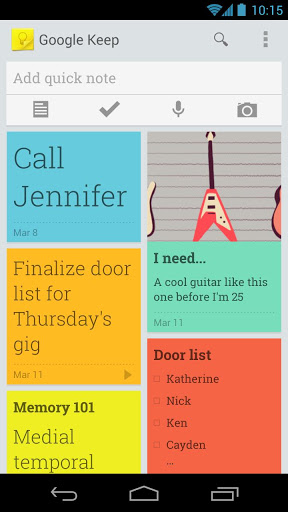 Confession: I’ve never used Evernote, much to the abash of colleague Alan Buckingham (or so he expressed in group chat a little while ago). But I would use Google Keep, which released today. Russell Holly calls Keep “the not-quite Evernote clone” — for anyone making bold comparisons.
 You tell me. Does this sound familiar, Evernote and OneNote users? “With Keep you can quickly jot ideas down when you think of them and even include checklists and photos to keep track of what’s important to you”, Katherine Kuan, Google software engineer, says. “Your notes are safely stored in Google Drive and synced to all your devices so you can always have them at hand”. She adds: “If it’s more convenient to speak than to type that’s fine — Keep transcribes voice memos for you automatically. There’s super-fast search to find what you’re looking for and when you’re finished with a note you can archive or delete it”.
Other features include color-coding (something geeks seem to like, right), swipe to archive, and note-to-checklist conversion. Users of Android 4.2 or higher also can keep Keep as a homescreen widget — for when the idea is immediate and you need to express it fast or forget.
Device sync, dictation capabilities and Google Drive integration are the three features that pique my interest. Whether or not I actually keep Keep beyond initial testing is yet to be seen. Evernote didn’t grab me.
I started writing this post at 4:53 pm EDT, when there was one review of the app on Google Play. Fifteen minutes later there are 179 — 147 of them five stars.
“Finally!” expresses Galaxy Nexus user Yuriy Melnik: “A native note/to do app is long overdue, a bit surprised to see no Google Tasks sync? This would be nice”.
Michael Bau gives three stars and expresses disappointment: “This app is just a plain app to take notes. You can record audio notes, include pictures, and write text with your keyboard, and make lists. That’s pretty much it. Other than that I would love to see a way to add deadlines and alerts to notes, and some kind of drawing support. I would love to replace Wunderlist with Keep, but it’s not quite there yet”.
Aaron Carvalho gives five stars, but asks for more, too: “Simple and neat interface. Easy to use. Very beautiful UI. I just wish it had the option of adding pictures from the gallery as a note. So far only option is to take a picture with the camera. Now let’s just hope it stays live”.
Nathan Burke and I share similar experience. “I can take a photo, add a list, create a note, but when I try to view anything on Chrome, I just get an error, and it keeps reloading”, he expresses. I have the same problem. What a crock! Error on Chrome. Google’s browser. For shame!
Matthew Kelly has “Keep on both the Nexus S and Nexus 7 devices is working well on both. Helps to be an Android ‘ecosystem’ user, and I’m eager to see how easily it extends into my Google Drive. Fast sync, easy to add images and quickly type content. Will try the dictation/transcription feature, as it will be a significant addition to the Google cloud toolkit. Excellent application with no issues thanks to its simplicity!”
Sentiments are a little different elsewhere, if the first comments to the above YouTube video indicate anything.
Vitruviux: “I don’t want Google Keep, I want Google Reader”. TheTimmant: “Now Google can spy on your notes! Yay!!!”
And you? Will you do Google Keep, or keep the note app (if any) you already use?
-
Results of trial to determine how to prevent future strokes encouraging
UCLA RESEARCH ALERTFINDINGS:The results of a major, multicenter clinical trial to determine the best treatment for younger patients who have strokes that are potentially due to a hole in the upper chambers of the heart has provided suggestive but not definitive evidence of the benefit of a new heart hole–closure device.The trial sought to determine which was the best treatment to prevent further strokes: a combination of closing the hole with a “button” device and anti-clotting medicines, or anti-clotting medicines alone. UCLA was one of the 69 performance sites for the study, called the Recurrent Stroke Comparing PFO Closure to Established Current Standard of Care Treatment (RESPECT).Over eight years, the study enrolled 980 patients between the ages of 18 and 60 (average age 46). All had experienced a stroke of unknown origin and had a hole in the wall of their heart known as a patent foramen ovaleor, or PFO. Nearly half had large strokes as their qualifying stroke event. In up to 10 percent of strokes in the U.S., a PFO is the only identified potential cause.Patients were followed for an average of two-and-a-half years. In the main analysis, patients assigned to receive the button device showed a trend toward having fewer recurrent strokes than those receiving standard care with anti-clotting medications (9 percent versus 16 percent), but the difference did not meet statistical tests for being definite. Further analyses conducted in the subset of patients who adhered to their assigned treatments provided additional evidence that the device was beneficial.IMPACT:Closure-device therapy may be a useful strategy for selected patients with a history of cryptogenic stroke and PFO —a population that is generally younger than the average stroke patient and otherwise facing a lifetime of potentially riskier medications, the UCLA researchers said. The authors said that closing the hole in the heart has also been studied as possibly helping with other health issues, such as migraines.UCLA INVESTIGATORS:Dr. Jeffrey Saver, director of the UCLA Stroke Center and a professor of neurology, was one of four national principal investigators of the study. Dr. Jonathan Tobis, director of interventional cardiology and professor of medicine at UCLA, was the RESPECT lead cardiology investigator at the UCLA site.AUTHORS:Dr. Jeffrey Saver was an author on the paper.JOURNAL:The studying findings are published in the March 21 issue of the New England Journal of Medicine.FUNDING:Funding for the study was provided by St. Jude Medical in St. Paul, Minn., maker of the “button” closing device. -
Google Keep Arrives (In An Official Capacity)
Earlier this week, Google Keep was spotted in the wild, and was quickly pulled down from view by the company. Today, Google announced the product.
“Every day we all see, hear or think of things we need to remember,” says Google software engineer Katherine Kuan. “Usually we grab a pad of sticky-notes, scribble a reminder and put it on the desk, the fridge or the relevant page of a magazine. Unfortunately, if you’re like me you probably often discover that the desk, fridge or magazine wasn’t such a clever place to leave the note after all…it’s rarely where you need it when you need it.”
“To solve this problem we’ve created Google Keep,” adds Kuan. “With Keep you can quickly jot ideas down when you think of them and even include checklists and photos to keep track of what’s important to you. Your notes are safely stored in Google Drive and synced to all your devices so you can always have them at hand.”
The app transcribes voice memos for you, and the search is “super-fast” according to the company.
It’s available in Google Play for devices running Android 4.0 and up. Notes can also be accessed, edited and created from drive.google/keep.