Author: Serkadis

  • LSI, NetApp Collaborate on Server-based Flash

    LSI-WarpDrive_HR

    LSI has announced its Nytro WarpDrive family of application acceleration PCIe flash cards, which are designed to address application performance by converting server-based flash into hot data cache for critical applications. The cards are among the first PCIe flash devices to be fully tested and qualified with NetApp’s intelligent server caching software.

    “Flash memory adoption in the enterprise is a powerful complement to hard-disk-based network storage,” said Tim Russell, vice president, Data Lifecycle Ecosystem Group, NetApp. “Deploying flash as a high-speed cache in the server is a simple and cost-effective way to significantly reduce latency and I/O bottlenecks, while providing enterprise-level data protection and manageability for the entire infrastructure. Working with our server cache partners, we’re able to offer customers a complete end-to-end, high-speed solution.”

    LSI Nytro WarpDrive cards deployed in conjunction with Flash Accel software deliver automated and intelligent caching of hot data to PCIe flash storage, and an optimized cost per IOPS and cost per gigabyte across flash and hard drives. Combined, it is an easy to use, fully tested, end-to-end solution. Test results have shown a reduction in application and server latency by up to 90 percent while increasing throughput by up to 80 percent. Storage efficiency is also improved by minimizing the number of input/output operations between servers and back-end storage systems, which frees up shared storage resources to handle additional workloads. In addition, the Nytro WarpDrive card’s advanced “off-loaded” multiprocessor architecture uses up to four times less CPU and memory resources than competing solutions.

    “LSI Nytro WarpDrive cards help datacenter managers contend with massive data growth by increasing the speed and responsiveness of critical applications,” said Gary Smerdon, senior vice president and general manager, Accelerated Solutions Division, LSI. “The combination of Nytro WarpDrive cards and Flash Accel software allows for an optimized use of flash while extending its significant performance and TCO benefits to any server connected to NetApp storage.”

    Nytro WarpDrive cards range in capacity from 200GB to 1.6TB of MLC or SLC flash memory and are designed for simple, plug-and-play integration into today’s low-profile, high-performance system chassis.

  • Google launches (and sells out of) a $30 Nexus 7 dock

    In the better late than never category, Google introduced a simple dock for its Nexus 7 tablet on Wednesday evening. The $29.99 accessory charges a Nexus 7, while propping it up in portrait mode. A 3.5 millimeter headphone jack in the dock supports external speakers when playing music from the tablet, which also supports wireless music playback over Bluetooth. Sadly, in what’s becoming a recurring theme, the dock is sold out as of Thursday morning.

    Nexus7+dock

    I bought a Nexus 7 after reviewing one last July but later sold it in favor of an iPad mini; not because Google’s tablet didn’t have a dock available, but because I use multiple mobile platforms to maintain perspective. If I still had my Nexus 7, however, I’d be quite miffed for two reasons. It really shouldn’t take a half-year or more to introduce simple accessories for a product. And once they finally arrive, why add insult to injury by not producing enough inventory?

    Nexus 7 dock inventoryThe odd thing to me is that it’s not as if Google doesn’t know how many Nexus 7 tablets have been sold. Yes, the tablet can be purchased outside of the Google Play store at some brick-and-mortar retailers, but Google surely keeps track of Nexus 7 activations.

    While it can’t predict demand perfectly, Google — with all of its data and algorithms — should have a better handle on expected demand; especially if it wants to really compete in the hardware market with Nexus devices, Chromebooks and Chromeboxes.

    Related research and analysis from GigaOM Pro:
    Subscriber content. Sign up for a free trial.

  • Job cuts to accompany T-Mobile, MetroPCS merger

    T-Mobile MetroPCS Merger Layoffs
    The proposed merger of No.4 wireless carrier T-Mobile USA and MetroPCS (PCScleared a major hurdle earlier this week, but some troubling news accompanied the win: more than 100 T-Mobile employees are reportedly set to lose their jobs. The Seattle Times reports that more than 100 people in T-Mobile’s marketing group and across other departments will be laid off during “integration” meetings scheduled to take place on Thursday. T-Mobile employed approximately 36,000 people across the country in 2012. MetroPCS shareholders will convene on April 12th to vote on the merger, which is still being reviewed by regulators.

  • 5 reasons why the future of Hadoop is real-time (relatively speaking)

    In some ways, Hadoop is a like a fine wine: It gets better with age as rough edges (or flavor profiles) are smoothed out, and those who wait to consume it will probably have a better experience. The only problem with this is that Hadoop exists in a world that’s more about MD 20/20 than it is about Relentless Napa Valley 2008: Companies often want to drink their big data fast, get drunk on insights, and then have some more — maybe something even stronger. And with data — unlike technology and tannins — it turns out older isn’t always better.

    That’s a crude analogy, of course, but it gets at the essence of what’s currently plaguing Hadoop adoption and what will propel it forward in the next couple years. The work being done by companies like Cloudera and Hortonworks at the distribution level is great and important, as is MapReduce as a processing framework for certain types of batch workloads. But not every company can afford to be concerned about managing Hadoop on a day-to-day basis. And not every analytic job pairs well with MapReduce.

    In Part I of our four-part series on Hadoop, we looked at how the technology was born and grew into the juggernaut it is today. In Part II, we laid out the map of the current products and projects that comprise the Hadoop ecosystem. In this installment, we’ll take a closer look at some of them and how they’re positioning themselves to be important players down the road.

    If there’s one big Hadoop theme at our Structure: Data conference March 20-21 in New York, it’s the new realization that people shouldn’t be asking “What’s next after Hadoop?” but rather “What will Hadoop become next?”. Based on what’s transpiring today, the answer to that question is that Hadoop will become faster in all regards and more useful as a result.

    Interactivity, big-data-style

    Source: Shutterstock user hauhu.

    Source: Shutterstock user hauhu.

    As I explained with some detail a couple weeks ago, SQL is what’s next for Hadoop, and that’s not because of familiarity alone or the types of queries permitted by SQL on relational data. It’s also because the types of massively parallel processing engines developed to analyze relational data over the years are very fast. That means analysts can ask questions and get answers at speeds much closer to the speed of their intuitions than is possible when querying entire data sets using standard MapReduce.

    But just as SQL and its processing techniques bring something to Hadoop, Hadoop (the Hadoop Distributed File System, specifically) brings something to the table, too. Namely, it brings scale and flexibility that don’t exist in the traditional data warehouse world, where new hardware and licenses can be expensive; so only the “valuable” data makes its way inside and only after it has been fitted to a pre-defined structure. Hadoop, on the other hand, provides virtually unlimited scale and schema-free storage, so companies can store however much information they want in whatever format they want and worry later about what they’ll actually use it for. (Actually, though, most Hadoop jobs do require some sort of structure in order to run, and Hadoop co-creator Mike Cafarella is working on a project called RecordBreaker that aims to automate this process for certain data types.)

    How hot is SQL-on-Hadoop space? I profiled the companies and projects working on it on Feb. 21, and since then EMC Greenplum announced a completely rewritten Hadoop distribution that fuses its analytic database to Hadoop, and an entirely new player called JethroData emerged along with $4.5 million in funding. Even if there’s a major shakeout, there will be a few lucky companies left standing to capitalize on a shift to Hadoop as the center of data gravity that EMC Greenplum’s Scott Yara (albeit a biased source) thinks will be the data equivalent of the mainframe’s demise.

    This is your database. This is your database on HDFS

    The SQL versus NoSQL debate appears to be dying down as companies and developers begin to realize there’s definitely a place for both in most environments, but a new debate — with Hadoop at the center — might be about to start up. At its core is the concept of data gravity and the large, attractive (in a gravitational sense) entity that is HDFS. Here’s the underlying question that might be posed: If I’m already storing my unstructured data in HDFS and am expected to replace my data warehouse with it, too, why would I also run a handful of other databases that require a separate data store?

    This is in part why HBase has attracted such a strong following despite its relative technical and commercial immaturity compared with comparable NoSQL database Cassandra. For applications that would benefit from a relational database, startups such as Drawn to Scale and Splice Machine have turned HBase into a transactional SQL system. Wibidata, the new startup from Cloudera C0-founder Christophe Bisciglia and Aaron Kimball, is pushing an open source framework called Kiji to make it easier to develop applications that use HBase.

    “If you talk to anyone from Cloudera or any of the platform vendors, I think they will tell you that a large percentage of their customers use HBase,” Bisciglia said. “It’s something that I only expect to see increasing.”

    MapR seems to think so, too: the Hadoop-distribution vendor is getting ahead of the game by selling an enterprise-grade version of HBase called M7. Should hot startups such as TempoDB and Ayasdi decide to take their HBase-reliant cloud services into the data center, they’ll tap into Hadoop clusters, too.

    And the National Security Agency built Apache Accumulo, a key-value database similar to HBase but designed for fine-grained security and massive scale. It’s now being sold commercially by a startup called Sqrrl. There’s even a graph-processing project called Giraph that relies on HBase or Accumulo as the database layer.

    Whatever “real-time” means to you

    Real-time is one of those terms that means different things to different people and different applications. The interactivity that SQL-on-Hadoop technologies promise is one definition, as is the type of stream processing enabled by technologies like Storm. When it comes to the latter, there’s a lot of excitement around YARN as the innovation will make it happen.

    YARN, aka MapReduce 2.0, is a resource scheduler and distributed application framework that allows Hadoop users to run processing paradigms other than MapReduce. This could mean things, from traditional parallel-processing methods such as MPI to graph processing to newly developed stream-processing engines such as Storm and S4. Considering for how many years Hadoop meant HDFS and MapReduce, this type flexibility is certainly a big deal.

    figure1Stream processing, of course, is the antithesis of batch processing, for which Hadoop is known, and which is inherently too slow for workloads such as serving real-time ads or monitoring sensor data. And even if Storm and other stream-processing platforms somehow don’t make their way onto Hadoop clusters, a startup called HStreaming has made it its mission to deliver stream processing to Hadoop, and it’s on other companies’ radars, as well.

    For what it’s worth, though, VertiCloud Founder and CEO and former Yahoo CTO Raymie Stata thinks we should do away with terms such as batch, real-time and interactive altogether. Instead, he prefers the terms synchronous and asynchronous to describe the human experience with the data rather than the speed of processing it. Synchronous computing happens at the speed of human activity, generally speaking, while asynchronous computing is largely decoupled from the idea of someone sitting in front of a computer screen awaiting a result.

    The change in terms is associated with a change in how you manage SLAs for applications. Uploading photos to Flickr: synchronous. Running a MapReduce job: most likely asynchronous. Ironically, according to Stata, stream processing data with Storm is often asynchronous, too. That’s because there’s probably not someone on the other end waiting for a page to update or a query to return. And unless you’re doing something where guaranteed real-time latency is necessary, the occasional difference between milliseconds and 1 second probably isn’t critical.

    Time to insight starts at the planning phase

    Even when MapReduce is the answer, though, not everyone is game for a long Hadoop deployment process coupled with a consulting deal to identify uses and build applications or workflows. Sometimes, you just want to buy some software and get going.

    Already, companies such as Wibidata and Continuuity are trying to make it easier for companies to build Hadoop applications specific to their own needs, and Wibidata’s Bisciglia said his company is doing less and less customization the more it deals with customers in the same vertical markets. “I think it’s still a couple years out before you can buy a generic application that runs on Hadoop,” he told me, but he does see opportunity for billion-dollar businesses at this level, possibly selling the Hadoop equivalent of an ERP or CRM application.

    Structure Data 2012: Michael Olson – CEO, Cloudera

    Cloudera CEO Mike Olson at Structure: Data 2012
    (c) 2012 Pinar Ozger [email protected]

    And Cloudera CEO Mike Olson told the audience at our Structure: Data conference last year that he’ll connect startups trying to build Hadoop-based applications with funding opportunities. In fact, Cloudera backer Accel Partners launched a Big Data Fund in 2011 with the sole purpose of funding application-level big data startups.

    But maybe Cloudera, like database vendor Oracle before it, will just get into the application space itself: According to Hadoop creator and Cloudera chief architect Doug Cutting:

    “I wouldn’t be surprised if you see vendors, like Cloudera, starting to creep up the stack and sell some applications. You’ve seen that before from Red Hat, from Oracle. You could argue that the relational database is a platform for Oracle and they’ve sold a lot of applications on top. So I think that happens as the market matures. When it’s young, we don’t want to stomp on potential collaborators at this point, we want to open that up to other people to really enhance the platform.”

    Cloud computing is proving to be a big help in getting Hadoop projects off the ground, too. Even low-level services such as Amazon Elastic MapReduce can ease the burden of managing a physical Hadoop cluster, and there are already a handful of cloud services exposing Hadoop as a SaaS application for business intelligence and analytics. The easier it gets to store, process and analyze data in the cloud, the more appealing Hadoop looks to potential users who can’t be bothered to invest in yet another IT project.

    Google (and Microsoft): A guiding light

    Lest we forget, Hadoop is based on a set of Google technologies, and it seems likely its future will also be influenced by what Google is doing. Already, improvements to HDFS seem to mirror changes to the Google File System a few years back, and YARN will enable some new types of non-MapReduce processing similar to what Google’s new Percolator framework does. (Google claims Percolator lets it “process the same number of documents per day, while reducing the average age of documents in Google search results by 50%.”) The MapR-led Apache Drill project is a Hadoop-based version of Google’s Dremel tool; Giraph was likely inspired by Google’s Pregel graph-processing technology.

    Cutting is particularly excited about Google Spanner, a database system that spans data geographies while still maintaining transactional consistency. “It’s a matter of time before somebody implements that in the Hadoop ecosystem,” he said. “That’s a huge change.”

    It’s possible Microsoft could be an inspiration to the Hadoop community, too, especially if it begins to surface pieces of its Bing search infrastructure as products like a couple of company executives have told me it will. Bing runs on a combination of tools called Cosmos, Tiger and Scope, and it’s part of the Online Services division ran by former Yahoo VP and Hadoop backer Qi Lu. Lu said that Microsoft (like Google) is looking beyond just search — Hadoop’s original function — and into building an information fabric that changes how data is indexed, searched for and presented.

    However it evolves, though, it’s becoming pretty obvious that Hadoop is no longer just a technology for doing cheap storage and some MapReduce processing. “I think there’s still some doubt in people’s minds about whether Hadoop is a flash in the pan … and I think they’re missing the point,” Cutting said. “I think that’s going to be proven to people in the next year.”

    Related research and analysis from GigaOM Pro:
    Subscriber content. Sign up for a free trial.

  • IoT podcast: When devices can talk, will they conspire against you?

    Alex Hawkinson lives in the smartest house around. As the CEO of SmartThings, a company building a hub and cloud service for the internet of things, he’s playing with connected toys all the time and trying to get them to work together. In this podcast, we talk about SmartThings, how we may one day program our fridge door to lock if we don’t meet our fitness goals and how your smart house could foil your future surprise parties.

    (download this episode)

    Subscribe to RSS

    iTunes

    Stitcher Radio

    Show notes:
    Host: Stacey Higginbotham

    • Why we need a “physical graph” for our stuff online
    • Hawkinson’s crazy smart house that stalks him throughout the day
    • What kind of privacy and security can we expect in a connected home?
    • The cool things we can do when we connect everything and that data is open

    SELECT PREVIOUS EPISODES:
    Call-in show: Why the “I’m leaving iPhone” trend?

    Internet of things Podcast – Almond+’s nutty idea: Making sensor connectivity a snap

    Yahoo’s WFH Boo-Boo

    PlayStation Snore?

    Podcast: Why the internet of things is cool and how Mobiplug is helping make it happen

    Podcast: Ballmer’s in the Dell, do tweets ruin TV? And how ISPs are not like gas pumps

    Podcast Q&A: MotoACTV smartwatch now or wait? Lumia 822 in India? Best running apps?

    Podcast: Kabam founder on scaling globally and designing for different platforms

    Related research and analysis from GigaOM Pro:
    Subscriber content. Sign up for a free trial.

  • It’s now clear: Obama intends to use drone strikes to kill American journalists and political enemies

    President Obama plans to use military drones in the skies over the United States to assassinate journalists, patriots and critics of his administration. That’s the inescapable conclusion from the emerging pattern of evidence now publicly available — keep reading for…
  • 100% organic, non-GMO, non-China, Freeze-Dried fruits and vegetables now available from Natural News Store

    Two years ago, I was trying to purchase a long-term storable freeze-dried, non-GMO, certified organic corn and I was shocked to realize there isn’t any sold at retail! As you probably already know, freeze-drying is the No. 1 best method for preserving foods. It pulls…
  • Stand with Rand! Sen. Rand Paul takes determined stand against insanity of Obama’s claimed power to kill Americans

    What kind of President refuses to say he will not kill Americans sitting in a cafe in Seattle, or walking down the street in Los Angeles, or driving a tractor on a farm in Texas? A President who respects no law and no rights of citizens as described in the Constitution…
  • Is this peptide a key to happiness?

    What makes us happy? Family? Money? Love? How about a peptide?
     
    The neurochemical changes underlying human emotions and social behavior are largely unknown. Now though, for the first time in humans, scientists at UCLA have measured the release of a specific peptide, a neurotransmitter called hypocretin, that greatly increased when subjects were happy but decreased when they were sad.
     
    The finding suggests that boosting hypocretin could elevate both mood and alertness in humans, thus laying the foundation for possible future treatments of psychiatric disorders like depression by targeting measureable abnormalities in brain chemistry. 
     
    In addition, the study measured for the first time the release of another peptide, this one called melanin concentrating hormone, or MCH. Researchers found that its release was minimal in waking but greatly increased during sleep, suggesting a key role for this peptide in making humans sleepy.
     
    The study is published in the March 5 online edition of the journal Nature Communications.
     
    “The current findings explain the sleepiness of narcolepsy, as well as the depression that frequently accompanies this disorder,” said senior author Jerome Siegel, a professor of psychiatry and director of the Center for Sleep Research at UCLA’s Semel Institute for Neuroscience and Human Behavior. “The findings also suggest that hypocretin deficiency may underlie depression from other causes.”
     
    In 2000, Siegel’s team published findings showing that people suffering from narcolepsy, a neurological disorder characterized by uncontrollable periods of deep sleep, had 95 percent fewer hypocretin nerve cells in their brains than those without the illness. The study was the first to show a possible biological cause of the disorder.
     
    Since depression is strongly associated with narcolepsy, Siegel’s lab began to explore hypocretin and its possible link to depression. 
     
    Depression is the leading cause of psychiatric disability in the U.S, Siegel noted. More than 6 percent of the population is affected each year, with lifetime prevalence exceeding 15 percent. Yet the use of antidepressants, such as selective serotonin reuptake inhibitors (SSRIs), has not been based on evidence of a deficiency, or excess, of any neurotransmitter. Several recent studies have questioned whether SSRIs, as well as other depression-fighting drugs, are any more effective than placebos.
     
    In the current study, the researchers obtained their data on both hypocretin and MCH directly from the brains of eight patients who were being treated at Ronald Reagan UCLA Medical Center for intractable epilepsy. The patients had been implanted with intracranial depth electrodes by Dr. Itzhak Fried, a UCLA professor of neurosurgery and psychiatry and a co-author of the study, to identify seizure foci for potential surgical treatment. The location of electrodes was based solely on clinical criteria. The researchers, with the patients’ consent, used these same electrodes to “piggyback” their research. A membrane similar to that used for kidney dialysis and a very sensitive radioimmunoassay procedure were used to measure the release of hypocretin and MCH.
     
    The patients were recorded while they watched television; engaged in social interactions such as talking to physicians, nursing staff or family; ate; underwent various clinical manipulations; and experienced sleep–wake transitions. Notes of activities were made throughout the study every 15 minutes in synchrony with a 15-minute microdialysis sample collection by a researcher in the patients’ rooms.
     
    The subjects rated their moods and attitudes on a questionnaire, which was administered every hour during waking.
     
    The researchers found that hypocretin levels were not linked to arousal in general but were maximized during positive emotions, anger, social interactions and awakening. In contrast, MCH levels were maximal during sleep onset and minimal during social interactions.
     
    “These results suggest a previously unappreciated emotional specificity in the activation of arousal and sleep in humans,” Siegel said. “The findings suggest that abnormalities in the pattern of activation of these systems may contribute to a number of psychiatric disorders.”
     
    Siegel noted that hypocretin antagonists are now being developed by several drug companies for use as sleeping pills. The current work suggests that these drugs will alter mood as well sleep tendency.
     
    The Siegel lab has also previously reported that hypocretin is required for the “pursuit of pleasure” in rodents but plays no role in avoidance behavior.
     
    “These results, in conjunction with the current findings, suggest that hypocretin administration will elevate both mood and alertness in humans,” Siegel said.
     
    Other authors on the study were Ashley M. Blouin, Charles L. Wilson, Richard J. Staba, Eric J. Behnke, Hoa A. Lam, Nigel T. Maidment, Karl Æ. Karlsson and Jennifer L. Lapierre. Funding was provided by National Institutes of Health grants MH064109, NS14610, NS33310 and NS02808 and by the Medical Research Service of the Department of Veterans Affairs.
     
    The UCLA Department of Psychiatry and Biobehavioral Sciences is the home within the David Geffen School of Medicine at UCLA for faculty who are experts in the origins and treatment of disorders of complex human behavior. The department is part of the Semel Institute for Neuroscience and Human Behavior at UCLA, a world-leading interdisciplinary research and education institute devoted to the understanding of complex human behavior and the causes and consequences of neuropsychiatric disorders.
     
    For more news, visit the UCLA Newsroom and follow us on Twitter.

  • Doing that one thing

    house1x09dvdripmp3-imaavi_001653069

    Over past few days I have been dealing with a flu-gone-wild. It is not exactly the way I wanted to spend my days, but sometimes cold happens. The good news, if there can be any, is that I had a lot of time on my hands to watch a lot of video. In my case it is usually one of the four shows: Wallander, Sherlock Holmes (with Jeremy Brett), Poirot and House M.D. It is mostly House MD, because well, I am a House MD junkie.

    As luck would have it, I was watching season one (for probably the 25th time) and came across  probably my favorite episode — DNR– where John Henry Giles, a saxophonist, falls sick. He goes to the hospital. There is a lot of drama, and somewhere along the way he tells Dr. House:

    The reason normal people got wives and kids and hobbies, whatever. That’s because they don’t got that one thing that hits them that hard and that true. I got music, you got this. The thing you think about all the time, the thing that keeps you south of normal. Yeah, makes us great, makes us the best. All we miss out on is everything else.

    One Thing

    When I look back at my own life as a writer, I somehow related to that “one thing” theory. Sometimes I wonder if that is my curse. But mostly I think of it as my blessing. Thinking, obsessing, composing — writing it all down on crevices of my brain before putting it to paper (or computer.) There are days when I fall asleep thinking about a story, only to find the entire story appearing magically which I am asleep and getting up in the middle of the night and writing it all down on a piece of paper that always is next to my bed. It is a process that is all-consuming.

    It is that “one thing” that made me read and re-read magazines, books and anything I could get my hands of in the 1980s India and learn how to write. Not just write, but think and write and write. It mattered to me more than anything — love, family, home and even my own identity.

    I didn’t do it because I thought I would make some money or get paid to do it. Thirty-five years later, I still do it because I don’t really have a choice, because I don’t really know any other way. Writing, painting, creating –creators don’t do it because they want to make money. Creativity is not a profession, it is a gift. It was, is and always will be a very selfish act.

    And the reason why I bring this up is because of the raging debate around writers, freelancers and how they are getting paid. I am bringing this up because of all the handwringing about the changing landscape. When I see all the arguments — whether it is Nate Thayer’s story about The Atlantic editor asking him to write for free in exchange for exposure, or The Atlantic’s Alexis Madrigal’s story of being a digital editor/writer or Felix Salmon’s unvarnished truth about the problems of online journalism – I empathize with each and every one of them. (My colleague Mathew Ingram has his nuanced take on the situation, and is worth reading.)

    End of freelance?

    Why? Because I sat on all four sides of this table. I have been an unpaid freelancer. I was a mistreated poorly paid staffer. And I was also employed by a magazine that was gorging at the dot-com orgy. And thanks to a lucky set of circumstances, I have been an employer. I have written for the paper and I have written for digital. I have been paid and I have been the payer. I have been a writer and a businessman.

    What my changing roles have made me aware of is the reality of today’s media business (something we’ll be talking about at our paidContent Live conference on April 17 in New York). Back in the day when it was an all- print business, the newspapers were always looking for ways to fill pages to support more advertising. More advertising meant more broadsheets to fill and more money to spend on whatever went next to advertising.

    Magazines charged a heck-of-a-lot more money than papers. The more ads they sold, the more money they doled out to the writers. If I remember, one of the Red Herring issues in 2000 put Bride magazine to shame. It was full of so many ads that I had to work on four stories for the issue — just to support the advertising. I was not privy to the freelance budget but the freelancers at Red Herring were getting paid quite handsomely. Then, advertising vanished and so did the freelance money and eventually the publications themselves.

    In other words, the spending on editorial was in direct correlation with the advertising dollars. Today, the ad dollars are hard to find, both in print and on the web. Sure, more dollars are being shoveled towards online properties, but then there are more zebras around this pond. Media publications are fighting with YouTube, Twitter, Facebook, Google and Amazon for ad dollars. But, then you knew that already.

    Frankly, it sucks. Not just sucks, it royally sucks. It boils my blood just thinking about the changes — but change it is and one has to live with it. And that is the biggest reality of our times.  Maybe the reality of this post-blogging, post-Twitter world where words exist for mere minutes, freelance writing isn’t an option anymore. As Felix Salmon so eloquently writes:

    The lesson here, then, is not that digital journalism doesn’t pay. It does pay, and often it pays better than print journalism. Rather, the lesson is that if you want to earn money in digital journalism, you’re probably going to have to get a full-time job somewhere.

    My personal view, shaped by the my own experience, is that if you are going to take freelance contributions, then pay something — just as a sign of respect (if not the true worth) of a writer’s capability.

    We have used freelance writers in the past and have always paid them — not a lot because we didn’t have a lot — but then we came to the conclusion that it didn’t really make sense in today’s always-on, constantly updating media ecosystem. We tried the monthly contract model but in the end decided that we want to adopt an in-house model. Today we have a few guest writers who write because of their love of our site and they do it for free. But we are still a team of our own.

    Brave old (new) world

    The reasons are actually pretty simple. Our roots are in blogging and we have a certain view of the world. In order to keep a consistent voice (not editorial style), we need to have a team that has an ability to look at the world through the same lens. That identifies us to our community of readers and it also helps us stay true to who we are and what we believe in. And most importantly it allows us to build a metabolic rate that suits us and create products that make sense to us.

    We know that advertising isn’t the golden gateway, so we decided to go the way of paid content via our research business. And because we don’t put all our eggs in advertising, it means that we don’t have to be beholden to the heroin of page views and pray at the temple of traffic.  Others chose to do things differently — but we have decided to go down a different path.

    Tomorrow, if they take everything away from me — the company, the job, the fame, the money — and leave me with a piece of paper. I know I will be 15 again, I will still write. And I still will have a reason to live. Just like Nate, Alexis, Felix and every other writer who gets up every morning to do that one thing… just one thing.

  • Google may be prepping next-day shipping service to tackle Amazon Prime

    Google Next-day Shipping Service
    Google (GOOG) has made a name for itself by entering established markets and launching bigger, often better products that ultimately become dominant, and the company may now be targeting a space currently occupied by rival Amazon (AMZN). According to TechCrunch, Google is quietly working with a number of nationwide retail chains — the blog speculates that retail parters may include the likes of Walmart, Target and Walgreens — to create a next-day shipping service that will undercut Amazon Prime. The service will reportedly cost between $64 and $69 per year compared to $79 for Amazon Prime, and no launch timeframe was provided in the report.

  • The Truth About Google Glass

    There’s very little to be said about this viral video except that it’s a cute rendition of what will happen for maybe the first two weeks after Google Glass is launched. In fact, I suspect it will almost be impossible to get away with this stuff once Glass hits its tipping point as potential dates will be wary of your motives when you blurt out “Google Jennifer Swanson” before sipping your latte.

    Imagine this dystopian future: You enter a bar on a date, spend a little time in awkward conversation, and then, bored, both of you end up staring at the readouts near your corneas, oblivious to each other. The birth-rate will fall. There will be anti-Glassites who snatch these things from people’s faces and there will be Glass-free zones where orgiastic explorations of the human animal will take place with reckless abandon for you will finally be free. Free! Men and women will be reduced to zombies, wandering aimlessly as texts scroll past their eyes like flies on a dead cow’s face. Slowly, surely, our major cities will descend into lethargy and a group of Luddites will arise to fill the vacuum. The Glassites will be pacified by porn piped right into their heads while the rest of the world – the dreamers, the drinkers, and the astigmatics – will take the reins. One day a nuclear dirty bomb, built using instructions found on the Internet by a Glassite who was vaguely upset with his score in Angry Birds Glass, will destroy most of the Northeast, and Glassites will descend into rabid madness as the media hubs of the world grind to a halt. With no more Reddit or BuzzFeed, Glassites will wake up from their slumbers, their atrophied bodies limp as old spinach. But by that time it will be too late. The anti-Glassites will rule the world, their Amish-like refusal to take up technology their only protection against the tyranny of Mother Google. They will rebuild civilization in their own image, which means there will be a lot of board games and barbecues.

    Or maybe Glass will end up like the Segway – kind of cool, but vaguely useless. Who knows? What am I? A mind reader?

  • Google reportedly inks deal with Warner for streaming music service

    Google Streaming Music Service
    Rumors surrounding Google’s (GOOG) inevitable entry into the subscription-based streaming music space continue to swirl. Following a report claiming that Google hopes to launch the new music services this year, Billboard claims that the company has inked a deal with major music label Warner Music Group. The terms of the supposed detail remain a mystery, however the report mirrors earlier rumors that Google will offer two separate music streaming services — one tied to YouTube and one tied to Google Play. Billboard also states that the services will launch this coming summer.

  • What Google Play’s first birthday means to you

    One year ago, March 6, 2012, Google renamed Android Market, and nothing is the same sense. The rebranded Google Play pushed forward a transition started in November 2011, with the broad expansion of content beyond apps. The name change also represented something bigger, shift in emphasis away from broader Android to the search giant’s siloed services and brands. Google sought to imitate Apple while tackling wild Amazon.

    On Play’s first birthday, Google Android — not the skinned software Amazon, HTC, LG, Samsung and others ship — is a 98-pound weakling gone super steroids. The Mountain View, Calif.-based company sells apps, ebooks, gift cards, magazines, music, movies, TV shows and devices through the online store. There were no devices available a year ago, but now accessories, Chromebooks, smartphones and tablets. Three different computers are available, including the new and Google-branded Chromebook Pixel. Also: Two different Nexus 4 smartphones and Nexus 10 tablets and three Nexus 7 slates — four if counting 32GB HSPA+ models twice, with different cellular SIMs.

    I can’t overstate what Play means to Google, and possibly to you. The store anchors a broader strategy to build out an end-to-end hardware, software and services platform rivaling Apple’s and keeping runaway successes like Amazon and Samsung from gaining too much influence over the entire Android ecosystem. Google is 1 and 0 — win against the retailer, but not the electronics manufacturer.

    Looked at differently, Play, the devices and all that curated content is about selling a Google lifestyle. The “Market” was all about an Android lifestyle. The rebranding and everything that followed dramatically shifted the digital lifestyle focus to Google.

    Android runs Aground

    A year ago, Android was lost at sea, with several captains’ mates at the wheel struggling to steer in different directions. Amazon looked to fracture the Android tablet market with its highly-customized OS and compelling curated experience matching Apple’s and, in some respects, exceeding it.

    Meanwhile, Samsung sold so many Android phones, influence grew organically fast. Neither company offered then, as now, the newest Android version on most devices — and none without some changes. Heck, Amazon ships its own web browser on Kindle tablets. I warned 11 months ago: “Google has lost control of Android“.

    Around the same time, Forrester Research predicted that proprietary Android versions, like Amazon’s, would surpass the Google Android ecosystem by 2015. Such circumstance would likely fracture the open-source platform into multiple fatally fragmented Android ecosystems. Beyond development, Google wasn’t really follower or leader, but surely destined for the rocks with the likes of Amazon steering the ship to self-interest rather than destination entire ecosystem.

    Play represents leadership, taking charge — one of several coordinated actions that put Google at the helm of good ship Android. Even if some partners leave the vessel for their own destinations, a core Android ecosystem will steam ahead. The OS technically still is open source, but the major benefits are Google’s and put the company at the forefront of the new computing era, rather than sinking with the old one.

    Meet Appooglesoft

    Look at the change! Google sits on atop a platform that looks like an Apple-Microsoft hybrid. The fruit-logo company develops everything important for its core ecosystem, selling a curated and integrated hardware-software-services stack. Sure there are third-party apps and physical goods, like cases and peripherals. But Apple controls the core.

    Microsoft, by contrast, sells and licenses software, while more recently expanding to services and dabbling in hardware. The two models are almost mirror images. Apple makes most money from stuff it sells directly. Microsoft primarily profits from products other people sell. If there is no OEM-made hardware, Microsoft software sells to no one.

    Google gives away Android for free, but benefits indirectly from attached products and services on devices third parties sell. There, the licensing model resembles Microsoft’s. But now with Play and all those devices, Google also has established, in less than 12 months, something that looks lots like Apple end-to-end, too. In many ways, Google has created an ecosystem and supporting platform that is the best of what both Apple and Microsoft offer. Google Play is a critical component to making the strategy work.

    You must understand, and many of you will disagree, people don’t buy products. They buy brands. Such as Amazon, Apple or Samsung — Kindle Fire, iPhone or Galaxy S III. Android by itself, with lots of would-be captains wrestling the rudder, is not strong enough brand, particularly if Google wants to be a player in the so-called post-PC — or what I call the cloud-connected or contextual cloud computing — era. Google Play is critical to that end, and by no means the most important. But the store is the most visible piece, as that’s where people go to buy the stuff supporting the Google lifestyle — what Google doesn’t give away with Android.

    A year later, people who want stock Android can purchase a Nexus device directly from Google at Play — one that feels like buying something from Apple. Hardware, software and services integration is tight. Digital content is available in all major categories and there is deep social sharing built in, whether Google+ or support for other services. Google and its sub-brands are front, center and behind — all around. Play is an integral part of promoting the Google lifestyle, something more tenuous in March 2012 than it is today.

    Photo Credit: Elena Schweitzer/Shutterstock

  • How woodworking and gadget design connect in the internet of things (video)

    Will the smartphone really be the only device you use to connect to the world around you? Or will objects like the Nike Fuelband, the TeleSound speaker or the Kindle also have a place in your device pantheon? Dave Merrill, the CEO of Sifteo (see disclosure) who spoke at the GigaOM internet of things meetup last week, thinks the “giant slab of glass” represented by the smartphone will be crucial, but it won’t be our only device.

    For many of us this might be an obvious realization, even though the smartphone has mooted gizmos like digital recorders, personal navigation systems, music players, guitar tuners and even books. Yet Merrill attempts to define what kinds of characteristics our future devices must have to retain our attention (and get us to shell out the big bucks to buy them). Like the many specialty tools used by carpenters, our future gadgets will evolve to fill specialized needs and will connect us to what we are manipulating — digital bits. Watch the video below.

    If you liked this talk, check out the others here or here, or come to our next Internet of Things meetup in Boulder, Colo. next week.

    Disclosure: Sifteo is backed by True Ventures. True Ventures is an investor in the parent company of this blog, Giga Omni Media. Om Malik, founder of Giga Omni Media, is also a venture partner at True.

    Related research and analysis from GigaOM Pro:
    Subscriber content. Sign up for a free trial.

  • Despite major growth, SolarCity shares drop on Q4 loss

    In SolarCity’s first earnings statement since it held its IPO in December 2012, the company showed major growth in 2012, but posted a larger loss than expected for the fourth quarter of 2012, causing its stock to drop sharply in after hours trading. SolarCity’s shares dropped as much as 10 percent in after-hours trading.

    SolarCity said for the fourth quarter of 2012, it had a net loss attributed to shareholders of $3.04 million, while it had a positive net income attributed to shareholders of $14.07 million for the same period a year earlier. Per share, that was a loss excluding items of $1.10 for the fourth quarter of 2012, compared to a positive gain in net income of $0.24 for the same period a year earlier. Revenue for the quarter was up slightly at $25.27 million.

    For the full year 2012, total revenues were $128.66 million, which was double the revenues in 2011 of $59.55 million. SolarCity CEO Lyndon Rive said the company is signing up a new customer every five minutes. There were 157 MW deployed in 2012, which was an increase of 118 percent over 2011.

    SolarCity now has over 50,000 customers and has deployed close to 300 MW worth of solar panel projects over its lifetime. They also have close to 200 MW of backlog orders to deploy. Rive said on the earnings call on Wednesday that for 2012 “we could not have asked for a better year.”

    Unfortunately now that the company is public, it’s a quarterly numbers game to Wall Street and analysts.

    Related research and analysis from GigaOM Pro:
    Subscriber content. Sign up for a free trial.

  • BlackBerry Z10 sell-through may already be slumping

    BlackBerry Z10 Sales
    Sales of BlackBerry’s (BBRY) new flagship BlackBerry Z10 smartphone are reportedly slumping in the United Kingdom after having gotten off to what appeared to be a strong start. Following up a note from last month that cast doubt on the likelihood of BlackBerry returning to sustained profitability, Pacific Crest analyst James Faucette claimed in a recent note to investors that Z10 inventory is building up across UK sales channels.

    Continue reading…

  • Want a map of the internet? There’s an app for that.

    The folks at Peer1, the hosting provider, have my number. They just released a map of the Internet that combines my love of cartography and connectivity in one beautiful mash up of pixels. The app is pretty simple, and shows the connections between bandwidth providers around the world.

    It’s an update to the a physical map Peer1 did in 2011, that was also awesome, but thanks to the Android and iOS apps you can now play around with the map in a global view or a network view. The global view is like one of those satellite images of city lights at night with glowing dots representing connections. The network view is a bit more esoteric, clustering those with the most connections at one end.

    The network view.

    The network view.

    It’s pretty basic, focusing mostly on the names of the players and how many connections they have to others on the net. For example it shows Hurricane Electric and Level 3 with more than a thousand connections to other peers while Google has 59. Apple and Facebook have 32 and 17 respectively. The app also allows you to perform a traceroute to measure how long it takes packets to traverse the networks, but that function wasn’t working on the iOS version I downloaded.

    A global view with provider info.

    A global view with provider info.

    There’s also a little timeline where you can watch how the internet spreads with more providers and connection points popping up. As for why Peer1 did an app instead of a poster or even a web site, Rajan Sodhi of PEER 1 said via email:

    “We decided to go with a mobile app for phones and tablets because we wanted to take advantage of the human gesturing – tapping, pinching, swiping, panning, rotating, etc – to make a more interactive and immersive experience for the user. The internet is complex, as the user can see, and we want to simplify or humanize it to make it more understandable.”

    I can’t wait to show my daughter as just one more way to explain how we’re all connected using the internet. This isn’t an app you’d use every day, but it is a beautiful way to show someone what the internet looks like.

    Related research and analysis from GigaOM Pro:
    Subscriber content. Sign up for a free trial.

  • Apple holds on to U.S. Smartphone subscriber lead

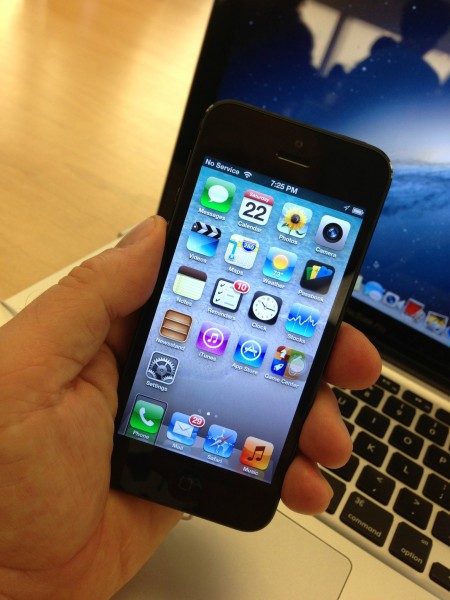
    In the highly saturated U.S. smartphone market, Apple’s dominance grew, while iPhone nipped upwards towards Android, for the three months ended in January, according to comScore. The analyst firm, unlike most of its competitors, measures actual subscriber share rather than number of units shipped. Like Gartner’s counting actual sales, comScore gives a clearer view of real-world dynamics.
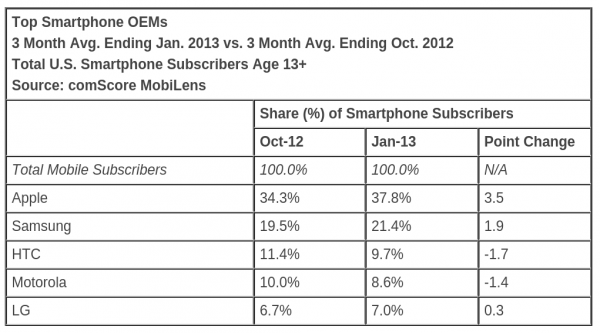
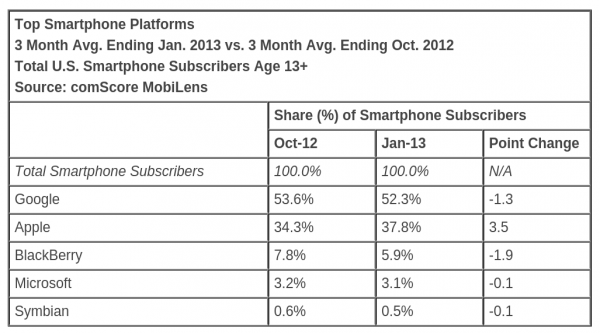
    During iPhone 5’s first full three months of sales, Apple’s share reached 37.8 percent — up from 36.3 percent in December and 34.3 percent in October. By comparison, second-place Samsung nudged up to 21.4 percent share, from 21 percent sequentially and 19.5 percent for the same three months. HTC, Motorola and LG followed, with respective shares of 9.7 percent, 8.6 percent and 7 percent. All three lost share from December, with LG up ever-so slightly from October. Motorola’s loses strongly suggest that at Verizon, carrier with the highly-visible Droid line of smartphones, subscribers shift allegiance to other brands. Good thing Moto has a new evangelist.

    The numbers, while meaningful, are far from perfect; comScore measures subscribers 13 and older, but counts primary phones only — no secondary devices.

    As the day moves along, you’ll read longer versions of stories like this one, which puff Apple’s feathers and lament stupid Wall Street for pulling down the company’s share price. Sigh. Too many American bloggers and journalists have too little perspective about the great, big world outside of the United States — where iPhone often isn’t treasured and where the dominance of Android and Samsung are indisputable. They just don’t get it.

    Nor do they recognize, or simply refuse to acknowledge, that this country is no longer the largest market for smartphones, but is one rapidly saturating. For Apple that means Samsung isn’t likely to catch up anytime soon, if ever, and Android will likely maintain a long subscriber share lead over iPhone short of some drastic maneuver — like paying people to buy iPhones.

    Don’t snicker or dismiss the idea, because ISPs did just that at the turn of the Century. What? You’re too young to remember free PCs with three-year ISP contracts? That is kind of the telco model today, given 2-year contracts, but is short of actually massively paying people to buy phones. But don’t be surprised if pay-to-buy crops up in the future, as data’s importance over voice as major revenue stream increases and saturation means people stop buying new smartphones every new release or so. If one carrier succeeds paying to purchase, others will follow.

    Back to blind-to-the-world American bloggers and journalists, I weary of their ethnocentric arrogance. My perspective isn’t often big enough either, seeing as I don’t live somewhere else and don’t directly see the circumstance in your country. But I try, when writing stories like this one: “Smartphone shipments surge ahead of lesser mobiles — Brazil, China and India lead the way“.

    China is now the world’s largest market for smartphones, which account for about two-thirds of new shipments there. In India, 80 percent of cellular mobile uses have feature phones, so there’s nothing but upside selling smartphones — as data infrastructure expands, device features increase and prices come down, according to IDC.

    Globally in fourth quarter, based on actual sales, Android share significantly outpaced iPhone — 69.7 percent to 20.7 percent, which is a 2.7 point decline from a year earlier, according to Gartner. The point: It’s a big world, and the United States is a small part of it.

    Photo Credit: Joe Wilcox

  • Finally! More devices using Android 4 than older versions

    It has taken since the introduction of Android 4.0 in Dec. 2011 until now, but there are finally more devices running Android 4.0 or better software than those that run older versions of Google’s platform. On its Android Developer Dashboard, Google notes that 45.1 percent of Androids hitting the Google Play store of late use Android 4.0 or better. That compares to the 44.2 percent that still use Android 2.3 Gingerbread software.

    The uptake of Android 4.0 and its sub-versions of late has been quick. In October, I saw that 1 in 4 devices visiting Google Play used Android 4.0 or better. At that time, I suggested that we’d see half of all Androids use recent versions of software within four to six months. We’re not at the halfway mark yet, but it’s only been four months. With the acceleration of phones and tablets running newer software, I won’t be surprised to see us reaching the tipping point next month.

    Android versions Feb 2013

    Clearly helping this phenomenon is Android’s changing pace. It has slowed over the past year or so, and that’s a good thing. It means that Android is more on par with iOS and other platforms than ever before. That’s part of the reason some prominent long-time iPhone users are now checking out Android — listen to our latest podcast to hear more on that topic, because there are other reasons as well.

    Hardware makers have also “caught” up to the software changes. Even after Android 4.0 arrived in late 2011, it took a good six months for phones to ship with a recent version of Android. By and large many of these now ship with Android 4.1 and not Android 4.2, but the differences between the versions aren’t that great. If the average consumer were to compare an Android 4.1 phone to one with Android 4.2, it’s safe to say they’d be hard pressed to tell the two apart.

    The feature differences brought by distributed Android software updates has been a key target for iOS users when looking to criticize Android. These points have definitely had merit; particularly early on in Android’s life-cycle. But I’d argue that Google’s issue has largely diminished and it’s really not that different on iOS; it’s just handled differently.

    Some iOS features found in software aren’t applicable to older devices and yet, these are reported as having the same version of iOS as devices that can use the new features. Every iPad Apple has produced can run iOS 6 which includes Siri, for example, but only Apple’s third- and fourth generation iPad’s can actually use Siri; different code is actually pushed by Apple to different devices, yet all have the same public version number.

    Regardless of which platform you use, this should help Android developers target more devices for mobile apps. And they shouldn’t have to worry as much about version numbers or supported API levels as more Androids run newer versions of the platform.

    Related research and analysis from GigaOM Pro:
    Subscriber content. Sign up for a free trial.