Author: Serkadis

  • 10 Austin startups you need to meet at SXSW in 2013

    As Austin preps for the annual influx of geeks, tweeps and marketing chic known as South by Southwest Interactive, I’d like to offer our visitors something more than just the parties and panels associated with the event. Why not also try to meet up with a few startups that might not be on your radar, or who should be on your radar?

    That’s why for the three years (2012, 2011 and 2010) I’ve prepped a list of the 10 startups you should meet at SXSW, focusing mostly the on startups that I think are going places, have awesome founders or have a great idea or technology underneath. Austin has deep roots in semiconductors and enterprise IT, but has some talented mobile entrepreneurs as well. So many of these startups will have a more enterprise or data-heavy flair; which should be just fine, since that’s what the venture capitalists are funding these days.

    Without further ado, here are my picks in alphabetical order. Of course, feel free to share your own faves and comments below.

    Aumanil: This team employs data scientists in the service of marketing. While that’s nothing new, the company’s service is one that’s becoming more prevalent — namely crunching customer data and interactions (in Aumanil’s case in online games) to determine who the most valuable customers are for your business and when and how to reach out to them so they keep spending.

    Continuum Analytics: This big data startup has been around since 2011 but this year scored a $3 million grant from DARPA to combine scientific databases with those more common in the business world (a.k.a., multidimensional arrays and relational databases, respectively). The company is creating several open source projects for dealing with massive amounts of data in ways that don’t require higher level programming skills.

    selectediconsIcon.me Online business cards are this gray area of opportunity where some people see irritating contact mining schemes (a la Plaxo) and others see a chance to make connections into a form of self-expression (a la Moo). With Icon, CEO Kent Savage — an old hand at creating enterprise companies — is walking the link between personal expression and professionalism. It makes money selling upgraded features and will also try to interest corporations in buying its digital business cards.

    Lynx Labs: There are two Kickstarter-famous companies on this list, and Lynx is known for the creation of a “camera” that takes measurements and models of objects and translates that picture into a rendering that a 3D printer can understand. So, if you like something, you snap it, the Lynx camera makes a rendering, and then you can ship it to a 3D printer. It’s the missing link for the age of personalized manufacturing — and a potential nightmare for intellectual property lawyers.

    Javelin Semiconductor: It wouldn’t be a list form me without some chip startup on here, and Javelin has a compelling power amplifier chip that’s inside certain Samsung handsets. The company’s chip, made using traditional manufacturing processes, helps reduce battery consumption and the cost of silicon on the phones it’s on. And Samsung is a big win for a little chip firm.

    RideScout: While the city of Austin preps for a legal showdown with ride-sharing company Sidecar, a local startup called RideScout (formerly known as GoingMyWay) has launched a similar app that hooks people up via their Facebook accounts with rides. But the real value in RideScout comes from its ability to integrate other transit information, from bus schedules to other ride-sharing services into its application. So instead of a random stranger, you can also choose to grab a cab or a bus.

    TwineSuperMechanical: This is the company behind Twine, a popular Kickstarter project that connects your physical gadgets to the internet. Yes, you can use Twine to get your washing machine to tweet, but this company has several other ideas for creating connected objects, so why not try to talk to them and see what else they are working on?

    Taskbox: Email overload got you down? I know there are a bunch of apps out there trying to solve this problem, but for people who love to turn their inbox into a testing ground, check out Taskbox, the iOS app (they are looking for an Android developer) that tries to take email — a desktop-oriented app — and make it mobile friendly. The company’s goal is to eventually help take the many source of requests for people’s time and attention and turn it into a task list where your list items come from voicemails, texts or even Twitter. It sounds daunting, but so is managing your life across so many platforms.

    Toopher: Requiring two pieces of information, such as a password as well as a fingerprint scan or a physical credit card and a PIN number, are all good examples of two-factor authentication, but translating that level of security to the virtual and mobile world can irritate users. Toopher adds security to mobile transactions using location as the second element in two-factor authentication, which may be irritating if you’re on a sudden trip in a foreign city, but in general makes for less friction with better security. The company raised $2 million last November from Alsop Louie and others.

    TrustRadius: The stealthy startup pitches itself as Yelp for enterprises, and it has some local investors pretty excited. The idea is interesting, and the TrustRadius CEO Vinay Baghat started Convio, an Austin startup that made software for the nonprofit sector. In 2010 Convio went public and was later acquired in 2012.

    Related research and analysis from GigaOM Pro:
    Subscriber content. Sign up for a free trial.

  • Bad Wi-Fi signal? Linkase iPhone 5 case boasts a 50% boost

    Wouldn’t it be great if an iPhone case increased wireless speeds while protecting the phone at the same time? That’s exactly what the Linkase for iPhone claims to do. The case includes a slide-out antenna that looks like it’s part of the case. According to Absolute Technology, the company behind the Linkase, it “is fueled by EMW technology (electromagnetic waveguide) and is designed with an embedded proprietary sliding antenna that dramatically boosts a Wi-Fi signal—by up to 50 percent.”

    Normally when I hear such claims, I raise an eyebrow. But these videos of the case in action have my brow falling back down; at least part-way until I can see the Linkase myself:

    The tests on camera look legitimate, but again, I plan to check out this technology for myself: a Linkase review unit is on the way for my iPhone 5. And I have some definite near-dead-zones in my home to use for testing, even with a new 802.11 a/c router that has generally fixed most of my Wi-Fi coverage and speed issues. Personally, I’d be happy to get a consistent signal — even with minimal speeds — in rooms furthest away from my router.

    For now, there’s no price or availability for the Linkase on the product web page. That information is listed as coming soon. If it works as advertised — offering up to 50 percent boost in Wi-Fi speeds for the iPhone 5, what would you be willing to pay? I’d drop $50 on it for sure as I’ve already spend that much for nice cases that don’t do a thing for my iPhone’s Wi-Fi speeds.

    Related research and analysis from GigaOM Pro:
    Subscriber content. Sign up for a free trial.

  • Notebook PC shipments to finally rebound in Q2

    Notebook PC Shipments Q2 2013
    The PC market is getting hit hard as tablets grow in popularity. PC sales declined this past holiday quarter for the first time in five years, and the first quarter isn’t expected to reverse PC vendors’ fortunes. According to a new report from Digitimes, however, laptop shipments are expected to climb across the board in the second quarter this year. “Toshiba is expected to enjoy a 42% on-quarter growth in the second quarter, followed by Asustek Computer with 41%, Hewlett-Packard (HPQ) 30%, Apple (AAPL) 26%, Lenovo 20%, Dell (DELL) 19% and Acer 10%,” Digitimes’ Aaron Lee wrote, citing vendors’ internal projections obtained by the site’s sources. The report also notes that Intel’s (INTC) next-generation “Haswell” processors will be unveiled in June.

  • Video: Why you shouldn’t care about securing the Internet of things just yet

    Does thinking about privacy and security at the developing states of the internet of things hinder innovators’ ability to build an open system? That’s one of several questions that Usman Haque of Cosm asks in his presentation from the GigaOM internet of things meetup we did last week in San Francisco.

    In his presentation Haque notes that we tend to think about the internet of things as already here, but just because something is connected to the internet, doesn’t mean it’s truly part of an internet of things with all of the openness and opportunity that might connote. Instead he presents some fears about what might derail the opportunity the internet of things represents. It’s a funny and thought-provoking talk that imagines a business model for the internet of things that relies on sharing revenue and open data.

    We’ll be running videos of the other presenters from our San Francisco IoT Meetup all week long, so grab a snack and take a break from email to check out some smart people discussing the Internet of things. And if you want to check one of these out in person, come to our Boulder, Colo. meetup on March 13.

    Related research and analysis from GigaOM Pro:
    Subscriber content. Sign up for a free trial.

  • PC shipments go from worse to, well, you don’t want to know

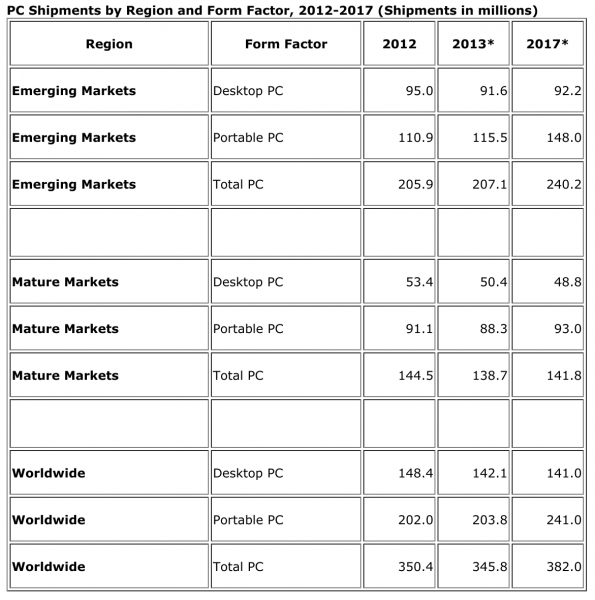
    IDC sure knows how to ruin a Monday. The analyst firm released final personal computer shipment tabulations for fourth quarter and all 2012 and made a dismal forecast for this year. If you’re as tired of reading “PC is dead” stories as I am writing them, cover your eyes. Read no further. The horrors ahead are unbearable.

    Global shipments will decline for the second year in a row in 2013, with Windows 8 giving no perceptual lift at all. Holidays were a bust, as will be the year. You can’t fault Microsoft for trying, but there is only so much water you can throw off a sinking ship with buckets before it plunges beneath the waves. Perhaps only the rumored Windows Blue can save the PC now, but Win8 was supposed to do that — and look what happened. When an analyst firm uses “underwhelming reception” to describe a Microsoft operating system, it’s time to abandon ship.

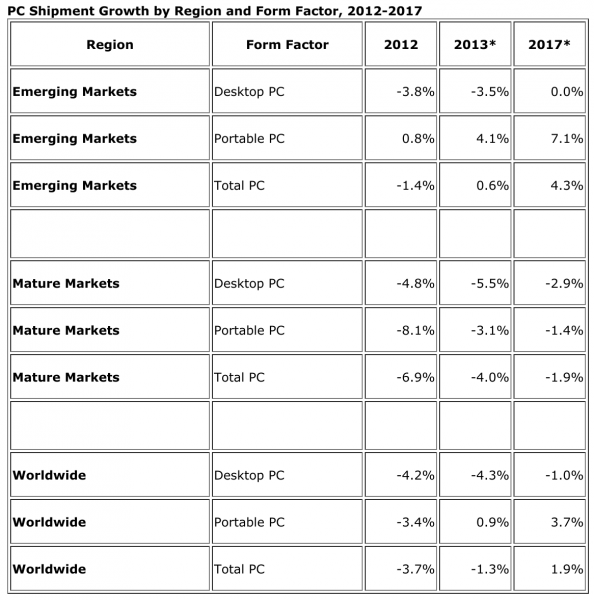
    Global PC shipments fell a stunning 8.2 percent during Q4, when Windows 8 launched, for the steepest holiday quarter decline ever. Shipments fell 3.7 percent for the year, and IDC predicts 1.2 percent dip in 2013. Remember: this year’s fall back comes from an already weak comparable.

    “The PC market is still looking for updated models to gain traction and demonstrate sufficient appeal to drive growth in a very competitive market”, Loren Loverde, IDC program vice president. Competition comes from you know where — tablets, which shipments will surpass notebooks this year, according to NPD DisplaySearch.

    For about eight quarters now, analysts promised some respite would come from either Windows 8 or emerging markets. They’re not buying either. Smartphones and tablets are only a little less likely to pull away sales there, too. Overall PC shipments to emerging markets fell 1.4 percent in 2012; IDC predicts tepid, 0.6 percent growth this year.

    “Growth in emerging regions has slowed considerably, and we continue to see constrained PC demand as buyers favor other devices for their mobility and convenience features”, Loverde says. (What’s that music? Do I hear a band playing “Nearer My God to Thee?”) “We still don’t see tablets — with limited local storage, file system, lesser focus on traditional productivity, etc. — as functional competitors to PCs, but they are winning consumer dollars with mobility and consumer appeal nevertheless”.

    I keep hearing analysts say tablets aren’t good enough, but consumers continue not to listen. That says how much for how long most people primarily use a computer to consume content — and smartphones and tablets are good enough for that. The real content most people create — emails, IMs, photo shares or social network posts — are easily done on mobile devices.

    As for mature markets, shipments fell by 6.9 percent last year and are forecast to decline 4 percent this year. Shipments of laptops, which compete most directly with tablets, fell 8.1 percent in 2012. IDC predicts only 3.1 percent drop this year. What a recovery!

    Here at home (hey, I live in the United States), the “PC market struggled in 2012, culminating with a 6.5 percent year-on-year decrease in the fourth quarter and -7.6 percent growth for the full year”, Rajani Singh, IDC research analyst, says. “Market saturation, a tough economic environment and weakness across the board, and lack of momentum for Windows 8, which led to 2012 contraction, are expected to persist at least during the first half of 2013”.

    Yikes! Did someone say “Man the lifeboats!” The ship isn’t lost yet.

    “IDC expects the second half of 2013 to regain some marginal momentum partly as a rubber band effect from 2012, and largely thanks to the outcome of industry restructuring, better channel involvement, and potentially greater acceptance of Windows 8”, Singh says. “We also anticipate a new refresh cycle momentum in the commercial segment driven by the end of Window XP life support”.

    Microsoft’s mainstream support ended four years ago next month, and the company will finally pull the plug on extended support in 13 months. Cute. In the “notes” section in the XP lifecycle support page table, someone at Microsoft put “Upgrade to Windows 8 now!” next to Home and Pro.

    That’s good advice for Microsoft Windows 8 license sales. As for helping new PCs — damn, the lifeboats are all gone.

  • Now on Kickstarter: a new kind of spinning energy storage device

    Will Kickstarter prove to be a good source for some of the geekier next-gen energy technologies? Well, crowdfunding has certainly emerged as an interesting new opportunity for solar roofs. On Monday entrepreneur Bill Gray launched a Kickstarter campaign to raise funds for his energy storage technology startup Velkess.

    Gray has spent the last six years at Velkess developing a new type of flywheel, which is traditionally an energy storage device that uses large spinning discs inside a vacuum. The rotation of the discs is stored as kinetic energy (or movement), and flywheels are used like batteries, usually as backup power for data centers. Research firm Lux Research estimated that flywheels and ultracapacitors could make up 10 percent of the datacenter backup power market market by 2016. Gray is excited about the possibilities of using his flywheels for enabling the addition of more clean power to the grid and combined with solar roofs.

    Traditional flywheels, made by companies like Beacon Power, use rigid materials like steel, and are made with ultra precision engineering and manufacturing. That makes them pretty expensive. Velkess’ technology, in contrast, is made with fiber glass and is much more flexible, and thus much more low cost. “Think about it as a jet engine versus a cowboy lasso,” explained Gray in an interview recently.

    Picture the material used for shower doors, or fishing rods or tennis rackets, but without an underlying matrix or frame. Velkess is using that type of material almost like a rope or flexible hoop, said Gray. While Gray didn’t share many specific numbers, he said by using this type of material, the Velkess flywheel could be cheaper than using lead acid batteries for backup power over ten years.

    Gray is looking to raise $54,000 to help him build a large 750-pound prototype of the flywheel. To date he’s bootstrapped the company, but he says he needs those tens of thousands of dollars to buy the next level of magnets needed for the large model. He says he’s been working with contractors in San Jose on testing technologies, and has made 50 prototypes, but with these funds he’ll build the first close-to-scale prototype product.

    Gray is excited about the possibility of crowdfunding as he says it gives entrepreneurs like him — that don’t come from a university, don’t have government backing and don’t go the venture capital route — an opportunity to raise money from a community. Backers of the Velkess flywheel can get incentives like a Velkess sweatshirt or a mini toy prototype.

    Manufacturing flywheels at scale, like most capital intensive energy technologies, has proved to be difficult at times. Flywheel maker Beacon Power was awarded a Department of Energy loan guarantee but then later went bankrupt and was sold to a private equity firm. Financing for cleantech innovations have dried up significantly in recent years, with venture capitalists putting a third less funding into cleantech startups in 2012. Government funding will also likely be constrained in 2013.

    Related research and analysis from GigaOM Pro:
    Subscriber content. Sign up for a free trial.

  • Next major Windows Phone release due this holiday season

    Windows Phone 9 Release Date
    Microsoft (MSFT) plans to release the next major update to its perpetually emerging Windows Phone platform this holiday season, according to a job posting on the company’s website. The listing for “Software Development Engineer in Test – Windows Phone,” which was first picked up by WMPoweruser, clearly states that Microsoft is “targeting the holiday of this year” with its next Windows Phone release, though it doesn’t provide any specific details about what features the new software might include. An earlier report claimed Microsoft is planning two minor bug-fix updates to its mobile platform before this major update is released ahead of the holidays.

  • Counting down to SimCity

    SimCity3
    The new SimCity is coming to town tomorrow. I can’t wait to play it (though it seems like we Mac people have to wait a little while longer.) I admit I am not much of a gamer – SimCity and Age of Empires are my two gaming weaknesses, so it makes sense that I have been waiting for this brand new sequel for a very long time. I used to look at the blank grid of my unbuilt dream city  and then take a long walk imaging the best possible city I could create based on the landscape. I often pondered decisions for hours and hours. I loved the windmills and big boulevards – explained by my love for Paris, Lyuten’s Delhi and Scandinavian sensibilities towards the environment.

    SimCity attuned me to the need for balance and refinement. I am and will always be a SimCity geek. There are many reasons to get excited about this version of the game and Josh Dzieza at the Daily Beast makes a great case for it. He writes:

    The game’s most salient message, though, is that cities are extremely complex. You have to deal with power, water, housing, transportation, pollution, even sewage.

    Magical words to my ears! So much so, I might have to install Windows just to play the game if the Mac version doesn’t come to market soon.

    welcome_1

    On the SimCity blog, senior producer Kip Katsarelis writes:

    This is a new SimCity that offers a deeper, richer game than ever before, with the new GlassBox engine driving the most authentic simulation you will ever see. We have created a model-like world that makes you want to reach in, poke, prod, tinker and destroy. We have put the simulation right in front of you so you can see the consequences of your actions and really dig in to see how the systems work. This new SimCity has been built from the ground up to be an online experience with a new Multi-City feature, which adds an epic scale to city planning, as your decisions impact both your city and your region.

    Here is a little taste of the game. Enjoy!


    Related research and analysis from GigaOM Pro:
    Subscriber content. Sign up for a free trial.

  • LG says LTE smartphone sales topped 10 million

    LG LTE Smartphone Sales
    As Apple (AAPL) and Samsung (005930) continued to divvy up just about all of the smartphone industry’s earnings last year, one other global vendor managed to step up and eke out a profit. LG’s (066570) smartphone business has inched up into the black thanks to gorgeous smartphones like the Optimus G, and the company confirmed on Sunday that it has now sold 10 million cumulative LTE-equipped smartphones globally. “Aggressive pushing forward with 4G LTE technology allows LG to satisfy the needs of consumers and is a huge factor in our growing success in global LTE smartphone sales,” said LG Mobile boss Dr. Jong-seok Park. “Having established ourselves as a major industry player, we will continue to expand our footprint in the global LTE market with a wider range of differentiated, high quality LTE smartphones.” LG’s full press release follows below.

    Continue reading…

  • Thanks to eye tracking, Samsung’s Galaxy S4 is sure to watch you watching it

    A new feature on the not-yet-announced Samsung Galaxy S4 may help you read more web content without having the touch the screen. Dubbed “Eye Scroll,” the function would use the phone’s front camera to track your eyes and automatically scroll content when it sees that you’ve read to the bottom of the screen. Samsung filed for an “Eye Scroll” patent in the U.S. last month, according to Brian Chen, writing for the New York Times.

    In the patent description, you can get a better idea of how this will work:

    “Computer application software having a feature of sensing eye movements and scrolling displays of mobile devices, namely, mobile phones, smartphones and tablet computers according to eye movements; digital cameras; mobile telephones; smartphones; tablet computers.”

    Ideally then you could use a Samsung device with Eye Scroll and one hand for content consumption. That’s important as the company’s smartphone and small tablet screens have ballooned over the past two years.

    The Galaxy S4, for example is rumored to have a 5-inch, 1080p display, while the company’s Galaxy Note 2 — the phone I use daily — has a 5.5-inch screen. Even Samsung’s small tablets, which used to have a standard 7-inch size, are moving toward 8-inch screens. For many, devices of this size means two-handed use. But with automatic page scrolling, content could be read while holding the device with one hand.

    Even if such a feature doesn’t make it into Samsung’s Galaxy S4 — the phone is widely expected to be introduced on March 14 — it could be added to the phone via a future software update. And it makes sense that Samsung is even pushing towards this kind of use; it’s done so before with prior Galaxy phones.

    My Galaxy Note 2, for example, has a similar function called “Smart Stay.” When enabled, the phone uses the front camera to look for my eyes and see if I’m actively looking at the screen. If so, it makes sure the phone display doesn’t dim or go into sleep mode. I have little doubt then that whatever features Samsung adds to the Galaxy S4, some of them will require the phone to be watching you.

    Related research and analysis from GigaOM Pro:
    Subscriber content. Sign up for a free trial.

  • Solar makers turn a laser-like focus on boosting the efficiency of solar cells

    In 2013, solar makers are preoccupied with boosting the efficiency of solar cells, or basically using various techniques to increase the amount of sunlight that each solar cell can convert into electricity. That’s because it’s one of the most important ways they have right now to reduce costs in a difficult year for solar manufacturers. The supply of solar cells in the market over the past year is far more than demand and some companies are selling solar cells at a loss.

    It’s a particularly important trend for solar maker startups that need a premium product to sell. For example, on Monday morning, venture-backed solar startup Alta Devices announced that it’s reached 30.8 percent efficiency for solar cells that it’s marketing to mobile gadget makers. For comparison’s sake traditional silicon solar cells are closer to 20 percent efficient.

    Alta Devices military 2Alta Devices says it has been working with mobile device maker customers that want to extend the battery life of gadgets using embedded Alta solar cells. The six-year-old company — which has raised $120 million from investors like Kleiner Perkins, NEA and Dow Chemical — has been planning on making a fast-charging solar iPad cover by the end of the year that could end the need to plug an iPad into the wall or laptop to charge.

    Alta Devices says the 30.8 percent is a world record for its dual junction solar cell made from the materials gallium-arsenide, and previously the company was saying its cells were 28 percent efficient. Check out this article for more details on Alta Device’s solar cell technology and a tour of its pilot factory. Alta says it has been shooting for an eventual efficiency of 38 percent for its cells.

    Remember this type of efficiency demonstrates what a company might be able to achieve. But whether a company will ever do so will depend on factors such as how much does it scale up its manufacturing, how much money is it able to raise and how efficiently it is operating factory equipment.

    Alta’s solar cells are more expensive than traditional silicon cells, but the company is hoping that niche markets like gadget makers will be willing to pay a premium for the next-gen cells. Alta is also developing solar cells for military applications, which can enable troops and their devices to charge up off-the-grid in combat less frequently.

    Startups aren’t the only ones that are focused heavily on solar cell efficiency. First Solar last week announced a world record of 18.7 percent for cells made from the material cadmium-telluride. That’s up from the 17.3 percent cell it touted in July 2011.

    SunPower has long touted highly efficient solar cells. And suppliers like DuPont sell materials that big solar companies can use to boost the efficiency of their cells.

    Related research and analysis from GigaOM Pro:
    Subscriber content. Sign up for a free trial.

  • ABI thinks 2013 is the year developers go Android first, but I doubt it

    Google Android will not only account for the majority of an expected 56 billion smartphone app downloads this year, but it will be the primary platform of choice for many more mobile app developers. So says ABI Research, which published on Monday its 2013 forecast of mobile app downloads by platform for both smartphones and tablets.

    Android is bigger for phone apps, but Apple owns the tablet app market

    Android app downloads on phones will consume 58 percent of the market this year, while programs for Apple’s iPhone will account for 33 percent. Windows Phone at 4 percent and BlackBerry capturing 3 percent will make up the total, according to ABI. The tables will turn on tablets, however, as ABI expects Apple’s iPad to commandeer three-fourths of the 14 billion mobile app downloads for tablets in 2013. Not counting Amazon’s tablets, Android will only pick up 17 percent of the tablet app market.

    So why might Android be the first choice of smartphone app developers this year? Because of “its vast installed base and the generally improved conditions for app building,” according to the ABI report. I’m not so sure, and I say that as someone who uses multiple platforms but generally relies on Google’s products.

    android-lineup-of-phones

    There’s certainly no debate over which smartphone platform is outpacing the other. While Apple had a blockbuster first fiscal quarter with 46.7 million iPhones sold, Google activates more than 1.3 million Android devices per day as of six months ago. Based on sales estimates, most of those are phones, not tablets. All evidence points to Android phones outselling iPhones by some amount.

    But that’s been the case for some time and very few top-tier apps have arrived first on Android phones. The best I’ve really seen is more simultaneous releases for iOS and Android. Not much has changed, even though Android is the smartphone market sales leader. So why does ABI suspect phone sales volumes will suddenly matter in 2013?

    Money matters

    It is possible that Android’s development tools are improving enough to cause some mobile app shops to reconsider their iOS-first approach. There’s another challenge that’s part of the equation, however: The price that smartphone owners are willing to pay for apps on their platform of choice.

    Simply put: Data suggests that iPhone owners are still willing to pay more for an app. The Wall Street Journal emphasizes this point today in article on app economics:

    “As of the end of 2012, the average price for a paid app in the Apple app store was $3.18 on an iPhone and $4.44 on an iPad, according to research firm Distimo. That compares with an average $3.06 in the Google Play store and $2.84 on Amazon Inc.’s app store.”

    Sure, developers can make up any shortfall in a lower per-unit price through volumes but if that were the secret sauce, it would have started when Android overtook iOS in smartphone market share.

    Tablets can influence the smartphone app market

    ABI’s tablet data also adds to my skepticism of an Android-first approach.  If Apple has a large majority of tablets, I’d argue it actually makes iOS more desirable as the development platform of choice.  Why? Because of Apple’s universal app approach that allow developers to create one app that essentially works on both iPhones and iPads.

    Thirst iPad app search news readerAndroid apps can be developed with a similar approach, but I find that few Android tablet apps are as good as their phone counterparts. Either developers aren’t taking advantage of Google’s development tools or they’re just stymied by the many resolutions found on Android tablets.

    In either case, while some mobile app developers will choose Android before iOS in 2013, I don’t think we’ll see a big shift this year, barring any major Android developments that cause app owners to pay a little more for mobile software.

    Related research and analysis from GigaOM Pro:
    Subscriber content. Sign up for a free trial.

  • Smartphone shipments surge ahead of lesser mobiles — Brazil, China and India lead the way

    Last month after analyzing Gartner’s Q4 handset sales data, I quipped: “At this pace, smartphone sales should surpass feature phones within a couple quarters”. Today, IDC released a real forecast, claiming that smartphone shipments would do just that. While not exactly sales, the change would mark a significant shift in the mobile phone market, with China charging ahead of all other countries.

    The analyst firm expects smartphone shipments to nudge past 50 percent for the year, a forecast I consider to be overly conservative. Based on sales, the category already has 44 percent share, according to Gartner. The smartphone market is so fast-changing, few analysts get anything right. As I explained in December, IDC repeatedly underforecast smartphone shipments throughout 2012. The general view is likely right, but with feature phones falling at brisker pace.

    IDC estimates manufacturers will ship 918.6 million smartphones this year, rising to 1.7 billion in 2017, for about two-thirds of global handset shipments. The changing dynamic creates and closes opportunities, depending on markets. The United States and parts of Europe rapidly reach saturation levels, where adoption of more sophisticated handsets slows and early leaders Android and iOS lock out competitors. Elsewhere, low smartphone adoption makes more opportunities for all.

    Falling prices and 4G network expansion are two trends driving smartphone adoption. Samsung and Chinese manufacturers like Lenovo and LTE rapidly bring compelling, lower-cost handsets to market, which contributes to smartphone gains against feature phones.

    The trends make sense of last week’s Mobile World Congress announcements, such as Firefox OS phones or new Nokia Lumias with fewer smartphone features for lower selling prices going to emerging markets first.

    IDC singles out three of the four BRIC countries — Brazil, China and India — as huge growth markets, but for different reasons. During 2012, China passed the United States as the largest market for smartphones, which account for about two-thirds of shipments there.

    “While we don’t expect China’s smartphone growth to maintain the pace of a runaway train as it has over the last two years, there continue to be big drivers to keep the market growing as it leads the way to ever-lower smartphone prices and the country’s transition to 4G networks is only just beginning”, Melissa Chau, IDC senior research manager, says.

    As I explained last month, cheap-selling smartphones and Android’s rapid rise in China — among buyers and manufacturers — weakens iPhone’s position in Apple’s second-largest market. “China is a massive growth prospect, but Apple is not making the market share impact there that it is in other markets”, Nicole Peng, Canalys China research director, says.

    “Smartphone shipments surged +64-percent annually in China during the fourth quarter of 2012”, Neil Mawston, Strategy Analytics research director, says. “Android and Android forks together accounted for a record volume of all smartphones shipped in China last year”.

    But, of course, there are limits to how far and fast smartphone shipments can go in the country. “Even as China starts to mature, there remains enormous untapped potential in other emerging markets like India, where we expect less than half of all phones shipped there to be smartphones by 2017, and yet it will weigh in as the world’s third largest market”, Chau says.

    Brazil and India are two other markets to watch. “Brazilians have yet to turn in their feature phones for smartphones on a wholesale basis”, Bruno Freitas, IDC consumer devices research manager, says. “The smartphone tide is turning in Brazil though, as wireless service providers and the government have laid the groundwork for a strong smartphone foundation that mobile phone manufacturers can build upon”.

    Through 2017, IDC predicts that India smartphone shipments will outpace other countries by enormous margins, rising 459.7 percent compounded annually.

    IDC’s analysis jives with a study Pew Internet released last week about mobile phone habits. The organization finds that, combined, 65 percent of Brazilian adults 16 or older have feature or multimedia phones. In India, 80 percent of adults use feature phones.

    Photo Credit: Massimo Cavallo/Shutterstock

  • Chrome for Android may get a speedy websurfing boost

    Google is reportedly experimenting with delivering the web faster on Android devices through data compression. Over the weekend, Francois Beaufort noted the development on his Google+ page; Beaufort has consistently delivered early information on Google’s Chrome OS and Android efforts in the past. He says the end result would be similar to the faster web experiences found in Opera’s Turbo and Amazon’s Silk browsers.

    Current Chrome for Android users can actually enable the test feature now, provided they know how to use tools found in Google’s Android SDK. This one line command turns the function on: adb shell ‘echo “chrome –enable-spdy-proxy-auth” > /data/local/tmp/content-shell-command-line’ although for it to work, Google’s proxy servers supporting Chrome for Android need to be in place and running. There’s no indication if they are at this point.

    According to Beaufort, code related to the effort suggests Google will use SPDY proxy authentication. SPDY is considered to be a next generation web protocol to lower page load times and latency; Google’s testing of SPDY has shown up to 64% reductions in page load times. Google created SPDY (pronounced “SPeeDY”) in 2009 as an experiment and support is now included in the Chrome, Amazon Silk, Opera and Firefox browsers.

    Related research and analysis from GigaOM Pro:
    Subscriber content. Sign up for a free trial.

  • DIY culture: Do you want your kids to create or consume?

    It has become a common refrain on the web: The rise of the DIY culture, the hacker movement and an overall sense that knowing how to code and hack is an important skill Events like Maker Faire are growing and attracting more participants, while venues like Kickstarter, Indiegogo and Etsy are offering makers of all types a viable venue for selling and advertising their skills. This cultural movement can rightly be seen a backlash against the passive consumerism of the last six decades, but it’s also about something larger — our place in an increasingly competitive, and “flat” world.

    And as such, a large part of this movement focuses on kids. How do we teach our kids to code? How can we get them interested in hacking? In building? SparkFun, a Boulder, Colo.-based retailer of various DIY hardware kits, has a solution: a subsidized national tour that will supply hardware and tools for teaching kids how to build electronics and code to schools.

    SparkFun wants to visit schools in all 50 states and will offer courses to both students and educators, as well as development kits. The first 50 spots are subsidized and so cost $1,500 for a class, while later spots will cost $2,500. Already 13 of those 50 slots have been claimed even before the program has been publicly announced outside of the SparkFun website, according to Lindsay Levkoff, the director of education at SparkFun.

    Teaching middle schoolers Scratch programming.

    Teaching middle schoolers Scratch programming.

    Levkoff created the SparkFun department of education in 2011 to help bring the maker movement to schools that were interested in adding programs but had no idea how to go about it. After a West Coast and East Coast tour last year, the company decided to make it even bigger with a nationwide effort. As a side benefit, SparkFun is creating potential customers for its store.

    “When I designed the department it was almost an altruistic branch and there was no guarantee that we would pay for ourselves,” Levkoff said. “We’re trying to be a nonprofit within SparkFun … but if people want to buy the kits and products then that’s a fantastic by-product.”

    SparkFun’s plans are part of a larger effort to create hacking groups like Hacker Scouts for kids and even offer classes or hacker space for the younger set.

    And while I’ve been pondering how to start one of those for my own daughter’s school, I’ve also been thinking a lot about the bigger issue here; namely why is this movement gaining ground and how important is it really? Is programming the literacy of the 21st century? Does being able to solder, sew or build a robot make someone more employable or creative than another?

    The SparkFun tour is helped along by a drive to push Science Technology Engineering and Math education (STEM) and subsequent government and private grants to schools. As a parent I also am eager for my daughter to engage in building things and playing around with hardware in part because I loved building computers, radios and whatnot with my own dad.

    But in some ways, beyond the mechanics of programming and the magic of electricity, I think these projects add a venue for concrete accomplishment that can be lacking in everyday schooling for many kids. And that sense of accomplishment, of completing a concrete task as opposed to learning algebra, might be the real value of these maker-based curricula. After all, there are a fair amount of people who get a lot more satisfaction from creating than from consuming.

    Related research and analysis from GigaOM Pro:
    Subscriber content. Sign up for a free trial.

  • Mellanox open sources its switch software as SDN pressures vendors to react

    Mellanox has jumped into the open-source hardware movement with both feet, offering to support open-source projects such as OpenFlow and Quagga on its gear while also opening up the code for its switching software. The networking chip maker is taking this stance as more networking companies find themselves under pressure from changing customer needs, the threat of OpenFlow and the rise of software-defined networking.

    open_ethernet

    Mellanox, primarily an Infiniband vendor, recently started gaining wins on the Ethernet side as well. Its history of providing networking gear and silicon for the highly-distributed and IO-intensive high-performance computing market has given it something of an edge in certain scale-out deployments. So the news that it’s trying to drive the creation of an Open Ethernet initiative makes sense. It’s listening to its customers and attempting to position itself as the replacement to traditional networking gear for the scale out and software-defined networking era.

    According to an EETimes article, Mellanox won’t open source its firmware drivers for its chips and so will retain its proprietary edge on the silicon. Once again, it’s clear that server and now networking gear is getting stripped down to its most basic construction, where the primary hardware value is in the silicon and whatever software runs on top of it. On the server side, the value of that software has slowly been driven down by open-source alternatives, but on the networking side that process is just beginning.

    Mellanox, like others in the space who have offered OpenFlow switches or APIs to their networking gear, has now announced its strategy for dealing with the threat open-source software poses to networking. Will it find partners and customers willing to buy into that vision?

    Related research and analysis from GigaOM Pro:
    Subscriber content. Sign up for a free trial.

  • Apple’s ‘iWatch’ to reportedly launch this year

    Apple iWatch Release Date
    Apple (AAPL) plans to debut its much rumored smartwatch later this year, according to a new report. Bloomberg on Monday issued a claim that the so-called “iWatch” could pose a larger revenue opportunity than the HDTV Apple has supposedly been working on for years. The report suggests that Apple hopes to launch the device later this year and is considering a variety of functionality such as voice calling, mapping features and the ability to display notifications from the user’s phone on the watch’s display. The report claims Apple’s iWatch will also include pedometer features, and it may even monitor the wearer’s heart rate.

  • Sprint takes a pass on BlackBerry’s first new smartphone

    BlackBerry Z10 Sprint
    BGR confirmed some of the best news BlackBerry could possibly get late last week, but not everyone is convinced that the BlackBerry Z10 will have the same draw in the United States. The nation’s No.3 carrier Sprint (S) recently confirmed to Bloomberg that it will be the only top carrier in the U.S. to pass on BlackBerry’s (BBRY) first next-generation smartphone. Instead, Sprint will wait for the BlackBerry Q10 before it gives the new BlackBerry 10 platform any support. “We aren’t saying there’s anything different about our customers,” a Sprint spokesperson said. “We think our customers will be happy with the qwerty keyboard and touch screen on the Q10.”

  • The history of Hadoop: From 4 nodes to the future of data

    Depending on how one defines its birth, Hadoop is now 10 years old. In that decade, Hadoop has gone from being the hopeful answer to Yahoo’s search-engine woes to a general-purpose computing platform that’s poised to be the foundation for the next generation of data-based applications.

    Alone, Hadoop is a software market that IDC predicts will be worth $813 million in 2016 (although that number is likely very low), but it’s also driving a big data market the research firm predicts will hit more than $23 billion by 2016. Since Cloudera launched in 2008, Hadoop has spawned dozens of startups and spurred hundreds of millions in venture capital investment since 2008.

    In this four-part series, we’ll explain everything anyone concerned with information technology needs to know about Hadoop. Part I is the history of Hadoop from the people who willed it into existence and took it mainstream. Part II is more graphic; a map of the now-large and complex ecosystem of companies selling Hadoop products. Part III is a look into the future of Hadoop that should serve as an opening salvo for much of the discussion at our Structure: Data conference March 20-21 in New York. Finally, Part IV will highlight some the best Hadoop applications and seminal moments in Hadoop history, as reported by GigaOM over the years.

    Wanted: A better search engine

    Almost everywhere you go online now, Hadoop is there in some capacity. Facebook, eBay, Etsy, Yelp , Twitter, Salesforce.com — you name a popular web site or service, and the chances are it’s using Hadoop to analyze the mountains of data it’s generating about user behavior and even its own operations. Even in the physical world, forward-thinking companies in fields ranging from entertainment to energy management to satellite imagery are using Hadoop to analyze the unique types of data they’re collecting and generating.

    Everyone involved with information technology at least knows what it is. Hadoop even serves as the foundation for new-school graph and NoSQL databases, as well as bigger, badder versions of relational databases that have been around for decades.

    But it wasn’t always this way, and today’s uses are a long way off from the original vision of what Hadoop could be.

    Doug Cutting

    Doug Cutting

    When the seeds of Hadoop were first planted in 2002, the world just wanted a better open-source search engine. So then-Internet Archive search director Doug Cutting and University of Washington graduate student Mike Cafarella set out to build it. They called their project Nutch and it was designed with that era’s web in mind.

    Looking back on it today, early iterations of Nutch were kind of laughable. About a year into their work on it, Cutting and Cafarella thought things were going pretty well because Nutch was already able to crawl and index hundreds of millions of pages. “At the time, when we started, we were sort of thinking that a web search engine was around a billion pages,” Cutting explained to me, “so we were getting up there.”

    There are now about 700 million web sites and, according to Wired’s Kevin Kelly, well over a trillion web pages.

    But getting Nutch to work wasn’t easy. It could only run across a handful of machines, and someone had to watch it around the clock to make sure it didn’t fall down.

    Mike Cafarella

    Mike Cafarella

    “I remember working on it for several months, being quite proud of what we had been doing, and then the Google File System paper came out and I realized ‘Oh, that’s a much better way of doing it. We should do it that way,’” reminisced Cafarella. “Then, by the time we had a first working version, the MapReduce paper came out and that seemed like a pretty good idea, too.”

    Google released the Google File System paper in October 2003 and the MapReduce paper in December 2004. The latter would prove especially revelatory to the two engineers building Nutch.

    “What they spent a lot of time doing was generalizing this into a framework that automated all these steps that we were doing manually,” Cutting explained.

    Raymie Stata, founder and CEO of Hadoop startup VertiCloud (and former Yahoo CTO), calls MapReduce “a fantastic kind of abstraction” over the distributed computing methods and algorithms most search companies were already using:

    “Everyone had something that pretty much was like MapReduce because we were all solving the same problems. We were trying to handle literally billions of web pages on machines that are probably, if you go back and check, epsilon more powerful than today’s cell phones. … So there was no option but to latch hundreds to thousands of machines together to build the index. So it was out of desperation that MapReduce was invented.”

    MapReduce diagram, from the Google paper

    Parallel processing in MapReduce, from the Google paper

    Over the course of a few months, Cutting and Cafarella built up the underlying file systems and processing framework that would become Hadoop (in Java, notably, whereas Google’s MapReduce used C++) and ported Nutch on top of it. Now, instead of having one guy watch a handful of machines all day long, Cutting explained, they could just set it running on between 20 and 40 machines that he and Cafarella were able to scrape together from their employers.

    Bringing Hadoop to life (but not in search)

    Anyone vaguely familiar with the history of Hadoop can guess what happens next: In 2006, Cutting went to work with Yahoo, which was equally impressed by the Google File System and MapReduce papers and wanted to build open source technologies based on them. They spun out the storage and processing parts of Nutch to form Hadoop (named after Cutting’s son’s stuffed elephant) as an open-source Apache Software Foundation project and the Nutch web crawler remained its own separate project.

    “This seem like a perfect fit because I was looking for more people to work on it, and people who had thousands of computers to run it on,” Cutting said.

    Cafarella, now an associate professor at the University of Michigan, opted to forgo a career in corporate IT and focus on his education. He’s happy as a professor — and currently working on a Hadoop-complementary project called RecordBreaker — but, he joked, “My dad calls me the Pete Best of the big data world.”

    Ironically, though, the 2006-era Hadoop was nowhere near ready to handle production search workloads at webscale — the very task it was created to do. “The thing you gotta remember,” explained Hortonworks Co-founder and CEO Eric Baldeschwieler (who was previously VP of Hadoop software development at Yahoo), “is at the time we started adopting it, the aspiration was definitely to rebuild Yahoo’s web search infrastructure, but Hadoop only really worked on 5 to 20 nodes at that point, and it wasn’t very performant, either.”

    Baldeschwieler at Hadoop Summit 2010. Source: Yodel Anectdotal

    Baldeschwieler at Hadoop Summit 2010. Source: Yodel Anectdotal

    Stata recalls a “slow march” of horizontal scalability, growing Hadoop’s capabilities from the single digits of nodes into the tens of nodes and ultimately into the thousands. “It was just an ongoing slog … every factor of 2 or 1.5 even was serious engineering work,” he said. But Yahoo was determined to scale Hadoop as far as it needed to go, and it continued investing heavy resources into the project.

    It actually took years for Yahoo to moves its web index onto Hadoop, but in the meantime the company made what would be a fortuitous decision to set up what it called a “research grid” for the company’s data scientists, to use today’s parlance. It started with dozens of nodes and ultimately grew to hundreds as they added more and more data and Hadoop’s technology matured. What began life as a proof of concept fast became a whole lot more.

    “This very quickly kind of exploded and became our core mission,” Baldeschwieler said, “because what happened is the data scientists not only got interesting research results — what we had anticipated — but they also prototyped new applications and demonstrated that those applications could substantially improve Yahoo’s search relevance or Yahoo’s advertising revenue.”

    Shortly thereafter, Yahoo began rolling out Hadoop to power analytics for various production applications. Eventually, Stata explained, Hadoop had proven so effective that Yahoo merged its search and advertising into one unit so that Yahoo’s bread-and-butter sponsored search business could benefit from the new technology.

    Cutting (center) flanked by Baldeschwieler and Om Malik at GigaOM's Hadoop Meetup in 2008.

    Cutting (center) flanked by Baldeschwieler and Om Malik at GigaOM’s Hadoop Meetup in 2008.

    And that’s exactly what happened, because although data scientists didn’t need things like service-level agreements, business leaders did. So, Stata said, Yahoo implemented some scheduling changes within Hadoop. And although data scientists didn’t need security, Securities and Exchange Commission requirements mandated a certain level of security when Yahoo moved its sponsored search data onto it.

    “That drove a certain level of maturity,” Stata said. “… We ran all the money in Yahoo through it, eventually.”

    The transformation into Hadoop being “behind every click” (or every batch process, technically) at Yahoo was pretty much complete by 2008, Baldeschwieler said. That meant doing everything from these line-of-business applications to spam filtering to personalized display decisions on the Yahoo front page. By the time Yahoo spun out Hortonworks into a separate, Hadoop-focused software company in 2011, Yahoo’s Hadoop infrastructure consisted of 42,000 nodes and hundreds of petabytes of storage.

    From the classroom …

    However, although Yahoo was responsible for the vast majority of development during its formative years, Hadoop didn’t exist in a bubble inside Yahoo’s headquarters. It was a full-on Apache project that attracted users and contributors from around the world. Guys like Tom White, a Welshman who actually wrote O’Reilly Media’s book Hadoop: The Definitive Guide despite being what Cutting describes as a guy who just liked software and played with Hadoop at night.

    Up in Seattle in 2006, a young Google engineer named Christophe Bisciglia was using his 20 percent time to teach a computer science course at the University of Washington. Google wanted to hire new employees with experience working on webscale data, but its MapReduce code was proprietary, so it bought a rack of servers and used Hadoop as a proxy.

    Go to page 2 (of 2) on GigaOM .

    Related research and analysis from GigaOM Pro:
    Subscriber content. Sign up for a free trial.

  • Samsung teases Galaxy S IV ahead of next week’s launch [video]

    Galaxy S IV Video
    Samsung (005930) will unveil its next-generation flagship smartphone during a press conference next week, where BGR will be reporting live. While we already know plenty about the upcoming Android phablet, Samsung has whet fans’ appetite with quick teaser video posted to its Facebook page. Nothing is revealed in the video, however it looks like the first part of an ongoing narrative we’ll see unfold over the next 10 days, culminating with the Galaxy S IV’s official unveiling on March 14th. Samsung’s teaser video follows below.

    Continue reading…