
Author: Serkadis
-
AT&T launches all-out attack on T-Mobile in new ad
-
Hugo Chávez Near Death, According To Reports
There have been rumors going around that Venezuela President Hugo Chávez had died, but reports have come out to the contrary.
The country’s vice president reportedly said on Thursday that he is “still fighting for his life,” and according to the AP, the majority of Venezuelans polled believe he’ll actually return to power.
According to VP, Nicolás Maduro, Chávez “is battling there for his health,” and “for his life”.
On Friday, senior aides and relatives of Chávez also spoke out to counter the rumors of his death. Reuters quotes some of them:
“There he is, continuing his fight, his battle, and we are sure of victory!” his brother Adan Chavez, the governor of Barinas state, told cheering supporters during an event.
…
“The launching of absurd and bizarre rumors by the right wing simply discredits them and isolates them further from the people,” Chavez’s son-in-law Jorge Arreaza, who is also Venezuela’s science minister, said via Twitter.
Chávez reportedly underwent his fourth surgery for cancer in December, and has not been seen in public since, though he is said to have gone to a military hospital in Caracas last week.
-
BlackBerry Z10 gets first software update, with 5 improvements
BlackBerry’s new platform and phone are getting the first software update since launching. Customers with a Z10 handset either have, or will soon have, a 150 MB over-the-air software package that betters five different functions of the newest BlackBerry handset. The company says that some carriers are already delivering the new software and that it’s working with others to make the update available soon.
I’d consider these to be core feature updates, some of which should improve the overall experience in areas that I find slightly lacking:
- Third-party application performance. I don’t find that many third-party apps run slow on the BlackBerry Z10, but this is still welcome news. The bigger issue in my opinion is a lack of top-tier software titles. BlackBerry says WhatsApp Messenger will join the platform this month.
- Phone, calendar and contacts. BlackBerry says there are fixes for Gmail accounts. I’m looking forward to this as I need Gmail for both work and personal uses; the experience could be improved on the Z10. The BlackBerry Hub is also better for call logging after this software update and it is easier to import contacts from online sources.
- Camera. The update reportedly improves photos in low-light conditions, something that many noted was an issue with the Z10.
- Video playback in the browser is improved.
- Battery life. BlackBerry says that 60 battery optimizations are implemented in the software update so “heavy users especially should see a longer average usage per charge cycle.”
I haven’t installed the update on the Z10 that BlackBerry provided me at the launch event yet, although I’ll check for it later today.
While I’m happy to see software improvements, I don’t see anything here that would alter my perception of BlackBerry’s challenge. The Z10 and BlackBerry platform look good and yet I can’t find a reason for most people to switch away from either an iPhone or Android handset at this point.

Related research and analysis from GigaOM Pro:
Subscriber content. Sign up for a free trial.- Carrier IQ and the continued erosion of operator trust
- What to watch in mobile in 2013
- Forecast: the converged mobile messaging market


-
Turn Printable Files into Industry-Standard PDFs
 Turning documents and other type of printable files into PDFs is not a tough job and it is basically a matter of choosing the right application to do it with. However, some programs are more versatile than others and offer more than just a standard set of features.
PrimoPDF from Nitro PDF is a simple yet powerful tool that can convert any printable file to PDF forma… (read more)
-
Apple’s mini is more popular than iPad, and that’s not a good thing
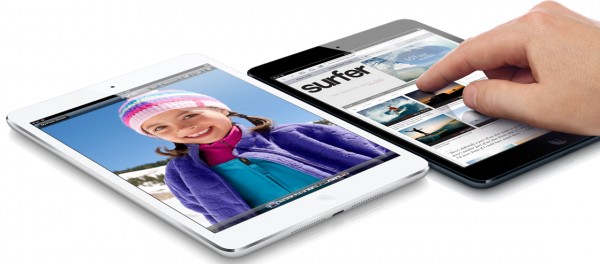
Nearly two months ago, when forecasting that tablets would outsell laptops this year, NPD DisplaySearch dropped dirty data bomb: shipments of slates with 7-7.9-inch screens will eclipse larger ones. Now the analyst firm puts real numbers behind the prediction, and they are grim for Apple. Talk about mixed blessings. iPad mini sizzles, while iPad fizzles. The problem: Higher sales of one takes away from the other, rather than expands demand. As such, margins are lower for the important category, likely biting Macs, too.
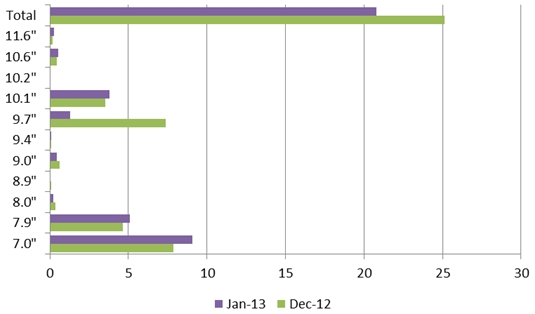
Panel shipments reveal the trend, and it is dramatic in just one month. “Shipments of 9.7-inch tablet PC panels collapsed, falling from 7.4 to 1.3 million, while 7-inch and 7.9-inch panel shipments grew rapidly, from 12 to 14 million”, David Hsieh, NPD vice president, says. “Shipments of 10.1-inch panels grew only slightly” from December to January. Apple and Sony are the major manufacturers selling 9.7-inch tablets, the overwhelming majority iPad. Starting today, Sony sells the Xperia Tablet Z, in a move to 10.1 inches, but 9.7-inch volumes aren’t high enough to account for such a dramatic shift in panel orders.
“Apple had planned to sell 40 million iPad minis (7.9 inches) and 60 million iPads (9.7 inches) in 2013”, Hsieh says. “However, the reality seems to be the reverse, as the iPad mini has been more popular than the iPad. We now understand that Apple may be planning to sell 55 million iPad minis and 33 million iPads in 2013. At the same time, Samsung, Amazon, Google, ASUS and Acer are all eyeing the 7-9-inch segment to grab tablet PC market share, while many white box makers in China are also emphasizing the smaller size tablet PC”.
So Apple’s problem is two-fold: iPad mini saps margins, while competitors bring lower-cost models to market — and we saw plenty of those introduced at Mobile World Congress this week, including a $169 tablet from HP.
Margin Math
By my calculations, during calendar Q4, iPad average selling prices fell 12.3 percent quarter on quarter — from $535 to $467. But there’s more! During Apple’s earnings call in January, the CFO acknowledged: “We saw a reduction in our iPad ASPs of about $101 year-over-year in the December quarter — and you can see that, our iPad units grew faster than our iPad revenue in the December quarter”. He later added: “iPad mini gross margin is significantly below the corporate average”.
As mini goes up, iPad goes down and overall margins with them. Combined, the two tablets make up Apple’s second-largest category by revenue, accounting for 18.9 percent during calendar Q4. Revenues rise with higher volumes, but margins decline in a critical segment that affects others.
DisplaySearch predicts global tablet shipments will reach 240 million this year. Assuming Apple does 88 million, that’s 36.7 percent. But most of the growth is mini. During 2012, Apple shipped 65 million tablets, but, according to Hsieh, expects to move 55 million iPad minis this year. Do the math.
Indications are strong that iPad mini cannibalizes the larger tablet’s sales, but the problem is much larger. During Q4, Mac sales fell about 1 million units short of Wall Street consensus. Apple’s excuse about late-delivery of the new iMac rings false, given how much higher are mobile volumes overall. More likely, iPad mini also robs Mac sales.
Think about it. A family with three kids shops Apple Store looking for a new computer, as the old one, while still functioning, has lost its zip. For less than the cost of the lowest-selling iMac ($1,299), the parents can buy three iPad minis ($987) and three Logitech keyboard covers ($299.85) — $1,286.85. Each student now has a mini-computer and ebook reader usable individually and personalized to taste, rather than fighting over the main Mac, which can still be used on those occasions only a big screen will do.
Cannibals Attack
Apple CEO Tim Cook has repeatedly dismissed this scenario. January’s conference call:
I see cannibalization as a huge opportunity for us. One, our base philosophy is to never fear cannibalization. If we do, somebody else will just cannibalize it and so we never fear it. We know that iPhone has cannibalized some iPod business. It doesn’t worry us, but it’s done that. We know that iPad will cannibalize some Macs that doesn’t worry us. On iPad in particular, we have the mother of all opportunities here, because the Windows market is much, much larger than the Mac market is.
That’s a lovely misdirection. Apple sells Macs, not Windows PCs. While iPad and mini sales might hurt PC sales more, the market is larger. Meanwhile, mini takes money directly from Apple’s pocket, shifting sales from higher- to lower-margin products.
Then there is DisplaySearch’s chilling forecast. Apple’s dominance in larger tablets is indisputable. But smaller slates nip overall market share. For example, Android tablet share surged past 50 percent during third quarter, according to IDC, largely because of smaller, lower-cost slates.
DisplaySearch forecasts that tablets with 7-7.9-inch displays will account for 45 percent of shipments this year, while 9.7-inch slate share falls to just 17 percent. Selling price — $329 to $659 — compared to, say, $199 to $299 for Nexus 7 is iPad’s disadvantage. If Apple cuts prices to gain, or just keep, market share, more margins bleed out.
I expect Cook to stand firm and use iPad mini sales’ success to benefit the broader iOS ecosystem, particularly based on past comments about cannibalization. Meanwhile, other areas of cannibalization work for Apple.
“As the smart phone moves to larger sizes such as 5-6 inches, phablets — converged smart phone and tablet PC devices — could cannibalize the 7-inch tablet PC market”, Hsieh says. For those people complaining iPhone 5’s display (4 inches) is too small and iPad mini’s too large, perhaps there is sense to Apple’s approach. The separation should prevent the kind of cannibalization Hsieh warns about.
-
BigData Top 100 Will Rank Data-Crunching Applications

Revelx
The “big data” community will get a global ranking system for data applications. The BigData Top 100 will create a counterpart to the Top500, the supercomputing rankings that have generated enormous interest in high performance computing. Charter members of the group include Facebook and Google, illustrating the importance of massive data-crunching to the largest players in Internet infrastructure.
The project’s objective is to develop an end-to-end application-layer benchmark for big data applications to enable ranking of big data systems, using metrics for performance and efficiency that are developed through a collaboration of academic and industry experts.
The initiative was announced at the O’Reilly Strata Conference in Santa Clara, California this week. The San Diego Supercomputing Center will serve as the lead academic sponsor of the BigData100, while EMC Greenplum will lead the industry sponsors. Other launch participants include Facebook, Google, Mellanox, Seagate, Brocade, Oracle, NetApp and the University of Toronto.
Need for Benchmarks
“Big data is now part of every sector and function of the global economy, and the tremendous growth in data has created the need for benchmarks to quantify system performance and price/performance on big data tasks and applications,” said Chaitan Baru of the San Diego Supercomputing Center. “The existence of such benchmarks enables healthy competition among technology and solution providers, resulting eventually in product improvements and evolution of new technologies.”
That “healthy competition” can raise the profile of specialized computing. Just look at the Top500, which now serves as the arbiter of supercomputing bragging rights for nations, vendors and universities. The list made national headlines when a supercomputer from China took the top spot in 2012. Major vendors and universities all promote their performance in the twice-yearly list.
But there’s more than bragging rights at stake. “The goal of this activity is to provide clear objective information to help characterize and understand hardware and system performance and price/performance of big data platforms,” the group said. “The new big data benchmark should characterize the new feature sets, large data sizes, large-scale and evolving system configurations, shifting loads, and heterogeneous technologies of big data platforms.”
The effort has been spearheaded by the San Diego Supercomputing Center, which has organized several workshops on big data benchmarking. For more info, see the BigData Top 100 web site.
-
5 potentially disruptive, but “out there,” energy innovations
Calling for a revival of the moon shot in America has become something of a trend. The Google guys are big fans, particularly with their Google Solve for X project, and the MIT Tech Review has recently been questioning why America can’t solve big problems anymore. But at the ARPA-E Summit this week there were thousands of researchers, inventors, entrepreneurs and investors who are working on “out there” answers to our energy problems, which, if they actually succeed, could be game-changers.
 That’s the whole idea of the ARPA-E program — the small grants are given to high-risk early-stage projects that have the potential to make a big impact, but are likely too early for private investors to support. At the end of the day that means that most of the projects won’t succeed, or as New York Mayor Michael Bloomberg said in a speech on the final morning: probability says most of these projects will flop. But in a year when other forms of government funding, and venture capital funding are drying, up ARPA-E is still giving big energy ideas a glimmer of hope.
As Bill Gates once said: we need crazy energy entrepreneurs. And they were there in full force at the ARPA-E Summit. Here are 5 projects I checked out this week:
1). A breakthrough ultracapacitor: Tesla CEO Elon Musk once said he thought ultracapacitors would one day supercede batteries in electric cars. Ultracapacitors store energy in an electric field, rather than in a chemical reaction, and can survive hundreds of thousands more charge and discharge cycles than a battery can, and can also deliver high bursts of power. ARPA-E grant winner FastCAP makes an ultracapacitor that uses carbon nanotubes to increase the surface area of the electrode — the more surface area of the electrode the more energy can be stored. FastCAP says its ultracapacitor has 5 to 10 times higher energy density than commercial ultracapacitors.
During the ARPA-E Summit showcase FastCAP Director of Operations Jamie Beard told me that an early application that its ultracapacitors are being used for is oil, gas and geothermal drilling. Because the ultracapacitors can be used at very high temperatures they can be used down in deep wells where the temperatures are high and the power needs are high, too. Drill operators don’t want to use standard batteries for this because batteries can catch on fire and
 explode under high temperatures. Beard says that FastCAP’s ultracapacitors can operate safely between -40 degrees C to 150 degrees C.
FastCAP is backed by the Chesonis Family Foundation, the Massachusetts Clean Energy Center, and angel investors. The company has 30 or so people, a 18,000 foot factory in Boston, and a 40-foot-long custom-built pilot line for making its ultracaps.
2). A natural gas tank that works like an intestine: Saul Griffith’s Otherlab is working on a natural gas tank for vehicles that uses small tubes that can conform to the shape of the vehicle. Mimicking how an intestine has boosted capacity in the body, the tubes of the natural gas tank could have maximum storage capacity. Otherlab’s Tucker Gilman pitched the intestinal natural gas tank to investors on the opening night of the Summit. ARPA-E gave the project a $250,000 grant.
3). The waste annihilating molten salt nuclear reactor: This nuclear project isn’t backed by ARPA-E, but Transatomic Power co-founder and CEO Russ Wilcox pitched the technology to investors at the beginning of the summit. Transatomic is designing a new type of nuclear reactor that can run off of nuclear waste and also produce significantly less waste than the traditional lightwater nuclear reactor. Wilcox is the former CEO and co-founder of display-maker E Ink.
Two other Transatomic co-founders are Leslie Dewan and Mark Massie (shown in the video) who are both PhD students at MIT’s nuclear engineering department. Transatomic also counts advisors Todd Allen, Director for the Advanced Test Reactor National Scientific User Facility at Idaho National Laboratory, Michael Corradini, president of the American Nuclear society, and Regis Matzie, who was the former CTO for Westinghouse. Kleiner Perkins’
 David Wells gave the company the feedback that while the company and executives are impressive, the project is “out of the range of the VC funding model.”
4). Tweaking E.Coli to solve our problems: Founded in 2007 by synthetic biologist Yasuo Yoshikuni, Bio Architecture Lab uses synthetic biology and enzyme design to convert seaweed into biochemicals and biofuels. It’s tweaked E.coli to be able to turn kelp into fuel. The company received an ARPA-E grant in 2010 to work on a project with DuPont to turn seaweed into isobutanol. DuPont is actively looking to partner with startups in various areas — check out my interview with DuPont’s CEO Ellen Kullman.
Ginko Bioworks is another startup that is focused on using synthetic biology to tweak E.coli — it’s developed a strain of E.coli that can directly use carbon dioxide to produce biofuels. Ginko Bioworks researcher Jason Kelly told me during the Summit that the company doesn’t plan on doing any production of the actual fuel and compared the startup to “biological software developers.”
5). Magnetic algae – say what?: There’s a type of bacteria in the soil that have cells filled with magnetic crystals, and this enables the bacteria to move along magnetic fields. Yeah, that’s pretty weird on its own. But researchers at Los Alamos National Labs are genetically engineering a gene in these bacteria and placing it in algae, creating magnetic algae which can be manipulated using magnets. The technology could theoretically be used in algae biofuel production and fuel use.

Related research and analysis from GigaOM Pro:
Subscriber content. Sign up for a free trial.- The fourth quarter of 2012 in cleantech
- Cleantech and investment in 2013
- Electric vehicle outlook: 2012–2017

-
Apple to reportedly launch ‘iPhone 5S’ and cheaper iPhone in August

-
Yahoo Is Now 18 Years Old. Is It On The Right Track?
Yahoo, as an incorporated company, is officially 18 years old on Friday. The company was incorporated on March 1, 1995. I can’t believe there’s no Google doodle to celebrate.
In fact, we’re not seeing much celebration at all. Barry Schwartz at Search Engine Roundtable has decorated his site, but that’s about it. Not even any acknowledgement on Yahoo’s own homepage.
Yahoo’s actual birthday is in January (of 1994). That is when it was actually created. It became a publicly traded company in April, 1996.
I’m not going to go through the entire history of the company. It’s pretty well documented, and frankly I was in middle school when the company was founded, and I’m not that young anymore. Yahoo is a dinosaur in Internet years. It’s been around since probably many of you have even been using the web.
It’s no secret that the company has struggled in recent years, implementing a revolving door for CEOs. Longtime Googler Marissa Mayer is now at the helm, and the real question is, can she get Yahoo on the right track. While it’s still early in her Yahoo career, Yahoo has already redesigned two of its major properties under Mayer – Mail and the homepage. Both have had their fair share of critics, but what redesign doesn’t?
Still, that home page has a lot of critics.
Mayer has been the subject of a fair amount of criticism herself this week, for her decision to have Yahoo employees all work at the office, rather than from at home, though she has also had some defending her stance.
Mayer also made headlines earlier this month, when she expressed dismay with the company’s partnership with Microsoft, leading many to wonder if the partnership will soon fall apart. The company has been doing better than expected in search, and based on recent words from Mayer, search is a priority at the company.
That doesn’t mean Yahoo is “a search company”. According to the company’s Investor Relations FAQ, this is what Yahoo “is”:
Yahoo! makes the world’s daily habits inspiring and entertaining. By creating highly personalized experiences for our users, we keep people connected to what matters most to them, across devices and around the globe. In turn, we create value for advertisers by connecting them with the audiences that build their businesses.
Is Yahoo on the right track?
-
SAP Boosts Hosting, Big Data and Mobile Solutions
Global enterprise software giant SAP AG (SAP) had several hosting, big data and mobile announcements from conference events around the world this week.
Savvis Delivers Subscription-based Hosting Services for SAP HANASavvis will be offer global, subscription-based hosting services for the SAP HANA platform. This hosting arrangement will provide enterprises a new way to tap into their big data. Using the hosted version will allow global enterprises gain instant, real-time entry into a leading transactional and analytical database platform–without the effort of owning and maintaining the infrastructure that supports it.
SAP HANA is a real-time database platform that streamlines analytics, planning, and predictive and sentiment assessment to allow business to operate in real time. As an SAP-certified provider of cloud and hosting services, Savvis will provide global enterprises with a cost-effective, on-demand hosting and cloud-based delivery model for mission-critical SAP applications.
“Our subscription-based services for SAP HANA give enterprises the ultimate flexibility and scalability they need as data sets grow and analytics capabilities evolve,” said Jeff Von Deylen, president of Savvis. “When organizations tap into SAP HANA through Savvis’ hosting services, they reduce the costs of owning and maintaining expensive server hardware without losing control over their operating systems and application layers.”
SAP to support Intel Hadoop Solution
SAP announced that it will work with Intel to bring to market a breakthrough big data solution for enterprise customers centered on the SAP HANA platform and Intel Distribution for Apache Hadoop software. The solution will store and analyze in real-time large volumes of structured and unstructured data from across the enterprise. SAP plans to leverage the in-memory technology innovations in SAP HANA as well as Intel’s innovations in security, connectivity and management tools for Apache Hadoop to bring a unique solution to market. The planned major technology components of the solution include integral parts of the SAP Real-time Data Platform, along with Intel Hadoop software.
“SAP is reinventing the information processing landscape with SAP HANA – from business analytics and data warehousing, to enterprise applications and SAP Business Suite, and next to big data with Intel Hadoop,” said Franz Faerber, head of Data Management, SAP. “Together, SAP and Intel have a strong vision to bring significant innovations, enterprise IT maturity and go-to market efficiencies that will enable organizations to easily adopt an enterprise-class big data solution.”
Upcoming phases of the big data solution from SAP and Intel are planned to enable integrated query processing, optimized data loading, and unified administration.
SAP expands Portugal Telecom partnership
At Mobile World Congress in Barcelona, SAP announced the expansion of a global relationship with Portugal Telecom to make solutions built on the SAP HANA Cloud platform available on SmartCloudPT. The two companies are collaborating and plan to make available a developer edition of the SAP Business One application, version for the SAP HANA platform.
“PT has changed its business model to focus on data and managing big data, which is a challenge for every enterprise,” said Miguel Moreira, Managing Director, Portugal Telecom, Sistemas de Infomacao. “We believe that with our SmartCloudPT offering for SAP HANA, small and large businesses will be able to experiment with the advantages provided by SAP solutions in a low-risk development environment. They can then later scale that environment to a virtually unlimited capacity as SAP HANA delivers more value to them.”
SAP launches Rich Communication Services 365
SAP announced the launch of the cloud-based SAP Rich Communication Services 365 (SAP RCS 365) mobile service. For mobile subscribers, RCS makes services such as instant messaging, video and file sharing as simple and intuitive as sending a text message. The new service enables a “pay-as-you-go/grow” model so that mobile operators can avoid both the complexity of deploying RCS within their networks and the capital expenditure traditionally associated with that approach. It also enables operators to quickly establish themselves in this evolving market, excite their subscribers with new IP-based messaging services and capitalize on the underlying value of their network.
“User behavior and expectations have dramatically changed with the emergence of smartphone and tablet experiences,” said John Sims, president, SAP Mobile Services. “In today’s evolving mobile environment, operators are being threatened by new competitors offering innovative IP-based services. They must respond by rethinking their business models and innovating new service offerings. SAP RCS 365 arms mobile operators to quickly and cost-effectively launch such services while the SAP IPX 365 mobile service allows them to be interconnected to our ecosystem of mobile operators around the world.”
For more big data news, follow our Big Data Channel.
-
BlackBerry coup confirmed: iPhone, Android users make up half of Z10 sales in Canada, one-third in UK

-
In-N-Out Cook Reddit AMA Reveals What An In-N-Out Bacon Burger Could Look Like
A reddit AMA (“Ask Me Anything”) with a cook from an In-N-Out Burger has been getting some attention outside of reddit. The cook of four years talked bacon burgers, and the burger chain’s lack of them with curious redditors.
One person asked, “What’s the one thing you don’t serve that you wish you did?”
The cook, going by the handle dravila9, responded, “Bacon burgers and onion rings. Took bacon in to cook after closing and it really changes everything. I can’t truly enjoy the burgers anymore.”
Another user asked, “Why do you think there aren’t bacon burgers?”
“Too complicated to keep real fresh bacon on hand and ready to cook since we don’t use that cheap fake bacon and it’s in the mission purpose statement that the menu will never change,” dravila9 responded.
Another user suggested that such a mission statement seems pretty restrictive for a company, to which dravila9 said, “Yeah and how we will never sacrifice quality for price. Like we will keep raising prices just to cover the cost instead of making the burgers smaller or not giving lettuce and tomatoes.”
dravila9′s original AMA post was edited to say, “Tonight after closing we made some bacon burgers with meat and bacon topped animal fries all smothered in Famous Dave’s BBQ sauce,” and points to this image:

-
iPad mini and other small tablets could outsell large slates in 2013
Apple may have publicly dismissed small tablets at first, but its bet to introduce the iPad mini last year has turned out to be a good one. As successful as the larger iPad model has been since 2010, the device’s smaller sibling is a hot seller. In fact, the overall market for small slates could be growing far faster than that of the larger tablet market if data out of Display Search is accurate. The research firm has reversed an earlier forecast and now suggests that smaller tablets will outsell larger ones in 2013.
Why the big change? It’s an early data point, but Display Search found that small tablet screen shipments dwarfed larger panels at the beginning of this year.
“Shipments of 9.7” tablet PC panels collapsed, falling from 7.4 to 1.3M, while 7” and 7.9” panel shipments grew rapidly, from 12 to 14M. Shipments of 10.1” panels grew only slightly. The January panel shipment data may be an indicator for 2013, starting with Apple’s product mix shift. As we noted in December, Apple had planned to sell 40M iPad minis (7.9”) and 60M iPads (9.7”) in 2013. However, the reality seems to be the reverse, as the iPad mini has been more popular than the iPad. We now understand that Apple may be planning to sell 55M iPad minis (7.9”) and 33M iPads (9.7”) in 2013.”
A visual representation of tablet panel shipments between Dec. 2012 and Jan. 2013 (in millions of units) show this stark difference between small and large displays. While one month doesn’t make a trend, it can surely be the beginning of one:

The lower price of smaller tablets is surely one driver for sales of the iPad mini, Google Nexus 7 and other similar devices in this market. Apple’s newest iPad starts at $499 while a Kindle Fire, Nexus tablet or iPad, for example, start at $159 to $329. But another reason is what I noted when comparing portability of the original iPad and a 7-inch Galaxy Tab in early 2011:
“I purchased the Tab on a weekend at the local T-Mobile store and my family wanted to hit the mall afterwards. I either carried the device in hand or placed it in my back jeans pocket while cruising the mall for hours. As my wife or daughter stopped to browse for clothes, I quickly whipped out the small tablet to manage email, web-surf, and watch YouTube videos.
I wouldn’t have been able to do that with the iPad for one simple reason: the iPad wouldn’t have come with me on a trip to the mall in the first place.”
Fast forward two years and I do take an iPad to the mall and nearly every other place I go. But it’s the iPad mini because it offers all of the features of a standard iPad in a more portable package. It’s easy to use in more places and simple to take everywhere.
There’s clearly still a market for larger slates; they’re better for productivity and media consumption due to the larger screen. Simply put, Apple’s 9.7-inch iPad isn’t going away anytime soon; nor will the Google Nexus 10, Samsung Galaxy Note 10.1, Asus Transformer or any number of other large slates.
The trend, however, is toward downsized tablets — or large phones such as the Samsung Galaxy Note 8.0, depending on your definition of what’s a smartphone and what’s a tablet.

Related research and analysis from GigaOM Pro:
Subscriber content. Sign up for a free trial.- Analyzing the wearable computing market
- Takeaways from connected consumer’s second quarter
- Takeaways from mobile’s second quarter

-
Andrew Mason Does Some Massaging In This Taiwanese Animation
If you’ve been on the Internet since yesterday afternoon, you’ve probably heard that Groupon CEO Andrew Mason has been fired. You can read his letter here. The move wasn’t much of a surprise, as many simply wondered for quite some time when it was going to happen.
Naturally, Next Media Animation has a video of its take on how the events unfolded:
Good thing Mason has a good sense of humor.
See Also:
Groupon CEO Andrew Mason Is Pissed Off About Mayo
Groupon Kidz Club Launches With Some Questionable Characters
Groupon’s Insane Kidz Club Is Back [Video] -
Equinix to Sell $1.5 Billion in Notes to Fund Construction, Acquisitions

Equinix is selling up to $1.5 billion in senior notes, and plans to use some of the funds for data center construction and potential acquisitions. Last year the colocation provider acquired Ancotel and its Kleyer90 connectivity hub in Frankfurt, pictured above. (Photo: Equinix)
Colocation provider Equinix plans to sell up to $1.5 billion in senior notes, and will use some of the money to build new data centers and fund acquisitions, the company said Thursday. The offering shows that the data center industry’s strongest players continue to use their financial strength to enter new markets and boost their competitive position.
Equinix (EQIX) will also use some of the money in its plan to convert to a real estate investment trust (REIT), a move that has boosted interest from investors but would involve a substantial cash payment to shareholders of at least $700 million.
The company plans two offerings: a sale of $1 billion in senior notes that mature in 2023 and pay 5.375 percent interest, and $500 million in notes due in 2020 pay 4.875 percent. Part of the proceeds will be used to reduce Equinix’s interest costs by paying off existing notes that pay 8.125 percent. Equinix said the remainder will be used for capital expenditures – which in the colocation business, means data center construction and maintenance – and to fund potential acquisitions.
The company said it does not currently have any deals pending deals. But in 2012 Equinix was an aggressive acquirer, boosting its global expansion with three deals, including the acquisition of Frankfurt data hub AncoTel, Shanghai provider AsiaTone and a data center in Dubai.
In the company’s recent earnings call, CEO Steve Smith said Equinix intends to “expand the global reach and scale of Platform Equinix both organically and through acquisitions.”
J.P. Morgan, Barclays, Citigroup, BofA Merrill Lynch and Deutsche Bank Securities are acting as joint book-running managers for the offering, and Evercore Partners, Goldman, Sachs & Co., HSBC, RBC Capital Markets and UBS Investment Bank.
-
Groupon Stock Rises On Andrew Mason Departure
As you may know, Groupon fired its CEO on Thursday, a day after another disappointing earnings release, which sent stock tumbling. Since the news broke, the stock has taken a turn for the better.
In after hours trading on Thursday, the shares rose as high as 12% from the $4.53 closing price. Things have calmed down a bit in pre-market trading on Friday, with shares up to $4.65, up 2.65%.
Meanwhile, seemingly everyone on the Internet is throwing around their opinion of Mason and speculating on his and Groupon’s next move. Mason has been relatively quiet since just after the news broke, when he shared a letter he sent to Groupon employees, which included some of his characteristic sense of humor, and a comparison of Groupon to a game of Battletoads:
For those who are concerned about me, please don’t be – I love Groupon, and I’m terribly proud of what we’ve created. I’m OK with having failed at this part of the journey. If Groupon was Battletoads, it would be like I made it all the way to the Terra Tubes without dying on my first ever play through. I am so lucky to have had the opportunity to take the company this far with all of you. I’ll now take some time to decompress (FYI I’m looking for a good fat camp to lose my Groupon 40, if anyone has a suggestion), and then maybe I’ll figure out how to channel this experience into something productive.
He followed that up with this:
OK, I’m good on the fat camp recommendations.You may stop.Thank you.
— Andrew Mason (@andrewmason) February 28, 2013
He also retweeted this:
First the #Pope and now @andrewmason!?! Our esteemed leaders are falling like flies. #JustKidding #WhoCares #Groupon
— Gentleman Guard (@GentlemanGuard) February 28, 2013
That was 15 hours ago, and he’s been quiet (at least on Twitter) since.
According to CNN, Mason is getting a severance package of $378.36 due to his $756.72 per year salary (as some tech CEOs famously take low salaries because of their fortunes in stock). The report says Mason’s Groupon’s shares are worth $213 million at Thursday’s closing price.
-
Nokia CEO says Windows Phone can beat Android, iOS

-
Happy Birthday, Raspberry Pi! A Chat With Creators Eben And Liz Upton, Pi-Friend Limor Fried

The Raspberry Pi project is one year old today, having launched on February 29, 2012 (they’re going to have a rager of a party in 2016.) I sat down with the Pi-parents themselves, Eben and Liz Upton, as well as Pi-supporter Limor Fried AKA Lady Ada of Adafruit Industries to talk about the special occasion.
The current incarnation of the Pi, the Model B, just sold its millionth unit and the Uptons are hard at work at new versions of the beloved mini-computer. The popularity has stunned supporters in the UK and the US alike and we talked about education, the future of the Pi, the mystery of the ultra-rare Model A owned by Lady Ada, the only unit of its kind in America.
“I remember when Raspberry Pis were rare enough that I had a spreadsheet that told me where they were in the world,” said Eben. “Now we’re a million Pis in.”
The Pi is computing of the best sort – it’s a little intimidating at first and then an amazing amount of fun. If the Upton’s vision comes to fruition, expect to see an entire generation of computer-educated kids rolling through the school systems around the world, ready to take on the future.
-
Podcast: Yahoo’s WFH boo-boo, Internet things too!
If you’re reading this from a home office and you work at Yahoo, stop and hurry into the office before you get busted! In this week’s podcast we break down Yahoo CEO Marissa Mayer’s decision to ban working from home. Then we shift gears to talk about what we learned at our recent internet of things meetup in San Francisco. Finally we wonder if the absence of news from Mobile World Congress is news.
(download)
SHOW NOTES:
Hosts: Chris Albrecht and Tom Krazit
Guests: Mathew Ingram, Nicole Solis, Stacey Higginbotham, Kevin Tofel00:00 – 17:17 – Is Yahoo’s work-from-home ban a good thing?
17:18 – 32:19 – Here’s the Internet of things
32:20 – 44:30 – No news is no news from Mobile World Congress
SELECT PREVIOUS EPISODES:
Call-in show: Chromebook Pixel’s pinch secretsInternet of things: Almond’s nutty idea
PlayStation snore? Google Pixel and Tesla earnings
Podcast: Why the internet of things is cool and how Mobiplug is helping make it happen
Podcast: Ballmer’s in the Dell, do tweets ruin TV? And how ISPs are not like gas pumps
Podcast Q&A: MotoACTV smartwatch now or wait? Lumia 822 in India? Best running apps?
Podcast: Kabam founder on scaling globally and designing for different platforms
Podcast: RoadMap Re-Run: Kickstarter’s Perry Chen on creativity and crowdsourcing
Podcast: The Sporkful’s Dan Pashman on web and food culture (and how bacon is over)

Related research and analysis from GigaOM Pro:
Subscriber content. Sign up for a free trial.- Facebook’s IPO filing: ideas and implications
- Connected world: the consumer technology revolution
- The state of cross-platform media measurement

-
Fluidic shows a peek of its metal air batteries for off and on the grid
A quiet startup in Scottsdale, Arizona called Fluidic Energy showed off its grid-scale metal air batteries for one of the first times in a video at the ARPA-E Summit this week (embedded below). The battery technology was developed at Arizona State University by ASU Materials Science Professor and Fluidic founder Cody Friesen, and spun out several years ago.
The video shows Fluidic’s batteries installed under what looks like a radio or cell phone tower, and Friesen said that the company’s batteries are already being tested in the field in developing markets where the grid is unreliable as a replacement for diesel generators or lead acid batteries. Friesen said that using the “tens of millions of cell hours in the field,” the company plans to target the grid market in the U.S.
FLUIDIC: Metal Air Recharged from DOE ARPA-E on Vimeo.
A battery is usually made up of an anode on one side and a cathode on the other, with an electrolyte in between. Fluidic’s battery uses zinc as the metal for the anode, air as the cathode, which is drawn in from the environment, and a liquid electrolyte. Air batteries have long been attractive to researchers because oxygen is abundant, free, and doesn’t require a heavy casing to keep it inside a battery cell.
Reporter Tyler Hamilton wrote some details about Fluidic’s technology in an article back in 2009. Hamilton wrote that one of the key innovations is that Fluidic’s battery uses an ionic liquid (liquid salt) for its electrolyte, instead of an aqueous solution that is made up of water. Water-based electrolytes can evaporate and tend to decompose when the voltage gets too high in metal air batteries.
Fluidic’s other innovation, reported Hamilton, is a metal electrode architecture that uses different sized pores to combat a problem with batteries where sharp needles called dendrites are formed. These needles occur because the metal isn’t plating across the battery uniformly and can ruin the battery.

The combo of these innovations are supposed to deliver a metal air battery that can be recharged, has high energy density (amount of energy that can be stored), and is inexpensive. If the battery was used in an electric car, it could have 400 to 500 mile range for the price of a lead acid battery. The ARPA-E site says the battery is shooting for 5,000 charge and discharge cycles. Friesen says in the video that the battery is the first proven, high-cycle rechargeable metal air battery out there.
Fluidic has a $5.13 million grant from the Department of Energy, and a $3 million grant from ARPA-E. A couple weeks ago Fluidic closed on a round of $13.8 million, in 2011 raised $33.4 million and in 2009 raised $1 million. This article in Phoenix Business Journal says inverter manufacturer Satcon and Chevron Energy Solutions are investors.
At one point in 2011 former First Solar President Bruce Sohn had joined Fluidic as CEO, but he only stayed on for about 8 months. Former WalMart CEO Lee Scott was sitting on the company board as of last year, and raved about Fluidic at the ARPA-E Summit in 2012.
Other companies developing metal air batteries include IBM, working with Japanese chemical companies Asahi Kasei and Central Glass, Eos Energy Storage, and PolyPlus. Metal air batteries have been under development for decades, and some think the technology is overhyped.

Related research and analysis from GigaOM Pro:
Subscriber content. Sign up for a free trial.- After Solyndra: analyzing the solar industry
- Report: Cleantech’s Third-Quarter Growing Pains
- The fourth quarter of 2012 in cleantech

