
The Curtis Park Railyards. I don’t know how old those boxcars are, but they’ve been sitting there my whole life.
The Curtis Park Railyards. I don’t know how old those boxcars are, but they’ve been sitting there my whole life.
Apesar da sua pequena extensão territorial, o Rio de Janeiro possui uma concentração de montanhas tal que faz do estado um verdadeiro paraíso para a prática do montanhismo.
No extremo oeste do estado, na divisa com Minas, está a seção mais generosa do Maciço do Itatiaia (e da Serra da Mantiqueira) em termos de vias de escalada.
Paralela à Serra da Mantiqueira, a Serra do Mar se estende do Paraná ao Espírito Santo, mas é no Rio que atinge suas maiores altitudes e os maiores desníveis de relevo. Cruza o Estado quase continuamente de ponta a ponta, no sentido SW – NE, e sua seção mais imponente é o trecho Petrópolis / Teresópolis / Friburgo – a Serra dos Órgãos. É aí que, em meio à vegetação exuberante do que restou da mata atlântica, brotam muitas das maiores paredes rochosas do país, que só encontram similares em algumas montanhas do interior do Espírito Santo e Minas Gerais.
O ponto culminante desta serra é o Pico Maior de Friburgo, com mais de 2.300m, no recém-criado Parque Estadual dos Três Picos. Nele e nas montanhas à sua volta encontra-se a maior concentração de vias longas do Brasil, várias delas tendo entre 10 e 24 enfiadas de corda.
O Texto e as informações sobre as montanhas foram retiradas do site da Federação de Montanhismo do Estado do Rio de Janeiro
http://www.femerj.org/
As fotos foram retiradas do flickr.
#1 – Pico das Agulhas Negras – 2.789m – Itatiaia
por Thiago Sanna F. Silva – Flickr

#2 – Morro do Couto – 2.680m – Itatiaia
por nossosolhares – Flickr

#3 – Pedra do Altar – 2.665m – Itatiaia
por PatSierra1 – Flickr

#4 – Pico dos Três Estados – 2.665m – Resende
Fotos de Claudio Kloss – site http://www.fotolog.com.br/ecosites/20200180

#5 – Pico da Maromba – 2.619m – Itatiaia
Foto do site http://robertolacaze.blogspot.com

#6 – Morro do Massena – 2.609m – Itatiaia
Foto do site http://parofess.blogspot.com

#7 – Pedra das Prateleiras – 2.540m – Itatiaia
por Gabriel San – Flickr

#8 – Pedra Assentada – 2.453m – Itatiaia
por Nilton Ueda – Flickr

#9 – Pedra Cabeça de Leão – 2.420m – Itatiaia
por tacio – Flickr

#10 – Pico Maior de Friburgo – 2.316m – Nova Friburgo / Teresópolis
por Sblen Mantovani – Flickr

#11 – Pedra da Cabeça de Gigante – 2.300m – Itatiaia
……
#12 – Pico Médio de Friburgo – 2.285m – Nova Friburgo / Teresópolis
por alinealmeida – Flickr

#13 – Pedra da Cabeça de Gorila – 2.281m – Itatiaia
……
#14 – Pedra do Sino – 2.275m – Guapimirim / Petrópolis / Teresópolis
por AlKoBy – Flickr

#15 – Morro do Urubu – 2.270m – Itatiaia
…….
#16 – Pedra dos Castelitos – 2.263m – Guapimirim / Petrópolis
…….
#17 – Pico Menor de Friburgo – 2.262m – Nova Friburgo / Teresópolis
por André Confort Rodrigues – Flickr

#18 -Morro da Luva – 2.240m – Guapimirim / Petrópolis
por Mariano Sant’Anna Condutor de Trilhas – Flickr

#19 – Morro da Pipoca – 2.225m – Guapimirim / Petrópolis
……
#20 – Pedra do Ovo – 2.220m – Itatiaia
Foto do site http://robertolacaze.blogspot.com

#21 – Morro do Cubaio – 2.220m – Guapimirim / Petrópolis
……
#22 – Morro da Caledônia – 2.219m – Nova Friburgo
por Mountainfriend – Flickr

#23 – Pedra do Papudo- 2.218m – Teresópolis / Petrópolis
por ecoando – Flickr

#24 – Morro da Bela Vista – 2.216m – Petrópolis / Magé / Guapimirim
…….
#25 – Pedra do Capacete – 2.200m – Nova Friburgo / Teresópolis
Foto do site http://aventurasvirtual.blogspot.com

#26 – Castelos do Açu – 2.184m – Magé / Guapimirim
por ASINIGALI – Flickr

#27 – Pedra do Gigante – 2.180m – Itatiaia
Foto do site http://robertolacaze.blogspot.com

#28 – Morro do Marco – 2.160m – Petrópolis / Guapimirim
por Mariano Sant’Anna Condutor de Trilhas – Flickr

#29 – Pedra de São Pedro – 2.160m – Guapimirim / Teresópolis
Foto do site http://altamontanha.com/iviturui/orgaos01.html

#30 – Pedra do Garrafão – 2.138m – Guapimirim
por Thiago Rodrigues2009 – Flickr

OBS: Depois eu posto as fotos das montanhas que estão faltando.
I spent a really great day with the most welcoming, friendly, kind and warm people today – Linda and Don. The were so kind to me, collecting me and then taking me on a really lovely driving tour out through Knoxville up to the Smokies. We had a lovely lunch together and even did some shopping, we finished it off with a snack and a pint in my Brother’s bar in Turkey Creek.
For me the day was filled with great chat and laughter, I had to two best tour guides who were very knowledgeable about their home area – it’s a day I will cherish. Don did so much driving, I’m sure he must be worn out, Linda and Don really are "Southern Hospitality" personified. I also going home laden down with gifts for me and my family.
Here’s a pic of me and Linda:

Another highlight of the day was getting to speak to Nancy on the phone, another lovely warm person, it was a pleasure and delight – Nancy also managed to smuggle a lovely gift in with the travelling duck(s), thank you Nancy, it’s just perfect.
Today is a day I will always remember with great fondness. The friends I have met and spoken to today, this is the forums brought to life.
Night y’all (I’m learning how to talk southern ;))
As reported on GeekTonic before CES began, SiliconDust has their own dual-tuner CableCard in the works and it will be a networked tuner device just like their other HDHomerun tuners! We’ve since learned several other details about this exciting device including pricing and ETA.
SiliconDust plans for the tuner to sell for $249 when first available. They plan a public beta sometime in March 2010 with the device slated to go on sale sometime in 2010. I know that’s pretty unspecific, but I expect the timing uncertainty has a lot to do with the CableLabs certification process and the unique nature of SiliconDust’s implementation of this CableCard product.
According to SiliconDust, the dual tuner will connect to your home network via Ethernet cable just like the companies other HDHomeRun products. This is different than other CableCard tuners because it doesn’t take up a slot on your HTPC server. It also means you can share a tuner with different PCs (with MediaCenter) and extenders (XBox360) in the home albeit only one tuner to one PC at a time. The caveat to that I see is the dreaded DRM that CableCard has built in. If the TV content is marked as “Copy Once” by the Cable Company or station, you only get to watch that content on the PC. I trust SiliconDust will work all of this out in the long run.
I’m intrigued by the way this tuner will work as it just might open up the opportunity for 3rd party solutions. I’m thinking programs like SageTV and possibly even other operating systems might find this implementation useful because it appears that the video comes out of the HDHomeRun CableCard across the network in the clear as long as those channels don’t have the CCI flags marked. Many cable companies do not flag most of their channels except for the premiums so it might just open up the possibility for non Windows 7 MediaCenter users at some point without needing an add-on like is being implement for SageTV.
GreenButton has a nice interview of Jason Ludka of SiliconDust about the new HDHomeRun CableCard tuner:
‘ target=_blank>video by Pete Brown of GreenButton
More info on SiliconDust HDHomeRun CableCard tuner and a good explanation of the implementation of this tuner at Engadget


We shot exclusive video footage during CES 2010 of a new Sony service called Qriocity, starting in February, and it is the basically the beginning of the Sony Online Service. Sony is going to bring streaming SD and HD to the consumer, but we’re not sure on pricing and I’m starting to believe there might be a subscription model. It’s significance is so strong that it will be added as a main icon on the XMB and as a button on many 2010 Sony remote controls that belong to networked TV’s and Blu-ray players. You can see it in the picture of the BRAVIA LX900’s remote above in the middle right.
You can see the movie titles when you enter the store through a great looking interface with rich album art. At the main menu is the option to go to Media Library, Choose Account, Search, New Releases, Genre, and Most Popular. You can log in with your PSN account, and have multiple accounts for parents and children. There will be the ability for master accounts to control sub accounts so your children dont access the content you don’t want them to.

Upon debut, Qriocity will have “hundreds” of HD and SD movies initially available, with titles from 20th Century Fox, Paramount, Walt Disney Pictures, Lionsgate, Warner Brothers, Universal, MGM, and of course Sony Pictures. I was able to watch the HD version of The Taking Of Pelham 1 2 3 for an extended version of time and felt that it was similiar to 720p/1080i quality with the 6mbps connection they had, and was certainly no Blu-ray. However, I liked how the software judges your Internet connection and plays a bandwidth optimized version. With higher bandwidth connections (very easy in many markets), it could be that kind of solid 720p/1080i that leaves you satisfied, however – especially for a streaming situation. The whole scene looks so much better than the Comcast On Demand I have at home. It was better than anything I’ve seen on a computer too, including Hulu. I noticed some artifacts on certain darker shades of colors, but I think that was because of the connection. A minor detail in comparison to the overall quality, however.
I would say this is a big power play for Sony and allows them to cater an On Demand experience to nearly everyone with the latest 2010 Sony networked home entertainment devices such as the LX900, BDP-S370 and so forth.
I’m pretty sure that Qriocity will also be coming to TV’s, VAIO PC’s, and Windows users overall in 2010. No word if this is coming to the PS3.

Jack of trades, master of none: that, friends, is the Sungale Smart Info Engine. There’s very little this breadbox-sized hunk of B-grade electronics can’t do — but what it can do, it does with the elegance and ergonomic grace of a tank. In the off chance you figure out a good place to set it in your home, you’ll be able to watch YouTube, awkwardly read e-books, get driving directions (heaven forbid you put this on your car dash), connect memory cards, and even check the time — but considering that it’s too big for an alarm clock and too small for a TV, we wouldn’t blame if you if you simply opted to do none of the above.
Sungale’s Smart Info Engine is none of the above originally appeared on Engadget on Sat, 09 Jan 2010 23:40:00 EST. Please see our terms for use of feeds.
Permalink | | Email this | Comments
Buy This Item: [Click here to buy this item]

Etymotic is holding down fort in the iLounge Pavilion at CES showcasing its new line of less expensive moving-coil based headphones. The mc-series consists of the hf2, hf3, and hf5, and employs the moving-coil sound tech instead of more expensive balanced armiture hardware. As Etymotic explained, it’s the extra air chamber that makes the moving coil acoustics better than they would normally be. We’re not crazy audiophiles, and we can’t really make a realistic judgment in the middle of the Las Vegas Convention Center, but the sound quality was definitely passable. They’ve got a couple of models sporting in-line remote controls for iPhone / iPod touch, and you can score ‘em in any color to match your iPod nano. Check the neon ‘buds out in our gallery below.
Gallery: Etymotic mc-series hands-on


Etymotic moving-coil based earphones ears-on originally appeared on Engadget on Sat, 09 Jan 2010 23:12:00 EST. Please see our terms for use of feeds.
Permalink | | Email this | Comments
Buy This Item: [Click here to buy this item]
Now Googles planning to insert adverts into the images by turning company logos and names in the images into links and inserting smartword adverts to words that appear in the images for rival companies or products. E.g. If on the streetview image their was an advert for a Sony TV Google could doctor the image to replace it with an advert for a Samsung TV.
Its going to be done automatically using word recognition and image recognition software combined with a database of known advert images.
En Lima, recorrer el Parque de las Leyendas o el clásico recorrido entre la Plaza Mayor y la Plaza San Martín (Jirón de la Unión), es sentir al Perú mismo, percibir a su gente, sus costumbres, sus virtudes y sus defectos . En ningún otro lugar de Lima he experimentado esa sensación.


Continuará
As reported on GeekTonic before CES started, the long awaited Ceton multistream tuner is real and the four-tuner version is scheduled to arrive by March 2010 for $399.

The Ceton Digital Cable Quad-Tuner will be available as a PCI Express, Low-Profile form factor at a suggested retail price of $399. The Ceton tuner was highlighted at Microsoft’s keynote address at the beginning of CES. Steve Balmer highlighted the Ceton four-stream CableCard Tuner with a demo during the keynote address showing how Windows 7 could be used with Windows MediaCenter.
From the Ceton Press Release:
PCs running Windows Media Center, included with most versions of Windows 7, with a Ceton Digital Cable Quad-Tuner card installed will natively support high-definition pay TV, including premium cable TV channels, without the need for a separate cable set-top box. In addition to standard- and high-definition channels, the Ceton solution will also support channels delivered using Switched Digital Video (SDV) via a Tuning Adapter. A single Ceton Digital Cable Quad-Tuner card with a single multi-stream CableCARD(TM) (M-Card) and single cable RF connection will support playing and/or recording of up to four live channels of high-definition digital cable TV simultaneously.
The card requires Windows 7 with MediaCenter.
Because there’s quite a bit of interest around the Ceton card, you might be interested in the following two quick videos. The first is an interview of Jeremy Hammer of CetonCorp. The second is another interview, but you get to see the card
Interview via Pete at the GreenButton


Localização:

Gostei muito do render e o projeto tem tudo para ser o prédio mais bonito de Nova Iguaçu. Só a localização que ficou devendo, pois ele ficará de frente para a linha férrea. Acredito que se esse projeto fosse feito na Via Light ele teria maior destaque. Mas ainda assim, muito bom!
OBS: Tosquíssima comparação com os prédios de Dubai… só faltou chamar o projeto de Burj Iguaçu … rs

Crapgadget CES, round 6: Goscam China’s Body-worn DV for Police originally appeared on Engadget on Sat, 09 Jan 2010 22:44:00 EST. Please see our terms for use of feeds.
Permalink | | Email this | Comments
Buy This Item: [Click here to buy this item]

Gallery: Razer Onza controller for Xbox 360


Razer hits the Xbox 360 with Onza controller and Chimaera headset, we go hands-on (video) originally appeared on Engadget on Sat, 09 Jan 2010 22:11:00 EST. Please see our terms for use of feeds.
Permalink | | Email this | Comments
Buy This Item: [Click here to buy this item]
With the release of Super Street Fighter IV just months away, Capcom has been busy lately hyping up the game. The sequel of last year’s highly succesful title, the game will feature eight additional characters, new gameplay
Sometimes an idea is so blindingly, obviously good that you have to wonder why it hasn’t already been implemented.
A few years ago, the National Institutes of Health (NIH) had an idea like that. Why not create a free, public, online archive of findings from research studies that were funded by Americans’ tax dollars? That way, members of the public could keep up to date on the latest health findings by reading about discoveries that they paid for and would otherwise be unable to access. To ensure academic publishers could recoup any investment made by publishing research in traditional print journals, scientists could wait 12 months before making the research available to the public, but no more. The policy was voluntary at first, then made mandatory — much to the consternation of commercial science publishers. (Make no mistake — scholarly publishing is a significant profit center, for publishers if not authors. For example, a subscription to Brain Research, the leading neuroscience journal, can cost a library over $23,000. Much of that is pure profit, as authors provide the content free of charge.) When Rep. John Conyers introduced legislation to end the policy earlier this year, public criticism and a wave of protest helped stop the bill in its tracks.
Now the Obama Administration (specifically, the Office of Science and Technology Policy, or OSTP) is considering extending the policy to other federal agencies that fund academic research. For example, the National Science Foundation spends $6 billion a year supporting basic research in America’s colleges and universities. If the fruits of that research were publicly accessible online, the taxpayers who actually paid for it could read and use it in new and interesting ways, just as patients and their families have used the newly accessible NIH-sponsored medical studies to help make informed medical decisions. Scholars and entrepreneurs could also access the research, promoting innovation in science and technology. Moreover, creating a publicly available research archive is simply fair. Your tax dollars paid for this research; you should have a chance to actually see those dollars at work.
Now, the public has an opportunity to show support for this innovative, common sense idea. Since December, the OSTP has been hosting an involved discussion on their blog, asking for input on every angle of public access, including which federal agencies should adopt public access policies, which file formats could help solve compliance and archival issues, and what the ongoing role of the government should be. The OSTP was originally going to close the comment period on January 7, but the moderators have decided to keep it open until January 14 in light of the holiday season’s effect on the ability of the public to comment. If you care about the availability of research and want the government to implement a policy that’s good for innovation, consider contributing to the great discussion taking place on the OSTP blog. You can find the complete collection of public access policy blog posts here, and the most recent call for comments here. Even though commercial publishers don’t like it, public access policies are an obvious way to maximize the usefulness of scientific research that taxpayers pay for. Head to the OSTP blog and share some ideas for how it should be done.
Aligned seats:

(from rail-technology.com)
Facing seats:
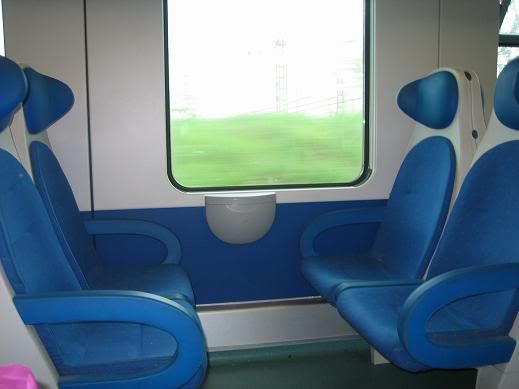
(from daniellecherney on photobucket)
Compartments


(from mararie on flickr)
What are your opinion in these different arrangements?
I’d point out this pros/cons:
Aligned seats
– Best overall arrangement for solo/couple travellers
– Allows for relative privacy
– Allows for trays to be installed
– Don’t have many luggage space under the seats
Facing seats
– Create embarassment when you have to ride with a strange in front of you for hours
– Maximize luggage space under the seats
– Better for families/groups
– When possible to compare, usually facing seats cars are more dirty and noisy.
Compartments
– Good for privacy if you are travelling with acquaintances and only with tehm
– Intimidating if you have to share the compartment with strangers
– Makes it easier for crimes/abuse to be commited onboard out of sight of conductors/fellow passengers
I myself would vow for majority of seats in any given train be arranged airplane-like, e.g., aligned (you face the back seat of the front row), some seats to be facing and a few compartments that can be booked only wholly (e.g., without putting strangers in the same compartment).
 ) Facebook and Zynga were among the winners at the Crunchies 2009 awards, held last evening in San Francisco’s Herbst Theater. The third annual award ceremony that is co-hosted by TechCrunch, VentureBeat & GigaOM, saw a mix of new and old technology companies share limelight in front of a sold out audience.
 Dropbox and Foursquare, two of my favorite applications won the Best Internet Application and Best Mobile Application awards respectively. Spotify was named the best International start-up. Animoto won the Best Design Award. Ron Conway of SV Angel was the Angel investor of the year. Mark Pinucs of Zynga was named CEO of the Year, while Aaron Patzer of Mint was named Founder of the year. Best overall start-up/product of the year was Facebook, which won the category third year in a row. (The complete winners’ list is here.
Photo by Scott Beale/Laughing Squid. More photos on my personal blog, OmIs.Me


Buy This Item: [Click here to buy this item]
Do you love any Nigerian book? Post reviews here. :cheers:


