Author: Serkadis

  • Preorders For The Gaming-Focused Razer Edge Tablet Start March 1st, Ships Later In The Month

    Razer_Edge_(1)_610x371

    Surface Pro fanboys, Take notice. Your hot little tablet will soon be the runner-up in the ever-growing category of “incredibly expensive Windows 8 tablets aimed at a tiny, but rabid demographic”.

    Razer just announced that the Edge and Edge Pro gaming tablet will ship in late March, with the startup accepting orders starting on March 1st.

    All joking aside, the Razer Edge is pretty damn exciting. Born from the minds of Razer’s fans, the Edge is a hardcore gaming tablet — no tired Fruit Ninja demo here. With a dedicated GPU and either a Core i5 or Core i7 CPU, the Edge can power through nearly any PC game on the market.

    What’s more, Razer designed modular accessories for the Edge. There’s a large gaming pad, keyboard, and dock, allowing the Edge to essentially morph into different products as needed.

    I spent sometime with the Edge at CES 2013 and was instantly impressed. It ran Dirt 3 seemingly as good as my monster desktop. But, also like my gaming PC, the Edge is expensive.

    The Core i5 Razer Edge costs $999 while the Core i7 Razer Edge Pro costs $1299. Plus, each one of the accessories are sold separately. Just the Gamepad Controller is $249. A fully decked-out Razer Edge Pro with Gamepad Controller rings up for $1,698. Ouch.

    The Microsoft Surface Pro has so far won over some Windows loyalists. They like the full computing power combined with the svelte form factor. The Surface Pro, with its Core i5 CPU, can power through most daily tasks and even handle some games, but, quite frankly, the husky Razer Edge is fully capable of beating it up and stealing its lunch money.


  • U.S. smartphone adoption is lowest in developed world, South Korea highest

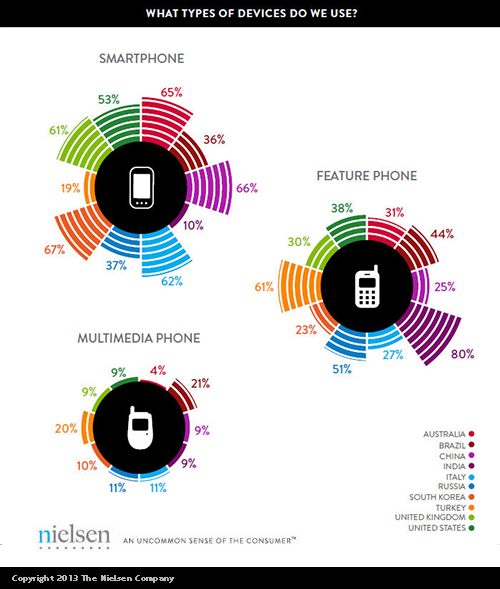
    Today at Mobile World Congress, Nielsen offered a snapshot of the global mobile consumer based on a report released this month. Some of the findings are quite startling. For example, mobile phone usage is highest in South Korea — get this, 99 percent among consumers older than 16. Same goes for smartphones (67 percent). By comparison, the United States has the lowest smartphone adoption among developed markets (53 percent). Now contrast that to China, where two-thirds of handset owners have smartphones, while in India 80 percent have feature phones. In Brazil, feature phones and multimedia handsets combined: 65 percent.

    Mobile phone usage is high in many countries, but infrastructure is not. For example, 98 percent of Russians have mobiles, as do 84 percent in Brazil and 81 percent in India. Problem, according to Nielsen: “The network infrastructure required for smartphones and next generation mobile devices has yet to appear outside of large, urban centers”. Lacking infrastructure explains some of this week’s MWC announcements, such as Firefox OS phones or new Nokia Lumias with fewer smartphone features for lower selling prices going to emerging markets first.

    Smartphone adoption largely, but not wholly, skews with age. According to Nielsen:

    Younger users are more likely to own a smartphone and older users are more likely to own a feature phone, which makes sense since feature phones are more established in the marketplace. Though there are some exceptions — in Italy consumers have higher smartphone ownership among users ages 35-64, whereas in India feature phones have far more penetration than smartphones across all age segments — the broader trend suggests that smartphone adoption will likely continue to rise as younger consumers age.

    In most countries, smartphone adoption is highest among 25-34 year olds:

    • South Korea: 86 percent
    • United Kingdom: 78 percent
    • United States: 73 percent
    • Italy: 72 percent

    Whereas in China and Australia, adoption is greater among 16-24 year olds — 82 percent and 77 percent, respectively — and equal to 25-34 year-olds in South Korea.

    Americans and South Koreans are most likely to have data plans — 96 percent and 89 percent, respectively — followed by Brits (86 percent), Australians (81 percent) and Chinese (77 percent).

    No surprise, text message usage is high in most countries — more than 90 percent in Australia, China, Russia, United Kingdom and United States. Instant messaging is big in South Korea (70 percent) and email in the United States (75 percent).

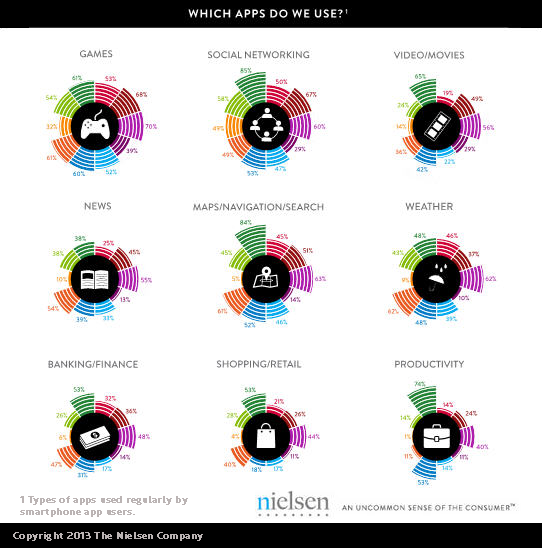
    Brazilians are the most avid social networkers (75 percent), followed by Turks (69 percent), Brits and Americans (both 63 percent). However, social and other activities look differently when taking app usage into account. That’s in part because of how smartphone, feature phone and multimedia phone adoption skews across geographies. Nielsen explains:

    Chinese and American smartphone owners are the heaviest app users overall, with games being the most used type of app in more than half of the selected countries (China, Australia, Italy and Brazil). Social networking app usage is strongest in the U.S., with 85 percent of American smartphone owners as regular users. Smartphone owners in India and Turkey are the least likely to regularly use all categories of apps, but the most popular tend to be more entertainment driven, like social networking and games.

    Data-consuming video is an increasingly popular mobile activity. Nielsen:

    Smartphones are a popular device for watching video, despite the smaller screen size. In most countries, mobile web is the most popular means of accessing mobile video, while smartphone owners in the U.K. and South Korea are more likely to watch mobile video using an app. In the U.S., smartphone owners are equally likely to watch video via mobile Internet and apps (72 percent), and Indian smartphone owners are the most likely to view downloaded video clips (57 percent).

    Video-watching frequency is interesting dynamic and somewhat rings where smartphone adoption and supporting infrastructure is greater. “Chinese smartphone owners are the heaviest users of mobile video, as 17 percent access more than three times a day”, according to Nielsen. American smartphone users lead “all countries in daily mobile video usage (31 percent use at least once per day)”.

    Photo Credit: D. Hammonds/Shutterstock

  • NMA Takes On Honey Boo Boo With Cocaine And Jabba The Hutt

    Honey Boo Boo (the show) is headed to Europe, so naturally, NMA has a video about the news. If your’e a fan of the Taiwanese animation firm’s work, this is pretty much classic NMA material. They’ve turned Honey Boo Boo’s mom into Jabba the Hutt (a cat-butchering version), and Honey Boo Boo herself concocts some kind of Mt. Dew/Red Bull/Cocaine cocktail.

    So yes, typical NMA.

    More of NMA’s work here.

  • BTI Systems Launches SDN-Enabled Platform

    Canadian networking software and systems company BTI Systems announced Intelligent Cloud Connect, an open software-rich platform that combines network intelligence and application awareness with significantly expanded capacity and scale. It is an inter-data center networking solution developed specifically to meet the stringent performance, scale, economics and agility demands of the cloud.

    Intelligent Cloud Connect combines the intelligence and flexibility of routing with the capacity and scale of optical bolstered by the efficiencies and extensibility of applications integration. It is a SDN-enabled integrated platform that allows content and service providers to rapidly scale new services, while reducing operational complexities and cost. It will replace the need to continue to purchase separate optical transport devices, switches, router ports, and network application appliances to handle and manage inter-data center traffic growth, with more control and flexibility to optimize services.

    “Legacy WAN solutions are not designed to optimize the dramatic gains achieved in today’s highly virtualized data centers,” said BTI Systems President and CEO Steve Waszak. “Intelligent Cloud Connect enables providers to create highly programmable network fabrics for improved applications performance, operational efficiencies as well as service innovation demands. Customers can literally ‘cap and grow,’ retaining existing equipment investments, while decreasing additional cost outlays and efficiently supporting bandwidth and capacity demands. Large content providers are validating that we have effectively addressed their requirements while reducing significant operational headaches and costs.”

    The new solution features a software-rich platform with open APIs, and that integrates a converged fabric with integrated high-performance applications modules and 10G/100G forwarding modules. Open APIs enable content and service providers to integrate rich, high-performance network optimization applications developed by BTI and by third parties. Intelligent Cloud Connect benefits include large scale capacity with low-latency, SDN-enabled management and control, and increased differentiation, control and applications performance.

    “Data centers are becoming major confluence points for high rates of traffic growth: interconnecting data centers, and connecting data centers to access networks or peering points,” said Ovum Vice President and Practice Leader Dana Cooperson. “As data centers are becoming much more critical in support of public and private cloud services, they are becoming both larger and more widely distributed, adding pressure on the connecting networks to scale, deliver higher-performance and differentiated services, and improve economics. BTI’s Intelligent Cloud Connect, with its focus on high-availability, high-capacity, open, application-aware, and even applications-based networking, supports these goals.”

    $10 Million Funding

    Building on unparalleled global demand from content and service providers BTI Systems announced $10 million in new growth capital. The Series C funding was led by Bain Capital Ventures and adds to the more than $33 million total that BTI Systems has raised since 2011. The funding will be used to scale BTI’s operations and accelerate the delivery of Intelligent Cloud Connect.

    “BTI Systems continues to enjoy tremendous growth based on our ability to understand our customers’ networking challenges and opportunities – paired with our ability to consistently deliver solutions that greatly improve the way they run their networks and business models,” said BTI Systems President and CEO Steve Waszak. “We’re excited to be expanding our relationship with our investors and we’re using those funds to bring new and even more powerful innovations to content and service providers worldwide.”

  • EMC Supercharges Hadoop

    At the RSA conference this week in San Francisco, EMC announced Pivotal HD, a new distribution of Apache Hadoop. Pivotal HD features native integration of EMC’s Greenplum massively parallel processing (MPP) database with Apache Hadoop.

    The new EMC Greenplum-developed HAWQ technology brings ten years of large scale data management research and development to Hadoop and delivers more than 100X performance improvements when compared to existing SQL-like services on top of Hadoop. What makes Pivotal HD different is its ability to offer the full spectrum of the SQL interface and run reports without moving data between systems or using connectors that require users to store the data twice. It removes the complexity of using Hadoop, thus expanding the platform’s potential and productivity, and allowing customers to enjoy the benefits of the most cost-effective and flexible data processing platform ever developed.

    Sam Grocott, vice president of marketing and product management, EMC Isilon, noted, “The introduction of Pivotal HD, combined with EMC Isilon’s native integration of the Hadoop Distributed File System (HDFS) protocol, continues the evolution of the industry’s first and only enterprise-proven Hadoop solution on a scale-out NAS architecture. This powerful combination succeeds in reducing the complexities traditionally associated with Hadoop deployments and allows enterprises to easily extract business value from unstructured data.”

    Using the Greenplum MPP analytical database, Pivotal HD is a true SQL parallel database on top of the Hadoop Distributed File System (HDFS).  HAWQ adds the capabilities of note include Dynamic Pipelining, a world-class query optimizer, horizontal scaling, SQL compliant, interactive query, deep analytics, and support for common Hadoop formats. HAWQ unlocks the potential of Hadoop’s fault-tolerant storage capabilities by bringing to bear the vast pool of “data worker” tools and languages into the Hadoop ecosystems.

    “With Pivotal HD, we can check off many of the items on our Hadoop wish-list—things like plug-in support for the ecosystem of tools, improved data management and greater elasticity in terms of the storage and compute layer,” Steven Hirsch, chief data officer, SVP Global Data Services, NYSE Euronext. ”But above all, it provides true SQL query interfaces for data workers and tools—not a superficial implementation of the kind that’s so common today, but a native implementation that delivers the capability of real and true SQL processing and optimization. Having a single Hadoop infrastructure for Big Data investigation and analysis changes everything. Now add to all of this functionality the fact that the SQL performance is up to 100x faster than other offerings and you have an environment that we at NYSE Euronext are extremely excited about.”


  • Meet Buddy, Another Ambitious, Crowdfunded Smart Watch

    20130208065347-05

    Haven’t we all suffered enough abuse at the hands of Big Smart Watch? No? Well now there’s Buddy, a Bluetooth smartwatch that aims to solve the problems associated with all those other watches. Buddy is focused on social networking and notifications so it will ping you when your Facebook or Twitter feed is updated as well as send the standard call/text/calendar notifications you expect from a smart watch.

    The ambitious watch is the product of Vea Digital, a smartwatch company best known for their Sportive work-out watch. The company’s new project, however, is wildly ambitious. It has a capacitive color touchscreen, works with iOS and Android, and contains 8GB of memory in a package 8mm thick. It’s a huge watch, to be sure, and the renders/prototype models show a unique and colorful icon-based UI that might work better than the cramped black and white design of other devices.

    What can it do?

    Show notifications displayed on your smartphone.
    Allow you to control your smartphone (initiate calls, control music…)
    Receive and display data from your smartphone (turn by turn navigation…)
    Display smartphone content (pictures…)Your smartphone and the VEA BUDDY connect with Bluetooth…

    The makers claim a battery life of “10 days or 2 weeks standby” which sounds like crazy talk. They’re asking for $320,000 to build the first run and have raised $42,000 so far. A black watch can be had for a pledge of $150 and they will be delivered in August 2013.

    I’ll believe it when I see it, but if you’re looking to get in on the ground floor of an acceptably cool-looking smart watch, Buddy might be the way to go.

  • Mobile World Congress News from the Hot Mobile Market

    Mobile World Congress kicked off Monday in Barcelona with a number of announcements from the red-hot mobile market. Here is conference news from Intel, IBM and Nokia, and Mellanox and 6WIND. The Twitter conversation for the event can be followed on hashtag #MWC13.

    Intel launches mobile solutions.

    Intel (INTC) announced several new products for the mobile market segments: a new dual-core Atom SoC platform for smartphones and Android tablets. “Today’s announcements build on Intel’s growing device portfolio across a range of mobile market segments,” said Hermann Eul, Intel vice president and co-general manager of the Mobile and Communications Group. “In less than a year’s time, we have worked closely with our customers to bring Intel-based smartphones to market in more than 20 countries around the world, and have also delivered an industry-leading low-power Atom SoC tablet solution running Windows 8, and shipping with leading OEM customers today.”

    Intel announced a new Atom processor platform with 32nm dual core Z2580, Z2560 and Z2520 products, available in speeds up to 2.0GHz, 1.6GHz and 1.2GHz respectively. The platform also features support for Intel Hyper-Threading, and an Intel Graphics Media Accelerator engine. It includes advanced imaging capabilities, including support for two cameras, with a primary camera sensor up to 16 megapixels. The platform is also equipped with Intel Identity Protection Technology (Intel IPT), helping to enable strong, two-factor authentication for protecting cloud services such as remote banking, e-commerce, online gaming and social networking from unauthorized access.

    “Our second-generation product delivers double the compute performance and up to three times the graphics capabilities, all while maintaining competitive low power,” Eul said. “As we transition to 22nm Atom SoCs later this year, we will take full advantage of the broad spectrum of capabilities enabled by our design, architecture, 22nm tri-gate transistor technology, and leading-edge manufacturing to further accelerate our position.”

    An Intel Atom Z2420 was announced for smartphones in emerging markets, and an Atom Z2760, the first quad-core Atom SoC (“Bay Trail”).  Intel also launched a Long-Term Evolution (4G LTE) strategy, for a low-power, global modem solution that works across multiple bands, modes, regions and devices. The Intel XMM 7160 is a solution that supports smartphones, tablets and Ultrabooks, with support for 15 LTE bands simultaneously.

    IBM and Nokia Siemens announce Edge Computing Platform.

    Nokia Siemens Networks and IBM announced a collaboration to deliver a mobile edge computing platform that can run applications directly within a mobile base station. This new platform allows mobile operators to create a truly unique mobile experience, relieve the ever increasing strain on network infrastructure and bring completely new solutions to market. Nokia’s Liquid Applications and IBM’s WebSphere Application Service Platform for Networks (ASPN) together provide an environment for operators to manage the many applications that will be deployed to the mobile edge.

    “Pushing applications, processing and storage to the edge of the mobile network allows large complex problems to be distributed into many smaller and more manageable pieces and to be physically located at the source of the information it needs to work on,” said Phil Buckellew, vice president, IBM Mobile Enterprise. “This enables a huge amount of rich data to be processed in real time that would be prohibitively complex and costly to deliver on a traditional centralized cloud.”

    Mellanox and 6WIND partner to help deployments of virtual and non-virtual networks.

    Mellanox (MLNX) and 6WIND, a solution for data plane processing in software defined networks, announced a performance-optimized solution featuring the Mellanox ConnectX-3 Network Interface Controller (NIC) together with the 6WINDGate networking software.  As a solution for Telecom Equipment Manufacturers (TEMs)it is combined with a Mellanox SwitchX 40GbE switch to aid deployments of virtualized and non-virtualized networks and SDN on standard high-volume servers.

    “Because it solves critical network performance challenges for mobile infrastructure, 6WIND’s software has been selected by multiple TEMs who provide equipment deployed in commercial LTE networks worldwide,” said Eric Carmès, CEO of 6WIND. “The addition of Mellanox ConnectX-3 support within 6WIND’s enhanced Intel DPDK library as well as the 6WINDGate software, incorporating features such as SR-IOV and RDMA over Converged Ethernet (RoCE), enables improved CAPEX and OPEX in service provider networks through the virtualization of network functions and more efficient SDN management.”


  • Twitter Offers Glimpse At Firefox OS App

    Twitter is already talking up its Firefox OS app.

    Mozilla announced at Mobile World Congress this week that its new operating system Firefox OS will make its way to a number of mobile operators around the world. More on that here.

    Twitter says that its app for Firefox OS will be similar to its other mobile apps with a “rich interface, featuring the Home, Connect, Discover and Me tabs, as well as the search and compose Tweet icons, so you can easily find and send Tweets from anywhere in the app.

    Yep. It looks pretty much like the other Twitter apps:

    Twitter for Firefox OS

    But it does have at least one difference.

    “We’ve also implemented support for a feature unique to Firefox OS: Web Activities. This lets you tweet photos directly out of any app that also supports web activities such as the built-in photos app.”

  • No Google Antitrust Decision Until After Summer Break [Report]

    It’s looking like this Google antitrust thing won’t be resolved anytime soon in Europe. Reuters is reporting that EU antitrust chief Joaquin Almunia said that the European Commission can reach an agreement after the summer break.

    “We can envisage this as a possible deadline,” he’s quoted as saying. As Reuters notes, the Commission is closed for summer break throughout most of August, so it sounds like we won’t be seeing any resolution before then.

    Several weeks ago, Almunia said Google had submitted its settlement proposal. The details of this have not been made public. At the time, Bloomberg reported:

    Google sent a “detailed proposal,” said Antoine Colombani, a spokesman for Almunia. He said he couldn’t anticipate if the offer was sufficient to allay antitrust concerns or whether it would be sent to rivals and customers for comments. If this market test is successful, the EU can make the commitments legally binding. Such a settlement would avoid possible fines against the Mountain View, California-based company.

    Google, of course, settled its antitrust issues in the U.S., ending a lengthy probe by the FTC, which found that Google’s search business was not anticompetitive. Google did make a couple voluntary concessions.

  • Google Makes Apps For Nonprofits Free To All

    Google announced that Google Apps for Nonprofits is now free for all nonprofits. Before, the free version was only available for nonprofits with less than 3,000 users.

    “Now, whether your nonprofit is 10 people or 10,000, you are eligible to start using Gmail, Calendar, Drive and more,” says Katie Kellogg with the Google for Nonprofits team.

    “Google Apps for Nonprofits allows your organization to reduce IT costs and helps your team collaborate more effectively,” says Kellogg. “The suite of tools uses cloud computing to securely store and update documents, calendars and email in real-time – meaning you can access data anywhere, anytime. Google manages all of the updating and maintenance in the cloud, so you’ll never be required to install hardware or update software. And if you need help, we have a 24/7 support team available.”

    New users can join the Google for Nonprofits program here. Google will then send instructions on how to enroll. There’s also a guide here.

    In other Google/nonprofit-related news, Google.org is donating millions of dollars for increased access to the Internet in emerging markets.

  • Google Subscription Music Service Coming In Third Quarter [Report]

    Rumors persisted throughout this past weekend that Google is working on a subscription music service that would take on Spotify, Pandora and the like.

    Bloomberg has since put out a report, citing two people with knowledge of the situation, that Google does indeed plan to do so, that negotiations are under way with major record labels, that the service will work with both Android and non-Android devices, and that the “worldwide service” is targeted for the third quarter. The report also says Google is discussing the renewal of deals for the use of songs in consumer-made YouTube videos.

    Obviously Google doesn’t comment on “rumor and speculation”.

    Such a service from Google would complement Google Play Music and YouTube quite nicely, basically eliminating the need for users to use Spotify or Pandora, provided that they prefer the Google experience. Of course, that will not necessarily be the case. People seem to be liking these services just fine, and Spotify’s heavy integration with Facebook seems to be a hit on the social level. Google still can’t really compete there (unless of course, they do tap into Facebook’s Open Graph).

    Either way, such an offering will give people more reason to turn to Google for their music needs, and it will be interesting to see how the competition shakes out. Those deals with labels will obviously be of vital importance.

    Meanwhile, it has been said that Spotify will try to negotiate with labels to make its free streaming service available on mobile devices, which would make the service all the more attractive of an option for users who aren’t willing to pay.

    Google’s Google Music offering recently got music matching capabilities.

  • Video: Jay Adelson on the Early Days of Equinix

    “It was a crazy time.” That comment sums up the experience of Jay Adelson, co-founder of Equinix, describing the effort to build the first major colocation provider. Adelson, known to many for his role in creating the news portal Digg, founded Equinix in 1998 with the late Al Avery. Adelson and Avery had worked at Digital Equipment Corp., and saw the need for carrier-neutral facilities where companies could interconnect their networks. The attractiveness of that business model, along with its early-mover advantage, made Equinix a key player in the data center sector. In this video from the Equinix Interconnections blog, Adelson discusses the company’s history and progress. “Equinix is the most powerful Internet infrastructure company in the world,” said Adelson. “It’s a powerful position. But you can use that position of power to make a diffference, and to enable the Internet in places it’s never been before.” Adelson also cited the power of culture at Equinix, and the connections that resulted. ”At the time I left, there had been 17 marriages of people who met at Equinix,” he says. This video runs

    For additional background on the history of Equinix, see the Vision & History area of the company web site.

    For more news about Equinix, please see our Equinix Channel. For additional video, check out our DCK video archive and the Data Center Videos channel on YouTube.

  • With The Open, ZTE Aims To Get The Young And Adventurous Fired Up For Firefox OS

    zte-open2

    ZTE’s press conference yesterday didn’t really reveal anything we didn’t already know, but it at least gave us the opportunity to play with the Chinese OEM’s first Firefox OS-powered smartphone. The cost-conscious Open is apparently meant for “young people who are adventurers and want to try something new” (according to He Shiyou, head of ZTE’s Mobile Devices Division anyway), but how is it?

    The Open’s 3.5-inch display is something of a mixed blessing here — it responds nicely to swipes and touch inputs, but its small size means that actions that require precision (say, banging out a text message) can be problematic if you have anything but the daintiest fingers. Color reproduction isn’t great and viewing angles are actually quite bad, but that’s to be expected out of such a price-conscious device.

    On the plus side, the Open is actually rather pretty, in a pared-down minimalist sort of way. It’s a very round little thing, and the models on display here were swathed in a nice orange or blue soft-touch plastic (a not-so-subtle nod to Firefox’s emblem, methinks). A 3.2 megapixel fixed-focus camera rides high on the Open’s back, and image quality seemed to skew towards the underwhelming end of the quality spectrum.

    To be quite frank, there really isn’t much to say about the hardware — like HP’s new Slate 7, it’s cheap and it works. But honestly, what else could you expect from a phone like this? If the images alone didn’t make it clear enough, the Open is a device meant to bust into emerging markets — it’s going launch first in Europe and Latin America starting this summer thanks to some help from wireless carrier Telefonica. There’s still no official word on price, but Mozilla engineering program manager Michael Treese told me that the bill of materials for ZTE’s Open comes out to “less than $100″ so I wouldn’t worry about going broke after buying one.

    Click to view slideshow.

    And of course, there’s Firefox OS. I’ll preface this next little bit by mentioning that the build I played with isn’t final just yet — it hasn’t undergone the final cleaning that comes with carrier testing. Things start off charmingly enough with a cute Firefox boot screen, and it isn’t long at all before users wind up on a lockscreen that’s easily dispatched with a single tap.

    We’ve seen Firefox OS in action a few times over the past few months so the interface looks very familiar — a quick swipe on the homescreen brings up a slew of HTML5 apps, while a persistent set of icons for the phone dialer, messaging app, Firefox browser, and the camera. Poking around seemed fluid enough save for the occasional hiccup (which honestly may be more hardware than Firefox OS), and apps fired up without too much delay.

    Speaking of apps, FFOS users have a decent little section of them to choose from at this stage — there are optimized versions of Facebook and Twitter, as well as HTML5 apps for Pulse, AirBnB, Soundcloud, and more. Firefox Marketplace plays home to “thousands” of apps, though Mozilla is quick to note that it’s but only one place for users to find content for their devices. Since the phone is meant for folks in emerging economies, Mozilla also baked in a service that provides real-time network and data traffic monitoring to help those people better manage their usage (and, by extension, their money).

    All things considered, Firefox OS definitely has some potential. Does it still need some polish? A bit, yes. Does it have what it takes to give platforms like Android a run for its money in terms of functionality? In its current state, no, and that’s something Mozilla is quite candid about.

    “We know there’s a certain parity gap,” Treese said of Firefox OS’ feature set. “We’re looking to close it within about a year.” Having ZTE — a pro at cobbling together inexpensive phones — is a smart move considering the markets Mozilla is trying to impact. With any luck, final review units will be available sooner rather than later, but this little guy could make a big splash if priced and marketed correctly.

  • The $169 Android HP Slate 7 Is Just HP’s Latest Beige Box, Only Flat

    slate7-1

    HP is late to the tablet game, but definitely not out. At $169, the HP Slate 7 is a sure thing. It’s a guaranteed win for HP even if it doesn’t outsell the competition.

    HP just announced the Slate 7. There is nothing particularly special about it. It costs $169, has a dual-core 1.6GHz SoC, and a 16×9 display with a rather thick plastic bezel. In short, it’s a cheap tablet. Remove the HP logo on the backside and it’s just a random, generic tablet. And that’s fine.

    At this point, HP as an established and trusted brand, doesn’t have to innovate; they just have to show up.

    Despite its recent troubles, HP is still the largest personal computer maker on the planet. The company has held this title since 2006 after trailing Dell for four years. Lenovo might soon steal the title from HP, but that doesn’t diminish HP’s still-valuable brand. For most consumers, HP has, and will continue to be, a safe buy.

    It’s not really hyperbole to say everyone has had problems with an HP computer. As the top-selling computer maker collectively over the last 15 years, it has had a long time to disenchant consumers. Everyone has an HP horror story. But despite this, the brand still sells more PCs than any other. A lot of people are still buying HP computers.

    Who is Asus to the average Walmart shopper?

    As a known brand, consumers are aware what they’re going to get with an HP product. They know they’re going to get adware, sub-par hardware, but a fair price. What will they get with an Asus tablet? Who is Asus to the average Walmart shopper? An unknown.

    We all know the story. After years of little executive leadership, HP is floundering in the consumer market. PC sales are down. HP doesn’t have a mobile product. People are buying fewer printers. And, like Aol with dial-up subscriptions, a laughable chunk of HP’s revenue comes from printer ink.

    Worse yet, HP’s enterprise hardware and services business is down, too. Still, even with these declines, HP managed to beat Wall Street’s expectations last quarter.

    In short, the HP machine is slowing down, but even a slowed HP is a serious contender.

    HP is ubiquitous. HP computers are sold everywhere from Walmart to Best Buy to every office supply store known to man. HP became the largest computer maker not because they made the best computers, but because of logistics.

    Thanks to this vast distribution network, HP can get a $169 Android tablet in front of a lot of eyes with little effort. Then, once this tablet makes inroads, HP will likely follow its proven laptop strategy and release an upgraded model with a better screen, better specs and a slightly higher price tag. This model, or perhaps family of models, would provide an easy up-sell from the Slate 7. Want a better screen? Spend an extra $30 and get a faster processor, too.

    The HP Slate 7 is HP playing to its strengths. This is HP moving units, not creating the next big thing.

    Tablets are quickly becoming a commodity and selling beige boxes is what HP does best. At this point a budget tablet is a budget tablet. Our own Chris Velazco played with HP’s model for a few minutes and found it underwhelming. Well, yeah. It’s a $169 tablet. It’s not going to impress, but it doesn’t have to.

    HP sat on the sidelines and watched Amazon and Google’s expensive race to the bottom, which created this market of cheap tablets. HP has never been a premium product; it knows how to sell boatloads of boring machines loaded with sponsored software to keep the cost down. HP’s first attempt at a consumer tablet failed simply because it attempted to be something special. It wasn’t a beige box. The HP Slate 7 shouldn’t fail.

  • Sony ships waterproof Xperia Tablet Z

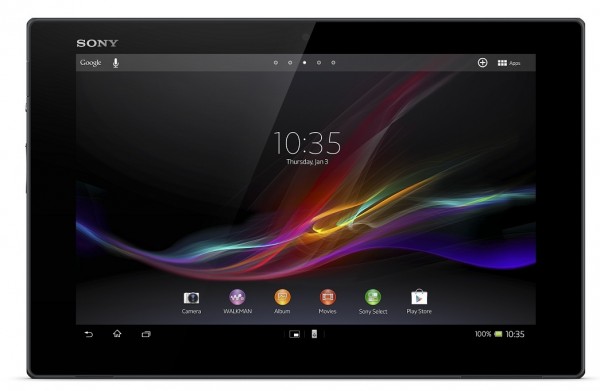
    Well, somebody finally announces something that’s actually shipping. One of Mobile World Congress’ worst traditions is the unveiling of new products not available for months. Today, Sony stepped out from the ranks with the ultrathin, waterproof, Xperia Tablet Z, which goes on sale March 1. That’s right, this week! Damn, if only my local Sony store wasn’t closed for renovations (until April).

    The 10.1-inch tablet stands apart from many of this week’s MWC 2013 announcements. Many of the new devices are down-market, offering lower-performance for less money, targeting economy shoppers in mature or emerging locales. By contrast, Xperia Tablet Z packs premium features at premium price.

    For starters, the display is high resolution — 1920 x 1200 — putting Sony’s slate in a small minority that includes Apple iPad, ASUS Pads and Google Nexus for being true HD or better.

    But the big sell is waterproofing, which I had hoped would be a big trend at this year’s Mobile World Congress. Xperia Tablet Z is dust and water resistant with Ingress Protection Rating of IP55 and IP57. The one number means seal against water sprays and the other submersion up to 1 meter. Whoa, for 30 minutes.

    So the next time you’re reading on the John and drop your tablet in the can — or perhaps the backyard Jacuzzi — you’ve got water protection. But don’t break the screen in the process!

    Sony claims that at 6.9 mm, Xperia Tablet Z is thinnest on the market. For comparison, Apple iPad mini is 7.2 mm, Google Galaxy Nexus 10 is 8.9 mm and iPad 4 is 9.4 mm. Sony’s slate is light too, just 495 grams, compared to 652 grams for iPad 4 and 603 grams for Nexus 10.

    Other features include 1.5GHz quad-core Qualcomm Snapdragon S4 Pro processor; 2GB RAM; 16GB or 32GB of storage; 8-megapixel rear-facing camera and 2MP front shooter; and twin, front-facing speakers. While the device ships with Android 4.1, Sony says buyers will be prompted to upgrade to 4.2.

    The electronics giant also pushes connectivity with this model, an attribute appealing to people living the Sony lifestyle by perhaps owning PS3, Bravia TV, wireless speakers or other devices. Consumers connect using “one-touch NFC” for moving content around various devices.

    “Xperia Tablet Z sets new standards in entertainment by matching premium specifications and Sony technology with cross-device connectivity and a consistent user-experience”, Kaz Tajima, Sony Mobile Communications corporate vice president, says. “Xperia Tablet Z reinforces our intention to be a leading player in the premium Android device market”.

    As previously mentioned, Sony’s slate goes on sale March 1 for $499 (16GB) or $599 (32GB) in black. However, Sony stores — brick and mortar and online — will exclusively carry the 32GB Tablet Z in white, too. Pricing matches iPad but is more than Nexus 10, which is $399 and $499 in same capacities with higher-screen resolution but doesn’t offer seamless integration with Sony products or cloud services.

  • Could Mobile World Congress 2013 be any more boring?

    I’m not loving this year’s big phone trade show. The news coming out of Barcelona is about as doldrums as the Spanish economy. Generally, the big stuff drops Day 0 and Day 1 at Mobile World Congress. They’re done, and so far the product announcements are generally less than last year. The phone launch seemingly everyone waits for, Samsung Galaxy IV, comes in March. That’s big commentary on what’s missing from MWC 2013.

    So far, I would call most new gear as the race to the bottom — same concepts as the last couple of years, only offering less, selling for less and marketed to less-developed smartphone or tablet markets.

    That surely describes Mozilla and Nokia, with new Firefox OS handsets and Lumias; low-brow smartphones reach down-market and doing so cede the greater world to leaders Apple and Samsung. There’s HP’s first Android tablet, Slate 7, which is light on price ($169) and features, or ASUS Fonepad and PadFone Infinity Android tablets, which similarly seek buyers looking to spend less. Are the smartphone and tablet markets already so mature, or so commoditized, that less for less is this year’s innovation?

    Frankly, I expected more, and perhaps there’s still hope with the event running through Thursday. But I’m not exactly hopeful given how much typically drops by end of the first day. Or maybe I missed the “next big thing”.

    Speaking of that phrase, which Samsung uses in mobile marketing, the company’s series of Galaxy S III and Note II commercials televised during last night’s Oscars — featuring a fictitious company developing a unicorn game — were way more interesting than anything coming out of MWC. (You simply must watch the 90-second spot featuring filmmaker Tim Burton looking to make zombie unicorn movie “Horn of Darkness” based on the game.)

    Samsung’s Galaxy Note 8.0 is one of the few really interesting new products unveiled at MWC 2013 — and even that is more about the same stylus concept used on Note smartphone and larger, 10.1-inch tablet. ZTE surprised somewhat, with Grand Memo — a Galaxy Note II competitor running the Snapdragon 800 processor.

    Where’s the dramatic new innovation? The next-generation OMG thing? LG outed the Optimus F5 and F7 smartphones last week. Even some of the more modest new mobiles came early — powerhouses, too. HTC unveiled flagship phone One, just six days ago.

    Honestly, some of the best mobile future-tech comes outside Mobile World Congress. Look at last week’s buzz about Google Glass and the company’s contest that could snag you one. On February 19, Canonical unveiled Ubuntu tablet, and released phone and slate software to developers two days later. Perhaps tomorrow’s Mozilla CEO MWC 2013 keynote will wow as much as Ubuntu’s efforts. Fingers crossed.

    My heart just isn’t thumping looking over Day 0 and Day 1 announcements. That’s good for Sony, which today launched one of the few remotely interesting products — one that stands out on the sea of sameness. The Xperia Tablet Z is uptown, with super-slim design, high-resolution 1920 x 1200 display and waterproofing. Now that is innovation, and I expected to see more waterproof mobiles at the event than actually have appeared. But at a show with so much less, why should anyone expect more?

    Photo Credit: Mozilla

  • Etsy Launches New Kinds Of Coupon Codes

    Etsy announced today that it is launching some new kinds of coupon codes.

    Merchants will now be able to offer fixed discounts on items and set price minimums for coupons. You could offer, for example, $10 off when the customer spends $50.

    Etsy is also testing Thank You emails as a way to introduce shoppers to the deals.

    “Buyers can opt in to receive an email with a promotion when shops they’ve purchased from have an active Thank You coupon,” the company explains in a blog post. “Bought a necklace as a birthday gift and got rave reviews? Maybe that shop is offering a discount and you can pick up the matching earrings for under the tree!”

    Etsy has offered Coupon codes since 2010, and about 3,000 of them are used every day, according to the company.

    Etsy has instructions for offering and promoting coupon codes here.

  • Secret Door Is An Interesting Google Street View Tour Guide

    Co.Exist put the spotlight on a new tool for browsing Google Street View imagery today. It’s called The Secret Door, and simply takes you to random spots around the world (inside and out) using Street View. Just click “Take me somewhere else,” and move on. Simple, but incredibly addictive. It makes you appreciate the scope of imagery Google actually has (and they’re far from done). If nothing else, it serves as a way to see a lot of interesting indoor photography. Here are a few of the first places the app took me.

    Secret Door

    Secret Door

    Secret Door

    Secret Door

    Secret Door

    Secret Door

    Secret Door

  • Live video talk: The power of storytelling for early stage energy tech

    Creating compelling narratives and telling solid stories can be a game-changer for early stage energy technologies — for developing products, for pitching investors, and for gaining customers and partners. At the fourth annual ARPA-E Summit on Monday around 4:30PM EST (1:30PM PST) we’ll be live streaming a discussion between Otherlab’s Saul Griffith, IDEO’s Dave Blakely, and myself, about the power of narratives for energy tech.

    Don’t miss this! It’s one of the only live, free online events for the show. ARPA-E is a program created by the Department of Energy to give small grants to early-stage, high-risk energy technologies that can be game-changers. Here’s to moonshots! They need some powerful stories. Watch to find out why. (If we’re running a few minutes late, be patient, we’ll start soon).


    Related research and analysis from GigaOM Pro:
    Subscriber content. Sign up for a free trial.

  • Google Finance Gets 3 New Stock Exchanges, VIX Index

    Google announced today that it has added three new stock exchanges to Google Finance, which will make some followers of international markets happy. Google has added Singapore, Korea and Israel stock exchanges, as well as the Chicago Board of Exchange index values (VIX).

    Google Finance

    “Even better, Singapore Exchange stock market data is available in real time,” says product manager Karolina Netolicka. “This is the first time Singapore Exchange has provided real time data to an open website, and we’re proud to be the first website to do so.”

    You can find the full list of exchanges, mutual funds and indexes that Google Finance includes here.