 |
Choosing better foods to eat is only half the battle when you’re goal is to improve your overall wellness. The road to a better diet is also paved with better preparation methods, not just better foods. ”While most people know to ditch the fryer when cooking up healthy… |
Author: Serkadis
-
How to use the healthiest cooking methods to improve your wellness
-
PlayStation 4 comes to stores this year
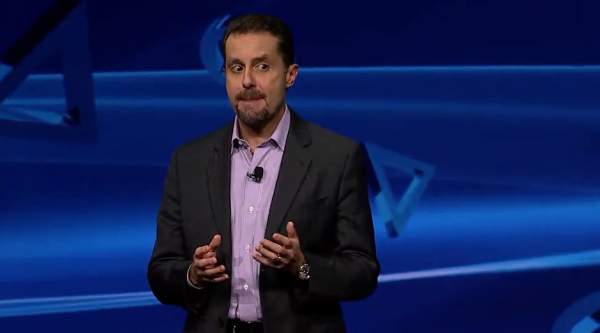
This evening, Sony captured geekdom for two hours, during a live event announcing PlayStation 4. If you’re not prostrate on the floor crying like a baby, desperate to get the console now, you must have missed the stream — or perhaps you’re holding out for E3 in a few months and the promise of Xbox 720.
PS4 will go on sale this year — that’s right, holiday 2013. So Microsoft better get its shtick together and have Xbox in stores, too. Consumers will make some hard choices this year about gaming platforms. Whichever, or both, console gaming is going to be a whole lot more exciting come Black Friday.
Sony didn’t exactly break out the specs, but expect PC in a console, so to speak — x86 processor, PC graphics chip and 8GB of GDDR5 RAM. (Excuse me while I wipe the drool, and from so little information.) The platform splits up tasks such that downloads are handled separately from gameplay. Benefit: Begin playing while a game downloads, something movie watchers get from many streaming services. Now Games, too.
Recognizing how much tablets, and even smartphones, are used as second screens on the couch, Sony plans to support them — and also PlayStation Vita — for gameplay.
PS4 comes with the new Dual Shock 4 controller, which features a touchpad and share button, which got big attention tonight. Sony is suddenly serious about social gaming and wants everyone to know it. Gamers will be able to share screenshots and video clips, which includes making personal game trailers and sharing with friends. Facebook and USTREAM are among the supported social services.
Friends also can join live-streamed games and even take control of them. That’s a great cloud benefit and good for driving game sales. What better recommendation than playing with someone you know before buying.
Rumors dogged Microsoft early this month about locked-down games. Don’t expect much better from Sony, which owning a movie studio has a long tradition of tight rights management. I see the streaming in this vein, presuming based on what little Sony shared today that the approach will make sharing (other than authorized Sony streaming) or reselling games nearly impossible. The concept of tying digital content to a single account isn’t new, but this feels pretty locked down to me, while granted, providing clear user benefits.
Like PS3 at launch, the new console is not backward-compatible with existing games. As a user, I take that as a “screw you approach” — Sony wanting to sell more stuff and help early-supporting game developers to do likewise. Game streaming is given as reason, and Sony suggests PS1, PS2 and PS3 streaming might come in the future. Oh yeah? For the games I already own?
PlayStation 3 launched in 2006, about a year after Xbox 360. Microsoft has had more success by the numbers, lifted in part by services, such as Xbox Live. That has long baffled me, seeing as Sony is a media company, too, with rich entertainment assets. Then again, Sony divisions are known for not always working well together. PlayStation 4, while primarily a game console, will be much more an entertainment platform than its predecessor. Microsoft will similarly reposition Xbox, as I explained last week.
-
Disruption: It moves in mysterious ways
A friend and a long time reader emailed earlier this morning, offering his observation regarding Google Glass. His prognosis – it was a hands-free camera. Laughs aside, it is an easy deduction to make from the new video shared by the Google Glass team. Sure, the video focused on ballerinas, balloon rides and bubbles, but Google was trying to get maximum oohs-and-aahs from as wide a set of people as possible.
That said, I have been intrigued by Google glasses from the very beginning, mostly because despite being nerdy and in a very early stage, it represents a bit of the old Google. As I previously wrote: “It represents the kind of things the company needs to do in order to leap over its rivals.”
So, if you focus on just the video, I guess, the shrug of shoulder is an appropriate response. However, when I watched that video, I saw three things that were possible.
- A new way to interact with information Google indexes: Google’s original premise was to make sense of all the messy data on the web. The mess has become bigger and finding information has become more difficult. We have to start looking at information we need in context of where we are, who we are and to what purpose we need that information. While it is easy to provide the “where” and “who” information, nothing adds “purpose” than what the eye is seeing. So, from that perspective, this is the right evolution of Google’s basic utility.
- A decent working voice-based user interface: Siri is cute. Siri is helpful … sometimes. But Siri is still not the answer. However, the Google Glass UI seems to have found the answer to the age old voice-based UI question. And with increased usage, the UI will get smarter and better. (Well, that is what I hope.)
- And lastly, it gives us the ability to add more contextual information to the real world around us: With Google glasses, everything becomes searchable. I think this is the most underrated part of Google Glass. So far, we have restricted “information lookup” to the computers.
That said, this is just a video. And as a cynic I am going to withhold final judgement on the glasses and what changes they might unleash, until the time I can get my hands on the actual devices. That said, the video released today definitely makes me even more keen on trying them on.
Google is working to get developers to sign-up and develop apps for this new class of anywhere, anytime computers. And we don’t know just yet, what the creative minds might do and what impact their efforts might have on how we live, create and consume.
iPad, the slate for disruption
 Three years ago, when everyone saw a bigger iPhone, I first saw the iPad and my initial response was that it was a slate “to reinvent pretty much how we think of media, information and in fact the whole user experience.” I saw a blank slate that was ready for lack of better words: creation and disruption. It is just that no one knew how it would disrupt and who it would disrupt. I was reminded of that today when I saw this news release from Jack Dorsey’s Square, a San Francisco-based payments company.
Business in a Box: all the hardware you need to run Square Register on your counter: Historically, business owners were forced to piece together multiple hardware components from various manufacturers, manage complicated contracts and pricing structures, and pay for expensive software licensing and service plans. Now, they can be up and running with Square Register in minutes.
Three years ago, it wasn’t clear if iPad was going to clean VeriFone’s clock or give an underclass of merchants a chance to participate in the mobile and electronic economy. It certainly wasn’t clear that it would become the engine for the people-to-people economy I often talk about. The sharp decline in the fortunes of laptops is another disruption.
The fact is that when you combine software with connectivity and use data to create new experiences, you end up disrupting old industries and building new fortunes.
 When I look at Google Glass today, I see a big similarity between them and Tesla — the electric car, not the company. Both are a bit nerdy, both are a bit cool and both are showing us the way to the future.
Elon Musk would like us to believe that he is building the new Toyota — and I for one am glad that he is — but the real impact of his car is on the business of transportation. Tesla for me is the marriage of electronics with data, software and connectivity.
The Big IF
“The big if” for both Tesla and Google Glass is going to be how they think about the interaction of humans and the machine. If they keep using data without an emotional quotient, then they are going to get nowhere fast. If they don’t build systems that constantly learn, evolve and become smarter with usage — much like human brain — they are not going to go anywhere. They should take a cue from IBM and its Watson effort: that’s where some of the answers lie for them.
And as for disruption, as the title says, it moves in mysterious ways.

Related research and analysis from GigaOM Pro:
Subscriber content. Sign up for a free trial.- CES 2012: a recap and analysis
- The state of cross-platform media measurement
- Analyzing the wearable computing market


-
ZTE to use Nvidia’s latest Tegra 4 chip in next-gen phones
Fresh off the launch of its Tegra 4i chips that integrate a modem and the tegra applciaiton processor, Nvidia is announcing a customer win for its standalone Tegra 4 applciaiton processor. ZTE, the Chinese handset and equipment maker, will produce a smartphone using the Tegra 4 processor and Nvidia’s i500 LTE modem.
The handset is anticipated in the first half of 2013 according to Nvidia, and follows ZTE’s use of Nvidia’s Tegra 2 and 3 processors and Icera modem in earlier phones. It’s also the beginning of handsets designed to wow users with full HD playback and other features that require some serious processing power.
Nvidia isn’t the only company pushing more powerful application processors and flexible modems; ST-Ericsson announced a 3GHz monstrosity today as part of its NovaThor line of integrated chips. While ST-Ericsson is only showing off a prototype, the specs clearly show that it too has visions of faster phones that require a lot of processing power.
The NovaThor also supports a huge variety of mobile radio technologies that make it useful in many geographic areas. For those who want to get technical, the NovaThor L8580 supports downlink speeds up to 150Mbps as well as LTE-FDD, LTE-TDD, HSPA+, GSM and TD-SCDMA. It has up to 17 bands in the same device and a single radio for carrier aggregation, which is what enables it to tune into frequencies in many markets. Like Broadcom’s latest modem, ST-Ericsson and Nvidia are pushing the bar when it comes to building radios that can travel far and wide even if a country uses different frequencies for their LTE deployments.
In many ways the future of phones is the same has it had been, more performance in more places. Technology is awesome.

Related research and analysis from GigaOM Pro:
Subscriber content. Sign up for a free trial.- CES 2012: a recap and analysis
- Who and what to watch in the new era of the living room
- Tablet market to hit over 377 million units by 2016

-
ZTE Aims To Launch The First Tegra 4 Smartphones In China By The End Of 1H 2013

When NVIDIA officially pulled back the curtains on its new Tegra 4 SoC at CES, it had no shortage of praise for the thing — the company referred to it as “the world’s fastest mobile processor” — but there was something missing from the announcement. Who would be using be using it?
Sure, Vizio revealed a 10.1-inch, T4-powered tablet just a day later, but there was nary a phone partnership in sight until tonight. NVIDIA has just announced it is working with the folks at ZTE to launch the first Tegra 4-powered smartphones in China during the first half of this year.
Here’s a quick refresher on the Tegra 4 in case you haven’t been keeping up with the wild and woolly world of mobile systems-on-chips. This particular SoC sports 72 GPU cores, as well a quad-core processor that feature’s ARM Cortex A15 core, and LTE support by way of NVIDIA’s Icera acquisition.
NVIDIA’s deal with ZTE honestly seems like a mixed bag. Don’t get me wrong — the Chinese company is capable of crafting some nice hardware (and we’re sure to see some of it at Mobile World Congress next week), but one can’t help but wonder if NVIDIA would’ve preferred a higher-profile partner to help usher in the age of Tegra. That’s not to say that NVIDIA isn’t getting anything out of this deal though. Far from it, actually — continued buy-in from a notable Chinese OEM will only help NVIDIA strengthen its position in a fast-growing mobile market.
For now, there’s no word on exactly what ZTE devices the Tegra 4 will find itself in, but NVIDIA is awfully fond of throwing the term “superphone” around, so I’d expect something with at least a little bit of wow factor.
Meanwhile, some of rival Qualcomm’s recently revamped chipsets have appeared in high-end hardware — HTC’s new One has a Snapdragon 600 ticking away inside of it, and it may not be alone. Rumor has it that Samsung is having some heat management problems with its newer in-house Exynos chipsets, and is mulling a switch to a Qualcomm SoC for its flagship Galaxy S IV. Couple that with the high-end 800 we saw at CES and the Snapdragon 200 and 400 chipsets that just officially got the nod and NVIDIA’s certainly got a fight on its hands.
-
The New, New PlayStation: Watch The 2013 Sony PlayStation Meeting Live At 6pm Eastern/3pm Pacific

Join us live at the 2013 PlayStation Meeting where Sony will hopefully unveil what’s next for their iconic gaming console. The event runs from 6pm Eastern/3pm Pacific and I’ll be posting images and commentary in our liveblog below. You can also watch it live right here thanks to Ustream.
-
Author George Saunders Talks At Google
Google shared another one of its @Google Talks today. This one features George Saunders, the New York Times bestselling writer of short stories, essays, novellas and children’s books.
He appeared at Google to promote his collection of stories “Tenth of December”.
More recent @Google Talks here.
-
Tesla expects to turn its first profit in the first quarter of 2013
Tesla released its fourth quarter and full year earnings for 2012 on Wednesday, and revealed that the company is expecting to generate its first quarterly profit — excluding non-cash options and warrant-related expenses — in the first quarter of 2013. So, yes, that’s on a non-GAAP basis, but it’s a pretty sizable achievement for the decade-old company.
Tesla also confirmed that it has hit its previously reported goal of producing its second electric car the Model S at a rate of 400 cars per week and 20,000 cars per year. This production rate is crucial because it will mean Tesla can get its Model S cars out to its line of thousands of customers in a timely manner and can book those revenues.
Tesla said for the fourth quarter of 2012, it made 2,750 Model S cars, and a total of 3,100 vehicles during the full year 2012. The company brought in 6,000 new reservations for the Model S in the fourth quarter, up from almost 2,900 in the third quarter of 2012. For the first quarter of 2013, Tesla says it will deliver 4,500 cars to customers. For comparison’s sake a smaller car brand like Volvo sells around a half million cars in a year.

Tesla brought in revenues of $306.33 million for the fourth quarter of 2012, up from $39.38 million for the fourth quarter in 2011. So yes, a massive jump due to its Model S sales. For the full year 2012, Tesla generated $413.26 million, up from $204.24 million for the full year in 2011.
For the fourth quarter of 2012, Tesla had a net loss of $89.93 million, or a loss of $0.79 per share for the fourth quarter, which was a bigger loss than its $81.49 million loss for the fourth quarter of 2011. But Tesla says it still expects to have a “slightly” positive net income for the first quarter of 2013 on a non-GAAP basis.
Tesla says it had cash flow of $221 million at the end of 2012, but had negative free cash flow for the fourth quarter of 2012, down from 40 percent from the previous quarter. So for JUST December, Tesla generated positive free cash flow, which must have been what CEO Elon Musk meant when he tweeted that the company had narrowly become cash flow positive. Usually companies say this about quarters, not individual months.
Tesla says it had an 8 percent gross margin for the fourth quarter of 2012 due to the higher Model S production rate. Tesla confirmed that it thinks it can meet its goal of gross margin of 25 percent by the end of the year. That 25 percent does not include regulatory credits, said Musk on the call.

Tesla now has 32 stores around the world that it’s opened to sell its cars in a hands-on type of way, not unlike Apple’s store experience. One of the leading designers of Apple’s store experience, George Blankenship, is actually heading up Tesla’s store experience. Tesla plans to open another 15 to 20 more stores in 2013. Tesla says it spent $46 million (on a GAAP basis) for the Q4, which much of that going toward store expansion.
In the next few months Tesla will market heavily in Asia and Europe and the company expects to see demand higher than 20,000 per year globally, said Musk on a Q&A call. Blankenship says they’re seeing a strong response in Europe even before they have Model S display cars in stores. The first Tesla store will be opened in China in the Spring in a shopping center in Beijing.
Tesla said it made its first payment of $12.7 million to the DOE for the loan it received, and will make its second payment in March 2013.
Overall 2012, and particularly the fourth quarter, was a breakthrough time for Tesla as it transitions to a profitable auto maker, and moves towards offering even more low-cost cars in the future. “That’s a pretty big deal,” said Musk, referring to the first profitable quarter.
Musk also said on the call that Tesla is considering leasing Model S cars in the U.S. in the second half of the year. But the lease deal must be compelling for customers and make banks feel comfortable, said Musk. In 2014, “leasing will be a big factor” in the U.S., and will be a moderate part of revenue in 2013 in Europe.
We’ll listen to the earnings call at 230 PST and update this with any crucial info. Tesla stock fell in after hours trading by almost 3 percent, perhaps on a larger than expected loss, but stocks just also had their biggest fall in 2013 after the Federal Reserve’s last meeting.
Updated between 2:30PM PST, and 3:15PM PST with updates from Tesla’s Q&A call.

Related research and analysis from GigaOM Pro:
Subscriber content. Sign up for a free trial.- The fourth quarter of 2012 in cleantech
- Cleantech and investment in 2013
- Cleantech third-quarter 2012

-
Explosives vapor detection technology: the new “sniff test�
A quick, accurate and highly sensitive process to reliably detect minute traces of explosives on luggage, cargo or travelling passengers has been demonstrated by scientists at the Department of Energy’s Pacific Northwest National Laboratory. The vapor detection technology accurately detects and identifies the vapors of even very low-volatility explosives in real time at ambient temperature and without sample pre-concentration. Details are outlined in a recent issue of Analytical Chemistry.
Rather than searching for particle residue using a typical method like surface swipes or using pulses of air to dislodge particles for analysis, the system ‘sniffs’ directly for explosives vapors, much the way bomb-sniffing canines do.
“We have demonstrated direct, real-time vapor detection for the low-volatility explosive compound RDX, which is used in many types of explosives,” said David Atkinson, senior research scientist at PNNL. Low-volatility compounds are those which release very small amounts of the explosive vapor typically at parts per trillion levels or lower, making it extremely difficult to detect. The PNNL system easily detects vapors from a fingerprint-sized sample of RDX at levels below 25 parts per quadrillion.
“The system correctly identified the RDX vapor using selective atmospheric pressure chemical ionization with mass spectrometry,” explained Atkinson. The approach involves pulling an air sample stream and ionizing it within a reaction region in an atmospheric flow tube. The ionized sample moves to a mass spectrometer for ion detection and identification. These air samples need no heating or pre-concentrating. Analysis happens in about one second.
“The key part is ionization,” said Atkinson. “We tailored the chemistry to greatly enhance both ionization efficiency and selectivity, which results in the best possible detection.”
Only a limited number of ultra-sensitive detection methods have been found capable of detecting low-volatility explosive compounds at levels below parts-per-trillion. But these methods typically take much longer and require pre-concentration of the sample from the vapor phase.
Currently, most airport security agents use cloth-like material to swipe luggage and cargo to collect explosives particles for detection. The samples are then analyzed one at a time in a process that requires the swipe to be heated to a temperature needed to volatilize the particles for detection.
In some cases, airport security will turn to canines for detection, especially for large items where size such as vehicles or cargo make particle sampling impractical.
“What we are attempting to develop is an instrument that replicates or surpasses the capabilities of a dog,” said Atkinson. However, while canine olfactory systems are highly developed, dogs present issues that machines don’t. Man’s best friend only works limited hours, must be fed, exercised regularly and rested. While a dog’s ability to smell and detect explosives is extremely sensitive, instruments may soon surpass their capabilities and perform at a lower cost.
Robert Ewing, PNNL senior research scientist, sees a bright future for the technology and is hoping to push the performance even further.
“Currently we have demonstrated the detection of explosive compounds such as RDX, PETN, nitroglycerine and tetryl, along with plastic explosives that contain these materials at low parts per quadrillion levels,” said Ewing. “Future research will focus on detecting other explosive threats by manipulating the ionization chemistry and lowering detection limits.”
PNNL’s vapor detection technology is part of the lab’s Initiative for Explosives Detection, which has received financial support from the Laboratory Directed Research and Development program at PNNL.
-
Google Drive Android App Gets Video Streaming
Google has launched an update to the Google Drive app for Android.
The biggest new feature is support for streaming video files. You must be using Honeycomb or greater to access the feature, but the ability to stream video files you have saved to Drive makes the app a lot more useful in a new way.
Google has also added pinch to zoom support in the presentation viewer in the app.
The update also includes some performance improvements across the app, as well as some bug fixes and other unspecified improvements.
Reviews for the app are pouring in. One user suggests they no longer need to carry a USB drive. Another says Dropbox is still better, and notes that Box gives them 50 GB of free space. Google Drive (and Google+ Photos) give you 5 GB.
-
iPhone 5 outsells Galaxy S III? In your DREAMS
Bloggers the globe over report today — and you can hear the snickering — that Apple’s flagship handset outsold Samsung’s during fourth quarter. That’s because Strategy Analytics director Neil Mawston told them so and they didn’t really look carefully at the data: “Apple’s iPhone 5 overtook Samsung’s Galaxy S3 to become the world’s best-selling smartphone model for the first time ever in the fourth quarter of 2012”.
Tsk. Tsk. Strategy Analytics mixes “bestselling” with “shipments”. They are not the same thing. Shipments refer to units going into the channel (carriers and dealers), while sales refer to product purchased by users (businesses and consumers). Only Gartner measures actual phone sales, so why does Mawston use bestselling in one sentence referring to shipments in another?
Heavy iPhone 5 shipments during the launch quarter makes loads of sense. Apple needs to stock the channel in anticipation of new sales. Samsung shipped fewer S3s, given earlier channel build up for the holidays and anticipating Apple competition.
Third quarter tells part of the story, when Galaxy S III shipments exceeded iPhone 4S. Apple shipments declined ahead of the new release — clearing old stock for the new. Consider this: When Samsung needed to stock the channel for S3’s global rollout, shipments tripled in just one quarter.
“Apple’s iPhone 5 smartphone model shipped an estimated 27.4 million units worldwide during the fourth quarter of 2012”, Mawston says. Emphasis: shipped. “The iPhone 5 captured an impressive 13 percent share of all smartphones shipped globally and it has become the world’s best-selling smartphone model for the first time ever”.
Two things: The aforementioned mixing of “shipped” and “best-selling smartphone” and use of “first time ever” as exclamation, which the Apple Fanclub burst-blogged today. This isn’t the first time for iPhone to be tops, just the new model and during the global launch quarter.
“In addition to the iPhone 5, Apple shipped an estimated 17.4 million iPhone 4S units for 8 percent smartphone share globally in Q4 2012. Apple’s iPhone 5 and iPhone 4S are currently the world’s two most popular smartphone models”, Mawston says.
No. 1 and No. 2 is impressive, I agree, except Apple also had to restock iPhone 4S, in anticipation of increased demand, because of price cut to $99 from $199 for the 16GB model.
“Apple’s iPhone 5 and iPhone 4S together accounted for 1 in 5 of all smartphones shipped worldwide in Q4 2012”, Mawston says. “We estimate Samsung’s Galaxy S3 was the world’s third best-selling smartphone model and it shipped 15.4 million units globally, capturing 7 percent share in the fourth quarter of 2012”. He rightly observes: “Global demand for the Galaxy S3 appears to have peaked”.
Right. Peaked. Which is another reason for Samsung to cut back shipments rather than overstock the channel.
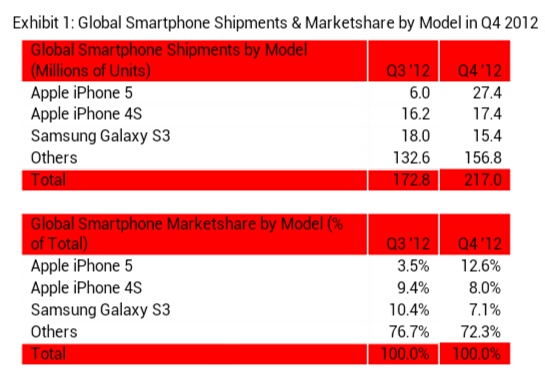
During third quarter, with iPhone 4S falling off with rumors roaring about its successor, Samsung shipped 18 million S3s, claiming the top spot. Apple shipped just 22.2 million smartphones — 16.2 million of the 4S and 6 million of the 5 (seeding the channel for limited September launch). Repeating Q4 numbers: Samsung reduced shipments, for the aforementioned reasons to 15.4 million, while Apple increased them to a staggering 44.8 million iPhones 4S and 5 combined. Right, nearly three times more than S3.
I would reasonably assume, based on Apple’s stated inventory numbers during last month’s earnings call, that both iPhones together outsold Galaxy S3 during Q4. To say either one did is a stretch without data showing how much inventory Samsung carried forward from Q3 or how much stock remained at the end of the year.
The numbers misrepresent sales for another reason. Apple sells three base iPhone models — 4, 4S and 5. Just in the United States, Samsung offers more than a half-dozen smartphones, including Galaxy Note II. Globally, Samsung sold, not shipped, 64.5 million smartphones during fourth quarter, according to Gartner. By comparison, Apple: 43.5 million.
I don’t believe Mawston tries to mislead anyone. Bad choice of words is the problem. Greater fault lies with bloggers and others regurgitating the data without examining the contents.
Photo Credit: Joe Wilcox
-
Jimmy Wales Can’t Shut Wikipedia Down At His Will, And He Thinks You’re Stupid For Asking
In case you’ve ever wondered just how much power Jimmy Wales has over Wikipedia, you can rest easy knowing that he can’t just pull the plug on his own. Someone on Quora was apparently wondering about this, and decided to ask him about it, as he is quite active on the Q&A site. His response is both humorous and reassuring.
Very stupid.
-
Here Comes The Next PlayStation! Join Us Live At 6pm Eastern/3pm Pacific For The Sony Event Liveblog

The war for your living room is about to heat up. While Microsoft is still keeping its own next-generation console under lock and key, rival Sony is gearing up to take the stage in New York City and show off exactly what it’s been working on for the past few years. Naturally, we’ll be liveblogging the whole thing starting at 6PM Eastern/3PM Pacific tonight.
Like nearly every other major hardware release in recent memory, the PlayStation 4 (or whatever it’s going to be called) has been the subject of scads of questionable rumors and clandestine leaks. Curious code name? Check. Preliminary glimpses at hardware? Check. Unnerving (and hopefully unfounded) reports that the console won’t play nice with used games? Sadly, check.
Even now, the rumor mill persists — Sony may push its next-gen console out the door as soon as November (with the ability to control it via smartphone, no less) if a new report from Kotaku holds water. Still, for while we know (or think we know) about Sony’s plans for tonight, expect the company to whip out a few surprises to keep the masses planted firmly on the edge of their seats.
That said, at this point it seems highly unlikely that Sony will pull back the curtain on everything it’s working on, if only because of its sketchy track record with keeping promises made on stage. One need only look at the company’s original PS3 announcement to see that some of the experiences that Sony promised it would bring to the table just haven’t materialized (or at least, haven’t materialized in the way we had hoped).
Either way, Sony’s little shindig in Gotham tonight is going to be one to worth listening in on. To stay abreast on all of Sony’s big announcements, keep your eyes on our PlayStation Meeting event tag here.
-
Adobe, HootSuite Talk About New Twitter Marketing Integrations
As previously reported, Twitter has officially launched its Ads API. Initial partners include: Adobe, HootSuite, Salesforce, SHIFT and TBG Digital.
Adobe shared some early results, as its Media Optimizer tool (which manages over $2 billion in annual ad spend) utilizes the API. The company worked with a few of its customers, including Levi Strauss and Threadless as well as its own Adobe account, and shared these results:
- By using granular targeting, testing different bid levels and segmenting campaigns by regions, Media Optimizer was able to increase the follower base (number of followers on Twitter) by 63%
- Adobe saw the total Cost Per Follow (CPF) decrease by close to 60% or approximately $2.00
- Prior to the campaign Adobe saw steady organic growth at around two dozen followers per day. With Promoted Accounts Adobe saw the growth rate spike dramatically to an average of over 400 new followers per day
- Since the completion of the campaign Adobe saw its follower growth revert to a new, higher baseline of about 115 followers per day. Postings and promotions have not changed significantly, which indicates a possible ongoing benefit of Twitter’s Promoted Accounts and new followers being highly engaged with the brand
“Our customers have been asking us to include Twitter in the Media Optimizer solution,” says David Karnstedt, Senior Vice President, Media and Ad Solutions at Adobe. “Promoted Tweets and Promoted Accounts are important assets in creating a holistic digital marketing campaign. The performance gains Media Optimizer produced during our beta period, such as lowering cost-per-follow by 60%, are indicative of the value we offer our customers for their Twitter campaigns.”
The company discusses its early campaign results more here.
HootSuite is offering a new integration for Twitter, providing customers with amplification of owned into paid media, agency collaboration, real-time social campaigning, and layered social media reporting.

“HootSuite provides our clients with the ability to amplify their owned content, keeping them at the forefront of social advertising opportunities. This process is now a simple and efficient one,” says Ryan Holmes, CEO of HootSuite. “The new integration allows stakeholders in social businesses to instantly buy Promoted Tweets and Accounts from their HootSuite dashboard using our secure, role-based team workflow.”
More on HootSuite’s new integration here.
-
Comcast launches app store for biz customers
Comcast opened Upware, an app store featuring nine services for its small and mid-sized business customers on Wednesday. The app store isn’t a new idea, but it’s one that will bring in a new line of revenue for the ISP and serve one of its fastest growing customer bases.
Comcast’s business services brought in $2.4 billion in 2012, up 34 percent from the previous year. That’s only 6 percent of the company’s cable sales, but it’s growing at almost 6 times the pace of total sales. And those customers were asking Comcast for choices on document storage, security and other resources, which led to the ISP building Upware.
While spokesman Charlie Douglas declined to give specific financial details associated with the app store, he did say it would be a revenue-generating service for Comcast. It will also be great for the partners who will have their services listed for Comcast’s business customers. Those companies so far include:
- Data Backup – Carbonite, DigitalSafe and Mozy.
- Data Security – Norton and Websense.
- Collaboration – Box, Microsoft, Soonr and YouSendIt (see disclosure.)
This is a good example of how a service provider can add value for its end users — value that it can monetize beyond a monthly broadband fee. Comcast has been pretty aggressive about adding connected home products on the residential side as well as beefing up it’s pay TV service to compete more with web-based on-demand services.
Disclosure: YouSendIt is backed by Alloy Ventures, a venture capital firm that is an investor in the parent company of this blog, Giga Omni Media.

Related research and analysis from GigaOM Pro:
Subscriber content. Sign up for a free trial.- When It Comes to Pain at the Pipe, Upstream Is the New Downstream
- New challenges for the IT organization
- A near-term outlook for big data

-
Why I love Chromebook
Third in a series. For Valentine’s Day, Wayne Williams and I explained why we love Kindle and Surface Pro, respectively. We’ve decided to extend the concept into an ongoing series, which I continue about Chromebook and in many more ways Chrome OS.
My Chromebook journey began in December 2010 when Google dispatched 60,000 Cr-48 test units. I used the computer as my primary PC for a week, but no more, being a concept. But, then, my 11.6-inch MacBook Air failed in March 2011, and I reverted back to the Cr-48 during the emergency. In June 2011, Samsung released the Series 5 Chromebook, which I used as my only PC for two solid months. But performance couldn’t meet my needs — that is until the successor, the 550, launched in May 2011. I abandoned MacBook Air and didn’t look back. Performance and features met my needs. I traded performance for better ergonomics when switching to the ARM-based Series 3 Chromebook in October.
Life Changing
Five months ago, I explained how “Chromebook changed my life“. For example, I went from relying on software running locally to that consumed in a browser connected to some service’s data center. I’ve used desktop software my entire computing life. Letting go concepts that cloud services couldn’t be enough proved challenging at first. My preconceptions limited how rapidly I received cloud benefits. But I found most of the web apps I needed, even for tasks like photo-editing, which surprised me.
Often these apps performed better than those run locally, which is contrary thinking — or to me. But it makes sense really. Distant datacenter does the heavy-lifting rather than the local computer, which is a major reason Chromebooks are so underpowered compared to Windows PCs or Macs. Consider the specs of the ARM Chromebook to the MacBook Air I sold last year.
Series 3 Chromebook: 1.7GHz Samsung Exynos 5250 dual-core processor (ARM); 11.6-inch matte display, 1366 x 768 resolution, 200-nit brightness; 2GB RAM; 16GB SSD; SD-card slot; Webcam; USB 2.0 and 3.0 ports (one each); WiFi A/N; Bluetooth 3.0 compatible; HDMI port; Chrome OS.
MacBook Air: 1.8GHz Intel Core i7 processor; 11.6-inch glossy display (1366 x 768 resolution); 256GB flash memory; Intel HD graphics; 4GB SDRAM; webcam; two USB ports; Thuderbolt port; WiFi N; Bluetooth 4.0; iLife ’11; and OS X.
Performance is not comparable, although size and ergonomics are. I initially moved from the Mac to the 550 Chromebook and found them to feel similarly speedy and responsive — that with 1.3GHz Intel Celeron 867 dual-core processor and 4GB of RAM. I recently switched back to the 550, because the Series 3 isn’t speedy enough for my needs.
My Chromebook Life
Chromebook is really about Chrome OS. The major benefits are about software and supporting services. For me what matters:
1. Sync changes everything. In March 2008 I asserted: “Synchronization is today’s killer application.” I warned: “Should Google get synchronization right before Microsoft, it would be game over. Google would be able to extend the relevancy of the Web platform back to the desktop on its terms — think invading army — and across many devices or services”. Google sync is that good now, and automatic, Chrome to Chrome OS and also from Android. Chrome OS syncs tabs, web apps and other stuff from Google’s cloud. That’s it. Because of Chrome sync, the experience follows me to other computers or should I switch Chomebooks.
2. Setup is so-o-o easy. Log into Google account. That’s it. When switching Chromebooks, settings immediately sync and migrate. Apps and desktop used on one follow to another — or from Mac or Windows PC if using Chrome. Setup is that simple and maintenance about equally.
3. Computer gets better with age. Google dispatches new Chrome OS versions, with new features, about every two months and most content automatically saves to the cloud. My Chromebook is better today than it was last week. I can’t complain about that. By comparison, Apple or Microsoft make me wait years to get new features.
4. Lifestyle is amazing. Since Larry Page took Google’s CEO reigns 22 months ago, the company has dramatically increased cross-integration of products and services around the browser as hub, and that means Chrome OS, too. Right now I live a fulfilling digital lifestyle because content, services and social click so well. Integration is tight and satisfying.
5. Value is huge. Consider the Series 3 Chromebook, which sells for $249. Size and ergonomics are similar to $999 MacBook Air. I can outfit the whole family (four of us, including mom) for the cost of the Apple laptop. Google and its partners provide a good-enough experience that satisfies for the money spent. MacBook Air offers more options, for sure, but for four times the price.
Easy is the best way to describe any Chromebook, from setup to ongoing management to daily use. If you can navigate a browser, you can use Chrome OS and content and settings follow you from device to device. The computer is by no means perfect, just more than good enough for my particular computing needs, which is why I love Chromebook.
I can only hope that rumors about Google-designed Pixel Chromebook are true. There’s love, and then there’s true love.
Photo Credit: Joe Wilcox
-
Say it with me now. Data caps are about profits, not recovering fixed costs
There are lies, damned lies, and the arguments the cable industry makes about broadband caps. As more ISPs cap their broadband service, more questions are raised about the practice, which has put cable providers on the defensive.
In the last month, cable companies have switched from justifying their caps as a means to handle congestion — or bandwidth hogs — and are now saying it’s about recovering the billions invested in their network. In January the NCTA president (and former FCC Chairman Michael Powell) said when asked about caps as a means of controlling congestion: “That’s wrong. Our principal purpose is how to fairly monetize a high fixed cost.”
After the FCC has decided to take a half-hearted interest in caps and users and industry participants questioned the accuracy of how such caps are measured and the implemented, the cable industry is changing its justification for their policies. The problem is that its latest justification is just as false as its previous one.
The fixed costs to deliver broadband are refuted by the high profit margins broadband delivers to cable firms, the fact that upgrades to higher speeds costs relatively little and that most of the infrastructure cable providers built is already paid for.
The Open Technology Institute, a policy group that, yes, takes money from Google, has released a report attempting to quell this line of argument form the cable industry. Data points cited in the report include the ever popular fact that cablecos get 95-97 percent profit margins on their broadband services, that the billions invested in their networks in the early 2000s were to compete with new pay TV products from the telcos and the satellite broadcasters, and that adding broadband to existing cable infrastructure costs very little.
To back up that last claim check back to Cablevision’s comments to Wall Street that upgrading to DOCSIS 3.0 which provided faster upload and download speeds, were $70 per home (Cablevision doesn’t have a cap.) Other analysts pegged that number at about $100.
From the report:
Yes, cable companies and others have invested billions in building networks, but they have received more than healthy returns on those investments for several decades. According to analyst estimates listed on the NCTA website, cable companies invested over $185 billion in capital expenditures between 1996 and 2011. But these networks generated close to $1 trillion in revenue in the same time period. Moreover, both Comcast and Time Warner Cable are now spending less on capital expenses relative to revenue than in past years.
I’m not actually against the 95 percent profit margins or even caps if the market for broadband were competitive. Unfortunately, when more than thee-quarters of American homes have the choice between only two providers it’s clear that competition for the basic broadband service is limited. And when you look at how competitive the services are based on speeds there are big differences. For example, AT&T U-Verse tops out at 24 Mbps on the download side while cable tops out at 50 Mbps or even 100 Mbps.
But as someone who has documented legitimate questions about caps; their size, their spread, their rationale and their effect on innovation, I’m hoping that more and more consumers, lawmakers and regulators wake up to the fact that these caps aren’t necessary and that they pose a tax on innovation.

Related research and analysis from GigaOM Pro:
Subscriber content. Sign up for a free trial.- Report: The Ongoing Battle for the Digital Home
- Who and what to watch in the new era of the living room
- What the shift to the cloud means for the future EPG

-
Twitter Officially Launches Twitter Ads API
Twitter has announced the official launch of the Twitter Ads API after testing it with partners since January. The first five partners include: Adobe, HootSuite, Salesforce, SHIFT and TBG Digital.
“Since we launched Promoted Tweets in April 2010, marketers have come to Twitter to reach new audiences and engage with more than 200 million active Twitter users on the web, on mobile devices, and on tablets,” says Twitter revenue product manager April Underwood. “As interest in Twitter has grown, our focus has been on delivering better ads for users, not more ads. We believe our system is working well because users like the ads experience on Twitter. Our system rewards marketers for being good, not for being loud. And this approach encourages ads that are engaging, relevant and useful.”
“Towards this goal, we’re always working on ways to make it easier to manage campaigns and get more value out of advertising with us,” she adds. “One important step is to enable a diverse group of companies that can integrate seamlessly with our ads platform.”
Twitter says marketers will be able to work with Twitter’s set of partners to manage Twitter Ad campaigns and integrate them into cross-channel advertising strategies.
“Equally important, users will continue to see the most relevant Promoted Tweets from advertisers,” notes Underwood. “With the Ads API, marketers now have more tools in their arsenal to help them deliver the right message, to the right audience, on the desktop and on mobile devices — all at scale.”
You can apply to join the partner program here.
Twitter says that in the coming months it will also start certifying ads products that integrate with the API, and that this is just the start of its efforts in this realm.
-
Red Hat open sources its take on Hadoop storage
Red Hat is getting into the big data act more deeply, announcing on Wednesday that it’s open sourcing its Red Hat Storage Hadoop plugin as an alternative to the Hadoop Distributed File System. The plugin, which the company expects to release to the Apache Software Foundation some time this year, is based on the Gluster File System technology Red Hat acquired when it bought Gluster for $136 million in 2011. Red Hat has already incorporated Gluster’s technology into its Red Hat Storage Server product.
According to a press release announcing the news
“Red Hat Storage brings enterprise-class features to big data environments, such as Geo replication, High Availability, POSIX compliance, disaster recovery, and management, without compromising API compatibility and data locality. Customers now have a unified data and scale out storage software platform to accommodate files and objects deployed across physical, virtual, public and hybrid cloud resources.”
Because it’s fully distributed, Red Hat’s file system does away with the NameNode that keeps track of data in most Hadoop clusters and can be both a bottleneck and a single point of failure. (Although, the Hadoop community has mitigated some of these concerns with Apache Hadoop 2.0 (as has Facebook with its own engineering effort called AvatarNode).) Red Hat has also combined its storage and virtualization technologies so anyone using both can have virtual pool of storage and compute resources residing on the same physical infrastructure.

Red Hat isn’t the only company or organization trying eliminate problems associated with HDFS or to improve its utility to large enterprises and/or webscale companies. Companies such EMC, NetApp and others are offering their own alternatives, and Quantcast actually built and open sourced its own version of HDFS called the Quantcast File System. As we’ll be discussing at Structure: Data next month, Hadoop’s future prospects will be determined by how applicable it is to the workloads companies want to run, and some of the HDFS alternatives might represent solid options for enterprise workloads until Apache Hadoop can catch up.
 Of course, Red Hat being Red Hat, Wednesday’s news isn’t all about big data. The company makes it pretty clear that it expects its Hadoop efforts to be part of a broader cloud computing push, in which companies can run their applications in big data environments that span private and public resources, including OpenStack and the Amazon Web Services clouds.
Related research and analysis from GigaOM Pro:
Subscriber content. Sign up for a free trial.- Infrastructure Q1: IaaS Comes Down to Earth; Big Data Takes Flight
- Cloud computing 2013: how to navigate without a map
- Infrastructure Q1: Cloud and big data woo enterprises

-
Startup Fenix now selling its off-grid batteries via Vodafone in Tanzania
San Francisco-based startup Fenix International, which makes a battery product that can charge cell phones and run lights in off-the-grid regions, has scored its largest deal to date with Vodafone in Tanzania. The telecom giant will sell Fenix’s ReadySet charger and its accompanying charging accessories in Tanzania, market the products via billboards and television spots in the region, and also create a fund to make loans to women entrepreneurs so they can
buy the product.The deal has nothing to do with charity. Vodafone sees a major opportunity in getting more electricity — in whatever form — to its customers in areas like Tanzania that have a large percentage of the population living off the grid. More electricity means more cell phone use. There are 46 million people in Tanzania and only 14 percent of them have access to grid power — the rest of them use a combination of car batteries and diesel generators when they need access to power. Vodafone has about 10 million subscribers in Tanzania.

Fenix’s ReadySet battery can be sold with a solar panel charger as well as a bicycle charger (riding the bike in stationary mode charges the battery), and the simple design of the battery is what makes it so accessible to customers. Users can charge cell phones and plug in lights using basic connectors like USB and car lighter ports. (Check out Kevin Tofel’s review of the ReadySet).
The device costs around $200, which is a relatively high price for that area. But the people who will buy the ReadySets are mostly entrepreneurs in villages that will use the battery to sell cell phone charging services and charge their shops after it gets dark. Entrepreneurs can make $40 to $50 per month from offering cell phone charging services.

Vodafone is already working with these types of entrepreneurs on other services. Vodafone created a mobile payment system called M-Pesa, where people can exchange cell phones minutes for goods and services. There are 4.5 million people in Tanzania using the M-Pesa service, and there are 40,000 agents that operate as M-Pesa entrepreneurs (like human ATMs with cell phone minutes).
It’s these 40,000 M-Pesa entrepreneurs that Vodafone thinks will be particularly attracted to ReadySets. With reliable off-grid power, these local business people can keep their phones charged longer — and provide more mobile banking services — and also they can start selling cell phone charging as well. Vodafone said that in a pilot in Tanzania with the ReadySets, it saw 14 percent more average revenue per user across the M-Pesa system, because more people’s phones were charged to receive and give money.

Scoring a deal with Vodafone is a game changer for Fenix. Vodafone has some 400 million subscribers globally, and 100 million of those are off-grid customers. Globally 1.3 billion people live off-grid, and 600 million of those are cell phone subscribers. Fenix also is working with MTN, the largest telco in Africa with 180 million subscribers.

Related research and analysis from GigaOM Pro:
Subscriber content. Sign up for a free trial.- Forecast: the converged mobile messaging market
- Consumer privacy in the mobile advertising era
- Why tomorrow’s iPad will need a battery breakthrough


