Author: Serkadis

  • Five important lessons from the dustup over the NYT’s Tesla test drive

    I’ve been quietly watching the firestorm brewing around the New York Times’ negative review of a test drive a reporter took in Tesla’s Model S electric car along the East Coast. Tesla’s CEO Elon Musk took to Twitter and called the review “fake” earlier this week. But late Wednesday night, Tesla published data logs of the reporter’s trip that seem to contradict some of the New York Times’ reporting (almost a week after the New York Times’ piece was published last Friday), and now it’s time for me to weigh in.

    In case you’re just joining us on this story, Tesla has installed Supercharger stations along the east and west coasts that will charge Tesla cars much more quickly then standard charging stations. Tesla did this to create an experience where Tesla drivers can drive beyond the range of the battery with a short stop at the fast charging station, and in effect enable the type of road trip a driver could take in a gas-powered car. New York Times reporter John Broder took one of these road trips and reported that he ended up running out of charge in the cold weather and had to have the Model S towed.

    We drive the new Tesla Model S thumbnail

    After Musk attacked the story, Broder responded with a follow up saying he followed the instructions that Tesla gave him and the New York Times issued a statement that they stood behind his story. Tesla’s data logs show that he drove above the speed limit (which taxes the battery more quickly than slower driving) for much of the trip, and he didn’t fully charge the battery during the stops. There’s also a hilarious graph that Tesla says shows Broder drove around in circles for 5 minutes in the parking lot trying to deplete the battery before he got to one of the Superchargers (I’ll leave analysis of that one to the lawyers). Broder tells New York Magazine that he was looking for an unlighted Supercharger in the dark.

    The New York Times has yet to officially respond to Tesla’s blog post, but tells the San Jose Mercury News on Thursday morning that the story was still “fair and accurate.” There are a variety of lessons I think we can take from this interaction that shed more light on Tesla and Elon Musk, electric cars and the concept of an EV road trip, and reporting in the connected age in general.

    1). Don’t f*ck with Elon Musk: A friend who’s spent a decade in the legal industry told me once that you shouldn’t start a fight unless you’re ready to take it to the mat; i.e. take it all the way. Elon Musk will always take it to the mat.

    The guy has been involved in close to a half dozen lawsuits over the years at Tesla, some of them brutal and involving former employees of the company, and when it comes to journalists, he is no stranger to combat. Tesla sued U.K. car show Top Gear back in 2011 for libel and malicious falsehood. That case was ultimately dismissed — Musk doesn’t even need a winnable case to take you to court. Tesla points out an inaccuracy in the New York Times story graphic, and it seems like if the New York Times doesn’t do some sort of correction on this story, Tesla could very well take it to court. Now that the data is out, we’ll see if New York Times does any clarifications or even corrections.

    Elon Musk in front of the frunk

    Elon Musk in front of the frunk

    2). At this early stage, an electric car road trip isn’t that great of an idea: Tesla installed these Superchargers so that its customers could feel like they can have the freedom of driving an electric car in the same way, and at the same distances, they would drive a gas-powered car. But at this early stage, driving an electric car — even an awesome car like the Model S — for hundreds of miles across multiple days just isn’t as easy as it is with a gas powered car. Supercharging can take 30 to 45 minutes, depending on how depleted the battery is, compared with the five or ten minutes it takes to fuel up with gas.

    Also, the chargers are only in specific areas, so test drivers (see the Verge’s test drive along the West Coast) start to get nervous and experience “range anxiety.” As electric car advocate Chelsea Sexton wrote in Wired, “road trips are a dangerous myth for the EV industry to perpetuate at all.” It’s amazing that the Model S and Tesla are enabling these types of trips with new technology, but they are just not as easy as with a gas car, and that comparison is a tricky one for Tesla to make.

    Tesla's line of Model S cars

    3). Data equals transparency: This type of rebuttal from Tesla to the test drive could only occur in our data-laden always-connected world. Broder drove above the speed limit most of the way of his trip, even though in his rebuttal he claimed he didn’t. Who knows if he knew he was being inaccurate? Tesla can tell his speed because there’s a cellular connection on the Model S and an onboard computer that logs all of the car’s stats. Tesla usually uses this type of data to better the driving experience for its customers, but in this case, it’s using that data to contest this review.

    Green Overdrive: We ride a Tesla Model S Beta! thumbnail

    4). Driving an electric car requires education: Like with all new technology, electric car drivers need time to learn how to best drive their cars and how to make the battery last as long as possible. It takes some education to feel comfortable and to know how and when to charge it. That’s why some of the reporters that take the Model S Tesla road trip test drive have gotten nervous. For many of them this is some of the first times they’ve driven an electric car, and particularly driven one over long distances.

    It’s unclear if Broder knew that he was supposed to charge the Model S for a longer period of time during his stops (so that it charged the battery fully), but his original piece suggested that he had followed Tesla’s instructions on how to charge it. If we give him the benefit of the doubt that he did this ethically (he very well could have not been ethical on this) then he needed a better education on how to drive it. The road trip is like an advanced application for a new technology — there’s a learning curve that can’t be accommodated on a single drive.

    Tesla logo on the Model X

    Tesla logo on the Model X

    5). The narrative for electric cars to fail — again — is powerful: Tesla is on the brink of leading a charge to break the electric car into the mainstream, despite the fact that there have been fits and starts for electric cars for decades. Many people have lost money over the years trying to support an emergence of an electric car sector that has failed to materialize.

    But this time around, I think it’s different: the electric car is here to stay. The Model S won Motor Trend’s car of the year award for 2012, which is the first time in history that this major award has been given to an electric car. GM’s Volt and Nissan’s LEAF are selling thousands of cars per month. But many people who have been burned in the past — traditional car industry folks, auto journalists, oil execs — are very skeptical and eager to believe that the EV will once again fail to materialize.

    Finally, I want to say that I’m not claiming to know the motivation or ethics of the New York Times reporter, and the New York Times has yet to come out with an official response to Tesla’s data logs. But I’ll update this when they do.

    Updated at 10:55AM with Broder’s explanation of why he was driving around in the parking lot before charging at the Supercharger.

    Related research and analysis from GigaOM Pro:
    Subscriber content. Sign up for a free trial.

  • Idera Launches Three New SQL Server Tools

    Idera announced the availability of three new free tools for SQL Server DBAs and IT administrators: Server Backup Free, SQL Backup Status Reporter and SQL Permissions Extractor Free.

    Idera CEO Rick Pleczko says, “Idera has made a commitment to providing free tools and solutions that help both IT and database administrators better manage their servers. It’s our way of paying back the success that the community has helped us achieve.”

    “Idera’s Server Backup Free delivers a free copy of their leading high performance server backup product,” the company says in an announcement. “Idera’s SQL backup status reporter and SQL permissions extractor allows DBAs to quickly and easily ensure that databases have been backed up and copy permissions across servers. All of these tools are designed to help administrators better manage the growing number of servers in the enterprise.”

    Server Backup Free has all of the features of the Enterprise version, except it’s for a single server. Features include the abiliy to backup physical and virtual servers in just minutes (as opposed to hours), the ability to backup to any disk-based storage (second hard disk, NAS, SAN, etc.), the ability to restore files in seconds with Disk Safe technology, and “easy” installation.

    Backup Status Reporter lets DBAs view a graphical representation of backups across their SQL Server environment. Features include: the ability to identify databases that haven’t had backups, the ability to view backup history (including backup date and type), a simplified grid view for easy sorting and navigation, and the ability to identify full and differential backups for one or many databases.

    Backup status reporter

    SQL Permissions Extractor lets DBAs copy and reassign permissions from one server to another without having to write any script. It can generate T-SQL scripts for copying of user permissions to other servers, and enables the editing, saving and execution of permissions scripts. It also lets users include object level permissions for selected databases.

  • Valentine’s Day: Our Beautiful, and Romantic, National Parks

    Happy Valentine's Day to everybody, but most especially my wife Nita!  We got engaged a little over three years ago in one of our country's great National Parks, in our case the home of the world’s most famous Portuguese Water Dog (read our story here).  That made me a natural candidate to promote this great new video from the good folks at the Interior Department highlighting some of America's epic National Park engagements.  For those mulling locations for that most special and anxiety-filled popping of questions, I can't recommend them highly enough, and they hold up very well in subtle "who's engagement was better" contests.

    read more

  • This ‘iphone’ From Brazil Runs Android, Much To Apple’s Chagrin

    Most of us know the iPhone to be Apple’s prized smartphone – the device that ushered in the current mobile era we’re experiencing. Unfortunately for Apple, a different company has the rights to the “IPHONE” name in Brazil.

    That company is IGB Eletrônica SA (Gradiente), and it applied for the “IPHONE” trademark all the back in 2000. Apple released its first iPhone in 2007. The Wall Street Journal reports that the agency who oversees patents in Brazil said that it denied Apple’s trademark application because of IGB’s rights to the name. Matthew Cowley and Loretta Chao report:

    Marcelo Chimento, spokesman for Brazil’s National Institute of Industrial Property, or INPI, said Apple is contesting the decision, charging that Gradiente failed to make use of the trademark within a five-year window, as required by Brazilian trademark law. An Apple spokeswoman declined to comment.

    Apple Defends Proxy in Response to Greenlight Suit Unlike in the U.S., Brazilian trademark regulations stipulate that registrations be rewarded on a first-come, first-served basis, regardless of which party used the trademark first, or which party brings more value and recognition to the brand.

    The company, according to the Journal, only utilized its “iphone” power a few weeks before the deadline for when it was required to actually use it to keep the trademark. They used it to put out a device running Android, called the “iphone neo one”. Here’s a look:

    iPhone Neo One

    iphone neo one

    Apple released its iPhone 5 in Brazil in December.

  • Equinix Building Boom Continues. Is Chicago Next?

    equinix-fiber-tray

    A look at the full cable trays in an Equinix data center. The company had a “milestone year” in 2012, according to CEO Steve Smith. (Photo: Equinix)

    For Equinix, 2012 was a year of extraordinary expansion in its global infrastructure, as the company spent $607 million on data center construction and another $334 million to acquire companies in key international markets. That colocation company’s growth spanned four continents, adding capacity for for more than 15,750 cabinets, with expansions in northern Virginia, northern New Jersey, Dallas, Miami, London, Paris, Amsterdam, Frankfurt, Hong Kong, Shanghai, Sydney and Singapore.

    “2012 was a milestone year for Equinix,” said CEO Steve Smith. “We delivered half a billion dollars of revenue in the fourth quarter, underscoring the scale and reach of our business. With our entry into Mainland China, Jakarta and Dubai as well as our continued investment in existing markets, we now have over 7 million of gross square feet of capacity, making us the largest retail colocation provider in the world.”

    The building boom will continue in 2013, as Equinix expects to spend another $550 million to $650 million in capital expenses for this year, including up to $485 million on data center construction and expansion. That could include new space in downtown Chicago, where Equinix is being tied to a project that has been seeking a major data center tenant.

    New Site in Chicago?

    Chicago Real Estate Daily reported this week that Equinix may invest in a new facility at 111 Cermak Road, a project that local developer James McHugh has been positioning for data center use. The paper said Equinix and McHugh are in “advanced talks” on the project. Equinix declined comment on the report, noting that its only announced expansion in Chicago is a new phase at its CH3 data center in Elk Grove Village in the suburban Chicago market, where it plans to add capacity for 630 cabinets in coming weeks.

    Current plans for 111 Cermak call for a six-story, 315,000 square foot ground-up data center adjacent to the McCormick Place convention center and 350 East Cermak Road, the enormous carrier hotel operated by Digital Realty Trust, which is now fully leased. Equinix is one of the largest tenants at 350 East Cermak, where it operates two data centers and a vibrant financial trading ecosystem supporting Chicago’s exchanges. With no more space available at that building, the McHugh property offers a potential off-site expansion option.

    Building Phase I in Toronto

    Equinix said yesterday that it will invest $42 million this year to complete the first phase of TR2, the company’s new Toronto data center. The initial phase of the 220,000 square foot facility will feature 137,000 square feet of data halls, and will be supported by 8 megawatts of power, with the option to expand to 20 megawatts.

    The expansion in Toronto is part of Equinix’ ongoing focus on providing colocation space and interconnection centers in leading financial markets. Toronto is home to the Toronto Stock Exchange, the largest financial exchange in Canada.

    Equinix also has budgeted 2013 capital for facility expansions in Zurich, Frankfurt, Tokyo and Singapore. Those projects reflect a shift in where Equinix is investing in its data center footprint. In 2012, the company spent 53 percent of its CapEx on expansion in the Americas, compared to 47 percent between Europe and the Asia-Pacific. This year Equinix will target 56 percent of its capital in Asia and Europe (28 percent apiece) and just 44 percent in the Americas.

  • Google Now Gets Better At Movies And Real Estate

    Google announced on Wednesday that it has added some new features to Google Now with a new update.

    For Movie cards, Google Now will now include ratings from Rotten Tomatoes, and let you purchase tickets through Fandango (a feature that was recently added to Apple’s Siri). Google Now will also remind users when they need to leave for the theater, and pull up the tickets once they arrive.

    Google Now Movies

    Google has also partnered with Zillow to provide nearby real estate listings. It will also pull up more info about a particular listing while you’re visiting the property.

    Google Now Real Estate info

    The update also brings a new widget, so users can see their cards on the home or lock screen without having to open the app.

    This is the fourth Google Now update since it launched.

  • HStreaming ready to show the world its real-time Hadoop

    San Francisco-based startup HStreaming has accepted its first venture funding — $1 million from Atlas Venture — and is ready to spread the word about its real-time Hadoop system. The three-person company has actually been around for two years, but CEO Jana Uhlig told me during a phone call that interest is just too high to keep the company self-funded.

    It’s not surprising HStreaming would be drowning in interest. Ask anyone how they’d like to see Hadoop evolve beyond its current status as a batch-processing platform, and you’ll likely hear “real-time” as one of the answers. In fact, this is a topic we’ll discussing a lot at Structure: Data next month with companies trying to turn Hadoop into operational databases and various types of OLAP engines, and those companies just generally struggling with unceasing streams of machine data.

    Presently, companies trying to incorporate a real-time component into their Hadoop environments, in order to process data as it streams into the system and before it hits the disk, are bolting on open source technologies such as Storm and Kafka. While these certainly aren’t toy technology, Uhlig thinks the open source versions are rudimentary (Storm, for example, can pretty much just classify each piece of data as it hits) and notes that they’re not part of a full-on analytic system.

    HStreaming, on the other hand, has built a complete system that incorporates its real-time engine for processing streams of video, server, sensor and other machine-generated data, but also is wholly compatible with Hadoop as an archiving and batch-processing system. It also plugs into a wide variety of existing BI tools for analytics, Uhlig said.

    hstreaming

    Better yet, for Hadoop users, nothing has to change. HStreaming can do its stream processing by re-using the same MapReduce algorithms and Pig scripts that customers have already written. In practice, Uhlig said, users can move from a batch-only system into a real-time system in just days.

    She said major interest thus far has come from governments (especially around video analysis, where HStreaming can stitch together images from thousands of cameras in real-time), telcos and advertising. The company plans to step up its focus on utilities and financial services, too.

    Former Vertica CEO and Atlas Venture partner Chris Lynch said telcos should be particularly excited about technologies like HStreaming for the purpose of network arbitrage. Without stream processing and some semi-complex algorithms, he explained, it’s impossible to tell what traffic belongs to which users so network providers can charge other carriers or ensure that premium customers don’t experience degraded service while others are doing fine.

    “We tried this unsuccessfully at Vertica,” Lynch said. “… We weren’t fast enough.”

    HStreaming certainly appears to have the technical chops to do what it promises. CEO Uhlig is joined by CTO Volkmar Uhlig (Jana’s husband) and Chief Software Architect Jan Stoess, both of whom hold Ph.Ds in computer science. Volkmar was lead architect on the L4 microkernel, has built high-frequency trading systems and spent five years a IBM’s TJ Watson Research Center working on stream-processing technologies.

    And while one expects investors to be supportive of their portfolio companies, Lynch is effusive in his praise for what HStreaming is doing. “The technology has no practical limitations, but we have to market the company,” he said. “… Watch what happens in the next six months. … I sold 800 customers at Vertica before I sold the company [to HP], and every one of them is going to want HStreaming.”

    Feature image courtesy of Shutterstock user MrJafari.

    Related research and analysis from GigaOM Pro:
    Subscriber content. Sign up for a free trial.

  • A Surface Mini Could Wake Up Windows Phone 8

    surface-family

    I love the idea of the Surface: compelling hardware, striking form factor, and, in the case of the Pro, smart compromises to offer a good value. But the products fail to live up to their promise. They have first generation bugs. But maybe a low-priced Surface with a smaller screen could finally help bring the Surface promise to life. It just better run Windows Phone 8 and not Windows RT.

    Yesterday at Goldman Sachs Technology & Internet Conference on Wednesday, Microsoft CFO Peter Klein spoke to the Surface and Microsoft’s ability to scale to different form factors. As John Paczkowski lays out, Microsoft could build a Surface Mini.

    Both Windows 8/RT and Windows Phone 8 could handle the task. With both options comes compromises, though.

    “We can have the same core code base driving form factors from four inches all the way up to 27-inch ones and everything in between,” Klein said. “So I think we are well set up to respond to demand as we see it. We can deliver a versatile set of experiences across form factors, whether they’re four-inch, five-inch, seven-inch, 10-inch or 13-inch.”

    Windows 8 requires beefy hardware but can run any Windows application. Windows RT has an extremely limited marketplace of apps and it doesn’t seem to be improving with time. The task seems best suited for Windows Phone 8 even though it’s far from a blockbuster hit yet.

    Microsoft’s latest mobile OS is still struggling. It’s fighting for third place against BlackBerry. Android and iOS are simply out of reach. Consumers might not be buying the smartphones en mass, but that doesn’t mean it’s not a fantastic user experience.

    I love Windows Phone 8, but I wouldn’t use one as a daily driver. The user experience is beautiful. It’s slick, intuitive, and would scale nicely to a larger screen. It doesn’t require serious computing hardware, allowing for tablets with thin form factors and longer battery lives.

    Microsoft might not be alone in developing a 7- to 8-inch tablet. Nokia has been said to be working one as well with its reveal coming as soon as next week at MWC.

    Even with a beautiful hardware and wonderful OS, it’s pretty clear that a Windows Phone 8 tablet would struggle to gain traction. Even though WinPhone 8 is growing, the platform’s app ecosystem is pretty weak. Developers are not flooding the Store with apps. The platform is relatively unknown to most consumers. And another Microsoft-made tablet platform could be detrimental to the entire operation.

    Microsoft is in a precarious situation. It can no longer rely on third parties like HP and Asus to advance its software. The company clearly feels its hardware needs to lead the charge. The first generation Surfaces are good, but not good enough. A smaller form factor model could help rejuvenation the brand once it goes stale in a few months.

  • Like Google’s Doodles? Watch This Hangout With The Doodlers

    The hangout features some Google doodlers, including Ryan Germick, who leads the Google Doodles team, as well as a judge from Doodle for Google contest, a member of Google Education team, and some Google-certified educators.

    Google is running a popular doodle today for Valentine’s Day. It also happens to honor the birthday of George Ferris, the creator of the Ferris Wheel. It’s a good example of a doodle that works at multiple levels. Not only is it Ferris’ birthday, but the Ferris Wheel happens to symbolize love and dating, as it is a popular ride for lovers.

    Interested in learning about the process behind this particular doodle? Read this explanation from the doodlers about how it was created.

  • George Ferris Google Doodle Comes To The Rest Of The World

    Google is celebrating Valentine’s Day with a Google Doodle honoring George Ferris, the creator of the original Ferris Wheel (and the source of its name). As previously reported, the doodle hit the other side of the world as it became February 14th over there, and has been rolling out to the rest of the world with the date change. Now we’re getting it here in the U.S.

    This particular doodle is pretty smart in that it works on a couple of different levels. Not only is the Ferris Wheel often associated with dating (which fits in with the Valentine’s Day theme), but it is also George Ferris’ 154th birthday.

    Google doodler Brian Kaas shares some background on the doodle here. “Romance and amusement parks often go hand in hand,” he says. “In many places a carnival, fair or circus is a popular destination for a thrilling and action-packed date. Coincidentally, George W.G. Ferris Jr., the creator of the Ferris Wheel was born on Valentine’s Day in 1859. This year seemed like a golden opportunity to combine our celebration of love with the birthday of the engineer whose mechanical invention has filled so many hearts with wonder.”

    “Early in the process we decided on depicting a scene with two, side-by-side Ferris Wheels among a landscape of other amusement park rides,” he adds. “Then when two Ferris Wheel carts happened to stop across from each other we thought that was the perfect moment for two characters to have a love at first sight moment. We thought this would be the best way to highlight the Ferris Wheel in its natural habitat and provide a clever way to introduce some valentines to each other. Plus, we thought it would be fun to push a big button to generate a whole series of combinations.”

    You should check out the the full explanation of the doodle if you get a chance. It provides some good insight into the doodle-making process.

    Ferris himself was born in Galesburg in 1859, attended Rensselaer Polytechnic Institute, and died in Pittsburgh in 1896. He was only 37 years old. His original Ferris Wheel was created for the 1893 Chicago World’s Columbian Exposition.

    Today’s doodle is one of Google’s many interactive ones, and clicking the heart button will bring up different animal matches, followed by quick little picture stories showing these animals going out on various dates.

    Here’s a video showing the doodle’s animation and the animal dating match-ups, courtesy of Simon Rüger:

    Here’s a look at the full cast of animal characters from the doodle:

    George Ferris doodle animal cast

    When you click the search icon on the doodle, it takes you to results for “George Ferris,” and highlights Google’s Knowledge Graph panel, showing information about him. According to the Knowledge Graph, people who search for George Ferris also search for Washington Roebling, H.H. Holmes, LaMarcus Adna Thompson, and Daniel Burnham. If you’re not looking for this particular George Ferris, the Knowledge Graph also gives you the option of seeing results for George Ferris the Cricketer (one of the most helpful features of the Knowledge Graph, which Google launched last year).

    Yesterday, Google ran a doodle in Russia celebrating the life of Russian opera singer Feodor Chaliapin.

    Check out some more of Google’s recent home page doodles here. If you’re not monitoring Google’s many international homepages, you might have missed some.

  • Google Maps With Street View Is Now Available For The Wii U

    wii-maps

    Nintendo just announced that Google Maps with Street View is now available for Wii U systems in North America. So you now have the ability to wander around Martha’s Vineyard if you don’t have access to your tablet, computer, or phone — or pretty much any other Internet-connected device.

    The Wii U’s implementation is rather clever. As Darrell explained previously, the Wii U’s GamePad lets users pan around various locations while the satellite imagery is shown on the television. While it’s most certainly a novelty, it can provide an escape from a lowly apartment in Scranton.

    The app launched in Japan last week and Nintendo announced its U.S. availability today on the ever-entertaining Nintendo Direct videocast. No word on the special Panorama View app that Nintendo originally revealed at E3. This novel app that will use 360-degree videos rather than static imagery was originally slated for a Spring 2013 release.

    Find the free app on the eShop right now.


  • Valentine’s Day “Scroogled” Video Has A Google Human Reading People’s Mail

    As you may know, Microsoft recently resurrected its “Scroogled” campaign against Google, attacking Gmail in the latest round. More on the campaign here, but the premise is basically that Microsoft wants Gmail users to be aware that Google serves them ads based on the content of their messages. They’re framing it as a privacy issue, though Google doesn’t actually have humans going through your email. It’s all algorithmic.

    We talked about the whole thing with Microsoft’s Stefan Weitz more in depth here.

    Anyhow today is Valentine’s Day, and Microsoft has put out a new Scroogled video for the occasion. The video shows a mail man (or a “Gmail” man) opening letters and reading them (again, Google has no humans reading your messages). It also shows an Outlook.com mail man delivering the mail without opening letters and reading them.

    It’s unclear how many non-keyword based ads the Outlook.com guy delivers.

  • New iOS 6.1 Security Flaw Grants Limited Access To Phone App, Photos, Email, Messages, FaceTime

    ios-6-logo

    With just a few quick steps, it’s easy to open the phone app on any locked iPhone running iOS 6.1. From there a person has full access to the photo library, can edit contacts, send emails, text messages or even make a FaceTime call. It’s so easy that it’s downright silly.

    As shown in the video here, the process involves holding down the power button and aborting an emergency call. It worked for me although the timing is tricky.

    The flaw causes the phone to load the phone app, giving anyone full access to the dialer, contact list, voicemails, call history and photos by editing a contact. An email or text message can be sent by sharing a contact. FaceTime is accessible through the contacts as well.

    Update: Apple has reached out to TechCrunch with the following comment:

    Apple takes user security very seriously. We are aware of this issue, and will deliver a fix in a future software update.

    The exploit is fairly easy to access but the timing is tricky.

    • From a locked iPhone running iOS 6, load the emergency dial screen.
    • Press and hold the power button and then hit cancel.
    • Make a fake emergency call — I dialed 112 like in the video.
    • Hang up immediately.
    • Hit the power button to put the phone back in standby.
    • Hit the home button to bring up the lockscreen
    • Hold down the power button and at the three-second mark, hit the Emergency Call button.
    • Keep holding the power button until the Phone App comes up.
    • Hit the Home Button and release as if you’re taking a screen shot.

    The last bit is the hard part. The timing needs to be just right. It took me about 20 minutes to get the timing down.

    While new to iOS 6.1, this isn’t the first time a simple workaround has resulted in similar access. A comparable exploit was found in iOS 4.1. 

    Apple will likely address this exploit rather quickly. It’s a massive backdoor to some of the iPhone’s core functions.

  • Stranded Carnival ‘Triumph’ cruise ship transformed into floating prison as company refuses to evacuate passengers barely surviving in filth and raw sewage

    The stranded Carnival cruise ship in the Gulf of Mexico has tragically proven to be quite an experiment in human behavior. The ship has been stranded for 96 hours following an engine fire. Ship engines also generate all the on-board electricity, so once the engine burned…
  • Pebble smartwatch can now display all iPhone notifications thanks to free jailbreak hack

    Pebble
    The Pebble smartwatch has been a great success story for a small startup that launched a Kickstarter campaign last year. Pebble ended up breaking records when it raised more than $10 million on the crowd-funding site and it finally began shipping to customers late last month. The smartwatch features some nice iPhone integration out of the box, but a new jailbreak hack released by developer Conrad Kramer allows all notifications to be displayed on the watch’s E Ink screen instead of just notifications for native Apple (AAPL) apps like Messages, Mail and Phone, and a few third-party apps. The “BTNotificationEnabler” tweak is available right now for free in Cydia, the jailbreak equivalent of Apple’s App Store.

  • There is little room for a third smartphone platform

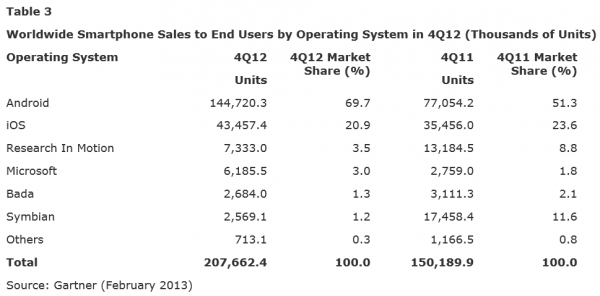
    “We’re No. 3!” will be BlackBerry’s and Microsoft’s rallying cry this year. Android and iOS so dominate the smartphone market, the best — and quite honestly dismal — hope is third; distant at that. Combined, based on actual phone sales, Android and iOS had 90.1 percent share during fourth quarter, up from 74.9 percent a year earlier, according to Gartner. BlackBerry and Windows Phone are neck-and-neck, with lowly 3.5 percent and 3 percent standings, respectively.
    Upstarts want third place, too. Anshul Gupta, Gartner principal research analyst, explains: “2013 will be the year of the rise of the third ecosystem as the battle between the new BlackBerry10 and Widows Phone intensifies. As carriers and vendors feel the pressure of the strong Android’s growth, alternative operating systems such as Tizen, Firefox, Ubuntu and Jolla will try and carve out an opportunity by positioning themselves as profitable alternatives”.

    Looked at differently, BlackBerry and Windows Phone combined-share was less in fourth quarter (6.5 percent) than a year earlier (10.6 percent). That said, while starting from a small base, Microsoft’s platform shows promise, with sales up 124.2 percent year over year.

    Individual vendor performance tells the story differently. Apple and Samsung combined smartphone sales share rose to 52 percent from 46.4 percent during the quarter.

    It’s a free-for-all. “There is no manufacturer that can firmly lay claim to the No. 3 spot in global smartphone sales”, Gupta says. “The success of Apple and Samsung is based on the strength of their brands as much as their actual products. Their direct competitors, including those with comparable products, struggle to achieve the same brand appreciation among consumers, who, in a tough economic environment, go for cheaper products over brand”.

    Samsung and Apple smartphone unit sales rose by 85.3 percent and 22.6 percent, respectively. The fruit-logo company accounts for all iOS, “with Samsung commanding over 42.5 percent of the Android market globally”, Gupta says, “and the next vendor at just 6 percent share. The Android brand is being overshadowed by Samsung’s brand with the Galaxy name nearly a synonym for Android phones in consumers’ mind share”.

    Samsung’s success is mixed for Android as a platform. The South Korean company, and not Google, largely controls customers’ experience via TouchWiz UI and other features. That can further fragment Android. On the other hand, consumers generally identify with uber-brands, like Samsung or Galaxy S III rather than Android 4.2.

    Samsung’s Android lift takes a bite out of Apple. For the second straight quarter, iOS lost smartphone sales share, year over year. Apple’s mobile operating system dropped to 20.9 percent from 23.6 percent during Q4. Meanwhile, Android leaped again, from 51.3 percent to 69.7 percent share. But unit sales jumped more than share suggests: 144.7 million from 77.1 million.

    Unlike most other analyst firms, Gartner measures actual sales to end users, not shipments into the channel. So there is no room for Apple apologists to argue about some disparity between the phone maker’s stated sales and those from others. Like competitors, Apple calls shipments sales. The company reported 47.8 million in Q4. Gartner says actual sales were 43.6 million, or 4.2 million less than the number the company gave last month. So while iPhone 5 still had a big launch quarter, sales missed analyst consensus (50 million) by wider margin.

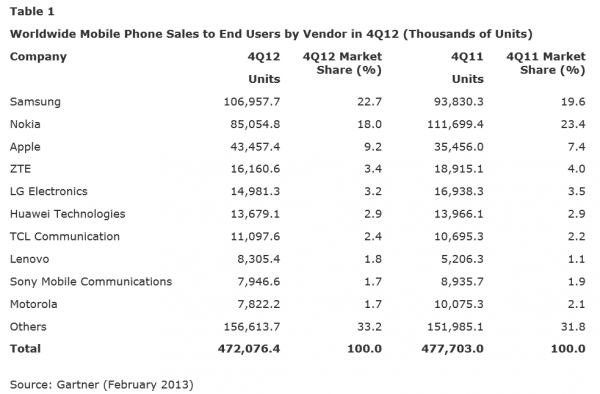
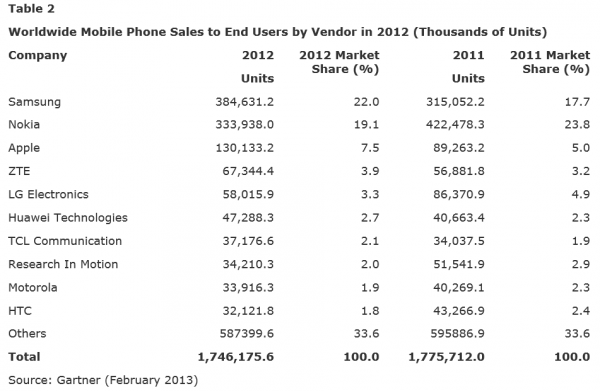
    In the broader phone market, Apple share rose to 9.2 percent from 7.4 percent for the quarter and to 7.5 percent from 5 percent for all 2012. The company maintained its third-place ranking for Q4 and the year. Market-leader Samsung grew share to 22.7 percent from 19.6 percent for fourth quarter and to 22 percent from 17.7 percent for all 2012.

    More broadly, worldwide mobile phone sales dipped about two percent for the quarter and year, to 1.75 billion and 472.1 million, respectively. Smartphone sales surged 38.3 percent in Q4, to 207.7 million. Meanwhile, feature phone sales fell 19 percent to 264.4 million. At this pace, smartphone sales should surpass feature phones within a couple quarters. Respective share in Q4: 44 percent and 56 percent.

    Photo Credit: David Andrew Larsen/Shutterstock

  • Internet Explorer is the last browser standing

    Opera’s decision to change rendering engines means three of the top five browsers will use Webkit. Internet Explorer stands alone, and that is the wrong place to be. In September 2009 post “Microsoft should dig deep into Webkit to keep Google from Framing IE“, I suggested radical change, which unsurprisingly was ignored. Since, Chrome usage share grew from 2.9 percent in August 2009 to 17.84 percent in January 2013, according to Net Applications. Meanwhile, IE share fell from 66.97 percent to 55.14 percent.

    But the real battleground, and where upstarts gobble up territory, is mobile — yeah smartphones and tablets. While the category accounted for just 11.8 percent browser usage share in January, the majority is Webkit — 61.02 percent just for Safari. Internet Explorer: 1.34 percent, or less than Chrome (2.02 percent). Android browser is 21.46 percent. As I expressed three-and-a-half years ago: “Microsoft should answer WebKit for WebKit, by releasing a new browser based on a new rendering engine; put on the IE brand and ship it for desktop and mobile”. There’s still time, but fast running out.

    Invasion

    Microsoft is losing the new browser war and needs to act rashly and, to be bluntly honest, should have taken my advice in 2009. Starting now is big disadvantage, but what else is there to do? The problem isn’t rocket science, but somehow is lost on the brainiacs in Redmond, Wash. There is:

    • Surge in competing browsers
    • Monetization of browsers around search
    • Growing demand for browsers on mobile devices
    • WebKit emerging as dominant rendering engine for mobile apps
    • Increasing developer distraction from other Web browsers or technologies
    • Rising interest in Chrome OS as platform competing with (and replacing) Windows

    Microsoft now fights the new browser war on multiple fronts:

    • Desktop, where territory recedes
    • Mobile, where rampaging hordes run wild
    • Operating systems, where Android, Chrome OS and iOS invade outlying areas

    Internet Explorer must reach where it doesn’t today — Android, Android hybrids from Amazon and Chinese phone manufacturers and iOS. Webkit stands in the way, particularly iOS, where Apple demands it. Microsoft develops numerous attractive and effective Android and iOS apps, with Bing being a star. IE needs to be there, too.

    Insurgency

    But mobile is but one insurgency on the browser battlefront.

    In May 2011 post “Chrome OS: The ghost of Netscape rises to haunt Microsoft“, I warned what could happen to Windows. Many BetaNews readers rejected the idea, but look where we are now with Chromebook. It was the geek gift this holiday. Microsoft OEM partners Acer, HP, Lenovo and Samsung now all ship Chromebooks. There are rampant rumors of a Google-branded laptop running Chrome OS and increasing speculation the operating system will soon merge with Android. Such union would be fast-track to rapid adoption across multiple devices. Microsoft CEO Steve Ballmer should pee at the thought. Several times a day!

    The situation is more than a browser-based OS shipping on low-cost laptops. As I explained nearly three years ago:

    During the PC era, Microsoft maintained Windows’ dominance through a number of means, including distribution, standards and contractual commitments. The company also used integration — the very thing that set off the U.S. antitrust case — as means of preserving Windows utility/relevance and to beat back competitors. Microsoft would take a technology a competitor spent millions to develop and integrate it into Windows, essentially giving it away for free. Google is doing something similar to Microsoft, by offering products/services for nominal fees or no cost that Microsoft charges heaps of money for. Enter Chrome or Chrome OS as platform for web apps connected to Google cloud product/services like Apps, Calendar and Gmail.

    Chrome OS is free to license, and since I posted Google has copied Microsoft’s past strategy leveraging dominant platforms. Over the past two years, Google has tightly tied most of its products and services together around search. Chrome and Chrome OS bring everything together in a tidy package that also supports third-party web apps. Seriously, if Ballmer isn’t peeing his pants, he should be replaced by someone who is scared, ah, witless.

    Mozilla has Firefox OS in the works but doesn’t command Google’s reach or resources. But even the operating system’s development shows competitive opportunity and Microsoft’s vulnerability.

    Defense

    Microsoft must recognize the seriousness of these competitive threats, particularly as it makes cloud services higher priorities. Can you say Office 365? Microsoft either takes control or is controlled by Apple and Google together setting standards for platforms in categories where Windows isn’t dominant or recedes.

    During Microsoft’s glory years, cofounder Bill Gates made dictating and dominating computer standards a top priority, one CEO Steve Ballmer left behind. During the 1990s browser war, Microsoft integrated Internet Explorer into Windows — not far removed from how Google leverages search today. But the software giant did much more, such as either developing or coming to effectively control emerging Web standards during the late 1990s and early 2000s.

    Microsoft isn’t really driving Web standards today. A commercially developed WebKit browser, supporting HTML 5 and other standards, would strengthen Microsoft’s position of influence against Apple, Google, Mozilla and other developers supporting open-source browsing engines. Done right, WebKit-based IE could even steal marketshare from other open-source browsers. Actually, there is no other choice.

    The first step is the hardest: Conceding defeat. Ballmer and team must admit they blew mobile browsing and that support for standards like HTML5, which is core to Windows 8, aren’t enough. Google is aggressive, like Microsoft in the 1990s, and leverages monopoly position. The search giant is poised to snatch Webkit leadership from Apple and, presumably, drive standards. From that perspective, WebKit IE is table stakes.

    Three-and-a-half years ago, I warned: “Left unchecked, Google will take Internet Explorer and Frame it. Perhaps Apple and Mozilla will break the glass. Microsoft is posed to become the Netscape of the 2010s, otherwise. Microsoft must act to preserve and even reclaim territory taken during the browser wars. There’s still time, but not for long”.

    Microsoft is running out of options fast. If your next browser is Chrome, why not Chrome OS the next operating system in three years when Windows 9 ships? The transition is easy. Remember a decade ago when analysts and Microsoft dismissed Google because search isn’t sticky — just type a new web address? Or how ridiculous a Google browser or operating system seemed just five years ago? How the industry reacted? Think about it?

  • Playtime for tech at the Toy Fair (photos)

    Several startups are combining technology and toys from LittleBits (see disclosure) and Sphero to Kickstarter darlings Romotive and Ubooly. As more companies from the tech realm try to bring their Silicon Valley ethos to the toy industry, I thought it would be fun to hit up the toy industry’s annual show — The Toy Fair — in New York City to see what the future holds. While there, I realized there is a massive gap between the $21.87 billion toy industry and the tech firms who want to change the way kids play.

    Toy Fair entrance

    First off, this show is huge. There are more than 1,000 vendors spread over 366,339 square feet of space. There are plush toys, dancing plush toys, building sets and dolls. The buyers at the show represent a wide assortment of stores, from large chains like Toys R Us and Best Buy to mom and pop toy shops, schools, car washes and dollar stores. These people are here to scope out new toys and buy inventory.

    Toy Fair plush

    Despite the lure of the high-tech toys that brought me here, many of the things that caught my eye and interest were lower tech. For example, I was charmed by shelves of Android robot plush toys (from $10 to $43) from Gann Memorials, a company in North Carolina. You could even buy a plush Android phone cover for $7 if you were so inclined.

    Toy Fair plush Android

    Another toy that I liked and saw buyers flock to at the Launchpad event — a small portion of the hall for upstart toy companies with prototypes and $1,900 to spend on a table — was a game called Awkward Moments. While it somewhat resembled the Cards Against Humanity game, it was created by a lab out of Dartmouth that built games to change public perception. This $18.95 game was designed to help overcome prejudice against women in the science, math and engineering fields with a small number of cards dedicated to situations that women might encounter. Surprisingly, it was fun instead of preachy.

    Toy Fair cars

    However, the tech-related toys that I was there to see were pretty cool. NeuroSky, a company that makes a brainwave-reading helmet was there with a few toys that worked with its headsets. They ranged form ears that wiggled when you were focused to a helicopter that you controlled with your mind. After trying the headset on, I discovered that I am a very focused individual — perhaps a little too focused. My helicopter launched itself pretty aggressively from the moment I put the headset on. At $70 for the headset and ears this was an investment, however.

    Toy Fair NeuroSky

    There were also tech toys for babies with iPads, such as Tiggly, a puzzle game to help toddlers recognize shapes.

    Toy Fair Tiggly

    And for young kids with iPads, there were the Apptivators. They sat on top of an iPad and interacted with the game playing on the screen. For $25 kids could get either a monster head or a car and play an associated game. When the character dies, the shell covering the little plastic head pops off.

    Toy Fair Apptivator

    And for adults with $1,000 to blow? Two 18-inch-high robots that could fight another robot via the web (the boxing ring is thrown in too).

    Toy Fair robots

    After all of this, the $150 for the Romo smartphone robot looked downright reasonable.

    romotive-2

    And the $90 for the Littlebits toys that have been dubbed the next-generation of LEGOs had me ready to plunk down my credit card. Several educational buyers felt the same way apparently. A lot of people were at the LittleBits booth.

    Toy Fair LittleBits parts

    Yet, the 20th century settled back in once I wandered away from the relatively small interactive and tech section of the show. Once again I was surrounded by plastic, plush and puzzles. And as I wondered how tech toys might do in the bigger market outside the geeks and early adopters, I got a reality check from a fellow blogger who writes for the parenting site Babble. She pointed out that $90 was crazy money for a toy. Adrienne Appell, a spokesman for the Toy Industry Association backed that up with data, telling me that the average price of a toy is $8. Of course, that average is brought down by stuff like the junk below.

    Toy Fair party and novelties

    At the end of two days at the Toy Fair I realized that connected toys, the threat of Kickstarter as a prototyping and marketing tool and advances in robotics were pretty inconsequential in the minds of most exhibitors, buyers and entrepreneurs at the fair, despite headlines shouting that tech was the big trend this year.

    The world of tech and the world of toys may be on a collision course, but that crash is far off. If the small space at the show dedicated to truly connected or novel tech toys wasn’t proof, then the fact that I was offered “a disc” of high-resolution images” by the PR person staffing the Madame Alexander booth was. Sadly, My MacBook Air doesn’t have a CD drive and she didn’t have the images on USB. I’m still waiting her to email the images, but I’m not holding my breath ( or the story).

    Toy Fair entrance vertical

    Disclosure: LittleBits is backed by True Ventures, a venture capital firm that is an investor in the parent company of this blog, Giga Omni Media. Om Malik, founder of Giga Omni Media, is also a venture partner at True.

    Related research and analysis from GigaOM Pro:
    Subscriber content. Sign up for a free trial.

  • The Internship Trailer Is Here (You Know, That Vince Vaughn Google Movie)

    The trailer for The Internship is out, following a Google+ Hangout with stars Vince Vaughn and Owen Wilson. If you’re expecting a jOBS-like look at a major tech company, you’re probably going to be disappointed. If you’re expecting a Vince Vaughn/Owen Wilson–style comedy with the Googleplex as the setting, enjoy:

  • Google Honors Feodor Chaliapin With A Google Doodle

    February 13th marks the 140th birthday of Russian opera singer Feodor Chaliapin, and Google showed a doodle on its home page in Russia.

    While it’s still the 13th here in the states, it has already moved on into the 14th in Russia, where Google is now showing the George Ferris doodle discussed earlier. Presumably, we’ll be getting that one here in the U.S. at midnight.

    A Google search for Feodor Chaliapin returns the option to see results about the opera singer or his son Feodor Chaliapin Jr., an actor. If you select the singer, you’ll see Google’s Knowledge Panel for him.

    Here’s a sample of Chaliapin’s work:

    More recent Google doodles here.