Author: Serkadis

  • Jill Lajdziak Becomes smart USA President

    Jill Lajdziak, the former CEO of GM’s Saturn, has been appointed President of smart USA by Penske Automotive Group, the retailer of the German brand in the United States. Lajdziak’s appointment in the new role comes less than a month after she was said to have started working for smart as vice president, sales and marketing.

    As we look to enhance the position of the smart brand, Jill’s background and experience will help us reinvigorate the dealer network and bring a greater awar… (read more)

  • Mercedes Offer Heidfeld Reserve/Test Role

    It was quite obvious that a potential deal between Mercedes GP and Michael Schumacher would have closed all doors for German driver Nick Heidfeld on his way to Brackley. The former BMW Sauber racer was hoping to secure the vacant seat alongside compatriot Nico Rosberg at Mercedes, but the return of Schumacher practically sealed all his hopes for the future.

    While several other teams continue to be alternatives for the F1 veteran to continue his career in the series – Renault, US F… (read more)

  • “Holy” Green Unholy Insanity By John Vennari, from Catholic Family News

    Article Tags: John Vennari

    Religious Leaders Hoodwinked into Global Warming Hysteria

    England’s Prince Philip, once president of the World Wildlife Fund, said that when he dies, he wishes to return as a killer virus to “lower human population levels”. This same Prince Philip explained in 1990 that it was a major goal of the anti-life ecology movment to get religious leaders involoved, so as to give enviromnentalism a “spiritual imperative”. In this, the Green Movement has succeeded. Our church leaders are now dancing to the tune of today’s pro-abortion environmentalism.

    Last month’s “Under the Green Thumb” (CFN, December 2009), spotlighted the questionable science and dark agenda behind today’s frenzy over alleged man-made global warming.[1]

    We saw that this modern environmentalist movement is pro-abortion, pro-population control, and anti-human at its core; and that there are scientists by the thousands who challenge the entire concept that global warming is a man-made phenomenon; or that global warming is even happening! Meteorologist John Coleman calls the whole notion “the greatest scam in history”. [2] BBC climate correspondent Paul Hudson reported that many people would be surprised to learn “the warmest year recorded globally was not in 2008 or 2007, but in 1998.”[3]

    Source: cfnews.org

    Read in full with comments »   


  • Anonymity, Self-Reference & Q&A: Formspring.me’s Winning Combination for the Social Web

    FormSpring.com is a data collection and management system with a particular emphasis in online forms, registrations and surveys. And enterprise-level system, FormSpring.com might seem rather dry to anyone but an online retailer or event coordinator.

    FormSpring.me, on the other hand, has tapped the very essence of what makes the social web so addictive. This new application, a free and social side project, nearly has all the requisite puzzle pieces to go completely viral. It’s fun, engaging, and slightly game-like, and it encourages the behaviors users love to indulge. It’s only missing one critical element.

    Sponsor

    A stable back end. But more about that in a moment. First, let me tell you what makes FormSpring.me so infinitely entertaining.

    First, the site is user-to-user Q&A. This is the kind of formula that has populated the Web with masses of UGC on sites such as Yahoo! Answers and Wiki Answers. It’s also the basic formula behind such highly praised startups as Aardvark, which allows users to ping one another across networks to get answers about specific topics. Q&A between end users is a growing trend on the web, without a doubt.

    Second, the site allows one user to anonymously ask questions of another user. Anonymity has bred some of the most interesting and varied experiments of the social web. Very often, a lack of links to users’ true identities leads to bathroom-wall-of-the-Internet content such as 4chan or YouTube comments. But while anonymity breeds trollism and is actually a dying phenomenon online, having a thin veil between the asker and the answerer of a question can act as a confessional booth in a way, allowing for more frank communication or the posing of some very interesting, controversial questions that might otherwise be considered impolite or risky.

    Finally, one of the most enduring trends of the social web, from its inception to the present day, is our deep and insatiable love of self-reference. The provocative beginning question for the site is, “Ask me anything,” which users then tweet or post to Facebook. Answering questions all about you, your preferences, your past, your thoughts, your wishes and hopes, your regrets, what you eat and where you live – nothing is more intoxicating to the average social media user. From our first LiveJournal entries to mid-2000s MySpace chain surveys to our latest tweets, we clearly love talking about ourselves. The way that FormSpring.me caters to this inherently human attribute is by giving us the impression or illusion that someone, somewhere actually cares about what we think and do enough to ask us and expect an answer.

    So, when you combine the power of a Q&A site with the magic of an anonymous commenting system and the addictive qualities of navel-gazing with the expectation of being noticed, you basically have on your hands the social web app of the year just waiting to happen.

    And if it weren’t for back end – which is likely built on Ruby on Rails, according to a few sources we’ve consulted today – FormSpring would have not only a money-making enterprise app but also a blockbuster social app.

    Although the concept is fascinating, the implementation is transparently shoddy. It seems like a hastily put-together weekend project along the lines of a Startup Weekend or Rails Rumble one-off. In fact, several developers we consulted said the site bears all the marks of a Ruby on Rails product, including rampant database scalability errors. ActiveRecord is a Rails class for accessing databases, and it’s been shown in past applications to be unscalable. Concurrency issues mean that a small group of geeks or judges can have a grand time with your app, but the second it catches on with the social media crowd and then – god help you – general Internet users, the app’s database is unable to handle that volume of traffic over a period of seconds, and end users start seeing error messages and abandoning ship like so many faithless rats.

    And since FormSpring.me is in all likelihood a side project from a single staffer or a couple employees (the company blog doesn’t even mention the offshoot), it might not get the executive attention for further development or resource allocation. After all, without a revenue model, why would an enterprise-focused company waste time and energy on a social application?

    Speculation aside, FormSpring.com support tech Ryan Dillman writes, “Eventually, we plan to rewrite the FormSpring.me code from the ground up using the same type of database as sites like Facebook, Twitter, etc., so that we can handle the load. In the meantime, the millions of calls to the database cause frequent issues during peak times.”

    Many parts of Twitter are built on Scala, and Facebook’s database abstraction layer was developed in-house. If that kind of userbase – millions upon millions of users accessing the site around the clock – is what FormSpring is preparing for, they’re going to need a much more robust solution that’s much closer to bare metal than whatever they’re currently running.

    And we do suggest they find one. FormSpring should consider monetizing and quickly scaling such an addictive little application before someone else does it next and better.

    So, to take the site’s “Ask me anything” query and pose it to the site’s creators, do you plan to seriously devote resources to create a stunning and addictive social app, or is this experiment destined for the digital dustbin?

    Ask us anything – or give us your frank opinions – in the comments.

    Discuss


    Buy This Item: [Click here to buy this item]

    Read Original Article

  • Best Buy’s $40 ‘pre-optimization’ determined to be worthless, iPhone earbuds determined to be white

    Best Buy's $40 'pre-optimization' determined to be worthless, iPhone earbuds determined to be white
    Have you tried to buy a laptop or desktop at Best Buy lately? If so, you’ve probably been hit for a $39.99 “pre-optimization” fee, an extra charge that you just couldn’t avoid. The cost goes toward covering the meager living expenses of some poor Geek Squad employee — and to keep their retro gaming habit in check. In exchange those workers laboriously go through your machine and “optimize” it, removing some trialware and, apparently, enabling status bars. Supposedly the machines are faster and easier to use after this service, but Consumerist and Consumer Reports tag-teamed to make sure. The results? Not good. In most cases there was no performance increase, though in one instance the machine was 32 percent slower! Laptops were also found to be left in suspend mode, sometimes with software installs and Windows Updates half-completed. The worst part is that stores often won’t sell you a machine that hasn’t had this “service” performed. That’s what we call shady behavior — the sort we’d expect to see at the competition.

    Continue reading Best Buy’s $40 ‘pre-optimization’ determined to be worthless, iPhone earbuds determined to be white

    Best Buy’s $40 ‘pre-optimization’ determined to be worthless, iPhone earbuds determined to be white originally appeared on Engadget on Tue, 05 Jan 2010 02:35:00 EST. Please see our terms for use of feeds.

    Permalink Gizmodo  |  sourceConsumerist  | Email this | Comments

    Buy This Item: [Click here to buy this item]

    Article

  • Univ. joins complaint against Comast sports networks

    San Jose’s hockey team isn’t the only shark in the Bay Area, according to a complaint filed against Comcast Cable by Stanford University, the city of San Bruno and two local cable providers.

    The Dec. 23 Federal Communications complaint — filed jointly by Horizon Cable TV, WaveDivision Holdings, the city of San Bruno and Stanford University–alleges that Comcast, the nation’s largest cable operator, unfairly combined its Sacramento and Bay Area regional sports networks, forcing cable competitors wanting to broadcast Comcast’s programming to purchase both CSN Bay Area and CSN California (Sacramento).

    Comcast reassigned its game coverage of MLB Baseball’s Oakland A’s and the NHL’s San Jose Sharks from its San Francisco network (CSN Bay Area) to its Sacramento network (CSN California), raising the price of both networks, even though CSN Bay Area lost coverage of its headlining teams. Competing cable companies that wanted to run coverage of those teams had to pay more for two Regional Sports Networks (RSNs) and non-Comcast subscribers were landed with increased rates.

    What’s more, the complaint says, Comcast raised prices for its own combined sports network package without increasing “major league sports programming.”

    Comcast maintains that it reassigned its game programming to reduce scheduling conflicts and increase local sports coverage. For instance, according to CED Magazine, CSN Bay Area used to run games of both the A’s and San Francisco Giants, whose extra-long major league seasons would conflict with The Sharks’ and NBA Golden State Warriors’ games. Comcast says offering games on the Sacramento network eliminates any overlaps.

    The allegations come at a bad time for Comcast, which is in the process of buying NBC Universal. The petitioners, backed by the American Cable Association, which represents small and medium-sized cable operators like Horizon and WaveDivision, slapped Comcast with the FCC complaint now to ensure that Comcast does not discriminate prices with NBC content.

    “The complaint highlights the need for additional safeguards and remedies to prevent Comcast Corp. from abusing its market power to harm consumers, competitors, and the public interest in the distribution of ‘must have’ regional sports networks under its control,” said American Cable Association President Matt Polka in a statement. “Regulators must be certain that if Comcast takes control of NBC Universal, it can’t engage in unfair methods of competition and deceptive practices when competitors seek access to NBC broadcast signals, Comcast-NBCU national cable networks, and various Internet-content services, such as live streaming of the Olympics.”

    Stanford University, the city of San Bruno and WaveDivision and Horizon are asking for the FCC to sanction Comcast, restore the previous major league content arrangements and award damages to the petitioners.

  • When the Princeton Review Met Facebook [Voices]

    By Jessica Shambora, Reporter, Fortune Brainstorm Tech

    Despite the controversy surrounding standardized tests for college admissions (Are they fair? What do they measure?), exams like the SAT and ACT remain a necessary evil for most college-bound students.

    The same might be said of the process of preparing for these exams, a phenomenon that has spawned a multi-billion dollar industry led by two companies, the Washington Post Co.’s (WPO) Kaplan and The Princeton Review.

    But like the music and publishing industries before it, the test-prep sector faces disruption from scrappy Internet startups.

    Read the rest of this post on the original site

    Buy This Item: [Click here to buy this item]

    Read Original Article

  • If You Tweet, He Will Come: Mayor Cory Booker Shovels Snow for a NJ Resident [Voices]

    By Brenna Erlich, Copy Editor, Mashable

    As the snow piled up on New Year’s Eve, Jersey resident Ravie Rave didn’t call a snow plow service to take care of her 65-year-old father’s walk — she tweeted at Newark Mayor Cory Booker.

    Booker, who has more than a million Twitter (Twitter) followers, is a regular man-about-town when it comes to the microblogging service (remember that whole thing with Conan?), but this level of responsiveness is extreme, even for the sometimes to-good-to-be-true politician.

    Read the rest of this post on the original site

    Buy This Item: [Click here to buy this item]

    Read Original Article

  • A Look at Apple’s Love for DRM and Consumer Lock-Ins [Voices]

    By Jacqui Cheng, Associate Editor, Ars Technica

    Apple (AAPL) is a company known for many things, but embracing copyright freedoms has not been one of them. The company loves creating new and innovative products that challenge the world’s perception of what it thought it wanted, but it then turns around and aggressively protects those products from being poked or prodded too much by curious onlookers. Some believe Apple is in the right to do this, while others feel the company could set a better example when it comes to using (or abusing) copyright legislation for its own self-serving purposes.

    Read the rest of this post on the original site

    Buy This Item: [Click here to buy this item]

    Read Original Article

  • EA Sports to announce the return of NBA Jam this month?

    If you remember, EA Sports community manager Alain Quinto tweeted something back in December about their announcement of a new game. Now what could it be? Do you have any idea? If you guessed MVP Baseball, you’re

  • Rock & Roll Will Never Die? It Might on Facebook [Voices]

    By Mike Melanson, Writer, ReadWriteWeb

    The graying of the Facebook population seems to have continued according to new stats released today by iStrategyLabs. And while one might expect more of the site’s now nearly 10 million users over the age of 55 to be Neil Young fans, his “Rock N’ Roll Will Never Die” refrain seems to be falling through.

    Read the rest of this post on the original site

    Buy This Item: [Click here to buy this item]

    Read Original Article

  • In Trying to Buy Yelp, Google Is Becoming … Yep, a Media Company [Voices]

    By Simon Dumenco, The Media Guy, Ad Age

    A little over a year ago, on Dec. 1, 2008, I made this prediction in my column: “Google will buy Yelp” — the social-networking-esque site that provides user-written reviews of businesses in cities across the U.S. and Canada. It took a while, but Google (GOOG) finally tried to make good on my prediction last month — but, of course, failed (at least initially).Yelp reportedly balked at being bought. Then Miguel Helft of The New York Times Bits blog reported that his source was saying that Google walked away from the acquisition talks, because it “didn’t want to let the negotiations be driven by leaks to the press.”

    Read the rest of this post on the original site

    Buy This Item: [Click here to buy this item]

    Read Original Article

  • The Mysterious GPhone Unveiled: A Slideshow History [Digital Daily]

    Since the earliest rumors shivered through the blogosphere, Google has been on a steady march toward releasing its own mobile offering.

    If the journey was steady, though, the communication was anything but. Google (GOOG) has shifted its language along the way and even outright denied the smartphone project once or twice.

    The Nexus One, news of which got out a few weeks ago, might not be the innovative free-to-all that everyone was fantasizing about, but it represents the most significant mobile announcement from Google to date, using its Android operating system software.

    More to the point, it is the Silicon Valley search giant’s most aggressive attack on the hegemony of the Apple (AAPL) iPhone.

    But overall, it was a pretty sneaky journey from there to here.

    So, here is the visual history, using our new All Things Digital slideshow format.

    View the slideshow
    View the slideshow

    Buy This Item: [Click here to buy this item]

    Read Original Article

  • Nuclear Powered Nanorobots To Replace Food?

    ‘In the future, we may
    see a type of pill for replacing food, but experts say it likely would
    not be a simple compound of chemicals. A pill-sized food replacement
    system would have to be extremely complex because of the sheer
    difficulty of the task it was being asked to perform, more complex than
    any simple chemical reaction could be. The most viable solution,
    according to many futurists, would be a nanorobot food replacement
    system.

    Dr. Robert Freitas,
    author of the Nanomedicine series and senior research fellow at the
    Institute for Molecular Manufacturing spoke with FUTURIST magazine
    senior editor Patrick Tucker about it.’

    Read more…

    Book Mark it-> del.icio.us | Reddit | Slashdot | Digg | Facebook | Technorati | Google | StumbleUpon | Window Live | Tailrank | Furl | Netscape | Yahoo | BlinkList

  • Social Networking App Maker Seesmic Acquires Ping.fm

    The social networking app land is about to get a lot more interesting with the confirmed acquisition of Ping.fm by Seesmic. This move enables users to update their status on 50 social networks, thanks to Ping.fm’s large catalogue of supported services. The plan is now to integrate the two services and add some Ping.fm functionality to the Seesmic desktop and mobile clients.
    “Your friends are not all in one social network, but we want to help you stay in touch with them anytime and from any device. That is Seesmic’s vision and to deliver this faster, we have acquired Ping.fm. You can now update 50 social networks using Seesmic+Ping.fm from email, chat, sms, Blackberry, Android, web, Windows, OSX and much more soon,” Seesmic announced on its blog.

    A great thing about social networking site is that they foster a huge ecosystem of apps and services which sprung up around them to cater to various needs unmet by the proper service. One type of apps which has proven very popular are the desktop and mobile clients like TweetDeck and Seesmic which first catered to Twitter user but soon expanded to support Facebook and others. It enables users to update their status and keep in touch on the go or without opening up a browser window. It also enables them to handle several accounts from several social ne… (read more)

  • 4chan Presents: YouTube Porn Day (NSFW)

    jLTPH

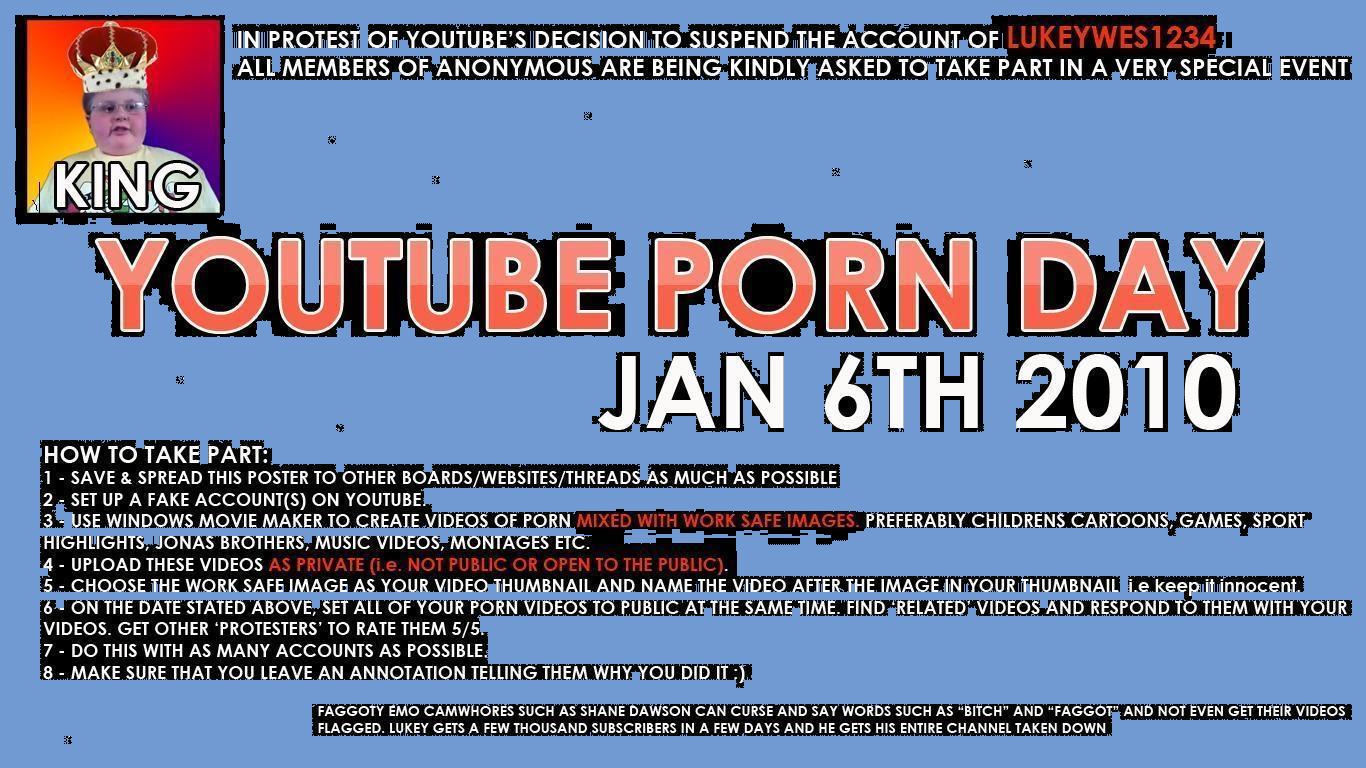
    It looks like 4chan has found its first major target of 2010. In a message sent to what is presumably a huge amount of undisclosed receipients, 4chan is announcing that this coming Wednesday, January 6, is going to be a very special event: YouTube Porn Day.

    The move comes in response to one account, Lukeywes1234, being suspended by YouTube. Apparently this was just a regular YouTube user who caught the eye of 4chan and they proceeded mass follow him and make tribute videos to him — like these (and the one below).

    I’ll let you read on the poster above for what they’re asking you to do for this special day. We’re not condoning this, we’re just as confused as the rest of you.

    Crunch Network: MobileCrunch Mobile Gadgets and Applications, Delivered Daily.


    Buy This Item: [Click here to buy this item]

    Read Original Article

  • EA Sports Relaunching NBA Jam on Nintendo Wii

    Basketball fans who have been requesting an NBA Jam revival are about to get their wish. EA Sports has picked up the classic franchise and will soon announce its official return.

    According to ESPN, sources within the publisher have confirmed that the revival will be shipping “exclusively for the Wii,” and that creator Mark Turmell will be involved in some capacity. EA Sports is reportedly bringing in Turmell to consult on NBA Jam as well as work on other upcoming sports games.

    The franchise is well-known for its popularity during the 16-bit era, when it was hot in both the arcades and on the Sega Genesis and Super Nintendo. It was famous not just for its wild brand of 2-on-2 hoops, but for the inclusion of celebrities like Bill Clinton.


    Buy This Item: [Click here to buy this item]

    Read Original Article

  • Apple to buy Quattro Wireless mobile ad firm for $275M

    quattroApple is expected to announce soon that it has purchased Quattro Wireless for $275 million, according to a report by AllThingsD. Quattro has a mobile ad network and platform that lets advertisers target mobile users with ads.

    The report said several sources had confirmed the announcement but that Apple has declined comment. The move would increase the stakes in the mobile ad business, since it would be a kind of counter to Google’s $750 million acquisition of AdMob, which competes with Quattro.

    The announcement could come as soon as tomorrow, according to the report. Waltham, Mass.-based Quattro is focused on ads for smartphones such as Google’s Android devices and Apple’s iPhone. The company has raised almost $30 million from Highland Capital Partners and Globespan Capital Partners. Its clients include Ford, Disney, and the National Football League.

    The news comes on the eve of Google’s new big move against Apple: the launch of the Google-designed Nexus One smartphone.


    Buy This Item: [Click here to buy this item]

    Read Original Article

  • Editorial: A new quarter, a new decade for the Stanford community

    On behalf of the Stanford Daily Vol. 236 Editorial Board, I would like to welcome the Stanford community back to campus for the start of the winter quarter, and the beginning of a brand new decade. In September, at the onset of the volume, the current Edit Board had yet to be assembled; we were hitting the ground running from the first week on, unsure of how the quarter would unfold. Now, as a new quarter begins and a new volume lies just over a month away, I can say in earnest that I am thrilled to be rejoined with my colleagues on the Board and at The Daily for the first volume of the second decade of the century.

    At the closing of the decade of the “zeros,” “aughts” or “thousands,” the feeling across America was an understandable mixture of relief and anxiety–relief that one of the most disappointing decades in its history was finally at an end, and anxiety over what the future may hold. While its body is not even cold in the ground, journalists have already begun labeling the past 10 years as a lost decade. And it is not hard to see why–with the shock of September 11 on one end and the collapse of our financial and economic security on the other, the decade’s entrance and exit were both defined by panic, fear and uncertainty. In between these two major shocks, the country waged two wars in the Middle East, at least one of which still threatens to lumber on well into the new decade. Less discussed in the media was the plight of the American working people, whose average salaries and range of opportunities stagnated throughout the decade while CEOs made billions, culminating in the first decade in 70 years during which there was no overall job growth in America.

    Here at Stanford, 10 classes of students have graduated since the start of the century, with the Class of ’10 being the first of the new decade. Since we arrived on campus in 2006 or earlier, some of the major events we have seen have been, as is often case, a combination or synthesis of local happenings here on campus and the larger goings on of the wider world. In November of 2008, the world witnessed two major events on the same day that affected many people on campus differently: the election of Barack Obama and the passage of Proposition 8. More recently, the troubles of the global economy touched Stanford’s endowment, leading to cuts in budget expenses and staff positions. For the individual gay or lesbian student on campus, or the individual staff member who lost his or her job, the boundary between the nice and private world they enjoyed on campus and the rhythms of the larger world suddenly fell away. These examples serve as cold reminders that, even amid the sunny glow of the Stanford bubble, we all are, as individuals, touched by the larger world.

    This lesson–applicable for both Stanford and America as a whole–may go down in history as the great lesson of the last decade. Here on the Editorial Board, we have committed ourselves to reaching a balance between addressing the issues of the day here on campus–from scheduling policies to Full Moon on the Quad–and greater issues of the world at large. Coming into the new quarter, we will remain committed to looking beyond our own daily worldview to the policies and practices that touch us all, not just as members of the Stanford community, but as citizens of the world.

    Andrew Valencia

    Editorial Board Chair

  • Goldman Sachs: Record of $23 Billion in Bonuses for 2009; Explaining Their Economic Parasitism

    ‘Goldman Sachs is among
    the most visible financial parasites. Their executives have a revolving
    door through the US Treasury Department. They profit through
    “trading,” much like Enron did; including selling
    investments represented as AAA while simultaneously betting the value
    of those investments tank. Their CEO says they’re “doing
    God’s work,” as Enron’s CEO said, “We are on
    the side of angels.”

    A US Senate report puts
    the parasitic cost to Americans at $2 to $4 trillion every year. To put
    that figure into perspective, that’s an almost unbelievable
    $20,000 to $40,000 added cost per US household every year. Goldman
    Sachs is so happy with their “trading,” they’ll pay
    out a record of $23 billion in bonuses to their top employees for their
    2009 work.’

    Read more…

    Book Mark it-> del.icio.us | Reddit | Slashdot | Digg | Facebook | Technorati | Google | StumbleUpon | Window Live | Tailrank | Furl | Netscape | Yahoo | BlinkList