Author: Serkadis

  • Ginkgo Biloba Maybe Not So Effective

    A large, long-term study funded by the National Institutes of Health revealed that the popular supplement ginkgo biloba doesn’t prevent cognitive decline or improve memory in seniors. The findings of this largest ever randomized controlled trial on ginkgo bilbo were published today in JAMA.

    I thought it appropriate to include fallen ginkgo leaves to illustrate this post. I’ve always been fond of the tree, even if its leaves don’t do everything we’d like them to. (Yellow ginkgo leaves remind me of potato chips!)

    ginkgo-leaves

    The ginkgo biloba study involved 3,000 people ages 72 to 96 who were followed for seven years. The authors write, “In sum, we find no evidence that G biloba slows the rate of cognitive decline in older adults.” They add that these findings are consistent with those of smaller studies. Read more about the study at USA Today.

    If you’re taking the supplement to prevent memory decline, you may need to save your cash instead. Some people take gingko for other reasons, including treating multiple sclerosis and tinnitus.

    On their website, the National Institutes of Health states that side effects of ginkgo biloba can include headache, nausea, gastrointestinal upset, diarrhea, dizziness, or allergic skin reactions. If you’re taking ginkgo or another alternative medicine, you should always tell your doctor and dentist. Gingko may increase bleeding risk.

    Other names for the ginkgo tree include maidenhair tree and Japanese silver apricot. No matter what you call it, the ginkgo is still a beautiful tree. I hope that science finds that it cures something one day.

    Will this study affect your use of ginkgo supplements?

    (Image via stock.xchng)

    Post from: Blisstree

    Ginkgo Biloba Maybe Not So Effective

  • Seibel’s Stealth Carbon Startup C3 Lands $26 Million And Condoleeza Rice On Its Board

    What do Thomas Seibel, Condoloeeza Rice and $26 million have in common? They are all connected to stealth energy startup C3, which may be entering the business of managing carbon cap-and-trade systems for corporations. In the past two weeks, C3 has filed three Form Ds with the SEC disclosing financings totaling almost $26M. Very little is known about the company publicly, and the company declines to comment on its future plans (or anything else). But from other publicly-available sources, an interesting story can be pieced together.

    C3 is the brainchild of Thomas Siebel, former CEO of Siebel Systems which was bought by Siebel’s previous employer Oracle for $5.7 billion in 2005. Seibel has brought in a lot of familiar talent, including former Siebel Systems and Oracle executives Patricia House and Edward Abbo. House is a star, serving on a number of boards and in the past being named one of Fortune’s 50 most powerful women. Abbo is the former CTO of Seibel Systems, among other positions. The holdover team from Siebel, including its CTO, points towards enterprise software.

    Also among the C3 board of directors are former Secretary of State Condoleezza Rice and former Senator and Secretary of Energy Spencer Abraham. Both are powerful Republicans, which comes as no surprise as Siebel played a role in introducing Vice Presidential candidate Sarah Palin to California. Far more interesting is the role each might play. C3 is focused on energy management and a former Secretary of Energy is a logical (and valuable) asset in that business. More interesting is the potential role of Rice. Rice’s most visible experience is as America’s lead representative to the world, suggesting that C3 is planning an international play.

    Another key Director is Jay Dweck, a Managing Director and Global Head of Strategies and Technology for the Institutional Securities Group at Morgan Stanley. Mr. Dweck’s insider knowledge of institutional securities and the underlying technology at least raises the possibility that C3 will seek to securitize and/or create a market for some kind of carbon security.

    So what does an enterprise-software, energy-management company with international ambitions, $26 million in capital, and sophisticated financial securities software do? Besides make a lot of money of course.

    One logical answer is that the company is planning to create software/platforms for the management of carbon emissions. What makes the space potentially so valuable is cap and trade. These systems substitute a market for regulation; an enterprise’s carbon emissions are measured against a specific amount, the cap. Companies with emissions below the cap can sell their extra “space,” while companies whose emissions exceed their cap need to purchase permits for their overage. Cap and trade is not currently in use in the United States, although it has been proposed and is being pushed by the Obama Administration, but it is being used to reduce carbon emissions on a cost-efficient basis elsewhere, notably in the EU.

    Two large and related problems plague cap and trade systems. One is measuring emissions (in an officially sanctioned manner) and the other is pricing them, and those two problems could very well be C3’s targets. The goal in this scenario would be to get licensed or approved to create and run cap-and-trade markets. If cap and trade is ultimately adopted as the way to control carbon emissions in the name of reducing global warming, it will be a multi-billion dollar market.

    C3 bills itself as an “Energy and Emissions Management” company. Limited information about it is currently available at c3welcome.com, itself an unlikely website. The company also appears to own c3-carbon.com, and may be shopping for a more euphonious domain as it has chosen to remain at the welcome site as opposed to the longer term c3-carbon.com, which redirects.

    There are other companies tackling this problem such as Greenstone Carbon Management, Carbon Hub, and Carbon Trust, but the glowing board/leadership pedigree on top of nearly limitless access to capital make C3 a diamond in the rough, so to speak.

    .

    Crunch Network: CrunchGear drool over the sexiest new gadgets and hardware.


    Buy This Item: [Click here to buy this item]

    Read Original Article

  • Is The Nexus One Bringing A New Android Backup Service With It?

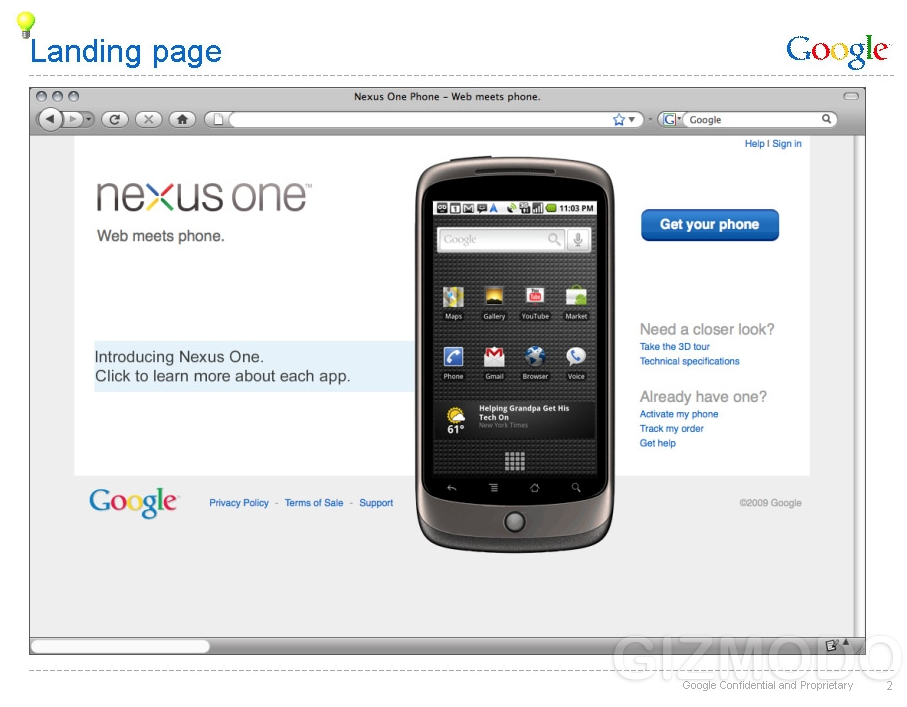
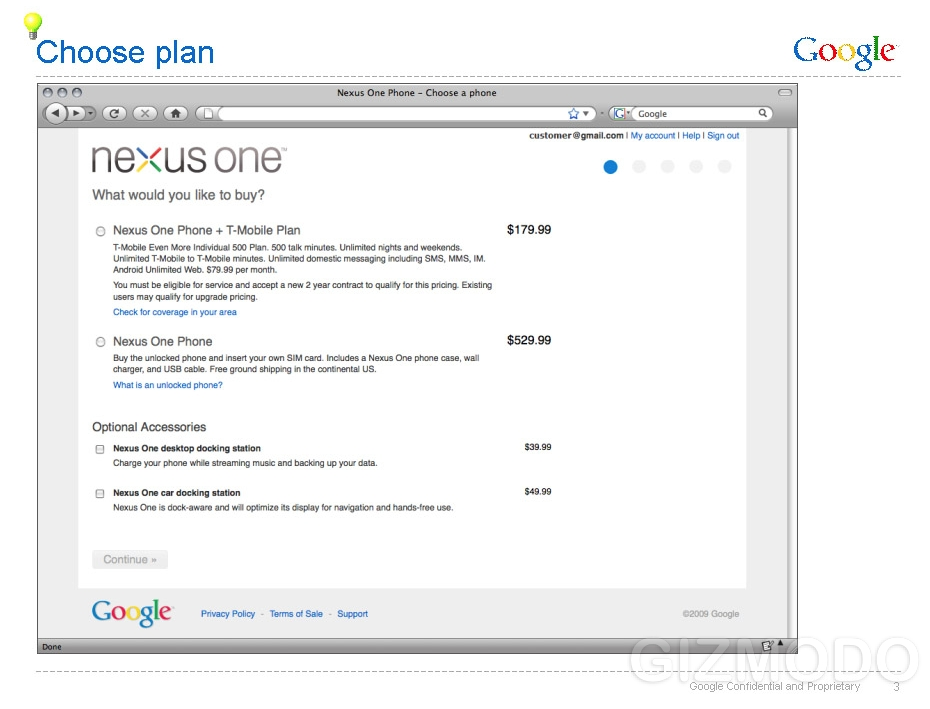
    Earlier this evening Gizmodo published leaked images that apparently show off the pricing details for Google’s upcoming Nexus One phone. The Nexus One comes in at a hefty $530 for an unlocked device, or $180 with contract on T-Mobile — pricing that’s pretty standard for a smart phone. But even still, it’s a very big deal. It also looks like Gizmodo’s screenshots may have included clues hinting at a previously unannounced feature for Android: automatic backup of your data.

    Under the section for Optional Accessories, the Nexus One will apparently have a docking station available (as did the Droid). The description for the dock is as follows: “Charge your phone while streaming music and backing up your data“.

    Now, that text isn’t terribly specific. In the case of the streaming music, I think Google is probably referring to an app like Pandora. In the case of backups, Google could be referring to using one of the third party backup solutions available on Android Market, like the top rated MyBackup Pro. Or it might just be saying that you can manually back up your phone to your computer while it’s charging. Or, it could be referring to a natively supported backup option. I’m guessing it’s the latter.

    Up until now Android hasn’t had a native backup solution. Unlike the iPhone, which backs up your data every time you plug the device into a computer, Android simply mounts your device as a USB drive. Granted, you could drag and drop these files to your computer’s desktop if you wanted to, but that’s hardly an intuitive solution and it doesn’t let you selectively update only the files that have changed.

    But what would an Android backup service look like? Google obviously favors the cloud, so it seems logical that it could back up your essential data wirelessly. Then again, Android already does that for much of your data, like Gmail and Contacts, because it’s tied to your Google Account. The fact that this backup is done while the phone is docked seems to imply it’s more time consuming. Perhaps it’s something that involves a desktop client — something that Google has avoided until now and would be at odds with their cloud-based strategy.

    We’ll likely know for sure by January 5th — the date that the Nexus One is rumored to make its public debut.

    Crunch Network: CrunchBoard because it’s time for you to find a new Job2.0


    Buy This Item: [Click here to buy this item]

    Read Original Article

  • Engadget for iPhone / iPod touch: available now!

    Good news, everyone! Our very own iPhone / iPod touch app is finally really available in Apple’s much talked about and critically acclaimed App Store! That’s right, all the excitement and info you’ve come to know and love from Engadget is now bottled in an easy to digest and delicious iPhone form. The application — easily downloadable from your device or iTunes — features a whole bunch of useful features such as offline viewing, built in streaming for The Engadget Show, in-app tipping (you know, for when you see the next iPhone), and all kinds of customization options. You can download the app right here, or click on the image above.

    Even better than this? We’ve got more apps on the way! Before CES (fingers crossed), you should see both a BlackBerry and webOS version of the Engadget application, and plans for the Android version are already in motion.

    Lastly, a big, big, big thanks to the team at AOL that actually made this thing a reality: Sun Sachs, Andy Averbuch, Hareesh P, Anibal Rosado, Rajesh Kumar, Rich Foster, Claudeland Louis, Mike Wolstat, Eric Wedge, Vikas B R, Asha Indira and Bob Gurwin. You guys rule.

    Update:
    Looks like it’s not showing on devices yet, but working just fine in iTunes. It will show up shortly we presume.

    Engadget for iPhone / iPod touch: available now! originally appeared on Engadget on Tue, 29 Dec 2009 22:59:00 EST. Please see our terms for use of feeds.

    Permalink   |   | Email this | Comments

    Buy This Item: [Click here to buy this item]

    Article

  • Villa Pisani Labirinto

    Veneto, Italy | Mazes

    Local lore holds that the hedge maze at Villa Pisani is so challenging, Napoleon was lost in it when he lived in the villa, and Hitler and Mussolini were too chicken to go into it at all.

    The maze is a classic medieval circular path with nine concentric repeating patterns and many dead ends surrounding a small tower in the center. It was designed by Girolamo Frigimelica for the Venetian Doge Alvise Pisani in 1720 as part of the beautifully landscaped grounds which surround the 114 room villa which was to be built 15 years later. The challenge comes from the hedges, which are so high that it is impossible to see over once you have entered. A statue of Minerva, goddess of wisdom and arts, holds court from the top of the central tower reached via a double spiral staircase.

    Pisani was a wealthy landowner with several estates in the area. He became the 114th Doge of nearby Venice in 1735, possibly the inspiration for the 114 rooms in the villa. He served for only six years before his death in 1741, ruling during the declining, hedonistic days of the Venetian Republic. There would be only six more Doges before it fell in 1797.

    Villa Pisani is an elaborate property by any comparison. Building began in 1735 in Baroque style, with its huge rectangular house surrounded by 30 acres of gardens dotted with follies, a Versailles-like reflecting pool, a petite hill-top ice house, a miniature forest, an orangery, and false hills, not to mention the labyrinth. Inside, the walls are painted with allegorical murals of cavorting Greek gods and celebrations of thePisani family, as well as trompe l’oil effects on ceilings and walls.

    It was seized by Napoleon in 1807 following his conquest of Venice, and given to his stepson Eugene Beauharnais (at which time the emperor may or may not have gotten lost in the labyrinth), and was later used by Hitler and Mussolini for talks in 1934. The villa is now empty, but open to visitors.

  • a1c 5.7 is now pre-diabetes.

    The ADA came out with new guidelines today. a1c is officially recommended to be a diagnostic tool for diabetes. An a1c of 5.7 to 6.4 is now considered a diagnosis of pre-diabetes. Diabetes diagnosis remains at 6.5.

    American Diabetes Association’s New Clinical Practice Recommendations Promote A1C as Diagnostic Test for Diabetes

  • Fakir too

    I have become a fakir. It had to happen.

    When I told my son, his eyes rolled like a startled horse and he reached for the phone. (None of them can wait to put me away).

    But I haven’t started tramping barefoot over burning coals, meditating, levitating, or living on air and I have no foreseeable intention of doing so. Unless it’s living on air after I’ve paid off my Christmas debts.

    What I have is a bed of nails. Well, they aren’t really nails and it’s not really a bed, but the spirit is there.

    Mine is a modern bed of nails, a Shakti Mat, an Acupressure Mat. I’m told it increases wellbeing and decreases pain. It certainly increased my nap time.

    Every time I lay (very carefully) on it I drop off to sleep like a drunken koala, perfectly balanced and perfectly content. And perfect for an afternoon snooze.

    I don’t recommend watching a DVD while resting on the mat, you’ll wake up with the blasted movie finished and the disc stuck in a loop.

    Let me tell you about the nails. The mat has little plastic spikey things on it which are the sterile equivalent of nails.

    Rolling onto is is the tricky part, once you have your weight on the mat the pressure is distributed evenly. Quite comfy in fact.

    The directions tell me that it will stimulate blood flow to all those bits and pieces of me that ache and complain, unclogging my joints as well as my mental blockages. Certainly my mentals need unblocking.

    I’ll let you know how I go with it.

    Spare a shilling for a glass of sweet sherry

  • Beth Teshome – Art as Clothing

    Beth Teshome’s clothing takes the female form and  helps it transcend into an elegant art form.  The designs are unique and creative–puffs of chiffon, ruffles of rose petals, sinewy silk, and elegant linen. 

    Her style is both elegant and quirky, a difficult look that she manages to pull together so that the clothes can be worn off the runway.  She created the now famous “Daddy Long Legs” legging bra that is very popular.   You can read more about her on her Myspace page.

    nd

  • The Apparent Cost Of Nexus One Freedom: $530. Why It Still Matters.

    Screen shot 2009-12-29 at 6.36.21 PMAfter our earlier post on the Nexus One, there was a lot of debate surrounding how much the thing would cost. It appears that this information is out there now. According to some leaked documents sent to Gizmodo, the Nexus One will be $529.99 unlocked and $179.99 if you sign up for a two-year T-Mobile contract (which runs $79.99 a month). This information is not 100% confirmed, but it seems in line with earlier reports and common sense.

    So what does this mean? Well, at first glance, it’s pretty standard, really. For example, you can buy an iPhone without having to sign up for a contract, but it will cost you $599 or $699 depending on the storage size of the device. With a contract, those models run $199 and $299, respectively. The difference is that those phones, and many of the others you can buy without a contract, are still carrier-locked. That means that even if you buy them without a monthly contract, you will eventually have to sign-up for some kind of plan through that carrier, if you plan to use that device. That is, unless you plan to manually unlock it, something which in most cases voids the warranty — if it works at all.

    But Google is supposedly selling this $530 Nexus One completely unlocked. That means that you can use it with any carrier — provided that carrier is running a compatible GSM network, which the Nexus One is built to run on. In the U.S., that basically means the device will be able to run on T-Mobile or AT&T. Though given earlier leaked specs, it would seem that if you do run it on AT&T, it may only work with EDGE data, and not the faster 3G variety. In other words, the thing still is rather locked down. In order to use it to its full potential in the U.S., you’ll likely want to be using it with T-Mobile anyway. But that’s not so bad since T-Mobile offers pay-as-you go SIM cards, though they are not a great deal.

    Still, the fact remains that this in an important moment in the mobile industry in the U.S. While unlocked phones are common abroad, they’re almost unheard of here where the carriers rule with an iron fist. The iPhone was able to break this domination somewhat, but they’re still only tied to one carrier (AT&T). Google directly selling an unlocked phone, even if it’s limited, is a big step in the right direction. As we noted earlier, the next step for them is to sell an unlocked device that is compatible with both GSM and CDMA networks, then things will really start to get interesting. And even if they don’t do that, in the next couple of years, the next generation LTE networks will come into play, and those promise a more unified mobile experience from a hardware perspective.

    So yes, while it’s true that Google is unlikely to be selling a $530 phone in droves, its existence means something. It points to a future where the carriers don’t dominate the mobile scene with their ridiculous contracts and lock-in policies. And that’s a good thing.

    Screen shot 2009-12-29 at 6.34.46 PM

    Screen shot 2009-12-29 at 6.34.36 PM

    Crunch Network: MobileCrunch Mobile Gadgets and Applications, Delivered Daily.


    Buy This Item: [Click here to buy this item]

    Read Original Article

  • HP 210 netbook forgets announcement in lieu of support pages, retail listings

    Uh oh, looks like HP has confused its product release order of operations. Without even a hint of an official announcement, the HP 210 netbook has appeared in two quadrants of the internet: retail and troubleshooting. The former is eCost, which claims the 10.1-inch matte black portable is in stock for $390 and touts a 1.66GHz Intel Atom N450 (yep, that’s Pine Trail), integrated graphics, 1GB RAM, 250GB HDD, and a 6-cell battery. As for the latter, we need look no further than HP’s own support pages — similar to what happened with the Mini 311 back in September. So will we get an eye-full before CES or will we have to wait for the big show? After?

    HP 210 netbook forgets announcement in lieu of support pages, retail listings originally appeared on Engadget on Tue, 29 Dec 2009 22:16:00 EST. Please see our terms for use of feeds.

    Permalink CNET  |  sourceeCost, HP Support  | Email this | Comments

    Buy This Item: [Click here to buy this item]

    Article

  • How many Economic Regional Zone are there in China?

    How many are there? I know that Pearl and Yangtze Delta Region are the most famous one. If none, which region in the future, you think will grow into an economic regional zone? or Which Region has the most potential/Better?
  • Word Works Around the Court

    Microsoft has just started offering something of a patch for its extremely popular Word software, allowing it to comply with the recent court ruling which banned the software giant from selling copyright infringing versions of the word processing product which contained a custom XML feature.

    Kevin Kutz, Microsoft’s director of public affairs, said in a statement last week that the firm had been preparing for the injunction decision handed down by the US Court of Appeals for quite some time, and was prepared. Kutz also said that he expected to have copies of the software with the offending features removed available for sale by the official injunction date, january 11, 2010.

    It now appears that this patch is available on Microsoft’s OEM Partner Center Website, under the heading – “2007 Microsoft Office Supplement Release (October 2009)”. The patch works so that once it is installed, Word will no longer read the Custom XML elements contained within DOCX, DOCM, or XML files. Microsoft also notes, very importantly, that the patch is required for all US customers.

    This creative workaround should put an end to a long-running dispute between Canadian i4i and Redmond, although Kutz has also hinted that this legal battle might yet take another turn, as the patch is indeed a workaroundCourtesy of itnews.com.au

  • Ruins of the Crystal Palace

    London, U.K. | Incredible Ruins

    It is difficult to imagine the enormous glass masterpiece of Victorian engineering that once stood on this spot. Few traces remain – just a few stairwells guarded by old sphinx, and some foundation stones. However, now new plans are underway, exploring the possibility of a new Crystal Palace rising again.

    In 1936 a great fire lit the London horizon, but the efforts of 381 firemen with 89 engines were not enough to stop the blaze. Arson or accident, it was destroyed beyond saving.

    The Crystal Palace was originally built to house the Great London Exhibition of 1951, a World’s Fair type expo highlighting the wonders of technology and arts of England’s far flung empire. The engineer Joseph Paxton was inspired by the underlying structure of the giant water lily to create ever larger conservatory buildings, culminating in the design of the spectacularly large exhibition hall, which he designed in just 10 days (his original sketch is now in the Victoria and Albert Museum).

    Taking advantage of new modular design innovations, the 108ft tall, 1,848ft x 408ft building was able to be assembled in record time. A newly constructed railroad brought the tons of timber and iron, and 10 million feet of glass to the original Hyde Park location, where the exposition opened on May 1, 1851, just a little over nine months from initial design.

    It was an intentionally elaborate and showy building, and became famous almost immediately.

    It was however not universally loved. “August Welby Pugin, a proponent of Gothic architecture, called it a “glass-monster” and even told Paxton “You had better keep to building greenhouses, and I will keep to my churches and cathedrals”(Harrison). Thomas Carlyle called it a “big glass soap bubble”, and John Ruskin a “conservatory”.” (The Demolition of the Crystal Palace, 1936-1941, By Manpreet Singh)

    Although it was originally intended only as a temporary structure, in 1854 after the close of the exhibition, it was moved to a permanent location at Sydenham in South-East London where it was surrounded by elaborate gardens, and became home to an eclectic assortment of attractions intended to draw back the crowds. Two new 280ft tall water towers designed by Isambard Kingdom Brunel powered fountains which launched jets of water 120ft in the air. The Dinosaur Court sculpture garden showed off recently discovered prehistoric beasts was added on the grounds – now a protected landmark still visible today.

    In 1866 the first of several fires struck, destroying the North transcept. A gigantic aquarium opened in place of the lost trancept in 1871, the largest in the world, hosting over 300 species and requiring 120,000 gallons of saltwater pumped in from Brighton. In the 1890s the fish were replaced by monkeys. Festivals and cricket matches were held on the grounds, along with roller coasters and hot air balloon rides.

    But by the turn of the century, the Palace was losing money and declared bankruptcy in 1911. The fountains were turned off, and Brunel’s huge water towers emptied. So when the building caught fire in 1936, there was no water on hand to put out the blaze.

    The towers made it through the fire, but were destroyed in WWII for fear that they were easy markers for German bombers. There are now plans to rebuild the water towers on site, reinvented as green technology with wind turbines.

    Another organization formed in 2008 is dedicated to efforts to rebuild a 2/3 size Crystal Palace at Sydenham. The new plans call for a building that is an homage to the original, but with shops, a hotel, underground parking, an enormous waterfall, and something referred to as “Hanging Gardens” included in the design. The grounds would be updated with sporting fields, RV parking, and other modern attractions.

    It is unclear whether the plans have moved beyond mere suggestion, however.

  • The Borderland’s Mad Moxxi Underdome Riot trailer

    Sit back and enjoy a trailer that shows a bit of gameplay of Borderland’s next DLC expansion, Mad Moxxi Underdome Riot. [via Joystiq]


    Buy This Item: [Click here to buy this item]

    Read Original Article

  • Yet another new e-book reader, this one looks vaguely familiar

    insdreamLooks like 2010 is turning out to be the year of the e-book reader. I’m not sure at what point these are going to stop being news, but here we go again. Insdream is launching the SX601 which seems to borrow some significant design ideas from another rather popular e-book reader. The Insdream does use a different type of screen from the source material (can you say Kindle), but looks pretty much the same otherwise.

    Insdream states that 6-inch DSTN panel is better then the E Ink display that Amazon uses, however refresh rate is really not all that important when you are talking about e-book readers. Insdream’s reader is also missing a wireless connection and support from the Amazon.com website, however it does have a text to speech in Mandarin Chinese, something that the Kindle does lack. The Insdream supports TXT, HTML, PDF, EPUB, PDB, and several other popular e-book formats. Battery life is expected to be around two weeks of regular reading.

    I wouldn’t expect to ever see this anywhere other then China, considering the potential for lawsuits, and we have no idea what it’d cost anyway.

    [via SlashGear]


    Buy This Item: [Click here to buy this item]

    Read Original Article

  • LinkedIn gives Bump a run for its money with latest iPhone app

    linkedin-iphone-inpersonThere’s a nice little feature addition to LinkedIn’s just updated iPhone app. Building on iPhone 3.0 OS’s expanded support for Bluetooth, you can connect or exchange contact details with others in person through the app.

    It’s quite similar to what Bump Technologies demoed when the startup initially showed off its product nine months ago. In Bump’s version, if “bumped” two phones (held them side by side), you could share e-mail addresses or phone numbers. It was a natural next-generation version of the old business card, so others were bound to copy it.

    But Sequoia-backed Bump is so far avoiding commodification — it’s launched an application programming interface this month to support all types of physical phone-to-phone interaction so that you could, for example, bump to exchange virtual gifts. Another goofy idea was to create a Bump Kevin Bacon, so you can see how many degrees of separation are between you and the actor. Bump also has a rough solution for Facebook friending and cross-platform support, so you can bump an Android phone against an iPhone.

    Expect LinkedIn’s Bump-like interaction to show up in more places soon.


    Buy This Item: [Click here to buy this item]

    Read Original Article

  • Musician Christopher Bryant ‘Opens For Himself’ To Connect With Fans… And To Find New Ones

    We’re always interested in cool promotional and marketing ideas from content creators, and Hypebot alerts us to the news that musician Christopher Bryant is planning a neat concept for his solo shows: throughout 2010, he’ll “open for himself” when playing live. Basically, he’s playing two sets, but the first set will all be music by another artist. The first such artist is Ben Harper, who is apparently a huge inspiration to Bryant:


    Now, of course, this might not sound like anything special. It’s just a musician playing a bunch of cover music before playing his own music. But the positioning is quite smart. It’s positioned in a different way that draws attention and helps better connect with fans. Not only that, but it helps this up-and-coming musician get some additional attention from fans of a much bigger artist. It’s a very smart move.

    Permalink | Comments | Email This Story


  • Qik Releases Local Video Recording For Older iPhones (They Already Can Do It Live)

    Two weeks ago, Apple opened the floodgates for video recording apps on the iPhone, ending a longstanding ban. Nobody was waiting longer for the change than mobile video startup Qik, which tonight is further building out its collection of iPhone apps with the launch of the Qik VideoCamera. The new app allows the original iPhone and the iPhone 3G to locally capture video — something that only the 3GS has been able to do until recently.

    Qik has, of course, made its name building live streaming apps that allow users to broadcast their video directly from their phones to the web. Their live streaming app, which is called Qik Live, was released less than a week ago.

    You’re not exactly going to be grabbing high quality video with the the Qik VideoCamera, but it could be worse. The first application to enable video recording on the older iPhones was iVideoCamera, which captures a mere three frames per second at a 160×213 resolution. Qik claims to record at 7FPS and 352×288, which is obviously a big step up. But it still pales in comparison to the iPhone 3GS’s 30FPS and VGA (640×480) resolution.

    Just to recap, Qik now has three applications available on the App Store. First, is Qik for 3GS, which was the company’s ‘workaround’ for Apple’s ban on video — it was for 3GS users only, and would upload videos after recordings were completed. Second is the live streaming app released last week that lets users broadcast from any model iPhone directly to the web. Today’s release is Qik’s third on the app store.

    Here’s a demo of the video quality, recorded using an iPhone 3G:

    Information provided by CrunchBase

    Crunch Network: CrunchGear drool over the sexiest new gadgets and hardware.


    Buy This Item: [Click here to buy this item]

    Read Original Article

  • OnLive Streaming Game Service Demonstrated On Video At Columbia

    You remember OnLive, right? The service, which lets you play any game remotely on a distant server, has produced much skepticism and much interest, and is now in public beta. We got a good look at it back in March when we were at GDC, and it appears that things are much the same. However, the combination of crowd noise and my bad playing made for a less-than-optimal viewing experience. This video is much clearer and much longer (it’s essentially a guest lecture at Columbia), so if you’re still interested in the OnLive thing, it may be for you.

    This video deals with some of the technical issues that have been brought up. I haven’t watched the whole thing (skipped around to get the interesting bits) but he does address some of the compression and packet loss issues they have to deal with.


    Buy This Item: [Click here to buy this item]

    Read Original Article

  • Allegedly leaked Nexus One purchase page answers, raises questions

    So apparently the cats over at Gizmodo have gotten their hands on leaked pics of the Nexus One’s landing and purchase page. First, the meat. According to the pages, the phone will be available in two ways: as a $529.99 unsubsidized and unlocked device, and as a $179.99 T-Mobile device locked to a two year contract. Sound familiar? It should, because it’s exactly the same story as every other phone available on the market right now. Additionally, the pics seem to suggest that there will only be one plan available should you get the device on contract — 500 minutes of talk time, unlimited text, data, and mobile to mobile for $79.99. Furthermore, Giz claims that if you cancel your contract within 120 days you have to pay a $350 fee (a la Verizon) or return the phone to Google, and any existing customer that wishes to buy the phone has to switch to the Nexus One plan. To be perfectly honest, it’s hard to say if this is the real deal or not. We don’t get why Google would want to lock you into a single plan, nor do we fully understand why you would need to activate your phone via the website (as shown in the grab). Of course, the big G sometimes works in mysterious ways — perhaps they’re going for a little Apple magic here with restrictive plans and draconian ideas about how you can use the phone. It wouldn’t be surprising given the timing of the company’s little event next week. Don’t worry, all will be revealed soon enough.

    Allegedly leaked Nexus One purchase page answers, raises questions originally appeared on Engadget on Tue, 29 Dec 2009 21:02:00 EST. Please see our terms for use of feeds.

    Permalink   |  sourceGizmodo  | Email this | Comments

    Buy This Item: [Click here to buy this item]

    Article