Bplay has launched a new line of city themes. They’re pretty basic themes with changing backgrounds and easy to read icons, but they do a good job of representing your favorite city.
Sprint held a happy hour last night to show off the WiMAX launch in here Austin, Texas, so I wandered over for some BBQ and broadband. I want to love WiMAX, but I can’t get excited about the promise of upload speeds of some 400 kilobits per second, which are only a wee bit more than what my Verizon 3G connection delivers. However, on the download side things are decent for a wired network and awesome for a wireless one.
And before any WiMAX boosters despair, I was told that the local 4G network should continue to improve over the next few weeks, which is why I’m holding off on an all-out review. For a sneak peak, check out the experience in the video below. You can see some freezing in the Hulu video stream during the demo; John Taylor, the Sprint spokesman I interviewed, said the location we were in had only two bars of coverage, which may have been the problem. Given the paucity of devices on display for mobile use and the lackluster network quality so far, I’m still thinking the bet that Clearwire (which is powering the 4G part of the Sprint network) and Sprint made on WiMAX is a bad one, but I’m hoping to be proven wrong.
Google doesn’t really like big product and feature launches. It’s about to have one very, very soon as it unleashes Google Chrome OS into the world, but for the most part its products and services evolve slowly with small but regular updates. Sometimes though, these small features may be a lot more important than they would appear at first glance. Take today’s announcement of a very small feature available now in Gmail labs notifying users that their chat buddies are currently connected using Android-powered devices.
“Gmail chat status (those green, orange, and red bubbles) indicates if your friends are online or not. But sometimes my buddies appear green when they’re not really “online online” — they just have chat open on their Android phones. Turn on Green Robot, a new experiment in Gmail Labs, and you’ll see a robot icon next to people who are currently using Android phones,” Chad Yoshikawa, a Google software engineer, wrote.
Moreover, Google has a perfectly legitimate example of why the feature is useful: “when you know the guy on the other end is using his Android phone, you may decide to send shorter, more concise chat messages.” The idea makes perfect sense, typing on most mobile devices is not exactly fun and the small feature can make a lot of d… (read more)
Bioware is looking to replicate the success of the Warden’s Keep DLC with a new Dragon Age: Origins downloadable pack coming this winter.The upcoming …
The twice-a-year list of the Top 500 supercomputers documents the most powerful systems on the planet. Many of these supercomputers are striking not just for their processing power, but for their design and appearance as well. Here’s a look at the top 5 supercomputers, their specs, and some cool photos.
There is a free app in App World called Hockey Scores that lets you check NHL scores across the league. The app is updated frequently but it’s not clear whether it takes advantage of the Push APIs from RIM, which would push the scores to the device in near-real time.
Koei has finally announced a US release date for the home console versions of Dynasty Warriors: Strikeforce, setting it just a few days before the rec…
Employee shares of Facebook are selling for $21 on SecondMarket, valuing the social network’s common stock at $9.5 billion, Bloomberg is reporting today. That’s up 42 percent in the past four months, which SecondMarket takes to mean that an IPO is nigh, but could also just reflect Facebook’s recent announcement that it’s cash-flow positive. And $9.5 billion doesn’t include the preferred shares issued to investors.
However, a recent report by Next Up Research (reg. req.) put out by a competing private company stock exchange, SharesPost, puts Facebook’s value much lower. Interestingly, it doesn’t use data from SharesPost’s own stock trades — though that may be due to the fact that the exchange’s last noted Facebook transaction is from August at $12 per share — but rather uses revenue projections, value vs. comparable companies and Digital Sky’s recent investment in the company (which included purchasing of employee stock). Those three methods give Facebook a total valuation of $5.48 billion, $5.07 billion and $6.5 billion, respectively.
Picture a house with absolutely filthy exterior basement windows, the kind that just barely peek out above ground level. The owner can’t see through the things, and they need a thorough washing. He could grab the bucket and a rag and squat or kneel down to commence cleaning. He could make it easy on himself, but for some bizarre reason, he doesn’t.
Instead, he spends the entire day slaving away with a shovel and a pick axe, hacking at the earth to loosen it and shoveling the loose dirt out. A deep hole appears, about eight feet in depth and wide enough to accommodate him and a ladder. In goes the ladder, and he follows with the wash bucket and rag. Dirty, grimy, sweaty, and disheveled, he ascends the ladder to finally reach the basement windows. He manages to clean them, but his alternate self in a parallel universe – that guy who decided to just kneel down to wash the windows – has clean windows, a killer tan from spending hours at the beach doing pushups and sprints, a couple racks of ribs on the barbecue, and a nice glass of Cab paired with a wedge of French brie. He enjoyed his day, while the ladder enthusiast had to work for hours just to arrive at the same point.
At the end of the day, the windows are clean in both instances. But which method made the most sense? Which method featured a whole lot of redundant BS, and which method allowed for plenty of free time?
“Diggin’ a hole to install a ladder to wash the basement windows” is a phrase I love to use to describe the inanity and redundancy of contemporary conceptions of fitness. Sometimes our methodologies are inherently ridiculous, like with the Treadmobile, a mobile treadmill, or the StreetStrider, a mobile elliptical with endorsements from The Biggest Loser (need I say more?). Anyone can recognize the absurdity of taking a stationary fitness machine that is itself an attempt to recreate a real world movement – like the treadmill tries to mimic running – and turning it into a functioning way to get around the environment. As if having a pair of thick, clunky rubber soles between you and the ground weren’t bad enough, now people are actually using treadmills to stay as removed from nature as humanly possible. And the elliptical is already a ridiculous looking contraption (easy on the joints, sure, but it might replace or even divorce you from real, natural movement patterns like swimming that are equally easy on the joints), but if you do like to use it, just please keep it in the gym. No need to go flailing all over the road.
But on a more serious note, far too many people dig the proverbial hole for themselves when they try to improve their fitness levels by following CW’s lead. Take the Chronic Cardio crowd, for example. Most people still buy the line that running sixty minutes every day is the key to health, fitness, longevity, and happiness. They run those sixty minutes – hating perhaps fifty-five of them – every night to lose weight and get fit and to burn the all-important calories. Sure, some calories get burnt, but so do all their glycogen stores, stores that require restocking with tons of carbs, the more refined and delicious the better. They’ve just come home from a grueling seven mile run and they feel like maybe they deserve a little break, a little treat for all that hard work – so they order a large pizza and wolf the entire thing down, followed by a bowl of ice cream. They wake up feeling bloated (but man are those glycogen stores ready to go!) and horrible, which leads to mild self-flagellation and the decision to “hit the treadmill extra hard tonight” to make up for all the carbs. The same thing happens all over again. The wheels are in motion. This vicious, endless, Sisyphean cycle of Chronic Cardio and carb refueling leads to weight gain and broken spirits (“why can’t I lose the weight?!”) – and the broken, overweight, totally confused about what works and what doesn’t nation we see today.
That’s not to say the Primal fitness community doesn’t have its hole diggers. Some of us – and I’m guilty of this from time to time – make the mistake of thinking more is always better. More pain, more sprints, more weight, more sweat, perhaps even more vomit – are encouraging signs that good work is being done. Now, I’m a huge proponent of compound strength building movements, sprints, hikes, and anything that engages the entire body and works it hard to the core. These exercises are meant to tax and test our strength and our stamina, but there is a point of diminishing returns. There are occasions where – even if you’re doing Primal approved exercises – you run the risk of compromising your health and fitness. The body needs rest at times, and it possesses a pretty effective subconscious feedback system to let you know when it needs that rest. If you’ve lost count of how many hill sprints you’ve done, and each “sprint” has devolved into a plodding uphill jog, it’s time to stop. You’re not doing yourself any good; you’re only hurting your body and increasing your recovery/downtime. If that ain’t diggin’ a hole for yourself, I don’t know what is.
Conventional notions about what constitutes an effective fitness regimen always make me shake my head and throw up my hands. I see people doing ridiculous, ineffective routines with every fiber of their being with nothing to show for it except some lingering injury or a lighter wallet. I can’t help but feel a bit superior, maybe even a tad patronizing, when unbending dedication to a failed, counterproductive fitness methodology persists. But that quickly disappears when I remember that it used to be me. I used to be the most ardent supporter of Conventional Wisdom around. Even when my ultra running and endurance training was physically wearing me down and forcing me into terrible dietary habits, I told myself this was normal. I assumed, despite mountains of evidence (both personal, anecdotal, and clinical) to the contrary, that I was ensuring a long, active life for myself. I think a lot of people are in that situation, so I empathize.
Are you engaging in redundant, inane workouts that go nowhere? Are you working out on a regular basis and failing to see any results?
You may be diggin’ a hole to install a ladder to wash the basement windows, when you could forget the shovel, lose the ladder, grab your wash bucket and handle business.
We’ve seen recently how some companies have turned copyright into something that certainly approximates a tool for extortion. Rather than threatening to break up your store with a baseball bat, they threaten to sue you if you don’t pay them for infringing on their copyrights. Even in the cases where the copyright has been infringed, this whole process seems incredibly sleazy and underhanded — and it’s even worse when it’s done against those who are clearly “accidental” or “unaware” infringers. Or you can take it even further: using this method to demand a non-negotiable payment from a church.
Reader Sam Cook writes in to let us know how a woman named Linda Amstutz is going around threatening pretty much anyone who posts her essay/poem called “If my body were a car.” It’s apparently one of those essays that gets regularly passed around the internet — often without attribution. While you can understand why the author might get a bit upset about it getting passed around without attribution, it appears that Amstutz has taken it to another level. She could alert those who are posting it with the evidence that she’s the author and ask, nicely, for proper attribution. She could also then use that fame and celebrity to get other commissioned writing projects, or maybe a book.
But no. She just sends them bills.
She (or, rather, her “literary agent” Mary Taylor Smith) sends nasty letters to people demanding immediate payment of $750, significantly more than anyone would ever pay for such reprint rights — using the fact that statutory copyright infringement violations have a $750/infringement starting point (which, we already know is ridiculous). Of course, Taylor Smith never seems to suggest that anyone might have a fair use exemption. She just sends the letter and an invoice demanding payment.
A couple years ago, the well-known author Orson Scott Card found out about Amstutz and Taylor Smith’s effort to abuse copyright law, and wrote up a blog post that pretty accurately described the picture. He notes that those who are posting the essay are almost certainly infringing on the copyright, but that’s no excuse for Amstutz’s actions, whom he refers to as “a moderately talented but extremely greedy, litigious, and self-righteous author:”
Now, her essay was originally published in Ozark Senior Living magazine. You can bet that she did not receive $750 for first publication. She may not have been paid at all.
Furthermore, $750 is a ridiculously high price for reprint rights for essays. I have stories reprinted all the time — sometimes award-winning stories twenty times the length of “If My Body Were a Car,” and for which I was originally paid many times $750. But the reprint rights usually go for $300 or less, and that’s fair.
Besides the money, you see, I get to have that story out there collecting new readers for me…
The web is full of people who don’t understand that websites are publications. Nobody gave them a course in copyright law before they put stuff up online. Most of them are decent folks who, as soon as someone tells them they’re doing something wrong, will immediately correct their error.
But Amstutz is not interested in understanding human failings. Instead, she has seized upon a means of terrifying people into paying her ridiculous amounts of money.
It’s as if you went into a store, inadvertently broke a vase worth $75, only to find that the store manager is going to make you pay $750 on the spot, or else you’ll be hauled off to jail for vandalism and fined $30,000.
Yep. $30,000. Because that’s what Mary Taylor Smith, Amstutz’s agent, misleadingly tells you you’ll have to pay. Here’s her exact language: “The minimum damages for copyright infringement in a court of law is $750 and is punishable up to $30,000, plus attorney fees and court costs.”
Yes, but that $30,000 is a maximum. There is zero chance that a rational court would charge a mom-and-pop non-profit website anywhere near that amount for infringing the copyright of a piece of writing that probably earned $100 or less on first publication. Especially when they took the essay down the moment they realized it was a copyright infringement.
Amstutz also has a rather obnoxious webpage up about this topic, saying that she’s building a list of all the people who refused to pay and will soon sue them all (at which point she’ll also “rescind” the invoice for $750, and try to get much more in court. She also has a “lesson” in copyright which gets a lot of the details wrong (she calls infringing stealing, makes no mention of fair use at all, and says you can never use someone else’s words without permission, etc.)
Card points out that this does, indeed, feel like extortion, even if it is infringement:
Amstutz brags about just how much money she intends to extort from anyone who trips over her essay.
Because that’s what it seems like to me: extortion. Yes, republishing her essay is an infringement of copyright. But most people who do it are ignorant of what they’re doing. Amstutz preys on these people, hovering to see who falls into the trap, and then threatening them and bullying them to pay her far more than the reprint rights are worth, under threat of maximum fines they would never have to pay.
There are plenty of people like this in the world — vultures who prey on people who make mistakes. I’ll wager that Amstutz makes far more money from legal extortion than she makes as a writer. She has left writing far behind. Now she’s just a bully, like a big kid threatening little kids so they’ll turn over their lunch money.
Card, as he did when JK Rowling started bullying the author of the Harry Potter Lexicon, points out how unoriginal the idea of Amstutz essay is in the first place. He points out that plenty of others have written similar things. While he says, correctly, that this doesn’t change the fact that her specific expression is covered by copyright, it does raise questions about why Amstutz thinks her work is so special. His suggested solution: stop posting or forwarding her writings and return her “to obscurity where she belongs.”
Finally, he shows how an author should respond to such flattery, by granting everyone the right to forward his works online, as long as they properly credit it. He does ask that people ask permission to repost his essays, but says he’ll often grant the right, free of charge with little hassle.
Purchasing a BlackBerry is a serious decision. Not only does the device cost up to $200, but you’re then committing to two years of service. We discussed the total BlackBerry cost a while ago. Voice plan, messaging plan, data plan — it all adds up over two years. Earlier this year we saw a prepaid carrier, MetroPCS, launch the BlackBerry Curve 8330. The service cost $50 per month for unlimited voice and messaging, plus BIS ($60 for BES), making it cheaper than most other BlackBerry service plans. It’s attractive because there is no commitment — not in the contractual sense, at least. The device cost over $400, and that kind of investment can keep you tied to the service. It appears T-Mobile is trying a similar gambit.
AT&T isn’t the only operator whose network shortcomings have been exposed by data-hungry iPhone users. O2 — which until recently was the only UK operator to carry Apple’s gadget — said it will spend $166 million over the next several months to shore up its network to meet ever-increasing demands from smartphone users. Additionally, the carrier said it will build 40 new cell sites in and around London in advance of the holiday season.
Like AT&T, O2 has drawn criticism regarding its network performance as smartphone usage increases. The increased traffic is directly attributable to the iPhone 3G S and the Palm Pre, which are the best-selling devices on its network, CTO Derek McManus said in a release:
“World-class smartphones have brought about an unprecedented demand on mobile data networks,” according to McManus. “Data on our network has increased 20-fold in the last year alone. As a result, we have recently experienced some isolated pressures in London where there is the highest concentration of smartphone users.”
O2 has effectively leveraged its exclusive iPhone deal, gaining nearly 300,000 net mobile subscribers in the third quarter and emerging as the only UK operator to increase revenue in the first nine months of the year. The company isn’t likely to keep up that pace as rival carriers begin to offer the iconic device, but if O2 can address its network problems it could retain its crown as the top carrier in the region — until Orange and T-Mobile consummate their merger, anyway.
I spend an awful lot of time poking around in the App Store in both iTunes and on my iPhone, just in the hopes of finding something new and exciting to download and use on my device. It’s not an ideal situation, and I often wish Apple would throw out its tired model and completely restructure the App Store from the ground up.
There’s little chance of that happening, but a new Facebook app could help make the App Store more navigable, and do so with a little help from your friends. Mplayit is a new service being offered on Facebook that aims to bring some sense to the jungle that is the 100,000-strong App Store using a more intelligent browsing system based on recommendations and demos.
The idea is that there’s no one better to recommend iPhone apps you’d like than your friends. Using Mplayit, friends can make recommendations via the app which will appear on their profile page and in the news feed. That way, you’ll have a trustworthy source when you’re shopping for new software for your device.
By far the most useful aspect of Mplayit during my brief use of it was the app recommendations and shared apps. The rest, including popularity, search and categories, is already available to users via the App Store itself.
I’m not exactly sure how apps get onto the recommended list, since I would assume that they would be the ones which are the most recommended, but then what’s to differentiate them from the shared app? Whatever the methodology behind their selection, the fact remains that they are good picks, and well-deserving of attention. The list provides a good variety, too, covering apps with a range of functions instead of just presenting, say, all the top Twitter apps.
The best part of Mplayit, from the standpoint of people who need to see to believe, is that most apps come complete with videos and images previewing the functionality of the software running on an actual iPhone, and a full text description, too. That’s what puts Mplayit ahead of other iPhone app discovery sites like AppShopper.com or 148apps. Of course, each app also includes buy links that redirect you to the App Store, and a link through which you can add the program to your collection, which helps Mplayit track app popularity and recommendation information.
Many people are reluctant to use Facebook apps because of privacy concerns and fears of spamming the news feeds of friends, but after trying out the service for a little while, I haven’t found any cause for concern with Mplayit. The best part is that you can still use most aspects of the app without granting it access to your profile information.
University of Central Oklahoma students swept all three awards in the Oklahoma Campus Compact’s statewide Civic Responsibility Contest.…“The students’ work highlights a critical component of our democracy,” said Gina Wekke, assistant vice chancellor of Academic Affairs for the Oklahoma State Regents for Higher Education and executive director of Oklahoma Campus Compact.
Some of us like music a lot. We love it so much that we buy it from the Internet, we take it with us to different places, and we just can’t get enough of it, no matter where we are. Some of us even have some huge and pretty impressive collections of various kinds of music. Rock, pop, techno, classic, each one has its different style and approach to the listener.
If one of us truly wants to become a fan, they have to know that each band has its own story, and some of them are pretty impressive. But, nowadays, the music is not just about fun, and singing, it’s a very big industry, where a lot of money is earned, and egos are massive. Some people became stars really quickly, some have been trying to make a name for themselves in the industry for years. But, in order to do that, they need to be promoted and make contact with the individuals.
Music Explorer FX is a program that allows you to search the Internet for various pieces of information about a specific band, and view others that relate to the genre that the band that you selected plays.
The Looks
I can say that Music Explorer FX is a piece of software created in Java, using the webstart technology. That means it’s lightweight, and very easy to use. The interface is truly one of the most simple I have ever seen. It’s comp… (read more)
I don’t want to grow up, but even if I did, I still would be a…can you hear it in your head now? Good. Toys R Us has released a few of their steals and deals for the fast approaching Black Friday, and some of them aren’t half bad. TRU will be offering a BOGOHO (buy one get one half off) sale on all PSP and DS games, The Beatles: Rock Band will be $49.99, and The Beatles: Rock Band “Special Value addition” will set you back $134.99. We’re not exactly sure what Toys R Us is trying to tell us with this next set of deals but all Xbox 360 and Wii hardware purchases will include a $15 gift card for Subway, Wendy’s, or Cold Stone Creamery — why not just include a free bottle of replacement bong water — also, “select games” will include a $25 iTunes gift card. The BOGOHO and Beatles offerings are good online or in-stores but the free gift cards are an in-store deal only. So what’s the verdict? Anyone going to head out to Toys R Us at 5am on the 27th to rub elbows with soccer mom’s trying to get a Tickle Me Elmo for these deals?
Google announced its open source Chrome OS last July and it has been a little more than a mystery to the wondering public since that time. Now, an official first look is mere hours away.
At 10:00 am PST (1:00 pm EST), Google will present a live webcast of Chrome OS, the search giant’s attempt to “rethink what operating systems should be.” Speakers this afternoon will include Sundar Pichai, Vice President of Product Management and Matthew Papakipos, Engineering Director for Google Chrome OS.
Besides finally getting to see just how Chrome will be laid out, we will get an overview of the underlying technology and find out about the operating system’s 2010 launch schedule.
What we know about Chrome OS already:
It will be free and open source
It is built on the Linux Kernel but has a totally new windowing system.
It will support both x86 and ARM architecture.
It will run Web apps as if they’re native desktop apps.
It is not a handset OS like Android, but there will be “overlap” in functionality
Acer, Adobe, ASUS, Freescale, Hewlett-Packard, Lenovo, Qualcomm, Texas Instruments, and Toshiba have all voiced support for Chrome OS.
Chrome OS Director Matthew Papakipos is director of the HTML 5 Open Web Platform efforts at Google.
The underlying security architecture of “standard” operating systems is being completely redesigned.
Until today, these facts have only raised more questions. Far too many to even list here. Hopefully, once the Webcast gets rolling, we’ll be able to finally put the most basic of these questions to rest.
11:23am PT: The Q&A session has ended, and now it’s time to go download the source code!
11:20am PT: It currently doesn’t support printing, but locally pluggable devices are recognized, and more are being added. (Nobody in the Q&A session is asking about local network presence/file sharing, etc…that’s disappointing.)
11:18am PT: “We’re trying to make the core boot operating system boot wicked fast…we’re really focused on making a lean and mean netbook that runs really fast.” –Matthew Papakipos
11:16am PT: Sergey Brin has joined the discussion.
11:13am PT: “If the cloud goes down, you’re going to be affected no matter what machine you’re on; Chrome OS or not.” -Sundar Pichai
11:13am PT: Though most of what is going on in Chrome OS can be accessed simply through any other browser…Verified Boot/malware prevention/fast boot/file system security are all benefits to the OS.
11:10am PT: “It’s very hard to build and ship an OS in a year, but that’s what we’re trying to do.” -Sundar Pichai
11:09am PT: Chrome Native Client will run on ARM chips eventually.
11:07am PT: To reiterate, the current plan is to ONLY SUPPORT WEB APPS in Chrome OS, period.
11:06am PT: Will Android Apps run on Chrome OS? Since they’re not Web apps…no.
11:05am PT: Media can be cached locally for offline access, and 802.11n is the focus wireless standard for connectivity.
11:03am PT: “We are working very, very, very hard to have a simple code stack.” -Sundar Pichai
11:02am PT: Chrome OS-based devices will be in the market by the middle of 2010.
11:00am PT: Working to support plugins. Asked if they’re working with Microsoft to develop a Chrome/OS Silverlight plugin, the answer was “no comment.”
10:58am PT: Everything that works in Chrome the browser, including Codecs, will also work in Chrome OS…Flash, Codec hardware acceleration, and Chrome native client.
10:57am PT: The archetypal Chrome OS device is going to be a companion device.
10:56am PT: Q: Will there be an application store?
A: There are hundreds of millions of web apps, so we’re working to solve the problem.
Q: What about driver certification?
A: Open source drivers whenever possible, but working closely with OEMs…
10:54am PT: With Web standards, many of those are still evolving, and the Device APIs are all still evolving too. Google is “working closely” with the big standards groups.
10:52am PT: Demo model running this build of Chrome OS is an “off the shelf Eee PC” (Asus)
10:51am PT: Q: What’s a Chrome OS netbook going to cost?
A: It will be up to the OEMs, and it’s too early to say.
10:49am PT: Google Chrome will ultimately be a “stateless computer”
10:47am PT: watching this video:
10:43am PT: How Chrome OS is going to go to market: Chrome OS image is being built against hardware profiles rather than generically. No support for HDDs, only Solid state drives. Wireless card support will be announced on a case by case basis. You won’t be able to just install Chrome. It’s pre-install only. (Kinda like OS X?)
10:40am PT: System is continuously auto-updated. Most of the system is in a writable partition, and that’s scary. System settings are stored separately, and user data is always encrypted. One benefit is safety of data; you can be assured that if some bad guy gets your machine with a screwdriver, he’ll have a hard time reading those bits.
10:38am PT: In the security model of the conventional application, apps run as you. (Impersonation). This is a big deal because it enables hackers to impersonate you. This makes it hard for users to make decisions.
Chrome OS applications are all Web apps, so you have a different security model. Apps are treated at the system level as fundamentally hostile by default. Web apps can’t change files on the hard disk, can’t change the power setting. (Evidently something does, but that’s not being discussed.)
All apps run in secure namespaces. “Every tab that you run in Chrome OS is run completely separate from other tabs in the OS — we’ve protected tabs from other tabs, apps from each other.”
10:35am PT: Talking now about the security model, and how the operating system will update itself continually. Components of the operating system must pass a cryptographic signature check before running. Malware protection enables the system to declare certain components of the operating system “wrong,” which apparently may be due to either malware or system updates. “We’re taking what used to be a painful imaging process, and we’ve made it transparent, saving your system settings.”
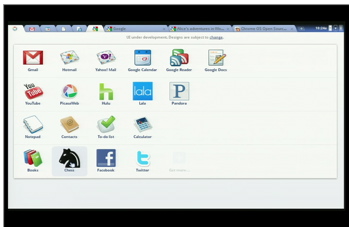
10:24am PT: Instead of browser tabs, they have become “application tabs,” and the far left tab is a menu of Web apps, there are also dedicated tabs for gmail, Google Docs, etc. “Panels” pop up from the bottom which can lay Web apps on top of one another.
10:21am PT: The UI is meant to feel like a browser, so it looks like the Chrome Browser. (as TechCrunch found out several weeks ago.) Bear in mind, this is a whole year ahead of release, so code is still being checked in right now.
10:19am PT: Chrome OS promises a 7 second cold boot. (though I counted 12 seconds in the demo…)
10:18am PT: Chrome OS is a “better model for personal computing,” focused on: speed (“we want it to be blazingly fast, like a TV”) simplicity (every application is a web application, nothing to maintain, all data is cloud data…sort of like a dumb terminal without the “dumbness”) and security (“we run completely within the browser security model”)
10:14am PT: Trends that Google is excited about: Growth of Netbooks, Growth of cloud usage, Convergence of phone and computer functionality.
The MENC Legislative Memo is a new communication that aims to update MENC members and music educators on music education policy. The first edition was e-mailed to MENC leaders this week and also can be viewed online.
The first issue discusses how MENC worked to change draft rules for the new federal Race to the Top program. Visit the U.S Department of Education Web site to read the final application, major changes made to the rules based on comments from groups like MENC, as well as a Race to the Top application.
According to the Department of Education, the Race to the Top program will offer "achievable plans for implementing coherent, compelling, and comprehensive education reform. Race to the Top winners will help trail-blaze effective reforms and provide examples for States and local school districts throughout the country to follow as they too are hard at work on reforms that can transform our schools for decades to come."
The newsletter will post approximately every two weeks and will include links to a variety of advocacy materials including MENC’s SupportMusic "Make Your Case" database, as well as links to other legislative matters in which MENC and music educators have an interest.
The online music business has proven a tough nut to crack again and again. Pioneering free service iMeem is more or less dead in its current form and in the process of being acquired by MySpace. Countless others have failed to provide a free music streaming service that actually generates revenue and it looks like Europe’s music streaming darling Spotify won’t be able to deliver on the promise in the US either.
This has been known for a while, as the service has pushed back plans to launch in the US after concerns that it won’t be able to offer a free music streaming service like it does in Europe. And now the major music labels are “concerned” that the free model just doesn’t work and it would be unwise for Spotify to launch the same service in the US, as the Financial Times reports (subscription required).
They are right to be worried too, free music streaming services in the US have failed over and over again and the last bastions are closing down too. iMeem is about to be sold with its future uncertain and MySpace Music may stop offering free streaming not too far in the future.
There’s just one small glitch in the labels’ rhetoric though. While it’s true that free services have failed, the reason they have failed has entirely to do with the ridiculous … (read more)


 Google doesn’t really like big product and feature launches. It’s about to have one very, very soon as it unleashes Google Chrome OS into the world, but for the most part its products and services evolve slowly with small but regular updates. Sometimes though, these small features may be a lot more important than they would appear at first glance. Take today’s announcement of a very small feature available now in Gmail labs notifying users that their chat buddies are currently connected using Android-powered devices.

 Employee shares of Facebook are selling for $21 on
 Picture a house with absolutely filthy exterior basement windows, the kind that just barely peek out above ground level. The owner can’t see through the things, and they need a thorough washing. He could grab the bucket and a rag and squat or kneel down to commence cleaning. He could make it easy on himself, but for some bizarre reason, he doesn’t.
 AT&T isn’t the only operator whose network shortcomings have been exposed
 I spend an awful lot of time poking around in the App Store in both iTunes and on my iPhone, just in the hopes of finding something new and exciting to download and use on my device. It’s not an ideal situation, and I often wish Apple would throw out its tired model and completely restructure the App Store from the ground up.
 The best part of Mplayit, from the standpoint of people who need to see to believe, is that most apps come complete with videos and images previewing the functionality of the software running on an actual iPhone, and a full text description, too. That’s what puts Mplayit ahead of other iPhone app discovery sites like


 Some of us like music a lot. We love it so much that we buy it from the Internet, we take it with us to different places, and we just can’t get enough of it, no matter where we are. Some of us even have some huge and pretty impressive collections of various kinds of music. Rock, pop, techno, classic, each one has its different style and approach to the listener.



 The online music business has proven a tough nut to crack again and again. Pioneering free service iMeem is more or less dead in its current form and in the process of being acquired by MySpace. Countless others have failed to provide a free music streaming service that actually generates revenue and it looks like Europe’s music streaming darling Spotify won’t be able to deliver on the promise in the US either.