Author: Serkadis

  • Survey shocker: 75 percent of respondents’ Xbox 360s died within 18 months of purchase

    redring

    Look at CNET, breaking news left and right. The site ran a little survey asking its UK readers how many times their video game consoles crashed. No surprise: the Xbox 360 leads the pack with a full 60 percent of heaving died (due to the red ring of death). The PS3 comes in at 16 percent (yellow light of death?), and the Wii is only 6 percent.

    Let’s focus on the Xbox 360 numbers. The most amazing thing to come from the survey is how quickly people’s Xboxen broken. It turns out that only 25 percent of those broken Xboxen lasted more than 18 months. So, 75 percent of those Xboxen didn’t even make it to month 18. That’s ridiculous.

    One thing to keep in mind about this survey: it wasn’t a random sample. So we’re not saying that 75 percent of all Xbox 360s will, or have, broken within the first 18 months, but that 75 percent of respondents’ Xbox 360s broke within the first 18 months. It might well be that put-off Xbox 360 owners filled out the survey to “stick it” to Microsoft. Owners of broken Xboxes, unite! That kind of thing.

    But the overall story—the Xbox 360 is not reliable—is nothing we didn’t know before. I’ve had two Xbox 360s die on me since August, 2006.


  • Resident Evil 5 Alternative Edition to add another episode and more costumes

    If you thought that the Alternative Edition DLC for Resident Evil 5 was simply going to be a single scenario and motion control support, think again…

  • Mahindra Truck Still Scheduled For North American Introduction

    Mahindra_Pickup_Truck_3

    Some reports have suggested the new pickup truck from relatively obscure (at least to those outside of the farming industry) Indian company Mahindra & Mahindra will be delayed until 2010, but official Mahindra spokespeople stepped forward today to confirm otherwise. Although the global recession forced the company to push their North American launch back by a few months, they still adamantly maintain that their ingaural line of trucks will touch down in U.S. dealerships sometime in 2009. To begin, only two body styles will be available including a 2-door regular cab and 4-door crew cab dubbed TR20 and TR40, respectively. The lone engine option will purportedly be a 4-cylinder common rail diesel.

    Why you should care: According to speculation, Mahindra’s primary target will be the legitimate Land Rover crowd (ie: hardcore off-road enthusiasts) and both the TR20 and the TR40 will be geared towards only the most utilitarian functions. Interior amenities are expected to be relatively spartan and all preliminary indicators suggest Mahindra will be providing the modern day equivalent of a W460 (read: all the capability, plus a warranty) – priced at thousands less.


  • PlayStation 3 3.10 firmware brings Facebook to PS3 today

    Did you think the would be the only console to integrate Facebook functionality? If so, Sony has another thing coming for you, as they are launching firmware 3.10 for the PlayStation 3 today, and, you guessed it, Facebook integration is included. Check out the video above to check out how it works, but in a nutshell, you’ll be able to have the PS3 post different events to your Facebook feed, like purchases, trophies, and in-game happenings. Other changes in PS3 firmware 3.10:

    • You can choose a color for your PSN ID badge
    • Photos are now displayed in a grid rather than a single column
    • The friends list has been modified, based on feedback from the community

    The update will be out today.


    Tags:
    ,
    ,
    ,
    ,
    ,
    ,
    ,
    ,
    ,
    ,
    ,
    ,

    PlayStation 3 3.10 firmware brings Facebook to PS3 today originally appeared on Playfeed on Wed, November 18, 2009 – 10:18:26


  • LTE Advances Across Asia

    The Asia-Pacific region is getting ever-closer to faster mobile broadband, with network operators in Japan, Singapore, Australia and Indonesia readying their Long Term Evolution networks. Today NTT DoCoMo, Japan’s largest mobile operator, affirmed its plans to deploy LTE in 2010; it also said it would shut off its 2G network in March 2011 since most subscribers now have 3G phones. NTT DoCoMo had previously said it would keep the 2G network running until December 2012. Speaking at the GSM Association’s Mobile Asia Congress 2009, Ryuji Yamada, president and CEO of NTT DoCoMo, said LTE data cards will be ready in 2010 and handsets will be ready in 2011.

    Singapore Telecommunications, the largest carrier in Singapore with operations in Australia, Indonesia and the Philippines, also disclosed plans for LTE trials. SingTel has chosen Alcatel-Lucent as its equipment vendor for the trials, which will begin in the first half of 2010 and take anywhere from six to nine months. The network operator hopes the trial will help it and its regional associates and joint ventures better understand LTE and determine the best approach and strategy for its adoption in their respective local markets. Meanwhile, here in the U.S., we await Verizon’s and MetroPCS’ 2010 deployments, with netbooks and smartphones in hand.


  • It Is Better to Have Teabagged and Lost, Than Never to Have Teabagged at All

    Last week, I reported that teabagging candidate Doug Hoffman still had a chance of winning the NY-23 congressional seat away from Democrat Whatever His Name Is and thus averting the tragedy of surrendering that seat to a Democrat for the first time since it was legal in the country to own human beings.

    Well, he's still got a chance, but it's not looking quite as chancerific as it was last week. Say la vee. (La vee.)

    This leads us to wonder if Republicans — despite growing dissatisfaction with congressional Democrats — the the GOP could still be getting ready to Scozzafava away all of its moderate (reasonable) candidates for 2010 and still end up losing ground.

    According to this poll from CNN, that seems to be a possibility

    The poll indicates that a slight majority, 51 percent, of Republicans would prefer to see the GOP in their area nominate candidates who agree with them on all the major the issues even if they have a poor chance of beating the Democratic candidate. Forty-three percent of Republicans say they would rather have candidates with whom they don't agree on all the important issues but who can beat the Democrats.

    Democrats polled seemed to place a slightly higher priority on electoral victory: 58 percent say that they would like their party to nominate candidates who can beat Republicans, even if they don't agree with those candidates on all the issues. Fewer than 4 in 10 Democrats say they would rather see their party nominate candidates who agree with them on all major issues, but have a poor chance of beating the Republican candidate.

    Translation: Republicans are obstinate and unrealistic, while Democrats are cowardly and accepting of mediocrity.

    So, this poll gives us no new information.

  • AMD releases dual GPU beast, Radeon HD 5970

    AMD Radeon HD 5970

    As the prophet Tim “The Tool Man” Taylor used to ask his audience, “what do we want?” More. Power. AMD has just released its dual-GPU ATI Radeon HD 5970 graphics card, and the specs are pretty ridiculous. Aside from having two GPUs capable of 4.64 teraflops of number-smashing goodness, the 5970 also comes standard with a 725 MHz engine processor (which can be overclocked), a 1 GHz memory clock, and 2 GB of GDDR5 RAM. Now, for those of you with 90-inches of screen real estate to fill, the 5970 can output in resolutions all the way up to 7,680 x 1,600. Direct X11, Open GL 3.2, and Open CL 1.0 compliance also made their way onto the stat sheet. Makes you want to fire up Mindsweeper and really put this puppy through its paces, doesn’t it? $599 is the number for this monster, if you haven’t fallen off your chair yet.

    P.S. In addition to two DVI ports, the Radeon HD 5970 also includes a Mini DisplayPort

    Read

  • Microsoft gives free laptops to PDC 2009 attendees

    By Joe Wilcox, Betanews

    Windows 7 took the Professional Developer Conference stage this morning in the guise of Steven Sinofsky, president of Microsoft’s Windows & Windows Live division. Sinofsky stood before the crowd of Microsoft developers as a victor. Last month, his team released Windows 7 nearly flawlessly and to generally positive reviews (PDC Day 2 live blog).

    Sinofsky did not pitch a three-screen strategy — PC, TV and mobile device — as I expected based on statements Ray Ozzie, Microsoft’s chief software architect, made during the Day 1 keynote. For PDC, Microsoft is missing one screen. The company doesn’t plan to announce its next-generation Windows Phone — or Windows Live, for that matter — until next year’s MIX conference.

    Sinofsky started by talking about Windows 7 development. “It’s an incredibly humbling experience,” he said. Sinofsky described developing Windows as building a movie theater. The movies are the applications developers create.

    Sinofsky’s keynote was exceptionally targeted to a developer audience and superbly delivered. He spoke practically about how Microsoft used different feedback mechanisms to improve Windows 7 development.

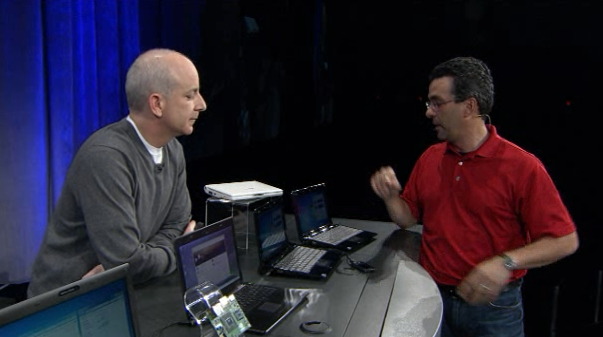
    In a stunning announcement, Sinofsky told the audience that paid PDC attendees would receive a free thin-and-light laptop that Microsoft designed with Acer. Microsoft designed the laptop with features and baseline hardware for which developers should create their applications. Touchscreen is among the capabilities.

    Sinfosky Windows 7 Demo

    Microsoft has given Sinofsky a difficult role: Pitchmen for revitalizing an aging platform, even as developers flock to the cloud and to mobile devices, where Apple’s App Store/iPhone/iPod platform is highly visible. About two weeks ago, Apple announced that the number of mobile applications available from App Store topped 100,000.

    The Netbook Problem

    Microsoft’s mobile problem is really twofold: Netbooks and smartphones, and the company appears ill-prepared to deal with either. Netbook sales are surging. For example, netbooks accounted for about 20 percent of all portable PC sales to EMEA (Europe, Middle East and Asia) in third quarter, according to Gartner. The netbook problem reduces Microsoft’s operating system margins; the company makes less money on Windows XP Home or Windows 7 Starter Edition than “premium” versions. Netbooks also tend to be underpowered compared to notebooks or desktops, making them better suited to running some cloud applications and services. I say some, because many cloud apps or services are resource intensive, too.

    Microsoft’s PDC attendee laptop giveaway is a brilliant response to the netbook problem. The company has talked about thin-and-light laptops as better alternative to netbooks — and for good reasons. Thin-and-light laptops offer many of the size-and-weight advantages of netbooks but with potentially hardier hardware performance, better customer experience and greater operating system margins for Microsoft.

    Smartphone OS Q3 2009

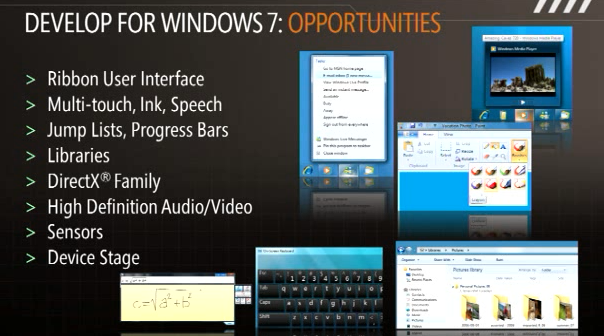
    Sinofsky asked developers to use Windows 7’s Device Stage to get applications “out of the boot path.” The feature lets users call up software services or applications when they are needed rather than having them run in the background. Applications or services in the boot path can slow down system startup or resume from sleep and degrade overall Windows performance. While Sinfosky didn’t specifically mention netbooks, the request would have huge potential performance and customer experience impact on the underpowered portables.

    Windows Mobile Declines

    Smartphones and other super small devices pose different problems for Microsoft. Smartphones like iPhone, Motorola DROID or Nokia N900 are as much pocket computers as cell phones. Like netbooks, they are designed to connect via 3G networks or WiFi to cloud services. Gartner predicts that smartphone sales will exceed notebooks this year, and that in response major PC manufacturers will develop their own devices, starting in 2010. Dell already is doing so.

    Smartphones are tracking to be the next major computing platform. A year ago next month, PEW Internet predicted that “the mobile device will be the primary connection tool to the Internet for most people in the world in 2020.” A year more of smartphones later and 2015 is looking to be a more realistic date.

    Windows 7 Development

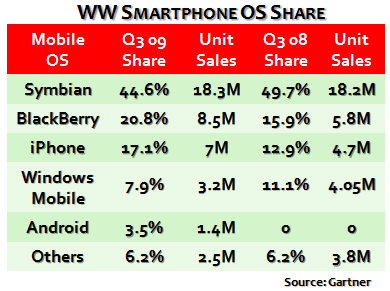
    According to Gartner, manufacturers sold 41 million smartphones during third quarter, for a 12.8 percent year-over-year increase. Smartphones accounted for about 13 percent of worldwide handset sales. Nokia (39.3 percent), Research in Motion (20.8 percent) and Apple (17.1 percent) are the smartphone market share leaders. None of these leading smartphone manufacturer leaders ships Windows Mobile.

    Microsoft’s mobile operating system is in decline. During third quarter, Windows Mobile worldwide market share fell to 7.9 percent from 11.1 percent a year earlier, according to Gartner (see chart). Meanwhile, Android, BlackBerry and iPhone operating systems all gained share. Android went from zero shipments in third quarter 2009 to 1.4 million units a year later, for 3.5 percent market share. Android gains are expected to increase. HTC and Sony Ericsson are among the handset manufacturers swapping out Windows Mobile for Android.

    Microsoft’s inability to articulate a clear mobile OS strategy undermines the overall messaging around Windows 7 development, or three screens. Should developers look to the past platform or to the future one? Perhaps for some of them, a free laptop will answer the question.

    Copyright Betanews, Inc. 2009


    Add to digg
    Add to Google
    Add to Slashdot
    Add to Twitter
    Add to del.icio.us
    Add to Facebook
    Add to Technorati


  • iCarte Turns the iPhone Into an RFID Reader

    Earlier we reported that the next generation of iPhone might have an RFID (Radio Frequency Identification) reader built in, if rumors prove true. Well, there’s no need to wait that long, if near-field communications (NFC) is what you’ve got a hankerin’ for. Wireless Dynamics has announced a device called the iCarte that will add both RFID and NFC capabilities to the iPhone.

    The device adds functionality to the iPhone via the dock connector, to which it connects without adding too much bulk or without being too much of an eyesore. In fact, it looks like the iCarte’s designers went out of their way to make sure the add-on looks like it’s a natural extension of the iPhone itself, rather than an apparent third-party accessory.

    A chip embedded in the iCarte turns your iPhone into a portable electronic wallet, able to process contactless payments. It can also transmit any information it receives directly to enterprise databases using Wi-Fi or 3G network connections, so that orders and purchases can be automatically input into your company’s home server. Of course, in order to use the iCarte, you’ll need to be using iPhone OS 3.0, since only the latest major software update supports dock accessory connectivity.

    The iCarte also has a mini-USB port to allow for pass-through charging and syncing, so you won’t have to constantly remove and replace the device, and it comes in both black and white, in case fashion is a concern of yours. To be clear, while Wireless Dynamics does talk about business applications, it looks like the iCarte’s functionality is aimed primarily at people on the consumer end of the retail equation:

    iCarte has an embedded smart-chip that can be configured as debit, credit, pre-paid and loyalty cards, for secure contactless transactions. iCarte can also read NFC Smart Posters, download or upload electronic coupons, tickets or receipts. iCarte is ideal for iPhone users who want to use their iPhones for fast and secure contactless payments, transit payments, loyalty rewards, checking balances, top-up, discovering new services from smart posters or kiosks and exchanging information with other NFC phones.

    iCarte’s web site is devoid of information regarding an official release date or pricing for the receiver, although it does offer contact info if you’re interested in finding out more about the tech. Presumably a companion iPhone application would be required for programming in payment card information, checking balances, etc., but as of yet no such app is available via the iTunes Store.


  • The fourth day of Peek-Mas


    We’re giving away five Peek Protos this week, one a day, and we want you to ask us nicely for one so we can give you one. What I’m basically trying to say is that you should respond to this post with a comment (using your real e-mail address) and also follow CG on Twitter and watch the Gift Guide for more special things.

    Also check the Twitter stream today and tomorrow.


  • Walmart Black Friday ad

    walmart

    Walmart’s Black Friday ad is here, packed full of holiday goodies. Stores open at 5AM Friday morning and doorbusters will be available until 11AM.

    Here’s a list of gadget-related items. Doorbusters are marked with an asterisk.

    Computers

    Acer 17.3″ Blue Laptop w/4GB Memory, 320GB Hard Drive and Windows 7 Premium (Online Only) – $498.00

    eMachines 15.6″ Notebook w/AMD Processor, 2GB Memory, 160GB Hard Drive (Model # EME627) – $198.00 *

    HP 15.6″ Notebook w/Intel Processor, 3GB Memory, 250GB Hard Drive (Model # G60-519WM) – $298.00 *

    HP 17″ Notebook w/4GB Memory, 320GB Hard Drive (Model # G71-329WM) – $398.00

    HP Pavilion All-In-One 19″ Desktop w/4GB Memory, 500GB Hard Drive, MS213 AMD – $598.00

    HP Pavilion Desktop w/AMD Processor, 3GB Memory, 320GB Hard Drive, w/20″ Monitor (Model # P6243w-b) – $398.00 *

    Digital Cameras

    Kodak C82 12.0 Megapixel Digital Camera – $69.00

    Nikon CoolPix S230 10MP Digital Camera – $139.00

    Sony Cyber-Shot DSCS930 10.0 Megapixel Digital Camera – $79.00

    Digital Media Cards

    Sandisk 4GB SDHC Card – $8.00

    Sony 4GB Memory Stick – $20.00

    DVD Players

    Magnavox NB500 Blu-ray Disc Player – $78.00 *

    Samsung BD-P1590 Blu Ray Player (Saturday) – $148.00

    Sony BDP-S369 Blu Ray Player – $148.00

    Electronics

    8″ LCD Digital Photo Frame – $29.00

    Philips 6′ Gold HDMI Cable – $19.00

    Philips 7″ Portable DVD Player – $49.00

    Philips Earbuds – $10.00

    Samsung MX20 Red Camcorder – $149.00

    GPS Systems

    TomTom One 125-SE GPS – $59.00

    TomTom XL325-SE GPS – $89.00

    Hard Drives

    Western Digital 1TB 3.5″ External Hard Drive – $78.00

    Western Digital My Passport Essential 320GB Hard Drive – $49.00

    Miscellaneous

    Duracell UltraAdvanced AA/AAA 6-Pack – 2 For $5

    Energizer Ultimate Lithium AA 2-Pack – 2 For $5

    Rayovac AA/AAA 12-Pack – 2 For $5

    MP3 Players

    Apple 8GB iPod Touch w/$50 iTunes GC – $195.00

    Phillips 4GB MP3/Video Player – $29.00

    Sony iPod Speaker – $69.00

    Networking

    Belkin N 150 Router – $29.00

    Portable USB Storage

    Sandisk Cruzer 4GB USB Flash Drive – $8.00

    Printers

    HP Deskjet F2430 All-In-One Printer – $25.00

    Kodak ESP5250LE Wireless Printer – $99.00

    Televisions

    Emerson 32″ LC320EMFX LCD 720P HDTV – $248.00 *

    Emerson 42″ PL-P42W-10A Plasma 720P HDTV – $448.00 *

    Flat-Panel TV Stand – $89.00

    Philips Large Fixed TV Mount – $69.00

    RCA 46″ LCD 1080p HDTV (Online Only) – $688.00

    Samsung 32″ LN328360 LCD 720P HDTV (Saturday) – $398.00

    Samsung 42″ LN40B500 LCD 1080P HDTV (Saturday) – $598.00

    Samsung 42″ PN42B400 Plasma 720P HDTV (Saturday) – $548.00

    Samsung 46″ LN46B500 LCD 1080P HDTV (Saturday) – $848.00

    Samsung 50″ PN50B400 Plasma 720P HDTV (Saturday) – $698.00

    Sansui 19″ HDLCD1909 LCD HDTV – $128.00

    Sayno 50″ DP50719 Plasma HDTV – $598.00

    Sony Bravia 32″ KDL32L504 LCD 720P HDTV – $378.00

    Sony Bravia 40″ KDL40S504 LCD 1080P HDTV – $598.00

    Sony Bravia 46″ KDL465504 LCD 1080P HDTV – $798.00 *

    Video Games

    2K Sports NBA 2K10 For Xbox 360 – $25.00

    Are You Smarter Than A 5th Grader For PS2 – $7.00

    Bakugan For Nintendo Wii – $25.00

    Big Beach Sports For Nintendo Wii – $10.00

    Call Of Duty 4 Modern Warfare For PS3 – $25.00

    Carnival Games For Nintendo Wii – $10.00

    Celebrity Sports Showdown For Nintendo Wii – $7.00

    Comand And Conquer Red Alert 3 For Xbox 360 – $7.00

    EA Sports Madden 10 For PS2 – $25.00

    Grand Theft Auto IV For Xbox 360 – $10.00

    Lock’s Quest (Nintendo DS) – $7.00

    Midnight Club Los Angeles (Xbox 360) – $10.00

    MX Vs ATV Untaimed (Nintendo DS) – $10.00

    Need For Speed Undercover (PS3) – $10.00

    NeoPets Puzzle Adventure (Nintendo DS) – $7.00

    Nintendo DS Lite – $98.00 *

    Nintendo DS Lite Starter Kit – $10.00 *

    Nintendo Wii Value Bundle With Console, Remote, Nunchuck, 2 Games And An Extra Set Of Nyko Controllers (Online Only) – $249.00

    Over 30 Games For $25 – $25.00

    Over 40 Games For $10.00 – $10.00

    Over 50 Video Games For $7.00 – $7.00

    Playstation 3 Console w/Infamous & Batman Arkham Asylum Games + Dark Knight Blu-ray – $299.00

    Rock Band Special Edition (PS3) – $50.00

    Rock Band Special Edition (XBox 360) – $50.00

    Suzuki TT Super Bikes (PS2) – $7.00

    Tak And The Guardians Of Gross (Nintendo Wii) – $7.00

    The Godfather II (PS3) – $10.00

    The Sims 3 For PC/Mac – $25.00

    Tiger Woods PGA Tour 10 (Nintendo Wii) – $25.00

    UFC 2009 Undisputed (Xbox 360) – $25.00

    WWE Smackdown Vs Raw 2009 For PS3 – $25.00

    Xbox 360 Arcade w/Madagascar 2 Game & w/Madagascar & w/Madagascar 2 Movie DVDs – $199.00

    X Rocker Turbo Sound Gaming Chair – $35.00

    Walmart Black Friday Ad [BlackFriday.info]

    More Black Friday posts here…


  • Cable Industry Joins MPAA In Asking FCC To Allow Them To Stop Your DVR From Recording Movies

    Ars Technica has allowed the cable industry lobbyists’ top lawyer to explain why the cable industry supports breaking your DVR in a misguided effort to add more windows to movie releases. Not surprisingly, he simply repeats the MPAA’s flat out lies and misrepresentations on this particular issue. For example, he claims that the movie studios need this or they won’t get content out to the industry early enough. But that’s wrong. There is nothing stopping the movie studios from releasing content whenever they would like. In fact, we’ve already seen that some of the major studios are releasing movies in exactly this manner (prior to DVD release), despite claiming that it’s impossible to do so without enabling this form of DRM.

    If the movie industry wants to add a new window where they release movies for pay-per-view offerings before they come out on DVD, there is nothing stopping them from doing so today. Nothing.

    The claim that this is about preventing “piracy” is flat out bogus. Even the movie studios themselves claim that nearly every movie is already “pirated” by the time the movies hit the theaters. And these pay-per-view offerings (they like to call them video on demand, but it’s really pay per view) are for a window later than the theater release. So the movies will already be available via unauthorized channels. That won’t change at all.

    So, what are we left with? The two main arguments simply don’t make sense at all. There’s nothing stopping the studios from adding this window now. And enabling selectable output control (SOC) to stop your DVR from recording these movies won’t do a damn thing to reduce unauthorized file sharing of the same content. The only thing it will serve to do is make legitimate customers pissed off, because they’ll be confused and annoyed when the DVR they purchased to record what comes out of their TV sets refuses to record this movie that they legally are accessing, but want to time shift (which, again, is perfectly legal).

    Contrary to the MPAA and the NCTA’s bogus claims, this has nothing to do with enabling some “awesome” new service. This has everything to do with trying to lock down your TV and DVR in an age when consumers are finally getting back some control. What’s amusing, of course, is that this comes just as the TV industry is finally realizing that letting consumers do what they wanted with DVRs didn’t harm the TV industry, but helped it. One of these days, maybe the MPAA and the NCTA will come to that realization as well. In the meantime, though, they want to get a foot in the door to let them stop your DVR from working as advertised, in the misguided belief that they need to push back on what legitimate consumers want to do with the content they watch.

    Permalink | Comments | Email This Story


  • Seesmic Releases a Native Twitter Client for Windows

    Twitter owes much of its popularity to the ecosystem of third-party apps and services that has sprung up around it. In fact, a big chunk of Twitter’s userbase doesn’t visit the site itself, but connects to the service via third-party desktop or mobile clients. On the desktop front, two players are battling it out for the title and, interestingly, both clients are built on top of the Adobe AIR platform. Now, though, Seesmic wants to get ahead by launching a dedicated Windows client, which offers several advantages over the AIR version like drag and drop and the possibility for a plug-in platform.

    “[W]e are extremely proud to announce that our most popular twitter client is now available as a feature-rich native application for Windows,” Seesmic announced on its blog. “Partnered with Microsoft, engineered for Windows and optimized for Windows 7, this preview version of Seesmic for Windows combines the best features from of our ever-popular social application and provides it to you in a native Windows environment.”

    Seesmic already builds a very popular client and the fact that it used AIR to do it didn’t seem to hinder its growth so far. Add to this the fact that the app works on Windows, Mac and Linux without having to write separate code for each platform and there doesn’t … (read more)

  • How Can You Stand Up for America While Sitting Down to Pee?

    Obviously, the biggest problem facing America today is that most male college professors, ACLU representatives and Democratic presidents have turned their back on the Biblical act of standing up to "pisseth," opting instead to sit down, probably so that they can more easily paint their toenails while peeing.

    This guy knows what I'm talking about…

    (via Pharyngula)

  • Facebook Integration For PS3 Lands Today

    Facebook is coming to a PS3 near you as part of the latest 3.10 update, which will be rolled out over the course of the next day. We knew it was coming, but Sony has been vague about exactly when the update would land. Turns out it was sooner than most people probably guessed, coming only a day after the November 17 release of Facebook’s integration with the Xbox 360.

    Here are some of the features listed on the press release Sony just issued about the update:

    Showcase Trophies: Instantly share trophies you earn in PS3 games in your Facebook stream. Simply sync your PS3 system and easily show off your accomplishments to friends and family.

    PlayStation Store Purchase Log Publishing: Let friends and family on Facebook instantly know which PlayStation 3 games you’ve purchased. The PlayStation Store, available to PS3 and PSP® (PlayStation®Portable) system owners through PlayStation Network, features over 200 downloadable games, many of which are exclusive to PS3 or PSP system owners, in addition to over 4,000 pieces of add-on game content.

    Game Event: With a few quick clicks of the controller sharing select game events, progress and statistics is now easier than ever with the Facebook integration.


  • Parenting Dilemma: Kids and Weight

    boybroccoli Parenting Dilemma: Kids and WeightSome of us have kids who seem to naturally flock to sports and physical activity. And while they might not resist every food temptation typical for their age group, they somehow pull together a pretty solid diet. Still others of us have children who aren’t necessarily the best eaters or exercisers but who seem (for now) more or less immune to the weight gain that might inspire better habits. Finally, some of us parent kids who truly struggle with weight. And even while poor food choices and low activity levels clearly contribute to most children’s problems, occasionally there are kids who, despite good habits, continue the battle into adulthood.

    For our part, as parents, we see both sides. We worry for our kids’ health. We hope for their social acceptance even as we encourage them not to depend on it. We want them to take good care of their bodies, enjoy the physical energy and potential of youth. We want them to be and feel their best. Meanwhile, we want them to know they’re amazing, beautiful and beloved just the way they are. We know what we want to do, how we want them to feel, but then there’s the sticky reality of it. What’s the right message exactly? How do we figure the perfect balance in communicating and cultivating all our good intentions for our kids’ health?

    A New York Times article, “Parenting and Food: Eat Your Peas. Or Don’t. Whatever.”, picks up this dicey parenting issue. It’s a discussion of the blurry lines between how to foster healthy habits without inhibiting a healthy self-concept. As any parent (or person who has any recollection of the awkward adolescent years) knows, taking on this issue can involve navigating an emotional mine field. One wrong move, and you face an explosion of tempers, guilt, and other psychological shrapnel. The long-term stakes, we learn, are high. Research has shown that fathers’ communication about and even “attention to” their daughters’ weight can raise their “risk of eating disorders.” Children of parents who promoted dieting “were significantly more likely to remain overweight than those whose parents didn’t.”

    Frank Bruni, the author of both the Times article and recent memoir Born Round: The Secret History of a Full-Time Eater, illustrates the precarious landscape with stories of hesitant parents attempting their best acrobatic acts. He gives us stories of parents who’ve diligently striven for “balanced meals and restrained portions.” On the other hand, Bruni gives us another angle of parental concern, a resistance to what some parents see as a tendency toward broader deprivation – a missing the forest through the trees if you will. As one mother put it, she wants to instill healthy habits but not deny her daughter the basic “psychological pleasures that come from sitting at a table and enjoying a meal.”

    Bruni’s article ends by rounding up several points of expert consensus. Most are basic and commonsensical. First, of course, he says parents should model healthy eating and exercise habits. It’s the old “Do what I do, not what I say” principle. Other effectual strategies include stocking the house with healthy options and planning dinners with homemade fare. Finally, he says with a personal note, it’s important to find a substitute “activity” that can provide a “similar emotional gratification” children may have previously associated with food.

    I found Bruni’s article engaging, relevant and thought-provoking. It got the Worker Bees and I talking. We had a slew of questions but few clear answers. (Isn’t that always the case in parenting though?) What do kids need and want to hear? How do parents inspire the best balance between emotional self-acceptance and physical self-investment? How much should we as parents demonstrate and divulge of our own struggles exactly?

    I thought I’d take up the conversation here with you all. I’ll throw out a few thoughts, and I hope you’ll add yours to the discussion.

    Clean up the family diet and environment.

    A physiological point first… Parents want to help their kids make good food choices and get plenty of physical activity. However, there’s another often missed piece to the puzzle. The increasing presence of toxins in our everyday environment and food supply can contribute to a myriad of health problems, including weight issues. Toxins, particularly in children, can disrupt basic hormonal balance. This disturbance can throw off the metabolic processes responsible for energy conversion and, particularly in tandem with a poor diet, boost fat storage. It’s a good excuse for explaining why a “good diet” entails more than a menu: it means fostering an educated and thoughtful mindset toward eating and health.

    Be honest (first with yourself) about your relationship with food and/or your physical self-image.

    Perhaps having lived a similar experience, we can identify on some level with our kids. If we were overweight once upon a time, we can understand what it’s like to struggle with weight as a child/teenager. Yet, once in a while we have to step back and ask ourselves if our level of concern has more to do with our child or our own past? In short, are we helping or projecting – or some combination of the two? Maybe we’re still struggling with weight or other body image issues. Regardless of how we approach our health and what priorities we focus on, our children are undeniable witnesses to our lives. They see our daily endeavors, and they undeniably pick up on our self-talk. What messages are we sending (consciously and unconsciously)?

    If your child is old enough, have a heart-to-heart about experiences with health, body image and weight. Divulge honestly – but selectively. You can show your kids you identify without burdening them. Most importantly, talk about where you get your sense of perspective. What guides you, motivates you and grounds you day to day? What have you learned that you wish you knew earlier in your life? What do you hope they enjoy about living a healthy life and taking care of themselves?

    Talk about what health really means.

    It’s pretty easy for kids to grow up not really having a clear understanding of health. Hey, most adults don’t get it either. If I’m not sick, I must be healthy, right? Health as a concept can be a random swirl of disconnected images for kids: food pyramids, sweaty gyms, sports icons, a salad bar. How do they put it together? What does it mean to be healthy? To feel healthy?

    In the vast array of images and messages out there, kids have to be pretty thrown by the paradoxical shape of it all. On the one hand, there’s infinite fun to be had in downing every variety of fast food, sodas, energy drinks, chips and other snack abominations (just look at the youth-centered commercials). On the other, there are tabloid articles about celebrity crash diets and stories of their three hour a day workout routines. Our culture encourages either disregarding or punishing the body – making a joke of physical health or exercising/depriving ourselves into the ground. The result? As a culture we don’t have the most comfortable relationships with our bodies. It’s little surprise that many of our kids absorb this mindset.

    Parents, unfortunately, have a lot of ground to fill in. Find a chance to talk about what health means to you personally. How did you come to learn about healthy eating? Why do you make the choices you do? What gets you motivated to stay active, to keep your stress under control? When do you feel the best physically? Ask them what makes them feel healthy, strong and rejuvenated? Is there a way you can help support those experiences (e.g. emotional support or family activities)? Let it be an open and continuing conversation. Let it be a catalyst for healthy changes and experimentation. Let it be a challenge to your family to play more, cook more, do more, get out more.

    Talk about what living really means.

    This website is all about health, yes. Nonetheless, I put health squarely into a large picture of happiness and vitality. Too often the messages kids get come off as instructive but less than relevant and inspiring. In the midst of navigating the social scene, figuring out an identity, and finding their way through school and other responsibilities, dry details can quickly fall on deaf ears. Consider a different angle. We hear a lot of success stories from people who have overcome serious health issues, dropped weight that they’d wanted to lose for years (or decades), and/or turned around their lifestyle to gain a whole new sense of energy in their lives. A common thread in so many of their accounts is a sense of self-investment. Whether a serious medical scare that made them realize how precious (and endangered) their lives were or the culmination of a deep soul-searching, something sparked a novel sense of ownership. Their health mattered more because they’d chosen to see it and value it in a new way.

    Maybe talking to kids about real health ultimately means talking about life. Owning your health necessitates – on some level – knowing and respecting yourself. It’s a self-commitment after all. The more self-confidence and self-respect we have, the more likely we are to invest in ourselves.

    For kids who struggle with weight and body image, too often the goal is outside themselves, remote and elusive. How can the goal finally be authentically personal? What does it mean to dig down and learn to tune out the noise in life – the social clamor, the media messages? What’s there to listen to once you reach the other side of the commotion? How, finally, do they see themselves there? What does their vision of a healthy and happy life look like from that vantage point? Kids, like the rest of us, shape their health a step at a time. Maybe a parent’s best role is to help them start down their own path.

    And now…let me know what you think. What should kids hear growing up? How can a parent walk the line to empower their kids’ overall health and well-being? How do we avoid the traps that either alienate or enable? I look forward to reading your thoughts. Thanks for reading.

    Get Free Health Tips, Recipes and Workouts Delivered to Your Inbox

    Related posts:

    1. Dear Mark: Weight Loss and Workout Routine
    2. Dear Mark: Healthy Body Weight?
    3. Trick or Treat: Yea or Nay?

  • Apps don’t make the platform

    Marketplace-Capture According to Microsoft’s chief software architect, Ray Ozzie:

    “All the apps that count will be ported to every one of them,” he said. “It’s a completely different situation from the PC market, where software’s built to run on a Windows or a Mac” he said. “Mobile apps require very little development, so it’s much easier to bring them onto every platform”.

    In many ways I agree, the best programs will be popular regardless of the platform, so developers will see market opportunity and develop. What does anyone else think?

    Let us only hope that Marketplace for Mobile sees a boost in submissions!

  • Black Friday 2009: MacMall ad

    MacBook Pro Black Friday

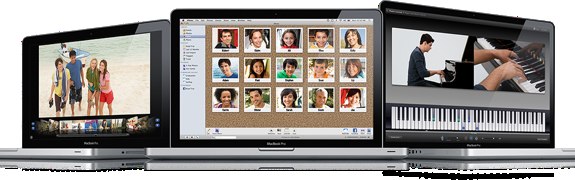
    Here at Gear Live we’re big fans of MacMall. Why? Because they consistently beat Apple in terms of pricing, by way of rebates – and their rebates don’t take forever to process.  MacMall will be having a fairly nice sale on a bunch of Apple gear, as well as a few surprises, like a GPS navigation system, video game consoles, players, and more. Hey, when you can pick up a new 13.3-inch MacBook Pro for $1099, you know something special is happening.

    We’ve got the full list of the MacMall Black Friday deals for you, after the jump.


    Continue reading Black Friday 2009: MacMall ad

    Tags:
    ,
    ,
    ,
    ,
    ,
    ,
    ,
    ,
    ,
    ,
    ,
    ,

    Black Friday 2009: MacMall ad originally appeared on Gear Live on Wed, November 18, 2009 – 9:16:35


  • Fring Now Works on Android, Does Skype VoIP Calls

    Fring, the mobile messaging and social communication tool that works on many smartphone platforms, is now available on the Android platform. Users of Android phones can get the client software from the Android Market or from Fring’s WAP site.

    Fring for Android works over 3G, GPRS or Wi-Fi connections. According to the company’s blog announcement:

    “Android device users can now get onto fring (we know you’ve been missing us since some of you recently switched to Android devices) with (the first) free VoIP calls over Skype, MSN and GoogleTalk and via hundreds of SIP providers. As always you can see real-time presence and live chat with your ICQ, Yahoo! And AIM buddies too. You can also use Twitter there, as part of  your integrated contact list.”

    The “we know you’ve been missing us” snippet in the announcement belongs there, as competitive applications such as Nimbuzz have already been available for Android for some time. Still, free VoIP calls over Skype with Fring will probably be pretty attractive to many users of Android phones, and Fring offers a number of options for keeping up with Twitter.


  • Colbert Better Knows California’s 12th District

    Anyone who knows anything about politics knows the true measure of a legislator isn't his or her voting record, it's how well he or she can gleam the cube (ask your parents). So last night, after grilling California Congresswoman Jackie Speier about her district's plans to cure gayness, Stephen Colbert took to the halls of Congress armed with his board and a hunger for shredding.


    The Colbert Report airs Monday through Thursday at 11:30pm / 10:30c.