Author: Serkadis

  • IBM, VMware and NSEC Agree on Partnership for Office Tools

    The IBM-native Lotus Symphony line of office apps will be offered in its portable version on NSEC products, such as the successful Keepod, the slimmest USB device in the world. IBM, VMWare and NSEC made this announcement on Tuesday, November 19, 2009, through an official press release by IBM.

    This means that users will be able to buy portable USB devices from NSEC with IBM’s Lotus Symphony office tools already installed using VMWare software, like ThinApp (application virtualization software that enables the portable version of Lotus Symphony to work properly).

    The combined solution will be more secure because every time a user will want to access a document on the USB device, Lotus Symphony will open it for them without installing any permanent or temporary files on the host computer. By keeping all the data on the portable stick, user privacy will not be put into any jeopardy of data theft risks. For now, NSEC’s prime product Keepod will benefit from the new partnership.

    “With this Keepod offering, we are able to extend Symphony benefits to many new users,” said Kevin Cavanaugh, vice president, Messaging and Collaboration, IBM Lotus. “Our goal with Lotus Symphony software is to provide a fully capable alternative to Microsoft Office, giving business and consumers al… (read more)

  • Apple Has Been Working on OS X 10.7 for At Least a Month

    Snow Leopard has barely gotten its paws wet, and now news comes that Apple is already working on its replacement. It’s not really surprising, since Apple is basically always either working on the next iteration of its products or releasing them, but still, it does whet the appetite for the next version of OS X.

    The suggestion of the new operating system appeared in an entry posted early this morning in a change database for “launchd,” an open source framework that controls the booting of OS X and administers running processes. The new entry includes an error message with the string “11A47″ in it, which is a reference to what version of Mac OS X is being used.

    Previous versions of OS X have all followed the same numbering scheme. The number at the start of the string references which version of OS X is being used, with the letter indicated the minor release number and finally another number at the end indicating the development progress of said minor release. So, for example, Snow Leopard at release was represented by the string 10A432, and Leopard was 9A571. 11A47, then, would seem to indicate that an early build of 10.7 was being used.

    According to MacRumors, the “47″ part of that number would suggest that Apple has already been working on the new version of OS X for at least a couple of months now. It’s still very early days, though, and probably even a long way off from a release to the developer community. We saw a two-year span between 10.4 and 10.5, but only a one year gap between the release of 10.5 and 10.6, because 10.6 represented mainly performance upgrades and refinements. Chances are, 10.7 is at least another year and a half off.

    No news yet on what to expect in 10.7, although there is reason to believe that the upcoming iteration of OS X will bring more major changes than the last update. Traditionally, Apple introduces far more GUI and basic functionality changes in major point releases, but Snow Leopard was a special exception to that rule, a fact reflected in the price. It’s possible that Apple will release OS 11 at some point, but as of right now, it seems likely that it will continue with the current numbering scheme.

    Anything in particular you’d like to see in 10.7? Maybe something you were disappointed wasn’t there in OS X 10.6? Personally, I still think Finder could use some further fine-tuning, but otherwise I’m at a loss at the moment.


  • Jon Stewart Interviews Vice President Joe Biden

    Last night, Joe Biden made his first appearance on The Daily Show since being elected Vice President of these United States of A, and I have to say I was thoroughly disappointed. The interview lasted 14 minutes and there weren't any of the hilarious gaffes I've come to expect from the Veep. He didn't call Khalid Sheikh Mohammed "a pretty okay guy once you get to know him." He didn't accidentally blurt out missile codes. Hell, it didn't even look like his shoelaces were tied together. What a let down.


    The interview continues below.

    The Daily Show airs Monday through Thursday at 11pm / 10c.


  • Surveillance: New Online Get A Mac Ad

    Today, on CNN.com I noticed a new online Get A Mac ad that I’ve lovingly named “Surveillance.”

    Apple has done these sort of multi-banner ads on large news sites like CNN and NY Times before where the two ads cleverly interact with one another.

    In this ad, Mac and PC are talking about Windows 7 and above them a number of surveillance cameras are showing people going in and out of Apple stores presumably switching from PC to Mac. PC can’t stand the thought so he runs to one of the stores and is observed on one of the surveillance cameras stopping people form going in to the Apple store.


  • Why LTE Patent Pools Are Sunk

    Qualcomm holds about a quarter of the patents required to make the Long Term Evolution wireless standard happen on mobile devices and networks, according to an ABI Research report published earlier this week. Other big holders include Interdigital, with 18 percent; Huawei, with 10 percent; Nokia and LG, with 9 percent each; and Samsung, with 7 percent. Which basically means Qualcomm may not be the patent shark that it could be with the CDMA 3G standard, but it’s still going to make some serious money with LTE. In fact, Len Lauer, COO of Qualcomm, confirmed that the company’s royalty rate for LTE would be about 1 percent lower than the royalty it charges for 3G.

    So Qualcomm’s sitting pretty with regard to 4G (this includes WiMAX, thanks to its 2005 Flarion buy). However, at least three different entities are attempting to get companies and people to create an LTE patent pool. I’ve covered efforts by Via Licensing, which operates the Near Field Communications patent pool, and MPEG LA, which controls the patents for MPEG-2 video codec. There’s also an attempt to pool patents by Sisvel, unveiled Monday. I’ve been skeptical of these from the beginning, however. As I noted in my Via story:

    Via can’t force patent holders to play, and without a majority of solid patents with which to negotiate, its attempts will fail. There’s little reason for a larger company to join a patent pool, unless it wants to help push through a standard, which isn’t the case with LTE (for the skinny on patent pools, check out this article I wrote back in 2007).

    Now that we know the leverage Qualcomm has — and the fact that Qualcomm doesn’t swim in patent pools (it has a dedicated staff to handle licensing and as such, no need to do so) — I’m pretty confident that these myriad efforts to get an LTE patent pool going are already sunk.


  • Beta of Opera 10 for Windows Mobile available now

    By Tim Conneally, Betanews

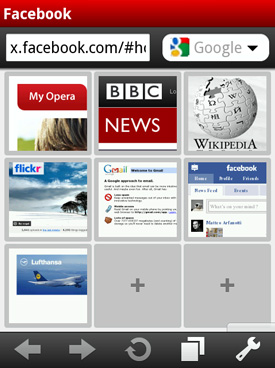
    Today, Opera Software has released the beta version of Opera Mobile 10 for Windows Phones, with support for touchscreen- and keypad-driven Windows Mobile 5 (PPC), 6.0, 6.1, and 6.5 devices.

    The keywords with this release are: speed, simplicity, and compatibility.

    Speed: With the current generation of Opera products, speed has been one of the central talking points. Though we at Betanews have found that Opera’s claims of speed boosts tend to be a little hyperbolical in the desktop versions, the company’s mobile products tend to be a different story. Using Opera Turbo compression, the company claims this version will be 50% faster than the previous version of Opera Mobile.

    Opera Mobile 10 Speed Dial screen

    Simplicity: Though navigation in each may vary, all of Opera’s current browsers share some essential design elements: the “Speed Dial” home screen, browser tabs, and the multi-search engine bar. The navigation buttons in Opera Mobile 10 have gotten a bit simpler than they were in 9.7 and now simply represent Back, Forward, Reload, Tabs, and Tools. Tabs have been turned into easily scrollable thumbnails, and the Tools menu accesses in-page search, bookmarks, browsing history, saved pages, and settings as large, easy-to-identify icons.

    Compatibility: “Opera Mobile is the most standards-compliant mobile browser available,” the company says. And while all browsers have at least some degree of compatibility trouble, mobile browsers are still extremely limited in the content they can display. Opera Mobile 10, however, uses the same Presto browser engine that desktop Opera 10 uses, so rich applications are more likely to be compatible with your phone. Furthermore, Opera Mobile 10 offers “Mobile View” mode, where Web pages are reformatted into a single column for easier consumption.

    Copyright Betanews, Inc. 2009


    Add to digg
    Add to Google
    Add to Slashdot
    Add to Twitter
    Add to del.icio.us
    Add to Facebook
    Add to Technorati


  • Sony’s Daily Edition Reader Available for Pre-Orders


    3GReader

    Yay! First Sony’s 3G enabled reader (PRS-900BC) is finally unlocked for readership to open up their wallets and pre-order 7″ Touch enabled reader. First shipments should start in the middle of next month, get your order in, so you could get your mittens on one soon. Pricewise this Reader is a little bit “immoderate” however since you are getting 3G access for free, we will let it slip…

    P.S. As of right now, Notify button is there instead of Pre-Order…I am sure it will be changed soon.

    Check out the full press release below:

    SAN DIEGO – November 18, 2009 Delivering on its promise to give consumers a variety of choices, Sony today announced its newest addition to the Sony Reader Family — the Reader Daily Edition™ — is now available for pre-order on SonyStyle.com. The Reader Daily Edition, a highly-anticipated wireless model with 3G connectivity, will ship next month.

    The Reader Daily Edition joins the Reader Pocket Edition™ and Reader Touch Edition™ to round out Sony’s complete family of digital readers. The Reader Daily Edition gives consumers wireless access to Sony’s eBookstore from most of the U.S., via a 3G mobile broadband network. Book lovers will be able to browse, purchase and download books as well as select newspapers and magazines on the go. There are no monthly fees or transaction charges for the basic wireless connectivity and users still have the option to side load personal documents or content from other compatible sites via USB. Sony will announce newspaper and magazine content providers within the next month.

    The Reader Daily Edition features a responsive, menu-driven, seven-inch touch screen panel that enables quick, intuitive navigation, page turning, highlighting and note taking with the swipe of a finger or by using the included stylus pen. Users can take handwritten notes with the stylus pen or type with the virtual keyboard. All notes can be exported and printed out for easy reference. The Reader Touch Edition includes an onboard Oxford American English Dictionary that allows you to look up a word by simply tapping on it.

  • Yahoo Search Share Drops While Bing Picks Up the Pace

    The search landscape is still evolving even if at its usual slow pace. Not too much has changed in October, Google still clearly dominates and has actually picked up a little market share in the last month, but the other two players are bit more dynamic. Yahoo took quite a significant dive, dropping almost 1 percent point, while Microsoft’s Bing continues its upwards crawl gaining a bit more market share.

    ComScore released the October numbers for the US “core search” market which takes into account just the five biggest search engines, Google, Yahoo, Bing, Ask, and AOL. The big winner last month, if you can call it that at 9.9 percent market share, was Bing, which proves to be a real success for Microsoft, taking into account the low expectations with which it launched. Microsoft’s search engine got just 8 percent of the searches the month before Bing launched and 9.4 percent in September.

    An almost 2 percent rise in market share in five months doesn’t look that impressive, but Microsoft has been trying to make inroads into the search market for years to little success until now. There’s just one downside to the numbers, Bing gained market share at the expense of Yahoo, while Google continues to look unfazed. Yahoo actually saw quite a big drop losing 0.8 percent points in just one mon… (read more)

  • Dilbert Evaluates Cloud Computing

    It seems everyone is talking about cloud computing. Even Dilbert, who discusses cloud computing with the Pointy-Haired Boss in today’s strip (link via Emil Sayegh). Click through for a larger version at Dilbert.com.

    Dilbert.com

  • Tony Hawk: RIDE now available in North America

    tony-hawk

    Dust off your old pair of Vans and get ready to party like it’s 1995, because Tony Hawk: RIDE has finally been released in North America. Available for the Nintendo Wii, Playstation 3 and Xbox 360, the game’s main attraction lies in its wireless skateboard controller that’s chockful of motion sensors and allows players to more or less feel that they themselves are on a real skateboard and part of the game. The game and skateboard are bundled together for $119.99, a far cry cheaper than your hospital bill will be after playing this game drunk at your office Christmas party.

    Read

  • The Bigfoot of Ereaders surfaces

    downsized_1116092247
    An anonymous tipster send us in this image of an e-reader running Android OS and explained that it came from a company that has never been in the tablet/e-reader business. Interesting…

    I suspect this is some sort of music device for composers/performers because of all the musical notes on the top of the screen and some things we saw in the background of the image. Any guesses as to what this could be?

    My suspicion is that someone like Yamaha is creating a control system for their MIDI devices, allowing folks to make music away from the PC.


  • Win $10,000 of audio related things from Sennheiser

    hookup_headphoneHey everybody! Let’s play the “What would you do if you had a million dollars?” game! Unfortunately, due to recent changes in corporation policy and budget cuts, you’ll only have 10,000 USD to play with. And it will have to go towards something music / audio related. Wait, that’s still totally awesome. But don’t tell me what you would do with the cash. Go and tell the guys over at Sennheiser. Their Sound Tour Hookup Challenge can give you and five friends the chance to spend ten thousand bucks on whatever crazy audio scheme you can think of.

    Entries so far range from flying to a festival in Europe, having your favorite band play a private party, building a recording studio, etc. But there’s no limit on what you can ask for. The entry mediums are pretty open-ended too. YouTube videos, essays, photo journals. You have until December 23rd to get yours in.

    The winner will be picked sometime in January 2010 by a panel of Sennheiser executives based on the following criteria.

    • Sennheiser product integration – 40%
    • The ability to show appreciation of sound – 25%
    • Creativity and overall appeal – 25%
    • Entry must show the integration of 5 friends – 10%

    But wait! There’s more! You can go and vote for other submissions that you like, entering you in a weekly drawing for a pair of Sennheiser headphones.

    As for me, I’d probably buy an analog Neve 88R console. Ten grand should be enough to buy maybe one channel strip.


  • AmEx to Buy Revolution Money for $300 Million

    American Express, the company well known for overpriced charge cards, is buying Ted Leonsis and Steve Case’s Revolution Money for $300 million. Leonsis shared this information on his blog. Amex wants to use Revolution Money to build a next-generation offering. Revolution Money has some kind of a next-generation payments technology that brings together offline and online worlds; it’s part of the Revolution group of companies floated by Steve Case. No one I know has either seen it or actually uses it. If there is one company that is going to do offline-online payments, that will be PayPal.


  • EJI Challenges Homelessness and Permanent Punishment Caused by Alabama’s Community Notification Act

    EJI is working to assist people who have been forced into homelessness, denied critical medical care, and subjected to permanent imprisonment as a result of Alabama’s Community Notification Act.

    read more

  • The HourTime Podcast talks about the Golden Hand watch awards


    Here’s another episode of my little side project, the HourTime Podcast. This time we talk about a $500K sports watch and the history of timekeeping and some of your favorite brands. Hope you’re enjoying this and we’d love some feedback.

    Download MP#
    Subscribe in iTunes


  • TiVo drops the prices of the HD and HD XL DVRs in the spirit of giving

    tivo-hd

    TiVo has finally dropped the price on the HD and HD XL DVRs. These models have been rocking their initial MSRP for years now, but now they can be had for a little bit less. The 160GB HD model is now $249 and the 1TB model, $499 down from $599. Of course you still have to pay a monthly fee to use these DVRs, but I’m not one to snub a modest price drop.

    I wonder if this was a reaction to the Moxi price drop from last week. Probably not because these things are usually planned months out, but you never know. Maybe TiVo is starting to feel a little heat from their closest competitors, who now have a 3-tuner DVR by the way…


  • NeoReader – new barcode scanning software for your smartphone

    neoreader-barcode NeoReader is a mobile application that turns a mobile phone camera into a code scanner and provides one-click access to mobile content on the go, anytime and anywhere. NeoReader features NeoMedia’s patented resolution technology and Gavitec’s ultra-small footprint and platform-independent code scanning algorithms. The software is available on Symbian, iPhone and now Windows Mobile.

    The application supports Data Matrix, QR code, Aztec code, EAN, UPC and Code 128, unfortunately Microsoft Tag is not included.

    The software is available to download by visiting get.neoreader.com from your mobile browser.

    Via Freewarepocketpc.net.

  • CrunchDeals: Buy a white DSi, get a free game or headset

    41FR4LYMGEL._SS350_

    Remember the good old days when video game machines ALWAYS came with a free game? Sometimes even two! Nintendo had Super Mario Bros. and Duck Hunt, Sega had Hang On! and Astro Warrior. Well that gravy train ended a while ago but you can hop back on, today only, as Amazon is offering a free game or headset with the purchase of a white Nintendo DSi.

    Now don’t get too excited just yet. Your game options are limited to Style Lab: Makeover, Style Lab: Jewelry Design, Dinosaur King, or Sonic Chronicles: The Dark Brotherhood and your headset options are limited to just the Nintendo DS Ear Force D2.

    Here’s to hoping that there’s a kid in footy pajamas somewhere out there begging his or her parents for a white DSi and Style Lab: Makeover and that those parents say, “Sorry honey but we only have $170 to spend! We can only afford the DSi, but not the game. Now give us some quiet time to read CrunchGear.”

    If that’s you, enjoy. Offer’s good today only.

    Buy a White DSi, Get a Select Game or Headset Free [Amazon.com]


  • Deal of the Day Reminder: Wrath retro space shooter for the Storm

    wrath_shooter

    Wrath is a retro space shooter for the BlackBerry Storm. Using the accelerometer or touchscreen, you control your ship as it picks up power-ups and blasts space aliens. If things look like they’re getting messy, click the screen to super-nuke everything.

    One of the coolest features in this game is the ability to listen to your own music while you play. Just make a playlist in the BlackBerry Media player, and Wrath will use it for the in-game music.

    Wrath, the retro space shooter for the BlackBerry Storm, is on sale for $2.49 (regular price $4.99).


    © BlackBerry Cool for BlackBerry Cool, 2009


  • 1020 Placecast Pins $5M for Mobile Geo-targeted Marketing

    With of an infrastructure of social location information just starting to coagulate, the monetization side is raring to go. Since real-time mobile advertising is inherently somewhat invasive (and by extension, somewhat creepy), these products end up less groundbreaking than they could be. (Which is OK by me.)

    A new offering from a San Francisco-based company called 1020 Placecast — which is announcing today that it’s raised a $5 million Series B — will be trialed with three retailers over the holidays; it uses a double-opt-in relationship built directly between users and their favorite shops. Once users sign up to receive alerts on a phone that has persistent location information (BlackBerry, Windows Mobile, Android), they get pinged with marketing messages from that brand every time they enter a “geo-fence” targeted area, as small as a single city block.

    Another way to geo-target users is to advertise to them when they’ve checked into a known venue — say, a baseball stadium for a game. Startups like mDialog are trying to make this work. To me, that makes a little more sense than waiting for a previously identified customer to wander onto your block.

    1020 Placecast raised the Series B round from Quatrex Capital, Onset Ventures and Voyager Capital; it brings total investment in the 3.5-year-old company to about $10 million. The company makes money by charging brands a set-up fee and then a monthly fee based on number of users. It says its technology is ready and it just needs the cash for marketing and biz dev.

    Though 1020 Placecast is really more of a mobile marketing company, any startup involved in advertising or mobile is pretty psyched about what Google’s bid-up $750 million AdMob buy does to its valuation.

    For more on the promise and worry of push-based location-aware mobile advertising, see this panel writeup from our Mobilize conference a couple months ago.