Author: Serkadis

  • The Pirate Bay kills its tracker, tries to usher in the DHT age

    magnet

    Pretty big news to share with y’all today: The Pirate Bay is no more. Well, “no more” in the sense that the site’s admins have decided to kill the tracker once and for all. The site will continue to serve the BitTorrent community, but will instead rely upon trackerless technology, such as DHT and PEX.

    You’ll notice that, for today at least, the site’s well-known pirate ship logo has been replaced by a giant magnet. (No, Panic Software didn’t buy ad space on the front page!) That’s a clever reference to the new type of non-tracker links you’ll be clicking should you continue to use TPB. Called magnet links, these links don’t contain .torrent files, but rather the data needed for your client (Vuze, uTorrent, etc.) to connect to other peers to download the data.

    It may take a little while to get used to non-torrents, yes.

    Perhaps even more interesting, it seems like TPB’s higher-ups are trying to convince other BitTorrent sites to eliminate trackers, too. So says TorrentFreak, who’s usually right on the money when it comes to TPB news.

    The idea is that the Internet’s big BitTorrent sites will do away with torrents so as to better evolve with the BitTorrent protocol. Presumably there are legal reasons for this, too.

    How you can convince the world’s big “private” BitTorrent sites to hop aboard the DHT bandwagon, I don’t know. All the private sites I’ve been a party to have discouraged the use of DHT for the longest time.

    All that said, you may want to star November 17, 2009 on your calendar, for that’s the day the tracker died. (How’s that for melodrama?)


  • Poet’s Son Says No One Can Quote Father Without Paying Up… Even Academic Dissertations…

    crcb alerts us to the bizarre situation where the son (and heir to the copyrights) of poet Louis Zukofsky isn’t just brandishing the copyrights against those trying to republish his works, but he seems to be demanding fees from anyone quoting his father or writing about him — even academic dissertations. It doesn’t appear as if Paul is doing this to protect a legacy or anything (if anything, it sounds like he’s not a fan of his father), but he does want cold hard cash:


    “I hardly give a damn what is said about my father (I am far more protective of my mother) as long as the name is spelled properly, and the fees are paid.”

    The full copyright notice is quite a doozy, where the son basically seems to think copyright law means he alone gets to determine what is acceptable and what is not — and, for the most part, his view is that he doesn’t want you ever quoting or discussing his father, but if you must, then he wants money. He also seems to think that fair use is as he defines it, rather than what the law actually says.


    All Louis and Celia Zukofsky is still copyright, and will remain so for many many years. I own all of these copyrights, and they are my property, and I insist upon deriving income from that property. For those of you convinced that LZ would find my stance abhorrent, the truth is that he kept all copyrights (initially in his name) as he had the rather absurd idea that said copyrights would be sufficient to allow for the economic survival of my mother, and their son. My stance is congruent with that hope.

    Despite what you may have been told, you may not use LZ’s words as you see fit, as if you owned them, while you hide behind the rubric of “fair use”. “Fair use” is a very-broadly defined doctrine, of which I take a very narrow interpretation, and I expect my views to be respected. We can therefore either more or less amicably work out the fees that I demand; you can remove all quotation; or we can turn the matter over to lawyers, this last solution being the worst of the three, but one which I will use if I need to enforce my rights.

    Except that, no, fair use is somewhat broadly defined under the law, and just because Paul wants it narrowly defined, it does not follow that this is the case. As Paul’s father, Louis Zukofsky once wrote: “The best way to find out about poetry is to read the poems.” Apparently, Paul would like to make that a lot more difficult and a lot more expensive. And, yes, Paul, quoting that was fair use.

    Permalink | Comments | Email This Story


  • Dem Leaders Eye Dec. 18 To End Congressional Session And Still Await CBO Figures

    Politico: “Senate and House leaders are hoping to close up shop for the year by Dec. 18, even though neither chamber has figured out the end game for health care reform and must-pass appropriations bills.” House Majority Leader Steny Hoyer, D-Md., said Tuesday that both he and Senate Majority Leader Harry Reid, D-Nev., are targeting that day 18 as “a last day for this session of Congress.” This shared focus, though, is complicated by the ongoing challenges associated with health reform legislation among other to-do items. Meanwhile, “[t]he Senate … will begin wrestling with its version of health-care overhaul legislation this week and will likely need to push full-steam ahead to finish by the Hoyer and Reid’s target adjournment date” (Sherman, 11/17).

    Roll Call: Reid “on Tuesday predicted Senate Democrats would get rave reviews for their forthcoming health care reform bill, even as he continues to wait for the official cost estimate from the Congressional Budget Office.” He was vague about when he was prepared to unveil the measure, but told reporters this afternoon, according to Roll Call, “that he would introduce a bill ‘in a little while.’ Democratic aides said Reid still expects the CBO score to be finalized sometime Tuesday” (Pierce, 11/17).

    Roll Call: In other health overhaul news, Sen. Jay Rockefeller (D-W.Va.), a leading proponent of the public insurance option, today rejected the idea the Senate use “filibuster-busting reconciliation rules to bypass opposition from Sen. Joe Lieberman (ID-Conn.) and all 40 Republicans to a Democratic health care reform bill.”

    “‘Reconciliation is a nonstarter,’ he said. ‘It doesn’t work. … It opens itself up to an endless, unstoppable number of amendments.’” Reconciliation would allow Democrats “to pass a health care overhaul with a simple majority” and this route may be “the only one that would yield a public insurance option if Lieberman and Republicans follow through on a threat to filibuster any bill that includes one” (Dennis, 11/17).

    And The Hill reports on comments made Monday by Sen. Sen. Judd Gregg, R-N.H., that Senate Democrats would prevail in winning the 60 votes needed to pass healthcare reform with a public plan. “‘My guess is, they’ll be able to pass something, and it will be very, very expensive and add a lot to our debt,’ the New Hampshire Republican [told CNBC last night], noting that Democrats are likely to allege the bill is ‘paid for (but) most of the pay-fors will never come to’ fruition” (Romm, 11/17).

  • With YouTube Direct, now users can yank videos from big media

    By Tim Conneally, Betanews

    Google today announced YouTube Direct, an open source platform that lets media organizations directly connect with YouTube users to request and rebroadcast their YouTube clips.

    The application allows custom YouTube uploaders to be built into another site, so users can submit their videos directly and track the viewing metrics in their own profile. Google highlights the rise of citizen journalism as a major reason for the program.

    ABC News, NPR, the San Francisco Chronicle, Washington Post and more have already picked up on YouTube Direct, and examples can be seen on their respective sites. All involved content remains hosted by YouTube, and the only cost incurred is associated with the media company’s Google App Engine account, and is based upon the amount of traffic being served.

    “Though we built YouTube Direct to help news organizations expand their coverage and connect directly with their audiences, the application is designed to meet any organization’s goal of leveraging video content submitted by the community,” Steve Grove of YouTube News and Politics said today. “Businesses can use YouTube Direct to solicit promotional videos, nonprofits can use the application to call out for support videos around social campaigns and politicians can use the platform to ask for user-generated political commercials. The opportunities to use the tool are as broad as the media spectrum itself.”

    In short, the idea is to pull free content from YouTube and syndicate it on high-traffic sites.

    But the most interesting part of this idea is that it puts the shoe on the other foot in terms of content control.

    One of big media’s problems with YouTube has been that it lets anyone upload copyrighted content, regardless of ownership. As a result, we’ve seen TV networks, record labels, performing artists, and every type of copyright holder force users to take down content that may have contained copyrighted material.

    But in this situation, the bigger media organizations would be looking to syndicate the users’ content, and the user retains the right to pull the video whenever he feels like it.

    To quote YouTube Direct’s FAQ:

    “If a user decides to delete a video after he or she has submitted it to your site via YouTube Direct, then this video will be removed from YouTube, and thus will no longer play anywhere on your site that the video has been embedded or linked to. When this happens, there will be a flag visible in the moderation panel indicating that the video is not longer live on YouTube, and any reference to it on your site should also be removed.”

    Copyright Betanews, Inc. 2009


    Add to digg
    Add to Google
    Add to Slashdot
    Add to Twitter
    Add to del.icio.us
    Add to Facebook
    Add to Technorati


  • Google Experiments with a New Image Search Feature

    Google has launched a new Labs experiment dealing with image search. The feature is called Image Swirl, and attempts to deliver the user image search results in a different and more visual interface. Google describes Image Swirl:

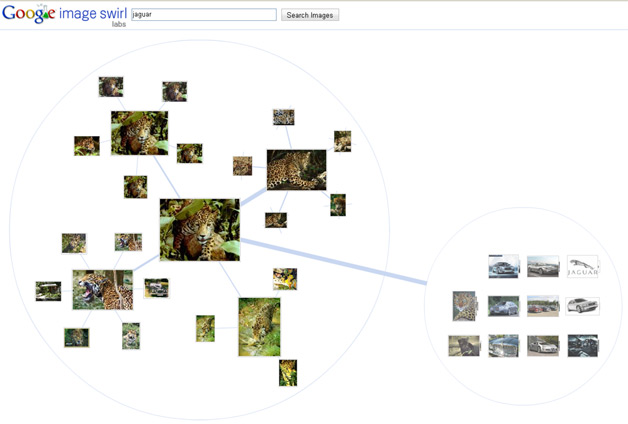
    Google Image Swirl organizes image search results into groups and sub-groups, based on their visual and semantic similarity and presents them in an intuitive exploratory interface. Think about Image Swirl as kind of a visual image version of the wonder wheel. The wonder wheel performs a very similar task with text. This works with actual images (not just image queries). Here’s what it looks like:

    Google Image Swirl

    Google Image Swirl

    Google says to try Image Swirl to resolve an ambiguous query visually, such as "apple," "jaguar," or "beetle." They also suggest using it to explore different visual perspectives on queries like "Eiffel Tower," "beach," or "impressionism." You can only use the feature for select queries at this point. It’s not just like performing a regular image search. They give you a list of possibilities in addition those mentioned above, but it is not limited to those. I tried searching for several band names, for example, and they all seemed to work.

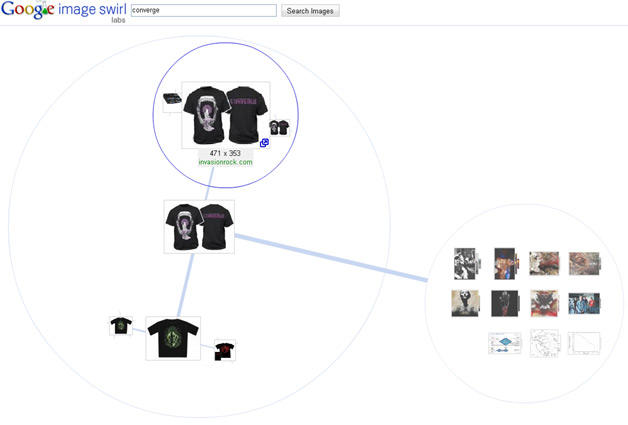
    After that quick test run, I could actually see this being useful in a shopping scenario. For example, when I search for the band "Converge," I get one result that shows a t-shirt, and when I click on that, it brings up other t-shirt results from various sites. If I was looking to buy a new Converge t-shirt, that could come in quite handy.

    Google Image Swirl

    Google Labs experiments are of course just that – experiments. Some of them blossom into full-fledged Google products. Others sit there and collect dust. I can already see a great deal of potential in this one, however, and based on Google’s use of the Wonder Wheel in its search options, I could easily see this one making a jump to the image search options.

    What do you think of the Image Swirl? Would you use this if it was a feature of Google Image Search? Share your thoughts.

    Related Articles:

    > Google "Similar Images" Feature Goes From Labs to Actual Feature

    > Rank in Image Searches and Get Valuable, Untapped Traffic

    > Google Presents New Image Search Options

  • EA memo confirms Pandemic closure

    Following up on earlier rumors of Pandemic Studios’ closure, Kotaku reports that an internal Electronic Arts memo has confirmed the studio’s fate.The …

  • Employee Fired From American Airlines For Transparent Email

    What is it with airlines?

    If they’re not breaking guitars, their pilots are missing airports, or they’re berating people that are trying to help them.

    Well, we have one more reputation disaster to add to the list, courtesy of American Airlines.

    You may recall the open letter web designer Dusting Curtis wrote to the airline. In it, Curtis suggested that AA was losing millions because of its poorly designed web site. He even went as far as suggesting a new design for the site.

    Shortly after, one of AA’s designers took it upon himself to reply and explain the complexities of AA web site design decisions. His reply was open, honest…radically transparent.

    American Airlines has allegedly fired him for it!

    This may have happened back in May, but it’s only just come to light that the AA designer was apparently fired an hour after he wrote his reply.

    AA searched their exchange database for the text I posted, found the guy, and fired Mr. X on the spot. From what I have learned, they also threatened him with legal action if he spoke to me again. Apparently he broke his non-disclosure agreement by discussing the design process at AA.

    OK, so maybe he shouldn’t have broken his NDA with the airline. But, maybe AA shouldn’t have been so near-sighted and pedantic about its employee policies. Surely the airline is aware that it’s industry hardly has the best reputation for caring about its customers. Heck, even Jet Blue–the poster child of airline awesomeness–has screwed-up royally in the past.

    In some ways, you can’t blame American Airlines. It is completely ignorant of how customers want to interact with the airline. We don’t want to hand flight attendants slips of paper that say “well done”–something AA encourages me to do as a frequent flier–we want to engage with the airline. We want it to do better, and we have ideas. Ideas about clean blankets, baggage fees, and yes, web site design. How does AA marry its apparent openness on Twitter, with this crackdown on a real employee that wants to help?

    Yes, you should have guidelines in place, but those guidelines should be designed to encourage thoughtful customer interaction, not prevent it! If we hear that you’re firing employees because of their transparency, how are we supposed to take your official social networking efforts seriously? What, do we now assume that everything that is shared on Twitter or Facebook is nothing more than sterile, PR sanctioned, sound bites?

    The airline industry may well be the very last to “get” the concept of Radically Transparent. When they do finally have that “aha!” moment, we’ll know that we’ve finally entered the age of open, honest, dialogs.

    Andy Beal – AA Platinum Card Holder; Million Mile Flier.

    (via)

    Comments

  • Who We Are On The Social Web

    I’m a different person at work than I am at home. I tell different jokes. I have different stories. I share different experiences with different people in different ways depending on a host of different factors (e.g., how well we know each other; where we went to school; what our shared interests may be, etc.).

    The context in which I know people is different from one person, one situation to the next. By and large, this is a good thing. I wouldn’t want my co-workers to know all that my wife knows and my wife wouldn’t be interested in all that my co-workers know.

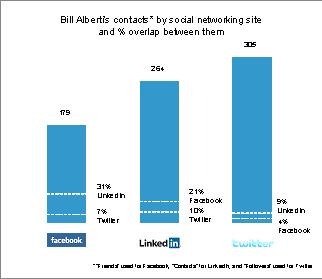
    Not surprisingly, online these relationships play out differently through different social networks. As a fairly engaged social networker (and dork), I recently tested my own social networks for what I’m calling, "social overlap" – the percent of overlapping "friends and followers" I have between the three social networks I am engaged in most: Facebook, Linkedin and Twitter. (I highly recommend doing this exercise yourself, it shows a number of revealing insights about yourself. Here are some of mine. I’d love to hear your findings in the comments.

    This analysis shows how few of my contacts overlap between different social networking platforms. This online fact echoes my offline reality of having different kinds of relationships with different people depending on the context of how we know one another.

    My own lack of "social overlap" is complemented by a recent report from Forrester. Analyst Jeremiah Owyang (who recently left the company) suggests, "Today’s social experience is disjointed because consumers have separate identities in each social network they visit." Owyang goes on to say, "This creates friction for consumers who must now manage multiplying personal information and username/password combinations."

    As a solution to this "friction" Owyang predicts that people will bring a single online identity from one social network to the next. Early examples of this prediction coming to light are "Facebook Connect," which allows users to "connect" their Facebook identity to any site, and "Open ID," a potential social network standard for a shared identity system.

    However, a single online ID seems out of synch with how we (or at least I) naturally relate to others in our offline/real world lives. Maybe I like having different platforms on which to interact with co-workers vs. family members. Maybe I’m not comfortable showing the same side of me to everyone I know, regardless of how I know them. Maybe my lack of "social overlap" online is a good thing…much as it is offline.

    The point here is not to knock a single online ID, it’s to ask bigger questions about who we are on the social web. How are we different consumers in different contexts? What permission do we give different brands on different sites? How does your brand fit in with your customers on Facebook differently than it does on Twitter? Because it’s not just a different tool, it may be a "different person" with whom you’re connecting.

    These questions point to the critical need to listen first before coming to market with a social media strategy. To understand how your customers think of your brand, product or service as relevant and meaningful in different social media contexts. Because maybe your customers are not the same people in one context that they are in another.

  • AOL and Time Warner Officially Splitting Up

    Sometimes, what looks like it will be as tasty as chocolate and peanut butter, ends up tasting more like pickles and ice cream. Nothing matches that last culinary disaster better than the merger of AOL and Time Warner.

    Well, on December 9th, that union will be no more.

    You can read the wordy Time Warner press release, but you’ll probably either fall asleep or your head will explode, before you reach the end. Instead, we’ll turn to trusty Reuters to translate the announcement into plain English:

    Time Warner shareholders of record on Nov. 27 will receive an AOL stock dividend for every 11 shares of Time Warner common stock they hold…Based on the closing price of Time Warner’s stock at $32.35 and its 1.17 billion outstanding shares, the ratio would effectively value AOL’s market capitalization at around $3.44 billion…AOL common stock will begin trading on a ‘when-issued’ basis on the New York stock Exchange on Nov. 24 and will start trading under the ‘AOL’ symbol on Dec. 10.

    Of course, it’s been almost 6 month months since Time Warner announced the AOL spin off, but now we finally get a date to watch. On December 9th, former Google exec and AOL CEO Tim Armstrong, will get to show us what he–and AOL–are made of!

    Comments

  • Facebook Blocks Popular iLike App

    Now that iLike owned by rival MySpace, Facebook is restricting some features of the iLike app on it pages. The move is bound to be unpopular with the 12 million users that have made iLike the #1 music app on Facebook. Over the last few days Facebook users who had installed the iLike app received this message:

    image from www.csgsnyu.org "Due to upcoming Facebook changes, your Music data on Facebook won’t show on your profile and you’ll stop getting concert alerts. Take this step to save your music data."

    The restrictions stop users from adding music to the Facebook profile and receiving personalized concert alerts. iLike has responded by asking users for their email address to send concert alers directly. 

    Facebook’s move against iLike is also a bi-product of what they called a wider

    campaign of "New Ways to Find and Engage with Your Favorite Applications".  Obviously, new does not always mean better.

    Comments

  • Consumers State They’re Willing To Pay A Little For Online News

    It seems like every month another news organization toys with the idea of charging for their content. But, we always rejoin, you’ll ultimately sacrifice your audience if you charge for news content. However, the Boston Consulting Group says that may not always be the case—in fact, even Americans are willing to pay for online news.

    Well, sort of. The average amount an American was willing to pay for news was $3—and not $3 a day, but $3 a month. Not exactly the profits Rupert Murdoch dreams of, is it?

    The survey also found that people were more willing to pay for news that was:

    • Unique, such as local news (67 percent overall are interested; 72 percent of U.S. respondents) or specialized coverage (63 percent overall are interested; 73 percent of U.S. respondents)
    • Timely, such as a continual news alert service (54 percent overall are interested; 61 percent of U.S. respondents)
    • Conveniently accessible on a device of choice

    And good news for newspapers: “consumers are more likely to pay for online news provided by newspapers than by other media, such as television stations, Web sites, or online portals,” especially since these other media have so much free competition. Interestingly, while Americans were more likely to pay for sites that offered access to multiple papers, only national and local—not major metropolitan-based papers—have that level of appeal. (I’m not sure which category The New York Times and Washington Post fall into here.)

    Marc Vos, a Milan-based partner and leader of BCG’s media sector in Europe, tells newspapers that they “should be experimenting with paid online content. It will take trial and error to find what works.”

    The prospects aren’t so bleak everywhere. In addition to 1000 US respondents, the survey also looked at results in Germany, Australia, France, the UK, Spain, Italy, Norway, Finland. While Australians also wanted to pay only $3 (USD?) for their news, other countries saw higher rates. The New York Times said that this may be because Western Europe has more consolidated news offerings, where news in the US is a very fragmented industry.

    However, before Western European news sites get all excited, note that the highest amount on the survey, in Italy, was $7 a month.

    What do you think? What would you be willing to pay for news?

    Comments

  • President Obama Admits To Never Using Twitter

    Social media is about community, right? Social media is about relationships, correct? What is required in a genuine relationship? People exchanging ideas and thoughts with each other and getting to know each other is how I look at it in an incredibly basic sense. At least that’s what I think. While social media is considered to be advancing our ability to connect with others it is still important to caution just how much we trust who is saying what. In other words, your relationship with many is more likely to be with a handler than the real person.

    I realize this is nothing new and I am not setting the world on fire with this but I came across this post at TechCrunch and it certainly made me think a little. Barack Obama, the President of the United States admitted on his current trip to China that he has never used Twitter. Huh? Wasn’t his campaign the one that utilized social media like never before so his supporters could have a feeling that they were truly a part of history in a real sense?

    This is not a political discussion so if you are getting all “blue” or “red” state on me just go read something else. This is about someone who utilized a technology for some advantage in a very important situation then admitted that he never used the technology personally. I find that a little disturbing and we, as social media professionals and watchdogs, should have some opinion on this practice (not the person or anything else, just the practice). Oh and let’s put out ‘preemptive strike’ on all of the “If you were stupid enough to think it was actually him tweeting comments ………..” People wanting to believe they are part of something genuine is not stupid. In fact, in this world it’s hard to find.

    MG Siegler reports

    President Barack Obama has one of the most popular Twitter accounts with over 2.6 million followers. It should be no real surprise that most of the time it’s not him tweeting from it, instead its various people within the White House communication team that use the account to send out information. And now that he is the President, certainly there are some security concerns with him using something like Twitter. But, did you know that he’s actually never used Twitter at all?

    That revelation was made tonight during a Q&A session at a town hall event with Chinese youth that was held in Shanghai this evening (which was streamed live on the web). The President fielded a question about the restricted use of Twitter in China and he had this to say, “I have never used Twitter but I’m an advocate of technology and not restricting internet access.”

    Once again, I know it is silly to think that someone as busy as President Obama would have the time to knock out a tweet from time to time but if that’s the case (that he has NEVER used it) I really think it would have been more transparent to know this a little earlier. In fact, if I was one of the followers that felt like I was part of something bigger I would feel a little duped. To be transparent, I have not followed a politician (to my knowledge) on Twitter because I feel I get enough spin and rhetoric just being alive so I don’t to seek more from either side of the aisle.

    TechCrunch’s visual take says it all in an ‘update’ to the President’s response to his Nobel Prize.

    Obama Twitter Screen Shot 2

    So who was / is actually updating this account with 2.7 million followers? I don’t know and probably never will. At this point, who really cares since we know that the President has never touched the account (although it is a Verified Account for Twitter which now means what?)

    What we need to be looking at as social media “insiders” is talking a great game about transparency and then allowing the medium to be questioned and eventually devalued because there is nothing that is real. Will social media just become a place for online actors and actresses to portray others? Will we a need SMAG (Social Media Actor’s Guild) card to tweet at some point? We are treading on some thin ice in these areas when we talk about accessibility but then only fake it. Maybe being genuine is just old fashioned and overrated?

    Maybe this is an emerging area of the online reputation monitoring and management industry which will require policies and actions on what to do when your social media persona is ‘found out’.

    Comments

  • Majority Of Americans Reading Newspapers In Print And Online

    The majority (74%) of Americans, or nearly 171 million people, read a newspaper in print or online during the past week, according to a new report by Scarborough Research.

    "While our data does show that print newspaper readership is slowly declining, it also illustrates that reports about the pending death of the newspaper industry are not supported by audience data," said Gary Meo, Scarborough Research’s Senior Vice President of Print and Digital Media Services.
    Gary-Meo
    "Given the fragmentation of media choices, printed newspapers are holding onto their audiences relatively well and this is refreshing news."

    Highlights of the report include:

    •   79% of adults employed in white collar positions read a newspaper in print or online
    •   82% of adults with household incomes of $100,000 or more read a printed newspaper in print or   online
    •   84% of adults who are college graduates or who have advanced degrees read a printed newspaper in print or online

    "Printed newspapers have been a trusted source of news and information for decades, and many newspapers have continued that tradition by successfully extending their brands into the digital space," said Meo.

    "In doing so, they are attracting an audience that has even stronger socioeconomic status-equally upscale with their print brethren, but younger."

    Circulation, which is audited and reported by the Audit Bureau of Circulations, refers to the number of printed newspaper copies sold. Audience, which is measured by Scarborough and accredited by the Media Rating Council, refers to the percentage of Americans who actually read the newspaper.

    "For media buyers, analysts and others who evaluate the health of newspapers and the value of our medium’s advertising, audience is a far more meaningful way to measure newspapers’ ability to attract a growing audience across multiple platforms," said John F. Sturm, president and CEO of the Newspaper Association of America.

    "This important data from Scarborough Research also provides further evidence that newspapers reach a highly educated, affluent audience."

    Related Articles:

    >Newspapers Not Effectively Using Social Media

    >Google News SEO Tips-Ranking In News Search

    >Newsday To Charge For Online Access


  • Pirate Bay’s Tracker Shutdown Won’t Snuff Torrents

    The Pirate Bay is shutting down its tracker technology, its crew announced in a blog post that only accentuated the positive, in a move that follows a multiyear hailstorm of legal machinations, jail sentences thrown at founders, and constant public scrutiny. The positive spin in the blog post is reminiscent of the founders’ claims that their jail sentences represented “an epic win.”  But now that the site will switch to decentralized distributed hash table (DHT) technology for pointing to torrent sources, what is the likely impact on downloaders and freeloaders? They will have to turn to new alternatives, but those choices will take shape.

    According to today’s blog post:

    Now that the decentralized system for finding peers is so well developed, TPB has decided that there is no need to run a tracker anymore, so it will remain down!…By moving to a more decentralized system of handling tracking (DHT+PEX) and distributions of torrent files (Magnet Links), BitTorrent will become less vulnerable to downtime and outages.

    Magnet links let users download torrents directly into BitTorrent clients, circumventing browsers. Through DHT technology, users seeking torrents access a dedicated DHT network, and find peers for the actual downloads. So, effectively, The Pirate Bay is seeking to avoid centralizing tracked torrents and services in such a way that it can stay free of legal problems.

    Does that mean the end of widespread torrent downloading, including illegal downloads, though? Absolutely not. The Pirate Bay’s position as the leading purveyor of BitTorrent traffic is threatened, but torrenters will march on.

    For one thing, TorrentFreak already spoke with Pirate Bay insiders who said that a decentralized model can work across many high-profile torrent sites:

    We’re talking to the other torrent admins on doing magnet links and DHT+PEX for all sites. Moving away from torrents and trackers totally — like pick a date and all agree “from this date, we’ll not support torrents anymore.”

    The idea of a federated collection of BitTorrent trackers around the web has been raised before. Now that idea could shift to a federated trackerless collection of sites, with P2P-based torrenting becoming more widely distributed.

    Let’s also keep in mind that the overall world of torrenting extends to many useful, legal sites providing content. NewTeeVee collected many of them hereLegaltorrents, for example, distributes lots of Creative Commons-licensed content. Legal and illegal torrenting will continue as The Pirate Bay sends its tracker to Davey Jones’ locker, but today does mark an official end to a torrent tracking strategy that was central to The Pirate Bay’s ongoing notoriety.


  • Albert Wesker and his sunglasses coming to Lost Planet 2

    Albert Wesker is so cool that he can wear sunglasses at night, and if you dare call him on it he can rip your spine out. Heck, he’s so cool that he ev…

  • RFI as rich asset

    I was talking with one of our Web CMS Report subscribers today, someone who is leading a state government’s effort to modernize its WCM system. The question arose as to how to keep vendors from giving softball answers to hardball questions when submitting a Request for Information. I proposed a simple expedient: Require screenshots.

    If a product supports a certain type of functionality via a graphical user interface, the vendor should have no qualms about showing the UI in question, doing the operation in question. It’s one thing to be told "Yes, our admin interface supports restricting a user’s right to Copy or Move a file" (for example), but a picture, as they say, is worth a thousand workarounds.

    What about when the vendor comes back with "This functionality is easily implemented via changes to a configuration file" (or via an API call)? Very well: In that case, let’s see the relevant XML fragment (or code snippet) with the changes highlighted. Demand to see the relevant lines of code. Is that so much to ask?

    Hey, the worst that could happen is that the vendor will skip past a few of your harder questions — or complain that your RFI process is just too burdensome. In which case, you’ve already learned a great deal indeed.

  • TweetDeck for iPhone Gets Facebook Integration

    tweetdeckThe iPhone isn’t capable of true multitasking if you’re running a legit, non-jailbroken device, so you can’t do something like, say, have Facebook and Twitter open at the same time. Thanks to the latest update, though, for TweetDeck for the iPhone (free, iTunes link), you can experience most of the advantages of that hypothetical situation using only one app.

    The newest version of TweetDeck for iPhone has lots of new features, but by far the most significant is the ability to add columns that show updates from your Facebook friends (and MySpace, too, if you’re a musician or a 13 year-old who somehow got transported to the future from the year 2000). You can read updates, yes, but you can also do wall posts, comment on things, and update your own status, all without leaving the app.

    tweetdeck_facebookYou can even “Like” someone’s status update from the zoomed in view. Really, if you use Facebook the way I do these days (never opening the inbox, browsing the news and live feeds like they were slightly broken Twitter feeds and occasionally doing a wall post or two if something catches my eye that needs direct address. My Inbox has become a wasteland of lost and unread missives, and I rarely look at event or other invitations, unless prompted to do so in real life or on Twitter.

    When you hit the compose button, you’re taken to the usual window, but now at the top you can opt to post your status update to one, some, or all of the accounts associated with your TweetDeck installation. It’s very handy if you want to post an update across more than one Twitter account, or if you’d like to selectively push some of your Twitter updates to your Facebook without using an extra plugin and the #fb tag, for instance.

    tweetdeck_composeOther new features include landscape keyboard support (via a button, not the accelerometer, which is actually better in my opinion), 12seconds.tv integration for 3GS video tweeting, and an option to save draft tweets you’re working on. Should give you a chance to rethink that disparaging comment about your workplace you’re thinking about posting. Bit.ly URL shortening with click tracking is also a new feature, as is the ability to add a column devoted exclusively to trending topics.

    It’s a good update, but I still don’t think it can replace Tweetie 2 as my primary client. If I was a social media manager at a company in charge of maintaining multiple Twitter streams for different lines of business, TweetDeck would be my go-to application, but as it stands, it’s just more meat than I can generally chew.


  • Explaining The Innovator’s Dilemma… In Two Minutes With A Whiteboard

    As you may recall from last month, UPS recently asked us to create a series of videos, where we explain some of the stuff we talk about here on Techdirt on a regular basis in under two minutes, using a whiteboard. The first video was about the economics of abundance and got a great response. The second video is now up, and it’s an attempt to explain the Innovator’s Dilemma, based on Clayton Christensen’s must-read research. If you’re unfamiliar with it, it explains how difficult it is for many companies to adapt to changing markets, and is a good framework for understanding both why some companies are so slow to adapt. More importantly, it provides a good system for thinking about your own company and understanding how to adapt and implement new ideas rapidly:


    Again, with only two minutes, I had to simplify things down a bit, but hopefully it will kick off another good discussion on the innovator’s dilemma and how to deal with it. We still have one more video to go, which I believe will be posted sometime next month. And, yes, once again (though, it should be obvious), UPS sponsored these videos, though we had free rein in creating the scripts — which should be quite obvious as the topic is one we talk about here frequently enough.

    Permalink | Comments | Email This Story


  • Google Takes us to Law School

    As you know, Google’s ultimate goal is to organize the world’s information. With this in mind, it should be no surprise that Google is organizing full-text legal opinions from United States federal and state district, appellate and supreme courts. The company is using its Google Scholar service to do so.

    "As many of us recall from our civics lessons in school, the United States is a common law country," says Google Distinguished Engineer Anurag Acharya. "That means when judges issue opinions in legal cases, they often establish precedents that will guide the rulings of other judges in similar cases and jurisdictions. Over time, these legal opinions build, refine and clarify the laws that govern our land. For average citizens, however, it can be difficult to find or even read these landmark opinions. We think that’s a problem: Laws that you don’t know about, you can’t follow — or make effective arguments to change."

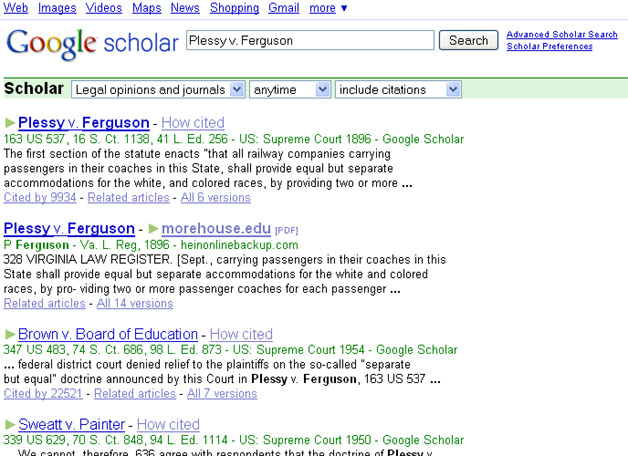
    You can now search Google Scholar to find opinions by searching specific cases (like Plessy v. Ferguson) or topics (like desegregation). You can type a phrase like "separate but equal" and get results for cases in which such a phrase is in included.

    Plessy v. Ferguson

    Users can look at cases that are related to others by using the links that say "Cited by" and "Related articles" on the results pages. This is useful for following citations within the opinions themselves.

    Google thinks being able to search these opinions will "empower the average citizen" by helping them learn more about the laws that govern them. It does appear to be a great way to educate yourself on legal issues without having to go to law school. Furthermore, it could be of tremendous benefit to students who are actually in law school.

    "As we worked to build this feature, we were struck by how readable and accessible these opinions are," says Acharya. "Court opinions don’t just describe a decision but also present the reasons that support the decision. In doing so, they explain the intricacies of law in the context of real-life situations. And they often do it in language that is surprisingly straightforward, even for those of us outside the legal profession. In many cases, judges have gone quite a bit out of their way to make complex legal issues easy to follow."

    Google really is working non-stop on "organizing the world’s information". This particular instance may only apply to the U.S. (and such a feature could get awfully tricky on a global scale), but it would not be surprising to see more countries’ data get included in the future.


    Related Articles:

    > Google News Organizes a Lot More of the World’s Information

    > 20,000 Sources Added to Google News in a Year’s Time

    > Google Puts News on a Timeline

  • The Sega Dreamcast keeps dropping in price

    dreamcast

    Last time Dreamcasts were spotted for sale, the price was north of $100, but Amazon now has the system for only $79. It’s NIB too. Ladies, this could make a great Christmas gift for your nerd boyfriend.

    Everyone loves the Dreamcast. It has a great selection of games (that are very easy to pirate), good enough graphics, and 10x the cool factor of a Nintendo Wii. If you’re going to get this system, make sure you get at least a Visual Memory Unit and you probably want an extra controller too. Chances are that local second-hand gaming outlets have those cheap.

    [Amazon via DealNews]