After a warm welcome in Beijing’s historic Great Hall of the People, President Obama and President Hu sat down to discuss the many overlapping issues facing both nations, including China’s growing economy and its effect on the US and the rest of the world and the exciting education reforms happening in each country:
PRESIDENT OBAMA: As we both affirmed, the United States and China have a great many mutual interests. And after 30 years of bilateral relations, I think it’s fair to say that our two governments have continued to move forward in a way that can bring even greater cooperation in the future.
And I want to reaffirm the fact that the American people are interested in stronger relations with the people of China, and that the more that we can encourage people-to-people exchanges that are consistent with the discussions that we’re having at the government level, the more that China and the United States will be able to work cooperatively on a whole range of issues — both economic issues, security issues, and global issues that are in the interest not just of our two nations but the entire world.
President Barack Obama and Chinese President Hu Jintao speak during a joint press conference held at the Great Hall of the People in Beijing, China, Nov 17, 2009. (Official White House Photo by Lawrence Jackson)
One topic of particular interest to both leaders is a joint initiative towards clean energy, and President Obama and President Hu introduced a far-reaching package of measures to strengthen cooperation between the United States and China on clean energy. An abridged version of the measures is below, and the full version is available here:
The U.S.-China Clean Energy Research Center will facilitate joint research and development of clean energy technologies by teams of scientists and engineers from the United States and China, as well as serve as a clearinghouse to help researchers in each country.
The U.S.-China Electric Vehicles Initiative will include joint standards development, demonstration projects in more than a dozen cities, technical roadmapping and public education projects, all aimed at eventual deployment of electric vehicles to reduce oil dependence.
The U.S. China Energy Efficiency Action Plan will allow the two countries to work together to improve the energy efficiency of buildings, industrial facilities, and consumer appliances, culminating with an annual U.S.-China Energy Efficiency Forum, rotating between the two countries.
The U.S. China Renewable Energy Partnership will facilitate development of roadmaps for wide-spread renewable energy deployment. A new Advanced Grid Working Group made up of American and Chinese developers and strategists will help plan for grid modernization in both countries, and a new U.S.-China Renewable Energy Forum will be held annually, rotating between the two countries.
A 21st Century Coal Initiative, for which the two Presidents pledged to promote cooperation on cleaner uses of coal, will include large-scale carbon capture and storage (CCS) demonstration projects.
A Shale Gas Initiative, will allow the U.S. and China to use experience gained in the United States to assess China’s shale gas potential, promote environmentally-sustainable development of shale gas resources, conduct joint technical studies to accelerate development of shale gas resources in China, and promote shale gas investment in China through the U.S.-China Oil and Gas Industry Forum, study tours, and workshops.
The U.S. China Energy Cooperation Program will leverage private sector resources for project development work in China across a broad array of clean energy projects, to the benefit of both nations.
Read more about the President’s historic 10-day trip to Asia here.
President Barack Obama and President Hu Jintao together at a reception before the formal state dinner at Great Hall of the People in Beijing, China on Nov. 17, 2009. (Official White House photo by Pete Souza)
Cloud Computing is becoming more and more the buzzword of every conference, meeting and article. Yet it is still in it’s inception, and there are multitude of issues and problems. Cloud services are springing up like mushrooms after rain, and all the big players want a piece of the pie.
Dark Reading discusses Quelling 7 Cloud Computing Fears in which it touches the issue of trust and security. The author recommends that the cloud computing providers be proactive in gaining the trust of their users and potential users.
How do we decide when we trust the cloud? Here are the mechanisms by which we can approach the level of trust that we have in our infrastructure for the cloud. But bear in mind, that each approach can have it’s own pitfall!
Encryption – Most readers will immediately start to think about encryption. Yes, it is a good idea, but is it enough? In encryption, regardless of the algorithm used, you are always dependent on the actual implementation of the algorithm. If the implementation is flawed, there can be back doors into your data. And you can’t control or check the implementation – it’s in the cloud
Certification to Security Standards – A logical industry choice – if you are certified to a security standard, you are all good and well. But tread very lightly and be very careful about this: most security standards are quite flexible – you can choose to certify only a subset of your operations. So a security certificate of the data transfer subsystem won’t do you much good when you are using the cloud for storing your customer database – the data storage and processing subsystem may not even be up to the security level of your home PC!
Compensating Penalties (Contractual and via Litigation) – You can try to define penalties for breach of security within the service contract. But the cloud provider will limit such penalties to a limit which may be far below what you estimate to be your financial impact, and simply refuse to offer the service if you insist on full penalties. And unless you have an army of international lawyers on your payroll, don’t even try to go into litigation – you’ll end up loosing even more money in the trial.
Insurance – Transferring the financial impact of the failure can be an elegant solution. But the insurance company will start asking the same questions about trusting the cloud provider and can quite easily deliver a significant premium charge on your insurance.
Conclusion There is no magic wand that will make the users suddenly increase their trust in the cloud computing services. But agreeing on a common standard for what is required to be met in terms of Confidentiality and Integrity is a step in the right direction.
We recommend that the minimal requirement should be:
Always insist on the cloud provider having a valid Security Standard Certificate which covers the entire scope of services that you plan on using.
Contractual penalties should be in place for everything that can be quantified. This means that you’ll even need to quantify loss of every byte of data.
If possible based on the cloud computing service that you use, encryption should be implemented for the data stored/processed in the cloud.
Fortune 100 companies don’t quite know what to do with Twitter, according to a new report. Public relations firm Weber Shandwick instead painted a picture of big corporations just staking out their territory and then occasionally issuing the 140-character equivalents of press releases.
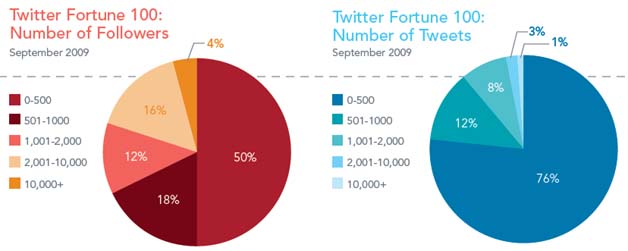
The Weber Shandwick report stated, "73 percent of Fortune 100 companies registered a total of 540 Twitter accounts. However, about three-quarters (76 percent) of those accounts did not post tweets very often, and more than half (52 percent) were not actively engaged."
Furthermore, "50 percent of the Fortune 100 accounts had fewer than 500 followers, a small number in relation to the size and reach of a major corporation. Another 15 percent were inactive . . ."
So there you have it, although "it" is something from which it’s hard to draw conclusions. After all, Fortune 100 companies are by definition doing more than all right, regardless of their awkwardness on Twitter. And many Twitter users have claimed that they don’t want to be bombarded with marketers’ messages, anyway.
What’ll be interesting to see is how this situation develops over time. Twitter’s said before that it might unveil analytics packages to attract big corporations.
Microsoft today at its developer conference in Los Angeles unveiled its Pinpoint service, which looks kind of like an app store aimed at enterprise developers and customers using Microsoft’s Azure cloud offerings, albeit one that goes beyond mere apps. It also showed off a data repository, code-named Dallas, that offers developers access to a wide variety of public and fee-based data sets with which they can build useful programs. Dallas, which can be found in the Pinpoint market, strongly resembles the service shown off this year at DEMO from Austin, Texas-based Infochimps. It was also by far the most interesting element of Microsoft’s chief software architect Ray Ozzie’s opening keynote, which highlighted what he called Redmond’s “three screens and cloud” view of the world.
If the remainder of the conference’s speaker line-up is any indication, Microsoft is embracing a world of apps and mashups to enable developers to build software that can run across mobile, PC and other device platforms. Linking all this together will be Microsoft’s Azure cloud, which will go into production Jan. 1, 2010. For more on Azure, check out our previous coverage. With Pinpoint, Microsoft is acknowledging the success of the Android Marketplace and Apple’s App Store, and trying to get developers excited about the prospect of building programs to run in Windows environments. Pinpoint also offers links to consulting services and companies that work with Microsoft.
The Dallas data store is a pretty compelling showcase “application” in the Pinpoint market, as developers could access any manner of data and build an application around it. For example, one could build an Urban Spoon-style application that uses a bunch of the available data sets to offer up evening entertainment options in the user’s local area. As Ozzie said after he emphasized all of the data now available to us in the form of government information, news, sensor networks and even web analytics, “Data does no good unless we turn it from the potential into the kinetic.”
With Dallas and Pinpoint Microsoft wants to become a company that aggregates, stores and serves up information in ways that are accessible to developers and corporate clients. On the consumer front, Microsoft has created agreements with companies like Wolfram Alpha, Facebook and Twitter for its Bing search engine as another way to surface data beyond the mere words listed on a web page. Microsoft isn’t just selling software anymore; it’s selling itself as a clearinghouse for information.
Among the other developments that have come out of the conference so far:
Seesmic, the popular Twitter client, is building a Windows client that uses Silverlight.
Matt Mullenweg Mullenwag, CEO of Automattic (Disclaimer: Automattic, maker of WordPress, is backed by True Ventures, a venture capital firm that is an investor in the parent company of this blog, Giga Omni Media. Om Malik, founder of Giga Omni Media, is also a venture partner at True), appeared onstage to say WordPress will offer access to Microsoft Azure for blogs to help handle spikes in traffic.
Azure nerds will appreciate that Microsoft will support Java, PHP, MySQL, and Eclipse in addition to .Net.
Those concerned about storing information on Microsoft’s servers after the T-Mobile Sidekick disaster should be relieved to hear that all items stored in Azure will be replicated in two data centers in each geographic region (in case a problem in one data center takes out the information there).
The Cheezburger Network has launched a new site called Oddly Specific that showcases funny signs and uses the WordPress for Azure platform.
When dealing with official state visits, things come in pairs. The leaders hold joint press conferences. The limousines in the motorcades fly the flags of both nations on the hood. The staff sit in equal numbers at the table, each opposite his or her equivalent in the other country’s delegation. Even the official photographers are paired together. Where one is allowed to go, the other will expect to follow.
For Pete Souza, director of the White House Photo Office (and my boss), it is a matter of professional courtesy and collegial camaraderie.
In this update Pete tells us some of the other trials and tribulations of shooting on the road. And he has one more surprising pair: though this is President Obama’s first trip to China, it is Pete’s second state visit. He was here as one of President Reagan’s official photographers in 1984 and shared with us some of the differences he has noticed over the decades in this vibrant city.
He also shared some of the lens lengths he uses but don’t be fooled, it takes more than a certain type of lens to capture a great photo.
Here are some pictures from the trip so far:
President Barack Obama, right, watches the entertainment with President Hu Jintao at a formal state dinner at Great Hall of the People in Beijing, China on Nov. 17, 2009. (Official White House photo by Pete Souza)
President Barack Obama shakes hands with the entertainers at a state dinner with President Hu Jintao at Great Hall of the People in Beijing, China on Nov. 17, 2009. (Official White House photo by Pete Souza)
President Barack Obama is escorted by officials as he tours the Forbidden City in Beijing, China, Nov. 17, 2009.
Chinese honor guards prepare for President Barack Obama’s arrival at the Great Hall of the People in Beijing, China, Nov. 17, 2009. (Official White House Photo by Lawrence Jackson)
President Barack Obama meets with Shanghai Communist Party chief Yu Zhengsheng at the Xijiao State Guest House in Shanghai, Nov. 16, 2009. (Official White House photo by Pete Souza)
Secretary of State Hillary Clinton jokes with President Barack Obama about their headphones for translation after a bilateral meeting with President Medvedev of Russia in Singapore on Nov. 15, 2009. President Obama’s headphones for translation weren’t working properly and he had just received a new headset. (Official White House photo by Pete Souza)
President Barack Obama greets children of U.S. embassy workers in Tokyo, Japan, Nov. 14, 2009. (Official White House photo by Pete Souza)
Arun Chaudhary is the official White House videographer
Sony Gulf announced that 16 school children from Dubai had a unique opportunity to walk the same pitch with their football idols as official flag bearers, carrying the FIFA flag for the 2009 FIFA Beach Soccer World Cup in Dubai. Selected through the Sony Dubai Schools Football League, children from the third, fourth, fifth and sixth grades were chosen from 22 schools through essay competitions and other in-house competitions for the program. The selected students have undergone extensive training to prepare themselves as flag bearers for the tournament which kicked off yesterday.
Osamu Miura, Managing Director of Sony Gulf, said: “Football is certainly a popular game in Dubai and young school children passionately follow the game with their own choice of icons. We are pleased to offer this incredible opportunity and engage the interested youngsters through our community initiative.”
Sony has been actively involved in the Dubai Schools Football League since 2007. By supporting the Dubai Schools Football League, Sony Gulf aims to nurture and enhance the skills of the young players and improve the overall quality of the game at the grassroots level. Sony’s agreement with FIFA makes it one of the games’ six global partners and will mark its participation in the ‘Digital Life’ category. Through this programme, Sony will exercise various rights as an official partner of over 40 FIFA events including the 2010 and 2014 FIFA World Cups, FIFA Women’s World Cup, FIFA Confederations Cup and the FIFA Interactive World Cup.
Google has launched some new features for Google Translate, while altering the look of the service. In addition to redesigning the site, the new features are aimed at making it faster and easier to translate text between 2,550 language pairs. Google Translate works for 51 languages, representing 98% of Internet users, according to the company.
One new feature is the ability to translate instantly. There used to be a "translate" button, but now it just translates your text as you type it.
Another new feature is the ability to read and write any language. Basically, you can just enter a word that you can’t read, and click "show romanization" to read the text written phonetically in English. Currently, this feature works for all non-Roman languages except for Hebrew, Arabic, and Persian. I would assume that these will be available in time.
There is also a new input transliteration feature for Arabic, Persian, and Hindi. "If you want to translate from one of these languages, but can’t type the script on your keyboard, our input transliteration feature will allow you to type words as they sound and convert them to native script," explains Google Translate product manager Awaneesh Verma.
Finally, the new Google Translate offers text-to-speech translation. When translating in English, you can hear translations in spoken form by clicking the speaker icon.
Here’s a weird one for you: A few hours ago, Motorola DROID users began reporting that the cameras on their handsets were suddenly.. better. The camera’s ability to auto-focus, which I’d railed in our review of the product, seemed to drastically improve overnight. And it did!
Most assumed that Verizon and Motorola had managed to sneak out some sort of stealth over-the-air update, patching the camera’s settings on the fly. A number of sites reported as much. Some even took offense to this idea, declaring that such things shouldn’t be allowed without their explicit permission. According to the folks that should know best, there was no over-the-air update at all; the camera fixed itself, and in 24.5 days, it’ll break all over again.
What we’re seeing evidence of today is a kind of Microsoft restructuring in progress — a slow shift toward a future revenue model that actually began about two years ago. Rather than alert Dow Jones as to the need for major structural change, the company did what its MVPs have always suggested enterprises do for themselves: Don’t panic, plan, and take things slowly.
But this means juggling a lot of balls in the air in mid-transition, the move to a more global network-centric and license-based revenue model. So individuals who were looking for the launch of a boxed product today, something with a jazz theme and a celebrity to accompany it, were probably disappointed — but that’s no evidence of the lack of a strategy. We’re seeing a framework shift, and if you look at Microsoft using the old frame, you don’t see the whole picture.
That’s not to say the shift toward Azure as a services platform isn’t a huge gamble that could fail altogether. But with Amazon’s announcement last week of a kind of applications development platform on top of its EC2 infrastructure, if Microsoft’s gamble goes down in flames, at least it won’t go down alone: There’s a genuine market here with major players and real innovators, Microsoft among them. Keeping developers “in the family” is critical to keeping the first great services-based applications on the Windows platform that Microsoft already built.
Otherwise, if developers start playing the table and jumping ship elsewhere, Microsoft could end up surrendering the cloud…the way it appears it may be surrendering its market space in mobile.
When Vivek Kundra demonstrated the Azure-based mobile job finder application this morning running on an iPhone, there was an audible “O-o-o-h” from attendees at this morning’s keynote; and although Kundra made certain never to invoke the word “iPhone” or refer to the phone, he did say the app was built and deployed in a matter of days — an indication that Microsoft was thinking about reaching customers where they lived and worked, even if it’s outside its platform.
I remember hearing “O-o-o-h” before, a quarter-century ago when Microsoft started creating its very first graphical applications for Macintosh. That gamble paid off.
The job of giving identity to the cloud concept has been left to Bob Muglia, whose annual funny video this morning wasn’t too far off the mark from reality: In the video, he acts as a kind of personal, spiritual counselor for “the cloud,” who in this case was an idea borrowed from a recent ad campaign for Bob Evans Restaurants. Here “The Cloud” is trying to find a purpose for itself, and Muglia’s advice is that the cloud can be anything and everything it wants to be…whatever that is.
While it is set to go on sale November 22nd, business customers on AT&T have been able to order the 9700 starting yesterday morning. If you got in early enough, there’s a good chance your unit shipped out the same day just as ours did. Here’s a quick unboxing for anyone desperately waiting for their BlackBerry 9700s to arrive, and you can always re-read our BlackBerry 9700 review in case you really want to tear your hair out. Also, if anyone else picked up an AT&T unit, or even a T-Mobile unit for that matter, we salute you, friends. BlackBerry fiends need to stick together…
P.S. We’ve been told most AT&T store locations actually have BlackBerry 9700s in stock as of now, but they’re not supposed to sell them until the 22nd.
Next time you’re at Sports Authority applying for a hunting license, you could pick up replacement Wii Remote or even the Wii Fit as the retailer is getting into the gaming business. But seriously, this kind of makes sense and has apparently been in the works for months.
The Nintendo Wii has long been associated with exercise. It forces players to get up and actually move. In fact, there is a whole market of accessories built around the Wii Fit. Sports Authority might not have any trouble selling the systems with Wii Fit if they are marketed with demo units available for shoppers to try out. I, for one, would much rather spend a couple hundred on the Wii than an entry-level treadmill or Stairmaster.
The WSJ is reporting that some stores could get the systems as soon as this week and Sports Authority has been working with Nintendo for almost six months. This might help Nintendo push a few more units into homes and regain a dominate position in the gaming console wars.
Mobile network operators can boost data revenues by providing personalized apps and content experiences for their subscribers, according to a report released today by Qualcomm. But the carriers will have to walk a fine line between being helpful and being invasive as they try to take their customers by the hand.
According to the San Diego-based chip maker — which is touting Xiam, its mobile content discovery technology — 63 percent of users polled in the UK and U.S. said they’d spend more time accessing or purchasing content if the stuff they were looking for was easier to find. Four out of five respondents said difficulty obtaining content is “a major problem,” and users estimated they would spend an average of an hour more per week and $8 more per month on mobile data if their content was personalized.
Such difficulty is especially easy to appreciate given the ways most users search for content on their phones. The two most common ways to look for mobile content are using search engines or typing in URLs on the device, Qualcomm said — methods that can deliver headaches more quickly than they produce accurate search results.
There’s no question that discoverability is a huge problem on the mobile web, and carriers — with their established billing mechanisms and strong content partners — are indeed well positioned to help their users spend money. But they’re also likely to be seen as intrusive by some, and as flat-out invading users’ privacy if they try to target content by tracking user behavior and purchases. And they’re sure to be resented by some users who figure their mobile company already takes a big enough chunk of change every month. There are opportunities to subtly suggest content their users might actually pay for, but carriers will have to tread very gingerly as they approach those subscribers.
Effective as of April 1, 2010, Sony will transfer certain PC-related operations, including design operations, carried out by Sony EMCS Corporation Nagano TEC (Azumino City, Nagano Prefecture) into the VAIO Business Group, the headquarters function of Sony’s PC business. Concurrently, the VAIO Business Group will be relocated to the “Nagano Business Center” of Sony, which will be newly located on the premises of Sony EMCS Corporation Nagano TEC. Following this move, Sony EMCS Corporation Nagano TEC, which is currently conducting design, manufacturing and related operations for Sony’s PC business, will be dedicated solely to manufacturing operations.
By centralizing all related operations of product planning, design and manufacturing for Sony’s PC business at one site, Sony aims to strengthen collaboration between each operation and establish a unified business structure that further enhances efficiency and accelerates business growth.
Operations relating to Sony’s “α” digital SLR business, which have been located at Sony’s Shin-Osaka Business Center in Osaka City, Osaka Prefecture, will move to Sony’s Shinagawa Technology Center (Minato -ku, Tokyo). This move is scheduled to be completed by the end of March 2010. It is designed to maximize synergies with other digital imaging business groups (including video cameras and digital still cameras) in areas such as technological and product development, with the aim of further reinforcing Sony’s “α” business and optimizing operations across Sony’s digital imaging business.
Tech professionals by day, rockers by night — on Dec. 9 at the Great American Music Hall, they’ll pick up their instruments and venture onto the big stage to let their alter egos shine…for a good cause and the love of music. Silicon Valley Rocks 2009 will bring together the Valley’s tech community — from VCs and entrepreneurs to bloggers and software developers — to raise money for Music in Schools Today (MuST), a Bay Area nonprofit that seeks to rescue music programs from budget cuts. The second annual showcase will once again feature Silicon Valley bands and original rockers who will entertain and amuse your entire social graph. Use discount code “gigaom5off” and register here.
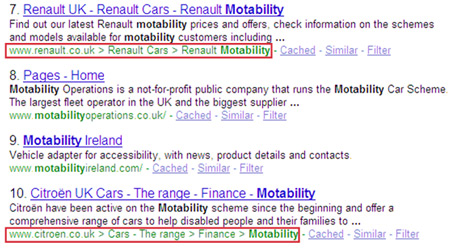
Update: Google announced today that it will now be rolling out the use of breadcrumbs in seach results on a global basis. They will only be used in place of some URLs – mainly the ones that don’t give the added context of a link the way that the breadcrumbs do. Google says:
Some web addresses help you understand the structure of the site and how the specific page fits into the site hierarchy. For example, consider a search for the biography of Vint Cerf (Google’s Internet Evangelist). The URL for one result, "www.google.com/corporate/execs.html," shows that the page is located in a page about "execs," under "corporate," which is on the "google.com" site. This can provide valuable context when deciding whether to click on the result.
Often, however, URLs are too long, too short, or too obscure to add useful information.
That’s where the breadcrumbs come in. Google says the feature should be available globally within the next few days.
Original Article: Google appears to be testing breadcrumbs in some search results, at least in some areas. If you are unfamiliar with the term breadcrumbs, it refers to the hierarchical display commonly used in site navigation. For example: Home Page>Product Page>Product A Page.
Do you utilize breadcrumbs on your site?Comment here.
Several bloggers have noticed Google displaying these types of breadcrumbs in various places in seemingly random results to some queries. For example, Rob Hammond provides the following screen shot:
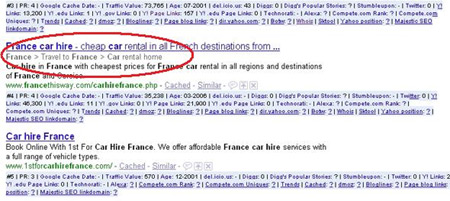
Leo Fogarty provides another, which shows the breadcrumbs displayed in a different position within the search result:
Google’s use of breadcrumbs appears to only be a test, and a limited one at that. Google has talked repeatedly about sites having good site architecture in the past. This allows Google to more easily and quickly crawl sites.
Bing acknowledges this too. Rick DeJarnette of Bing Webmaster Center recently said, "You can have great content and a plethora of high quality inbound links from authority sites, but if your site’s structure is flawed or broken, then it will still not achieve the optimal page rank you desire from search engines."
If Google begins incorporating the breadcrumbs display as in the above tests, on a mainstream level, that will be all the more reason to clean your site architecture up, at least in the navigation area. Site architecture certainly goes beyond this, but it is a key part of usability anyway.
Have you seen breadcrumbs show up in Google results? What do you think about the idea? Share your thoughts.
Someone once told me that Viacom’s top lawyer, Michael Fricklas, has been known to read Techdirt on occasion. I have no idea if this is true, but it still is interesting to watch him give a lecture to some Yale law students where he offers a somewhat nuanced position on copyright issues (thanks to JJ for being the first of many to forward the video to us), but which repeatedly seems to leave out certain pertinent facts:
He starts out by saying that he’s a strong supporter of fair use, and doesn’t like the idea of having to get licenses for creating new works — but is concerned about the “exact copy” problem. So, basically he’s in favor of fair use for creating new works, but not direct distribution.
He discusses copyright vs. free speech — and insists that there’s no “tension” between the two (despite many recent studies suggesting the exact opposite). Of course, he does a bit of a twist there, by saying that copyright is pro-free speech because it creates incentive for speech. The problem with this statement is that while that’s the theory, the evidence for it is somewhat lacking. However, there is tremendous evidence of cases where copyright is used to stifle speech — and of all the massive extensions and changes in copyright laws over the past 200 years, almost all have served to stifle more speech than they have encouraged.
He then trots out the industry’s own numbers claiming how much copyright contributes to the economy, even though those numbers are based on a variety of questionable assumptions, including the idea that all content covered by copyright is only created because of copyright. Along those lines, he also credits copyright for things like the iPod and the Kindle, saying that no one’s buying those devices just to look at them. This is correct — but note the trick. He did not say that it was content that drove the iPod and the Kindle, but copyright. He’s wrong. It’s content. Not copyright.
He notes that some say that “unlicensed IP” might drive this innovation, but he favors “sustainable innovation” (as if anyone doesn’t). And then he makes this odd statement:
“A more sustainable innovation is one where, if you make an investment, you have the opportunity to make a return.”
Now, that’s a great (by which we mean, useless) statement, because it’s obviously true. Who would ever deny that? But it’s a sneaky and disingenuous statement, because it implies something that’s simply not true: that without copyright or without restrictive licensing, the investors do not have an opportunity to make a return. As we’ve shown over and over again, plenty of content creators who “free” their IP have not only made a return, but have made a better return than they did under older models that relied on copyright. But it’s a sneaky trick that’s often used by folks in this debate. You set up this strawman argument and then knock it down, despite the fact that no one ever made the argument, and you argue that something is fact (that you can’t make a return) when it’s empirically false. It’s frustrating that this argument still gets made and people should really start calling the folks who make it out whenever they state such falsehoods.
Later, he talks about the “losses” from piracy, insisting that the findings come from a “sophisticated” analysis, not just from counting all downloads as lost sales. Of course, these numbers came from the same study process that led to some results that even the MPAA (of which Viacom is a major member) had to later admit were bogus. This is also the same “sophisticated analysis” that includes ripple effects in one direction only, so it’s actually double, triple, quadruple, quintuple counting some numbers, while totally ignoring how those numbers actually help the industry in other ways. So, sorry if I don’t take those loss numbers seriously, no matter how “sophisticated” he thinks they are. They’re not. They’re only “sophisticated” in how misleading they are.
He does have a short discussion on RealNetworks’ RealDVD offering, which he implies enables piracy — even as he admits he wants the functionality, where he could move a copy of a legally purchased DVD to his hard drive for backup or other viewing, but says his “concern” is that people would do this with Netflix DVDs. He believes that the problem with this is that RealNetworks had to break the encryption put in place by the studios. Notice, again, what Fricklas conveniently leaves out. First, he leaves out the fact that it is already legal for people to make backup copies of content they legally own — but, thanks in part to Hollywood lobbying, Hollywood itself can block that right, simply by putting encryption on something and then saying that you can’t circumvent it without breaking the law (thank you, DMCA anti-circumvention clause). He also leaves out (conveniently) the fact that RealDVD doesn’t actually “break” the encryption and that the resulting copy still includes DRM that prevents copies. The fact that he’s “concerned” about the Netflix model is of no consequence whatsoever. McDonalds is “concerned” about Burger King, but that doesn’t give them a legal right to block them from being in business.
Then he pulls out the ever popular “$200 million movie” myth, which I thought was a favorite of NBC Universal, but I guess Viacom is going with it now as well. It’s not a myth that there are movies that cost $200 million. The myth is that people want movies that cost that much. No one watching a movie cares how much it costs. They want good movies, no matter how much they cost. I’m sure people would like some $1 billion or $100 billion movies as well, but that doesn’t mean we need to grant Viacom extra special legal privileges to make sure it can make a $1 billion or $100 billion movie profitably. People like good movies. Viacom wants to make profitable movies. We agree. But the $200 million number is meaningless. There are ways to make good movies for both less and more than $200 million and there are ways to make profitable movies even in the face of piracy. The claim that piracy undermines the $200 million movie, which is some sort of “necessity,” is simply not supported.
On top of that, he tosses out the debunked claim that if something is “free” it means it’s devalued. That’s simply not true, no matter how many times people repeat it. If it were true, and the content had no value, no one would want it. Value and price are two separate things.
Then, he discusses the “Kanye West” MTV Video Awards “Imma let you finish…” example, by talking about how Viacom used various filtering tools to pull that clip off of various “unlicensed” user uploaded video sites. But he also talks about how they drove people to use the official Viacom clip, which allowed them to “participate in the benefit” of the video. Now, that’s interesting, and it’s great that they put their own clips up and made them embeddable. But, again, it’s important to note what he left out. In forcing everyone to view the content through Viacom directly, it also increased Viacom’s own cost in terms of bandwidth. The advantage of letting others help host and distribute the content is that it actually eases that cost.
His discussion on kicking people off the internet via a “three strikes” mechanism is getting much of the attention on other sites, because he mentions, totally in passing, that suing users “feels like bullying.” This may sound like a big deal — and certainly some other sites (and industry lawyers) are making it out like a big revelation, but it’s not. The movie industry has never sued individuals for such things — only the recording industry has. And even way back in the Jack Valenti days, he talked about why he didn’t like the idea of suing individuals. So, this isn’t a shift in positioning at all. Rather, it’s a repeat of the new silly strategy of some in the industry to try to pretend that kicking people off the internet is “consumer relief.” Not quite. Shooting someone in the leg instead of the head is certainly “better,” but I doubt that the person shot in the leg considers it “relief.”
Towards the end of that discussion, though, he makes another interesting statement, saying that: “there’s no way to deal with this problem other than to move viewing into licensed contexts.” Except, that’s not true. There are other ways. It’s called setting up a business model where people actually do have a reason to buy things, whether they view the content in a licensed or unlicensed manner. I recognize he’s on the legal side, rather than the business side, but the idea that the “only” way to deal with piracy is to attack it, rather than embrace it, is a position that the industry long ago should have learned was a mistake.
His final point is discussing how DRM “enables new business models,” and he more or less dismisses criticism of DRM as really just being criticism of “bad” DRM (of which there is plenty). However, what struck me, was how none of the “new business models” he described actually required DRM at all. You could do them all in some way entirely without DRM. All the DRM does is add restrictions. Of course, rather than adding restrictions, why doesn’t the industry focus on employing new business models that give users more and make them want to buy, rather than trying to enforce artificial limitations?
On the whole, it is an interesting video, and well worth watching, but it conveniently misstates or leaves out important facts throughout. Unfortunately, the Q&A session that follows the presentation wasn’t included, so I have no idea if any of the students challenged some of his assertions or pointed out some of the points that he left out. Anyway, maybe we can hope that Fricklas is, in fact, an occasional reader here and can stop by to address those questions and omissions.
This morning AT&T announced that they’ve done a “substantial upgrade” of its 3G coverage in the Seattle area, having deployed additional wireless spectrum using the 850 MHz band. According to AT&T, the upgrade should mean that customers in Seattle, Tacoma, Everett, Renton, Auburn, and King County should all have better 3G connectivity, performance, and the signal should be much stronger when indoors as well. The move should also increase overall network capacity, which AT&T is hoping will support subscriber growth.
Since Gear Live HQ is located smack-dab in the middle of the enhanced coverage area, we’ll be giving things a try, and we will let you know if the use of 850 MHz spectrum truly helps the dire situation that is AT&T coverage. Seattle iPhone 3GS and 3G users, give it your best!
Some people like keeping some huge collections. No matter what, they like having a big and impressive collection of whatever they can get their hands on. Movies, pieces of software, images and music, you name it. So, it’s pretty tough for them to organize and manage a big collection. Data Crow is a piece of software created especially for this, one that will help you create a huge database containing all your collected items, and store them appropriately. This is very useful, since one of the most important things for any collection is the appropriate management system, in order to find all the things you search for fast and easily.
The Looks
When starting Data Crow, you will probably be overwhelmed by the many menus available. Not to worry, though, most of them are very easy to use and pretty intuitive. Depending on the module you select, things can get a little different, but, mostly, they are all the same. Data Crow lets you register all of them in an easy way, so that you can store them and gain a quick access to them when needed.
The Works
Data Crow is pretty easy to use by yourself, but, if you need help, you can catalog any media by using the item wizard. In order to add media to a catalog, you must select the module that your media belongs to. Modules range from movies, pieces of software, ima… (read more)
We’re giving away five Peek Protos this week, one a day, and we want you to ask us nicely for one so we can give you one. What I’m basically trying to say is that you should respond to this post with a comment (using your real e-mail address) and also follow CG on Twitter and watch the Gift Guide for more special things.
CNN Political Ticker: According to a CNN/Opinion Research Corporation poll released today, “Americans are split over the health care bill which narrowly passed the House of Representatives earlier this month … and the survey suggests the opposition to the legislation isn’t coming only from the right.”
“The survey suggests that 46 percent of Americans favor the bill, which passed in the House on November 7 by a 220 to 215 margin, with 49 percent of the public opposed to the legislation. ‘Roughly one in three Americans opposes the House bill because it is too liberal, but one in 10 oppose the bill because it is not liberal enough,’ says CNN Polling Director Keating Holland. ‘That may indicate that a majority opposes the details in the bill, but also that a majority may approve of the overall approach taken by House Democrats and President Obama.’”
And, even with this deep split in public opinion about pending reform proposals, “a majority of Americans would like to see the Senate take up the legislation.” The telephone survey was conducted Nov. 13-15 and has a overall sampling error of +/- 3 percentage points (Steinhauser, 11/17).
The Washington Post reports on a new Washington Post-ABC News poll that also “shows Americans are deeply divided over the proposals under consideration. But Republican opponents have done little better in rallying the public opposition to kill the reform effort. … 48 percent say they support the proposed changes; 49 percent are opposed. … The new poll provides ammunition for both advocates and opponents of reform. For opponents, a clear area of public concern centers on cost — 52 percent say an altered system would probably make their own care more expensive, and 56 percent see the overall cost of health care in the country going up as a result … But reform proponents have other findings to bolster their case. Two-thirds of those surveyed support one of the basic tenets of the reform plan, a new requirement that all employers with payrolls of $500,000 or more provide health insurance coverage for their employees or face fines. As in previous polls, a majority supports a government-sponsored heath insurance plan to compete with private insurers, although the percentage supporting the general idea has slipped slightly over the past month to 53 percent” (Balz and Cohen, 11/17).
ABC News: “Other measures underscore the difficulties facing the GOP. … Democrats in this poll outnumber the Republicans by 10 points as the party that ‘better represents your own personal values’ and by 15 points as being ‘more concerned with the needs of people like you.’” ABC notes that “Obama leads the Republicans in Congress in trust to handle health care by 13 points, 50 percent to 37 percent” (Langer, 11/17).







 What we’re seeing evidence of today is a kind of Microsoft restructuring in progress — a slow shift toward a future revenue model that actually began about two years ago. Rather than alert Dow Jones as to the need for major structural change, the company did what its MVPs have always suggested enterprises do for themselves: Don’t panic, plan, and take things slowly.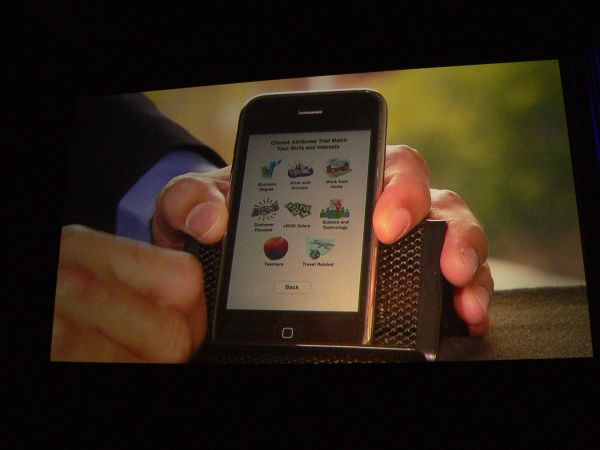
 The job of giving identity to the cloud concept has been left to Bob Muglia, whose annual funny video this morning wasn’t too far off the mark from reality: In the video, he acts as a kind of personal, spiritual counselor for “the cloud,” who in this case was an idea borrowed from a recent ad campaign for Bob Evans Restaurants. Here “The Cloud” is trying to find a purpose for itself, and Muglia’s advice is that the cloud can be anything and everything it wants to be…whatever that is.



 Mobile network operators can boost data revenues by providing personalized apps and content experiences for their subscribers, according to


 Some people like keeping some huge collections. No matter what, they like having a big and impressive collection of whatever they can get their hands on. Movies, pieces of software, images and music, you name it. So, it’s pretty tough for them to organize and manage a big collection. Data Crow is a piece of software created especially for this, one that will help you create a huge database containing all your collected items, and store them appropriately. This is very useful, since one of the most important things for any collection is the appropriate management system, in order to find all the things you search for fast and easily.