Nintendo’s Kensuke Tanabe has intimated that Metroid Prime 3: Corruption may not be the last we’ll see of the Prime series. Another handheld iteration…
Author: Serkadis
-
Canadian High School To Use Sony Reader Exclusively

One of the Canadian high schools – Blyth Academy is the first school in the world at this point to switch from heavy weight paper textbooks to exclusive use of the Sony Reader Touch edition in their place. I am sure a number of students of that school and their families are rejoicing of the fact that they do not need to carry a ton of weight on their backs or shoulders, as pretty much all of the content for the semester can be loaded into Sony Reader. Pretty cool I would say! I hope some day we will see more schools switching to the digital format. Check out the news release below:
TORONTO, Nov. 17 /CNW/ – Embracing the benefits of electronic reading, students at Blyth Academy are today beginning the transition from using traditional printed textbooks to digital textbooks read on the Sony(R) Reader Digital Book. Blyth Academy is the first high school in the world to announce that each student will be supplied with an e-Reader in place of printed textbooks.
From history class to political science, each student will have access to all of his or her course content using leading edge digital technology from Sony and publishers like Pearson Canada. The students will use Sony Readers that are pre-loaded with course textbooks, outlines, assignments, reference materials, background reading and personal timetables.
“My Sony Reader helps me get organized,” said Michael Tyrrell, student at Blyth Academy. “I have all my textbooks and class material on it – it’s really cool. I feel like somebody just personalised school to fit me.”
Blyth Academy selected the Sony Reader Touch(TM) Edition because it’s easy to use with intuitive touch screen navigation, and its open format provides students with access to content from numerous sources.
“We’re excited about how the Sony Reader can enhance a student’s learning experience,” says Tim Algate, Reader Product Manager with Sony Canada. “We’ll be listening to these students, using their feedback to evolve our Reader offering for education.”
The school has compiled a library of digital content from textbook publishers like Pearson and other class material and literature in digital format. Blyth will give students access to digital assets for university admission, offering everything they need to chose and apply to any university.
“The digital content we’ve acquired, coupled with the students’ Sony Readers, will dramatically improve student access to textbooks, collateral material, literature and reading in general,” said Sam Blyth, Chair, Blyth Academy. “Our student survey shows that they are twice as likely to read a book available in an e-book format as in hard copy form.”
Helping lead the way in delivering digital content for education are publishers like Pearson Canada.
“Pearson Canada is taking students beyond the four corners of the printed textbook,” said Anne-Marie Scullion, Vice President of Marketing Field Services, Pearson Canada. “Our focus is on developing flexible and adaptive content to engage students in a 21st century learning environment.”
Students will also have access to more than half a million free e-books from Google through the Sony eBook store at www.ebookstore.sony.com, as well as the e-books offered by the Toronto Public Library.
-
Windows Azure opens for business on Jan. 1, 2010
By Joe Wilcox, Betanews
This morning, Microsoft kicked off its 2009 Professional Developer Conference in Los Angeles. Typically, Microsoft times PDC around new operating systems that are testing and launching in the near future. Windows 7 and Windows Server 2008 R2 launched less than a month ago. So what operating is left? Windows Azure Platform (Day 1 Live Blog).
Ray Ozzie, Microsoft’s chief software architect, took the keynote stage in typical fashion. Ozzie is a brainy type, who talks like his head is in the clouds, which is perhaps appropriate for someone laying out Microsoft’s cloud computing strategy. He introduced the world to Azure Services Platform a year ago, during PDC 08. Today, he added when to why, what and where about what Microsoft now calls the Windows Azure Platform.
Microsoft will launch Azure as a production service on January 1st, but customers won’t be billed until February 1st, so the first month will be free. The Technical Preview now underway will continue through the end of the year.
Ozzie said that a few companies would take Azure into production starting today. With that as introduction, Ozzie announced that Automattic, creator of open-source WordPress blogging system, would be one of those companies. From a marketing perspective, it was a stunning announcement, since Automattic uses open-source tools like Apache and MySQL. The message: Azure isn’t just about Microsoft products or development tools. I must say it was simply shocking to see WordPress creator Matt Mullenweg on the PDC stage.
In another brilliant marketing move, Vivek Kundra, the US government’s chief information officer, appeared via satellite link. Many news reports have painted Kundra as a Google hosted apps lover. He is on record supporting the use of open development tools for government online services. While Kundra mostly spoke about the government’s open-development efforts, his appearance at PDC is good for Microsoft by association. Kundra concluded by saying that he looks forward to the “thousands of applications that are going to be created.”
Azure Primer
Azure is, simply put, an operating system in the clouds. Developers write to an applications layer hosted on datacenters, as they might for an operating system on the PC or other device. This morning, Ozzie described Azure as a cloud OS “designed for the future but made familiar for today.” Azure also provides data services.
During the keynote, Ozzie also announced Microsoft Pinpoint for building online marketplaces and catalogs. Related, starting today, Microsoft is previewing “Dallas,” which Ozzie said is “built on Windows Azure and SQL Azure.” Dallas showcases how Azure can be used to provide cloud-based data services.
More broadly, Microsoft sees the cloud as unifying business users’ and consumers’ experiences with existing products. “Many platforms means many choices,” Ozzie asserted. In dealing with these choices, Microsoft has but one goal: “Focus on leverage and seamlessness in everything that we do.”
Put another way, Ozzie described Microsoft’s broader paroduct strategy as “three screens and a cloud.” He spoke about Web-based experiences delivered to various devices.
But the strategy is incomplete, which Ozzie acknowledged by telling PDC attendees what’s coming next year. He promised that Microsoft would reveal its next-generation development strategy for Windows Live and for Windows Phone during the MIX 10 Web developer conference.
Ozzie praised Windows 7, claiming it could for developers “sweep through and reinvigorate” the “fragmented” PC market. Perhaps Steven Sinofsky, Windows & Windows Live division president, will explain how during tomorrow’s keynote.
Storm Clouds Rising
In the year since Microsoft debuted Azure, with expectation of late 2009 or 2010 release, much has changed for the company and its customers. The late-September 2008 stock market crash sent IT budgets tumbling, millions of global information workers into unemployment and Microsoft sales falling. For Microsoft flagship products, Office and Windows, 2009 has brought slower sales.
Meanwhile, the social, cloud-based Web is seemingly advancing exponentially. During his keynote, Ozzie said that Microsoft started talking about services “four years ago this month.” There was something prescient in the timing. Nearly all the most popular social services in use today didn’t exist before 2006. Many of them gained huge mass-market success in 2009.
For example, most social media startups, whose products and services are taken for granted today, came to market in the last three years. Facebook, Twitter and YouTube opened to the public in 2006. Most other popular or growing popular social media tools launched within the last three years: Disqus, FriendFeed, tumbr, Twine, Qik and USTREAM, among many others.
Meanwhile, in the year since Microsoft announced Azure, smartphone and netbook sales have surged, creating new mobile platforms for consuming cloud services. In the smartphone market, Apple’s App Store/iPhone/iPod touch platform is doing for software plus services today what Microsoft is talking about delivering tomorrow.
The point: The cloud isn’t static. It is a storm moving across the technological and societal landscapes. Can Microsoft keep pace? That’s the question PDC may answer over the next three days.
-
NZXT releases the updated Tempest EVO gaming chassis

The NZXT Tempest is a great case. It’s, has tons of room, a sleek look, and amazing airflow. But it seems everyone’s chief complaint is that it’s very loud. The newly redesigned Temptest EVO aims to solve that problem.
 The new case is almost the same thing except the fans have been reworked to take the noise level down a notch. Plus the side panel now sports a smoked look that’s actually quite attractive. Of course everything else carried over from the original Temptest including a bottom-mounted PSU, E-ATX support, cable management, and pre-drilled for watercooling tubes. It’s $99 and available now.
-
Walkthrough of QuickLaunch for BlackBerry
There are many applications that make your BlackBerry and even better productivity tool. Last week we examined StudentDocket, an application that provides organizational tools superior to those natively on the BlackBerry. While StudentDocket can streamline your professional and personal lives, it doesn’t streamline your BlackBerry itself. This week we’re going to look at an application that does. It’s called QuickLaunch, and the name couldn’t be any more appropriate. It will make navigating your BlackBerry that much easier.
-
Amazon Launches Packaging Certification Program
Amazon.com is launching a Frustration-Free Packaging certification program aimed at convincing manufacturers to provide more user-friendly packaging.
"Wrap rage is real," said Dr. Nadia Shouraboura, vice president of Global Fulfillment for Amazon. "We launched packaging feedback and we were surprised by the customer participation and response world-wide. Our customers told us they want packaging that is easier to open, and is free of wire ties and impenetrable plastic clamshells."
"We are launching the certification program to share customer feedback with manufacturers and provide an easy way for manufacturers to modify their packaging to make it Frustration-Free. We want to give customers the best possible experience from the time the order is placed, to when they remove the items from the packaging."
 Manufacturers that want to get their packaging Certified Frustration-Free can submit their packaging to Amazon’s team of engineers for free. The team will analyze the packaging and determine if it needs modifications. Manufacturers that become certified can then use the "Certified Frustration-Free" logo on their packaging.
Amazon said it has extended its Frustration-Free Packaging certification program to Germany, France, Japan and the United Kingdom.
Related Articles:
>Amazon Rolls Out Kindle For PC
>Amazon Shows Interest In Twitter Referrals
-
PM welcomes Slovakian troop boost
 The Prime Minister has welcomed an announcement by his Slovakian counterpart to double the number of Slovakian troops serving in Afghanistan.
At a joint press conference at Number 10 following a meeting between the two leaders, Gordon Brown said he “applauded” Robert Fico’s decision to increase the number of soldiers that will serve as part of the NATO coalition.
He said:
“It shows the coordinated effort we are all prepared to make to train up the Afghan forces to ensure that they can take control of their own territory and gradually we can see a move towards districts being under the control of the Afghans themselves.”
Mr Brown also emphasised that Britain was part of a larger coalition of 43 nations operating in Afghanistan.
“There is a great deal of burden-sharing. There are more forces ready to come in from other countries and I believe that we will approaching a number of other countries in the next few days.”
Speaking through an interpreter, Mr Fico said Slovakian units would also begin operating in regions of Afghanistan outside Kabul and Khandahar.
He added:
“In this way, Slovakia, as part of a member of a 43-country coalition, wants to contribute to achievement of legitimate objectives in Afghanistan.”
The two leaders also discussed the upcoming climate change conference in Copenhagen, where they believe the EU can take a lead in negotiations, and economic cooperation between the UK and Slovakia.
-
Is the Primal Blueprint a Type of Asceticism?
 Last week, MDA member Bobbylight posed a pretty poignant question in the forum: is the Primal Blueprint an ascetic lifestyle? As you’ll see from the actual post, he basically answered his own question (he agrees that the PB, by definition, is not asceticism, but his particular brand of the PB has gradually morphed into a kind of personal journey away from material pleasures; a “food as fuel” mode of asceticism), but the concept of asceticism gives me a jumping off point for a larger issue that needs addressing.
First, I’d like to review the differences between asceticism and eating in accordance with evolutionary biology. As it’s generally practiced across multiple disciplines and belief systems, asceticism refers to the complete and utter refutation of “worldly pleasures” to achieve spiritual and physical enrichment. Cleansing the mind along with the body. Regarding the pursuit of pleasure as somehow unnatural or impure, as if giving in to our animal urges is something to be ashamed of. It promotes permanent abstention from material desires with the hope that they will permanently atrophy and dissipate, like some little-used muscle or organ withers and dies. If the fate of the appendix is any indication of this idea’s validity, though, I wouldn’t hold your breath. Pleasure is here to stay. In fact, I’d argue that our relentless pursuit of pleasure is actually completely natural, deep-seated, and immutable. The basic human condition is desire. Without that pursuit of pleasure, we may not have made it this far. Without that constant, nagging desire to feel good, to taste good things and enjoy the warmth and intimacy of a sexual companion, to sit bundled up in front of a roaring fire licking marrow from sticky fingers, we lose the desire to survive – because what use is living if you’re not going to enjoy it on some basic level? Why get up in the morning without something to look forward to? It may be that thriving is actually necessary for surviving after all.
What do we crave, once we’ve transcended the artifice of refined sugar and whole grain addiction? Once we’ve spent a few weeks eating clean, Primal foods and cleansed our palate, most of us don’t even want the Twinkies or the Wonder Bread or the pizza anymore; we want the fat, the grease, and the gristle. We want fresh veggies sautéed in butter and salads drenched in olive oil and vinegar. We crave chicken with the skin, and we might just eat an entire pack of bacon to finish off an IF (if you put it in front of us). Some of us want nothing but the animal, while others sample the entire pantheon of flora and fauna. Above all, though, we all suddenly want nothing but real, whole foods once we get off the Neolithic faux-food. And when we get it, it tastes good.
Damn good.
Doesn’t that make you wonder? Might that not-so-subtle positive interplay between taste bud and food stuff be by design? I mean, sex feels good because it promotes procreation. The sun feels good to convince us to stay outside long enough to make vitamin D, an essential prohormone for life. Conversely, direct flame applied to our skin hurts like hell because it’s damaging our body and threatening our health, and we get sunburns to let us know we’ve gotten a bit too much sunlight. Wouldn’t it follow that the things that taste good actually are good for us, that the things we could conceivably come across and eat raw in nature are in fact suitable for consumption? I’d say so, yes.
I can already hear the fingers typing furiously.
“What about candy? Candy tastes good, so doesn’t that mean it’s good for us?”
For one, consumption of refined sugar and excess fructose beyond evolutionarily-realistic amounts is proven to be harmful. Tooth decay, insulin resistance, small and dense LDL formation – all that and more can be directly attributed to sugar intake. We all know that. But we also know that candies are clusters of pure sugar, half glucose and half fructose (a bit more fructose than glucose if made with HFCS), that appeared only recently on the menu. Crystallized sugar appeared on the scene around 5,000 years ago in Ancient Egypt, but until Columbus realized sugar cane flourished in the Americas and established a profitable slave-based industry, refined sugar in all forms was cost-prohibitive for anyone that wasn’t rich. Now? Now it’s cheap. It’s actually cost effective for companies to stick sugar and especially HFCS in anything and everything. Breads, salad dressings, condiments, sauces – pretty much everything on shelves and in packages contains a form of sugar. Some estimates peg our yearly intake of the stuff at over a hundred pounds each. Each, per year! That’s terrifying (especially when you realize that it’s an average, and that there are a significant number of people that minimize sugar intake, like us – somewhere, someone is eating two hundred pounds a year!), and it far exceeds what we could have mustered in Grok’s day.
A better question would be, “What about the sweet flavor? Why are we drawn to the sweet flavor if it signifies danger?”
That’s just it; in and of itself, it doesn’t necessarily mean bad things to come. In days of yore, sweet things were difficult to come by. Honey meant receiving bee stings and climbing tall trees, and, while there’s no way of knowing exactly how sweet or bitter seasonal fruit in the Paleolithic was or was not, we do know that today’s fruits are selectively bred for increased sugar content. Yesterday’s fruits were sweet (they had to be to enable seed dispersion), and sweet meant nutrients, but that sweetness was naturally selected for, rather than forced and sped up by man’s hands. Simple logic indicates that a fruit actively bred for sweetness will trend sweeter than the fruit left alone. The data certainly suggests as much.
Then there’s the fact that fruit used to be seasonal. Northern European Grok wasn’t shivering by fjords waiting for the latest shipment of Amazonian bananas (fun fact: here’s what a wild banana actually looks like – a far cry from the perfect peel-able fruit that we’re able to produce) by dug-out canoe. If he was lucky, he might nab a bushel or two of berries and apples in season and then gorge on them. But an apple a day? No, that wasn’t possible for Grok year round. Tropical or temperate Grok probably had more access to fruit, but they still weren’t as sweet. And wherever he was, Grok was not drinking Jamba juice or chugging a liter of orange juice in a single sitting. If he lucked out on a sweet fruit, he was eating the entire thing.
We may be drawn to the sweet flavor, but that’s because it was such a rare, quick source of cheap energy for our ancestors (and possibly a bit of a holdover from our extremely distant days as arboreal frugivores about 4 million years ago). Besides, what better time to fatten up than with a dose of sugar right before winter? The fact remains that, historically, the fruit we rarely ate was less abundant, and it contained less sugar than modern fruits. Our attraction to sweet flavors is not a free pass to subsist on bananas and figs. It’s merely a cue for Grok to snap up all the fruit and honey he can carry, because this might be the last time he sees any for a long, long time.
Meat, however, was abundant. Man had yet to encroach upon and severely disrupt local ecologies, and game was not relegated to a preserve or a national forest. Our brains grew big and hogged our metabolic output thanks to meat, which represented a new, denser source of energy for Grok. Neanderthals were our closest ancestors, and they were completely carnivorous, while many Homo sapien cultures were essentially pure meat eaters. Meat was the foundation for man’s emergence as conscious, cunning, brilliant, adaptable, preeminent predator. We depended on meat, which explains why we have such a visceral reaction to it.
The dog salivates at the whiff of a meaty bone, the cat seeks out the sunny patch so it can synthesize Vitamin D in its fur, and the plant strains toward the nourishing sunlight. Organisms are pleasure seekers, and we are no different. We’ve just the ability (or curse) to rationalize and analyze our behavior, sometimes to our detriment. When we start using some arbitrary moral system to condemn and regulate our very natures, we deny our humanity. That is a very, very bad thing. I dunno about you, but I like being human. I like my big brain, and my compassion, and my conscience, and my consciousness. I can appreciate the fact that I drool a little when I smell a steak seared in butter even as I sit down to read the paper with my meal. We represent the union between animal urge and reason. The former keeps us alive and well, while the latter makes us human. The Primal Blueprint simply recognizes those urges, rationalizes them with an examination of the clinical and anthropological evidence, and offers a stable (yet malleable) foundation for people to follow. We satisfy our cravings, blood and grease dripping from our chins, content that this time (like most, actually) our basest urges are the purest and most righteous.
Jack LaLanne got it half right when he said, “If man made it, don’t eat it,” but I think he dropped the ball with “If it tastes good, spit it out.” I say embrace worldly pleasures that nourish our bodies and minds. Pastured meat, relations with a loved one, a bowl of wild berries, a day of play with some pals, a healthy serving of sunshine – these are true worldly pleasures that we derive from the natural world and to which we are drawn by our natural, animalistic urges. These are urges that promote healthful, vibrant living and true happiness, and I think the ascetic does himself a disservice in denying them. We are animals – thinking, feeling, loving, free animals – and we shouldn’t ignore or bury that fact for inconsequential ideologies or self-imposed limitations.
As William Blake wrote, “The road of excess leads to the palace of wisdom.” Grok took that road, and perhaps we should, too.
Get Free Health Tips, Recipes and Workouts Delivered to Your Inbox
Related posts:
- The Primal Blueprint Carbohydrate Curve
- Definitive Guide: The Primal Blueprint
- Dear Mark: Primal Blueprint Superiority?
-
Empowering U.S. Companies to Compete Abroad
It’s been over a week since we first arrived in Asia. First, we traveled to the Asia Pacific Economic Cooperation (APEC) Summit in Singapore, and now we have joined President Obama in Beijing, China. We have come to this important region to engage our counterparts to strengthen our economic relationships, further open Asian markets to American exports and create well-paid jobs at home.
The 21 countries that make up APEC account for some 61 percent of American exports, and traveling today through the streets of Beijing, it’s not hard to see why.
There’s a frenetic pace in Asia’s big cities, with construction cranes an ever present part of the cities’ skylines.
This growth is good news for the people of Asia who have found exciting new opportunities in these cities. But it’s also promising news for the workers, small businesspeople, ranchers and farmers of the United States, because selling our goods and services to these markets can put scores of Americans back to work and get our economy growing again.
And that is fundamentally why we are here this week. We’re trying to open up markets for American products and ensure that our businesses are able to compete on a level playing field in the global economy.
During our time in Asia, we’ve been meeting with various ministers from Asian governments as well as representatives of the American business community like the U.S.-China Business Council and the American Chamber of Commerce in China.
We are also taking the opportunity on this trip to talk about recent trade disputes and how such disputes are ultimately a healthy part of a mature trading relationship.
The United States is the most open major economy in the world and the Administration is committed to ensuring our borders will remain open to the world’s products.
But that commitment will be met by a renewed focus on doing more to enable U.S. companies to compete in foreign markets.
Ultimately, that will be good for everyone. U.S. technology and know-how can be of great benefit to countries throughout Asia. For example, as countries like China strive to reach ambitious clean energy and efficiency targets, they will depend on expertise of U.S. firms with a proven record of success in these areas.
This year, we have already made great progress in creating a freer, fairer trade environment with Asia. When we were in China a few weeks ago, our Chinese ministerial counterparts pledged to open up their markets to U.S. wind turbine producers and lifted a needless non-science based ban on the import of U.S. pork.
They also promised significant strides towards protecting the intellectual property of American companies operating within their borders and steps to ensure a more level playing field in China’s government procurement market.
These are important steps that will be good both for the creation of America jobs and the continuance of Chinese growth. And we are seeking to build on the positive momentum this week.
As President Obama recently said "power in the 21st century is no longer a zero-sum game; one country’s success need not come at the expense of another."
There is a lot to be gained from cooperation between Asia and the United States, and we are excited to be playing our part to move things forward.
-
Imeem Buyout Could Push MySpace Closer to “Freemium”
 Consolidation appears imminent in the free streaming music sector, as MySpace is on the verge of acquiring social music site Imeem. A source with knowledge of the situation confirmed that negotiations are in process, but no deal is set. If it happens, the buy would be MySpace’s second fire-sale acquisition this year, following its mid-summer deal for iLike at a bargain-basement price. Imeem’s valuation, once reportedly above $200 million, was said to have fallen below $10 million at the time of a recapitalization round earlier this year.
The proposed deal would unite two companies that share the same problem: Rights holders demand royalties for song streams at rates higher than advertising alone can offset. Imeem has been a money drain to its stakeholders, but it does have several assets that could prove valuable to MySpace, which may be mulling a move toward a “freemium” model. Its sales, engineering and leadership teams hold significant value. Imeem acquired Snocap, the music-selling widget provider founded by Napster creator Shawn Fanning and seen on many MySpace artist pages, in early 2008, and launched an iPhone app in May 2009.
Although no company has reached profitability providing free ad-supported music streams, Imeem was optimistic about reaching that point next year. The company had renegotiated its royalty rates with at least some of the major labels, reduced its headcount and other expenses, and accepted a round of funding worth about $6 million in spring 2009. But key investor Sequoia Capital bailed out of the recap round, and was largely washed out along with other stakeholders.
What’s more, its brand name is known as a music destination, in contrast with MySpace’s reputation as a broader social network. Imeem is also said to be developing a new user interface, the better to compete with Spotify, and if MySpace is planning to launch a paid service, it could incorporate parts of Imeem’s existing but little-used VIP service. Imeem has put those pieces in place already; for MySpace it’s a chance to buy rather than build them.
Imeem began exploring a sale more than a year ago, retaining Montgomery & Co. to evaluate strategic options, but no buyer emerged. Since that time, the free streaming model has fallen on hard times, and may soon be a thing of the past. If the current deal produces an exit disappointing to Imeem’s stakeholders, at least it will have produced something better than bankruptcy — which would be a small victory.


-
Tinychat Encroaches Ustream's and Stickam's Areas
 Tinychat, a rapidly growing bootstrapped startup, announced on November 16 2009 the launch of Tinychat.tv, which is in fact a Ustream-like platform that would offer users the possibility to live stream any video or show hosted on Tinychat. The new service uses the Tinychat’s API as its basis and allows people to launch a personalized page and channel for initiating multi-user shows. Furthermore, Tinychat will not charge any cost for those using the bandwidth, and enables members to fully modify the interface of the page where the videos are placed.
One of the major benefits of this platform is that it permits visitors to post comments on the preferred videos using other social networks, such as Twitter and Facebook, while also supporting user subscription to any show.
On the other hand, developers might be interested in the platform since Tinychat.tv is merely one of the numerous uses that can be achieved by customizing Tinychat’s API, not to mention the multitude of purposes a live streaming video site could serve (ranging from marketing and promoting, and going all the way to entertainment).
Startup Tinychat was initially launched as a basic IRC-style (Internet Relay Chat) chatroom tool that aimed to complement discussion on services such as Twitter, and it has constantly increased its val… (read more)
-
Adobe Flashes Its Mobile Cards With New Releases
 Adobe today released developer betas of Flash Player 10.1 and AIR 2.0 and said it plans to extend full Flash support to mobile devices next year. It’s a move that could go a long way toward improving the user experience on the wireless web.
Flash 10.1, which was unveiled last month, is designed to run on platforms including Google’s Android, Research In Motion’s BlackBerry, Microsoft’s Windows Mobile, Nokia’s Symbian and Palm’s webOS. Today’s beta releases are limited to devices running Windows, Mac or Linux operating systems, however. Flash 10.1 is expected to be available “across a broad spectrum of smartphones” and other connected devices next year, the company said.
“With the beta availability of Adobe AIR 2 and Flash Player 10.1 today, we are taking an important step toward realizing the Open Screen Project vision to enable rich Internet experiences across any device, anywhere,” said David Wadhwani, general manager and vice president of Platform Business Unit at Adobe. “Content creators will provide multi-screen experiences with uncompromised Web browsing and standalone applications across desktops and netbooks, and in the near future across a wide range of mobile devices.”
While Apple’s iPhone was once again conspicuously absent from Adobe’s announcement, Adobe has consistently said it has a working relationship with the Cupertino company and would like to bring Flash to the iPhone. (Both of Adobe’s new beta releases support multi-touch input.)
Flash is the centerpiece of Adobe’s Open Screen Project, an 18-month-old initiative aimed at bridging the substantial gaps that remain between the “PC web” and other platforms such as mobile and consumer devices. The lack of support for Flash on mobile devices has been a substantial problem on the wireless web, leading to user experiences on phones that can be vastly different — and oftentimes inferior — from traditional computers. Bringing the technology to a wide variety of mobile phones would be a big step toward the “one web” that today is just a dream for most wireless users.

-
Bing U.S. market share approches 10%

We have some news coming out of the world of those new-fangled “search engines” that are so popular with the kids; it looks like Microsoft’s re-branded search product’s market share is creeping up on double digits in the U.S., currently sitting at 9.9% for September of 2009. Bing’s share of internet spelunking is up 1.4% for the year and 0.5% in September alone, compare that with -3% on the year for Yahoo! and +2.4% for Google. Not too shabby, considering bing.com was just launched on May 28th of this year. Here at BGR we are pretty loyal Googler’s, what about you? Any die hard, uh, Binger’s out there?
-
ASUS and Toshiba winners of reliability survey, don’t ask about HP

SquareTrade, proprietors of extended warranties, just released a 3-year study that sheds some light on the reliability of laptops and netbooks. The main conclusion that 1 in 3 notebooks fail within three year should come as no surprise. After all, they are portable computers that get banged around. It’s the nature of the beast. However, the study does reveal some other interesting tid-bits, including a handy graph the shows the malfunction rate of the top nine laptop manufacturers.
Feel free to read the whole study here, but here are the main points.
- 31% of notebooks suffer a total failure rate before 3 years
- Netbooks fail 20% more often than laptops
- 5.8% of netbooks malfunction within the first 12 months
- Asus has the best 3-year malfunction rate at 15.6%
- HP has the worst 3-year malfunction rate at 25.6%
- You might want a warranty
-
Lawyers Write Law, And Then Are The Only Ones To Make Millions Directly Off Of It
It’s difficult not to become even more cynical when you read stories like the following one. Sent in by Eric Goldman, it’s about a state law in California that was mainly written by two lawyers: Joaquin Avila, a law professor from Seattle, and Robert Rubin, the “legal director” for the Lawyers’ Committee for Civil Rights of the San Francisco Bay Area. So, here’s the interesting thing: since this state law has been put in place (seven years ago), the only lawsuits have been brought by Rubin’s committee or Avila and they’ve made themselves over $4 million with a few more lawsuits pending and a bunch more threatened (again, all from either Avila or Rubin’s committee).
What a great deal: write a law, and then be the only lawyers to use the law to make millions.
As for the law itself, it was a law that apparently very few people were asking for — requiring that state courts carve out specific districts that favor minority groups, so they are not excluded from local elections. Here’s how the AP describes it:
The California statute targets commonly used “at-large” elections — those in which candidates run citywide or across an entire school district. Avila said that method can result in discrimination because whatever group constitutes the majority of voters can dominate the ballot box and block minorities from winning representation. As a remedy, the law empowers state courts to create smaller election districts favoring minority candidates.Officials in several California communities said they never heard complaints of voter discrimination until the lawyers stepped forward. In one case, the Tulare Local Healthcare District, now known as Tulare Regional Medical Center, was sued even though its five-member governing board is a rainbow of diversity — two emigres from India, a Hispanic, a black and a white. The lawsuit argues Hispanics, who make up about a third of local voters, have been shortchanged.
Of course, there are many reasons why the exact makeup of a governing board might not match the exact percentage of the population (including the simple fact that most people vote on issues, not the ethnicity of the people they’re voting for). But, even if there was a problem it seems highly questionable that the two lawyers who wrote the bill are now profiting tremendously from it and appear to be the only ones who do so.
It’s stories like this one that make us so nervous about so much legislation. This is the type of law they create: it maysound good (who’s going to argue against diversity?). But, the actual law appears to have been nothing more than a way for these lawyers to go around collecting millions, while disrupting communities and schoolboards, and sending their taxpayer money to these lawyers.
Permalink | Comments | Email This Story
-
Twitter Gives Apps Access to People Search
Twitter is making it easier for third-party apps to allow users to find other people to follow. On the Twitter API Announcements Google Group, the company announced that they are adding the functionality of Twitter’s "find people" feature to a new API.
"For a while now Twitter.com has had a ‘Find People’ button that allows users to search for other people to follow. Starting today we’re exposing that functionality over the API as well — take a look at the new endpoint that we’re calling the ‘Find People API,’" Raffi Krikorian of the Twitter Platform Team. Krikorian points to this page.
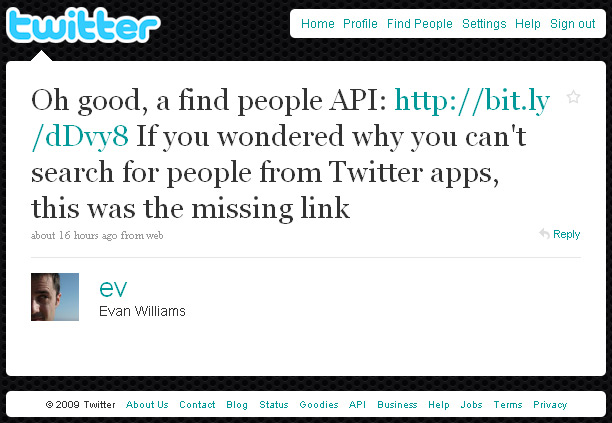
Of course some Twitter apps (like our own Twellow) are dedicated to helping Twitterers find other people of interest to follow. Twellow lets you browse by topic or location (as well as search) to find people on Twitter who you may be interested in following.
Twitter seems to be taking the concept of making twitterers of interest easier to find more seriously lately. Apart from this new API, Twitter has of course launched the Lists feature, which is great for the discovery of new "tweeps." In addition, it looks like the company is planning on launching a new version of the suggested users list, which will be different for each user, and will be tailored to fit specific interests (this is also similar to a feature Twellow already offers).
How do you find new people to follow? Tell us your preferred method.Related Articles:
> A Suggested Users List for Twitter That You Can Actually Use
> Easily Find Twitterers You’re Interested In
> Twellow Adds New "View Non-Mutuals" Feature
> Location Adds Purpose and Context to Twitter
-
FileScout updated to version 1.5.0.0
FileScout presented at the BlackBerry Developer Conference Final 16 in San Francisco and they have since updated their application. The latest updates include:
- Display of thumbnails in search result.
- Thumbnail-Options: New Button to generate all thumbnails for all images on your device.
- When resizing images to device resolution size you can now select to keep the aspect ratio of the original image.
- UserDefined resolution (image resizing) can be now be max 9999 pixel [but it’s recommended not use more then 1200px].
- Support for DesktopManager Backup & Restore (FileScout settings).
- A ‘[W]‘ in the Screen Title indicating that the background threads (required for Search and other extended features) are still running (after FileScout is started) – once the threads are completed the ‘[W]‘ will disappear.
- Integration in the RIMs FileExplorer Application: a ‘Explore with FileScout’ MenuItem is added.
What’s fixed?
- Search files in the current Directory only function fixed to be usable multiple times.
- Potential OutOfMemeory Error during start of FileScout (when the thumbnail store is getting too large).
- Accessing OS5 System Folder for Bold, Bold2, Storm and Storm2.
- For all of you who are waiting to get a “fix” for the System folder on the Bold, Bold2, Storm and Strom2 on OS5.
- RIM confirmed that they made the System folder in OS5.x read only.
- FileScout (and all other 3′rd party applications) can only show the content of the System folder but can’t modify anything.
© BlackBerry Cool for BlackBerry Cool, 2009
-
Quick Picture Downsizer
 Sharing images over the Internet via e-mail services and keeping them in online photo albums often requires that your pictures come in a smaller size. This can be a requirement for previewing purposes, in the case of catalogs, or a condition imposed by the current limit of mail attachments. Usually, these occurrences are best translated by ”less is more” and the saying is true because the more reduced the photo dimensions are the more their number can increase. So, if you want to display, let’s say, all the pictures you took during family vacations, you’d better find a way to decrease their size in order to share them with efficiency.
This task can be easily accomplished by anyone thanks to the multitude of tools out there that are specially designed for this specific purpose. It’s more a matter of personal choice to opt for one piece of software or another, as the differences among these utilities tend to become smoothed out. For the ease of use, solid pack of features and great overall value, you can try PIXresizer, a freeware that will surely fit your bill.
With an uncomplicated interface that was created to accommodate even the less experienced users, this application is easy to set up and operate, so you can do the transformations fast and with quality results. The focus is mainly set on functionality, therefore you shouldn’… (read more)
-
Self-powered diaper monitor system automatically detects wet diapers

A research laboratory at Japan’s Ritsumeikan University has developed a monitoring system for wet diapers that consists of a self-powered sensor/transmitter and a receiver and is supposed to assist staff in hospitals and nursing homes in performing diaper checks with elderly patients. The sensor kit has to be placed inside the diaper and sends signals to the receiver unit, which was co-developed in collaboration with Seiko Epson.
Both the sensor and the accompanying wireless transmitter are powered by a built-in battery that can generate electricity following a chemical reaction in the presence of urine. Once this happens, the sensor kit can transmit signals to a receiver located as far as 3 meters away.
The university lab says their wet diaper monitoring system is still in prototype mode. One possible area for improvement is to add circuitry to the sensor system so that a single system can monitor a group of people, for example in a nursing home.
Via Nikkei [registration required, paid subcription]
-
Word from the White House: Hospitals Reaffirm Commitment to America's Seniors
It’s no secret that institutions of all stripes focus their communications on certain messages day to day. We thought it would all be a little more open and transparent if we went ahead and published what our focus will be for the day, along with any related articles, documents, or reports.
Supporting article: "Hospitals contradict CMS report," Politico, 11/17/09
Talking Points: Hospitals Reaffirm Commitment to America’s Seniors
Yesterday, the Federation of American Hospitals reaffirmed that – despite reports to the contrary – nothing in health insurance reform will cause hospitals to end their participation in Medicare or stop serving America’s seniors.
The Federation said, "Hospitals always will stand by senior citizens," and reiterated that hospitals are committed to "contribute substantial Medicare savings as part of our shared sacrifice to reform health care and achieve near universal coverage for all Americans."
Medicare is a sacred trust with America’s seniors, and health insurance reform will help ensure that trust is never broken.Reform will extend the life of the Medicare trust fund while providing better, more affordable care for America’s seniors.
Talking Points: Controlling Costs for Families, Small Businesses, and the Government
President Obama has been clear from the beginning of this process that, in addition to providing security and stability for Americans with insurance and affordable options for uninsured Americans, reform must lower costs for American businesses, families, and the country as a whole.
And objective analysis finds that it will.MIT Economist Jon Gruber reports that reform could a typical family thousands of dollars on health care costs.
And a recent study from the Business Roundtable confirms that legislation in Congress is moving in the right direction on cost containment and could reduce premiums by as much as $3,000 per employee.The House and Senate versions of reform share a variety of measures that will reduce the rapid growth in health care costs while also providing Americans with higher quality care including:
Changing the way we handle hospitalizations, to prevent mistakes and to prevent unnecessary readmissions.
Creating incentives in the payment system to reward quality of care rather than just the quantity of procedures.
Giving physicians incentives to collaborate in the coordination of patient care.
Investing in research into what works and what doesn’t in health care.
Reducing hospital-acquired infections and other avoidable health-center acquired conditions through rigorous reporting and transparency.
Putting prevention first, rewarding care that focuses on wellness and treating the whole patient in an integrated and coordinated delivery system.
Tackling the insurance bureaucracy, streamlining the payment system to save time and money that is now spent processing claims and navigating through the byzantine insurance system.
Establishing a health insurance exchange with a public insurance option, where individuals and small businesses can buy lower-cost insurance that will spur competition and put downward pressure on costs.And there are also ideas that will further control cost growth that have been proposed and are being looked at as the legislative process continues, such as:
A fee on insurance companies offering high-premium plans — which would create a strong incentive for more efficient plans that would help reduce the growth of premiums.
Establishing a Medicare commission — which would develop and submit proposals to Congress aimed at extending the solvency of Medicare, slowing Medicare cost growth, and improving the quality of care delivered to Medicare beneficiaries.


