Author: Serkadis

  • Twitter To Make Suggested Users Feature More Like Twellow’s?

    Last month Twitter CEO Evan Williams made some comments at the Web 2.0 Summit, indicating that the company was strongly considering ditching the "Suggested Users" list. This is a list that co-founder Biz Stone once discussed as being a way to get new users engaged with Twitter. This has historically been an important thing for Twitter to consider, as user retention rates have suffered in the past.

    "When you don’t follow any other accounts on Twitter the product is not as relevant as it could be," Stone said in an old post to the Twitter blog. "To improve the user experience, we started suggesting some accounts to follow. As a result, new users are much more engaged and active."

    Twiter Suggestions

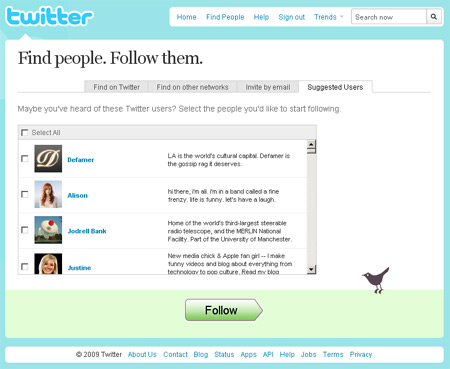
    But since then, the company’s attitude towards this list has changed. Williams noted that the list was initially meant as a way to help new users, but it became controversial. The biggest problem with the list is that it is not personalized. If you are not interested in the specific people that Twitter thinks you should be, you will still find no reason to continue using the service (at least if you are the type of person who needed suggested users to find value in the service in the first place).

    suggested_users_tab

    Our own Twellow service (shameless plug) recently launched a new feature, which provides suggested users for Twitter on a more personalized level, making it far more useful. The feature is aimed at connecting Twitterers with similar interests. It’s tailored to the interests of the specific user, rather than just one list for everyone.

    It appears that Twitter is looking to offer its suggested user list in a similar way. Sarah Perez at ReadWriteWeb reports that Biz Stone told a crowd at a conference in Malaysia, that the current suggested users list "will" be going away, and "in its stead will be something that is more programmatically chosen, something that actually delivers more relevant suggestions."

    That sounds pretty similar, but one difference is that Twellow’s feature is already available. There’s no telling how long it will take for Twitter to actually roll it out. We’re still waiting on the retweet feature.

    Twitter’s Lists feature of course was recently launched after a significant wait, and it should go a long way in helping user retention moving into the future. It’s an incredibly valuable tool for Twitter users, for a variety of reasons. Between that and a more personalized suggested users list on the way, Twitter should be keeping more people using its service longer.

    Do you think a personalized suggested users list would be beneficial to Twitter users? Have you tried Twellow’s version? Let us know what you think.

    Related Articles:

    A Suggested Users List for Twitter That You Can Actually Use

    Easily Find Twitterers You’re Interested In

    Twellow Adds New "View Non-Mutuals" Feature

    Location Adds Purpose and Context to Twitter

  • WiMAX Hits Austin and San Antonio Today

    Sprint announced WiMAX service today in San Antonio and my hometown of Austin, Texas, so this is just to tell y’all I’m playing with a modem and will be letting folks know how it all works, once I activate the darn thing. Currently Sprint doesn’t support a USB modem for Macs (but I’m assured that one is coming, likely in time for the holidays), which means I need a PC to activate my modem on. But then I can use a personal hotspot product that converts the WiMAX signal to Wi-Fi to test it out on my MacBook (and iPod Touch)! So send me your questions, concerns and anything else WiMAX-related, and I’ll try to address them or get them answered. Personally, I want to see if this is something I could replace my wired connection with, or if it’s really just what I’d use instead of my 3G MiFi while I wait for LTE.

  • RoadRunnerGPS Fitness Tracking for BlackBerry with Giveaways

    RoadRunner_GPS

    RoadRunnerGPS is a feature rich app for fitness enthusiasts. The app uses GPS features to provide feedback for joggers and walkers on their time, speed, distance, pace and calories.

    Once you have finished your run, you can upload the data to Kanavon’s servers where you can review the data and get a variety of metrics and statistics about your workout.

    We’re giving away 25 copies of this app, so just comment and let us know what other fitness apps you have tried for BlackBerry.

    There is more information about RoadRunnerGPS on their site, as well as in the App World webstore.

    Update: Thanks everyone for participating! The 25 winners have been selected and will receive an email shortly.


    © BlackBerry Cool for BlackBerry Cool, 2009


  • PS3s being used to catch child pornographers

    Back in the old days, the hand of justice used sophisticated, thousand-dollar computers to crack down on sickos on the internet. Although expensive,…

  • Yahoo Launches Comedy Clip Show

    Yahoo has launched a new original online series sponsored by ConAgra Foods, called "What’s So Funny?"

    "What’s So Funny?" features daily three-minute clips with hosts Mike Bachmann and Shira Lazar, which recap the funniest moments from the previous night’s prime time lineup.

    Viewers can vote on the funniest moments of the week, helping to decide the content for a weekend episode recapping the week’s most humorous moments. Each episode will include a 30 to 60-second ad that features a ConAgra Foods brand.

    What's-so-Funny

    "Yahoo! continues to expand its portfolio of branded entertainment programming, allowing brands to connect with our audience in unique and meaningful ways," said Erika Nardini, vice president brand packaging, Yahoo!

    "With ‘What’s So Funny?,’ Yahoo! and the brands of ConAgra Foods will bring together the best ingredients for a daily laugh."

    The sponsoring brand also will be featured on the "What’s So Funny?" homepage, which will be linked from Yahoo TV. MediaCom, ConAgra’s media agency, helped create and develop the program in partnership with Yahoo.


    Related Articles:

    >Yahoo Hires Editor For Homepage News

    >Yahoo Launches Spanish Version Of Mobile Home Page

    >Research Scientist Heads From Yahoo To Twitter


  • Information Should Not Be Free… Says InfoWorld Columnist That You Can Read For Free

    Doug sent over a link to an angry screed by columnist Bill Snyder that bashes anyone who thinks anything should be offered for free. Want to read it? Go ahead, because it’s free at InfoWorld.

    And, of course, that’s the problem with Snyder’s analysis. It doesn’t take into account the wider business model. The reason that Snyder’s article is available for free is because InfoWorld has decided that it has a better chance of monetizing that content by offering it for free and selling advertising. It’s other option would be to charge people directly to read Snyder’s economically confused analysis — but then no one might pay. So which makes more sense? According to Snyder, the latter.

    Snyder also takes on the scourge of free WiFi, that pretty quickly showed that paid WiFi is a niche market, only working where you have limited and captive audiences (and even it is under greater and greater competitive threats). Unfortunately, his economic analysis is misguided:


    News and Wi-Fi service are commodities, just like cars, housing, and food are commodities. Labor and raw materials, as well as the capital to buy them, are the essential ingredients of most any good or service we might care to own or consume. No money, no commodity — that’s a basic economic principle that the digital revolution has done nothing to change.

    Sounds good, but it’s wrong. Very wrong. Yes, they’re commodities, but the defining rule of a commodity is that it is priced on the marginal cost, not the fixed costs. And yet, Synder suddenly thinks that while that applies to cars, housing and food… it goes away in the digital world? The only person really claiming that the economics has changed is Snyder, in insisting that digital products do not adhere to the same laws of supply and demand.

    Snyder seems positively confused that free is a part of a larger business model:


    I don’t write for free, my editors don’t edit for free, and I’ll bet your IT hands don’t run networks or produce code for free.

    And yet, your content is available for free. Funny how that works. Why does it work? Because it makes good business sense. But, to Snyder, when this is pointed out, he gets confused and thinks that it proves his point:


    I know, I know — some of you are going to bring up open source.

    Sorry, that proves my point. Open source has grown in influence and quality in the last few years as business models in the community have evolved. Not too long ago, any open source company that dared post a paid or paid-support enterprise version of its software would be pilloried. But not any more. The recession has put many excellent technologists out of work, but there would be even fewer employed if open source companies were afraid to make a profit, then plow it back into development projects and expanded infrastructure.

    Just ask the open source millionaires at MySQL if they think everything they produce should be free.

    Snyder figured out the wrong thing. Yes, getting paid is important, but the question is what you get paid for, and he’s asking people to charge for the parts of a business that make the most sense being free — and doesn’t explain why he gets to decide what should be free and what shouldn’t. The answer, really, is that none of us decides: basic economics tells us. If you have a competitive product with no marginal cost, it’s going to eventually get driven to free. Whether you like it or not. And then you shouldn’t whine about the evils of “free.” You should instead figure out ways to use that to your advantage.

    Permalink | Comments | Email This Story


  • CMS Report: House Bill Will Raise Health Care Costs, Affect Seniors’ Benefits

    A new report from the Centers for Medicare and Medicaid Services finds that the health overhaul bill passed by the House will raise health costs by approximately $289 billion in the next ten years.  The report was requested by House Republicans and compiled by CMS’ chief actuary, Richard Foster.

    The Washington Post: “A plan to slash more than $500 billion from future Medicare spending — one of the biggest sources of funding for President Obama’s proposed overhaul of the nation’s health-care system — would sharply reduce benefits for some senior citizens and could jeopardize access to care for millions of others, according to a government evaluation released Saturday. The report, requested by House Republicans, found that Medicare cuts contained in the health package approved by the House on Nov. 7 are likely to prove so costly to hospitals and nursing homes that they could stop taking Medicare altogether.”

    “Democrats focused Saturday on the positive aspects of the report, noting that Foster concludes that overall national spending on health care would increase by a little more than 1 percent over the next decade, even though millions of additional people would gain insurance. Out-of-pocket spending would decline more than $200 billion by 2019, with the government picking up much of that. The Medicare savings, if they materialized, would extend the life of that program by five years, meaning it would not begin to require cash infusions until 2022.” (Montgomery, 11/15).

    The Hill: “CMS’s analysis is not an apples-to-apples comparison to the cost estimate conducted by the Congressional Budget Office (CBO) and the Joint Committee on Taxation (JCT) because CMS did not review tax provisions, which help offset the price tag of the Democrats’ measure. However, the CMS analysis clearly states that the House bill falls short in attaining a key goal of the Democrats’ effort to reform the nation’s healthcare system: ‘With the exception of the proposed reduction in Medicare… the provisions of H.R. 3962 would not have a significant impact on future healthcare cost growth rates.’”

    “Minority Leader John Boehner (R-Ohio) highlighted the report on Saturday in a written statement. ‘This report once again discredits Democrats’ assertions that their $1.3 trillion government takeover of health care will lower costs, and it confirms that this bill violates President Obama’s promise to “bend the cost curve.” It’s now beyond dispute that their bill will raise costs, which is exactly what the American people don’t want.’ … CMS’s findings are not binding on Congress, however. Congress must abide by CBO and JCT estimates. The Hill has a copy of the full report (Hooper, 11/14).

    The Associated Press: “Overall spending on health care would rise as a result of legislation approved a week ago by the House, and billions of dollars in projected savings contained in the measure will be difficult to maintain, according to a report by a top official at the agency that oversees Medicare. The legislation would expand insurance coverage to an estimated 32 million people who now lack it, according to the report, creating a demand for services that ‘could be difficult to meet initially … and could lead to price-increases, cost-shifting and/or changes in providers’ willingness to treat patients with low-reimbursement health coverage’” (Espo, 11/14).

    Politico analyzed some of the the report’s statements: “Pg. 3 – ‘Most of the provisions of H.R. 3962 that were designed, in part, to reduce the rate of growth in health care costs would have a relatively small savings impact.’ Translation: Things like wellness and prevention programs and reducing Medicare fraud don’t save much money.”

    “Pg. 9 – Over the next decade, the report estimates ‘a relatively small reduction in non-Medicare federal health care expenditures of $2.1 billion, all of which is associated with the comparative effectiveness research provision.’ … Pg 16 – ‘The additional demand for health services could be difficult to meet initially with existing health provider resources and could lead to price increases, cost-shifting, changes in providers’ willingness to treat patients with low-reimbursement health coverage.” Translation: A crush of newly insured patients could be a shock to the system’” (Frates, 11/14).

    In a second story, Politico reports on White House reaction to the report. “Nancy-Ann DeParle, director of the White House Office of Health Reform, pushed back Sunday on the CMS report that concluded Medicare beneficiaries could lose access to health care providers under the House bill. …’It is an interesting analysis but it is pretty speculative though of what the impact will be on providers and beneficiaries. Our recent experience would indicate something quite different’” (Budoff Brown, 11/15).

  • States Experience Medicaid Changes And Offer New Models For Reform

    News outlets report on a variety of health issues at the state level including the upcoming launch of a huge Medicaid data project in Florida, health care changes that could reduce  spending in Georgia and a model for reform in Vermont.

    Health News Florida: “In a big step forward in the use of electronic health records, Florida is preparing to make the health histories of 1.6 (million) Medicaid patients accessible to 80,000 doctors, clinics and hospitals in the state on a secured-access system, one of the planners said Thursday. … The information will be that derived from claim forms, including office visits, hospitalizations, diagnoses, prescriptions, immunizations and lab results. Except in an emergency, it will be available only if the Medicaid patient agrees, (Christine Nye, director of the State Center for Health Information and Policy Analysis) said, and the state will track every authorization that is granted” (Sexton, 11/13). 

    The Augusta Chronicle: “Figures released Thursday show Georgia taxpayers saved between $123 million and $140 million in the past fiscal year because of the state’s own health-care reform of sorts. The federal share of savings is even greater. For 1 million low-income Georgians covered by the state’s Medicaid and PeachCare for Kids insurance plans, the Perdue administration began nudging them toward a concept it called care-management organizations. Three private companies bid for the business, which requires them to provide a more intense level of interaction with patients. The goal is for case managers to teach more healthful habits” (Jones, 11/16).

    NPR reports on health care in Vermont and interviews the state’s Republican governor Jim Douglas, who chairs the National Governors Association. Douglas says Vermont’s own state-initiated reforms called Blueprint for Health, which focuses on preventative and coordinated care, could provide a national model. Douglas says: “I realize that the time that our Medicaid budget was headed for unsustainability, we got permission from the federal government to redeploy our Medicaid dollars for preventive care. And we’ve seen a significant decline in hospital utilization by Medicaid participants and trips to the emergency room and in the dollars we’re expending. Secondly, we have a community health team that coordinates the care for each individual person. And we provide payment incentives for following that model” (11/15).

  • Big Dog, now with more killing power

    So the dudes at Boston Dynamics have finally added weapons to the Big Dog, America’s favorite scary striding robot. What does this mean? More fun when you run naked and bleeding from your home, your left kidney stolen from you as you slept, as the robots rise up and begin preparing our organs for harvest!

    OK, so horns aren’t weapons, but they are pointy!

    How long before Big Dog starts looking like this scene from a recent school reunion gone wrong in Scranton, PA?


  • Revised Google Books Settlement Still Has Critics

    Another milestone in a significant legal dispute has passed; a revised version of the Google Books settlement was submitted to U.S. District Court late Friday.  It looks like the book-scanning clash isn’t nearly over, however, since some powerful groups still have qualms about Google’s proposed resolution.

    Google tried to dial back both the scope of the agreement and the degree to which it would represent a be-all, end-all decree.  The settlement would now just cover books published in Australia, Canada, the U.K., and the U.S., and more of an effort would be made to find and pay the creators of so-called orphan works.

    Also, Google promised that it would price its out-of-print books so that they’re in line with a competitive market, and repeated an older pledge to allow book retailers to sell online access.

    But here’s what Peter Brantley, co-chair of the Open Book Alliance, had to say in a statement emailed to WebProNews.  "Our initial review of the new proposal tells us that Google and its partners are performing a sleight of hand; fundamentally, this settlement remains a set-piece designed to serve the private commercial interests of Google and its partners."

    Brantley later continued, "By performing surgical nip and tuck, Google, [the Association of American Publishers], and [the Authors Guild] are attempting to distract people from their continued efforts to establish a monopoly over digital content access and distribution; usurp Congress’s role in setting copyright policy; lock writers into their unsought registry, stripping them of their individual contract rights; put library budgets and patron privacy at risk; and establish a dangerous precedent by abusing the class action process."

    Jessica E. Vascellaro and Jeffrey A. Trachtenberg reported that the Department of Justice is unhappy, too.

    This promises to stay interesting, then, or at least get interesting again following a lull.  The next hearing on the matter should be held sometime early next year.

    Related Articles:

    > (Another) New Google Books Deadline Set

    > Google Books Gets A Little More Organized

    > November 9th Target Set In Google Books Case

  • KHN Column: Will There Be A Market For Gov’t Long-Term Care Insurance?

    In his latest Kaiser Health News column, Howard Gleckman writes about long-term care: “The CLASS Act—the far-reaching proposal to create a national long-term care insurance program—is in the House health reform bill, and is still in the mix as Senate leaders struggle to design their own version of reform.” He also poses the following: “[A] key question about the CLASS Act remains: How many will buy the coverage even if it is broadly available? (11/16). Read the entire column.


  • Political Cartoon: ‘Derailed?’

    Kaiser Health News offers a humorous view of health policy developments with Milt Priggee’s “Derailed?”

  • A Challenge To Dartmouth Atlas’ Claims Of Wasteful Health Care Spending

    Kaiser Health News staff writer Jordan Rau reports on Dr. Richard Cooper’s contrarian views. “Cooper, a 73-year-old University of Pennsylvania medical school professor, …  denounced as ‘malarkey’ a reigning premise of the health care debate — that one-third of the nation’s $2.5 trillion in annual health spending is unnecessary — and said that the idea came from ‘a bunch of clowns’ (11/16). This story was produced in collaboration with The Philadelphia Inquirer. Read the entire article. Rau also details the reaction to Cooper’s challenge (11/16).

  • Evernote Gets $10 Million in New Funding

    evernote-3.jpgEvernote, a Mountain View, Calif.-based company that makes one of my favorite cross-platform apps, called (what else) Evernote, has raised $10 million in new funding. The new round was led by Morgenthaler Ventures, a respected Sand Hill Road firm with a deep history. Evernote had previously raised $6.5 million in VC funding. Phil Libin, Evernote’s CEO, tells The New York Times that he is going to be using the money to expand to new geographic markets and add new platforms. At present the app works on Android, iPhone, BlackBerry, Mac, PC and Palm’s WebOS. As you all know, I am a big fan of the application and its freemium business model. It probably is the single most useful app on my computer and my phones. (Related articles from WebWorkerDaily: Evernote Wants to Be Your Long-term Memory and How to Use Evernote for Collaboration.)

  • YouTube On Verge Of Supporting 1080p Video

    YouTube will soon put even more distance between itself and its old reputation for being a repository of crummy-looking, user-generated content.  Support for watching 1080p HD videos in full resolution is due to be introduced on Monday.

    YouTube Logo

    1080p is, in case you didn’t know, the picture type associated with Blu-ray.  It makes very minute details visible (hair and makeup teams were none too happy about its creation), and on YouTube, should simply allow for larger images, too.

    Unfortunately, creating and displaying 1080p clips requires enough stuff that not everyone will be able to take part.  Content creators who don’t have fairly new cameras will be left out.  Then, viewers who don’t have fast Internet connections, fast computers, and large monitors should probably just stick to what was already available for the sake of not having clips stutter.

    Still, YouTube’s trying to make the switch easy on people.  A post on the YouTube Blog stated, "[T]hose of you who have already uploaded in 1080p, don’t worry.  We’re in the process of re-encoding your videos so we can show them the way you intended."

    And the introduction of support for 1080p is important.  In the long run, it’ll provide an attractive option to professional content creators and advertisers, along with the obvious eye candy benefits for YouTube users.

    Related Articles:

    > YouTube Talks Up Social Side

    > Has YouTube Found The Right Ad Solution?

    > Yahoo Challenges YouTube On Music Video Front

  • Beijing Watch Party for President's Town Hall

    As President Obama spoke in Shanghai to four hundred-plus Chinese youth, many thousands more young (and not so young) people throughout China attended the event virtually in classrooms, coffee houses, living rooms, and at “watch parties” organized by the U.S. Embassy and Consulates.   Some events were hosted by Fulbright professors or Chinese exchange program alumni who had taught or studied in the U.S.  Others were organized by Embassy or Consulate contacts.  The vast majority, however, were simply groups of interested Chinese citizens and netizens who tuned in on their own.

  • The Leica M7 Hermes edition is yet another gadget none of us will ever own

    leica-m7
    Leica loves to produce ultra special editions of its high-end cameras. The latest example is this $14k Hermes edition of the M7. Yes, $14,000 dollars for a film-based camera.

    Now, if you happen to be from what Rush Limbaugh likes to call the “job creating class”, you better get your name on one of these quick. There will only be 100 produced under the Hermes name. And I think it’s important to remember that you would be spending roughly the equivalent of a Kia for a non-digital camera. Hey, if I had the ability, I probably would.


  • Google May Change Your Page Titles

    In case you were not aware, Google "reserves the right" to change the titles of your pages in search results. Google’s Matt Cutts has released a video discussing why and how they go about doing this.

    Cutts says Google wants to show the titles that it thinks are most useful. "For example, suppose the title of your page is ‘Untitled’ or if there is no title. If that’s the case, we try to show a relevant, useful title."

    "We reserve the right to try to figure out what’s a better title, what’s a more descriptive title or snippet to show the users," he continues.

    According to Cutts, if you have a title that’s really long, they may still use that in their scoring, but in the snippet, they might try to find a "better title." This is presumably based on what the user is looking for.

    As Cutts has said in the past, sometimes Google will use snippets right from the Open Directory Project (DMOZ). Sometimes, they’ll simply use snippets from the page or the meta description tag. "We do a bunch of different things to find the best description that we can," he says.

    "If you have a bad title or a title that we don’t think helps users as much, we can try to find a better title, and one we think will be an informative result so that users will know whether that’s a good result for them to click on," he says.

    Have you noticed Google changing your titles? Did they find better ones? Discuss here.

    Related Articles:

    > Why Your Email Address May Show up in Google Search Results

    > Why Your Robots.txt Blocked URLs May Show up in Google

    > Does Google Recognize the Name of Your Business?

  • 2009 Report: False Medicare Claims Cost Government More Than $47 Billion

    The Associated Press: “The government paid more than $47 billion in questionable Medicare claims including medical treatment showing little relation to a patient’s condition, wasting taxpayer dollars at a rate nearly three times the previous year. Excerpts of a new federal report, obtained by The Associated Press, show a dramatic increase in improper payments in the $440 billion Medicare program that has been cited by government auditors as a high risk for fraud and waste for 20 years. It’s not clear whether Medicare fraud is actually worsening.”

    Much of the increase is attributed to better data collection and the new report shows the challenges the government faces to combat fraud: “While noting that several new anti-fraud efforts were beginning, the government report makes clear that ‘aggressive actions’ to date aimed at reducing improper payments had yielded little improvement. … [President] Obama is expected to announce new initiatives this coming week to help crack down on Medicare fraud.” This week the Centers for Medicare and Medicaid Services is also planning to unveil a new Web site with additional data (Yen, 11/15).

  • The SEO’s Toolkit Part Three of Three: Resources

    Welcome to part three of this three part series on SEO tools and resources. In the last two articles we discussed the variety of Firefox extensions used for SEO as well as an assortment of other free or affordable SEO tools. In this article we’ll discuss some of the resources you’ll want to access on a regular basis to keep up to date and informed on the goings-on in the search engine and SEO realm.


    We’re doing to cover a few different types of resources below and I’m going to try to keep this article to a reasonable length so let’s begin …

    Media

    when there’s a breaking story or you want an expert opinion on a subject, a good first place to hit is the media sources in that industry. The SEO industry is no different and there are some amazing albeit often unconventional media sources. Some of my favorite are:

    Webmaster Radio

    Webmaster Radio is an Internet-based radio station with some great programing ranging from affiliate marketing to PPC to organic optimization and much more. With shows hosted by experts in their fields from Danny Sullivan (Search news) to Dave Szetela (PPC) you’ll solid information that is well-sounded. I’d list my favorite shows however what I like may be different than you and what I need to know may be different than what you need to know so look through their programming and either listen through your work day as I often do or download the podcasts for later listening.

    WebProNews

    WebProNews offers up-to-the-minute information on virtually every event. They have reporters writing constantly and have other scoring SEO blogs and other news sources, compiling the information in one place for easy access. They also have great articles by third-party writers and a very active readership that is proactive in their commenting. Definitely near the top of my go-to list when I’m looking for news and current feedback.

    Addme

    This site is difficult to classify as it fits into a couple categories but I decided to include under media as that’s my primary use. They include tools, resources, a directory and much more on their site. My primary use of this site is for the articles and newsletter.

    Search Engine Watch

    No list of SEO resources would be complete without including Search Engine Watch. This site is the one that started it all. Search Engine Watch provides everything from fantastic articles to breaking news to search engine stats and an awesome forum. A definite bookmark.

    Blogs

    As with many industries – blogs are a great way to keep informed on the latest goings-on in the SEO realm. The trick, however, is figuring out which blogs are worth reading and which authors are truly knowledgeable. Over the years I’ve read many blogs and to be honest – I still do. Below are some of the key blogs I reference on a regular basis.

    SEO Book Blog

    Aaron Wall over at SEO Book has an excellent blog worth reading on a regular basis. I have yet to visit his blog and not find some tid-bit of information that was worth reading either because of the information itself or because often he’s just entertaining. Another to add to your weekly reading list.

    Matt Cutts Blog

    It’s nice to get it from the horse’s mouth. For those who don’t know – Matt Cutts is the head of Google’s Webspam team. He blogs about Google, technology and occasionally his cat. One has to read what he writes knowing that he’s a Google employee and as such can’t really give away the farm BUT he gives tons of great advice, insight and tips. The perk being – this time you don’t have to ask if following his advice will get you banned. 🙂

    SEO By The Sea

    Bill Slawski (the author) focuses his attentions on the more technical side of things with tales of patents, algorithmic possibilities, statistics and functionalities. For many, his would be one of the more dry blogs if not for his gift with words and ability to make even the most bland of subject, palatable. You don’t need to visit his blog daily but adding it to your weekly journey through the web is recommended.

    SEOmoz Blog

    What blog list would be complete without the inclusion of the SEOmoz blog. Rand Fishkin and crew keep their visitors up-to-date of some great research, news and SEO tips. From opinion pieces to months-long whitepapers you’ll find useful information. Again – not necessary to visit every day but a weekly pass is always worthwhile.

    Forums

    Forums are a great place to gather information, especially on current events such as ranking updates. That said, reading forums can be a risky thing. Almost anyone can join a forum and post their thoughts. While this format allows us to capture a wide range of information and knowledge – it also results in less qualified people giving advice as well. So while I recommend reading forums – I also recommend taking things with a grain of salt – at least until you figure out who’s who.

    SEO Chat Forums

    The SEO chat forums are easily one of the largest and most popular of the SEO forums. They cover a HUGE array of issues from Google to social media to Alexa rankings to (hold your hats) Ask Jeeves (that’s right – the forum’s been around for THAT long). Users worth noting are rustybrick, fathom, and randfish.

    DigitalPoint Forums

    DigitalPoint also is an ancient forum (2000 – ancient by web standards at least). They cover a wide range of topics from SEO to PPC to affiliate programs. Some users worth noting there are shoemoney, daven, and of course digitalpoint. A great place to ask your questions. Heavily visited and they have a ranking system for their users so you can get a decent feel as to whether they’re reliable.

    SitePoint Forums

    There are a variety of reasons I like SitePoint and I own a number of their books. Their forums focus on design and development (not SEO) but every SEO needs resources on the design and development side.

    Newsletters & Other Resources

    Of course there are other resources that every SEO or webmaster needs to be able to get their hands on. Here they are:

    Google Webmaster Guidelines

    These are the guidelines set out by Google telling you what you can and can’t do and what tactics to look out for. Worth a look over periodically as the do change from time-to-time. If you’re heading into the forums for advice you’ll definitely want to gander at the guidelines first to make sure that if you get lead astray – at least you’ll know what can get you banned or penalized first.

    Sphinn

    A social media site for SEO. Here you’ll find user-submitted stories on a wide array of Internet Marketing topics. Obviously the quality and relevancy of the stories ranges from brilliant to utter crud but the cream usually rises to the top with good stories hitting page one. That said – an occasional peek at specific threads often reveals some hidden gems.

    Search Engine Land Newsletter

    Perhaps I should have included this in the media section above as it’s a fine site unto itself but it was the newsletter component that I find most helpful and so I have decided to place it here. Sign up for their newsletter and you’ll get daily notification as to when some of the major search engine events happen and some solid advice as to what it means for you.

    High Rankings Newsletter

    Jill over at High Rankings puts out a solid newsletter where she provides tips and advice including replies to visitor questions. While I may disagree with some of her points from time to time (the same can likely be said for more of the resources noted and I’m sure others can say the same about my writings and opinions) I’ve never seen her provide bad advice – my advice just might be different from time-to-time.

    Conclusion

    Obviously there are a ton more tools and resources available. In this series of articles I’ve tried to include those that apply to the broadest spectrum of people and that are the most helpful. I highly recommend hunting for your own – especially if you’ve got issues that you can’t find help for here.

    Good luck to all the DIYers out there.