Author: Serkadis

  • Health Lobbying Ranges From Below The Radar To High Profile

    A Charlotte, N.C., law firm is operating a secretive group called Americans for Quality and Affordable Healthcare to attempt to shape lawmakers’ and the public’s opinions on health reform, the Associated Press reports. The law firm would not name the groups’ backers, saying they want to remain “off the front page,” but the group’s “below-the-radar” activities (such as helping a member of a Las Vegas conservative group appear on local talk radio to criticize the Democrats’ proposal) oppose any “government-run” insurance plan and support broader mandates for people to buy insurance, two goals shared by insurers. Major insurers in North Carolina and nationally, as well as the leading industry group, said they were not involved in the group.

    The group is not alone – its “activities illustrate how some are furtively trying to shape public and congressional opinion through front groups — seemingly independent organizations that pursue their founders’ goals while masking their identity,” the AP reports. The group has so far caught notice in Louisiana, Maine, and Nevada, three crucial reform states as the home to the Senate Majority leader and two potential Senate swing votes (Fram, 11/15).

    Meanwhile, “[t]he U.S. Chamber of Commerce and an assortment of national business groups opposed to President Obama’s health-care reform effort are collecting money to finance an economic study that could be used to portray the legislation as a job killer and threat to the nation’s economy, according to an e-mail solicitation from a top Chamber official,” The Washington Post reports. Under the plan, the Chamber would spend $50,000 to have a “respected economist” to study “the impact of health-care legislation …  on jobs and the economy.”  Step two as outlined in an email written by a Chamber senior health policy manager and obtained by The Post would be as follows: “The economist will then circulate a sign-on letter to hundreds of other economists saying that the bill will kill jobs and hurt the economy. We will then be able to use this open letter to produce advertisements, and as a powerful lobbying and grass-roots document” (Shear, 11/16).

    Meanwhile, Roll Call reports that “Downtown’s newest labor boss is making bold predictions during his first weeks on the job, assuring passage of a liberal health care overhaul by the 2010 State of the Union … Newly minted AFL-CIO President Richard Trumka also is not ruling out launching television advertisements or rallying his members against a Democratic-backed health care bill if it taxes benefits, does not include a public insurance option or if it does not force companies to cover their employees.” The organization oopses taxes on employee health plans (Murray, 11/16).

  • Electronic Health Records Not Yet Making Impact, Patients Turn To Web For Advice

    As the United States launches “an ambitious program, backed by $19 billion in government incentives, to accelerate the adoption of computerized patient records in doctors’ offices and hospitals,” a new study of 3,000 hospitals “has found little difference in the cost and quality of care,” The New York Times reports. “Dr. Karen Bell, a former senior official in the Department of Health and Human Services and an expert in health technology, said she was not surprised by the research. ‘Very few hospitals today are effectively using the capabilities of electronic health records,’ she observed.”

    Dr. Ashish K. Jha, “an assistant professor at the Harvard School of Public health, who led the research project,” notes that most of the gains found from the technology “has come from looking at an elite group of large, high-performing health providers that have spent years adapting their practices to the technology. The group usually includes Kaiser Permanente, the Mayo Clinic, the Cleveland Clinic and Intermountain Healthcare, among others. But the new study… suggests that these exceptions mostly point to the long-term potential of electronic health records, properly used” (Lohr, 11/15).

    In other medical technology news, 61 percent of adults say they seek health information online, according to a recent survey by the Pew Internet and American Life Project, NPR reports. About 20 percent of these so-called “e-patients” visit “Internet and social-networking sites where they can talk to medical experts and other patients, says Susannah Fox, with the Pew Internet and American Life Project. ‘They are posting their first-person accounts of treatments and side effects from medications,’ says Fox. ‘They are recording and posting those podcasts. They’re tagging content. They are part of the conversation. And that, I think, is an indicator of where we could be going in terms of the future of participatory medicine.’” Fox “says patients are far ahead of doctors and hospitals when it comes to using the Internet” (Shapiro, 11/16).

    Pittsburgh Tribune Review: The Pew researchers report that “[t]he Internet ranks third behind health professionals and family members as a source for medical advice.” But there is a generational divide. “Younger patients are more likely to research health issues online and follow up with their doctors. Internet users ages 18 to 29 make up the largest group of people seeking health information, the Pew study found. Those ages 30 to 49 were second” (Smith, 11/16).

  • Cisco Yields to Tandberg Shareholders

    norway_headquarters1Cisco said today it would up its offer to buy Tandberg to $3.4 billion — a boost of $400 million over its original bid, made last month — and said 40 percent of Tandberg’s shareholders have so far accepted the deal (Cisco needs 90 percent). About two weeks after the networking giant offered to buy the Norwegian video conferencing equipment maker, a group of shareholders protested, saying the offer was too low. This new offer should placate those shareholders, one of which was a brokerage firm that at the time of the original announcement had a target value on the shares that was slightly lower than the per-share price Cisco is now offering.

  • How Important is Natural Language to the Future of Search?

    Where Google is a search engine, and Bing is a "decision engine," Ask.com seeks to be an answer engine. Ask thinks the future of search is in questions and answers. This means, you should be able to ask a direct question and get a specific answer, rather than pages of results, which can lead you to finding the answer on your own.

    It’s natural language search, and it’s not exactly a new concept. However, Ask says it is dedicated to improving how well this works. It makes sense, since the Q&A niche has been the area of search, which Ask has carved out for itself. Rather than trying to compete directly with Google as Bing does, Ask appears to be more interested in setting itself apart as a place to go simply to find answers. "Asking a question isn’t the same as searching," says Ask.

    How imporant will natural language search be in the future? Share your thoughts.

    Ask illustrates the difference with a couple sample queries, saying that the most successful answers won’t get clicked:

    Comparing Q&A Results

    Comparing Q&A Results

    The company says it is seeing increased loyalty from users who conduct question searches, and has seen "a pronounced increase" in the percentage of users who conduct queries in the form of a question. In fact, they claim to see three times more questions as a share of total queries than their competitors.

    "Indeed, the information that is directly relevant to many questions most certainly exists; it’s just that it’s locked in people’s heads or captured in unpublished conversations, and therefore inaccessible by traditional search," says Ask President Doug Leeds. "Obviously, this is not a trivial deficiency in a world that is increasingly interconnected and clamoring for perspective, guidance, and shared knowledge at an interpersonal level online."

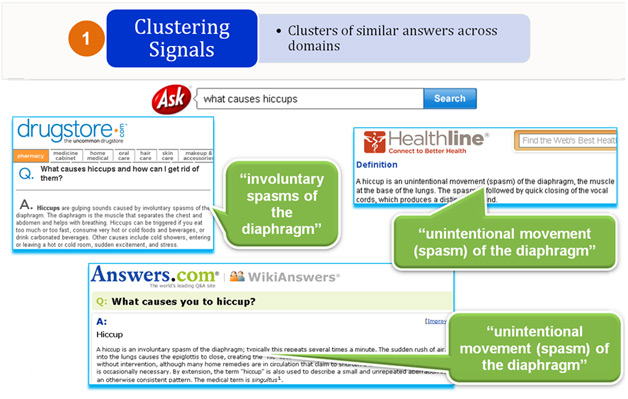
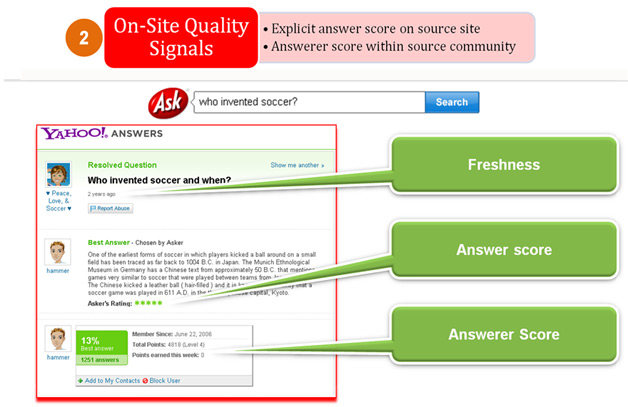
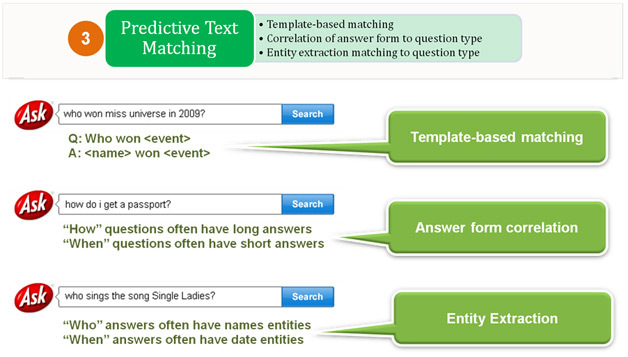
    Ask is setting out to extract and rank existing answers, and index sources of answers that have not yet been published. "To extract and rank existing answers, as opposed to merely ranking web pages that contain information, we have and are continuing to develop a unique set of algorithms and technologies that are based on new signals for relevance specifically tuned to questions and answers," says Leeds, outlining these signals with the following images.

    Ask Algorithm Elements

    Ask Algorithm Elements

    Ask Algorithm Elements

    Right now, Ask is focused on developing a new algorithm that utilizes the signals highlighted above. "But our work doesn’t end with extraction and ranking of existing, published answers," says Leeds. "Where our vision really comes to life is in our efforts to index the sources of unpublished knowledge that can generate answers specifically in response to a question, in the moment it’s asked. This is the long tail of questions that are nearly impossible for search engines to answer, but which create incredible value for users when they are."

    These include complex questions (like "What is the cheapest way to get to the Austin airport from downtown Austin?"), temporally dependant questions (like "When will the Oakland Bay Bridge re-open?"), and subjective questions (like "What should you do to save a withering tomato plant?").

    Ask has reached a milestone of 400 million Q&A pairs in its database, so the engine is already capable of answering a significant amount of questions you might have, but there’s a lot of work to be done in order to give users the "best answers on the planet" in real time, as the company intends to do. It will be interesting to see how Ask’s progress comes along. Leeds promises updates on the company blog as they work their way along.

    Do you think Q&A search is an important part of search’s future? Do you think Ask will play a key role in it? Do you ever use Ask to find answers? Tell us what you think in the comments.

    Related Articles:

    > Ask Gets More Serious About Answers

    > Ask.com Gets New U.S. Leadership

    > Microsoft Tipped As Most Likely Ask.com Buyer

    > Searching for Answers Google Doesn’t Have

  • Your hipster GF will love these iPhone earrings

    iphoneearings3
    You could spend $14.95 to buy the set pre-made, or follow your mom’s advice and make a set yourself. It means more that way. [via MAKE]


  • Media Literacy Project: “Basta Dobbs, It’s Just the Beginning.”

    Media Literacy Project celebrated a victory on November 11th when longtime CNN anchor Lou Dobbs announced his resignation. MLP has been collaborating locally and nationally to advocate for journalistic integrity in an attempt to remove inflammatory language and misinformation from our media system.DDLM_110109 014

    Nationally, MLP joined more than 40 other organizations to promote the BastaDobbs.com campaign, which launched in mid-September. More than 100,000 people joined the effort, which included online petitions, a viral YouTube video, a text-message campaign, and radio PSAs.

    On October 21st, MLP and New Mexico MAG-Net hub members – SouthWest Organizing Project, Quote Unquote Community Media Center, KUNM Youth Radio, Young Women United, El Centro de la Raza and El Centro de Igualdad y Derechos – held a press conference at the National Hispanic Cultural Center to call on CNN to remove Dobbs and to speak out against hate speech in our communities.hspc_aq_4

    A week later, Media Literacy Project conducted a town hall with Albuquerque community leaders to develop a volunteer council that would address these issues while working as part of MLP’s Siembra la palabra digna campaign.

    Upon learning of Dobb’s resignation, Andrea Quijada, Executive Director of the NM Media Literacy Project promised,

    “This is just the beginning of our efforts in Albuquerque as we continue to collaborate with local immigrant rights organizations to educate our communities and prevent hate speech in New Mexico’s media.”

  • Record Breaking Spring Heat Wave in South Australia 2009

    australia_heat-091116

    2009Nov16: “An unusual spring heat wave in South Australia broke numerous records and left the land extremely vulnerable to fire danger. Adelaide experienced eight consecutive days with temperatures in excess of 35 °C (95 °F), resulting in the first spring heat wave experienced by the city since records began in 1887. The average maximum temperature for Adeliade for the first 15 days of November was more than 8 °C (14 °F) above the normal of 24.9 °C (77 °F)” (NCDC/NOAA).

    Reference: NCDC/NOAA http://www.ncdc.noaa.gov/sotc/?report=hazards&year=2009&month=11&submitted=Get+Report

    Image Description: Australia –  Maximum Temperature Anomaly 16 Nov. Source: Australian BoM. Image Location: http://www.ncdc.noaa.gov/sotc/?report=hazards&year=2009&month=11&submitted=Get+Report Credit: Commonwealth of Australia/Australian Bureau of Meteorology, 2009 Image Permission: This work is copyrighted and unlicensed. However, it is believed that the use of this work to illustrate the subject in question, Where no free equivalent is available or could be created that would adequately give the same information, on Interlinked Challenges, hosted on servers in the United States by Michigan State University, qualifies as fair use under United States copyright law.

  • Analysts talk about upcoming BlackBerry slider

    blackberry_slider

    Analysts at Kaufman Bros are saying that RIM will be launching a touchscreen BlackBerry slider with a QWERTY keyboard, along with an updated web browser.

    Kaufman said they are picking up strong indications of a new form factor under development that would be a cross between a touchscreen BlackBerry Storm 2 and a physical keyboard BlackBerry. They said, “from our understanding, this new BlackBerry would have a full touchscreen plus a pull-out physical keyboard. It would be similar to others from HTC, Palm, Motorola and others but of course sport a distinctive signature BlackBerry industrial design.”

    We have heard rumors of such a device being codenamed Talladega, but nothing much else. It would still be cool to see a BlackBerry Storm slider though. Also, a touchscreen device would be a great launch device for the new WebKit-based BlackBerry Browser.


    © Kyle for BlackBerry Cool, 2009


  • Coming This Week: New Law To Prevent Discrimination Based On Genes

    “The most important new antidiscrimination law in two decades — the Genetic Information Nondiscrimination Act — will take effect in the nation’s workplaces next weekend, prohibiting employers from requesting genetic testing or considering someone’s genetic background in hiring, firing or promotions,” The New York Times reports. “The act also prohibits health insurers and group plans from requiring such testing or using genetic information — like a family history of heart disease — to deny coverage or set premiums or deductibles.” Employers and insurers would no longer be allowed to ask employees for their medical histories. Group health plans would also be banned from “the common practice of rewarding workers, often with lower premiums or one-time payments, if they give their family medical histories when completing health risk questionnaires.”

    “The new law (called GINA) was passed by Congress last year because many Americans feared that if they had a genetic test, their employers or health insurers would discriminate against them, perhaps by firing them or denying coverage.” Genetic tests can be used to “help determine whether someone is at risk of developing an inherited disease or medical condition” (Greenhouse, 11/15).

  • Samsung announces the Galaxy Spica i5700

    samsung-galaxy-spica-i5700

    Today Samsung officially announced the Galaxy Spica i5700, a wallet-friendly Android smartphone that we’ve been keeping tabs on since September. On sale now in Europe and the Commonwealth of Independent States with availability in the Middle East and Asia coming shortly, the Galaxy Spica features an AMOLED touchscreen display, 3.2 megapixel camera, DivX support (a first for Android), 3.5mm headphone jack and an 800MHz processor. Oddly enough, official pricing was omitted from the press release, but last we heard it was to go for around 350€ or $524 USD.

    Read

  • Drug Makers Hike Prices, Lobby Hard As Reform Efforts Progress

    Drug makers are bracing for reform by raising their prices – by 9 percent in the last year, perhaps the fastest rate since 1992, The New York Times reports. This happened “even as drug makers promise to support Washington’s health care overhaul by shaving $8 billion a year off the nation’s drug costs after the legislation takes effect.” The increases “will add more than $10 billion to the nation’s drug bill, which is on track to exceed $300 billion this year.”

    “Drug makers say they have valid business reasons for the price increases. Critics say the industry is trying to establish a higher price base before Congress passes legislation that tries to curb drug spending in coming years” (Wilson, 11/15).

    In a separate story, the Times reports that Genentech, a subsidiary the Swiss drug maker Roche, succeeded in getting “estimates that 42 House members picked up some of its talking points — 22 Republicans and 20 Democrats, an unusual bipartisan coup for lobbyists.” The remarks appeared in the Congressional Record.

    “Statements by more than a dozen lawmakers were ghostwritten, in whole or in part, by Washington lobbyists working for Genentech, one of the world’s largest biotechnology companies. … E-mail messages obtained by The New York Times show that the lobbyists drafted one statement for Democrats and another for Republicans.” The statements emphasized that a provision regulating the FDA’s power to approve generic biotechnology drugs that came out favorably for companies like Genentech would help preserve American jobs.

    “The statements were not intended to change the bill, which was not open for much amendment during the debate. They were meant to show bipartisan support for certain provisions, even though the vote on passage generally followed party lines” (Pear, 11/14).

  • Insuring Immigrants A Sticking Point Between House, Senate Health Reform Bills

    The Washington Post reports that the question of how and if some immigrants will have access to care under health care reform remains one of the sticking points between the chambers as the Congressional debate unfolds. “The controversy centers largely on whether illegal immigrants should benefit at all under a revised health-care system. Democratic leaders had vowed that only legal residents would receive subsidies to buy insurance. … That stark debate, however, has largely obscured the distinct challenge raised by immigrant families as reformers try to provide coverage to as many Americans as possible. Because so many of the nation’s 38 million immigrants — legal and illegal — live in households that include both categories, families must often rely on a patchwork of care and funding. And while the legislation could have a significant impact on how millions of immigrants obtain care, it is clear that large gaps in coverage will remain, not only across immigrant communities but also even within individual families” (Montgomery, 11/16).

  • BlackBerry Bold 9700 comes decently priced at Walmart

    bold9700_walmart

    The BlackBerry Bold 9700 is on sale from the official T-Mobile site, but you can get a bit of a better deal from Walmart. The official price for the 9700 is $199.99 on the new Even More plan, or at $449.99 on the Even More Plus plan. From Walmart, the device is as low as $129.99.

    The device is clearly a hot item as there is a back order already.


    © Kyle for BlackBerry Cool, 2009


  • Making the font smaller on your BlackBerry Tour

    What at one point appeared to be another frustrating BlackBerry weekend turned into a pleasant surprise. After upgrading the BlackBerry WordPress app, I rebooted my Curve, as required. The next time I checked it, it was frozen. I rebooted again, but soon found myself in the same situation as a few weeks ago, when my Curve died. This time I took it to the Verizon store, knowing that even if I fixed it again, I’d get the same problem again eventually. The rep was receptive to my plight, and offered to exchange my Curve for a Tour. I couldn’t say no. Immediately after booting up and activating, I noticed an issue with the font.

    (more…)

  • Metal Gear Solid hits Euro PSN this week, says Konami Germany

    Here’s some good news for gamers in Europe. Konami Germany has apparently sent out a press release announcing the arrival of Metal Gear Solid on …

  • Modern Warfare 2 gets dedicated servers while angels sing above


    All around the world, virgins and baby seals are weeping in joy as dedicated servers have finally been enabled in Modern Warfare 2. It all has to do with that development console hack that surfaced over the weekend. Now, modders and cheaters alike can tune the game to their liking as the video after the jump clearly shows. Awesome! [via Destructoid]


  • Apple Tries To Patent Annoying People With Intrusive Advertising That Requires Attention

    The NY Times is discussing a patent application by Apple (20090265214) for putting really intrusive advertising into products that would require users to respond to prove that they’re paying attention to the advertising. First, there’s a fair amount of prior art on very similar ideas. Not all of the prior attempts were quite so draconian — but that’s not because they needed some special new invention or “spark of genius.” Instead, the reason why this hasn’t been implemented fully is because most people realize it’s stupid and would only serve to piss off customers. But it’s hardly a new, unique or non-obvious idea. Hell, I remember discussing a nearly identical scheme around 1995 as a joke because it was so ridiculously stupid. Hopefully, the Patent Office realizes that this is an obvious concept and doesn’t grant the patent.

    Permalink | Comments | Email This Story


  • Dynasty Warriors: Strikeforce dated for consoles in UK

    The United Kingdom will be joined by the Three Kingdoms once again, and with this new info, we know exactly when. The PS3 and Xbox 360 versions of Dyn…

  • AmeriCorps Leadership and Conservation Program

    Get experience. Get out of your comfort zone. Get outside. If you need a change and want be a part of a change larger than yourself, then get involved. Mile High Youth Corps is looking for 19-24 year old motivated candidates for The AmeriCorps Leadership and Conservation Program.

    The AmeriCorps Leadership and Conservation Program at MHYC is a demanding, team-based experience providing diverse service opportunities in education, community outreach, youth development and physical labor to achieve a common goal: environmental conservation. The position is a 10-month commitment, where a Corpsmember must be able to complete a minimum of 1700 hours of service. The term of service runs from February 1st, 2010 – December 10th, 2010 and is divided into three seasons. In the spring and fall, Corpsmembers participate in the Home Energy and Water Conservation Projects installing energy/water saving measures in low-income homes while educating residents about environmental and financial benefits of using less energy. Summer is spent outdoors completing physically demanding land conservation projects in state and local parks, mountain areas, and national forests including trail building, noxious weed removal, community gardening, and fire mitigation. Corpsmembers also take on leadership roles for seasonal crews that employ local youth ages 16-24. They actively participate in and facilitate weekly environmental education and team building activities, plan and lead service projects, and work towards future career goals with job readiness training. Successful candidates will demonstrate a strong personal work ethic, a commitment to service, diversity, self development, and team work.

    Work days are Monday through Thursday, 7:30 a.m. to 4:00 p.m. Fridays from 8:00 a.m. to 4:00 p.m. (may vary depending on projects and season.) Work-related overnight trips may be required for trainings, conferences, and projects. Corpsmembers receive one paid week of vacation, August 16 to August 20 and seven paid holidays throughout term of service. Corpsmembers earn a living stipend of $11,400 paid in bi-weekly installments throughout the year (bi-weekly amount will be roughly $500.00 before taxes) and are eligible for a $4,725 AmeriCorps Education Award upon successful completion of 1700 hours of service. Student loan forbearance (on qualifying student loan) is possible though the National Service Trust and health insurance will be provided through Summit America Insurance.

    For a complete job description, visit: http://www.milehighyouthcorps.org/youth_jobs/americorps.html

    Applicants must be a United States Citizen or Permanent Resident, and have a high school diploma or GED. Applicants must be capable of participating in intense physical labor including, but not limited to: able to lift 50 lbs., spend 8-10 hours a day in all weather conditions (e.g., sun, heat, wind, rain, cold, snow, etc.) and hike 5 miles with a day-pack. Applicants must have a valid driver’s license and a pre-employment background check and drug screening are required. Application deadline in December 11, 2009.

    TO APPLY:
    Online: https://secure.digital-community.com/english/milehighyouthcorps.org/youth_jobs/youthjobs_app_secure.html
    e-mail: youthjobs {at} mhyc(.)net (include the position title in the subject line)
    fax: 720-407-7286
    mail:

    Attn: Outreach Coordinator

    6740 E. Colfax Ave.

    Denver, CO 80220

    QUESTIONS?
    call: 303-433-1206, option 1, extension 333
    e-mail: youthjobs {at} mhyc(.)net
    visit: http://www.milehighyouthcorps.org

  • Samsung Galaxy Spica i5700 Officially Announced

    Over the weekend Samsung officially unveiled their latest Android powered handset, the i5700 Galaxy Spica.

    We first heard about the Spica (or Galaxy Lite) back in August when the device was approved by the FCC.

    Samsung Galaxy Spica

    The Samsung Galaxy Spica is powered by an 800MHz CPU, and features a 3.2-inch HVGA (320 x 480 pixel) TFT display, a 3 mega-pixel camera, and 180Mb of internal memory with microSDHC card support.

    Powered by Android 1.5 (Cupcake), the Spica will also be the first Android handset to include support for DivX video playback.

    According to Samsung The Galaxy Spica is already available in Europe and Russia, and is expected to launch in Africa and the Middle East shortly.

    At present the device doesn’t support North American 3G bands, with support limited to GSM and EDGE.

    [via newswire.co.kr]

    If you’re looking for more info on the new Verizon Android phones, then be sure to check out Droid Forums & Droid Eris Forums

    Samsung Galaxy Spica i5700 Officially Announced