Let me start by clarifying that this is in no way a Nintendo marketing attempt for the New Super Mario Bros. Wii coming out on November 15th (WTF if …
Author: Serkadis
-
Google Wave Gets a Feature for “Following”
Google has added a "follow" feature to Google Wave. The feature is designed to let users stay up to date on public waves of interest. In other words, if there are waves out there that are available to everybody, and you want to follow it, simply click the follow button for that particular wave.
When a user adds you to a Wave, or if you contribute to one, you will automatically be "following" that wave. You can remove waves from your inbox by hitting the "archive" button, but they will come back when they are updated. Users can switch between unfollowing and following waves as often as they like.
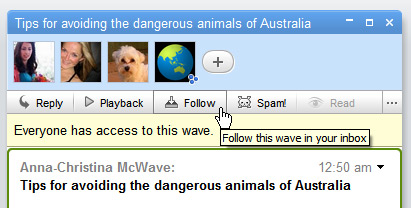

"Public waves that are in your inbox simply because you opened them at some point in the past will start to leave your inbox as they get updated," says Google Wave engineering tech lead Casey Whitelaw. "You can also manually remove them with the ‘archive’ feature, and they will no longer return. We hope this will help with clearing a backlog of unwanted waves."
The "unfollow" feature takes the place of the "mute" feature, which has been part of Google Wave. If you don’t want a Wave anymore, just unfollow it. If you need to find a particular wave in the future, you can still search for it, even if you aren’t following it.
"Following is the first step towards a set of new tools for managing waves in your inbox," says Whitelaw. "In the future, there will be more control over what kinds of changes will cause a wave to appear in your inbox, and we will soon introduce better support for groups of wave users. We’re also thinking of expanding the following concept to let you follow people, groups, and searches."
If you have not yet had an opportunity to use Google Wave, there is a good chance that none of this makes much sense to you. However, you can get an idea of how Wave basically works by reading this.
Related Articles:
> Google Wave Simplified: How it Basically Works
> Will Google Wave Shape the Future of Online Communication?
> Is Google Wave Getting An App Store?
-
With iTunes’ Variable Pricing, Fewer Hit Song Sales Still Mean More Money For Apple
 When it comes to selling a song online, 30 cents means a lot. Sales of hit songs in Apple’s iTunes store have dipped 6 percent since April, in part due to a new variable song pricing structure that has driven up the price of most hits to $1.29, data from a new study by Billboard’s Glenn Peoples shows. But popular tracks by Lady GaGa, Miley Cyrus and their ilk are keeping their market share in comparison with the remainder of the music market, and Apple’s revenue from sales of the more expensive hit songs appears to be rising faster than consumers are turning away. For Apple and other retailers testing variable pricing in the digital music marketplace, the early returns suggest that their six-month-long experiment is succeeding — and generating more revenue for labels and rights holders as well.
Hit songs account for more of the overall music marketplace today than they did five years ago, with the top 200 songs now making up more than one-sixth of digital track sales, Peoples writes in his extensive piece concerning sales patterns of hit records vs. works by less popular “long tail” artists. But the advent of variable pricing, which has boosted the price of most hit songs from 99 cents to $1.29 in Apple’s store, seems to have affected sales of hit songs over the past few months. “Higher prices have depressed sales of hits — in terms of units, not revenue,” he says. (Think of a teenager using up a $25 gift card, and receiving 19 hit songs instead of 25.) Ultimately, he writes, “many music fans aren’t shunning hits because they don’t like them but because the price rose by 30 cents.”
A little quick math implies that Apple is reaping larger rewards by increasing the price of hit songs by about 30 percent. By my count, only 2 of the current top 50 songs, and 26 of the top 200, in the iTunes Store are still priced at 99 cents, with the remainder at $1.29. If the average price of a top-200 hit is therefore about $1.25, and track sales among the top 200 have fallen by 6 percent, sales revenue from hit songs would still be up by at least 18 percent compared with an all 99-cent store.
Apple also reduced the price of another subset of its songs in its store to 69 cents in April, and has seen a bump in overall transactions per user since that time, so its experiment may be working on both ends. (The majority are still priced at 99 cents.) Other retailers such as Amazon.com, RealNetworks’ Rhapsody and Lala.com have begun using variable pricing in their MP3 stores as well, and Lala CEO Geoff Ralston mentioned to me recently that the company would consider variable pricing for its “web songs,” permanent streaming songs that now cost 10 cents apiece. The data suggests that even if some frustrated consumers are tuning out on higher-priced songs, Apple is still gaining more than it loses from the new pricing structure.

-
Staying in Touch During the Asia Trip
Earlier today, the President left for Asia, stopping over in Alaska before heading to Tokyo, Japan.
During this trip, we’re going to try something new. To offer an inside perspective to everyone back here in the U.S., Ben Rhodes, the Deputy National Security Advisor for Strategic Communications, will provide frequent updates on the trip.
Watch his first video, and be sure to check back for new faces and stories:
-
Vitamin D turns your webcam into a virtual doorman
When I bought a webcam for my front door – mine is the Linksys WVC54GCA – I was faced with a predicament. The built-in motion detection software bombarded my email inbox with images of an empty frame. It was set off by the motion of a leaf or a reflection, rendering one of the most important aspects – notification of trespass – ineffective.
At an impasse, I decided to build a cyberbiomimetic AI using a cockroach brain and a vat of amino acids. The resulting system, while effective at spotting intruders, eventually threatened to become self-aware and so I had to shut it down. Finally, I tried Vitamin D. Problem, as they say, solved.
Vitamin D is a three-step piece of software. You point it at a webcam on your network (it’s compatible with a few models right now) and tell it what to do when it sees evil people encroaching on your turf. Be they the UPS guy or brain-eating zombies, the system will record a clip of their activity and can even notify you via email and an audible chime when it senses movement. In short, it allows you to create a very powerful security system in a few minutes.
You can add multiple cameras and the system grabs only the most important parts of the day, ensuring you don’t miss a single entry or exit. Because it’s compatible a number of webcams, including webcams over a network.
I was able to connect my webcam and start recording in less than a minute. It’s a great feeling to know that the webcam has suddenly become more than a way to watch your front step. Sadly, you need a PC or Mac running the Vitamin D software to record 24/7 video but if you set this up on an always attended-to system it makes for an interesting and valuable upgrade.
It’s free right now and you can download the beta here. A subscription version will be sold in early 2010.
Note: My webcam is sideways because that’s how I mounted it in my window. Long story.
-
iPhone Increases Marketshare Again
For Q3 2009, Apple’s iPhone accounted for 17.1 percent of worldwide smartphone marketshare, a new high for the company. That’s the good news from Gartner, and there’s more where that came from.

While overall mobile phone sales were flat for the quarter, smartphone sales were up 12.8 percent, some 41 million units. Carolina Milanesi, research director at Gartner, notes that smartphones “represent the fastest-growing segment of the mobile-devices market and we remain confident about the potential for smartphones in the fourth quarter of 2009 and in 2010.” How convenient for Apple.
3.4, 12.9, and 17.1 percent…that’s Apple’s market share for each third quarter from 2007 through 2009, the growth rate easily besting even RIM’s doubling of its own market share over the same period of time. For the current quarter, Apple also outpaced RIM, the two companies growing by 49.2 and 46.9 percent, respectively. While that surge could be attributed to the launch of the iPhone 3GS, it should be noted that the iPhone 3GS was supply constrained during the quarter. Further, Gartner believes the fourth quarter “should be even stronger as Apple starts selling in China, through one additional carrier in the UK, and in an additional 16 countries.”
While Nokia did manage growth, it picked up only 4.4 percent in units sold, putting the company at 39.3 percent market share, down from 42.3 percent for the same period last year. The big losers for the quarter appears to have been manufacturers saddled with Windows Mobile 6.
According to Gartner, Windows Mobile 6.5 came “too late to have an impact on the third quarter, so sales of Windows-based smartphones saw another decline.” Apparently, HTC must be gaining strength based upon Android. Google’s mobile OS “picked up momentum but with only a handful of Android devices available, its share remained modest at 3.5 per cent” of the mobile operating systems.
No doubt phones like Verizon’s Droid will help to increase Android’s share of the market, but arguably not at Apple’s expense. The problem with Android is that each carrier is free to create its own mind-numbing implementation, resulting in a lack of consistency for the users of different phones. A case in point is the Droid, which currently lacks multi-touch, even though Android 2.0 supports it. For the most consistent and elegant mobile experience, the only choice remains the iPhone.


-
Ford’s using wheat straw in a 2010 Flex component

Here’s a little known fact: Henry Ford used natural material like hemp and stray to reinforce plastic components in his cars. Now, Ford is at it again with a small quarter trim bin found in the third row of the Ford Flex made out of wheat straw bio-filled polypropylene. Wheat straw!
Sure, it’s just one small part in one vehicle, but according to the numbers, the impact on the environment sounds at least significant.
This modest step, says Ford, will cut the need for some 20,000 pounds of petroleum and prevent 30,000 pounds of carbon dioxide emissions each year.
This so-called wheat straw is the byproduct of wheat harvesting and isn’t exactly useful. Chances are that if this trial works out on this one part, Ford, and the rest of the industry, will look into ways to further incorporate green materials into their vehicles. I, for one, look forward to the day that my steering wheel is made from corn and I can spreed a little butter and salt on it to enjoy a nice snack while driving down I-75.
-
UK Gov’t Official: Innocent People Won’t Get Kicked Off The Internet; Trust Us
With all of the concern over the proposed bill in the UK to kick file sharers off the internet based on accusations (not convictions), some have been raising concerns about innocent users kicked off the internet. Culture Minister Sion Simon has hit back at those claims insisting that the innocent won’t be kicked offline. Really. Trust us. Or something like that. The main reason he claims that it won’t impact the innocent is because multiple letters will be sent and there will be an “appeals” process. Of course, that ignores the fact that this could still be quite a disruption in someone’s life. If they’re falsely accused, they risk losing their internet access and have to fight an appeal? That could be costly in terms of both time and money. And, of course, we’ve already seen, with other similar threats, that the warning letters sometimes get sent to the wrong address or wrong person and get ignored entirely.
Permalink | Comments | Email This Story
-
GameStop to sell DLC in-store starting next year
GameStop may not be threatened yet by digital distribution, but they’re certainly taking steps to profit from it as soon as they can. The retail giant…
-
T-Mobile plans to unleash blazing 21Mbps HSPA+ in mid-2010
 T-Mobile might have been last in launching a 3G network in the U.S., but that hasn’t stopped it from moving right along. We had already known that T-Mobile was planning on lighting up its 7.2Mbps speeds in some cities by the end of 2009, but it looks like HSPA+ is kicking in just months later. Slated for mid-2010, a number of U.S. markets will have data speeds of up to 21Mbps on T-Mobile’s network. There are also a decent amount of handsets that will be able to take advantage of the 7.2Mbps kick, like the G1, CLIQ and the myTouch 3G, but we’re really looking for what T-Mobile has in store for the masses once HSPA+ hits. In addition to the speed upgrades, the company is also continuing to spread its 3G footprint across the country. Now where are those Nokia N900s with AWS 3G support?
 -
Google Announces SPDY Application-Layer Protocol
Except, perhaps, for multitasking techies and the last few people using dialup connections, load times aren’t a huge deal from a user perspective; the average page appears before most folks think to click on anything else. Still, Google looks set to make a lot of friends with the introduction of a research project dubbed SPDY ("speedy").
A post on Google’s Research Blog gave a little background by stating, "SPDY is at its core an application-layer protocol for transporting content over the web. It is designed specifically for minimizing latency through features such as multiplexed streams, request prioritization and HTTP header compression."

As for how that translates into a measurable effect, the post later tied in the "speedy" name and relayed a key point by adding, "[W]hen we download the top 25 websites over simulated home network connections, we see a significant improvement in performance – pages loaded up to 55% faster."
A savings of 55 percent is huge, of course – something that every user would notice. And site owners might be able to take advantage of the SPDY boost by packing more interesting stuff onto every page.
So, per the SPDY team’s request, look its documentation, inspect its code, and provide feedback if you can. SPDY’s not ready to make a mainstream debut, but bringing it to that point is almost certainly in everybody’s best interest.
Related Articles:
> Google Makes Improvements To Movie Showtime Searches
> Google Chrome For Mac May Hit Beta In December
> Google Announces Details Of New Product Listing Ads
-
Health Care In Hazard, Ky.: Cathy Nance
Six years ago, Cathy Nance had to have open heart surgery. Later, she had kidney cancer. Because of poor health and inability to work, she became homeless, until she was helped by Harlan Countians for a Healthy Community. “I worked all my life. If anyone had told me that later on I would be in the shape I was in, I wouldn’t have believed it,” she confesses. “So it can happen before you know it.”
Related Videos:
Gerry Roll
|
Beverly May
|
Annie Fox
-
Health Care In Hazard, Ky.: Annie Fox
Health care has to be looked at in context, according to Annie Fox and Teana Burns of “Harlan Countians for a Healthy Community.” Fox says: “We still have issues in rural America with sanitation, potable water, electricity. Until you deal with those things, you’re always going to have health care issues.”
Related Videos: Gerry Roll | Beverly May | Cathy Nance
-
Health Care In Hazard, Ky.: Beverly May
Family nurse practitioner Beverly May, of the Kentucky Mountain Health Alliance, treats many patients with chronic diseases. She says the typical patient hasn’t had any care for years, and that every week, people walk in who have no idea they have serious health problems.
Related Videos: Gerry Roll | Annie Fox | Cathy Nance
-
Health Care In Hazard, Ky.: Gerry Roll
Gerry Roll helped organize Hazard-Perry County Community Ministries, which – despite its name – has no religious mission. She says people don’t understand the problems in southeastern Kentucky: “You can get whatever you need as far as traditional medical care goes. Yet we have the highest levels of chronic disease in the nation. So when I hear people talking about access to health care being a problem, I am livid.”
Related Videos: Beverly May | Annie Fox | Cathy Nance
-
PS3, Xbox to soon get Twitter, Facebook integration
Microsoft has kept few secrets about its upcoming Dashboard update, which will give Xbox Live Gold members Twitter, Facebook, and Last.fm integration on November 17.
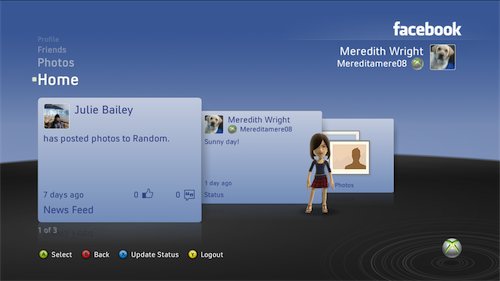
“Xbox Live’s differentiator has always been our community, and we’ve already seen a tremendous response to these features in our public preview. It’s the community that drives us forward and allows us to pioneer new ways of connecting people through the entertainment they love,” Xbox Live general manager Marc Whitten said.
But accidentally leaked screenshots of Facebook running natively on the PlayStation 3 have caused a little more of a stir among the video game media. As usual, this is because of the element of mystery involved, and also Sony’s track record of giving out for free what Microsoft charges for. Sony has not yet issued any comments on the leaked images, but Eurogamer today said that there will be more information on them “very shortly.”
Betanews sent an inquiry to SCEA this afternoon, and will report on its response if and when it comes.
-
Kicker to make the ZK500 Zune HD compatible

One of the only downsides to owning a Zune HD instead of an iPod is the lack of speaker docks. There simply isn’t that many available and the ones for the previous Zune’s aren’t compatible. But Kicker knows what’s up and just released firmware to make its $249 ZK500 Zune HD friendly. But there is fine print involved and you can’t update the system yourself.Here’s the thing: you have to ship the system to company to have the firmware installed. But if you bought the ZK500 after the Zune HD was released, you’re good. The company will pay the necessary shipping cost to have the update completed.
However if you bought it before, you’re going to have to pay $40 to have the firmware installed. Ridiculous? Yeah, it kind of is.
Either way though, the system will not output high-def from the Zune HD because of the older dock connector used. But I guess if you spent the cash on the new Zune HD, you may as well spend another $40 to make your older speaker dock compatible.
-
The iTunes App Store at 100,000: Can we stop counting, already?
By Carmi Levy, Betanews
Ever since Apple launched its App Store barely 16 months ago, we’ve paid a lot of attention — indeed, too much — to the number of applications it contains. As the App Store crossed the 100,000 title barrier last week, it occurred to me that the bigger this number gets, the less it actually means.
I get that Apple has won the sheer-number sweepstakes. I appreciate that no other mobile storefront can even come close. I also understand how broad software availability (in terms of sheer numbers as well as ease of acquisition) has helped fuel the growth of the iPhone/iPod touch universe. I just think we attach way too much importance to this single figure, and it distorts our ability to understand ultimate value to end users and developers alike.
So many titles, not enough room
Never mind that no one person could ever assess, let alone install and use, anything approaching a broad cross-section of this ever expanding library. Ignore the fact that the vast majority of these titles are near-dormant, gathering dust while the masses pay attention to newer, higher-profile offerings. Forget that this number is bloated by countless apps that replicate bodily functions, play visual party tricks, and otherwise consume time that could be productively spent…I don’t know, composing e-mails to your mother.
 Does the world really need fifty different ways to display the time? Or forty-five weather forecasting apps or a couple of hundred alarm clocks? At what point does the sheer size of the library become so large that successive additions become meaningless? I accept that there’s a certain value in choice — that in a tiny library, users would be ill-served by a product category with only a couple of feature-limited, badly integrated choices. A larger playground increases the size of the app-specific talent pool and ensures someone looking for an alarm clock will eventually find what he or she needs.
But there’s choice and there’s choice. When neighborhood supermarkets replaced the corner store, we all benefitted from greater choice and more competitive pricing. Economies of scale will do that, as stores that buy in larger quantities have greater buying power than those with smaller inventories. But as plain old supermarkets were supplanted by big-box megastores, we ended up with too much of a good thing. A thirty-minute cruise through the aisles easily doubled or tripled as many of us got lost in the cavernous new temples of conspicuous consumption. We’d stand in front of the ketchup shelves, unable to decide between the ten brands, fifteen different sizes, and packaging combinations, and even colors…remember green and purple? We’d end up with more than we needed, or stuff we hadn’t intended on buying in the first place.
YouRememberThat.Com | MySpace VideoLost in the wilderness
Apple’s App Store has gone well beyond the big-box stage. Shopping there isn’t the focused, quick and direct process it once was, and by the time most of us are done loading up on new code, we inevitably end up with stuff we didn’t want or need in the first place. Worse for Apple, it can’t simply build a bigger building to house all its new inventory. Computer and iPhone screens aren’t getting bigger, and new and existing titles find themselves fighting for an ever dimmer slice of virtual storefront for consumers’ increasingly ADHD-infused attention.
It hurts developers as well as consumers. We wrestle with the challenge of finding what we want without pulling our hair out in the process, while developers simply try to avoid getting lost in the ever growing ocean of offerings — assuming, of course, that they can get past Apple’s app approval process to get into that ocean in the first place.
I hesitate to blame Apple, as it’s simply riding the wave of the most buzzworthy mobile device to hit consumers’ radar since Ford’s Model T. As long as we’re content to measure the iPhone platform’s worth by the number of available apps, Apple is perfectly content to trumpet each major milestone, and absolutely justified in doing so. For a company that has long prided itself on simple, easily understood methods for users, nothing’s easier to articulate than a big number that dwarfs all competitors, and keeps getting bigger on a seemingly exponential path.
Even if, from where I sit, it’s an ultimately meaningless number, it remains a marketer’s dream, so don’t expect Apple to stop flogging it.
New ways to measure
Still, it leaves the door open for measures of value that reflect actual utility. Google’s Android platform may sport a software library that’s an order of magnitude smaller than Apple’s, but Google doesn’t live in the same download-and-use universe that Apple does. Its core strength lies in its expanding universe of increasingly integrated Web-based services. And successive generations of its mobile platform will reflect this shifting reality, especially as 3G wipes GSM and CDMA off the map, and 4G-based technologies like LTE move into the mainstream.
It may seem laughable now given AT&T’s and other carriers’ troubles with network coverage of any kind, but at some point in the not-too-distant future, mobile bandwidth will be so abundant that the same paradigms of always-on Web services that we take for granted on our conventional laptops and desktops will seamlessly apply to our smartphones as well. And the download-and-use metaphor will fade.
So although the size of Google’s library currently places it in a firm second place in the mobile online store rankings and gives it a fair degree of street cred, I doubt Google hangs on the daily figures as much as Apple does given the sea change that will fundamentally change how we get work (and play) done on mobile devices.
For now, though, we still measure our devices by the number of apps available for download, and we continue to focus on quantity when handicapping the various platforms against each other. As mobile infrastructure matures and consumers improve their ability to assess the value proposition of a platform’s complete feature set — and not just its simple library size — simply having the biggest of anything may no longer be enough to sustain interest. Bigger, after all, isn’t always better.
Carmi Levy is a Canadian-based independent technology analyst and journalist still trying to live down his past life leading help desks and managing projects for large financial services organizations. He comments extensively in a wide range of media, and works closely with clients to help them leverage technology and social media tools and processes to drive their business.
-
HP Buys 3Com for $2.7 Billion
HP announced today that it is acquiring 3Com, makers of network switching, routing, and security solutions, for $2.7 billion in cash (at 7.90 per share). Both boards have already approved the transaction.
HP says the combination of these two companies will transform the networking industry and "underscore HP’s next-generation data center strategy." The company believes this will help customers simplify networks and improve IT service delivery capabilities.
 "Companies are looking for ways to break free from the business limitations imposed by a networking paradigm that has been dominated by a single vendor," said Dave Donatelli, executive vice president and general manager, Enterprise Servers and Networking, HP. "By acquiring 3Com, we are accelerating the execution of our Converged Infrastructure strategy and bringing disruptive change to the networking industry. By combining HP ProCurve offerings with 3Com’s extensive set of solutions, we will enable customers to build a next-generation network infrastructure that supports customer needs from the edge of the network to the heart of the data center."
HP’s Ethernet switching offerings will see a significant expansion as a result from the acquisition. It will also add routing solutions, and greatly strengthen HP’s position in China. They will also be adding a large research and development team in that country.
"Our extensive product line and innovative technology together with HP’s breadth and scale will expand our global opportunity," said 3Com CEO Bob Mao. "3Com’s networking products are based on a modern architecture which has been designed to offer better performance, require less power and eliminate administrative complexity when compared against current network offerings. Our products are enterprise proven and widely deployed in the world’s largest banks, manufacturers, Internet service providers, public utilities and retailers."
HP will be getting 3Com’s security solutions, which include its TippingPoint line, which is apparently used among 30% of Fortune 1000 companies.
The deal is still subject to domestic and foreign regulatory approval, as well as approval from 3Com’s stockholders. The transaction is expected to close in the first half of next year.
Related Articles:
> Intel Pays AMD $1.25 Billion, Following That $1.5 Billion Fine
> Cisco Announces $3 Billion Starent Networks Acquisition
> Cisco Says It’s Building a Multi-Billion Dollar Industry
-
Twitter, Facebook come to Xbox 360 on Nov. 17

As of next Tuesday, November 17, you’ll be able to access Twitter and Facebook on your Xbox 360. The software update is free, like previous updates, and also includes Last.fm and Zune video compatibility. “What are you doing?” “Losing to 12-year-olds in Modern Warfare 2 over and over again! Not fun.”

The idea, I guess, is that you’ll be able let your friends know just how much fun you’re having while playing the latest game, or streaming the latest Netflix release, without having to go through the trouble of whipping out your phone or walking over to your computer. I see it as a convenience and nothing more. It may also mean that there’s nothing you can to do stop Twitter’s worldwide dominance.
This is what the Twitter interface looks like in motion:
Note that the Xbox 360 isn’t the only video game console whence you can tweet or alter your Facebook status. The PS3 and Wii come with a built-in Web browser, and a stand-alone Facebook interface for the PS3 was leaked just yesterday.
And while the Twitter and Facebook support will get the most attention, I think it’s the Zune HD support that’s most interesting. Say what you will about the Zune HD—Devin liked it, and I went out and bought it I was so impressed—but the idea of an instant-on, HD, 5.1 surround system movie service certainly intrigues me. Of course, its success now depends on what type of movies are released for it.


