Author: Serkadis

  • Google Doesn’t Rely On Intellectual Property For Its Leadership Position

    In the various debates we have on intellectual property, we often hear people insisting that Google’s dominance is based on intellectual property — even though there’s very little evidence to support this at all. The people who make this argument are guilty of the same mistake made in studies that count all things covered by intellectual property laws as if they only exist because of those laws. Entertainment industry lobbyists, like The Copyright Alliance, love to tout that “$1.52 trillion of the nation’s GDP” comes from intellectual property. But that’s both misleading and wrong. The number itself is exaggerated, but it also gives credit to intellectual property for anything that touches IP. For example, when we dug into the methodology, we saw that the study counts things that clearly were not because of IP law: such as furniture and jewelry. Are the Copyright Alliance and its entertainment backers really trying to suggest that without copyright law we would have no furniture or jewelry?

    Similarly, Google often gets lumped into these discussions, with people insisting that its position in the market is due to copyright and patents. Google does, in fact, have a bunch of patents — but I watch the patent app filings and patent grants on a bunch of different companies each week, and Google tends to file significantly fewer patents than other comparable companies. Furthermore, I don’t know of a single case where Google even hinted at or threatened another company with a patent infringement suit (if there are any examples, please let me know). It appears that Google has focused very much on just using patents for defensive purposes, since it is regularly sued by others for infringement.

    Matt Asay, over at News.com, has now highlighted an even stronger example of how Google is showing that it’s not relying on intellectual property, but on execution, for its business position. The company recently open sourced its Closure tools, which it uses to build its web services (disclosure: I’m good friends with one of the folks involved in this project, and yes, he reads Techdirt regularly). As Asay puts it:


    In many ways, Google is giving away the recipe to those that would like to build a Google clone.

    The problem? Google is so much more than software.

    In fact, one of the primary reasons that Google can write and open-source so much software is that it isn’t a software company. Not even remotely. I could have every line of Google’s software, both open source and proprietary, and I couldn’t hope to compete with Google.

    Google is what Google does with the software, and not the software itself.

    It’s the execution, not the idea. It’s the service, not the code.

    In fact, this sort of activity confuses the hell out of companies that do rely on intellectual property. Again, Asay makes this clear:


    Google and Red Hat have moved beyond software. Software enables their operations, but software doesn’t define such operations. Google, for its part, is open sourcing Microsoft, one line of code at a time, and Microsoft hasn’t a clue as to how to respond, because it only knows the old world: competition through better IP.

    And that — right there — is the key point we keep trying to make around here. You don’t need to rely on intellectual property. And, if you do, you are opening yourself up wide to competition that doesn’t rely on IP and innovates in a way that simply cuts your legs out from under you. Yet… we’ll still hear stories for years about how all of Google’s billions are because of its intellectual property, even as it gives away more and more of it each and every day.

    Permalink | Comments | Email This Story


  • EC still holds Intel accountable even after AMD settlement

    By Scott M. Fulton, III, Betanews

    Despite an historic resolution to AMD’s and Intel’s long-standing business practices and intellectual property disputes this morning, the official position of the European Commission — which issued formal objections to, and fines for, Intel’s alleged conduct last May — is that nothing whatsoever has changed with regard to its ongoing prosecution of its Statement of Objections.

    In a statement to Betanews this afternoon, EC spokesperson Jonathan Todd said: “The Commission takes note that Intel and AMD have settled all their litigation and that Intel is paying AMD compensation of $1.25 billion. Intel has an ongoing obligation to comply with the Commission’s May 2009 Decision and with EU antitrust law. The Commission continues to vigorously monitor Intel’s compliance with its obligations under the May 2009 Decision.”

    Although AMD is likely to continue cooperating with regulators worldwide, its active participation in their efforts is likely to subside, but not yet completely.

    “The regulatory investigations and enforcement actions around the world are conducted by sovereign governments pursuant to law and their mandates to protect competitive processes and consumer value,” said AMD Executive Vice President for Legal Affairs Tom McCoy this morning. “So the regulators will do what they are going to do; and what we would say is that, from our perspective, we are withdrawing, obviously, from all pending litigation. We will be withdrawing all complaints that have been lodged with regulatory agencies, and if asked, we will say that the agreement, to a great extent, resolves outstanding disputes between AMD and Intel under the antitrust laws. There are some exceptions, there are some practices that we believe are exclusionary, that we will, under the agreement, there are a narrow set which we will continue to advocate to the regulators should be addressed for the health of the industry; and Intel will have its own point of view of that, of course. So the regulatory agencies still have a role to play, but from our perspective, this agreement significantly resolves our concerns.”

    From Intel’s perspective, all of the regulatory concerns that governments may have stem from AMD’s original civil complaint. And now that that’s over, Intel believes, the rest of it all should follow.

    “In terms of regulators, I think in general, all of these comments that have been coming from regulators, and actions, have been as a result of the complaints between these two private parties,” said Intel CEO Paul Otellini this morning. “Now that the issues between the private parties are settled, I think that should provide some degree of comfort for the regulators, at least in terms of our behaviors and how we’re going to compete in the marketplace, and so forth. Beyond that, they may have their other concerns in areas like pricing, as we’ve mentioned, that we may still want to them and they may want to talk to us about.”

    Endpoint analyst Roger Kay later pressed the Intel executives for further clarity, including with regard to the New York Attorney General’s antitrust complaint, filed last week.

    “In the places in the world where AMD had complaints against us, those will be withdrawn,” responded Intel Executive Vice President for Legal Affairs Andy Bryant. “In places where governments around the world were asking us questions, those will continue on. Actually the EU appeal will continue on…We are having discussions with the [US] FTC; currently, there are other countries in the world who have asked us questions, we will still continue to talk to them, answer their questions. And of course, we have the New York Attorney General situation to deal with.”

    This prompted a Fortune Magazine correspondent to ask whether A-G Andrew Cuomo’s complaint — which contained never-before-public e-mails from Intel execs, including Otellini, as evidence of improper conduct — led Intel to conclude it must settle now with AMD to avoid embarrassment.

    Otellini responded first by revealing that settlement talks with AMD actually began last April, before the EC’s Statement of Objections. In fact, it’s conceivable that had the EC suspended its operations for another month, it might have discovered it had less to complain about.

    With respect to Mr. Cuomo’s filed complaint, Otellini added, “On some of the statements in there that were attributed to me, yeah, I wrote some of those, at least the ones I remember. On the other hand, many of those documents are taken broadly out of context. When the full nature of the e-mails is exposed, I think that you’ll see there’s another way to interpret some of these statements. Remember, there were 200 million pages of documents produced, and these were four or five snippets out of 200 million pages. So we’re anxious to talk about our side of the story and show our other halves of e-mails, and so forth, as we go forward.”

    Betanews has shared some of Otellini’s statements with Attorney General Cuomo’s office, and we may expect a response from him later in the day.

    Copyright Betanews, Inc. 2009


    Add to digg
    Add to Google
    Add to Slashdot
    Add to Twitter
    Add to del.icio.us
    Add to Facebook
    Add to Technorati


  • An asteroid almost smashed into Earth, and we only knew about it 15 hours before it happened

    asteroid

    Did you hear the news? An asteroid passed within 8,700 miles of the planet on Friday. The craziest thing is that scientists only knew about it 15 hours before it flew by. So if you have any confidence that this planet is safe from giant space objects smashing into the surface, possibly destroying all life in the process, well, think again.

    This particular asteroid wasn’t so big, measuring at around 23 feet across, that it would have caused mass destruction, but it just goes to show you: maybe one day, when the big one arrives, we’ll have a hot 20 hours to figure out what to do.

    Can you even imagine what would happen? Scientists spot a gigantic asteroid that would surely cause planet-wide destruction, but they only discover it a few hours before it hits the planet. How would people react? How would society function when faced with mass carnage, if not certain doom?

    Now you can see why asteroids represent my favorite sci-fi scenario: how does humanity react when it faces such a cataclysm? Do we band together in the interest of survival? Do we take the opportunity to invade Country A in order to secure resources that we could use?

    Oh my God, how would Twitter react?

    It should be noted that objects enter the Earth’s atmosphere all the time, and that relatively big ones pass by the planet about two times per year.

    Done right, a doomsday scenario movie, unlike that hunk of junk 2012, could be really interesting. None of this, “pull the plane into the air even though we haven’t reached the speed necessary to generate enough lift to pull us upward to begin with,” but a serious look at how people would react.

    Which is to say the movie could never be made by Hollywood, lest some American Joe Blow somehow save the day.


  • This Veterans Day Took on a New Meaning

    Ed. Note: Learn more about Darienne’s work here at the White House in a New York Times audio slideshow.

    In my family, military service is tradition.  My grandfathers were infantry and airmen.  My mother is a Gulf War veteran; my father was a Noncommissioned Officer.  Among my siblings, three of us are Operation Iraqi Freedom veterans.

    We serve this country out of a profound sense of duty, with the knowledge that the freedom we enjoy today was secured for us on the backs of generations who were willing to go forward and fight for it.  We serve out of commitment to the values of dedication and sacrifice.  We serve because it is an honor.  Veterans Day is a day we call each other to give thanks for one another and for the time we have together; to pay tribute to those we have lost, and to say prayers for those serving in foreign lands.

    This Veterans Day took on a new meaning.  The day prior, I had the honor of traveling to Texas with the President and First Lady, where we attended the memorial service for the soldiers and civilians that were killed at Ft. Hood.  I watched as they individually addressed and embraced the families that had lost their loved ones, the soldiers who were wounded, and the first responders who provided aid.  I witnessed the First Family grieving with our larger military family, and I was moved to tears. 

    It reminded me, once again, why I joined Barack Obama’s presidential campaign in the first place – a sense of duty.  I wanted more for my country, and saw that he did too.  I wanted more for our Veterans, and I see progress for them every day thanks to the tireless efforts of our Veterans and Wounded Warrior team.  I wanted more for my family and my future, and I’m watching that become a reality through improved veteran’s education benefits.  I see new laws and executive orders that help veterans find jobs and reliable health services.  I see our Commander-in-Chief fighting for these policies, for people like me, the members of my family, and our troops – and I am proud to have served him and our country as a civilian and as a soldier.  

    Darienne Page is the West Wing Receptionist

  • BlackBerry News From the Wire for the Week of 11/9/2009

    RIM held the second annual BlackBerry Developer Conference this week, and where there is a conference there is news. Considering the BlackBerry’s inferiority in the software department, the conference had the potential to be big. And, unsurprisingly, we got a few announcements that could eventually change the BlackBerry software for the better. Which is nothing but good news.

    (more…)

  • Vlingo is now available for the BlackBerry Storm 2

    vlingo

    Vlingo has announced that they are available for the BlackBerry Storm 2. Right now, you can download Vlingo for Storm 2 and Storm 1 if you have upgraded to 5.0. If you have already paid for Vlingo Plus, you will get the premium features loaded on the new version automatically.

    While it’s not yet up on App World, you can grab your copy from Vlingo themselves.


    © BlackBerry Cool for BlackBerry Cool, 2009


  • How to Watch NewTeeVee Live From Your iPhone

    Livestreaming is all the rage today, be it from a handset or home computer with a webcam. But one of the major challenges is how to view that live content on a handset. Wouldn’t it be nice if a company could provide a method for livestreaming to mobiles without a lengthy re-encoding process? Lo and behold, enter Livestream, which today announced its Procaster beta application for Mac and PC at NewTeeVee Live, our annual online video industry conference. Using the iPhone’s native H.264 HTTP streaming, Procaster allows for near-instant broadcasting to iPhones — there’s roughly a 20-second delay from live broadcast to the devices, and multiple handsets can tune into the same stream. Watch NTV Live by clicking here or going to iphone.livestream.com. Here’s a video demo to see how Procaster works:

    I took the Procaster software for a short test drive, and I was broadcasting live from my Mac in under five minutes using an integrated webcam and microphone. Procaster can use any attached webcam or microphone, so you don’t have to limit yourself to integrated audio or video capture devices. Once my broadcast was live, I simply pointed the Safari browser on my iPhone to http://iphone.livestream.com where I saw my personal channel. Tapping it opened up QuickTime where I saw a near real-time, high-quality view of my  broadcast. Even better: As a broadcaster, I was able to toggle between my camera setup and my desktop, a solution I envision as being useful for real-time training and presentations.

    While there are other ways to view video on the iPhone, most involve a lengthy re-encoding effort. Livestream has cut that down to under a half-minute. And the best part? Procaster is simply using the native functions that Apple already provides to the platform. That’s a killer feature right there because it means people can begin to live stream to iPhones without any software installs on the handset.

  • Emails With Coupons Achieve Higher Open Rates

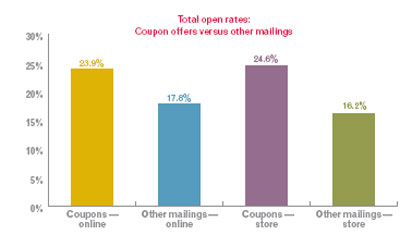
    The majority (80%) of emails sent with coupons received higher open rates and transaction rates than non-coupon campaigns, according to a new report from Experian Marketing Services.

    Seventy percent of coupons-using households get their coupons from newspapers. However, the Internet is a growing coupon resource. Over the last three years, the number of households that get their coupons online has increased by 46 percent.

    Click rates trended higher for coupon emails, with an average of 17 percent for coupons redeemable online and 24 percent for coupons redeemable in-store.

    Open-Rates

    "For marketers, the data behind our coupon study further validates how email coupons can and should be used to engage customers and drive traffic and sales to other channels," said Matt Seeley, president of Experian Marketing Services‘ .

     "Understanding the purchase drivers and triggers along with the channel preferences of unique customers is an essential element in building loyalty and engagement. Today’s consumers are multi-channel and marketers that acknowledge this will see greater return on their marketing spend."

    Other highlights from the study include:

    Two-thirds of American households use coupons, with the vast majority of them (87 percent) used to save money and 30 percent used to try a new product or service.

    Eighty percent of online coupon mailings garnered higher transaction-to-click rates and transaction rates than the non-coupon campaigns. Of this group, 78 percent also had higher revenue per email.

    More households are now using coupons at restaurants/fast food chains. Compared to 2006, there are now 9 percent more households redeeming coupons at restaurants.


    Related Articles:

    >10 Reasons Social Media Isn’t Replacing Email

    >Holiday Shoppers Want Deals Even More Than They Did Last Year

    >Majority Of Consumers Want To Interact With Brands Online


  • Reggie unconcerned with motion control competition

    Nintendo currently has the motion-controlled console market in a chokehold, but Sony and Microsoft are planning to cut into Nintendo’s slice of the ma…

  • The Boxee Box will rock your sox!

    boxee

    Boxee, everyone’s favorite HTPC software, just announced that the company just partnered with its first CE company. But that’s all the company is saying. We don’t know anything else. However, there is an event coming up on December 7th right around the corner from John’s house where we should learn more. I’m already excited though. Just think what this means.

    Boxee is amazing program and many people geeks are already using it on their Apple TVs, HTPCs, and other devices. But it deserves so much more. The irony here is that the people with the necessary skills to get Boxee on their HDTVs currently probably don’t really need the super-user friendly interface found on Boxee. It’s the people that don’t have any idea what the hell Boxee is that really could benefit from the program.

    Boxee is by far the easiest HTPC software to use. But not only that, the system is about as robust as you can ask for with the ability to stream media from countless online video sites and share viewing data with friends. It’s really HTPC software 2.0.

    Hopefully the upcoming box will bring all the goods at a fair price. Considering just about any system that can output HD can run Boxee, I wouldn’t expect the box to cost all that much.


  • The President Announces a Forum on Jobs and Economic Growth

    As the President was preparing to leave for his trip to Asia this morning, he took a moment to discuss the economy, which will of course have a central role in his discussions with leaders throughout the trip. He made clear that while we have come back from the brink of what many predicted would be a depression, he will not be satisfied until robust job growth returns. Towards that end, he announced that in December he will bring minds and stakeholders together for an intensive jobs forum:

    As I’ve said from the start of this crisis, hiring often takes time to catch up to economic growth.  And given the magnitude of the economic turmoil that we’ve experienced, employers are reluctant to hire.

    Small businesses and large firms are demanding more of their employees, their increasing their hours, and adding temporary workers — but these companies have not yet been willing to take the steps necessary to hire again.  Meanwhile, millions of Americans — our friends, our neighbors, our family members — are desperately searching for jobs.  This is one of the great challenges that remains in our economy — a challenge that my administration is absolutely determined to meet.

    We all know that there are limits to what government can and should do, even during such difficult times.  But we have an obligation to consider every additional, responsible step that we can [take] to encourage and accelerate job creation in this country.  And that’s why, in December, we’ll be holding a forum at the White House on jobs and economic growth.  We’ll gather CEOs and small business owners, economists and financial experts, as well as representatives from labor unions and nonprofit groups, to talk about how we can work together to create jobs and get this economy moving again.

    It’s important that we don’t make any ill-considered decisions — even with the best intentions — particularly at a time when our resources are so limited.  But it’s just as important that we are open to any demonstrably good idea to supplement the steps we’ve already taken to put America back to work.  That’s what this forum is about.

    President in Diplomatic Room, November 12, 2009

    President Barack Obama makes a statement on the economy in the Diplomatic Room, announcing that a jobs forum will be held at the White House in December, November 12, 2009. (Official White House Photograph by Chuck Kennedy)

  • Key figures in building industry visit Number 10

    The PM meets students from Eastbourne College; Crown copyrightThe Prime Minister has welcomed leading architects, key members of the construction industry and other figures involved in creating Britain’s public spaces to Downing Street.

    Gordon Brown told guests, who included the winners of this year’s Commission for Architecture and the Built Environment (CABE) Public Building Award, that British design and architecture are “second to none”.

    Speaking at the reception, the Prime Minister said:

    “Everywhere I go round the world I see British architecture and I see the fruits of the great talent and ability we have in Britain, and everywhere I go round Britain these days I see the tremendous creativity of British architects and what you’re achieving in new schools, new hospitals, but also in new public as well as private buildings.”

    He also met student from Eastbourne College, who won the Royal Institute for British Architect’s (RIBA) 175th Anniversary competition to design a Parliament building of the future.

    The PM said:

    “It is a really exciting design and it shows huge creativity amongst young people.”

    Visit RIBA and CABE’s websites

  • What If You Could Recreate Live Performances By Dead Artists On A Computer?

    Via Shocklee comes this story of a company that claims to have created software that can recreate live performances by famous musicians (even dead ones). Basically, the software learns (or so its creators claim) exactly how certain musicians played, and then can mimic that style exactly. Here’s how Pocket Lint describes it:


    Zenph Studio’s approach is to work out how the musician and the instrument acts and responds, then get a computer to play that track again as a real-time, real-life performance, which in turn can be recorded using modern techniques. The new track isn’t a re-mastering, but a re-performance, as if the musician was actually playing it even though the artist may or may not be dead.

    The technology works by ascertaining how an artist strikes a note and then recreating that note again. For the piano, the company takes into account everything from how an artist strikes a note to their hand movement, how they play when tired (yes, it can recreate fatigue) and even, as for the case of Jerry Lee Lewis, how they play with their feet. For the guitar there is even more to take into account, like pad placement, fingernails, and bending of the strings, the list goes on.

    The result is that songs recorded 100 years ago can and will be able to be re-recorded with modern recording equipment, allowing old songs to be revitalised and enjoyed once more “in surround sound or headphone listening”.

    And, of course, the technology goes well beyond just remastering. In theory, you could create entirely new recordings by long-dead artists, matching their exact styles. As the article suggests, you could toss John Lennon into a Rolling Stones song.

    Of course, if this sounds sorta familiar, that’s because we were just talking about the legal mess associated with Bluebeat.com’s claims that the music it offers from its site for sale are not the original works by bands like the Beatles, but an entirely new recording through a “psycho-acoustic simulation.”

    So, now, take this software that supposedly can perfectly mimic a certain musician’s playing, and have it record a song. Say it’s a new song. Who owns the copyright? What if it’s adding John Lennon to a Rolling Stone’s song? Who owns the copyright? What if it’s an old song, updated in some slight way? Who owns the copyright? What if it’s just the same song but “remastered”? Who owns the copyright? The legal questions raised by this kind of software are going to keep copyright lawyers busy for a long, long time.

    Permalink | Comments | Email This Story


  • “Green Tap”: NEC develops energy-saving power strip

    green_tap_nec

    NEC subsidiary NEC System Technologies has developed a power strip [JP] with a built-in processor, sensor (the device pictured on the right) and remote control that can cut power consumption by as much as 15% and more. The company says the so-called Green Tap, which sports four outlets, can be used by both offices and private homes.

    The device can be used for all kinds of electric appliances. The sensor monitors various data such as the luminosity, temperature, humidity or human heat around it. If you’re out of the room in which you placed your TV, for example, the sensor makes the power strip send an infrared signal to the remote control, which then makes the TV go into standby mode or turn it off completely. If you return, the TV will be turned on again.

    The Green Tap works similarly for air conditioners or heaters, automatically setting the temperature in a room, for example. It will even cut off power supply in case of an earthquake (the sensor has a built-in accelerometer).

    NEC System Technologies plans to start commercializing its technology in 2011 but hasn’t decided about pricing and other details yet.


  • Compete Builds “Twitter Down” Case

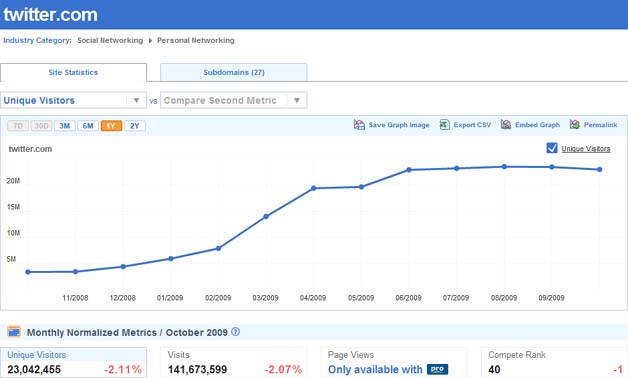
    According to the latest stats from Compete, Twitter didn’t fare too well in October.  In fact, rather than pull in more unique visitors compared to the previous month, Twitter may have lost some and turned a one-time anomaly into a two-time streak.

    As the below graph shows, Twitter’s growth rate slowed quite a bit starting in June.  Compete then recorded that its unique visitor count peaked in August.  September didn’t play out at all in the site’s favor, and in October, both visits and unique visitors dropped by about 2.1 percent.

    This left Twitter only slight ahead of where it stood in June.

    Meanwhile, Compete stats show that Facebook saw a month-to-month surge of 3.50 percent in terms of unique visitors.  LinkedIn saw a bump of 3.29 percent, too.  Even MySpace, which suffered a hit, only experienced a small drop of 0.65 percent.  So Twitter seems to be on its own here.

    Nonetheless, after writing up a similar report from Hitwise late last month, a quote from Evan Williams seemed appropriate, and it may fit here, too.  Williams told Adam Lashinsky, "It’s grown a little bit slower lately, but we have some things in the works that we think will change that."

    Related Articles:

    > Twitter Continues Retweet Roll-Out

    > Twitter Analytics Service Gets Off To Great Start

    > New Hitwise Report Exposes Twitter Trouble

  • Japan getting Hotel Dusk sequel next year?

    Almost buried in a deluge of shovelware and games with “Imagine” in the title, Cing’s Hotel Dusk: Room 215 was a surprisingly well-written and well-ex…

  • Boxee’s first official hardware to premiere December 7

    By Tim Conneally, Betanews

    Boxee, the freeware multimedia management software based on the XBMC framework will soon be getting its own set top box.

    Boxee’s Avner Ronen today announced that the startup has signed its first partnership with a consumer electronics hardware company, and that the mockups of the upcoming set-top box will be shown off on December 7.

    “This will be the first connected device running Boxee, but the idea is to provide consumers with a way to get Boxee in their living rooms, no matter whether it’s on a Connected TV, game console, set-top box, BluRay player, computer, etc,” Ronen said today. “Our goal is to be on every Connected device in the living room.”

    Last week, we saw the first shots of the upcoming Myka ION “nettop box,” which is already running both Boxee and XBMC. We’ve sent out inquiries to find out if the two products are related in any way.

    Copyright Betanews, Inc. 2009


    Add to digg
    Add to Google
    Add to Slashdot
    Add to Twitter
    Add to del.icio.us
    Add to Facebook
    Add to Technorati


  • Facebook Developer Turns Back on iPhone

    facebook app logo

    Facebook for the iPhone is one of my most used applications, and I’m not alone as it’s amongst the most popular iPhone applications ever. This success is due to the size of Facebook itself, that the application is free, and that it is very well done. That last is due mainly to Joe Hewitt, who has been the main developer for Facebook’s iPhone application. Unfortunately that’s about to change, as Hewitt tweeted that he is moving “…onto a new project.”

    At face value this may not be of any importance beyond a certain sadness to see a great developer leave a platform and an application so many love. In a conversation with TechCrunch, however, Hewitt made clear that the principal reason behind his departure from this project is his unhappiness with Apple’s management of the iPhone app store. Hewitt specifically mentions his philosophical opposition to the review process, indicating that it puts an unnecessary middleman between developers and users. He also fears that it sets a dangerous precedent for other platforms. Hewitt will be moving onto a web project at Facebook, which offers the opportunity to work on an open platform.

    Hewitt is not the first developer to abandon the iPhone due to Apple’s perceived mismanagement of the app store, but he may be the highest profile. His departure from iPhone development highlights a critical danger that Apple faces with the app store. For a variety of reasons, ranging from an inability to get your application noticed, the danger of having your application rejected for unforeseen reasons and the very low prices charged on the app store, many developers are growing disillusioned with the iPhone as a platform.

    If this trend reaches a critical level it could deal a blow to the iPhone, which has touted the wide variety of high quality applications in its marketing. Even more dangerous is the possibility that developers will move in large numbers to other platforms, with Android being the most likely option. Of course Android has its own problems related to app development, and there are still plenty of developers who are focusing on the iPhone as their principal mobile platform.

    It may be, however, that Apple is offering its competitors an opening to create a much more developer-friendly environment and steal one of its key advantages: the quality, not the quantity, of applications available. If Android, BlackBerry or Symbian can attract top developers to produce 1,000 high quality applications for its platform, that will probably be enough to erase the huge lead Apple has today. Who cares if you can’t choose between 500 tip calculators, or 30 different versions of the same public domain book as long as you can get high quality versions of the apps you actually want?

    It’s clear that Apple realizes there are problems with the way it is currently managing the app store. The question is whether it can make the necessary adjustments to attract and keep the best developers for the iPhone, or if the Joe Hewitt’s of the world decide it’s just not worth their time.


  • “ikee” iPhone Worm Progeny Not So Harmless

    iphone-malwareEarlier this week, we reported that the first iPhone worm had been created. It was called “ikee,” and all it did was change the default wallpaper on devices to an image of Rick Astley with “ikee is never going to give you up” printed across the top. It was relatively harmless, if annoying, and the hacker responsible claimed that it was more of a warning than anything else.

    Hopefully many heeded that warning, since now a new virus has surfaced that uses the same M.O. as ikee, but that has a much more malicious intent and effect. Specifically, the new malware mines personal data from your device, using the very same exploit ikee revealed earlier in the week.

    The new worm, dubbed “iPhone/Privacy.A” by digital security firm Intego, affects only jailbroken iPhones, and grabs things from your device like address book contacts, text messages, photos, music, video, calendar entries and email messages. Basically, almost anywhere it can look for sensitive data, it will. The virus doesn’t seem to be able to access information stored by other applications on your iPhone, like password managers, but if you’re affected, the only safe course of action is a full wipe and restore.

    Theoretically, according to iPhone security researcher Charlie Miller speaking to Computerworld, attacks based on the same exploit could do more than just mine data. Running up your phone bill, sending out bulk text messages and spamming your contacts are all well within the realm of possibility. Miller goes on to describe how easy it would be for a hacker to infect a device:

    This could easily be installed on a computer on display in a retail store, which could then scan all iPhones that pass within the reach of its network. Or a hacker could sit in an Internet café and let his computer scan all iPhones that come within the range of the Wi-Fi network in search of data.

    In order to secure your device against this kind of attack, there are a few options. First, change the default SSH password if you haven’t already. So far, that appears to be the easiest way to foil attempts to infiltrate your jailbroken device. The best way to prevent this and any kind of future attack along the same lines, however, is to not jailbreak your device in the first place, or to restore it to factory settings if you’ve already jailbroken. Of course, for many who use their devices with carriers who don’t officially offer the iPhone, that isn’t an option.

    Miller suggested that Apple may want to consider re-engineering its security measures to account for jailbroken devices, but as that would mean tacitly acknowledging and even accepting a practice it stridently disapproves of, I think the best bet for jailbreakers is just to shut down all SSH access, if possible.


  • TV Everywhere: Livestream of NewTeeVee Live

    tagline_orangeThe race to bring the flexibility and variety of online video delivery to the comfort of your couch was taken to a whole new level in 2009 — soon, the content you want to watch will be accessible wherever and whenever you want. With that in mind, the theme of our third annual NewTeeVee Live event is TV Everywhere. Join us today here at the Mission Bay Conference Center in San Francisco  as we talk to some of the industry’s key players to learn about the future of this increasingly exciting industry. Our livestream — which includes a chat feature — will start at 9 am PT, and we will be live-blogging the onstage sessions throughout the day. You can watch it on your iPhone as well. The Twitter hashtag is #ntvl. Enjoy!


    Live blogs of today’s sessions: